Exam
Name___________________________________
MULTIPLE CHOICE. Choose the one alternative that best completes the statement or answers the question.
1)
Which of the following often involves positive external benefits?
1)
A)
Drunken driving
B)
Inoculation programs
C)
Water pollution
D)
Tobacco smoking
2)
A government–sponsored good is one that
2)
A)
everybody will receive concrete benefits from.
B)
the political process has determined socially desirable.
C)
everybody is willing to support with funding contributions.
D)
is inherently valuable.
3)
In the United States, which of the following is an example of a government–sponsored good?
3)
A)
Concerts
B)
Cable T.V.
C)
Cigarettes
D)
Coffee
4)
What type of policy does the government adopt in dealing with government–inhibited goods?
4)
A)
It subsidizes their consumption.
B)
It provides them as public goods.
C)
It subsidizes their production.
D)
It taxes, regulates, or prohibits their use.
5)
A government action that can help correct positive externalities is
5)
A)
regulations aimed at reduced production by sellers of the good that provides external
benefits.
B)
an effluent fee charged to producers of the good that provides external benefits.
C)
a subsidy to consumers of the good that provides external benefits.
D)
a tax on producers of the good that provides external benefits.
6)
A free rider is someone who
6)
A)
enjoys the flowers I have planted and does not compensate me for them.
B)
creates a negative externality.
C)
buys a ticket for a movie.
D)
hops on the bus for free.
7)
One way that the government encourages the production of a good with positive externalities is to
offer
7)
A)
a pollution tax.
B)
an effluent fee.
C)
a subsidy.
D)
a market to pollute.
8)
The free–rider problem is
8)
A)
the use of private goods in one state by residents of another state.
B)
that people cannot be forced to accept public goods.
C)
the incentive that people have to avoid paying for a public good.
D)
the incentive that people have once they are receiving welfare to keep getting welfare.
9)
Over the past 40 years, there has been an increase in spending on public education without a
significant increase in student performance. One explanation given by economists on why student
performance has not improved is that
9)
A)
schools are providing high–priced services that are not valued by parents.
B)
the quantity of educational services has not increased beyond the pre–subsidy equilibrium.
C)
not enough funds have been spent on public education.
D)
too much competition for educational services.
10)
Under present U.S. law, cocaine is an example of
10)
A)
a capital good.
B)
a government–sponsored good.
C)
a government–inhibited good.
D)
a public good.
11)
A difference between the market and the public sector is that
11)
A)
decision making is by majority rule in the public sector but not in the market sector.
B)
only the public sector produces private goods.
C)
resources are only scarce for the market sector.
D)
competition exists only in the market sector.
12)
Which of the following is FALSE about public–sector decision making?
12)
A)
The price charged to consumers is often less than its full opportunity cost.
B)
Decisions involve no opportunity cost.
C)
Incentives play a role in decision making.
D)
Decisions are based on majority rule.
13)
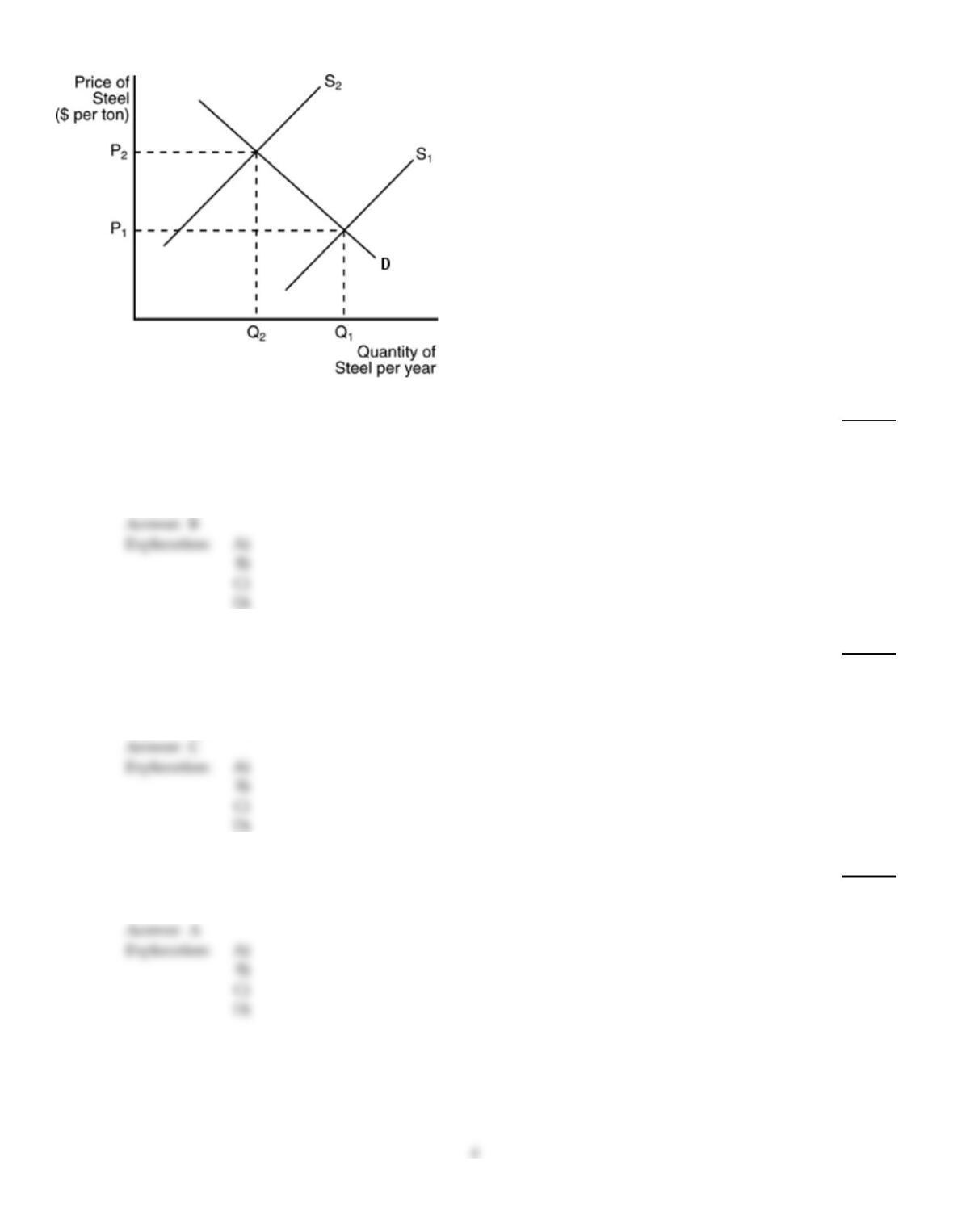
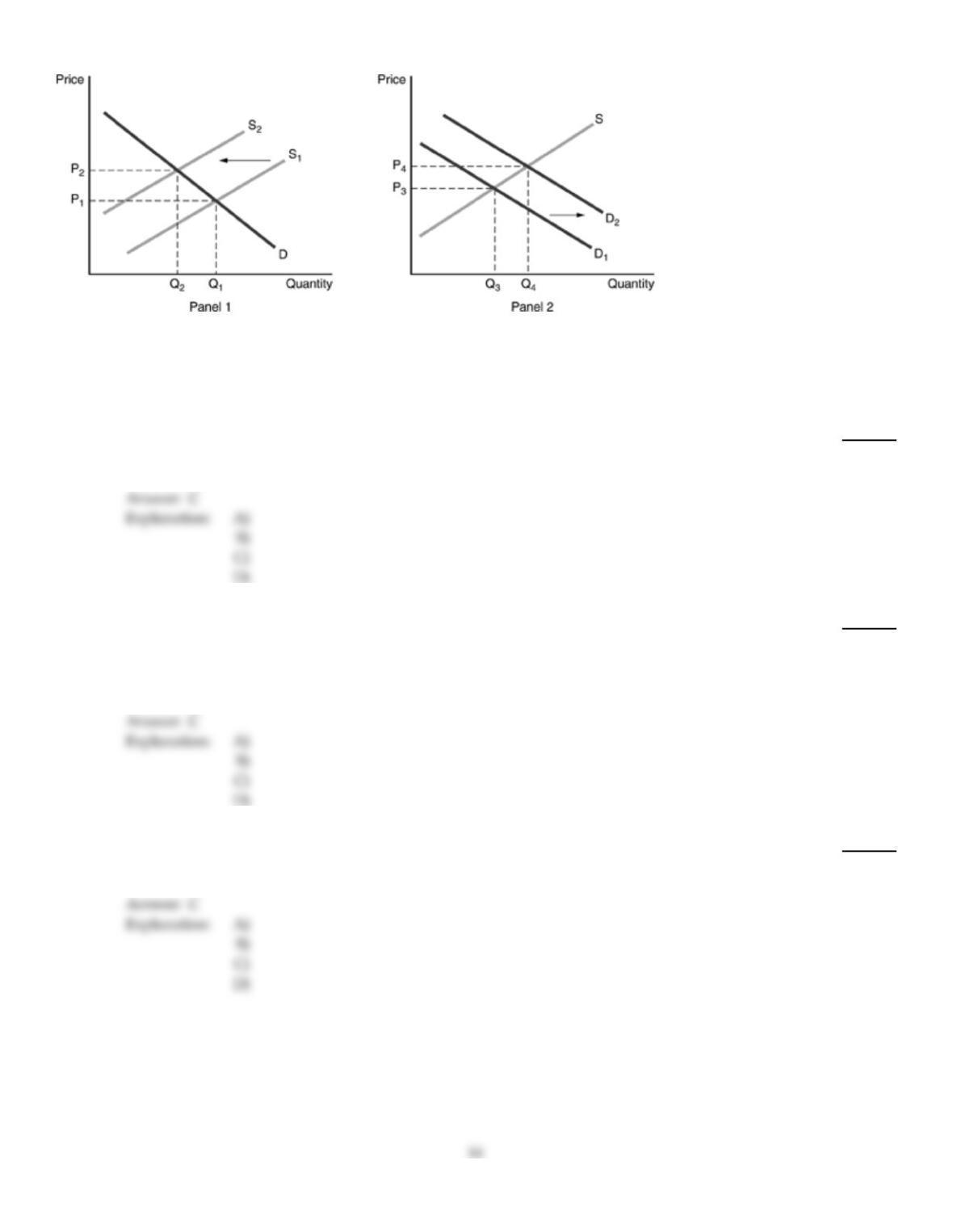
According to the above figure, , then the supply curve will
13)
A)
remain at S1.
B)
shift from S1 to S2.
C)
shift from S2 to S1.
D)
shift either to the left or the right, but it is impossible to say without more information.
14)
Market failure means that
14)
A)
too many outdated products are offered for sale in the local supermarket.
B)
an unexpectedly harsh winter shuts down a factory.
C)
there is overallocation or underallocation of resources to certain economic activity.
D)
the strike organized by unionized employees fails to achieve its goal.
15)
Markets tend to underallocate resources to the production of a good when
15)
A)
there are positive externalities.
B)
equilibrium occurs.
C)
there are negative externalities.
D)
there are public goods produced.
16)
Compared with the market clearing price of a health care service covered by Medicare, the
Medicare program pays a ________ price to health care providers and charges a ________ price to
consumers.
16)
A)
higher, higher
B)
higher, lower
C)
lower, higher
D)
lower, lower
17)
A paint firm has just announced that it will be building a new plant in a small town that is
currently experiencing a high level of unemployment. The new plant will create 500 new jobs in the
area and will occupy unused land at the edge of town. The plant will also dump some harmful
chemicals into the town’s river. From an economic standpoint this dumping of chemicals
17)
A)
creates a positive externality.
B)
creates a negative externality.
C)
is unimportant since the firm is reducing the unemployment in the region.
D)
is the production of a public good.
18)
Which of the following is NOT an economic function of government?
18)
A)
Promoting competition
B)
Ensuring economic stability
C)
Providing government–inhibited goods
D)
Providing a legal system
19)
Which of the following is an example of a public good?
19)
A)
The provision of medical care
B)
Amtrak rail transport services
C)
Services of the U.S. Post Office
D)
The provision of national defense
20)
The opportunity cost of providing a public good to an additional individual is
20)
A)
impossible to determine.
B)
infinite.
C)
high because of the exclusion principle.
D)
zero.
21)
A possible solution to the problems of external benefits is
21)
A)
to restrict the amount of the good through direct government regulation.
B)
effluent fees.
C)
to tax those receiving the extra benefits.
D)
production of the good by government.
22)
In public education, the value of the services provided is
22)
A)
greater than the value that parents and students place on the services.
B)
less than the value that parents and students place on the services.
C)
zero since they are a public good.
D)
equal to the value that parents and students place on the services.
23)
The current Medicare system is designed so that it actually encourages
23)
A)
cost reductions.
B)
higher costs only for surgeries.
C)
lower drug costs for recipients.
D)
higher costs of medical services.
24)
Market failures occur when
24)
A)
externalities exist.
B)
there is an increase in demand.
C)
wages increase.
D)
there is a change in quantity demanded.
25)
A fundamental aspect of public goods is that they
25)
A)
are characterized by the principle of rival consumption.
B)
are just like private goods EXCEPT that everybody wants to consume the same amount.
C)
can be consumed jointly by many people simultaneously.
D)
have positive externalities.
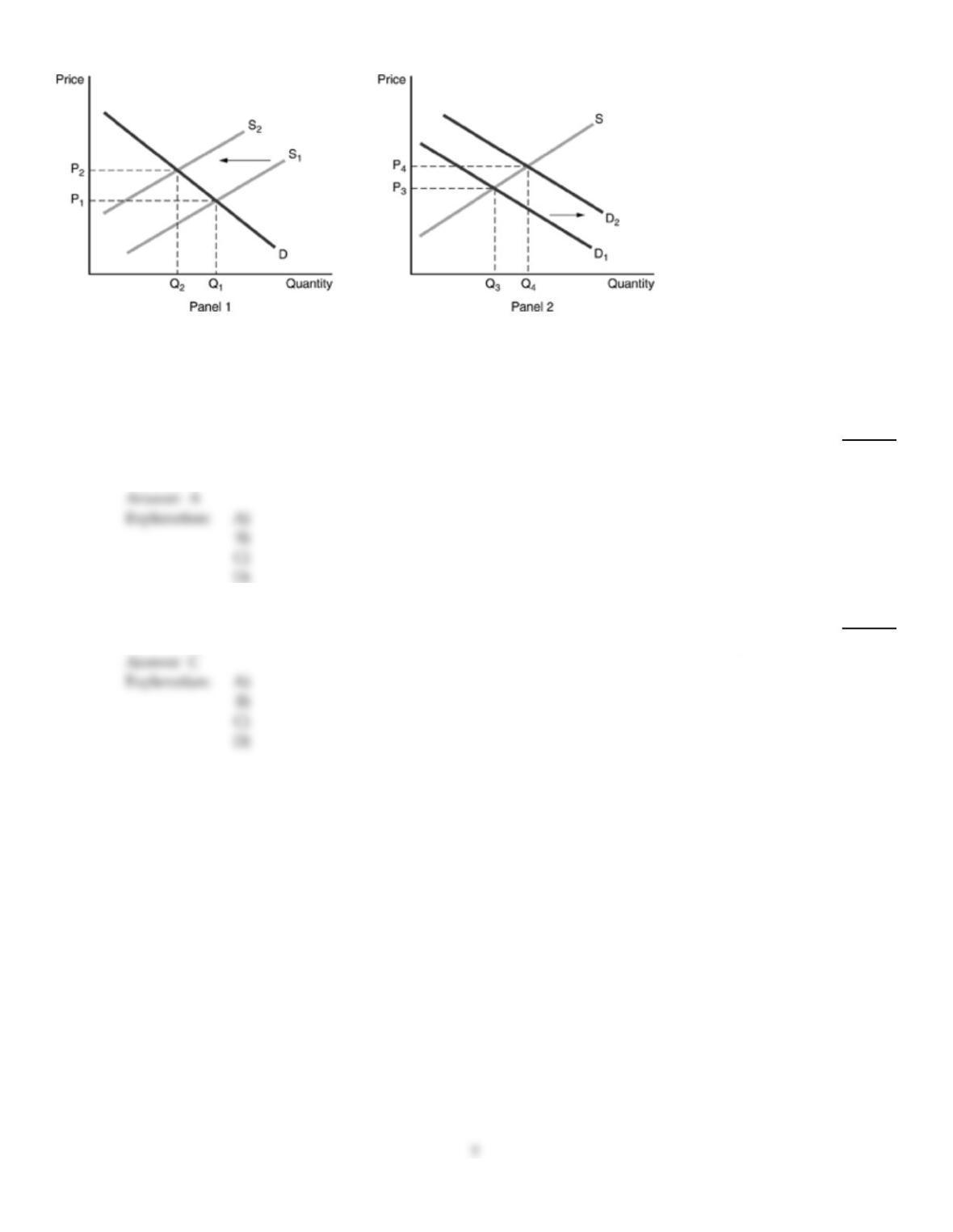
A shift from S1 to S2 reflects the change that happens when a negative externality is taken into account. A shift from D1
to D2 reflects the change that happens when a positive externality is taken into account.
26)
Refer to the above figures. If a positive externality that existed becomes corrected, price and
quantity will become
26)
A)
P4 and Q4.
B)
P2 and Q2.
C)
P1 and Q1.
D)
P3 and Q3.
27)
Under present U.S. law, which one of the following is a government–inhibited good?
27)
A)
Medical care
B)
Education
C)
Heroin
D)
Housing
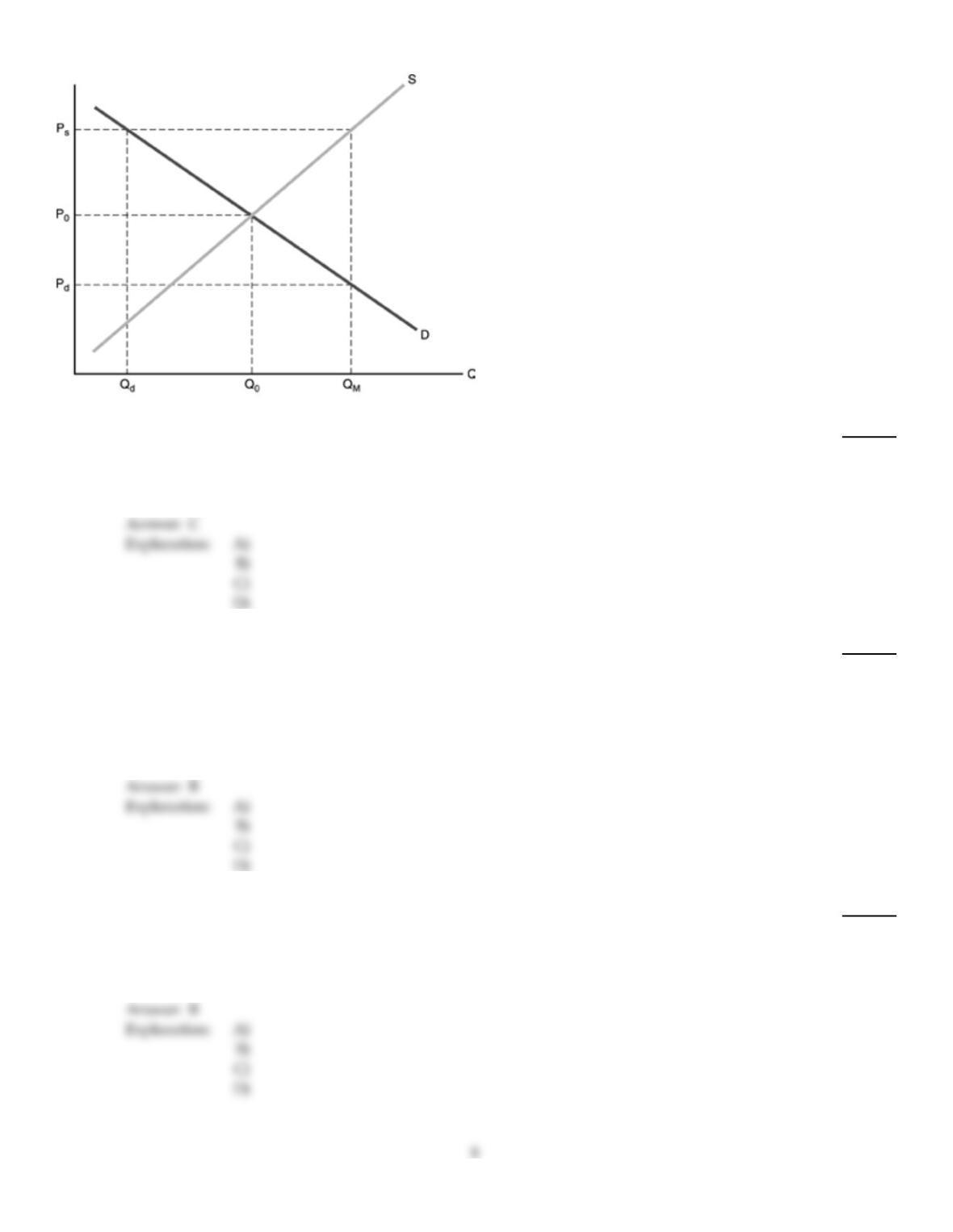
28)
Refer to the above figure. Medicare subsidies have increased the price of medical services to Ps. The
perceived price on the part of consumers is
28)
A)
Ps.
B)
P0.
C)
Pd.
D)
undetermined without more information.
29)
Which of the following characterizes the largest difference between the way decisions are made in
the private sector versus the public sector?
29)
A)
In both sectors individuals will try to maximize their own individual gains over the gains of
others.
B)
The incentive system for individuals to perform efficiently are vastly different.
C)
The workers themselves are really quite different types of people.
D)
Costs and resources are vastly different in each sector.
30)
Pollution is caused by a market failure, in an industry in which there is
30)
A)
unemployment.
B)
an over–allocation of resources in production.
C)
excessive cost borne by the firm.
D)
excess demand.
31)
When there is an external benefit, the unregulated market
31)
A)
maximizes public welfare.
B)
overproduces the good or service.
C)
reaches the most efficient solution.
D)
underproduces the good or service.
32)
Which law specifically mandated the federal government’s responsibility for economy–wide
stability?
32)
A)
The Great Depression Act of 1930
B)
The Miller Act of 1960
C)
The Employment Act of 1946
D)
The Sherman Act of 1890
33)
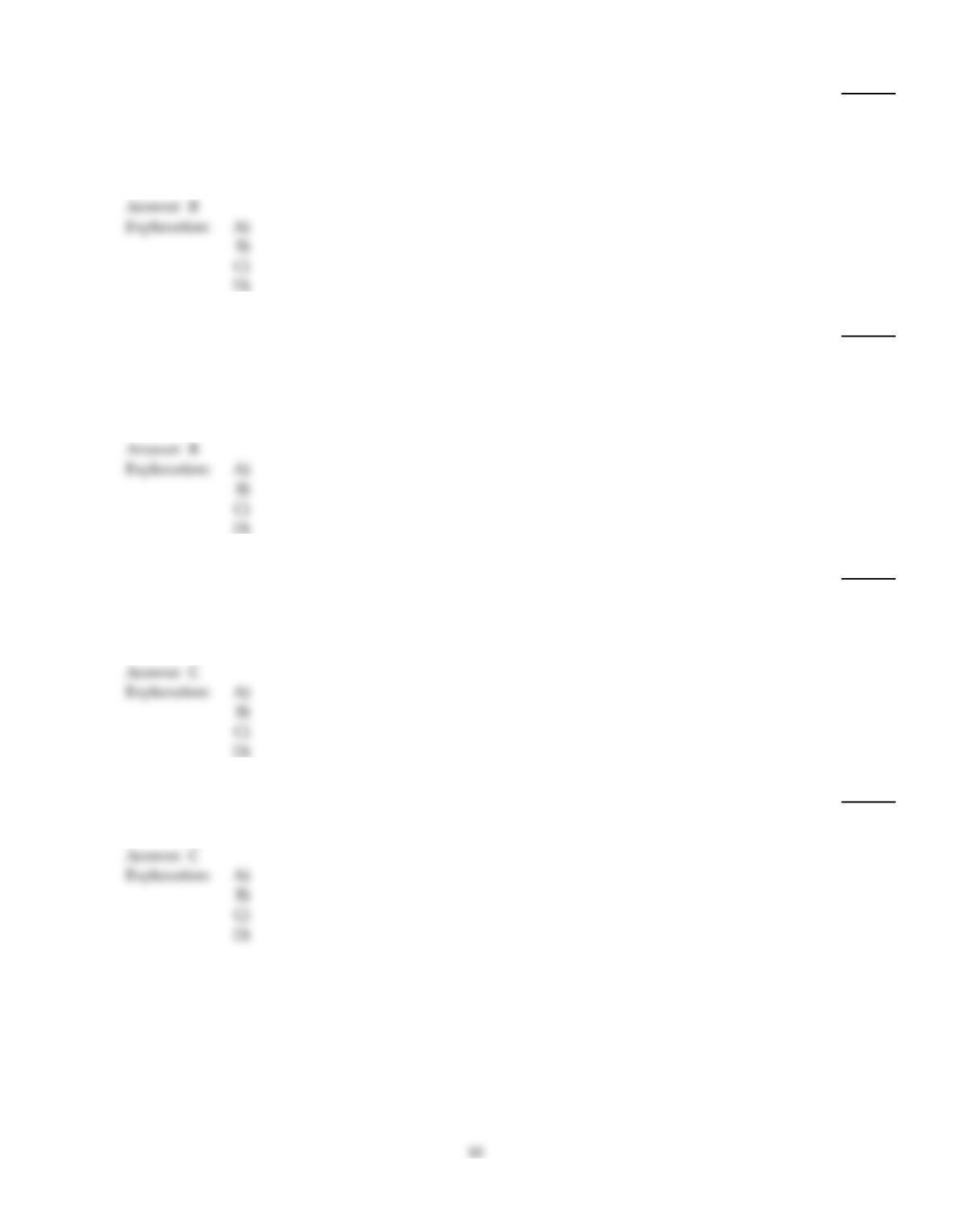
According to the above figure, if steel mills are charged an effluent fee in order to bear the cost of
pollution, what happens to the equilibrium price and equilibrium quantity?
33)
A)
The equilibrium price increases from P1 and P2, but the equilibrium quantity is unchanged.
B)
They are unchanged.
C)
They change from P2 and Q2 to P1 and Q1.
D)
They change from P1 and Q1 to P2 and Q2.
34)
When state and local governments provide public schools with a per–unit subsidy to provide
educational services, the price that the schools providing these services receive is
34)
A)
less than the price that consumers pay to receive educational services.
B)
greater than the market clearing price without the subsidy.
C)
less than the amount of the per–unit subsidy that the schools receive.
D)
equal to zero.
35)
Assume the production of a good gives rise to external benefits. The government may increase
efficiency by
35)
A)
imposing taxes on the good.
B)
subsidizing consumption of the good.
C)
taxing production of the good.
D)
requiring all producers of the good to be licensed.
36)
A public museum is an example of a
36)
A)
good which generates a negative externality.
B)
good which generates a positive externality.
C)
government–sponsored good.
D)
public good.
37)
A government–sponsored good is often
37)
A)
produced by the government.
B)
advertised.
C)
subsidized.
D)
taxed.
38)
A result of a positive externality in the production of a good is that
38)
A)
the market supply will be too high.
B)
the price system will under–allocate resources to the production of that good or service.
C)
the price system will over–allocate resources to the production of that good or service.
D)
the market demand will be too high.
39)
Which of the following is a transfer payment?
I. Social Security
II. Unemployment benefits
39)
A)
I only
B)
II only
C)
Both I and II
D)
Neither I nor II
40)
The provision of a legal system is an important economic function of the government because
40)
A)
people need to feel safe when they go to work.
B)
the legal system affects the distribution of income through its awarding of damages in
accident claims.
C)
the legal system affects how exchange takes place through its enforcement of contracts.
D)
lawyers and judges tend to be high–income people.
41)
Which of the following goods is NOT subject to the free–rider problem?
41)
A)
The local police force
B)
A public transit system
C)
National defense
D)
Public fireworks
42)
Examples of transfer payments are
42)
A)
wages, profits, and rents.
B)
federal government spending for national defense.
C)
Social Security checks and unemployment insurance payments.
D)
salaries of educators, police, and firefighters.
43)
One of the most important characteristics of the price system is that
43)
A)
all exchanges are regulated by the government.
B)
competition among sellers is reduced.
C)
consumers are the ones who ultimately decide what is produced.
D)
politicians are the ones who ultimately decide what is produced.
44)
A government agency charged with enforcing antitrust laws is
44)
A)
the Council of Economic Advisors.
B)
the Federal Trade Commission.
C)
the National Labor Relations Board.
D)
the Federal Reserve Board.
45)
The government tries to protect the competitive economic system by passing and enforcing
45)
A)
tariff legislation.
B)
building codes and zoning laws.
C)
antitrust laws.
D)
price controls.
46)
If the production of a product results in significant external costs, an appropriate government
policy might be to
46)
A)
tax consumers’ incomes and thus shift the demand curve to the left.
B)
subsidize consumers since the good is being under–consumed.
C)
tax producers and thus shift the supply curve to the left.
D)
subsidize the production of the good.
47)
“Second–hand” smoke, an often cited disadvantage of allowing smoking in restaurants, is referred
to in economics as a(n)
47)
A)
externality.
B)
capital good.
C)
economic cost.
D)
negative investment.
48)
Medicare
48)
A)
subsidizes the care of young people, which gives them an incentive to consume less medical
services.
B)
subsidizes the care of middle aged people, which gives them an incentive to consume more
medical services.
C)
subsidizes the care of older people, which gives them NO incentive to consume more medical
services.
D)
subsidizes the care of older people, which gives them an incentive to consume more medical
services.
49)
The non–exclusion principle means
49)
A)
people who do not pay for a public good can be excluded from receiving its benefits.
B)
no one who pays for a public good can be excluded from receiving the benefits of a public
good.
C)
no one can be excluded from the benefits of a public good, even if the person does not pay for
it.
D)
no one can be excluded from the benefits of a private good, even if only one person pays for
it.
A shift from S1 to S2 reflects the change that happens when a negative externality is taken into account. A shift from D1
to D2 reflects the change that happens when a positive externality is taken into account.
50)
Refer to the above figures. Externalities exist in both panels. After correcting for the externalities the
prices should be
50)
A)
P1 and P4.
B)
P1 and P3.
C)
P2 and P4.
D)
P2 and P3.
51)
In the absence of government,
51)
A)
market failure is less likely to occur.
B)
public goods are likely to be overprovided.
C)
public goods are likely to be underprovided.
D)
the free–rider problem is more likely to occur.
52)
A government–inhibited good is often
52)
A)
subsidized.
B)
produced by the government.
C)
taxed.
D)
advertised.
53)
Which of the following does NOT describe the intended purpose of the antitrust laws of the United
States?
53)
A)
To restrict the formation of monopolies
B)
To promote competition within the economic system
C)
To reduce the power of monopolies
D)
To prohibit certain economic activities that promote trade
54)
Which of the following is an example of a positive externality?
54)
A)
Traffic congestion
B)
An increased supply of chocolate lowers chocolate prices for all consumers
C)
Pollution
D)
A neighbor’s flower garden that you enjoy seeing
55)
The funds that polluters pay that gives them the right to discharge into the air or water a certain
amount of pollution are
55)
A)
effluent fees.
B)
special subsidies.
C)
external costs.
D)
regulation fees.
56)
A government–inhibited good is a good which
56)
A)
the political process has deemed socially undesirable.
B)
the political process has deemed socially desirable.
C)
is not subject to the principle of mutual exclusivity.
D)
can be consumed by one individual without affecting the consumption of another individual.
57)
Market failures include all of the following EXCEPT
57)
A)
positive externalities
B)
equalization of quantity supplied and quantity demanded
C)
public goods
D)
negative externalities
58)
When positive externalities exist, the private market equilibrium represents a
58)
A)
market price which is too low and a market quantity which is too low.
B)
market price which is too low and a market quantity which is too high.
C)
market price which is too high and a market quantity which is too high.
D)
market price which is too high and a market quantity which is too low.
59)
When market failures occur,
59)
A)
the price system will correct the market failures.
B)
the government can step in to correct the market failure.
C)
people will reduce their consumption.
D)
the invisible had will correct for the market failures.
60)
Scarcity
60)
A)
affects market, but not public sector decision making.
B)
is really not an issue in such a wealthy nation as the United States.
C)
affects both market and public sector decision making.
D)
affects public sector, but not market decision making.
61)
Which of the following would be classified as a public good?
61)
A)
telephone service
B)
state lotteries
C)
national defense
D)
cable TV programming
62)
Providing public goods is a(n)
62)
A)
economic function of government.
B)
price system function.
C)
economic and political function of government.
D)
political function of government.
A
63)
Government payment of a per–unit subsidy for medical care causes
63)
A)
the market supply curve to shift upward.
B)
a reduction in the price that providers of medical care receive for each unit of care provided.
C)
an increase in the quantity of medical care demanded above the quantity demanded in the
absence of the subsidy.
D)
the market demand curve to shift downward.
C
64)
An effluent fee is a
64)
A)
fine imposed on a polluter for dumping illegal pollution.
B)
subsidy given to the producer of a positive externality.
C)
charge for a public good.
D)
charge to a polluter that gives the right to discharge pollution into the air.
D
65)
Social Security and Medicare are clear examples of
65)
A)
capitalism.
B)
governmental intervention in the market.
C)
market–determined services.
D)
market failures and externalities.
B
C
66)
An example of an in–kind transfer is
66)
A)
Unemployment benefits.
B)
low–cost public housing.
C)
Social Security.
D)
national defense.
67)
When there are too few or too many resources going to an economic activity,
67)
A)
a regressive tax is in place.
B)
a free–rider problem exists.
C)
a public good exists.
D)
a market failure exists.
68)
Subsidies paid to the health care industry for Medicare patients are paid by
68)
A)
Congress.
B)
current taxes.
C)
the Teamsters union.
D)
the Federal Reserve.
69)
Public goods are basically
69)
A)
nonrival in consumption.
B)
nondepletable in consumption.
C)
rival in consumption.
D)
depletable in consumption.
70)
When a person throws a cigarette out of a car window and starts a brush fire, this is
70)
A)
an example of a public good.
B)
an example of market power.
C)
an example of an external cost.
D)
an example of an external benefit.