
Test Bank—Chapter Five (Algorithms)
Multiple Choice Questions
1. Which of the following is an activity?
A. Algorithm B. Program C. Process
2. Which of the following is a representation?
A. Algorithm B. Program C. Process
3. Which of the following set of instructions defines an algorithm in the formal, strict sense?
A. X = 3 B. X = 3 C. X = 3
while (X < 5): while (X < 5): while (X < 5):
X = X X = X + 1 X = X – 1
4. Which of the following is not a means of repeating a block of instructions?
A. Pretest loop B. Posttest loop C. Recursion D. Assignment statement
5. When searching within the list
Lewis, Maurice, Nathan, Oliver, Pat, Quincy, Roger, Stan, Tom
which of the following entries will be found most quickly using the sequential search algorithm?
A. Lewis B. Pat C. Tom
6. When searching within the list
Lewis, Maurice, Nathan, Oliver, Pat, Quincy, Roger, Stan, Tom
which of the following entries will be found most quickly using the binary search algorithm?
A. Lewis B. Pat C. Tom
7. Which of the following lists would not be obtained at some point when applying the insertion sort
algorithm to the list below?
Sylvia
Nancy

Lois
Alice
A. Nancy B. Alice C. Alice D. Lois
Sylvia Lois Sylvia Nancy
Lois Nancy Nancy Sylvia
Alice Sylvia Lois Alice
8. In general, an algorithm in which of the following categories is considered more efficient?
A. (log2 n) B. (n) C. (n log2 n) D. ( n2 )
9. The insertion sort algorithm is an example of an algorithm in which of the following classes?
A. (log2 n) B. (n) C. (n log2 n) D. ( n2 )
10. The binary search algorithm is an example of an algorithm in which of the following classes?
A. (log2 n) B. (n) C. (n log2 n) D. ( n2 )
11. Under the assumption that X takes on only integer values, which of the following is the termination
condition for the following loop?
while (X < 5):
. . .
A. X < 5 B. X > 4 C. X < 4
12. Under the assumption that X takes on only integer values, which of the following is the termination
condition for the following loop?
repeat:
. . .
until (X < 5)
A. X < 5 B. X > 4 C. X > 5
13. Under the assumption that N takes on only integer values, which of the following is the termination
condition in the following recursive function?
def xxx(N):
if (N < 5):
xxx(N + 1)
else:
print(N)
A. N < 5 B. N > 4 C. N < 4
14. Under the assumption that N takes on only integer values, which of the following is the termination
condition in the following recursive function?
def xxx(N):
if (N < 5):
print(N)
else:
xxx(N – 1)
A. N < 5 B. N > 4 C. N > 5
15. Which of the following is a loop invariant at the point at which the test for termination is performed in
the following loop structure?
X = 3
while (X < 5):
X = X + 2
A. X > 5 B. X < 5 C. X 5 D. X 5
16. Which of the following is a loop invariant at the point at which the test for termination is performed in
the following loop structure?
X = 3
repeat:
X = X + 2
until (X > 5)
A. X > 5 B. X < 8 C. X 5 D. X 6
17. Which of the following is the base case in the recursive function below?
def xxx(N):
if (N == 0):
print(N)
else:
xxx(N – 1)
A. N > 0 B. N = 0 C. N < 0
18. Preconditions, postconditions, and loop invariants are examples of which of the following?
A. Pseudocode B. Iterative structures C. Assertions D. Recursion
19. Which of the following does not print the same sequence of numbers as the others?
A. X = 5 B. X = 4 C. X = 5
while (X < 6): while (X < 5): repeat:
print(X) X = X + 1 print( X)
X = X + 1 print(X) X = X + 1
until (X > 6)
20. Which of the following is not a way of representing algorithms?
A. Stepwise refinement B. Pseudocode C. Flowchart D. Programming language
Fill–in-the-blank/Short-answer Questions
1. Define each of the following terms.
A. Algorithm _______________________________________________________________
B. Program _______________________________________________________________
C. Process _______________________________________________________________
2. List three of the primitives in the pseudocode developed in this chapter.
____________________
____________________
____________________
3. What sequence of values will be printed when the following instructions are executed?

X = 5
if (X < 7):
print(6)
Y = 6
else:
print(4)
Y = 4
if (Y < 5):
print(3)
else:
print(2)
_______________________
4. What sequence of values will be printed when the following instructions are executed?
X = 5
while (X < 7):
print(X)
X = X + 1
print(X)
while (X > 2):
print(X)
X = X – 2
_______________________
5. What sequence of values would be printed if the function xxx described below were executed with the
value of N being 9?
def xxx(N):
if (N < 4):
print(N)
yyy(7)
else:
yyy(2)
print(N)
def yyy(N):
if (N < 5):
print(N)
zzz(6)
else:
zzz(5)
def zzz(N):
if (N == 5):
print(7)
else:
print(8)
________________________
6. When searching for the entry X within the list
R, S, T, U, V, W, Z
how many entries will be considered before discovering that the entry is not present? (Note that the list is in
alphabetical order.)
____________
7. When searching for the entry X within the list
R, S, T, U, V, W, Z
how many entries will be considered before discovering that the entry is not present? (Note that the list is in
alphabetical order.)
____________
8. Suppose the binary search algorithm was being used to search for the entry Tom in the list
Nathan, Oliver, Pat, Quincy, Rodger, Stan, Tom
A. What would be the first entry in the list to be considered? _____________
B. What would be the second entry in the list to be considered? _____________
9. At most, how many entries in a list of 5000 names will be interrogated when using the binary search
algorithm?
___________
10. At most, how many entries in a list of 5000 names will be interrogated when using the sequential search
algorithm?
___________
11. Which of the sequential or binary search algorithms would find the name Kelly in the list
John, Kelly, Lewis, Maurice, Nathan, Oliver, Pat, Quincy, Roger, Stan, Tom
more quickly?
_______________
12. Which of the sequential or binary search algorithms would find the name Roger in the list
John, Kelly, Lewis, Maurice, Nathan, Oliver, Pat, Quincy, Roger, Stan, Tom
more quickly?
_______________
13. What would be printed if the following instructions were executed?
X = 3
print(X)
Y = 5
if (X < Y):
print(6)
else:
print(7)
_________________
14. What would be printed if the following instructions were executed?
X = 3
while (X > 0):
print(X)
X = X – 1
_________________
15. Answer the following questions in terms of the function xxx below.
def xxx(N):
if (N < 7):
print(N)
else:
N = n + 3
print(N)
A. What value would be printed if the following function were executed with the value of N
being 4?
____________
B. What value would be printed if the following function were executed with the value of N
being 9?
____________
16. What sequence of numbers would be printed if the following function were executed with the value of
N being 0?
def xxx(N):
while (N < 4):
print(N)
N = N + 2
print(N)
__________________
17. What sequence of numbers would be printed if the following function were executed with the value of
N being 0?
def xxx(N):
print(N)
if (N < 5):
xxx(N + 2)
print(N)
__________________
18. What sequence of numbers would be printed if the following function were executed with the value of
N being 0?
def xxx(N):
print(N)
if (N < 2):
xxx(N + 1)
else:
print(N)
print(N)
__________________
19. What sequence of numbers would be printed if the function named xxx as described below were
executed with the value of N being 2?
def xxx (N):
print(N)
if (N < 3):
yyy(4)
print(N)
def yyy(N):
print(N)
xxx(5)
print(N)
_____________________
20. Circle the portion of the program below in which control of the loop is initialized. Draw a rectangle
around the portion in which the test for termination is performed. Underline the portion in which the state
of the loop is moved toward the termination condition.
X = 3
while (X < 9):
X = X + 1
21. Fill in the blank in the function below so that the function prints the integers from 0 up to the integer
value it was given for N. That is, if the function is executed with the value of N being 3, it should print 0, 1,
2, 3.
def xxx(N):
if (_________):
xxx(N – 1)
print(N)
22. Identify a loop invariant associated with the point in the loop below at which a test for termination is
performed.
X = 0
repeat:
print(X)
X = X + 2
until (X > 6)
___________________
Vocabulary (Matching) Questions
The following is a list of terms from the chapter along with descriptive phrases that can be used to produce
questions (depending on the topics covered in your course) in which the students are ask to match phrases
and terms. An example would be a question of the form, “In the blank next to each phrase, write the term
from the following list that is best described by the phrase.”
Term Descriptive Phrase
algorithm The fundamental concept in computer science
pseudocode An informal notation for representing algorithms
assignment statement A means of saving the result of a computation for future use
if-else statement A means of producing different actions depending on a condition
General Format Questions
1. Rewrite the following routine using a pretest while statement.
repeat:
print(X)
X = X + 1
until (X > 5)
2. If numeric values are represented in two’s complement notation, does the following program represent
an infinite process? Explain your answer.
X = 2
while (X > 0):
X = X + 1
3. Identify a flaw in the control of the following loop.
X = 3
while (X != 8):
X = X + 2
4. Do the following instructions define an algorithm? Explain your answer.
Write down all the positive odd integers.
Select the integer in the middle of the list.
Print the even integer that is one less than the selected odd integer.
5. Use a repeat loop structure to produce a non-recursive program segment that prints the same sequence of
numbers as the following recursive function.
def xxx(N):
print(N)
if (N < 5):
xxx(N + 1)
6. Use a while loop structure to produce a non-recursive program segment that prints the same sequence of
numbers as the following recursive function.
def xxx(N):
print(N)
if (N < 5):
xxx(N + 1)
7. Use a repeat loop rather than a while loop to accomplish the same results as the following program
segment. Assume that X will have only integer values. (You may also use an if statement if you like.)
while (X < 5):
print(X)
X = X + 1
8. Suppose the statement “X is an integer and X < 5” is a loop invariant at the point at which the test for
termination is performed in the loop outlined below. What can be concluded about the value of X
immediately after the loop is terminated?
repeat:
. . .
until (X > 3)
9. The pseudocode used in this chapter included both an if–then statement and an if-then-else statement.
Show how the statement
if (X == 5):
. . .
else:
. . .
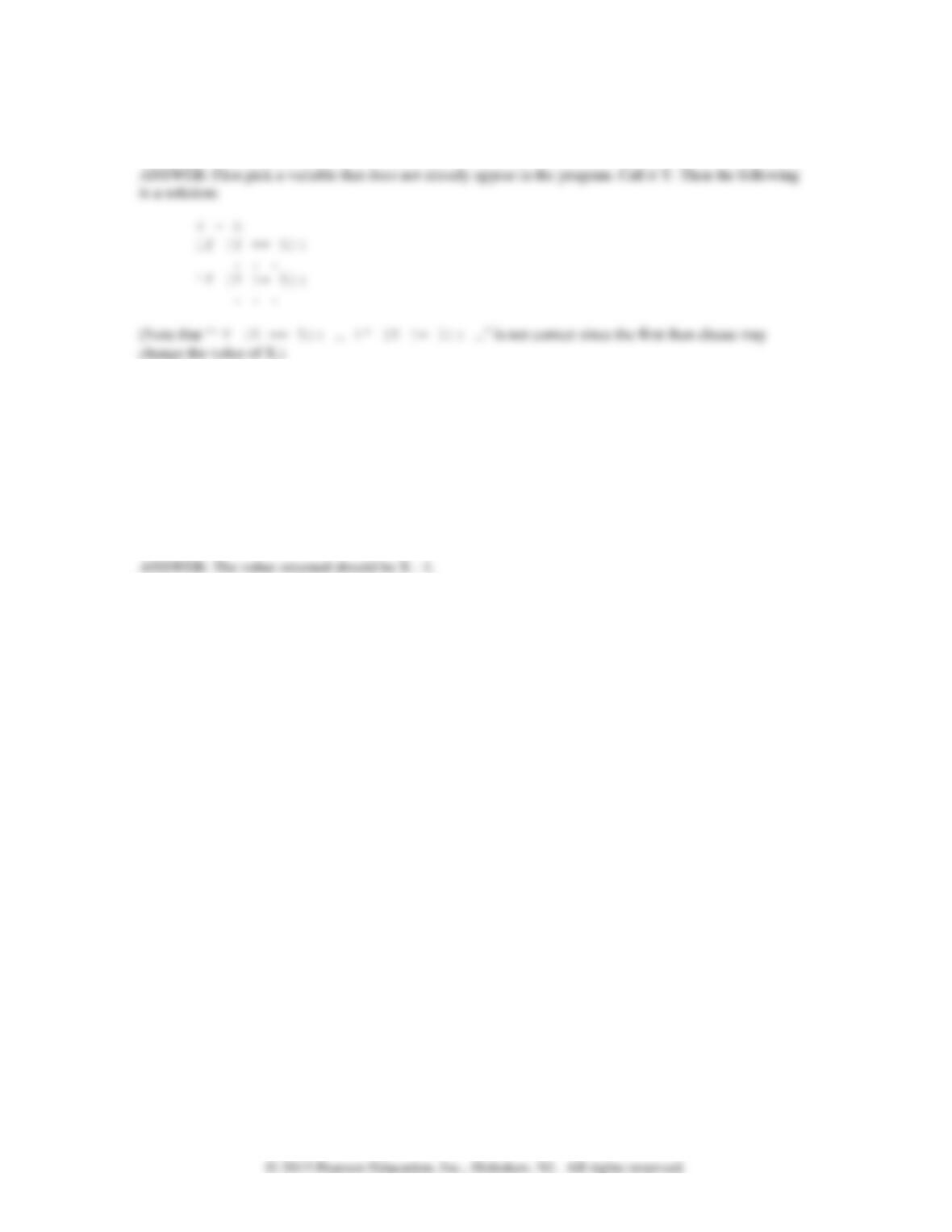
can be simulated with a program segment using only if-then statements.
10. The following function was designed to compute the largest integer whose square is no greater than N,
where N is assumed to be a positive number. (If N is 5, then the function should report the value 2.) Find
and correct the error.
def squareRoot(N):
X = 0
while (X*X <= N):
X = X + 1;
return X