Chapter 5
Using Financial Statement Information
MULTIPLE CHOICE QUESTIONS
1. The current ratio is
a. current assets divided by current liabilities.
b. current liabilities divided by current assets.
c. current assets divided by total liabilities.
d. total assets divided by total liabilities.
2. The current ratio
a. provides users with an estimate of a company’s human resources.
b. is reported on a company’s balance sheet in the asset section.
c. is a measure of a company’s solvency.
d. is a measure of a company’s leverage.
3. Earnings per share
a. must appear on a company’s income statement if the company is publicly traded.
b. is rarely used by analysts since it is not required by GAAP.
c. is based on the market price of the company’s stock.
d. is typically presented in its two forms: simple and advanced.
4. Return on equity compares
a. the market price of the company’s stock to its dividend policy.
b. a company’s earnings to the dividends paid for the year.
c. the profits of a company to the investment made by its shareholders.
d. the profits of a company to the selling price of each share of stock.
5-2 Test Bank – Chapter 5 – Using Financial Statement Information
5. Operating performance is a company’s ability to
a. control acquisitions of other companies in the same industry.
b. generate cash from sources other than regular operations.
c. increase its net assets through regular operations.
d. employ off-balance-sheet financing.
6. Financial statements help present and potential investors, creditors, and other users in
assessing the amount, timing, and uncertainty of
a. future income.
b. future assets.
c. future liabilities.
d. future cash flows.
7. The price-earnings ratio is
a. the market price of an equity share divided by earnings per share.
b. the amount of a company’s retained earnings.
c. the purchase price of a firm’s assets divided by net income.
d. used to measure the speed at which the company sells its inventories.
8. Financial flexibility is
a. a good indicator of a company’s ability to grow through operations.
b. evident when a company’s assets are greater than its liabilities.
c. the ability to convert existing assets into money.
d. the ability to generate cash from sources other than regular operations.
9. A standard audit report
a. states that a company has the right to select members of its board of directors.
b. serves as the accounting profession’s seal of approval.
c. states whether a company will be profitable or not in the future.
d. serves as a guarantee that the financial statements are free of any errors.
Test Bank – Chapter 5 – Using Financial Statement Information 5-3
10. Liquidity is the ability
a. to increase net assets through regular operations.
b. to generate cash from sources other than regular operations.
c. to convert existing assets into cash.
d. of financial statement users to predict a company’s cash flows.
11. Which of the following may be a limitation of financial statements?
a. Subject to biases of management
b. Provides no information on the company’s accounting methods
c. Typically reflects the view of inherently unethical managers
d. Communicates only market values and no historical information
12. Which one of the following is a reason a company’s reported book value and its true
value may differ?
a. Management calculates net worth different than shareholders.
b. GAAP requires too many estimates.
c. Statements are forward-looking.
d. Statements do not reflect the company’s prospects within its business environment.
13. The current ratio helps assess a company’s
a. profitability.
b. asset turnover.
c. capital structure leverage.
d. solvency.
14. Return on equity helps assess a company’s
a. marketability.
b. solvency.
c. profitability.
d. leverage.
5-4 Test Bank – Chapter 5 – Using Financial Statement Information
15. The quick ratio helps assess a company’s
a. annual stock price.
b. solvency.
c. inventory turnover.
d. profit during the current period.
16. The dividend yield ratio helps assess the
a. profitability of the current year.
b. cash return on a shareholders’ investment.
c. company’s ability to pay its current liabilities as they come due.
d. solvency of a company.
17. Which of the following ratios would be of primary importance to a manager in evaluating
the success of a new policy of reducing the stock of goods needed to meet customer
demand?
a. Total asset turnover
b. Fixed assets turnover
c. Receivables turnover
d. Inventory turnover
18. Which of the following ratios might a potential investor use to determine if the return to
shareholders is a large portion of the total return generated by a company?
a. Earnings per share
b. Common equity leverage
c. Current ratio
d. Total asset turnover
19. Assessing a company’s inventory turnover helps assess the
a. effectiveness of a company’s collection activities.
b. ability to measure the quality of the inventory on hand.
c. speed at which inventories move through operations.
d. efficiency of a company.
Test Bank – Chapter 5 – Using Financial Statement Information 5-5
20. Which of the following ratios would be of primary importance to a supplier in deciding to
extend credit for goods delivered?
a. Earnings per share
b. Debt/equity ratio
c. Accounts receivable turnover
d. Quick ratio
21. Which of the following ratios would be of primary importance to a creditor in deciding to
extend long-term credit?
a. Current ratio
b. Debt/equity ratio
c. Inventory turnover
d. Earnings per share
22. Which of the following ratios would be of primary importance to a manager in evaluating
the success of a computerized collection process?
a. Accounts receivable turnover
b. Account payable turnover
c. Quick ratio
d. Return of equity
23. Book value fails to reflect true value primarily because:
a. financial statements are irrelevant.
b. financial statements are backward-looking.
c. financial statements are forward-looking.
d. financial statements are typically biased.
24. Which of the following is a fundamental way in which financial accounting numbers are
useful?
a. They can predict the way the stock price will behave.
b. They are used to assess the quality of a company’s products.
c. They can be used to predict a company‘s future earnings.
d. They identify the effect of inflation on the value of company’s assets.
5-6 Test Bank – Chapter 5 – Using Financial Statement Information
25. The long-term debt ratio
a. measures the significance of long-term debt as a source of asset financing.
b. measures the effect of management’s use of long-term debt.
c. compares profits to the company’s total debt.
d. is a measure of profitability.
26. The use of financial statements for predicting future earnings and cash flows is limited
due to
a. management bias, lack of forward-looking information, and certain inherent
limitations.
b. lack of judgment, management bias, and lack of inclusion of inflationary effects.
c. lack of forward and backward-looking information.
d. lack of backward-looking information, the likelihood of management bias, and the
omission of historical costs.
27. Which one of the following is a step used in assessing whether or not to invest in a
particular company?
a. Determine the number of employees a company has.
b. Obtain an understanding of the company and its industry.
c. Determine the number of years the company has been in business.
d. Calculate the amount of advertising costs incurred by the company during the
previous year.
28. A company would likely “take a bath”
a. in periods of extraordinarily high net income.
b. just prior to creating hidden reserves.
c. when it has experienced an extremely poor year.
d. when its quality of earnings is very high.
Test Bank – Chapter 5 – Using Financial Statement Information 5-7
29. An analyst assessed a company and determined the company reported a “high quality of
earnings.” This implies that
a. management issued a press release indicating it was not aware of any fraud during
the current year.
b. the company’s management exercised little or no discretionary influence in reporting
financial statement information to shareholders.
c. management has used its influence in determining the dollar amounts reported on
financial statements.
d. income statement items reported during the current period can be expected to reflect
future income levels.
30. Managers that structure financing transactions and choose accounting methods that
exclude debt on the company’s balance sheet are using
a. hidden reserves.
b. fraudulent methods by default.
c. performance overstatement.
d. off-balance-sheet financing.
31. Information concerning industry averages will likely be found in
a. Barron’s.
b. The Wall Street Journal.
c. Dun & Bradstreet’s Key Business Ratios.
d. The New York Times.
32. Common-size financial statements are based on
a. percentages of other numbers on the same statements.
b. a percent comparison of other companies in the same industry.
c. a common way of preparing certain types of financial statements.
d. percentages of increases and decreases compared to the previous accounting
period.
5-8 Test Bank – Chapter 5 – Using Financial Statement Information
33. The primary measure of the overall success of a company is
a. total shareholders’ equity.
b. total assets.
c. net income.
d. the number of shares of stock it has sold to investors.
34. Many ratios require an average be used for the balance sheet numbers because the
a. income statement refers to a point in time.
b. accountants may have made errors in the financial statements.
c. balance sheet numbers are at a point in time and are being compared to an income
statement number that covers a period of time.
d. income statement numbers represent a point in time and are being compared to a
balance sheet number that covers a period of time.
35. Using borrowed funds to generate returns for the shareholders is called
a. leverage.
b. profitability.
c. taking a bath.
d. solvency.
36. A company that reports high levels of common equity leverage is probably
a. reporting higher earnings per share than other companies in the same industry.
b. meeting its financing needs effectively.
c. using leverage very effectively.
d. demonstrating it has a large amount of off-balance-sheet financing.
37. The item that causes the greatest and most immediate effect on a company’s stock price
will generally be
a. cash on hand.
b. the company’s solvency.
c. profits.
d. dependent upon the industry in which the company operates.
Test Bank – Chapter 5 – Using Financial Statement Information 5-9
38. Investors who use accounting information to guide trading in foreign securities
a. should carefully compare expenses, but not revenues to companies in the same
industry in the United States.
b. must adjust the numbers of foreign-based companies’ financial statements and
thoroughly understand the foreign environment.
c. must contact the foreign CEO before any investment in stock occurs.
d. should contact the foreign company’s auditors to find out how much dividends will be
paid.
39. The DuPont model is
a. a method of off-balance sheet financing.
b. a framework to analyze ROE changes and identify value drivers.
c. a method of preparing a balance sheet.
d. a solvency calculation.
40. Accounting numbers are useful in that they
a. are easy to manipulate by management and help predict a company’s future
earnings and cash flows.
b. allow users to see management’s predictions of future profits and help predict a
company’s future cash flows.
c. help investors and creditors influence and monitor management’s business decisions
and help predict a company’s future earnings and cash flows.
d. help investors and creditors influence, manipulate, and monitor management’s
business decisions so that future profits are high.
41. The two fundamental ways in which financial accounting numbers are useful are
a. prediction and influence.
b. control and monitoring.
c. prediction and monitoring.
d. control and prediction.

5-10 Test Bank – Chapter 5 – Using Financial Statement Information
42. What type of audit report do most companies receive from their auditors?
a. standard audit reports
b. no report unless the company has problems
c. a GAAP report
d. a comprehensive report
Test Bank – Chapter 5 – Using Financial Statement Information 5-11
43. Use the information that follows taken from Campbell Company’s financial statements
for the years ending December 31, 2017 and 2016.
Balance Sheet Information
2017
2016
Assets
Cash
$ 25
$ 50
Accounts receivable
60
70
Inventory
40
30
Land, building, and equipment
225
250
Total Assets
$350
$400
Liabilities and Shareholders’ Equity
Accounts payable
$ 85
$ 100
Long term note payable
180
200
Common stock
150
150
Retained earnings
(65)
(50)
Total Liabilities & Shareholders’ Equity
$350
$400
Income Statement Information
Sales (all sales are on credit)
$850
Cost of goods sold
425
Gross profit
425
Operating expenses
440
Net income
$(15)
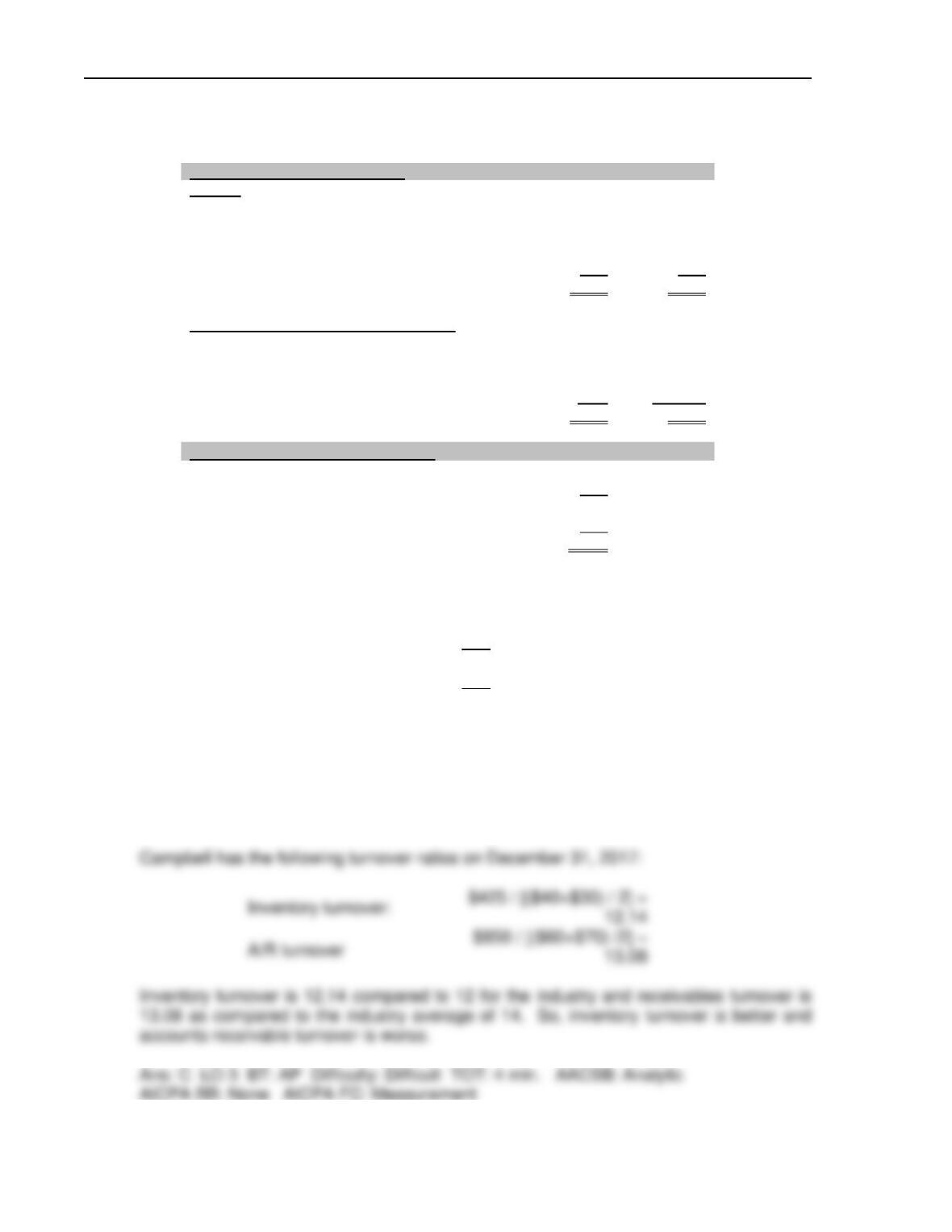
Calculate Campbell’s current and quick ratios as of December 31, 2016 and December
31, 2017 and choose the correct answers below:
a. Campbell’s quick and current ratios improved from December 31, 2016 to December
31, 2017.
b. Campbell’s quick and current ratios worsened from December 31, 2016 to December
31, 2017.
c. Campbell’s quick ratio improved but the current ratio worsened December 31, 2016
to December 31, 2017.
d. Campbell’s quick ratio worsened but the current ratio improved from December 31,
2016 to December 31, 2017.
Solution:
Current:
Quick:
Current:
Quick:
5-12 Test Bank – Chapter 5 – Using Financial Statement Information
44. Use the information that follows taken from Campbell Company’s financial statements
for the years ending December 31, 2017 and 2016.
Balance Sheet Information
2017
2016
Assets
Cash
$ 25
$ 50
Accounts receivable
60
70
Inventory
40
30
Land, building, and equipment
225
250
Total Assets
$350
$400
Liabilities and Shareholders’ Equity
Accounts payable
$ 85
$ 100
Long term note payable
180
200
Common stock
150
150
Retained earnings
(65)
(50)
Total Liabilities & Shareholders’ Equity
$350
$400
Income Statement Information
Sales (all sales are on credit)
$850
Cost of goods sold
425
Gross profit
425
Operating expenses
440
Net income
$(15)
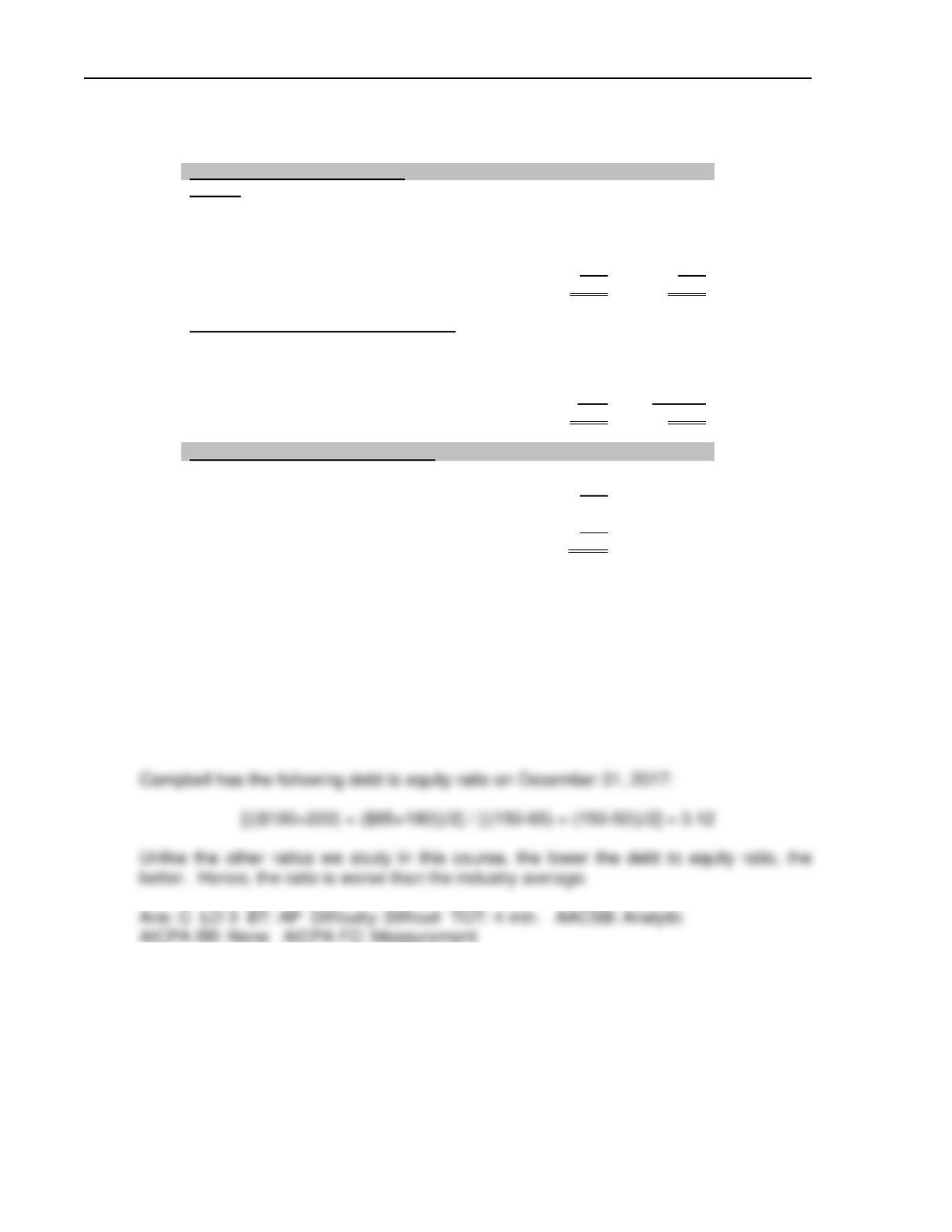
Calculate Campbell’s inventory turnover ratio and accounts receivable turnover ratio for
the year ended 2017. Further, assume that in Campbell’s industry, the industry average
inventory turnover ratio is 12 and the industry average receivables turnover ratio is 14.
a. Campbell’s inventory turnover ratio and accounts receivable turnover ratios are
better than average for Campbell’s industry.
b. Campbell’s inventory turnover ratio and accounts receivable turnover ratios are
worse than average for Campbell’s industry.
c. Campbell’s inventory turnover ratio is better but the accounts receivable turnover
ratio is worse than average for Campbell’s industry.
d. Campbell’s inventory turnover ratio is worse and accounts receivable turnover ratio
is better than average for Campbell’s industry.
Solution:

Test Bank – Chapter 5 – Using Financial Statement Information 5-13
45. Use the information that follows taken from Campbell Company’s financial statements
for the years ending December 31, 2017 and 2016.
Balance Sheet Information
2017
2016
Assets
Cash
$ 25
$ 50
Accounts receivable
60
70
Inventory
40
30
Land, building, and equipment
225
250
Total Assets
$350
$400
Liabilities and Shareholders’ Equity
Accounts payable
$ 85
$ 100
Long term note payable
180
200
Common stock
150
150
Retained earnings
(65)
(50)
Total Liabilities & Shareholders’ Equity
$350
$400
Income Statement Information
Sales (all sales are on credit)
$850
Cost of goods sold
425
Gross profit
425
Operating expenses
440
Net income
$(15)
Calculate Campbell’s return on equity and return on assets for the year ended
December 31, 2017. Assume that the income tax rate is 30%. Also assume that in
Campbell’s industry, the industry average return on equity is 19% and the average return
on assets is 11%.
a. Campbell’s return on equity and return on assets are better than average for
Campbell’s industry.
b. Campbell’s return on equity and return on assets are worse than average for
Campbell’s industry.
c. Campbell’s return on equity is better but return on assets is worse than average
for Campbell’s industry.
d. Campbell’s return on equity is worse but return on assets is better than average
for Campbell’s industry.
Solution:
5-14 Test Bank – Chapter 5 – Using Financial Statement Information
46. Use the information that follows taken from Campbell Company’s financial statements
for the years ending December 31, 2017 and 2016.
Balance Sheet Information
2017
2016
Assets
Cash
$ 25
$ 50
Accounts receivable
60
70
Inventory
40
30
Land, building, and equipment
225
250
Total Assets
$350
$400
Liabilities and Shareholders’ Equity
Accounts payable
$ 85
$ 100
Long term note payable
180
200
Common stock
150
150
Retained earnings
(65)
(50)
Total Liabilities & Shareholders’ Equity
$350
$400
Income Statement Information
Sales (all sales are on credit)
$850
Cost of goods sold
425
Gross profit
425
Operating expenses
440
Net income
$(15)
Calculate Campbell’s debt to equity ratio as of December 31, 2017. Also assume that in
Campbell’s industry, the industry average debt to equity ratio is 2.75 as of December 31,
2017.
a. Campbell’s debt to equity ratio is 3.12
b. Campbell’s debt to equity ratio was better than average for the industry.
c. Campbell’s debt to equity is equal to the average for the industry.
d. Both a and b above, but not c.
Solution:
Test Bank – Chapter 5 – Using Financial Statement Information 5-15
47. Devin Inc. has an inventory turnover ratio of 35. Devin’s average number of day’s
inventory is:
a. Less than 10.
b. Between 10 and 12.
c. More than 12.
d. Unable to be determined based on this limited information.
Solution:
48. Justin Company has total assets, liabilities, and shareholders‘ equity of $38,000,
$17,000, and $21,000, respectively, at the beginning of 2017. At the end of 2017, total
assets, liabilities, and shareholders’ equity were reported at $32,000, $13,000, and
$19,000, respectively. What is Justin’s 2017 debt to equity ratio?
a. 0.70
b. 1.17
c. 0.75
d. 1.13
5-16 Test Bank – Chapter 5 – Using Financial Statement Information
49. Justin Company has total assets, liabilities, and shareholders’ equity of $38,000,
$17,000, and $21,000, respectively, at the beginning of 2017. At the end of 2017, total
assets, liabilities, and shareholders’ equity were reported at $32,000, $13,000, and
$19,000, respectively. How much additional debt can Justin Company incur and still
have its debt/equity ratio remain less than or equal to 1.00?
a. $10,000
b. $25,000
c. $12,000
d. $24,000
50. Sheena Company has current assets, current liabilities, and long-term liabilities of
$20,000, $13,000, and $17,000, respectively. Within these amounts, $2,000 is accounts
payable, and $3,500 is accounts receivable. If $2,000 of cash were used to pay off the
accounts payable, what effect would this have on the current ratio?
a. The current ratio would increase by approximately 0.10.
b. The current ratio would decrease by approximately 0.10.
c. The current ratio would decrease by approximately 0.03.
d. There would be no change in the current ratio.
Test Bank – Chapter 5 – Using Financial Statement Information 5-17
51. Buffalo Company has current assets, current liabilities, and long-term liabilities of
$10,500, $3,000, and $4,000, respectively at the end of 2017. How much cash can
Buffalo use to acquire equipment and retain a current ratio of at least 2.0?
a. $1,000
b. $4,500
c. $4,000
d. $6,000
52. Rudy Company has total assets, liabilities, and shareholders’ equity of $28,000,
$21,000, and $7,000, respectively. Assume no material change occurred during the year
to totals on the balance sheet. What amount of long-term debt must Rudy exchange for
new shares of common stock issued in order to decrease its debt/equity ratio to 1.0?
a. $17,500
b. $7,000
c. $14,000
d. $21,000
53. Samson Company has common stock of $120,000 and retained earnings of $140,000 at
yearend. During the year, 20,000 shares of stock were outstanding. Net income was
reported as $80,000. What is the company’s earnings per share?
a. $4.00
b. $1.07
c. $0.73
d. $10.25
5-18 Test Bank – Chapter 5 – Using Financial Statement Information
54. Grey Company has a current ratio of 0.35 and return on equity of 0.04. Which of the
following statements is the best regarding Grey’s profitability and solvency?
a. Grey is very profitable, but not very solvent.
b. Grey is very profitable and very solvent.
c. Grey is not very profitable, but very solvent.
d. Grey is not very profitable and not very solvent.
55. Pasky Company has the following financial data on January 1, 2017 and January 1,
2016.
1/1/17
1/1/16
Cash
$35,000
$71,000
Accounts receivable
69,000
33,000
Marketable securities
9,000
30,000
Inventory
87,000
105,000
Net plant and equipment
120,000
96,000
Current liabilities
$42,000
$71,000
Long-term debt
147,000
90,000
Shareholders’ equity
131,000
174,000
In terms of the quick and current ratio, which of the following statements is true?
a. Pasky’s short-term solvency position has improved.
b. Pasky’s short-term solvency position has declined.
c. Pasky’s short-term solvency position has remained the same
d. Pasky’s quick ratio is increasing, but its current ratio is decreasing.
(in thousands)
1/01/17
1/01/16
= ($35+ $69 + $9 + $87)/$42 =
= ($71 + $33 + $30 + $105)/$71 =
Quick ratio = Quick assets / Current liabilities =
= ($35 + $69 + $9)/$42 =
= ($71 + $33 + $30)/$71 =
Test Bank – Chapter 5 – Using Financial Statement Information 5-19
56. Walker Company has the following assets on January 1, 2017 and January 1, 2016.
1/1/17
1/1/16
Cash
$451,000
$366,000
Accounts receivable
302,000
333,000
Marketable securities
36,000
30,000
Inventory
87,000
105,000
Net plant and equipment
120,000
96,000
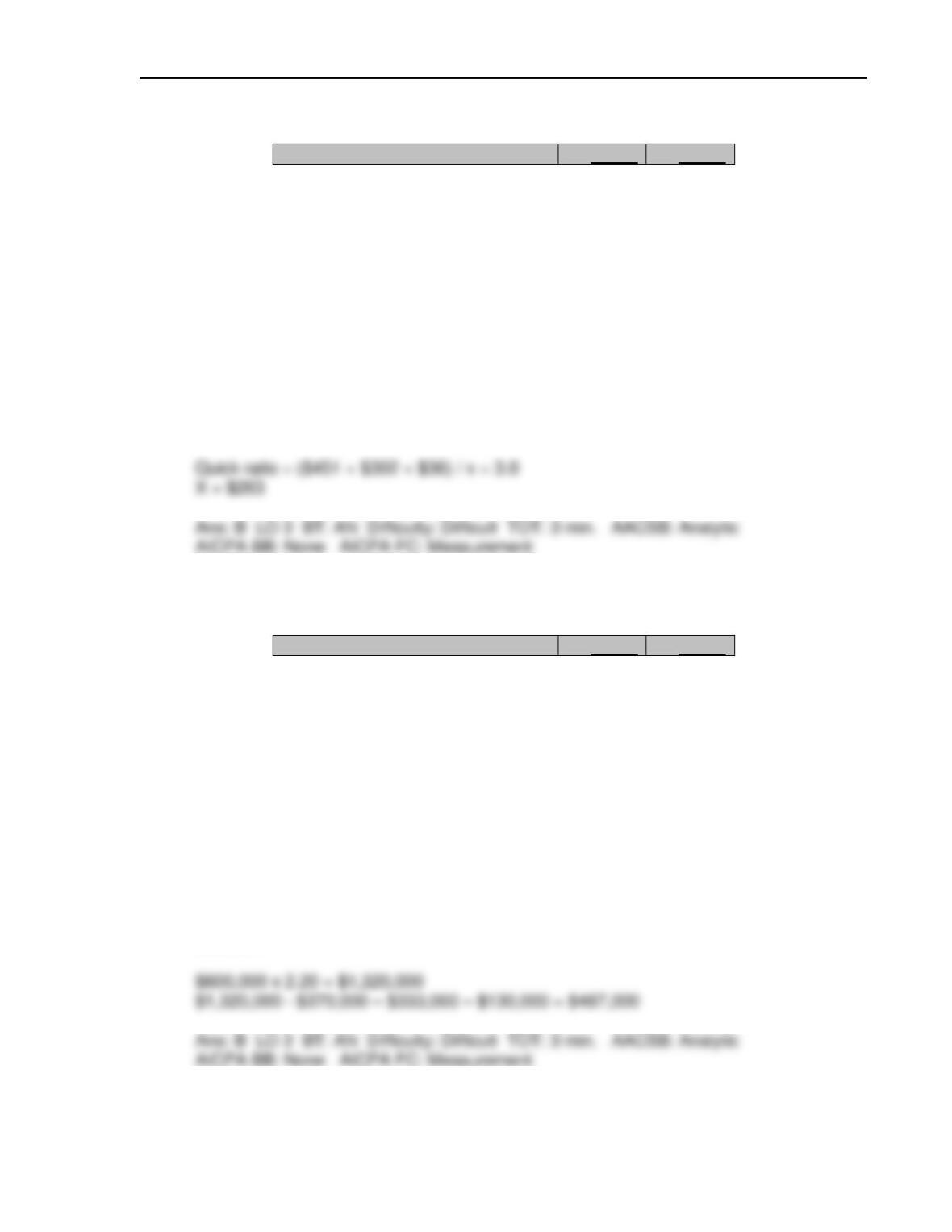
If Walker’s quick ratio is 3.00 for 2017, what is the amount of its current liabilities?
a. $325,000
b. $263,000
c. $285,000
d. There is not enough information to answer this question.
Solution (in thousands):
57. Norton Company has the following assets on January 1, 2017 and January 1, 2016.
1/1/17
1/1/16
Cash
$430,000
$370,000
Accounts receivables
?
333,000
Marketable securities
36,000
130,000
Inventory
220,000
?
Net plant and equipment
120,000
129,000
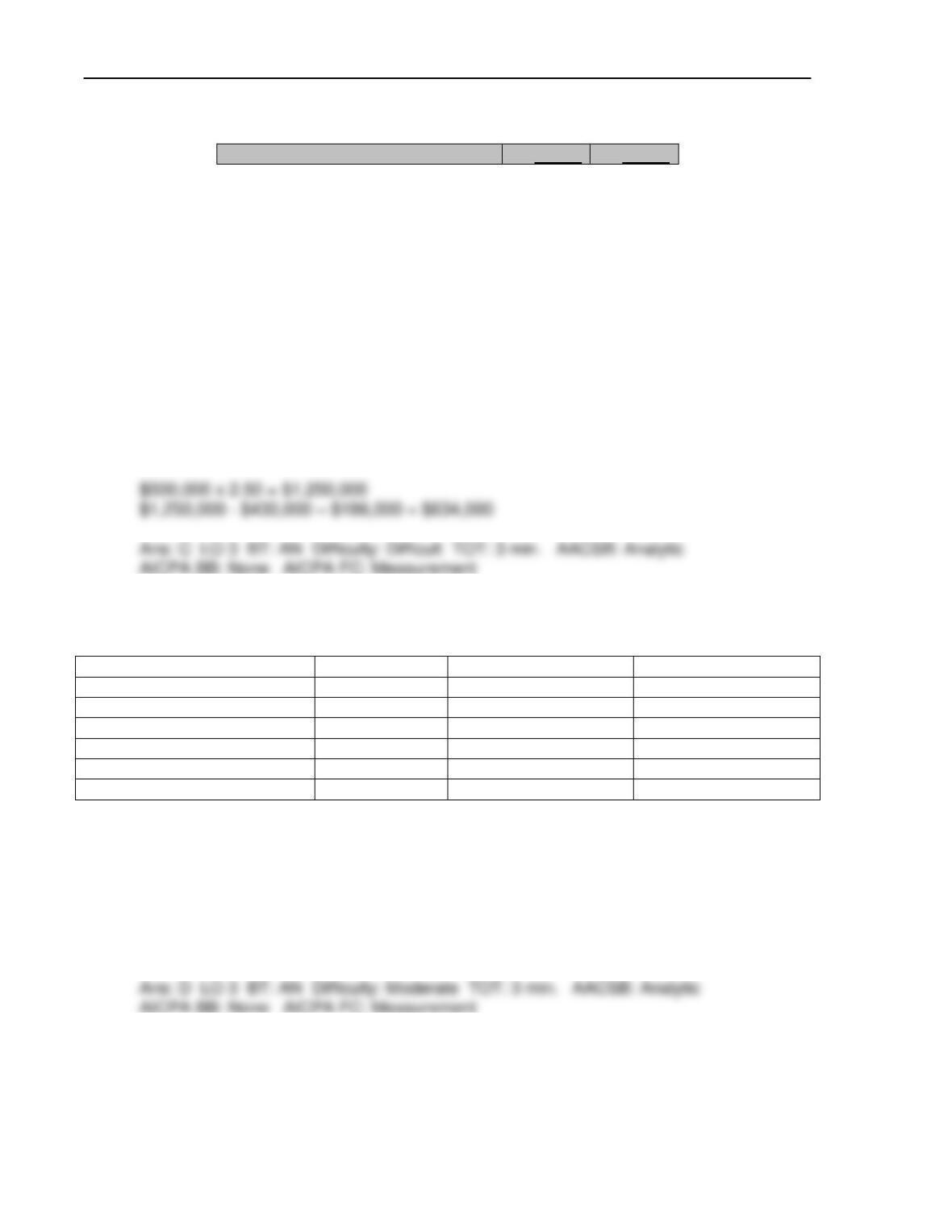
If Norton’s current ratio is 2.20 for 2016 and its current liabilities are $600,000, what is
the amount of its inventory?
a. $197,000
b. $487,000
c. $238,636
d. There is not enough information to answer this question.
Solution:
5-20 Test Bank – Chapter 5 – Using Financial Statement Information
58. Norton Company has the following assets on January 1, 2017 and January 1, 2016.
1/1/17
1/1/16
Cash
$430,000
$370,000
Accounts receivables
?
333,000
Marketable securities
186,000
130,000
Inventory
220,000
?
Net plant and equipment
120,000
129,000
If Norton’s quick ratio is 2.50 for 2017 and its current liabilities are $500,000, what is the
amount of its accounts receivables?
a. $324,000
b. $204,000
c. $634,000
d. There is not enough information to answer this question.
Solution:
59. The following ratios were computed from the financial statement of Darren Technologies:
2018
2017
2016
Return on equity
0.30
0.27
0.23
Return on assets
0.17
0.20
0.22
Common equity leverage
0.87
0.90
0.92
Capital structure leverage
2.22
1.60
1.24
Profit margin
0.11
0.10
0.09
Asset turnover
1.69
2.27
2.87
Which of the following statements is true?
a. There has been a steady decline in ROE from 2016 through 2018.
b. The increase in ROA is due primarily to the changes in asset turnover.
c. The changes in ROA could be due to increasing sales.
d. The change in ROA could be due to a large increase in the asset base of the
company.