Chapter 5—Job Costing, Process Costing, and Operations Costing
Key
1. The accumulating, tracking, and assigning of production costs to the goods and services produced is called a:
2. Companies that manufacture products such as custom-designed decks and pools would most likely use which
type of costing?
3. Companies that produce a homogeneous product where all the units are the same would most likely use
which type of costing?
4. Companies that produce large numbers of standardized products within a particular batch would most likely
use which type of costing?
5. Which of the following companies would be the most likely to adopt a job order costing system?
6. Which of the following companies would be the most likely to adopt a process costing system?
7. Which of the following types of companies would probably not use job order costing?
8. Which of the following types of costs would be specifically tracked or traced and assigned to a specific job in
a job order costing system?
9. Which of the following types of costs are easily tracked or traced and assigned to a specific job in a job order
costing system?
10. Which of the following types of costs is not easily tracked or traced to a specific job or file in job-order
costing?
11. Which of the following would not be included on a job cost report?
12. Peterson Upholstery manufactures custom furniture. Peterson has just completed a job which required 20
yards of fabric at a cost of $15 per yard. Out of the 20 yards of fabric, 18 yards actually became a part of the
completed project. The remaining 2 yards were considered “normal spoilage” in the production process. Which
of the following statements is correct regarding the fabric cost for this job?
13. Normal spoilage:
14. Which of the following statements is correct regarding “abnormal” spoilage of materials used for a
particular job?
15. Which of the following statements regarding “normal” spoilage of materials is not correct?
16. Which of the following statements is correct regarding fringe benefits earned by employees whose regular
wages are normally classified as direct labor?
17. Which of the following should not be considered in the calculation of direct labor cost?
18. George Wilson is an assembly-line worker for Gantt Manufacturing. Gantt pays its employees weekly. The
following is a breakdown of all the labor costs traced to George for the previous week:
Regular pay:
40 hours at $12 per hour
Overtime pay:
5 hours at $18 per hour
Fringe benefits received:
$50 per week
Last week, George spent the entire 45 hours he worked on a special order “rush” job for a particular customer. The overtime was necessary in order
to complete the job from start to finish within one week. Assuming that George was the only employee who worked directly on this job, how much
direct labor cost should be assigned to the job?
19. Costs associated with factory insurance, maintenance, rent, property taxes, and other similar items are
typically included in manufacturing overhead and assigned to products:
20. In job costing, which of the following types of costs is usually the most difficult to trace to a product?
21. Cost allocation:
22. Which of the following costs is the most likely to be allocated to a product in a traditional job costing
environment?
23. Which of the following costs is the most likely to not be allocated to a product in a job costing
environment?
24. Which of the following statements is correct?
25. A good allocation base:
26. An allocation base that causes overhead costs to be incurred is called a(n):
27. The key to allocating overhead costs is the determination of the ____.
28. Which of the following statements is true with respect to cost drivers?
29. What should determine whether an allocation base is a good cost driver?
30. Which of the following would probably not be a cost driver in a manufacturing environment?
31. Maria’s Custom Tailoring is very labor intensive. Therefore, Maria has decided to use direct labor hours as
the cost driver for assigning overhead costs to specific jobs. During the month of February, the company
incurred overhead costs of $3,000. Total direct labor hours during the month totaled 600. Out of a total of 30
different jobs worked on during the month, Job #100 required 6 direct labors to complete and Job #200 required
10 direct labor hours. The total amount of overhead allocated to these two jobs is:
32. Horatio Ltd. uses job order costing to measure and track product costs. Horatio has determined that machine
hours drive its manufacturing overhead costs. During the month of June, the following data were available for
Product #80:
Direct labor
350 hours at $10 per hour
Direct materials
40 square yards at $25 per yard
Machine hours used
1,000 hours
If total manufacturing overhead costs during the month totaled $10,000 when a total of 25,000 machine hours were used, what will be the total
manufacturing cost of Product #80?
33. Presley Products Inc. is a manufacturer of limited edition dolls. They use operations costing to measure and
track the costs incurred for specific product lines. While most of the products do require some machine time,
Presley has determined that direct labor hours drive its manufacturing overhead costs. During the month of
April, the following data were available for a particular line of dolls:
Direct labor
3,000 hours at $10 per hour
Direct materials
4,000 pounds at $2 per pound
If total overhead costs during the month totaled $25,000 when a total of 50,000 direct labor hours were worked, what will be the total manufacturing
cost for this line of dolls?
34. Griffin Manufacturing uses job order costing to measure and track the costs incurred for specific jobs. While
most of the jobs do require some machine time, Griffin has determined that direct labor cost drives its
manufacturing overhead costs. During the month of August, the following data were available for Job #45:
Direct labor
200 hours at $15 per hour
Direct materials
90 gallons at $6 per gallon
Machine hours used
100 hours
If total overhead costs during the month totaled $4,000 when a total of $20,000 in direct labor costs were incurred, what will be the total
manufacturing cost of Job #45?
35. Benjamin Products uses job order costing and assigns overhead to specific jobs using direct labor hours.
During the month of June, a total of 1,800 direct labor hours at a cost of $14 per hour were incurred for all jobs.
Actual overhead costs for the month totaled $4,500. If a specific job required 32 direct labor hours of work, how
much overhead should be applied to that job?
36. Which of the following statements regarding plantwide overhead rates is true?
37. Which of the following statements regarding plantwide versus departmental overhead rates is true?
38. Carla’s Bakery has recently expanded its operations to include private-party catering. Prior to this
expansion, Carla used a plantwide overhead rate with machine hours as the cost driver. Now, due to the
expansion, Carla would like to implement departmental overhead rates. She will continue to use machine hours
as the cost driver for the bakery division but will use direct labor hours for the catering division. The following
is a breakdown of product costs and other data for the two divisions for the month of May:
Bakery
Catering
Direct labor hours
500 hours at $10 per hour
200 hours at $15 per hour
Machine hours
200 hours
30 hours
If total overhead for the month of May was $5,000, with $3,500 allocated to the bakery and $1,500 allocated to catering, what are the overhead rates
for the bakery and catering divisions, respectively?
39. City Doughnuts recently expanded its eat-in doughnut business to include the wholesale market where
doughnuts will be sold in local grocery stores. City Doughnuts makes the doughnuts for its eat-in business on
the premises (Department A), but has recently rented a separate factory to use solely for its wholesale business
(Department B).
The company used to use direct labor hours as its plantwide overhead rate. But now, due to the heavily
automated factory, would like to start using departmental overhead rates using different cost drivers. The
following information is available for the month of April:
Department “A”
Doughnuts
Department “B”
Doughnuts
Total overhead allocated by department
$3,000
$4,000
Overhead cost driver
direct labor hours
machine hours
Number of direct labor hours
200 hours
—-
Number of machine hours
—-
250 hours
Direct labor hours per dozen doughnuts
4 minutes
—-
Machine hours per dozen doughnuts
—-
3 minutes
What is the overhead cost per dozen doughnuts for Department A and Department B, respectively?
40. When using job-order costing, which of the following costs is the least likely to be known in a timely
enough manner for decision-making purposes?
41. Why do many managers desire to use a predetermined overhead rate instead of an actual overhead rate?
42. Which of the following is not true regarding predetermined overhead rates?
43. The formula for calculating the predetermined overhead rate is:
44. The formula for calculating the amount of overhead applied to a product is:
45. Aronson & Associates LLP
Aronson & Associates LLP, an accounting firm, assigns overhead to clients based on direct labor hours. The
following information is available for the month of March:
Estimated direct labor hours
4,000 hours
Estimated overhead costs
$8,000
Actual direct labor hours
4,200 hours
Actual overhead costs
$8,190
Refer to the Aronson & Associates LLP information above. The predetermined overhead rate for the month of March is:
46. Aronson & Associates LLP
Aronson & Associates LLP, an accounting firm, assigns overhead to clients based on direct labor hours. The
following information is available for the month of March:
Estimated direct labor hours
4,000 hours
Estimated overhead costs
$8,000
Actual direct labor hours
4,200 hours
Actual overhead costs
$8,190
Refer to the Aronson & Associates LLP information above. The amount of applied overhead for March will be:
47. Aronson & Associates LLP
Aronson & Associates LLP, an accounting firm, assigns overhead to clients based on direct labor hours. The
following information is available for the month of March:
Estimated direct labor hours
4,000 hours
Estimated overhead costs
$8,000
Actual direct labor hours
4,200 hours
Actual overhead costs
$8,190
Refer to the Aronson & Associates LLP information above. By how much was overhead over– or underapplied for the month of March?
48. Rolling Hills Construction
Rolling Hills Construction Co. assigns overhead to specific jobs based on direct labor cost (dollars). The
following information is available for the month of June:
Estimated direct labor hours
2,000 hours
Estimated direct labor cost per hour
$12/hour
Estimated overhead costs
$3,000
Actual direct labor hours
2,300 hours
Actual direct labor cost per hour
$13/hour
Actual overhead costs
$3,300
Refer to the Rolling Hills Construction information above. The predetermined overhead rate for the month of June is:
49. Rolling Hills Construction
Rolling Hills Construction Co. assigns overhead to specific jobs based on direct labor cost (dollars). The
following information is available for the month of June:
Estimated direct labor hours
2,000 hours
Estimated direct labor cost per hour
$12/hour
Estimated overhead costs
$3,000
Actual direct labor hours
2,300 hours
Actual direct labor cost per hour
$13/hour
Actual overhead costs
$3,300
Refer to the Rolling Hills Construction information above. The amount of overhead applied for June is:
50. Martin Manufacturing assigns overhead to jobs based on machine hours. At the beginning of the current
year, estimated overhead costs were $200,000 and estimated machine hours were 40,000. During the year, 140
machine hours were used on Job #88. By the end of the year, actual overhead costs were calculated to be
$202,500 and actual machine hours were 45,000.
How much overhead was applied to Job #88 during the year?
51. Giles Inc.
Giles Inc. manufactures high quality golfing equipment. Giles assigns overhead to products based on machine
hours. At the beginning of the current year, estimated overhead costs were $500,000 and estimated machine
hours were 50,000. During the year, 54,000 machine hours were actually used. By the end of the year, actual
overhead costs were calculated to be $529,200.
Refer to the Giles Inc. information above. What was the predetermined overhead rate?
52. Giles Inc.
Giles Inc. manufactures high quality golfing equipment. Giles assigns overhead to products based on machine
hours. At the beginning of the current year, estimated overhead costs were $500,000 and estimated machine
hours were 50,000. During the year, 54,000 machine hours were actually used. By the end of the year, actual
overhead costs were calculated to be $529,200.
Refer to the Giles Inc. information above. How much total overhead was applied to products during the year?
53. Giles Inc.
Giles Inc. manufactures high quality golfing equipment. Giles assigns overhead to products based on machine
hours. At the beginning of the current year, estimated overhead costs were $500,000 and estimated machine
hours were 50,000. During the year, 54,000 machine hours were actually used. By the end of the year, actual
overhead costs were calculated to be $529,200.
Refer to the Giles Inc. information above. By how much was overhead over- or underapplied for the year?
54. Teresa Summerlin
Teresa Summerlin manufactures hand-crafted pottery. Overhead is applied to products based on direct labor
hours. At the beginning of the current year, Teresa estimated total overhead costs would be $30,000 and
estimated direct labor hours would be 20,000. Actual overhead costs for the year totaled $36,000 for 18,000
actual direct labor hours.
Refer to the Teresa Summerlin information above. How much overhead was applied during the year?
55. Teresa Summerlin
Teresa Summerlin manufactures hand-crafted pottery. Overhead is applied to products based on direct labor
hours. At the beginning of the current year, Teresa estimated total overhead costs would be $30,000 and
estimated direct labor hours would be 20,000. Actual overhead costs for the year totaled $36,000 for 18,000
actual direct labor hours.
Refer to the Teresa Summerlin information above. By how much was overhead underapplied for the year?
56. Nelson Manufacturing applies overhead to its manufactured products based on direct labor hours. Last year,
total overhead costs were estimated to be $100,000. Actual overhead costs ended up totaling $115,000 when
10,000 direct labor hours were actually worked. At the end of the year, overhead was overapplied by $6,000.
What was the predetermined overhead rate that must have been used during the year?
57. Southern Manufacturing applies overhead to its products based on direct labor hours. During 2009 the
company allocated overhead using a predetermined overhead rate of $5.25. At the end of 2009 it was
determined that overhead was underapplied by $10,000. Which of the following could not be a possible reason
for overhead being underapplied?
58. Wintergreen Products allocates overhead based on direct labor hours. During 2009 overhead was
overapplied by $4,000. Assuming that the year-end adjustment to clear out the overapplied overhead has not yet
been done, which of the following statements is most likely true if there are no ending inventories?
59. Newman Manufacturing underapplied its manufacturing overhead during 2009 Which of the following
statements is true regarding the adjustment to clear out the underapplied overhead?
60. If the under- or overapplied overhead amount is considered material, which of the following accounts would
be the least likely to be adjusted at the end of the year?
61. Which of the following statements is true regarding process costing?
62. Which type(s) of cost(s) are accumulated, tracked, and assigned to products when a company uses process
costing?
63. In its initial year of operation, Montoya Manufacturing started and completed 4,000 identical widgets and
had 1,000 widgets that were 40% complete in work-in-process at the end of the year. Total production costs for
the year were $55,000. How many total equivalent units were completed during the year?
64. In its initial year of operation, Montoya Manufacturing started and completed 4,000 identical widgets and
had 1,000 widgets that were 40% complete in work-in-process at the end of the year. Total production costs for
the year were $55,000. What is the cost per equivalent unit?
65. Howell Manufacturers had no units in process at the beginning of the year. During the current year, 40,000
units were started. There were 5,000 units in work-in-process at the end of the year. These units were 35%
complete. How many total equivalent units were completed during the year?
66. Howell Manufacturers had no units in process at the beginning of the year. During the current year, 40,000
units were started. There were 5,000 units in work-in-process at the end of the year. These units were 35%
complete. If total production costs for the year were $275,625, what should be the cost per equivalent unit?
67. Reliable Manufacturers had no units in process at the beginning of the year. During the current year,
140,000 units were started. There were 15,000 units in work–in-process at the end of the year. These units were
40% complete. If total production costs for the year were $393,000 what should be the cost per equivalent unit?
68. Jet Products had no units in process at the beginning of the year. Jet uses process costing and has calculated
45,000 total equivalent units completed during the year. If there were 53,000 units started in the current period
and 10,000 units in ending work-in-process, what percentage complete were the ending inventory units?
69. Which of the following statements is false regarding process costing?
70. Lee Manufacturing uses process costing. The following information is available for the current year:
Number of units in beginning inventory
1,000
Number of units started in the current period
10,000
Number of units available in the current period
11,000
Number of units in ending inventory
(1,600)
Number of units completed in the current period
9,400
If Lee uses the FIFO method of process costing, which units are assumed to be the first ones finished during the year?
71. Under which of the following conditions will the first-in, first-out method produce the same cost of goods
manufactured as the weighted-average method?
72. Which of the following statements is true regarding the FIFO method of process costing?
73. Which of the following statements is true regarding the weighted-average method of process costing?
74. Which costs should be included in the calculation of the cost per equivalent unit using the FIFO method of
process costing?
75. Which costs should be included in the calculation of the cost per equivalent unit using the weighted-average
method of process costing?
76. Rollins Manufacturing
Rollins Manufacturing uses process costing. The following information was available for the current year:
Number of units in beginning work-in-process inventory
4,000
(30% complete)
Number of units started in the current period
35,000
Number of units in ending work-in-process inventory
3,000
(80% complete)
Refer to the Rollins Manufacturing information above. If Rollins uses the first-in, first-out (FIFO) method, how many total equivalent units were
completed in the current period?
77. Rollins Manufacturing
Rollins Manufacturing uses process costing. The following information was available for the current year:
Number of units in beginning work-in-process inventory
4,000
(30% complete)
Number of units started in the current period
35,000
Number of units in ending work-in-process inventory
3,000
(80% complete)
Refer to the Rollins Manufacturing information above. If Rollins uses the weighted-average method, how many total equivalent units were
completed in the current period?
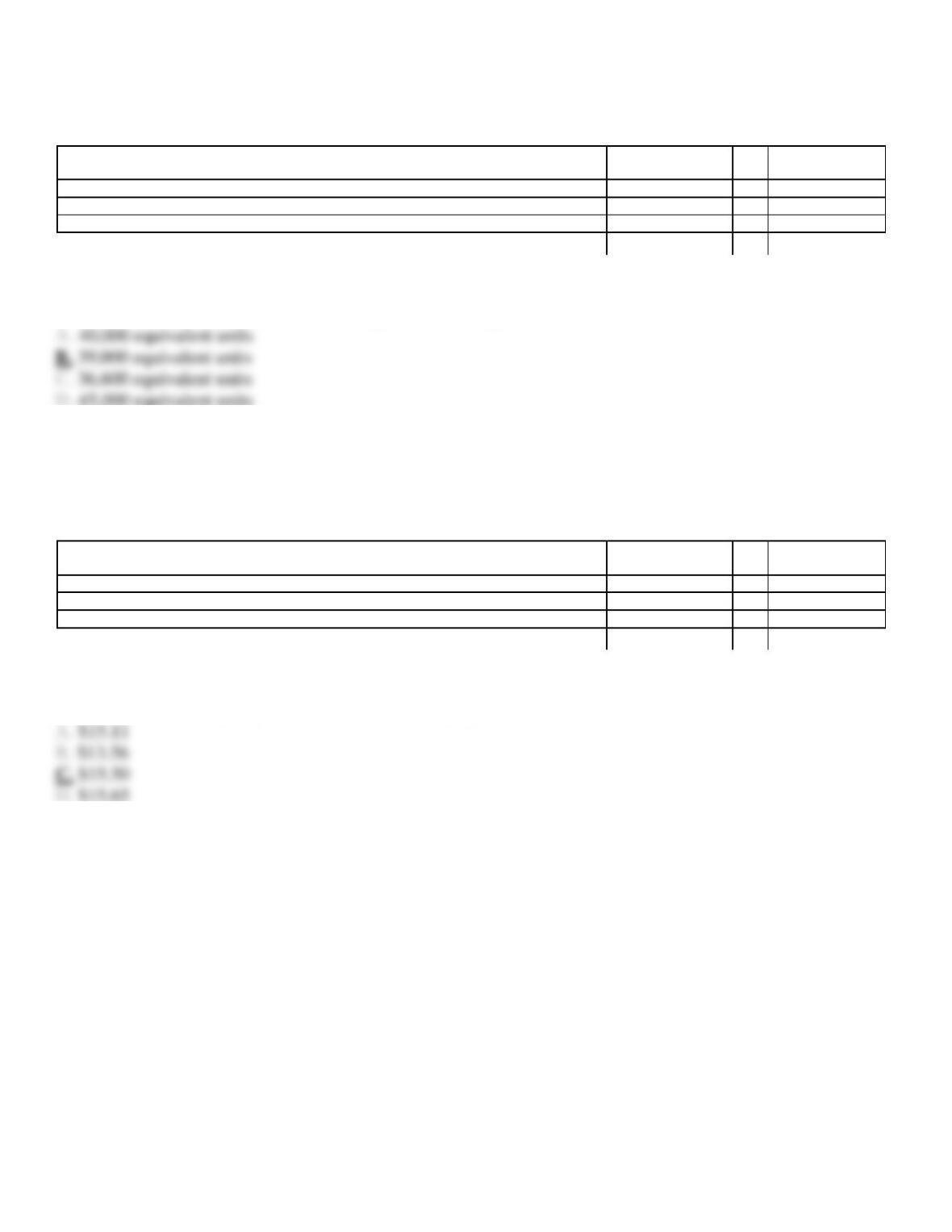
78. Peace Products Inc.
Peace Products Inc. uses process costing. The following information was available for the current year:
Number
of units
Production
Costs
Beginning work-in-process (20% complete)
1,000
$ 5,850
Current period production
40,000
604,500
Ending work-in-process (70% complete)
6,000
Refer to the Peace Products Inc. information above. If Peace uses the first-in, first-out (FIFO) method of computing equivalent units and assigning
product costs, how many total equivalent units were completed in the current period?
79. Peace Products Inc.
Peace Products Inc. uses process costing. The following information was available for the current year:
Number
of units
Production
Costs
Beginning work-in-process (20% complete)
1,000
$ 5,850
Current period production
40,000
604,500
Ending work-in-process (70% complete)
6,000
Refer to the Peace Products Inc. information above. If Peace uses the first-in, first-out (FIFO) method of computing equivalent units and assigning
product costs, what is the cost per equivalent unit? (round to nearest penny)