5-1: ROI and Residual Income
The following investment opportunities are available to an investment center manager:
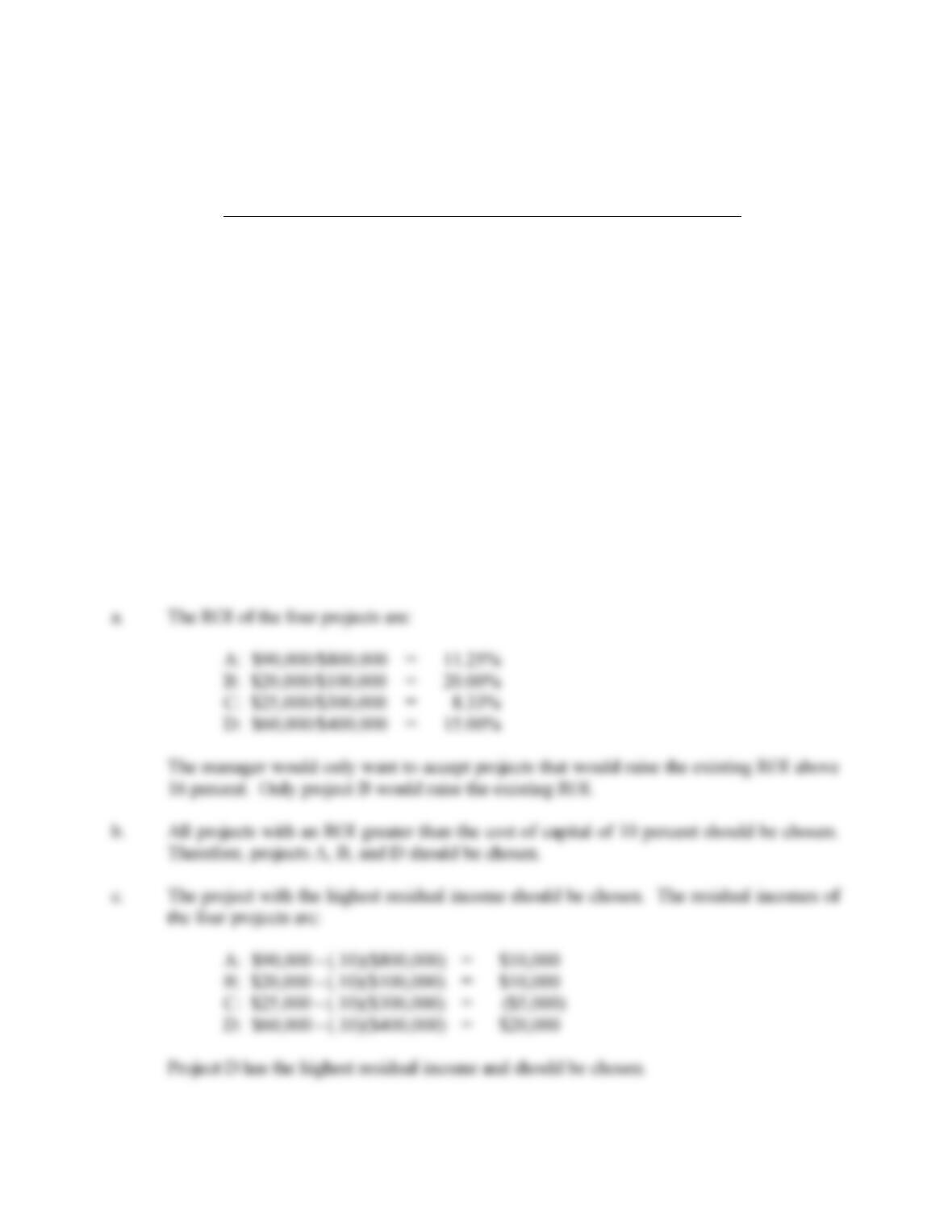
Project Initial Investment Annual Earnings
A $800,000 $90,000
B 100,000 20,000
C 300,000 25,000
D 400,000 60,000
Required:
a. If the investment manager is currently making a return on investment of 16 percent, which
project(s) would the manager want to pursue?
b. If the cost of capital is 10 percent and the annual earnings approximate cash flows
excluding finance charges, which project(s) should be chosen?
c. Suppose only one project can be chosen and the annual earnings approximate cash flows
excluding finance charges. Which project should be chosen?
5-1: Solution to ROI and Residual Income (10 minutes)
5-2: Transfer Prices
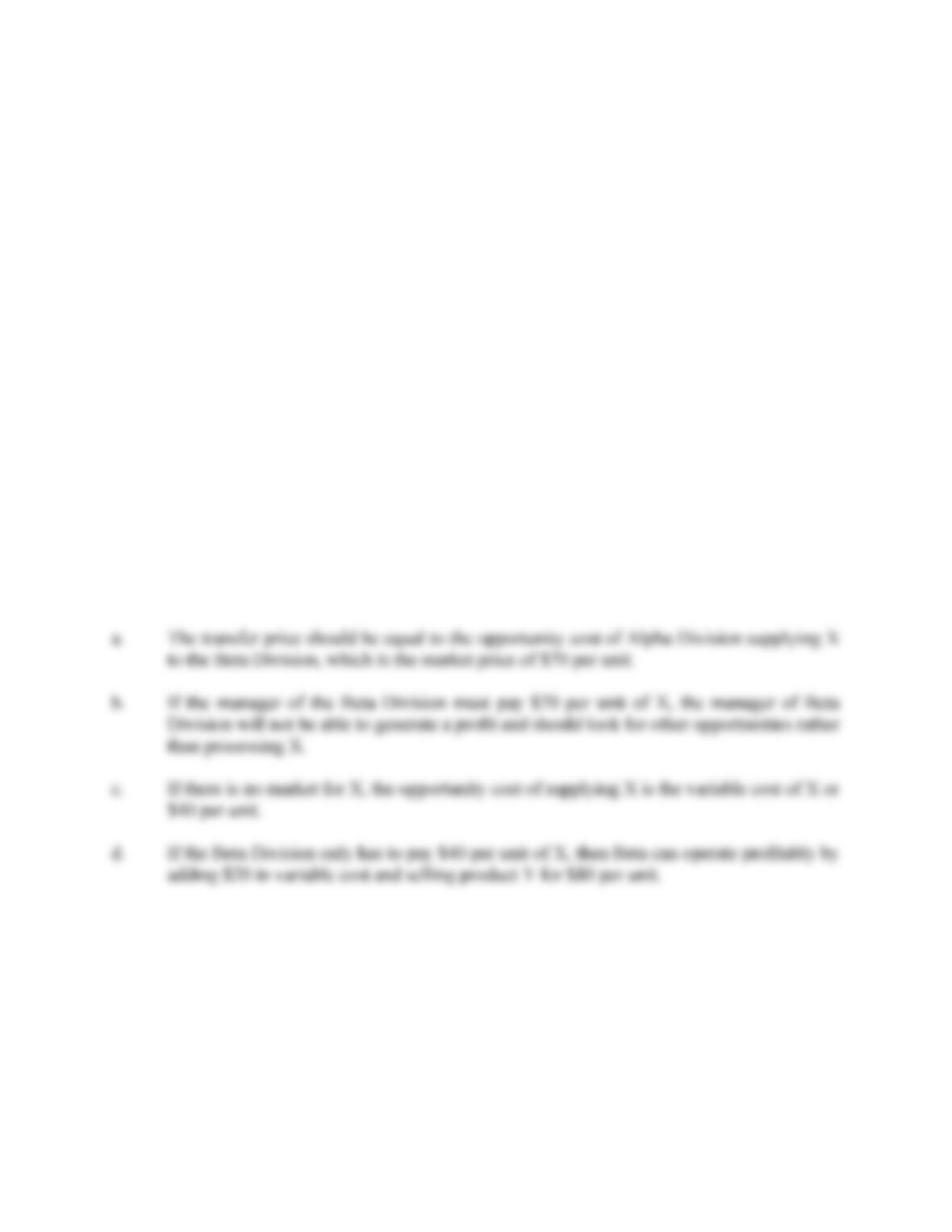
The Alpha Division of the Carlson Company manufactures product X at a variable cost of
$40 per unit. Alpha Division’s fixed costs, which are sunk, are $20 per unit. The market price of
X is $70 per unit. Beta Division of Carlson Company uses product X to make Y. The variable
costs to convert X to Y are $20 per unit and the fixed costs, which are sunk, are $10 per unit. The
product Y sells for $80 per unit.
Required:
a. What transfer price of X causes divisional managers to make decentralized decisions that
maximize Carlson Company’s profit if each division is treated as a profit center?
b. Given the transfer price from part (a), what should the manager of the Beta Division do?
c. Suppose there is no market price for product X. What transfer price should be used for
decentralized decision-making?
d. If there is no market for product X, is the operations of the Beta Division profitable?
5-2: Solution to Transfer Prices (15 minutes)
5-3: Transfer Pri
ces and Capacity
Jefferson Company has two divisions: Jefferson Bottles and Jefferson Juice. Jefferson
Bottles makes glass containers, which it sells to Jefferson Juice and other companies. Jefferson
Bottles has a capacity of 10 million bottles a year. Jefferson Juice currently has a capacity of 3
million bottles of juice per year. Jefferson Bottles has a fixed cost of $100,000 per year and a
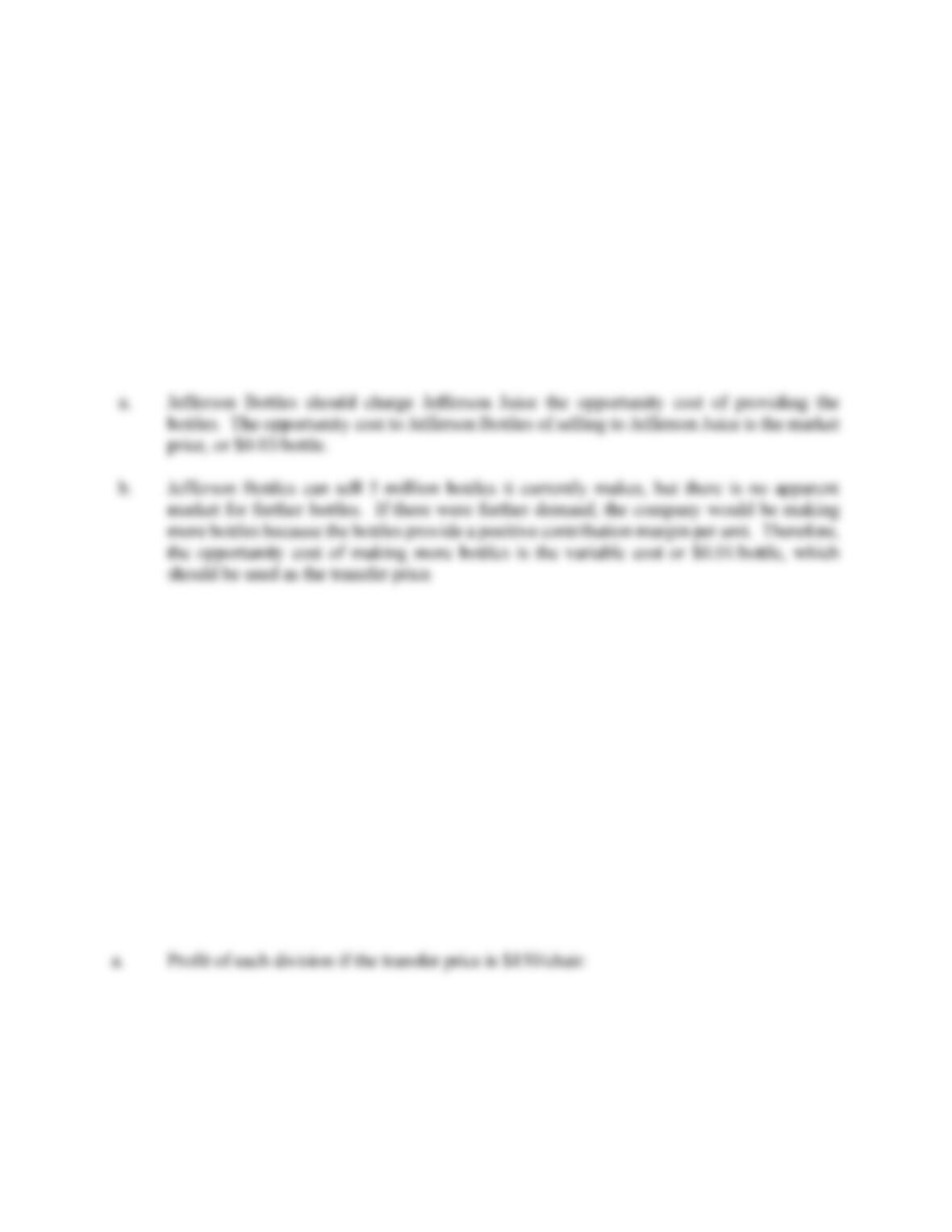
variable cost of $0.01/bottle. Jefferson Bottles can currently sell all of its output at $0.03/bottle.
Required:
a. What should Jefferson Bottles charge Jefferson Juice for bottles so that both divisions will
make appropriate decentralized planning decisions?
b. If Jefferson Bottles can only sell 5 million bottles to outside buyers, what should Jefferson
Bottles charge Jefferson Juice for bottles so that both divisions will make appropriate
decentralized planning decisions?
5-3: Solution to Transfer Prices and Capacity (10 minutes)
5-4: Transfer Prices and Divisional Profit
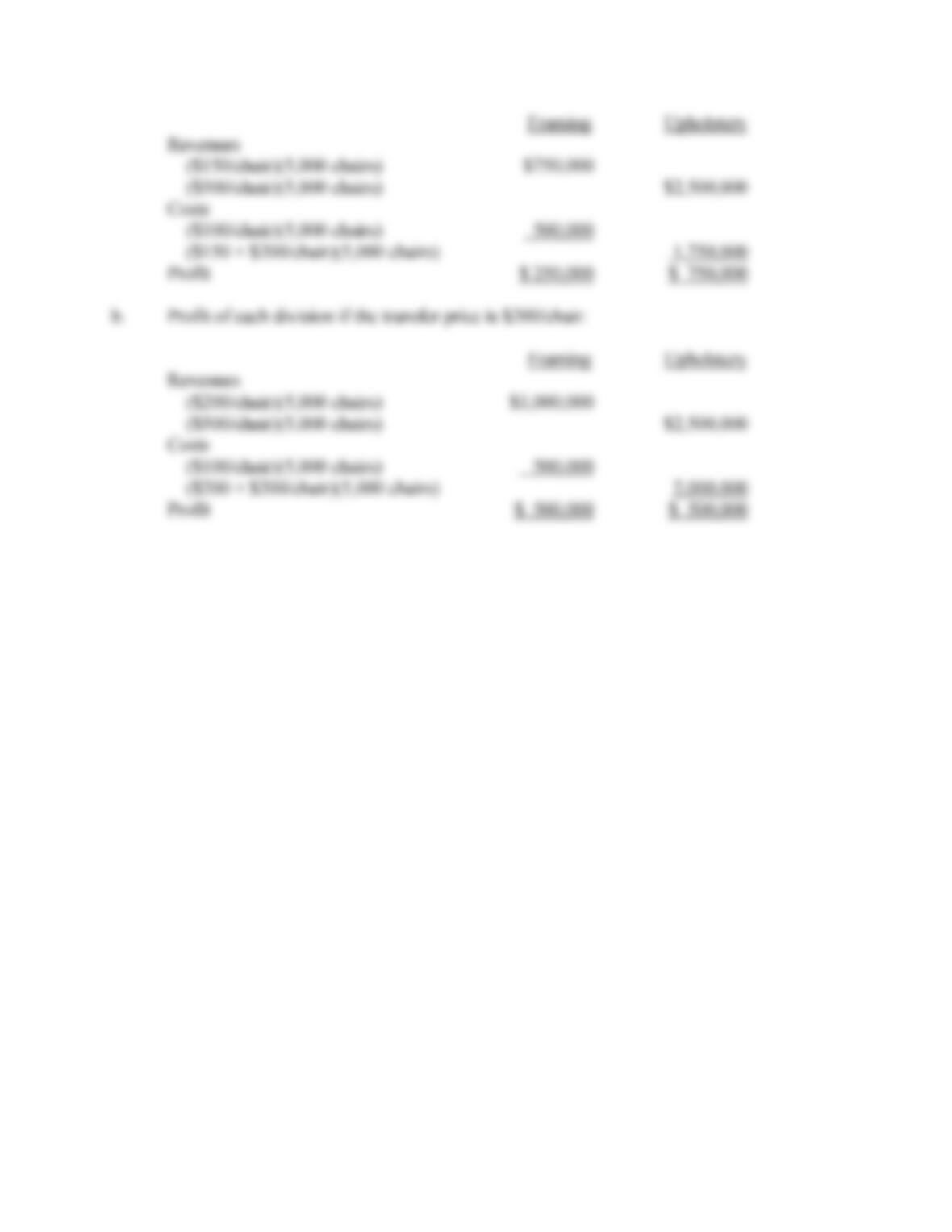
A chair manufacturer has two divisions: framing and upholstering. The framing costs are
$100 per chair and the upholstering costs are $200 per chair. The company makes 5,000 chairs
each year, which are sold for $500.
Required:
a. What is the profit of each division if the transfer price is $150?
b. What is the profit of each division if the transfer price is $200?
5-4: Solution to Transfer Prices and Divisional Profit (10 minutes)
5-5: Performance Measures for Cost Centers
A soft drink company has three bottling plants throughout the country. Bottling occurs at
the regional level because of the high cost of transporting bottled soft drinks. The parent company
supplies each plant with the syrup. The bottling plants combine the syrup with carbonated soda to
make and bottle the soft drinks. The bottled soft drinks are then sent to regional grocery stores.
The bottling plants are treated as costs centers. The managers of the bottling plants are
evaluated based on minimizing the cost per soft drink bottled and delivered. Each bottling plant
uses the same equipment, but some produce more bottles of soft drinks because of different
demand. The costs and output for each bottling plant are:
A B C
Units Produced 10,000,000 20,000,000 30,000,000
Variable Costs $ 200,000 $ 450,000 $ 650,000
Fixed Costs $1,000,000 $1,000,000 $1,000,000
Required:
a. Estimate the average cost per unit for each plant.
b. Why would the manager of plant A be unhappy with using the average cost as the
performance measure?
c. What is an alternative performance measure that would make the manager of plant A
happier?
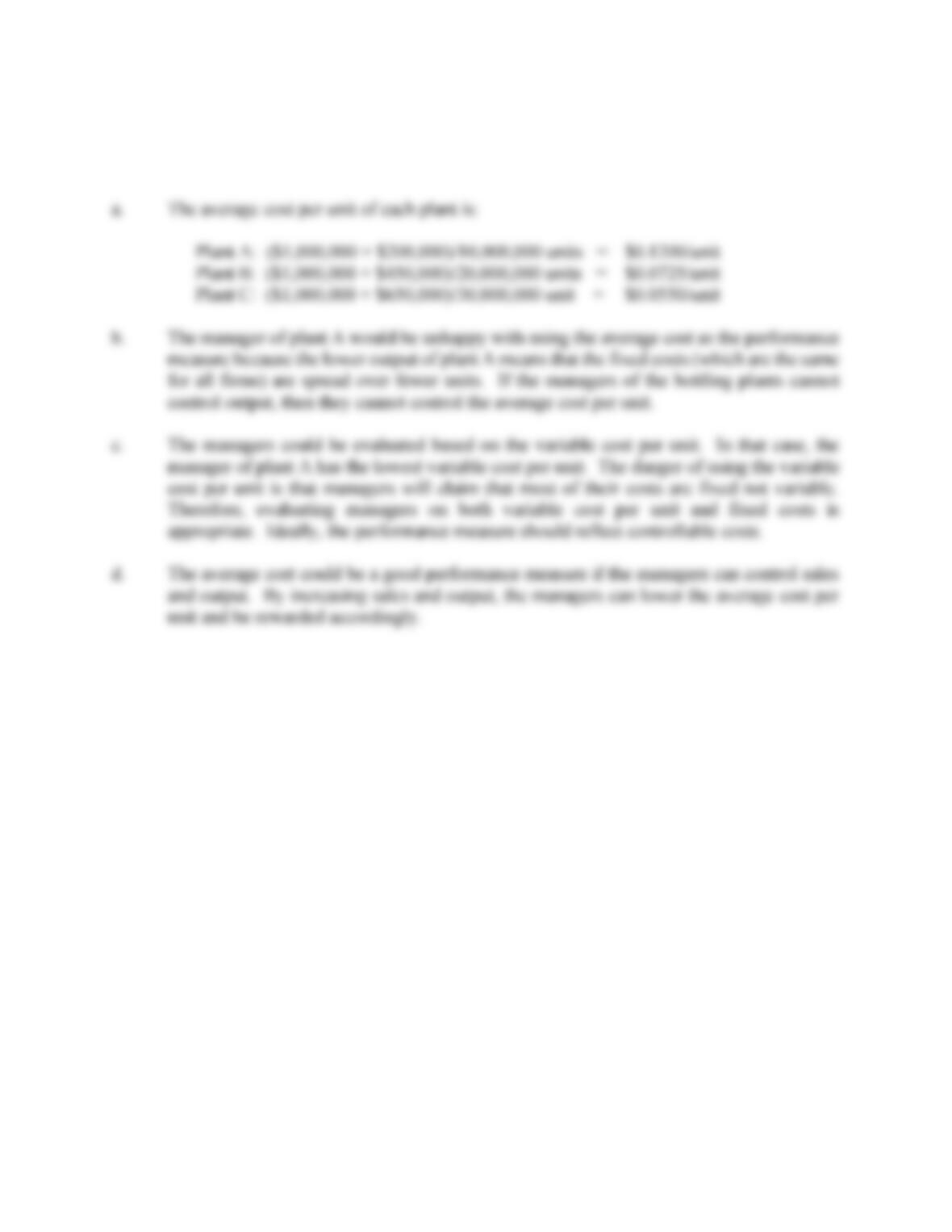
d. Under what circumstances might the average cost be a better performance measure?
5-5: Solution to Performance Measures for Cost Centers (15 minutes)
5-6: Responsibility Centers
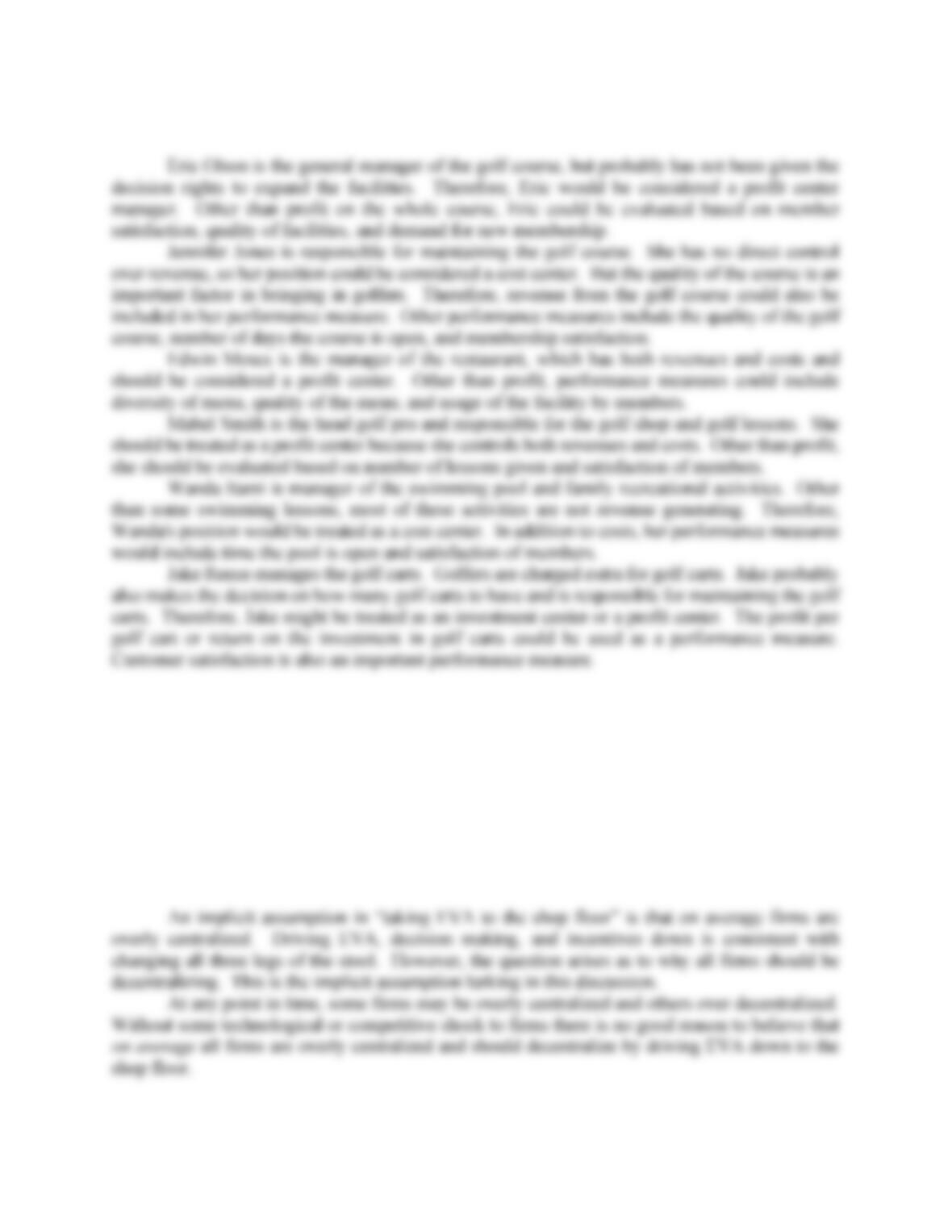
The Maple Way Golf Course is a private club that is owned by the members. It has the
following managers and organizational structure:
Eric Olson: General manager responsible for all the operations of the golf course and
other facilities (swimming pool, restaurant, golf shop).
Jennifer Jones: Manager of the golf course and responsible for its maintenance.
Edwin Moses: Manager of the restaurant.
Mabel Smith: Head golf professional and responsible for golf lessons, the golf shop, and
reserving times for starting golfers on the course.
Wanda Itami: Manager of the swimming pool and family recreational activities.
Jake Reece: Manager of golf carts rented to golfers.
Describe each of the managers in terms of being responsible for a cost, profit, or investment
center and possible performance measures for each manager.
5-6: Solution to Responsibility Centers (20 minutes)
5–7: Decision Rights Assignments and EVA
At a Stern–Stewart conference, one of the topics discussed was “taking EVA to the shop
floor.” This session described “driving EVA analysis, decision making and incentives down
through every level of an organization.” If you were attending this session, what questions
would you ask the panelists?
5–7: Solution to Decision Rights Assignments and EVA (15 minutes)
5-8: Transfer Pricing in Universities
The Eastern University Business School teaches some undergraduate business courses for
students in the Eastern University College of Arts and Science (CAS). The 6,000 undergraduates
generate 2,000 undergraduate student course enrollments in business courses per year. The B–
school and CAS are treated as profit centers in that their budgets contain student tuition revenues
as well as costs. The deans have discretion to set tuition and salaries and determine hiring as long
as they operate with no deficit (revenues = expenses). Undergraduate tuition is $12,000 per year
and each student takes eight courses per year. Average undergraduate financial aid amounts to
20% of gross tuition. The current transfer price rule is gross tuition per course less average
financial aid.
This transfer price rule gives net tuition to the B-school as a revenue and deducts an equal
amount from the CAS budget. The CAS dean argues that the current system is grossly unfair.
CAS must provide costly services for undergraduates to maintain a top-rated undergraduate
program. For example, career counseling, academic advising, sports programs, and the admissions
office are costs that must be incurred if undergraduates are to enroll at Eastern. Therefore, the
CAS dean argues, the average cost of these services per undergraduate student course enrollment
should be deducted from the tuition transfer price. These undergraduate student services total $9.6
million per year.
Required:
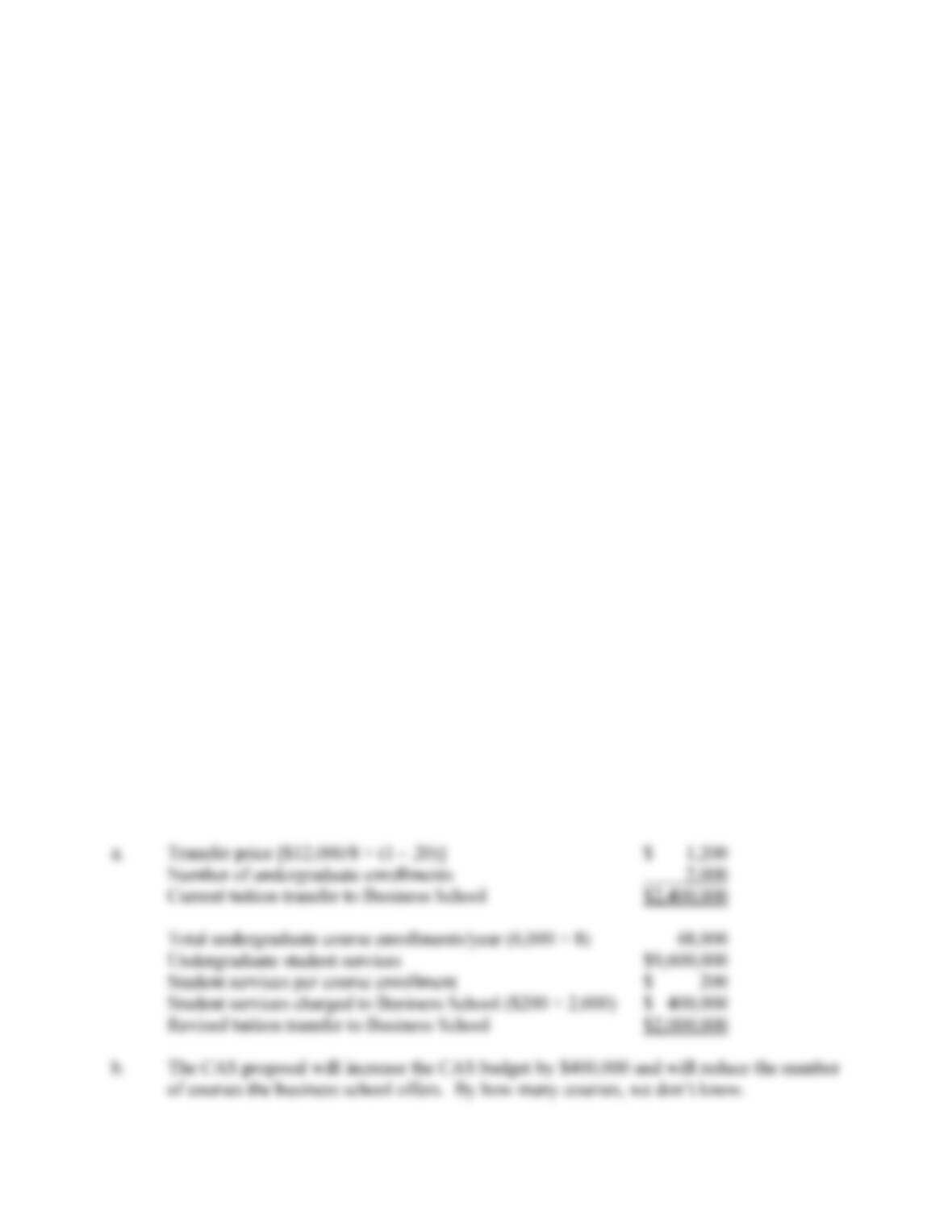
a. Calculate the current revenue the B-school is receiving from undergraduate business
courses. What will it be if the CAS dean’s proposal is adopted?
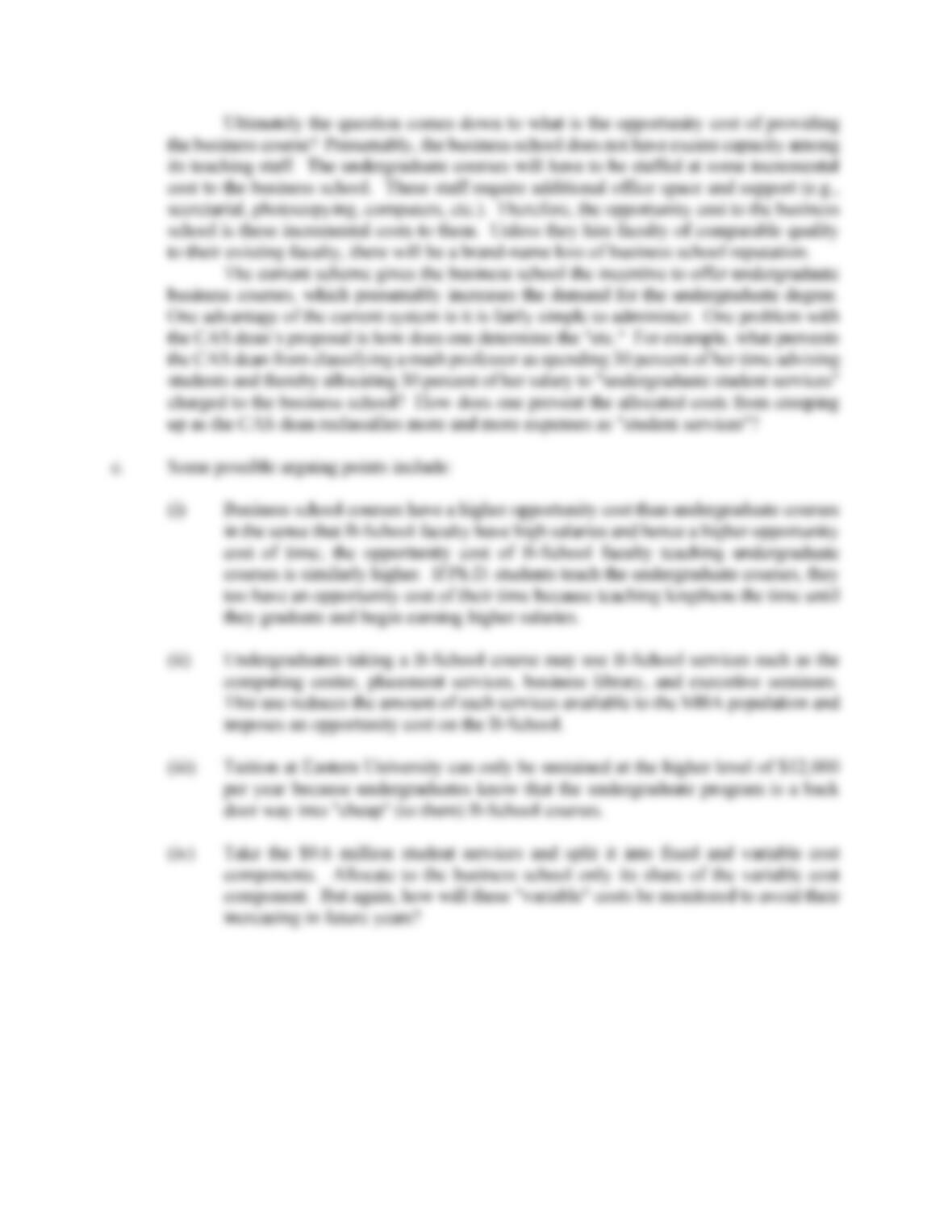
b. Discuss the pros and cons of the CAS dean’s proposal.
c. As special assistant to the B-school dean, prepare a response to the proposed tuition transfer
pricing scheme.
5–8: Solution to Transfer Pricing in Universities (20 minutes)
5-9: Transfer Prices and External Sourcing
Lewis is a large manufacturer of office equipment, including copiers. Its electronics
division is a cost center. Currently, electronics sells circuit boards to other divisions exclusively.
Lewis has a policy that internal transfers are to be priced at full cost (fixed + variable). Thirty
percent of the cost of a board is considered fixed.
The electronics division is operating at 75 percent of capacity. Because there is excess
capacity, electronics is seeking opportunities to sell boards to non-Lewis firms. The electronics
division policy on non-Lewis sales states that each job must cover full cost and a minimum 10
percent profit. Electronics division management will be measured on its ability to make the
minimum profit on any non-Lewis contracts that are accepted.
Copy products is another Lewis division. Copy products has recently reached an
agreement with Siviy, a non-Lewis firm, for the assembly of subsystems for a copier. Copy
products has selected Siviy because of Siviy’s low labor cost. The subsystem Siviy will assemble
requires circuit boards. Copy products has stipulated that Siviy must purchase the circuit boards
from the electronics division because of electronics’ high quality and dependability.
Electronic products is anxious to accept this new work from copy products because it will
increase electronic product’s workload by 15 percent.
In negotiating a contract price with Siviy, copy products needs to take into account the cost
of the circuit boards from electronics. The financial analyst from copy products assumes that
electronics will sell the circuit boards to Siviy at full cost (the same as the internal transfer price).
Electronics is considering adding the minimum 10 percent profit margin to their full cost and
transferring at that price to Siviy.
Copy products is preparing to negotiate its contract with Siviy. Develop and discuss at
least three options that may be used in establishing the transfer price between the electronics
division and Siviy. Discuss the advantages and disadvantages of each.
Source: L Harrington, R Lewis, P Siviy, and S Spector.
5–9: Solution to Transfer Prices and External Sourcing (20 minutes)
5-10: Comparing ROA and EVA
General Motors’s CFO, Michael Losh, converted GM’s performance measure for
compensation from net income to ROA. In explaining the move in CFO (August 1996), he said,
“ROA was a logical next step because all those other measures generally have focused on the
income statement. Moving to ROA means that we’re going to focus not only on the income
statement, but on the balance sheet and effective utilization of the assets and liabilities that are on
the balance sheet as well.
“ROA is a better measure for us than EVA. … EVA is simpler conceptually, because it
automatically builds on growth, whereas with this approach we know that we’ve got to have
growth as an overlying objective. … EVA is more comprehensive. And that has a certain appeal
to me. But, given our situation, particularly in our North American operations, it just would not
have been the right measure.
“ROA works for us and EVA doesn’t because our operations have to deal with those two
different kinds of starting points. Within GM, in our North American operations, you’ve got a
classic turnaround situation, and in our international operations, you’ve got a classic growth
situation. You can apply ROA to both; you can’t apply EVA to both.”
Required:
a. Explain how ROA focuses on both the income statement and the balance sheet.
b. Explain why EVA is more “comprehensive” than ROA.
c. Do you agree with Losh’s statement that “you can apply ROA to both; you can’t apply
EVA to both”? Explain.
5-10: Solution to Comparing ROA and EVA (30 minutes)
5-11: Transfer Pricing in the Presence of Divisional Interdependencies
Prior to 1997, PepsiCo, a major soft drink company, had a restaurant division consisting of
Kentucky Fried Chicken, Taco Bell, and Pizza Hut. The only cola beverage these restaurants
served was Pepsi. Assume that the major reason PepsiCo owned fast food restaurants is an attempt
to increase its share of the cola market. Under this assumption, some Pizza Hut patrons who order
a cola at the restaurant and are told they are drinking a Pepsi will switch and become Pepsi drinkers
instead of Coke drinkers on other purchase occasions. However, studies have shown that some
customers refuse to eat at restaurants unless they can get a Coke.
PepsiCo sells Pepsi Cola to non-PepsiCo restaurants at $0.53 per gallon. This is the market
price of Pepsi-Cola. Pepsi-Cola’s variable manufacturing cost is $0.09 per gallon and its total
(fixed and variable) manufacturing cost is $0.22 per gallon. PepsiCo produces Pepsi-Cola in
numerous plants located around the world. Plant capacity can be added in small increments (e.g.,
a half-million gallons per year). The cost of additional capacity is approximately equal to the fixed
costs per gallon of $0.13.
Required:
What transfer price should be set for Pepsi transferred from the soft drink division of
PepsiCo to a PepsiCo restaurant such as Taco Bell? Justify your answer.
5-11: Solution to Transfer Pricing in the Presence of Divisional Interdependencies (30
minutes)