
CHAPTER 5
Professional Responsibilities, Ethical Behavior, and Legal Requirements in
Educational Assessments
ITEMS
1. In making evaluative decisions about students, a teacher should be most mindful of
(a) his/her reputation as a professional.
(b) the consequences of the decisions for students.
(c) the consequences of the decisions for the teacher.
2. Quality information in decision-making refers to information that is
(a) appropriate for all decision-making situations.
(b) relevant and reliable for the specific use to which it is to be put.
(c) widely recognized as useful in and of itself.
3. Which of the following actions violate(s) the professional responsibility of a teacher in the
assessment of students?
(a) Insisting that one should only use test items that are relevant and reliable.
(b) Selecting a standardized test that is relevant to his/her purpose.
(c) Reporting the scores to the students four weeks after a classroom test is administered.
(d) Both (a) and (b) are violations of professional responsibility.
4. Before administering his end-of-semester exam, a high school teacher hinted to his favorite
students what they should expect on the exam. Which of the responsibilities of teachers has he
violated?
(a) Accommodating students
(b) Communicating assessment results
(c) Fairness to all students
5. It is a professional assessment responsibility of teachers to change their students’ test results to
reflect the teachers’ belief about what the students are capable of doing.
(a) True
(b) False
6. Which of the following activities does NOT exemplify a responsible professional action of a
teacher who teaches a group of students who differ widely in their socioeconomic status?
(a) Developing a comprehensive scoring rubric for assessing students’ writing ability.
(b) Developing a special version of a reading test for the disabled students in the class.
(c) Assessing reading comprehension using only passages containing content exclusively
within the experience of the high socioeconomic status students.

7. In selecting published material to assess students in your classroom, which of the following is the
most important criterion?
(a) The credibility of the publisher.
(b) The technical quality of the items.
(c) How well the tasks match what you taught.
8. Achievement tests that accompany curriculum materials are usually of higher quality than teacher–
made items.
(a) True
(b) False
9. Two teachers were reprimanded by the principal because of the poor performance of their students
on a standardized test. What would you recommend to other teachers who face a situation like
these two colleagues?
(a) Assist students by telling them the answers to the difficult items before testing begins.
(b) Make a few changes to the scores of students to ensure that the class average is what the
principal expects.
(c) Limit teaching to only content that appears on the standardized test.
(d) All of the above
(e) None of the above
10. A science teacher discovered two weeks after students’ grades were sent to parents that there was
an error in the teacher’s totaling of one student’s marks. As a result, an incorrect grade was sent
home for one student. What would you recommend to the teacher?
(a) Since the grades have been sent home, the teacher should disregard the error.
(b) The teacher should correct the error, award a new grade, and tell the student.
(c) In order not to lose face before the student and the parents, the teacher should make an
adjustment in the gradebook but not send home the grade change.
11. Which pair of practices BEST shows responsible behavior in scoring assessments?
(a) Use of scoring key or rubrics, prompt feedback to students.
(b) Detailed feedback to students, willingness to raise low scores for students who tried hard.
(c) Scoring based on informed personal judgment, personalized feedback on demand.
12. Providing timely feedback to students after assessing them is important because students need to
(a) know their grades.
(b) correct their mistakes to improve.
(c) Both (a) and (b)
13. Which of the following statements does NOT exemplify a responsible professional action on the
part of the teacher?
(a) Providing students the chance to evaluate their own work.
(b) Refusing to explain to students why a particular grade was given.
(c) Scoring assessments based primarily on clearly spelled out rubrics.
14. In administering a standardized achievement test, a teacher should be most familiar with the
(a) table of specifications of the test.
(b) guidelines in the manual for the test administration.
(c) guidelines for scoring the test.
15. If a state required certification of minimum competency by testing content that not all students had
had the opportunity to learn, which aspect of testing would most likely be legally challenged?
(a) the passing scores
(b) the reliability
(c) the test security
(d) the validity
16. It is better to use a single, but highly reliable, comprehensive assessment than to use a combination
of several moderately reliable assessments covering the same material.
(a) True
(b) False
17. A parent noticed that the teacher made an error in the grading his child’s exam. He went to the
teacher the next day to complain. What should the teacher’s reaction be?
(a) Accept the parent’s discovery but let him know that it is too late to change the grade.
(b) Accept the parent’s discovery and rescore the paper immediately.
(c) Tell the parent that a teacher, like any human being, can make a mistake but students must
learn to live with them.
18. Calvin was nasty to his teacher. When the teacher asked him to behave, he continued to conduct
himself in an unacceptable manner. The teacher then told him that if he continued to behave that
way she would not pass him. Was the statement from the teacher appropriate?
(a) Yes, because a student must learn the consequences of misbehaving in the classroom.
(b) Yes, because proper conduct is part of the education that students should receive.
(c) No, because a student’s achievement should be assessed independently of his conduct.
(d) No, because the student’s parents may complain to the principal.

19. Which of the following procedures is most likely to violate an elementary school student’s rights
of privacy?
(a) Reporting a student’s test score to her parents.
(b) Post a student’s assessment results along with her name on a wall in the classroom.
(c) Asking a student to explain her thinking when solving a science problem.
20. The parent of a 19-year old college student has the legal right to obtain the academic record of his
child.
(a) True
(b) False
21. Michelle is a first grade student. Her teacher, Mrs. Jackson, observed her for some time and came
to the conclusion that she should be considered for special education placement. Which of the
following would be the most appropriate first step for Mrs. Jackson?
(a) To seek the permission of the parents to have the child tested.
(b) To have the child tested and subsequently inform the parents.
(c) To inform the school principal or the school psychologist.
22. A first grade student was referred to the school psychologist who administered the Wechsler
Preschool and Primary Intelligence Test to the student. Based solely on the result of this test, it
was concluded that the pupil had mild retardation. Assuming the test results are valid, is the
decision appropriate?
(a) Yes, because the test is valid and is an acceptable measure of intelligence.
(b) No, because the pupil should have been given a number of assessments before
classification.
23. Under the present rights of students and ethics of secrecy, the release and use of students’ scores
(without identification) for research purposes is a violation of students’ privacy.
(a) True
(b) False
24. In order for a school system to make good decisions about students, they must
(a) regularly update students’ records.
(b) avoid making changes in students’ records.
(c) keep both obsolete and new records of students.
25. It is NOT appropriate for a teacher at the Smithville Community High School to transfer a
student’s test scores and records to the Jamesburg Community High School without prior
permission from the student or the parents.
(a) True
(b) False
26. In the staff room at lunch, Mr. Jones discussed the poor performance of Sally Bates, a grade six
student, with her previous year’s teacher with the view to finding a solution to Sally’s learning
problems. Is this professionally appropriate?
(a) Yes, because a teacher has a responsibility to try to help students experiencing difficulty.
(b) Yes, because both Mr. Jones and the other teacher were in a private setting.
(c) No, because the behavior violated the student’s right to privacy.
27. A student was asked by a researcher to sign a form granting permission to use personal
information with the assurance that the information would remain anonymous among others in the
data set. This is an illustration of seeking
(a) informed consent.
(b) implied consent.
(c) presumed consent.
28. What is an appropriate way to accommodate students with disabilities in a mathematics
assessment?
(a) Allow the students more time than the standard conditions.
(b) Ask the students to do fewer questions than the other students.
(c) Ensure standard conditions for the assessment of the students with disabilities.
29. With which of the following should you be concerned if you modify assessment conditions to
accommodate students with disabilities?
(a) The specific disability being considered
(b) The singling-out of the student
(c) The validity of the assessment results
(d) All of the above
30. Students with disabilities are not required to pay for the necessary accommodation provided for
their assessment.
(a) True
(b) False
31. When empirical evidence shows differential item functioning for boys and girls of the same
ability, the item is biased.
(a) True
(b) False
(c) It cannot be determined.
32. When the results of a mathematics test in a high school were analyzed, it was discovered that the
average score for the males was significantly higher than that for the females. This is strong
evidence that the test is biased against the females.
(a) True
(b) False
33. An examiner wants to determine whether an assessment task (test item) functions differentially for
females and males. How should the examiner proceed?
(a) Determine if the population of females scores higher or lower than males on the task.
(b) Compare scores on the task for several groups of females and males who have similar
ability.
(c) Compare total-test performance for females and males and use judgment to decide whether
the task in question contributed to any differential functioning.
(d) Use a panel of content experts who are sensitive to how the wording of the task may affect
females and males differently.
34. The legal issue of whether use of a test causes harm to a particular subgroup of the population
focuses on technical aspects of testing.
(a) True
(b) False
CHAPTER 5
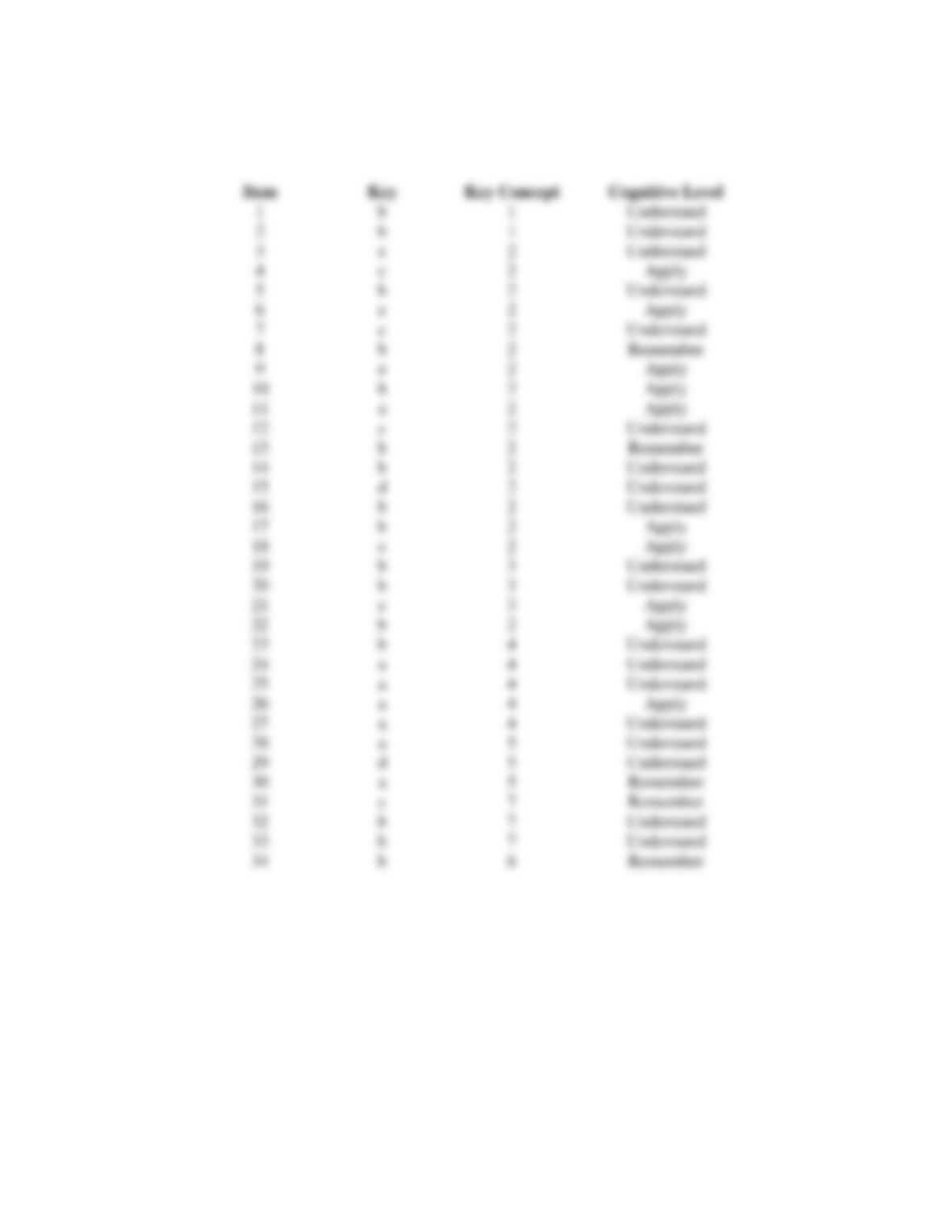
Answers and Classification of Items