Microeconomics, 4e (Hubbard/O’Brien)
Chapter 5 Externalities, Environmental Policy, and Public Goods
5.1 Externalities and Economic Efficiency
1) In 2011, New Jersey Governor Chris Christie announced that he would pull the state out of the
Regional Greenhouse Gas Initiative (RGGI), which is a coalition of 10 states that agreed to
reduce their emissions of carbon dioxide by 10 percent by 2018. RGGI is an example of
A) command and control.
B) cap-and-trade.
C) the greenhouse gas reduction initiative.
D) the zero pollution goal.
2) Some critics of the U.S. Environmental Protection Agency’s proposed NSPS air pollution
regulations which are designed to reduce carbon dioxide emissions argue that the policy will
A) significantly increase electric utility rates.
B) ultimately result in an increase in carbon dioxide emissions.
C) increase greenhouse gases in exchange for the reduction of carbon dioxide.
D) result in an increase in the consumption of fossil fuels.
3) Conceptually, the efficient level of carbon emissions is the level for which
A) the marginal benefit of reducing carbon emissions is maximized.
B) the marginal cost of reducing carbon emissions is minimized.
C) the marginal benefit of reducing carbon emissions is equal to the cost of reducing carbon
emissions.
D) the marginal benefit of reducing carbon emissions is minimized and the marginal cost of
reducing carbon emissions is maximized.
4) An externality is
A) a benefit realized by the purchaser of a good or service.
B) a cost paid for by the producer of a good or service.
C) a benefit or cost experienced by someone who is not a producer or consumer of a good or
service.
D) anything that is external or not relevant to the production of a good or service.
5) Which of the following is a source of market failure?
A) unforeseen circumstances which leads to the bankruptcy of many firms
B) a lack of government intervention in a market
C) incomplete property rights or inability to enforce property rights
D) an inequitable income distribution
6) What is a market failure?
A) It refers to the inability of the market to allocate resources efficiently up to the point where
marginal social benefit equals marginal social cost.
B) It refers to the inability of the market to allocate resources efficiently up to the point where
marginal social benefit equals marginal private cost.
C) It refers to a situation where an entire sector of the economy (for example, the airline
industry) collapses because of some unforeseen event.
D) It refers to a breakdown in a market economy because of widespread corruption in
government.
7) What are property rights?
A) the title to ownership of any physical asset
B) a legal document verifying ownership of intangible assets
C) the rights individuals or firms have to the exclusive use of their property, including the right
to buy or sell it
D) the right of the government to appropriate private assets for the good of society
8) Which of the following activities create a negative externality?
A) cleaning up the sidewalk on your block
B) graduating from college
C) repainting the house you live in to improve its appearance
D) keeping a junked car parked on your front lawn
9) A negative externality exists if
A) there are price controls in a market.
B) there are quantity controls in a market.
C) the marginal social cost of producing a good or service exceeds the private cost.
D) the marginal private cost of producing a good or service exceeds the social cost.
10) Which of the following represents the true economic cost of production when firms produce
goods that cause negative externalities?
A) the private cost of production
B) the social cost of production
C) the external cost of production
D) the explicit cost of production
11) Private costs
A) are borne by producers of a good while social costs are borne by government.
B) are borne by consumers of a good while social costs are borne by government.
C) are borne by producers of a good while social costs are borne by society at large.
D) are borne by producers of a good while social costs are borne by those who cannot afford to
purchase the good.
12) What is a “social cost” of production?
A) the cost of the natural resources used up in production
B) the total costs of producing a product, both implicit and explicit costs
C) the sum of all costs to individuals in society, regardless of whether the costs are borne by
those who produce the products or consume the product
D) the cost of the environmental damage created by production
13) If you burn your trash in the back yard in spite of regulations against it, then you are
A) acting economically irrationally and creating a social cost.
B) avoiding the private costs associated with disposing your trash some other way and creating a
social cost.
C) acting rationally and creating a positive externality.
D) saving landfill space and creating a social benefit.
14) Which of the following is an example of a positive externality?
A) banning the sale of candy in elementary schools
B) planting trees along a sidewalk which add beauty and creates shade
C) forbidding the use of cell phones in public
D) prohibit street parking in all residential neighborhoods
15) A positive externality causes
A) the marginal social benefit to be equal to the marginal private cost of the last unit produced.
B) the marginal social benefit to be less than the marginal private cost of the last unit produced.
C) the marginal social benefit to exceed the marginal private cost of the last unit produced.
D) the marginal private benefit to exceed the marginal social cost of the last unit produced.
16) When a negative externality exists, the private market produces
A) more than the economically efficient output level.
B) less than the economically efficient output level.
C) products at a low opportunity cost.
D) products at a high opportunity cost.
17) Mandatory motorcycle helmet laws are designed to reduce the severity of injuries resulting
from motorcycle involvement in traffic accidents. In this sense, these mandatory helmet laws are
reducing ________ of risky behavior.
A) positive externalities
B) negative externalities
C) the private benefit
D) the social benefit
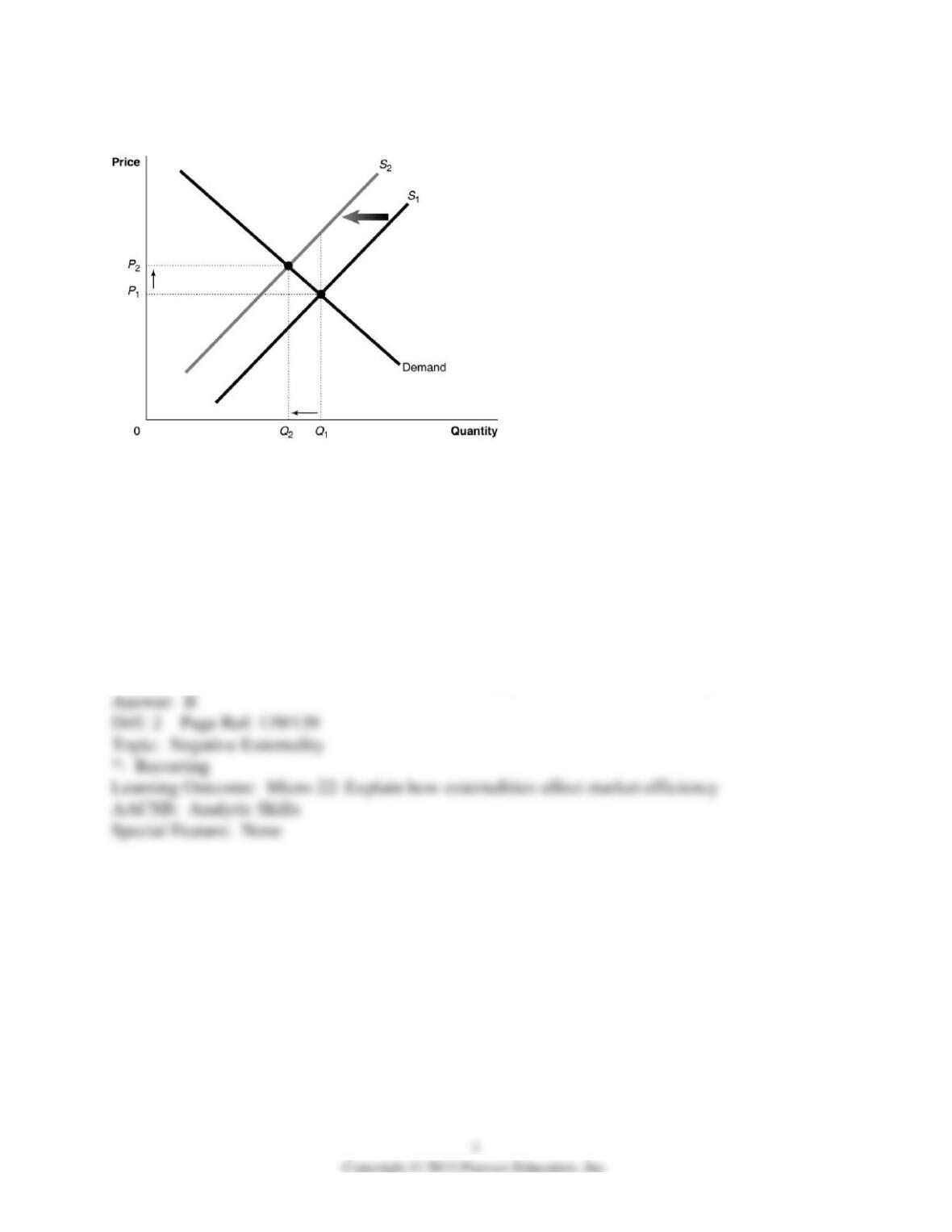
Figure 5-1
Figure 5-1 shows a market with an externality. The current market equilibrium output of Q1 is
not the economically efficient output. The economically efficient output is Q2.
18) Refer to Figure 5-1. Suppose the current market equilibrium output of Q1 is not the
economically efficient output because of an externality. The economically efficient output is Q2.
In that case, the diagram shows
A) the effect of a positive externality in the production of a good.
B) the effect of a negative externality in the production of a good.
C) the effect of an external cost imposed on a producer.
D) the effect of an external benefit such as a subsidy granted to consumers of a good.
19) Refer to Figure 5-1. If, because of an externality, the economically efficient output is Q2
and not the current equilibrium output of Q1, what does S1 represent?
A) the market supply curve reflecting external cost
B) the market supply curve reflecting implicit cost
C) the market supply curve reflecting social cost
D) the market supply curve reflecting private cost
20) Refer to Figure 5-1. If, because of an externality, the economically efficient output is Q2
and not the current equilibrium output of Q1, what does S2 represent?
A) the market supply curve reflecting private cost
B) the market supply curve reflecting social cost
C) the market supply curve reflecting external cost
D) the market supply curve reflecting implicit cost
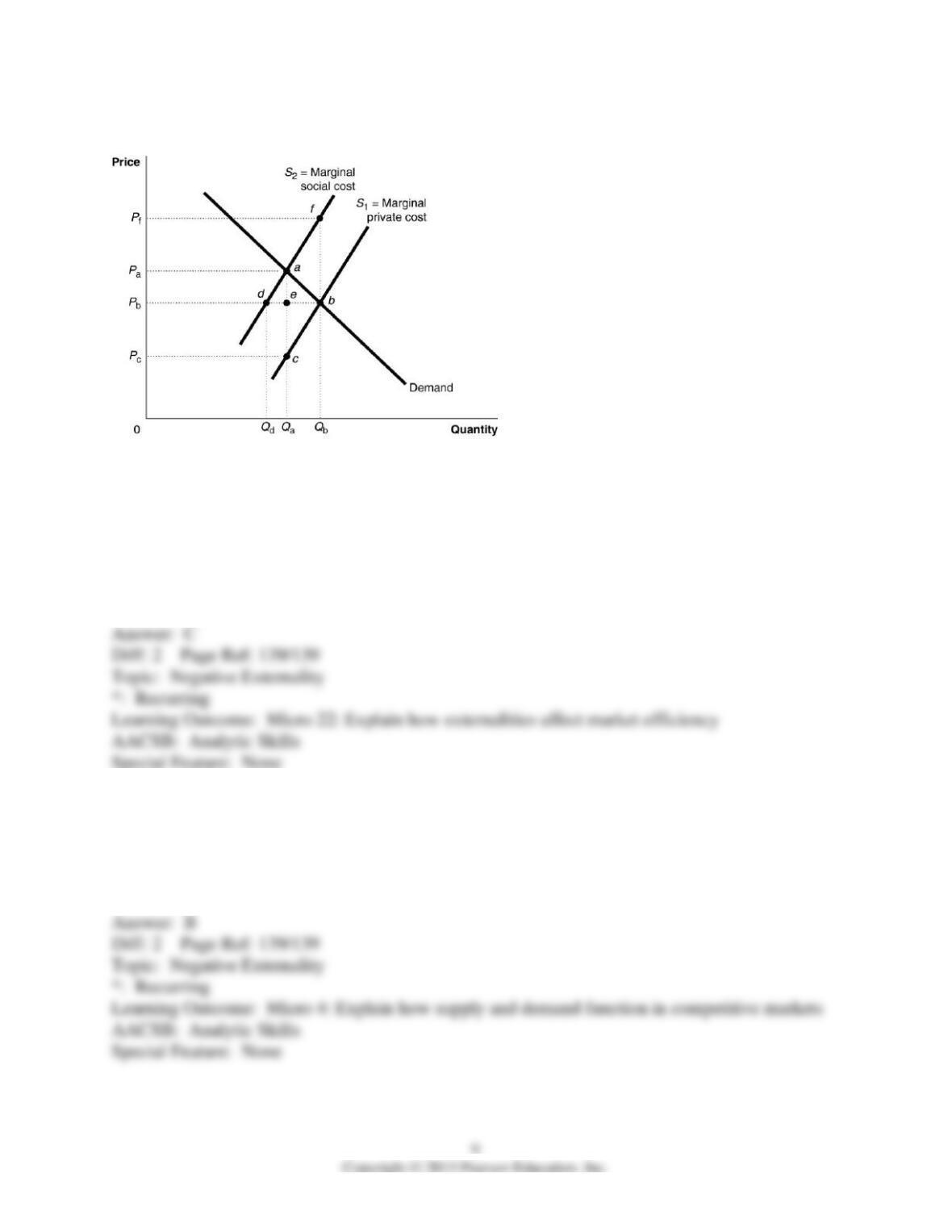
Figure 5-2
Figure 5-2 shows a market with a negative externality.
21) Refer to Figure 5-2. The efficient output level is
A) Qd.
B) Qb.
C) Qa.
D) Qb – Qd.
22) Refer to Figure 5-2. The private profit maximizing quantity for the firm is
A) Qa.
B) Qb.
C) Qb – Qd.
D) Qd.
23) Refer to Figure 5-2. The deadweight loss due to the externality is represented by the area
A) abc.
B) abf.
C) abd.
D) ade.
24) Refer to Figure 5-2. The size of marginal external costs can be determined by
A) S2 + S1 at each output level.
B) S2 – S1 at each output level.
C) the supply curve S2.
D) the supply curve S1.
25) Refer to Figure 5-2. The marginal benefit of the last unit produced is represented by the
price
A) Pa.
B) Pb.
C) Pc.
D) Pf.
26) Refer to Figure 5-2. The true marginal cost of the last unit produced is represented by the
price
A) Pa.
B) Pb.
C) Pc.
D) Pf.
27) A market supply curve reflects the
A) external costs of producing a good or service.
B) external benefits of producing a good or service.
C) social costs of producing a good or service.
D) private costs of producing a good or service.
28) Which of the following conditions holds in an economically efficient competitive market
equilibrium?
A) The deadweight loss is positive but at a minimum.
B) Producer and consumer surplus are exactly equal in size.
C) There are no positive and no negative external effects from consumption and production.
D) The marginal benefit of the last unit produced and consumed is maximized.
29) A market demand curve reflects the
A) private benefits of consuming a product.
B) external benefits of consuming a product.
C) social benefits of consuming a product.
D) the sum of private and social benefits of consuming a product.
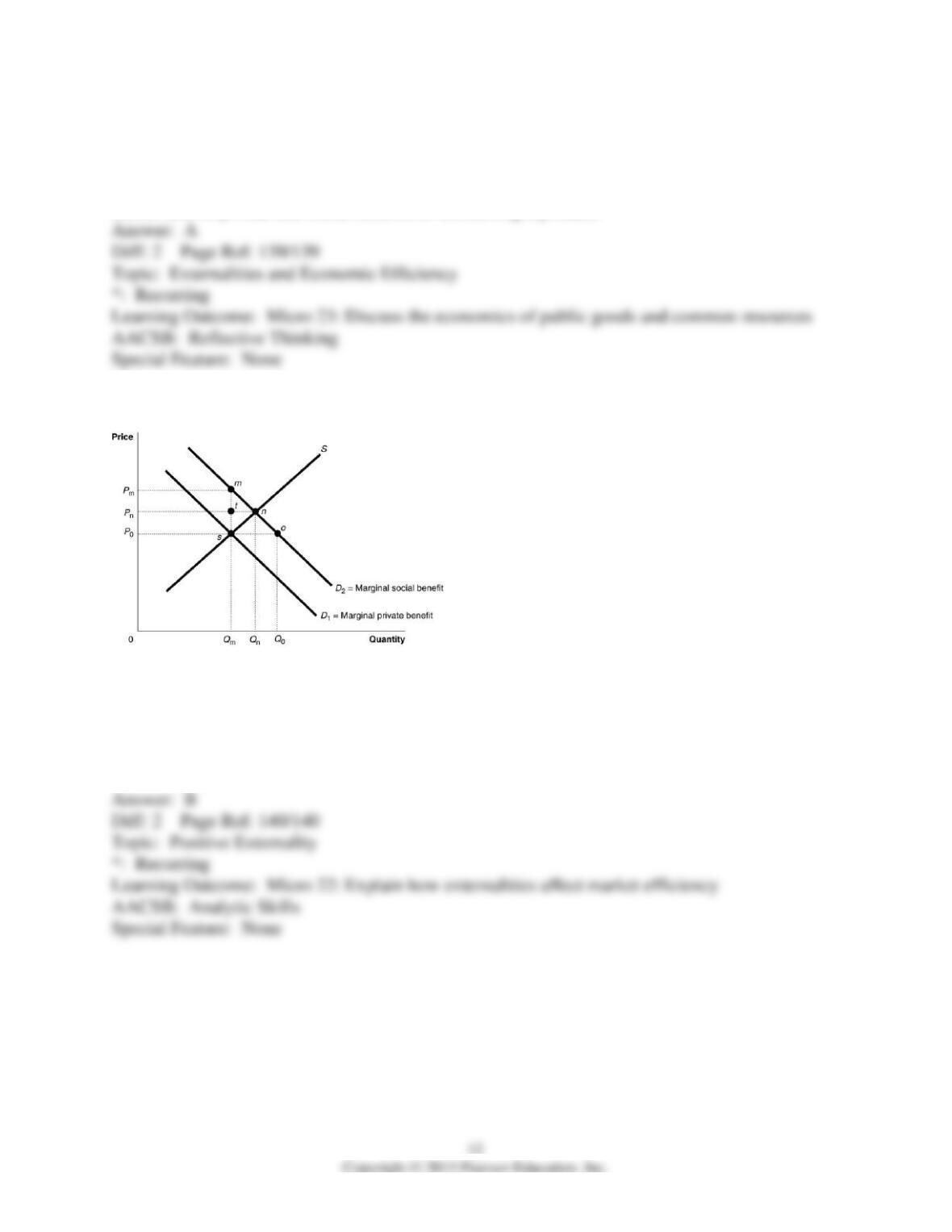
Figure 5-3
30) Refer to Figure 5-3. The efficient output level is
A) Qm.
B) Qn.
C) Qo.
D) Qo – Qm.
31) Refer to Figure 5-3. The private profit maximizing output level is
A) Qm.
B) Qn.
C) Qo.
D) Qo – Qm.
32) Refer to Figure 5-3. The size of marginal external benefits can be determined by
A) the demand curve D2.
B) D2 + D1 at each output level
C) D2 – D1 at each output level.
D) the demand curve D1.
33) Refer to Figure 5-3. In the absence of any government intervention, the private market
A) under produces by Qo – Qm units.
B) over produces by Qo – Qm units.
C) over produces by Qn – Qm units.
D) under produces by Qn – Qm units.
34) Refer to Figure 5-3. The deadweight loss due to the externality is represented by the area
A) mso.
B) msn.
C) nso.
D) mtn.
35) Refer to Figure 5-3. At the competitive market equilibrium, for the last unit produced,
A) the size of the external cost is Pm – Po.
B) the size of the external benefit is Pm – Po.
C) the size of the external cost is Pn – Po.
D) the size of the external benefit is Pn – Po.
36) An externality refers to economic events outside a market.
37) The private cost of a good or service is the cost borne by the producer.
38) A market failure arises when an entire sector of the economy (for example, the airline
industry) collapses because of some unforeseen event.
39) When there is a positive externality in a free market, too much of the good is produced and
consumed.
40) When there is a negative externality, the competitive output is more than the economically
efficient output level.
41) What is an externality?
42) What is a private cost of production? What is a social cost of production? When is the private
cost of production equal to the social cost of production?
43) How does a negative externality in production reduce economic efficiency?
44) Explain how mandatory seat belt laws may reduce the negative externalities of risky
behavior.
5.2 Private Solutions to Externalities: The Coase Theorem
1) In economics, the optimal level of pollution is
A) zero.
B) the level for which the total benefit from reducing the pollution is the greatest.
C) the level for which the marginal benefit from reducing the pollution is the greatest.
D) the level for which the net benefit from reducing the pollution is the greatest.
2) Economists argue that the level of pollution should be
A) reduced completely to zero because by definition, it is a negative external effect.
B) ignored because it has always been present since the beginning of history.
C) reduced to the point where the marginal benefit of pollution reduction is equal to the marginal
cost of pollution reduction to society.
D) best determined by elected officials who can speak on behalf of the public.
3) Because producers do not bear the external cost of pollution
A) the economically efficient level of production is achieved.
B) private production is below the economically efficient level.
C) private production exceeds the economically efficient level.
D) the market price is too high.
4) If there is pollution in producing a product, then the market equilibrium price
A) is too high and equilibrium quantity is too low.
B) and equilibrium quantity are too low.
C) and equilibrium quantity are too high.
D) is too low and equilibrium quantity is too high.
Figure 5-4
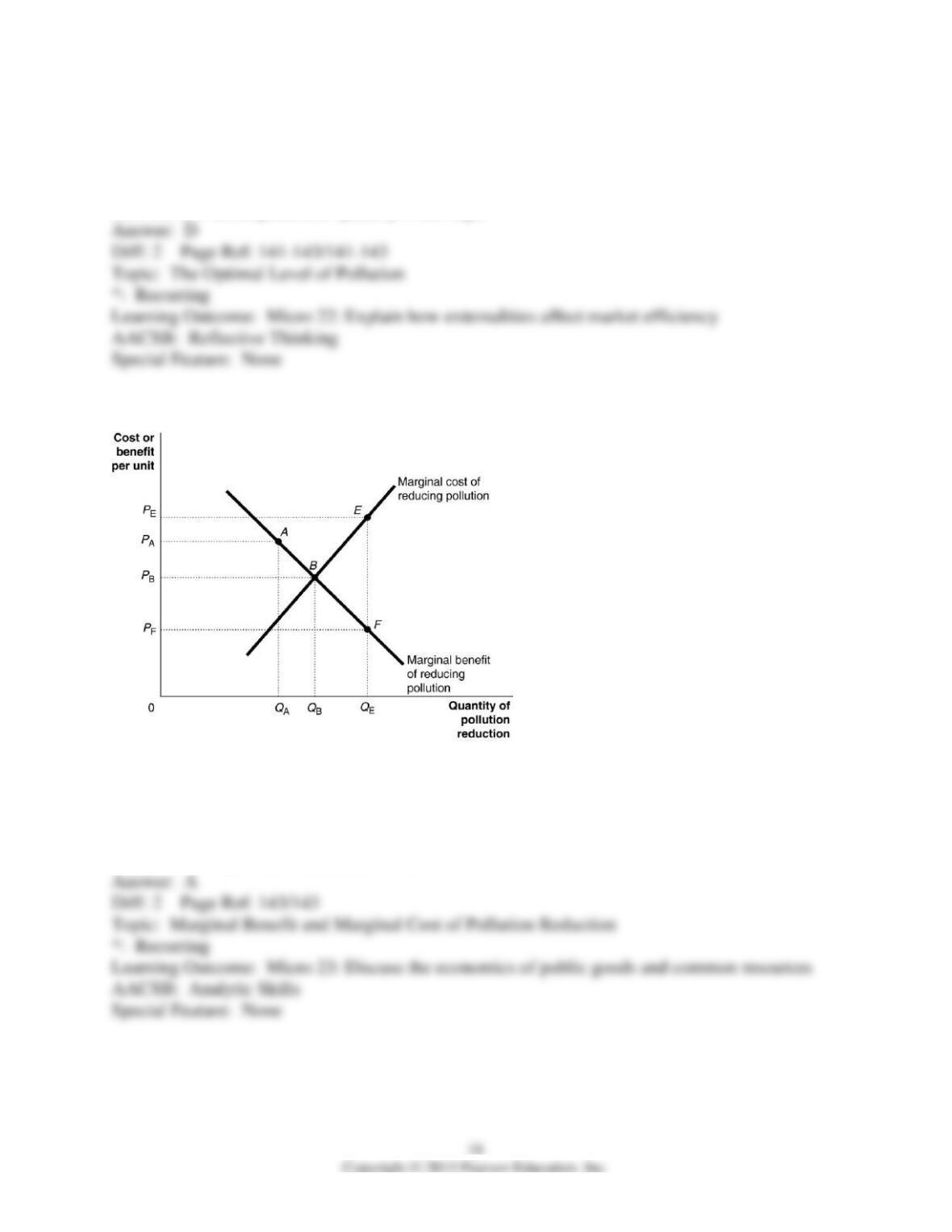
5) Refer to Figure 5-4. The marginal cost of reducing pollution curve is the same curve as
A) the supply of pollution reduction curve.
B) the demand for pollution reduction curve.
C) the negative externality curve.
D) the value of pollution reduction curve.
6) Refer to Figure 5-4. The marginal benefit of reducing pollution curve is the same curve as
A) the supply of pollution reduction curve.
B) the demand for pollution reduction curve.
C) the positive externality curve.
D) the external benefit curve.
7) Refer to Figure 5-4. What is the incremental cost of increasing the quantity of pollution
reduction from QB to QE units?
A) PE
B) the value of the area QBBEQE
C) PE × QE
D) the value of the area BEF
8) Refer to Figure 5-4. What is the incremental benefit of increasing the quantity of pollution
reduction from QB to QE units?
A) PF
B) PF × QE
C) the value of the area BEF
D) the value of the area QBBFQE
9) Refer to Figure 5-4. Which of the following statements is true?
A) At QE the benefits of reducing pollution outweighs the cost of pollution reduction.
B) At QB society is under allocating resources to pollution reduction.
C) The optimal quantity of pollution reduction is QB.
D) The optimal quantity of pollution reduction is QE.
10) The Coase theorem states that
A) government intervention is always needed if externalities are present.
B) assigning property rights is the only thing the government should do in a market economy.
C) if transactions costs are low, private bargaining will result in an efficient solution to the
problem of externalities.
D) a free market equilibrium is the best solution to address externalities.
11) According to ________, in a market with an externality, private parties would voluntarily
negotiate an efficient outcome without government intervention.
A) A. C. Pigou
B) Adam Smith
C) Ronald Coase
D) John Maynard Keynes