
Chemistry, 7e (McMurry/Fay)
Chapter 5 Periodicity and the Electronic Structure of Atoms
5.1 Multiple-Choice Questions
1) Arrange the following spectral regions in order of increasing wavelength:
infrared, microwave, ultraviolet, visible.
A) microwave < infrared < visible < ultraviolet
B) microwave < visible < infrared < ultraviolet
C) ultraviolet < infrared < visible < microwave
D) ultraviolet < visible < infrared < microwave
2) The greater the energy of a photon, the
A) longer the wavelength and the higher the frequency.
B) longer the wavelength and the lower the frequency.
C) shorter the wavelength and the higher the frequency.
D) shorter the wavelength and the lower the frequency.
3) Arrange the following spectral regions in order of increasing energy:
infrared, microwave, ultraviolet, visible.
A) microwave < infrared < visible < ultraviolet
B) microwave < visible < infrared < ultraviolet
C) ultraviolet < infrared < visible < microwave
D) ultraviolet < visible < infrared < microwave

2
4) What is the frequency of a helium-neon laser light with a wavelength of 632.8 nm? The speed of light is
3.00 × 10⁸ m/s.
A) 4.74 × 10¹⁴ s-1
B) 4.74 × 10⁵ s-1
C) 2.11 × 10⁻¹⁵ s-1
D) 1.58 × 10⁻¹⁵ s-1
5) Photochemists use electromagnetic radiation to initiate chemical reactions, often by providing the
energy required to break bonds within a molecule. Lowering which of the following will result in
electromagnetic radiation having more energy per photon?
A) amplitude
B) frequency
C) intensity
D) wavelength
6) Light can be made to have a higher intensity by raising its
A) amplitude.
B) energy.
C) frequency.
D) wavelength.
7) What is a quantum of light called?
A) the amplitude
B) the frequency
C) a photon
D) the wavelength
8) A quantized variable
A) can be continuously varied.
B) can only assume certain values.
C) consists of photons.
D) is extremely small.
9) Which of the following is not quantized?
A) the charge on a monatomic ion
B) the distance between two objects
C) the population of the United States
D) the static charge on a balloon rubbed with wool
10) The intensity of a beam of light is related to its
A) frequency.
B) relative number of photons.
C) speed.
D) wavelength.
11) According to the Balmer-Rydberg equation, electromagnetic radiation with the shortest wavelength
will be emitted when an electron undergoes which of the following transitions?
A) m = 1 → n = 2
B) m = 2 → n = 3
C) n = 2 → m = 1
D) n = 3 → m = 2
4
12) According to the Balmer-Rydberg equation, electromagnetic radiation with wavelength λ = 486.1 nm
will be absorbed when an electron undergoes which of the following transitions?
A) m = 2 → n = 3
B) m = 2 → n = 4
C) n = 3 → m = 2
D) n = 4 → m = 2
13) According to the Balmer-Rydberg equation, which transition results in the emission of a photon in the
ultraviolet region of the electromagnetic radiation spectrum?
A) m = 1 → n = 2
B) m = 3 → n = 4
C) m = 2 → n = 1
D) m = 4 → n = 3
14) According to the Balmer-Rydberg equation, the transition from n = 6 to m = 2 results in a spectral line
having which color?
A) blue
B) blue-green
C) indigo
D) red
15) The Balmer-Rydberg equation can be extended to ions with only one electron, such as He+. In that
case it has the form: 1/λ = Z2R(1/m2 – 1/n2), where Z is the atomic number. What is the energy of the
photon required to promote an electron in He+ from a 1s orbital to a 2p orbital?
A) (3/4)hcR
B) 3hcR
C) 4hcR
D) 12hcR
16) What is the first ionization energy for a hydrogen atom in the ground state? The Rydberg constant is
.
A) 7.27 × 10–36 J
B) 1.63 × 10⁻²⁷ J
C) 2.18 × 10⁻¹⁸ J
D) 0.00823 J
17) For hydrogen, what is the wavelength of the photon emitted when an electron drops from a 3d orbital
to a 2p orbital in a hydrogen atom? The Rydberg constant is 1.097 × 10⁻² nm-1.
A) 656.3 nm
B) 486.2 nm
C) 364.6 nm
D) 2.057 × 10⁻³ nm
18) Molecular vibrational energy transitions are observed in the infrared, molecular rotational transitions
in the microwave, and electronic transitions in the ultraviolet–visible range. Which transitions require the
most energy and which the least energy?
A) Electronic transitions require the least energy and vibrational transitions the most.
B) Rotational transitions require the least energy and electronic transitions the most.
C) Vibrational transitions require the least energy and electronic transitions the most.
D) Vibrational transitions require the least energy and rotational transitions the most.
19) The absorption of light of frequency 1.16 × 10¹¹ Hz is required for CO molecules to go from the lowest
rotational energy level to the next highest rotational energy level. Determine the energy for this transition
in kJ/mol. (h = 6.626 × 10⁻³⁴ J ∙ s)
A) 7.69 × 10⁻²³ kJ/mol
B) 0.0463 kJ/mol
C) 46.3 kJ/mol
D) 949 kJ/mol
20) The absorption of a photon of wavelength 4.67 × 10⁻⁶ m is necessary for a CO molecule to pass from
the lowest vibrational energy level to the next highest vibrational level. If this higher vibrational level has
an energy of 6.41 × 10⁻²⁰ J, what is the energy of the lowest vibrational level? (h = 6.626 × 10⁻³⁴ J ∙ s)
A) 1.60 × 10⁻²⁰ J
B) 2.15 × 10⁻²⁰ J
C) 3.20 × 10⁻²⁰ J
D) 4.26 × 10⁻²⁰ J
21) The four lines observed in the visible emission spectrum of hydrogen tell us that
A) The hydrogen molecules they came from have the formula H4.
B) We could observe more lines if we had a stronger prism.
C) There are four electrons in an excited hydrogen atom.
D) Only certain energies are allowed for the electron in a hydrogen atom.
22) According to the Bohr model, when a hydrogen electron makes a transition from n=4 to n=2, which of
the following statements is true?
I. Energy is emitted.
II. Energy is absorbed.
III. Electrons lose energy.
IV. Electrons gain energy.
A) I only
B) I and III
C) I and IV
D) II and IV
23) What is the de Broglie wavelength of an electron (m = 9.11 × 10⁻³¹ kg) moving at a velocity of
(10% of the speed of light)?
A) less than 3.9 × 10⁻¹² m
B) 2.4 × 10⁻¹¹ m
C) 3.3 × 10⁻⁸ m
D) greater than 1.1 × 10⁻⁴ m
24) An old copper penny has a mass 3 × 10²² times that of a copper atom. Compare the de Broglie
wavelength of a penny moving at 0.5 m/s to that of a copper atom moving 104 times as fast. The
wavelength for the
A) copper atom is 3 × 10¹⁸ times that of the penny.
B) copper atom is 3 × 1026 times that of the penny.
C) penny is 3 × 10¹⁸ times that of the copper atom.
D) penny is 3 × 1026 times that of the copper atom.
25) The wave characteristics of a large, moving object, such as an automobile, are difficult to observe
because the
A) energy is not quantized.
B) energy is quantized, but the spacing between energy levels is small.
C) wavelength is very large.
D) wavelength is very small.
26) From the following list of observations, choose the one that most clearly supports the following
conclusion by de Broglie: “Electrons have wave properties.”
A) Line emission spectrum of hydrogen
B) The photoelectric effect
C) Xray diffraction
D) Sodium chloride produces sodium solid and chlorine gas
27) Which of the following is not true?
A) All moving objects have wave characteristics.
B) For objects moving at a given speed, the larger the mass, the shorter the wavelength.
C) The de Broglie relation and the Heisenberg uncertainty principle apply only to small particles.
D) The Heisenberg uncertainty principle is an inequality.
28) According to the Heisenberg uncertainty principle,
A) the position of a particle cannot be measured precisely.
B) the momentum of a particle cannot be measured precisely.
C) neither the position nor the momentum of a particle can be measured precisely.
D) the position and momentum of a particle can be measured precisely, but not at the same time.
29) A baseball with a mass of 150 g is moving at a velocity of 40 m/s (90 mph). If the uncertainty in the
velocity is 0.1 m/s, the uncertainty in position
A) may be zero.
B) must be less than or equal to 4 × 10–33 m.
C) must be 4 × 10–33 m.
D) must be greater than or equal to 4 × 10–33 m.
30) An oxygen molecule has a mass of 5.3 × 10⁻²⁶ kg and an approximate diameter of 3.6 × 10⁻¹⁰ m. If the
molecule is moving at 400 m/s (1000 mph) with an uncertainty in velocity of 1 m/s, the uncertainty in
position
A) is less than or equal to 5 × 10–26 m.
B) must be equal to 5 × 10–26 m.
C) must be equal to 1 × 10⁻⁹ m.
D) is greater than or equal to 1 × 10⁻⁹ m.
31) Which of the following is true?
A) The Bohr atom is the model currently accepted for electrons in atoms.
B) Electrons travel around the nucleus in circular orbits.
C) There is a 5% chance of finding an electron in an atom outside its orbital.
D) The square of the wave function gives the probability of finding the electron.
32) For an electron in a given atom, the larger n, the
A) larger the average distance from the nucleus and the higher the orbital energy.
B) larger the average distance from the nucleus and the lower the orbital energy.
C) smaller the average distance from the nucleus and the higher the orbital energy.
D) smaller the average distance from the nucleus and the lower the orbital energy.
33) What are the possible values of l if n = 5?
A) 5
B) 0, 1, 2, 3, or 4
C) -4, -3, -2, -1, 0, +1, +2, +3, or +4
D) -5, -4, –3, -2, -1, 0, +1, +2, +3, +4, or +5
34) How many subshells are there in the shell with n = 6?
A) 5
B) 6
C) 15
D) 36
35) The subshell designations follow the alphabet after f. What is the first shell in which an h orbital
would be allowed?
A) fifth
B) sixth
C) seventh
D) eighth
36) How many h orbitals are allowed in a given shell?
A) 5
B) 6
C) 11
D) 13

11
37) The number of orbitals in a given subshell, such as the 5d subshell, is determined by the number of
possible values of
A) n.
B) l.
C) ml.
D) ms.
38) What are the possible values of n and ml for an electron in a 6d orbital?
A) n = 1, 2, 3, 4, or 5 and ml = 2
B) n = 1, 2, 3, 4, or 5 and ml = -2, -1, 0, +1, or +2
C) n = 6 and ml = 2
D) n = 6 and ml = -2, -1, 0, +1, or +2
39) How many orbitals are there in the seventh shell?
A) 6
B) 7
C) 21
D) 49
40) How many electrons can a single orbital hold?
A) 2n
B) 2
C) 2l + 1
D) 8
41) The first vibrational level for NaH lies at 1.154 × 10⁻²⁰ J and the second vibrational level lies at
What is the frequency of the photon emitted when a molecule of NaH drops from the
second vibrational level to the first vibrational level?
A) 1.742 × 10¹³ Hz
B) 3.399 × 10¹³ Hz
C) 5.140 × 10¹³ Hz
D) 6.882 × 10¹³ Hz
42) Which orbitals have two nodal planes passing through the nucleus?
A) s
B) p
C) d
D) all in the third shell
43) For an orbital, a node is
A) the midpoint of the orbital.
B) a surface inside which there is a 90% chance of finding the electron.
C) a surface where there is a maximum probability of finding the electron.
D) a surface where there is no chance of finding the electron.
44) Which of the following is true? The probability density
A) for all s orbitals is independent of direction from the nucleus.
B) for all s orbitals is independent of distance from the nucleus.
C) is independent of direction from the nucleus for 1s orbitals only.
D) is independent of distance from the nucleus for 1s orbitals only.
45) If the quantum number ms had possible values +1/2, -1/2, what would be the maximum number of
electrons that be placed in a single orbital?
A) one
B) two
C) three
D) four
46) Which statement is false?
A) For any atom, the 4s orbital lies lower in energy than the 5s orbital.
B) For a hydrogen atom, a 4s orbital, a 4p orbital, and a 4d orbital all have the same energy.
C) The 4s orbital lies lower in energy than the 3d orbital for atoms K, Ca, Sc, and Ti.
D) The 4s orbital lies lower in energy than the 3d orbital for Cu and Fe2+.
47) Within a given shell of a multielectron atom, the lower l for an orbital, the
A) higher the orbital energy and the higher Zeff for the electron.
B) higher the orbital energy and the lower Zeff for the electron.
C) lower the orbital energy and the higher Zeff for the electron.
D) lower the orbital energy and the lower Zeff for the electron.
48) For a multielectron atom, a 3s orbital lies lower in energy than a 3p orbital because
A) a 3p orbital has more nodal surfaces than a 3s orbital.
B) other electrons more effectively shield electrons in the 3s orbital from the nucleus.
C) other electrons more effectively shield electrons in the 3p orbital from the nucleus.
D) there are more p orbitals than s orbitals in a given shell.
49) Which has the highest Zeff for its valence electrons?
A) Na
B) Mg
C) Si
D) Cl
50) The symbol [Kr] represents
A) 4s24p6.
B) 1s22s22p63s23p64s24p6.
C) 1s22s22p63s23p63d104s24p6.
D) 1s22s22p63s23p63d104s24p64d10.
51) An element in a ground state electron configuration has 4 electrons in the 4p orbitals. Which of the
following statements can not describe the electron configurations in this atom?
A) At least one electron has an orbital angular momentum (l) of 2.
B) Six electrons are in the n=4 shell.
C) The valence electron configuration is identical to carbon.
D) No electrons have an orbital angular momentum (l) of 3.3.
52) Molybdenum has an anomalous electron configuration. Write the electron configuration of Mo using
shorthand notation.
A) [Kr] 5s0 4d6
B) [Kr] 5s0 4d0 5p6
C) [Kr] 5s1 4d5
D) [Kr] 5s2 4d4
53) What is the general valence-electron ground-state electron configuration for neutral halogens?
A) ns1
B) ns2np7
C) 1s22s22p7
D) 1s22s23p7
54) What is the ground-state electron configuration of tellurium?
A) [Kr]4d105s25p4
B) [Kr]5s25p65d8
C) [Kr]5s25p4
D) [Kr]4f144d105s25p4
55) Which element has the ground-state electron configuration [Xe]6s25f4?
A) Pr
B) Nd
C) Pm
D) Sm
56) List all the elements that have a ground-state configuration with five unpaired electrons in the 3d
subshell.
A) Mn, Fe, Co, Cu, and Zn
B) Cr and Mn
C) Cr
D) Mn
57) Which of the following elements will have unpaired electrons in the ground state?
Ca, Li, C, F
A) Ca, Li, C, and F
B) Li, C, and F
C) Li and F
D) C and F
58) Rank the following elements in order of increasing effective nuclear charge: Na, Mg, Cl, and S.
A) S < Cl < Mg < Na
B) Cl < Mg < Na < S
C) Mg < Na < Cl < S
D) Na < Mg < Cl < S
Two electromagnetic waves are represented below.
59) Wave (a) has the
A) longer wavelength and higher energy than wave (b).
B) longer wavelength and lower energy than wave (b).
C) shorter wavelength and higher energy than wave (b).
D) shorter wavelength and lower energy than wave (b).
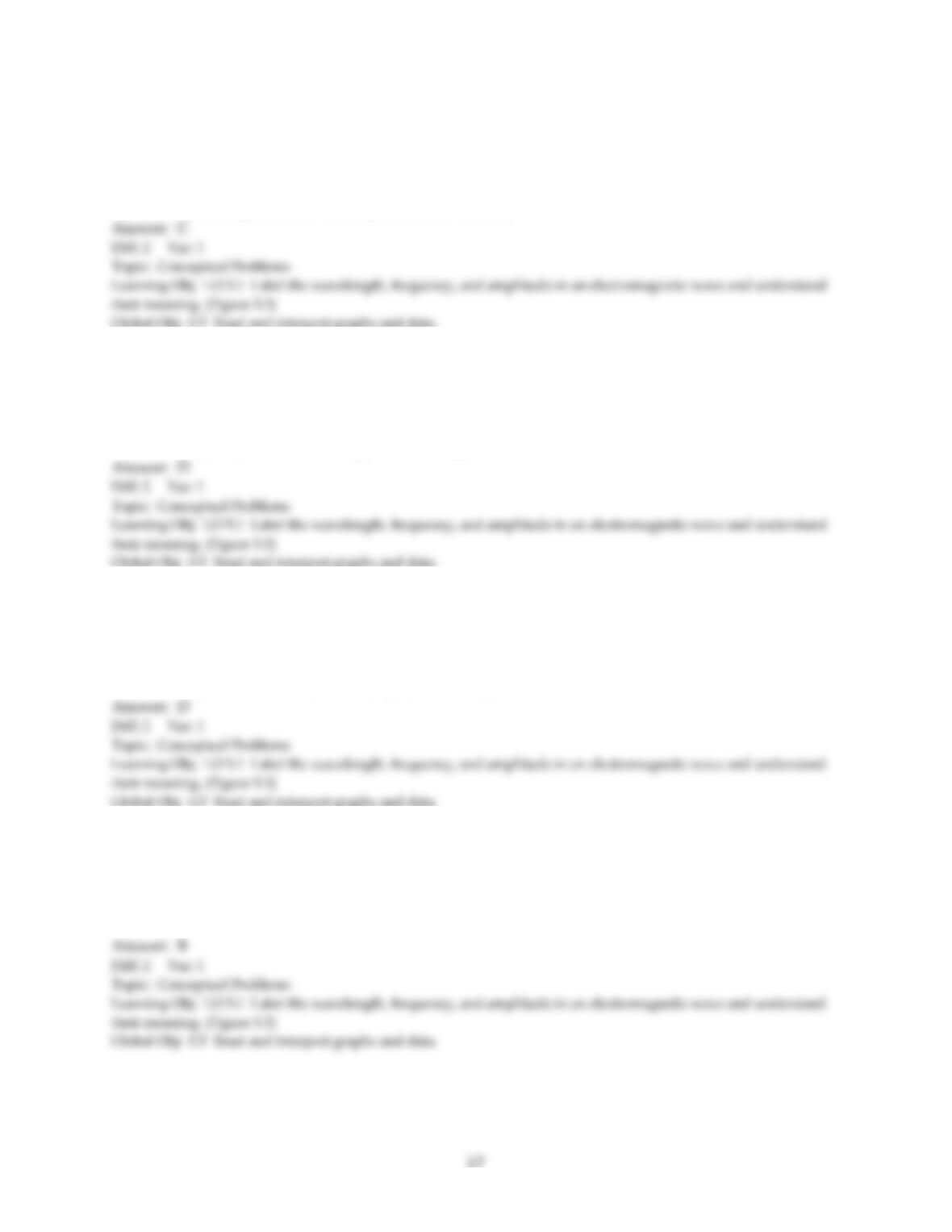
60) Wave (a) has the
A) longer wavelength and higher frequency than wave (b).
B) longer wavelength and lower frequency than wave (b).
C) shorter wavelength and higher frequency than wave (b).
D) shorter wavelength and lower frequency than wave (b).
61) Wave (b) has the
A) higher frequency and higher energy than wave (a).
B) higher frequency and lower energy than wave (a).
C) lower frequency and higher energy than wave (a).
D) lower frequency and lower energy than wave (a).
62) Wave (b) has the
A) higher amplitude and greater intensity than wave (a).
B) higher amplitude and weaker intensity than wave (a).
C) lower amplitude and greater intensity than wave (a).
D) lower amplitude and weaker intensity than wave (a).
63) If wave (a) represents green light, wave (b) might represent
A) blue light.
B) red light.
C) ultraviolet radiation.
D) X-rays.
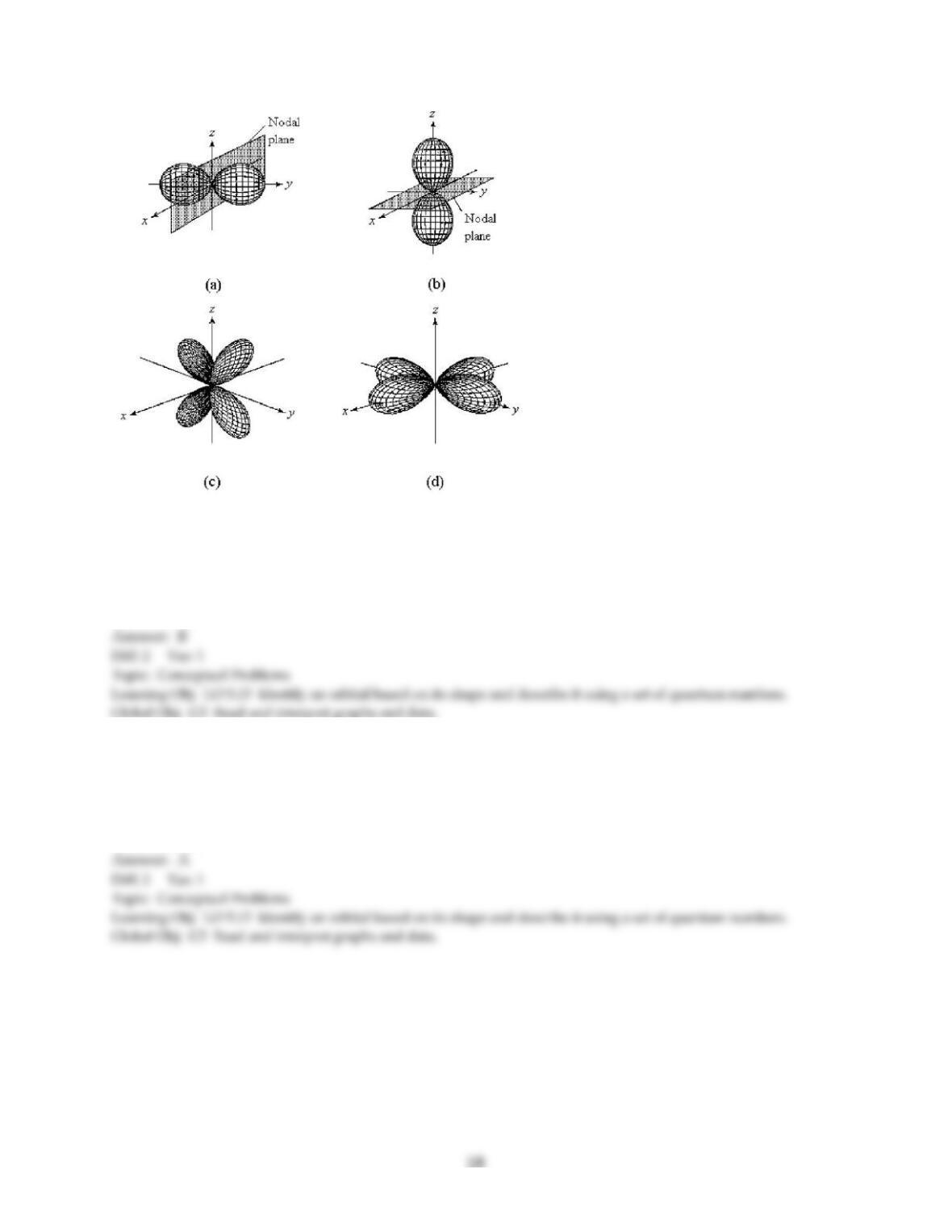
64) Which of the above fourth-shell orbitals is a 4pz orbital?
A) orbital (a)
B) orbital (b)
C) orbital (c)
D) orbital (d)
65) Which of the above fourth-shell orbitals is a 4py orbital?
A) orbital (a)
B) orbital (b)
C) orbital (c)
D) orbital (d)
66) Which of the above fourth-shell orbitals is a 4dx2-y2 orbital?
A) orbital (a)
B) orbital (b)
C) orbital (c)
D) orbital (d)
67) Which of the above fourth-shell orbitals is a 4dyz orbital?
A) orbital (a)
B) orbital (b)
C) orbital (c)
D) orbital (d)
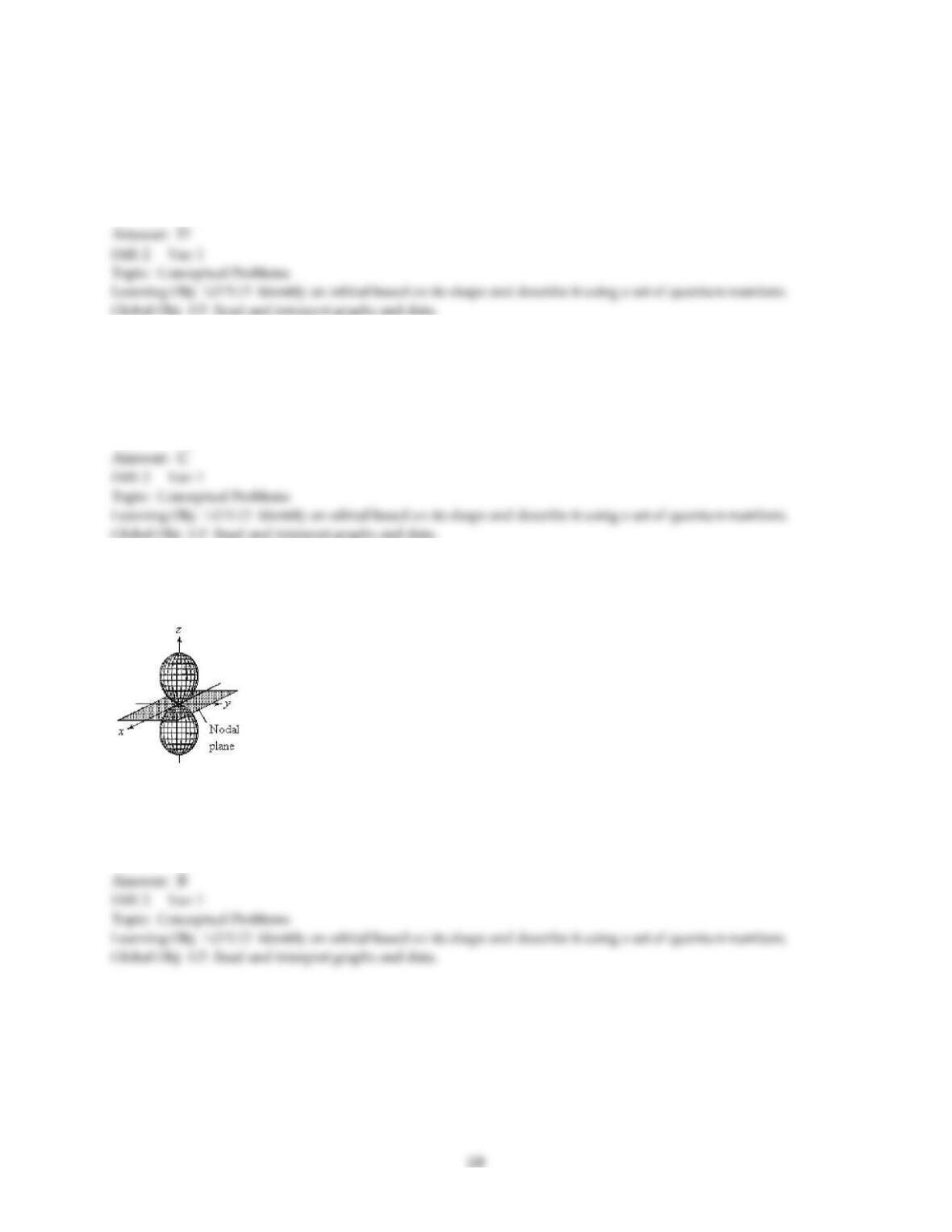
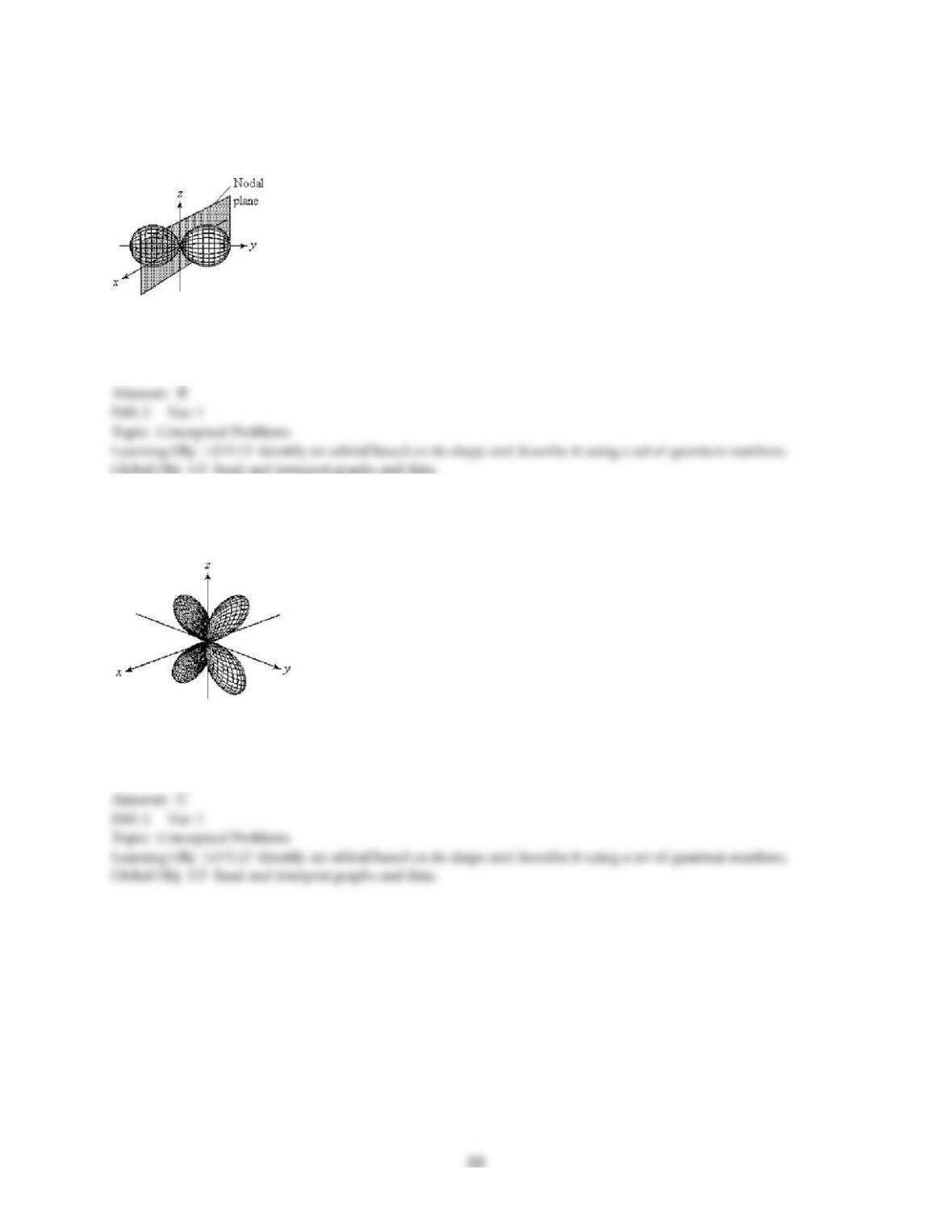
68) For the fourth-shell orbital shown below, what are the principal quantum number, n, and the angular
momentum quantum number, l?
A) n = 4 and l = 0
B) n = 4 and l = 1
C) n = 4 and l = 2
D) n = 4 and l = 3
69) For the fourth-shell orbital shown below, what are the principal quantum number, n, and the angular
momentum quantum number, l?
A) n = 4 and l = 0
B) n = 4 and l = 1
C) n = 4 and l = 2
D) n = 4 and l = 3
70) For the fourth-shell orbital shown below, what are the principal quantum number, n, and the angular
momentum quantum number, l?
A) n = 4 and l = 0
B) n = 4 and l = 1
C) n = 4 and l = 2
D) n = 4 and l = 3