
ch5 Key
1. Activity-Based Costing evaluates the costs and values of process activities to identify opportunities for
improved efficiency.
2. By itself, Activity–Based Costing does not result in the process improvements that might be necessary to
achieve desired efficiencies.
3. Target cost is the highest cost of a good or service that meets both customer needs and company profit goals.
4. Target cost is the selling price assigned to a product or service that allows the company to achieve a desired
gross profit level.

5. A currently feasible cost is the cost of all current operations necessary to produce and deliver a product
6. Non-value-added activities do not contribute to customer perceived value.
7. Value-added activities enhance the value of production and services in the eyes of management while
meeting the goals of the organization.
8. Producing units to build up inventory for future sales is a value-added activity.
9. Waiting time for processing is a source of non-value-added activity.

10. Processing payments from customers at Bell Atlantic is a value-added activity.
11. Transporting workers to work sites is an example of a value-added activity.
12. In general, approval processes tend to be non-value added.
13. Simply eliminating non-value-added activities without redesigning processes is unlikely to result in
long–term benefits.
14. Setting-up machines to run a new production order for a customer is a value-added activity.

15. The first question to ask in deciding whether an activity adds customer value is how the organization should
measure its value–added activities.
16. Generally, all of a company’s customers will have the same responses when identify activities they consider
value-added.
17. The best approach to identifying a company’s value-added activities is to use cross-functional teams.
18. If an external customer would encourage an organization to do more of an activity, the activity would be
classified as a value-added activity.

19. Rewriting faulty software code is an example of a value-added activity.
20. A test for determining whether an activity is value-added is to ask whether profits will increase because of
that activity.
21. A bar-coding system creates a unique bar code for each order and allows a company to mark and track
orders electronically.
22. Bar-coding systems tend to increase non-value added recording time.
23. With effective application of Activity Based Management, it is possible to eliminate all non-value-added
activities.

24. Unused capacity is the difference between resources supplied in an organization and resources used.
25. Conventional management reports do not typically distinguish between resources used and resources
supplied.
26. Under Activity-Based-Costing, unit–level costing measures the impact of the use of resources by various
products.
27. Under Activity-Based-Costing, unit–level costing measures the impact of various products on spending for
resources.
28. If a company operates at less than full capacity, facility-level costs will have unused resources.
29. Financial accounting reports generally focus on resources used by various parts of the organization.
30. Activity-Based-Management is concerned with identifying opportunities for improving processes.
31. Activity-Based-Management techniques are simple to implement.
32. Companies with multiple complex products are more likely to benefit from Activity–Based–Management
than companies producing a single product.
33. A pilot program is an activity–based–management program employed to train pilots at major airlines.
34. A pilot project is a project of limited-scope intended to be a small-scale of a system-wide project.
35. Not all organizations may need improved product or service costs, but most organizations could benefit
from process improvements.
36. Top managers in an organization should be responsible for analyzing the data gathered in an
activity-based–management study.
37. Measuring the costs of current process activities involves five steps. Which of the following is the first
step?
38. Measuring the costs of current process activities involves five steps. Which of the following is the last
step?
39. Which of the following is not a step in Activity-based management?
40. Which of the following would be the first step in Activity–based management?
41. Which of the following is a value-added activity?
42. Which of the following is not a value-added activity.
43. Which of the following is an example of a non-value added activity?
44. Which of the following statements is true?
45. Which of the following statements is False?
46. Which of the following is not a value-added activity?
47. Which of the following would be a non-value-added activity in the payroll department of a large computer
manufacturer?
48. Which of the following is a value-added activity in the claims division of a large insurance company?
49. Which of the following is not a planning issue in Activity-Based-Management?
50. Which of the following statements is True regarding activity-based-costing and profitability analysis?
51. Which of the following would not be important to the successful implementation of activity-based costing
and management in a large organization?
52. Which of the following statements is false?
53. Which of the following companies would benefit least from Activity-Based-Costing?
54. Which of the following is not a resource necessary to successful implementation of Activity-Based
Management?
55. Which of the following statements is False about recommended changes in the implementation of Activity–
Based-Management?
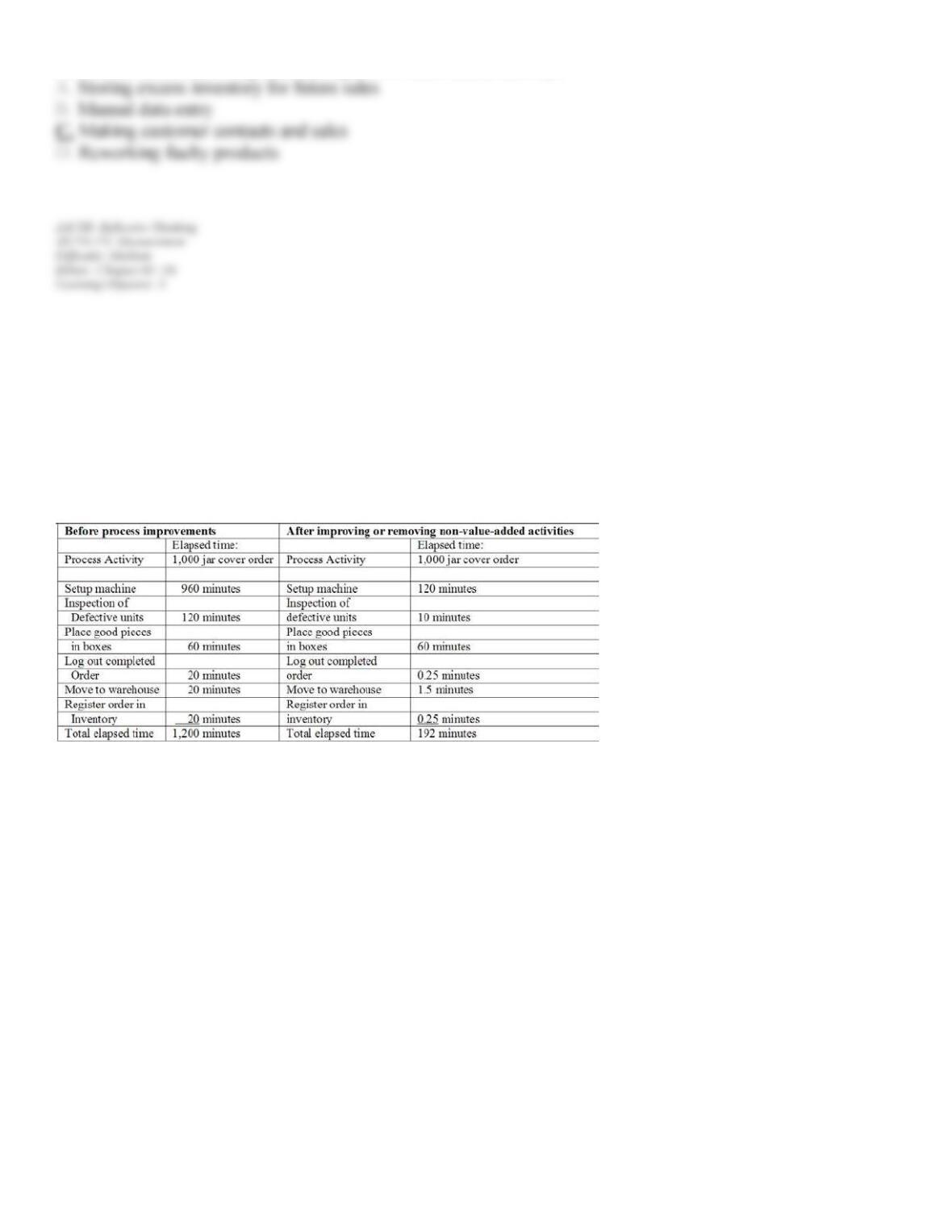
56. Which of the following is an example of a value-added-activity?
Use the following to Ans questions 57-60:
Stow Machining is a compression-molding plastics company that specializes in high priced jar covers for the
cosmetics industry. Because appearance is so important, customers can reject covers even for minor blemishes
that do not affect the cover’s function. Therefore, preventing dust and contamination in the molding process is
an ongoing problem for the company. Each order requires a machine setup that can be complex. The company
recently implemented some major process improvements. The value-added analysis of the
compression-molding process for placing good pieces in inventory appears below:
Setup mechanics earn $25 per hour. All other factory labor earns $10 per hour.
Hilton – Chapter 05
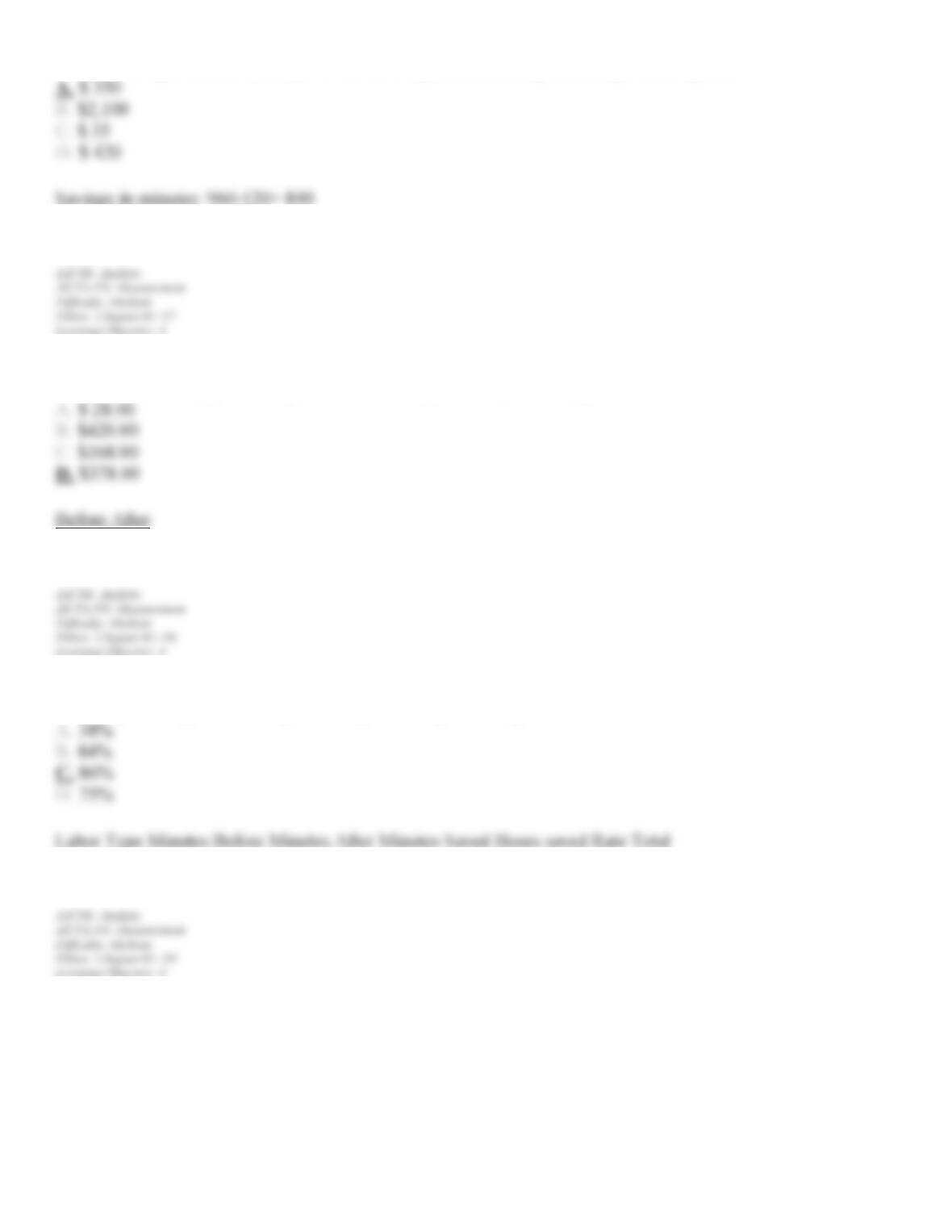
57. The savings for each 1,000 jar covers for setup labor after implementing the changes is:
58. The total savings per 1,000 jar covers after implementing the changes is:
59. The percentage total savings after implementing the changes is:
60. The company is considering accepting an order for a more complex jar cover from a major customer. It
estimates that each 1,000 jar cover order will take an extra 120 minutes for setup due to the complexity of the
molds and an extra 20 minutes for placing good pieces in boxes. Under the old system, with all personnel
earning the wages stated above, what would be the cost to process a 1,000-unit order?
61. Which of the following statements is false about pilot programs?
Use the following to Ans questions 62-64:
Lawrence Corporation has recently performed a value-added analysis and ranking of activities. Presented below
is an analysis of one sub-activity cost, sorted by value and cost:
Hilton – Chapter 05
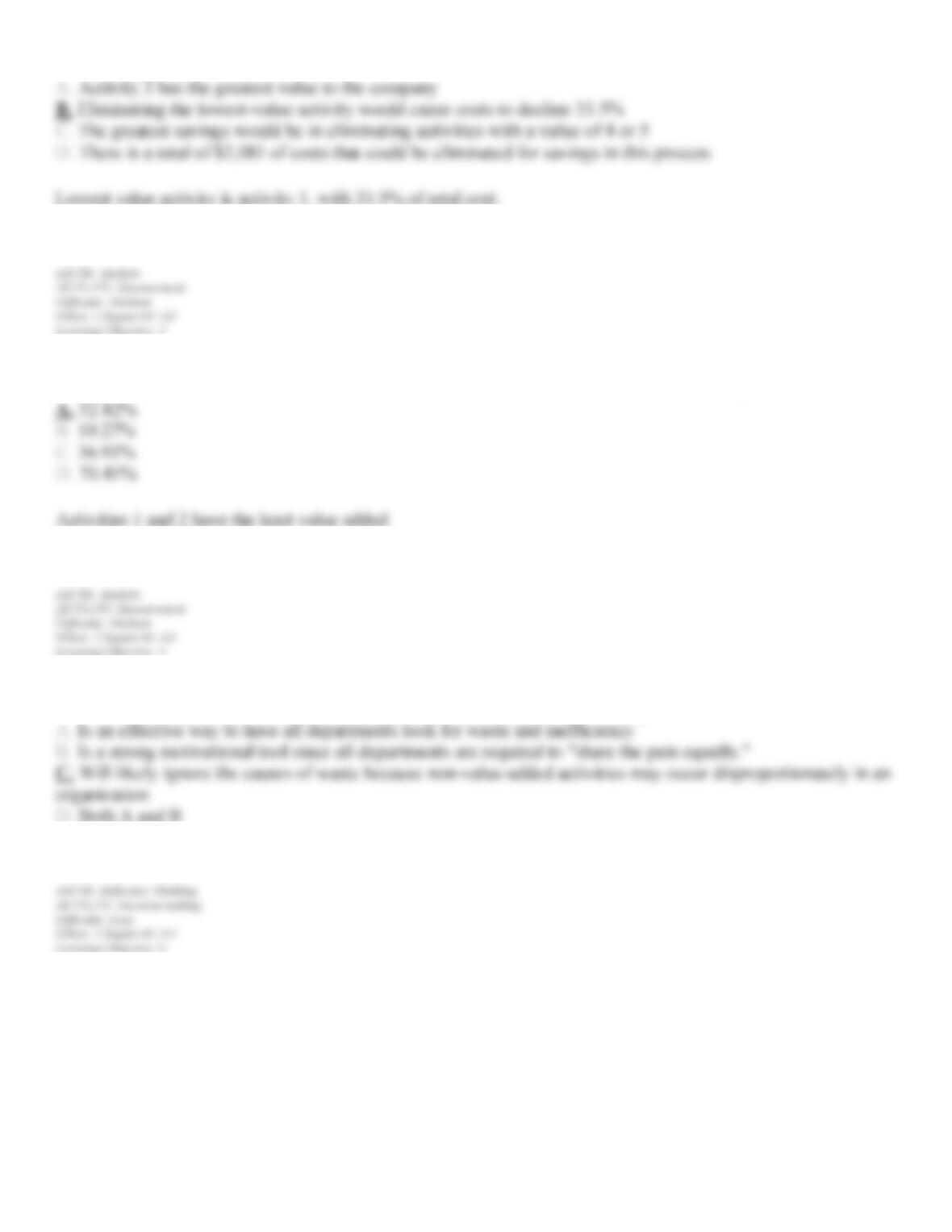
62. This comparison shows that:
63. If Lawrence eliminates the two activities with the least value-added, the total cost savings will be:
64. Under Activity-Based-Management, suggesting across-the-board percentage reductions in cost
Use the following to Ans questions 65-66:
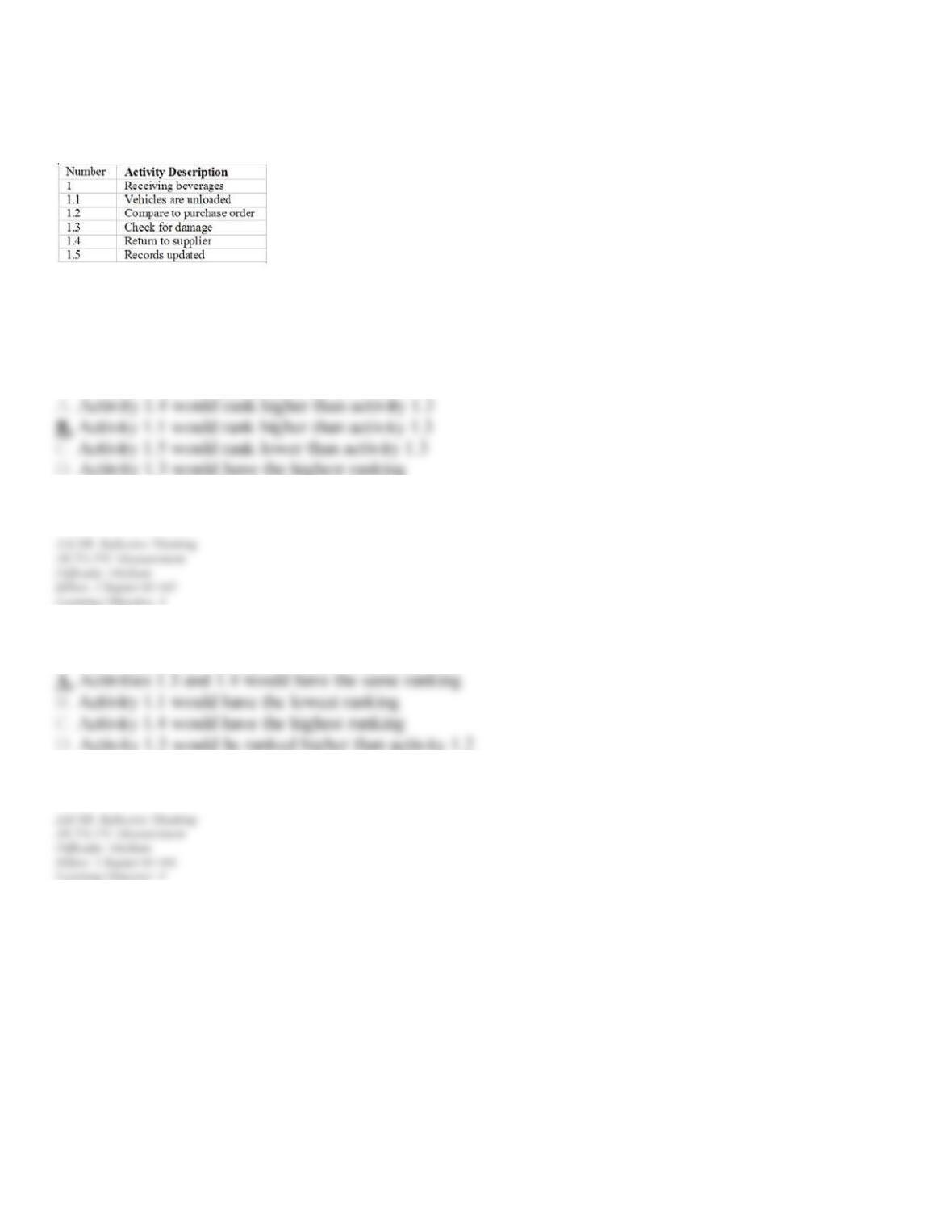
Listed below are warehousing sub-activities related to the warehousing activity of receiving beverages for
a distributor of bottled waters
Hilton – Chapter 05
65. In an activity listing with value-added scores:
66. In an activity listing with value added scores:
Use the following to Ans questions 67-69:
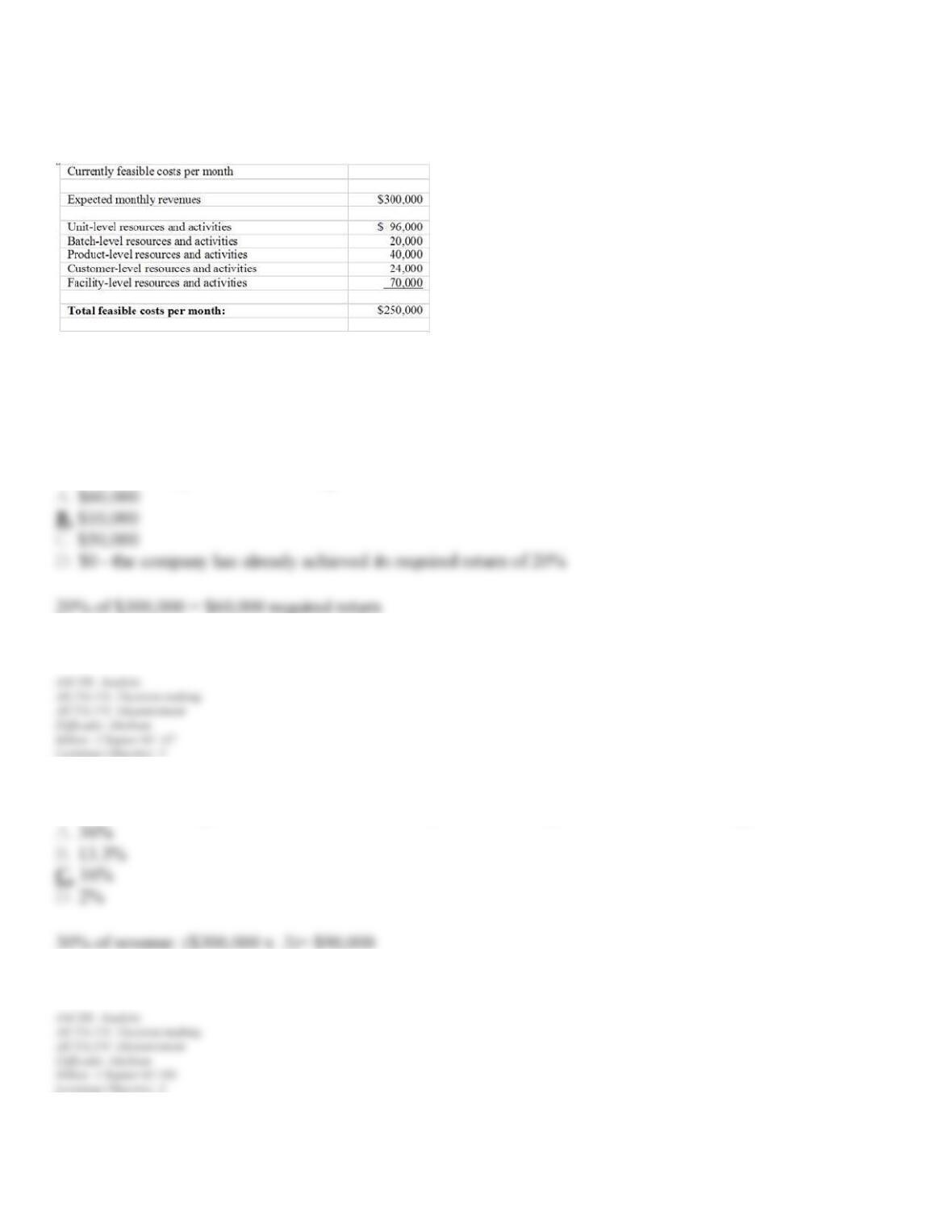
Chelsea Toy Manufacturing has recently performed an activity–based costing analysis of one of its best-selling
toys, the Main Man Robot. The analysis shows the following estimated monthly cost per 1,000 unit production
run:
Hilton – Chapter 05
67. Chelsea’s management has targeted a required return of 20% of monthly revenues. To achieve its objective,
Chelsea‘s monthly cost reduction target is:
68. To achieve a required return of 30% of monthly revenues, the percent cost reduction target is: