1
Chapter 5: Understanding Students with Learning Disabilities
Multiple Choice
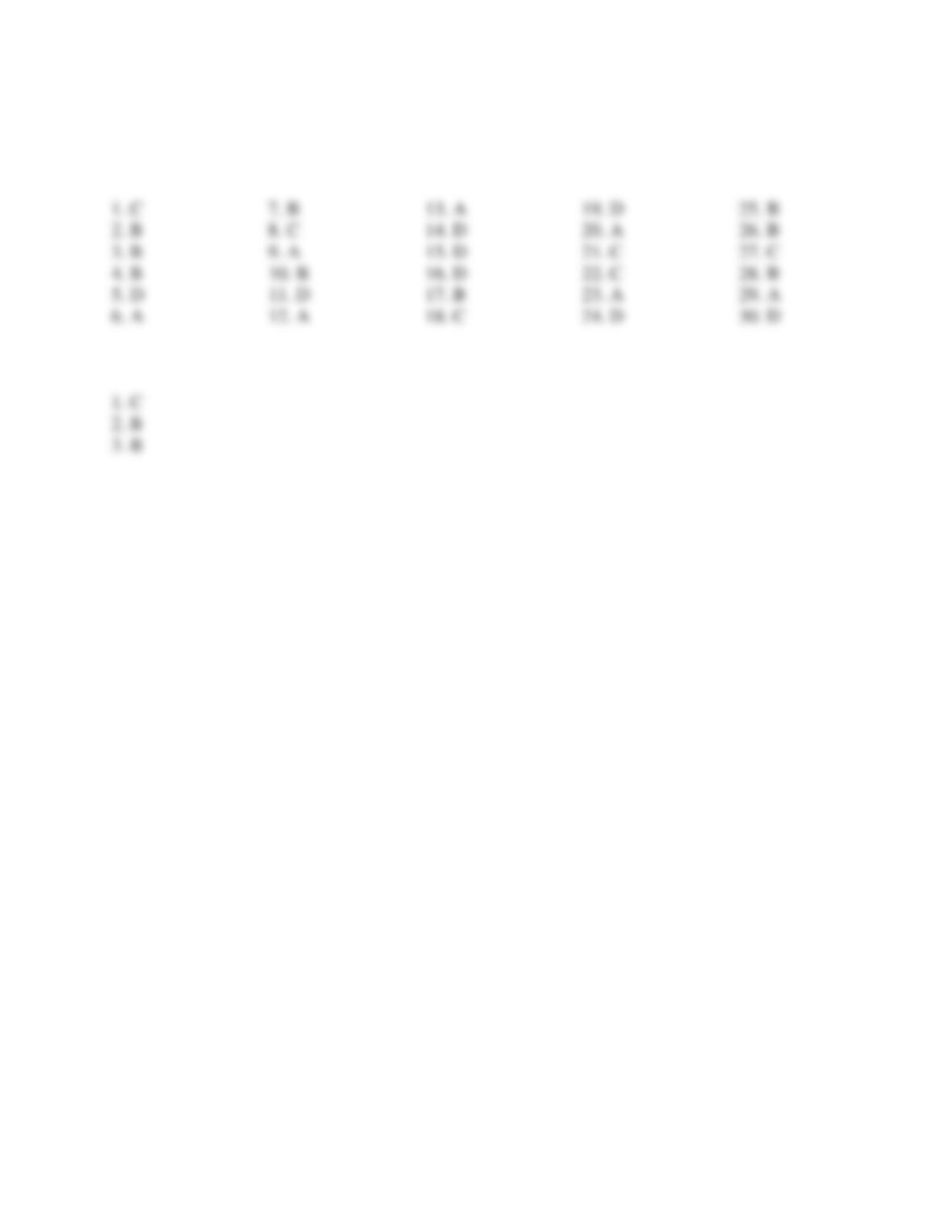
1. Which one of the following is part of the exclusionary criteria for learning disabilities?
A. An impairment that is caused primarily by poor instruction
B. An impairment that is caused primarily by perceptual difficulties
C. An impairment that is caused primarily by emotional disturbance
D. An impairment that is caused primarily by brain injury
2. What percentage of students with disabilities have specific learning disabilities?
A. About 75%
B. Nearly 43%
C. Almost 26%
D. About 14%
3. Which of the following is one of the most significant challenges facing students with learning
disabilities?
A. Writing difficulties
B. Reading difficulties
C. Behavior difficulties
D. Math difficulties
4. Difficulty with decoding words, comprehending text, and appropriate speed and fluency are
elements of:
A. Language disorder
B. Reading disorder
C. Written language disorder
D. Math disorder
5. Procedural problems, semantic memory problems, and visual-spatial problems are
indications of:
A. Language difficulty
B. Reading difficulty
C. Executive functioning
D. Math difficulty
2
6. An example of executive functioning is:
A. Prioritizing key information
B. Reading in an automatic fashion
C. Remembering facts
D. Decoding words
7. Being organized, engaging in future planning, and solving problems are elements of:
A. Language skills
B. Executive functioning skills
C. Metacognition
D. Social skills
8. Compared to students with other disabilities, those with learning disabilities have:
A. Fewer friends
B. Less anxiety
C. Fewer problems with mental health
D. A lower incidence of behavior problems
9. Children and youth with learning disabilities typically have less activity in which part of the
brain?
A. Left hemisphere
B. Right hemisphere
C. Temporal lobe
D. Parietal lobe
10. Three ways that IDEA allows agencies to determine the presence of learning disabilities are
the response to intervention approach, a discrepancy standard, and:
A. Nonbiased assessment
B. Other research-based procedures
C. Due process
D. IQ test
11. A student with a chronological age of 11 and a mental age of 9 has an IQ of about:
A. 100
B. 18
C. 122
D. 82
3
12. When determining the presence of learning disabilities using the discrepancy standard,
evaluators compare a student’s IQ and achievement scores. Woodcock (1990) described three
types of discrepancies which include all of the following EXCEPT:
A. Norm-referenced
B. Aptitude-achievement
C. Intracognitive
D. Intra-achievement
13. A problem-solving approach that involves multiple tiers of increasingly intense, research-
based interventions matched to each student’s needs is:
A. Response to Intervention
B. Norm-referenced assessment
C. Discrepancy model
D. Reaction to Instruction
14. RTI is a model for:
A. Identification
B. Rehabilitation
C. Assessment
D. Instruction
15. In the RTI model, identification of learning disabilities is based on each of the following
EXCEPT:
A. Response to instruction in terms of progress rates and performance levels
B. Assessment of low achievement using norm-referenced achievement tests
C. Application of the exclusionary standard
D. Assessment of the IQ-achievement discrepancy
16. Each is an example of psychological processing EXCEPT:
A. Executive functions
B. Processing speed
C. Short-term memory
D. Semantic memory
17. The capacity to use a sound system of language to process oral and written communication
is:
A. Language
B. Phonological processing
C. Dyslexia
D. Phonics
4
18. An instructional program with eleven lessons designed to promote greater student
involvement in IEP meetings is:
A. Self-advocated IEP
B. Self-determined IEP
C. Self-directed IEP
D. Self-administered IEP
19. To know the scope and sequence of content being delivered in the general curriculum,
teachers should engage in:
A. Curriculum-based measurement
B. Individualized education planning
C. Universal design for learning
D. Curriculum mapping
20. Which of the following helps students anticipate the relationship between their prior
knowledge and the new material they must master?
A. Advance organizers
B. Graphic organizers
C. Priority organizers
D. Cognitive organizers
21. Which skill did college students with disabilities identify as being necessary for success in
postsecondary education?
A. Test-taking skills
B. Writing skills
C. Problem-solving skills
D. Content reading skills
22. Using more than one methodology, providing a variety of formats of materials, expanding
assessment options, and varying the complexity and nature of the content are elements of:
A. Response to intervention
B. Embedded learning approach
C. Differentiated instruction
D. Universal design for learning
5
23. Three areas in which a teacher can differentiate are curricular content, instructional process,
and:
A. Product requirements
B. Homework length
C. Problem-solving steps
D. Advanced organizers
24. Learning strategies can help students with disabilities to learn independently and to:
A. Assess learning
B. Comprehend material
C. Acquire information
D. Generalize information
25. A learning strategy that requires students to actively interact with material and promotes
intrinsic motivation for learning is:
A. Metacognition
B. Self-questioning
C. Graphic organizers
D. Advance organizers
26. Graphic organizers assist students in all of the following EXCEPT:
A. Identifying key concepts
B. Verbalizing the information they are learning
C. Comparing and contrasting information
D. Relating cause and effect
27. What percent of time is the majority of students with learning disabilities included in the
general education classroom?
A. 40–79%
B. 0–39%
C. 80–100%
D. 50–89%
28. A frequently used method of RTI used to track progress in reading, writing, spelling, and
math for students with disabilities is:
A. Response to intervention
B. Curriculum-based measurement
C. Nonbiased assessment
D. Differentiated instruction
6
29. A maze task and read aloud are two measures in:
A. Reading probes
B. State tests
C. Testing accommodations
D. Writing probes
30. The most frequently implemented accommodation for students with learning disabilities is:
A. Taking an alternative test
B. Having tests read out loud
C. Testing in a separate setting
D. Extra time to take a test
Praxis style questions
1. James frequently disrupts other students when he needs to be working independently on his
assignments. You have discussed this behavior with James but it continues. An appropriate
teacher intervention would be:
A. When James is disruptive, send him to the principal’s office.
B. Move James to a different part of the classroom away from other students.
C. Use advance organizers to guide James’ learning on independent assignments.
D. Inform James’ parents of his behavior and ask for help.
2. Mr. File teaches history. His teaching style is to lecture to his students and require them to
write notes and important dates to study for the chapter tests. A suggestion for Mr. File to
differentiate his instructional process would be to:
A. Have the students read the chapter on their own.
B. Provide visual or graphic organizers to accompany the lectures.
C. Tape record the lectures for students to listen to later.
D. Continue with the lectures, there is nothing wrong with this teaching style.
3. Sheila and her parents would like her to participate in her IEP meetings. You would like to
prepare Sheila to become an active participant in the meetings and her education. What
would you suggest to prepare Sheila for the meeting?
A. Role-play the meeting with Sheila.
B. Review Sheila’s current IEP with her before the meeting.
C. Have Sheila fill out the IEP paperwork during the meeting.
D. Send her the IEP to study ahead of time.
7
Short Answer
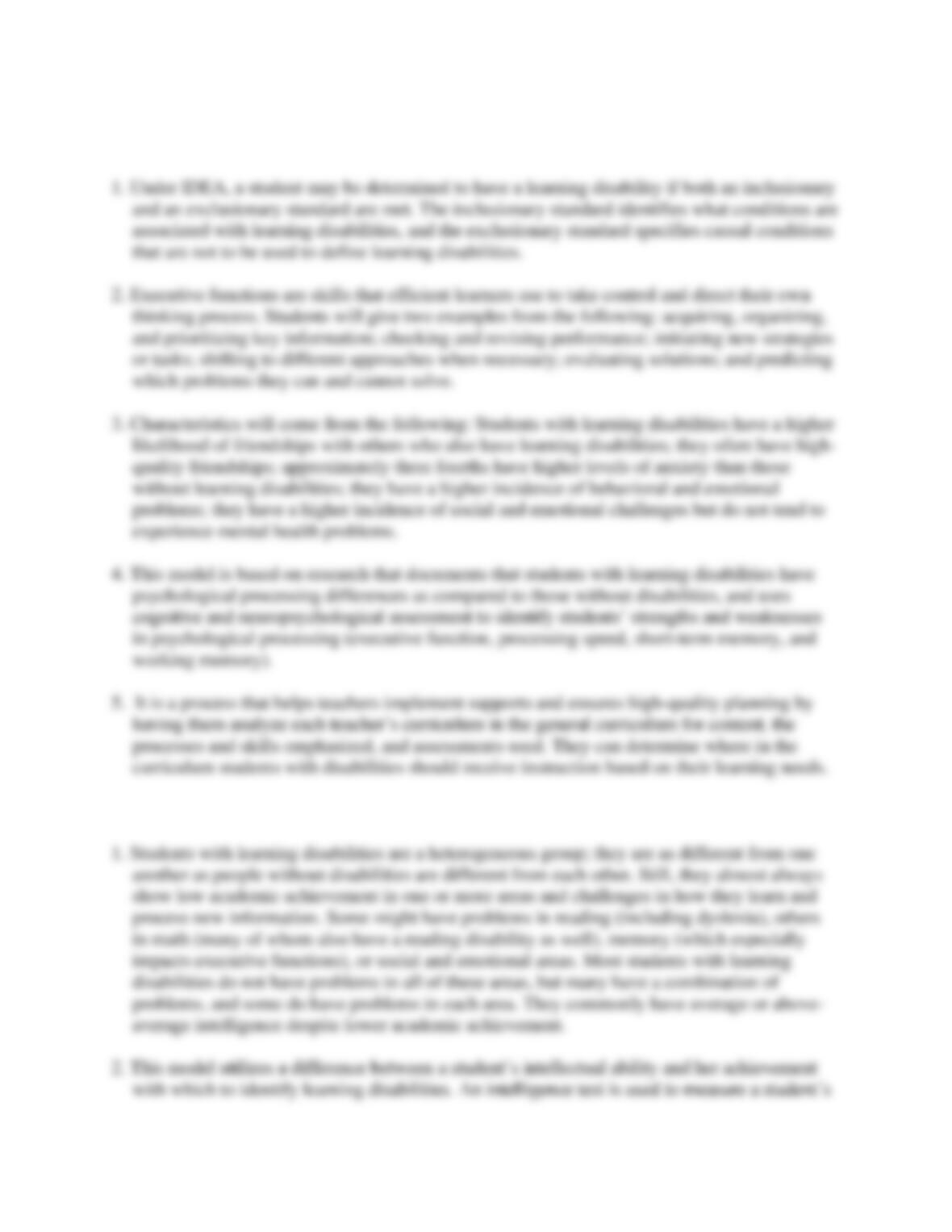
1. What are the inclusionary and exclusionary standards for defining specific learning
disabilities? Don’t list them, explain what they are.
2. Describe executive functions and give two examples of problems students with learning
disabilities have with this.
3. Briefly describe three emotional and social characteristics associated with many students
with learning disabilities.
4. What is the psychological processing model for identifying students with disabilities?
5. What is curriculum mapping?
Essay
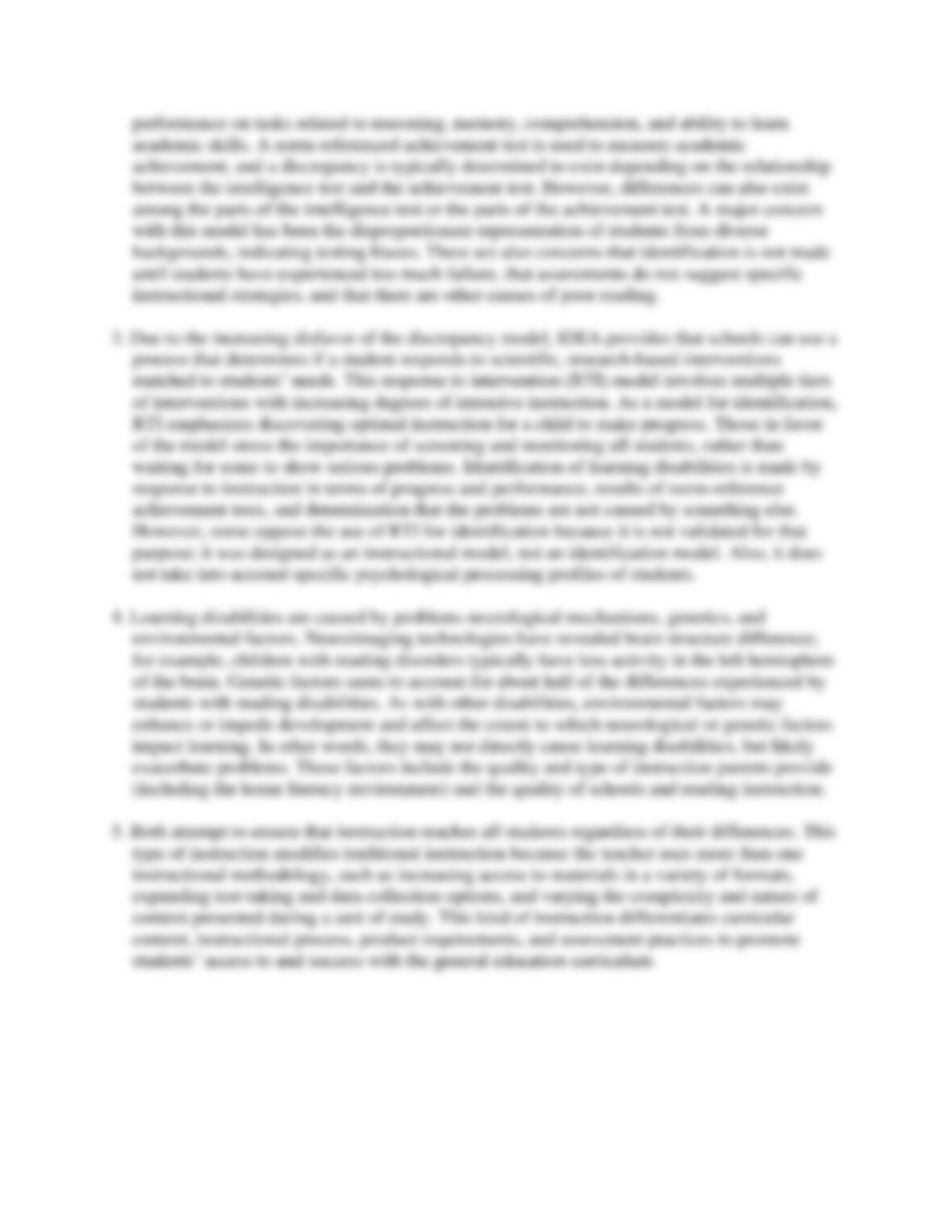
1. What is meant by your textbook authors’ statement: “There is no such thing as a typical
student with learning disabilities”? How does this relate to characteristics of students with
learning disabilities?
2. Describe the discrepancy model for identifying learning disabilities, including problems with
this model.
3. Describe the response to the intervention model for identifying learning disabilities,
including concerns about the model.
4. Summarize the causes of learning disabilities.
5. What is meant by your textbook authors’ statement: “Differentiated instruction is a logical
companion to universal design for learning”?
8
Chapter 5
Multiple Choice
Praxis
9
Short Answer
Essay
10