Exam
Name___________________________________
MULTIPLE CHOICE. Choose the one alternative that best completes the statement or answers the question.
1)
Government can correct for negative externalities by
1)
A)
allowing the market system to correct the problem.
B)
decreasing the costs to those responsible for the externality.
C)
increasing taxes or regulation.
D)
decreasing taxes.
2)
All of the following are major sources for financing public education EXCEPT
2)
A)
property taxes.
B)
government fees.
C)
income taxes.
D)
sales taxes.
B
3)
Which of the following is NOT a consequence of the introduction of the Medicare program?
3)
A)
an increased quantity of medical services demanded
B)
an increased ability for the poor to obtain medical services
C)
a reduced demand for medical services
D)
an increased ability for the elderly to obtain medical services
C
4)
The market and public sector are similar in that
4)
A)
the resources used in both sectors are scarce.
B)
the participants in both sectors react to incentives.
C)
there is competition amongst the participants in both sectors.
D)
All of the above are true.
D
C
5)
A government–inhibited good is a good which
5)
A)
the political process has deemed socially undesirable.
B)
can be consumed by one individual without affecting the consumption of another individual.
C)
the political process has deemed socially desirable.
D)
is not subject to the principle of mutual exclusivity.
6)
Which of the following statements is NOT true of external benefits?
6)
A)
External benefits lead to a price in the market that is too high.
B)
External benefits lead to too few of the goods that have the external benefit being produced.
C)
External benefits are a good thing for the allocation of resources because people are getting
something at no cost.
D)
External benefits lead to an underallocation of resources to the production of the good that
has the external benefit.
C
7)
Providing public goods is a(n)
7)
A)
economic and political function of government.
B)
political function of government.
C)
price system function.
D)
economic function of government.
D
8)
Education in the United States is
8)
A)
subsidized mainly by state and local governments.
B)
paid for by the parents of students in public school system.
C)
paid for by Social Security taxes.
D)
funded by the federal government only.
A
A
9)
External costs can be defined as
9)
A)
the cost of providing all public goods and services.
B)
the sum of all private production costs.
C)
the cost of running the federal government.
D)
the cost associated with private production, but partially borne by society.
10)
A situation in which the market system allocates too many resources to the production of a given
activity is known as
10)
A)
market breakdown.
B)
market efficiency.
C)
market allocation.
D)
market failure.
D
Explanation:
11)
Social Security and Medicare are clear examples of
11)
A)
capitalism.
B)
governmental intervention in the market.
C)
market–determined services.
D)
market failures and externalities.
B
Explanation:
12)
An externality is
12)
A)
transaction costs.
B)
a third–party benefit or cost that is associated with the production of a good.
C)
when external forces such as war or flood affect the market.
D)
government intervention in the markets.
B
Explanation:
13)
A fundamental reason that governments provide public goods is that
13)
A)
those goods are subject to the free–rider problem.
B)
negative externalities are part of the production process of those goods.
C)
those goods are perfectly divisible.
D)
public goods are merit goods.
A
Explanation:
D
Explanation:
14)
Economically speaking, the design of Medicare
14)
A)
helps to decrease the cost of care to non–Medicare patients.
B)
discourages the consumption of medical services.
C)
encourages the consumption of medical services.
D)
discourages the provision of medical services.
15)
The purpose of antitrust legislation is
15)
A)
to reduce unemployment.
B)
to maximize employment for a given price level.
C)
to reduce the power of monopoly.
D)
to increase the power of monopoly.
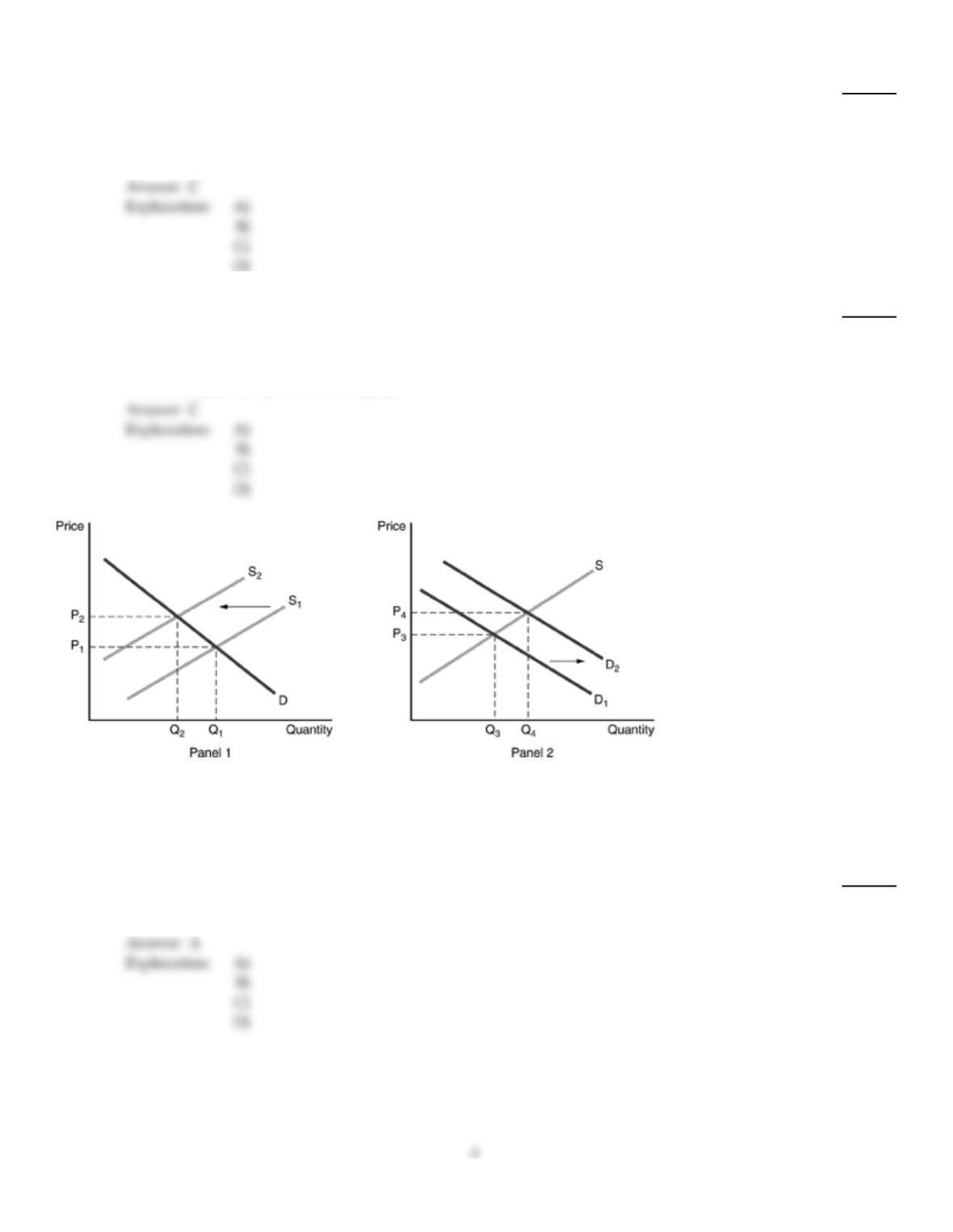
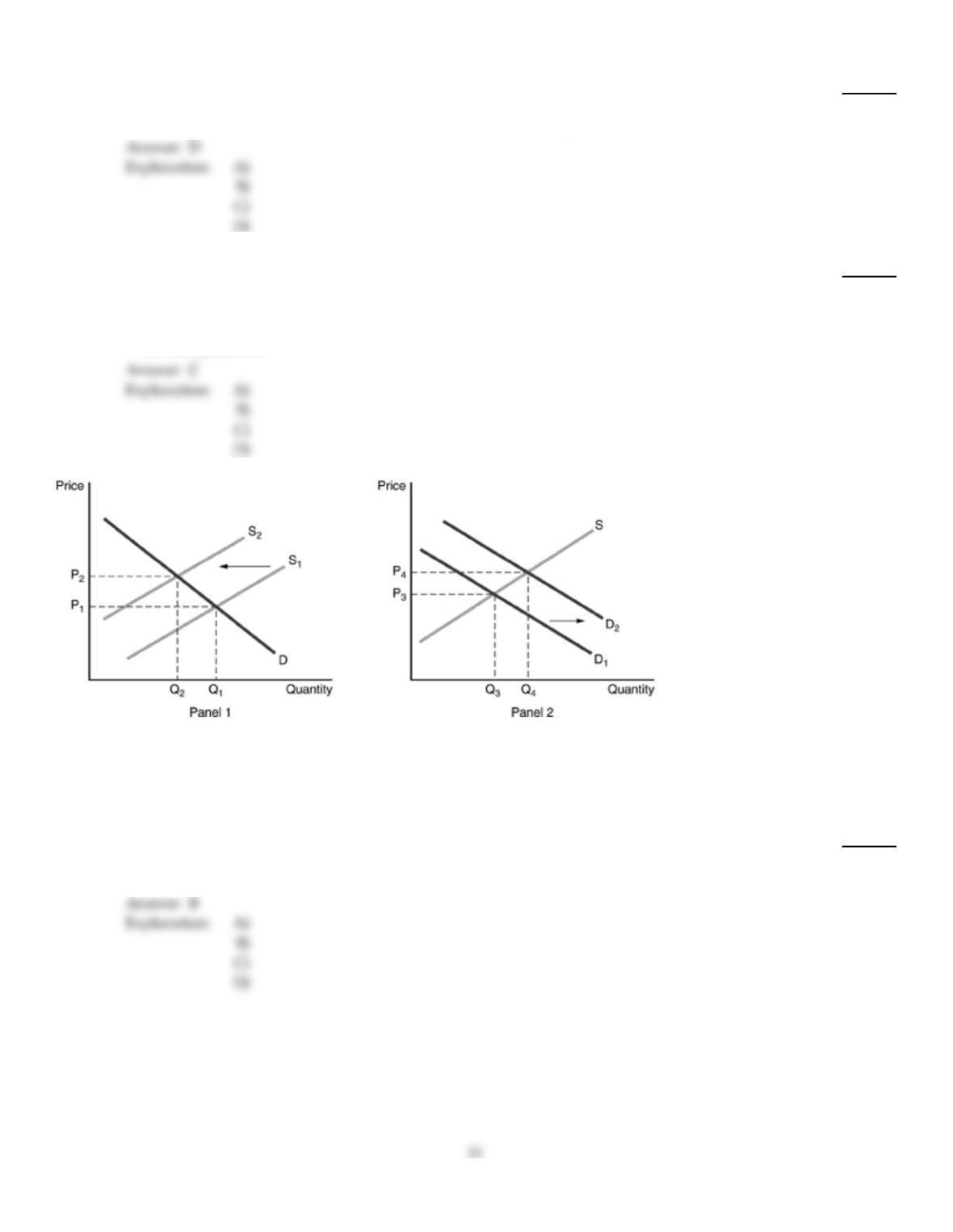
A shift from S1 to S2 reflects the change that happens when a negative externality is taken into account. A shift from D1
to D2 reflects the change that happens when a positive externality is taken into account.
16)
Refer to above figures. Prior to the shift of the curves, which panel and which curve involve the
existence of negative externality?
16)
A)
Panel 1 and S1
B)
Panel 1 and S2
C)
Panel 2 and D1
D)
Panel 2 and D2
17)
Which of the following types of goods is subject to the free–rider problem?
17)
A)
a public good
B)
a product that creates a positive externality
C)
a private good
D)
a product that creates a negative externality
18)
Orchards provide services to beekeepers because the bees use the pollen to make honey. This is an
example of
18)
A)
a positive externality, and too many orchards exist in society.
B)
a negative externality, and too many orchards exist in society.
C)
a negative externality, and too few orchards exist in society.
D)
a positive externality, and too few orchards exist in society.
19)
Government–sponsored goods are those goods
19)
A)
that only low–income individuals consume.
B)
that society views desirable through the political process.
C)
that companies give away as promotional prizes.
D)
that have lower than average negative externality.
20)
Which of the following is an example of a negative externality?
20)
A)
There is an increase in injuries to pedestrians caused by accidents resulting from electronic
billboards distracting drivers.
B)
A consumer pays a higher price than another consumer does for the same product.
C)
The opening of a new shopping mall increases the business of nearby restaurants.
D)
Consumers pay a sales tax in addition to the price of a product.
21)
In the United States, which of the following is an example of a government–sponsored good?
21)
A)
wireless networks
B)
marijuana
C)
cigarettes
D)
concerts
22)
Over the past 40 years, there has been an increase in spending on public education without a
significant increase in student performance. One explanation given by economists on why student
performance has not improved is that
22)
A)
schools are providing high–priced services that are not valued by parents.
B)
too much competition for educational services.
C)
the quantity of educational services has not increased beyond the pre–subsidy equilibrium.
D)
not enough funds have been spent on public education.
23)
An example of a market failure is
23)
A)
when not everyone who wants to see a major league football game can.
B)
unemployment.
C)
when there is an increase in demand and a shortage develops.
D)
a firm is dumping toxic waste that is making people sick.
24)
When misallocation of resources for production of a good results in spillover effects on third
parties, there is a
24)
A)
government failure.
B)
productive failure.
C)
legislative failure.
D)
market failure.
25)
The funding of public education is
25)
A)
a subsidy program.
B)
a private program.
C)
done by voluntary contributions.
D)
provided by Social Security.
26)
The total amount that the U.S. government spends to support a covered type of health care service
under the Medicare system equals
26)
A)
the per–unit subsidy provided to producers of that service times the quantity of the service
demanded by consumers at a below–equilibrium out–of–pocket price of the service.
B)
the below–equilibrium, out–of–pocket price that consumers pay for the service times the
quantity of the service demanded by consumers at that out–of–pocket price.
C)
the below–equilibrium, out–of–pocket price that consumers pay for the service times the
quantity of the service provided by producers at that out–of–pocket price.
D)
the per–unit subsidy provided to producers of that service times the equilibrium quantity of
the service demanded at the market clearing price that would arise in the absence of
Medicare.
27)
A difference between the market and the public sector is that
27)
A)
decision making is by majority rule in the public sector but not in the market sector.
B)
resources are only scarce for the market sector.
C)
only the public sector produces private goods.
D)
competition exists only in the market sector.
28)
Under present U.S. law, cocaine is an example of
28)
A)
a public good.
B)
a government–inhibited good.
C)
a government–sponsored good.
D)
a capital good.
29)
An example of a negative externality created in the market system would be
29)
A)
poverty.
B)
an increased number of bird flu patients.
C)
unemployment.
D)
water pollution.
30)
If the production of a product results in significant external costs, an appropriate government
policy might be to
30)
A)
tax consumers’ incomes and thus shift the demand curve to the left.
B)
subsidize the production of the good.
C)
subsidize consumers since the good is being under–consumed.
D)
tax producers and thus shift the supply curve to the left.
31)
Which of the following is an example of a positive externality?
31)
A)
a neighbor’s flower garden that you enjoy seeing
B)
pollution
C)
traffic congestion
D)
an increased supply of chocolate lowers chocolate prices for all consumers
A
32)
The purpose of an effluent fee is to
32)
A)
reward people producing externalities.
B)
encourage producers to keep the quantity produced the same while lowering the price.
C)
reduce the amount produced of a good and to raise the market price.
D)
correct for pollution while keeping the price of the good the same as before the correction.
C
33)
Which of the following could best be categorized as a public good?
33)
A)
a pumpkin pie
B)
an apartment in a public housing project
C)
a race track
D)
public fireworks
D
D
34)
The price system allocates resources efficiently EXCEPT when
34)
A)
consumers decide they want more of a good.
B)
the production of a good affects parties other than its buyers and sellers.
C)
resources are utilized to produce the highest–valued goods and services.
D)
voluntary exchange exists.
35)
Which of the following leads to an underallocation of resources to a specific economic activity?
35)
A)
effluent benefits
B)
marginal costs
C)
external costs
D)
external benefits
D
36)
Which one of the following is NOT a characteristic of public goods?
36)
A)
They are indivisible.
B)
Public goods are subject to the principle of rival consumption.
C)
Public goods can be used by increasing numbers of people at no additional cost.
D)
It is difficult to charge people on the basis of how much they use.
B
37)
Costs that spill over to third parties are called
37)
A)
variable costs.
B)
opportunity costs.
C)
public costs.
D)
external costs.
D
B
38)
Which of the following characterizes the largest difference between the way decisions are made in
the private sector versus the public sector?
38)
A)
Costs and resources are vastly different in each sector.
B)
In both sectors individuals will try to maximize their own individual gains over the gains of
others.
C)
The incentive system for individuals to perform efficiently are vastly different.
D)
The workers themselves are really quite different types of people.
39)
To correct for the underproduction of products with positive externalities, the government must
39)
A)
increase taxes on the industry.
B)
fine the industry.
C)
provide the incentives for the private sector to produce and consume the good.
D)
provide tougher regulations on the industry.
40)
A price system is considered to be efficient when
40)
A)
an underground market develops.
B)
it fails to have the goods that consumers want.
C)
firms produce more than what consumers want.
D)
all resources are allocated to the highest–valued uses.
41)
Which of the following is the largest component of federal spending today?
41)
A)
Medicare
B)
national defense
C)
Social Security
D)
income security
42)
Inoculations of children against infectious diseases are
42)
A)
an example of a public good.
B)
an example of an external cost.
C)
dangerous for society.
D)
an example of an external benefit.
43)
Pollution is caused by a market failure, in an industry in which there is
43)
A)
excessive cost borne by the firm.
B)
excess demand.
C)
an over–allocation of resources in production.
D)
unemployment.
A shift from S1 to S2 reflects the change that happens when a negative externality is taken into account. A shift from D1
to D2 reflects the change that happens when a positive externality is taken into account.
44)
Refer to the above figures. Externalities exist in both panels. After correcting for the externalities the
prices should be
44)
A)
P1 and P3.
B)
P2 and P4.
C)
P1 and P4.
D)
P2 and P3.
45)
When costs spill over to third parties, there is a(n)
45)
A)
cost overrun.
B)
government subsidy.
C)
excessive competition.
D)
negative externality.
46)
The Employment Act of 1946 reflects which one of the following functions of government?
46)
A)
correcting externalities
B)
providing a legal system
C)
improving economy–wide stabilization
D)
providing public goods
47)
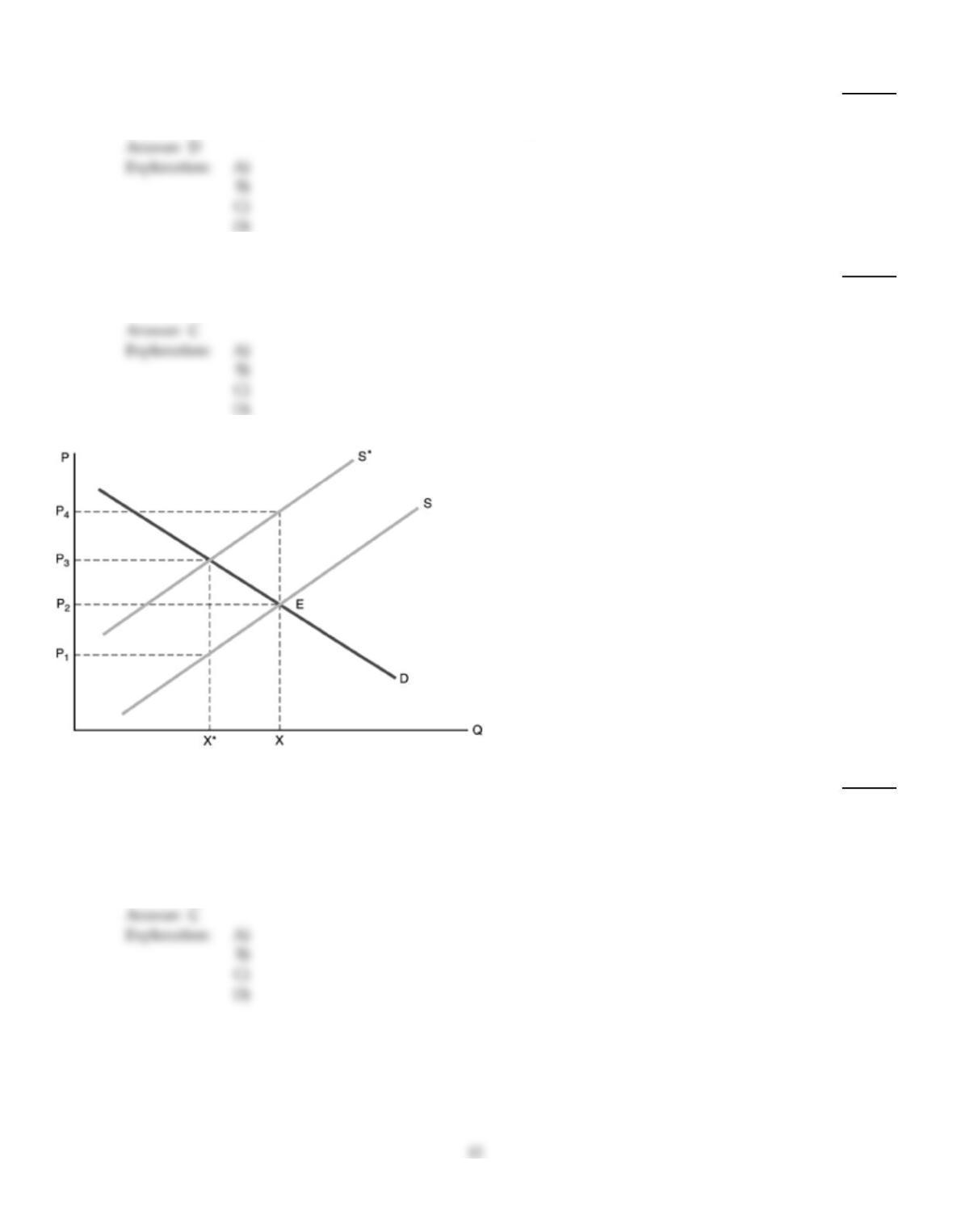
In the above figure, market equilibrium at point E yields the quantity X. The quantity X* is socially
optimal amount. The government can achieve the optimal outcome by
47)
A)
setting the price at P1.
B)
setting the price at P4.
C)
establishing a tax of P3– P1 per unit of the good sold.
D)
establishing a tax of P3– P2 per unit of the good sold.
48)
The economic functions of government differ from the political functions of government in that
48)
A)
the economic functions involve things that affect the way exchange is carried out while the
political functions include policies that affect income redistribution.
B)
the economic functions include policies that affect income redistribution, while the political
functions involve things that affect the way exchange is carried out.
C)
the economic functions are carried out by state and local governments, while the political
functions are carried out by the federal government.
D)
the economic functions are carried out by the federal government, while the political
functions are carried out by state and local governments.
49)
Which of the following statements is TRUE?
49)
A)
Transfer payments are money payments made by the government for which no goods or
services are currently received.
B)
Government spending as a percent of total national income has continuously decreased since
the 1950s.
C)
Education is the largest category of federal government expenditures.
D)
Transfers in kind include Welfare, Social Security, and unemployment insurance benefits.
50)
When an Australian citizen enjoys military protection in Australia without contributing to the cost
of Australia’s defense budget, then
50)
A)
Australia is a free rider.
B)
this citizen is a free rider.
C)
this citizen receives no benefits if Australia is attacked.
D)
Australia’s defense budget will run out of funds.
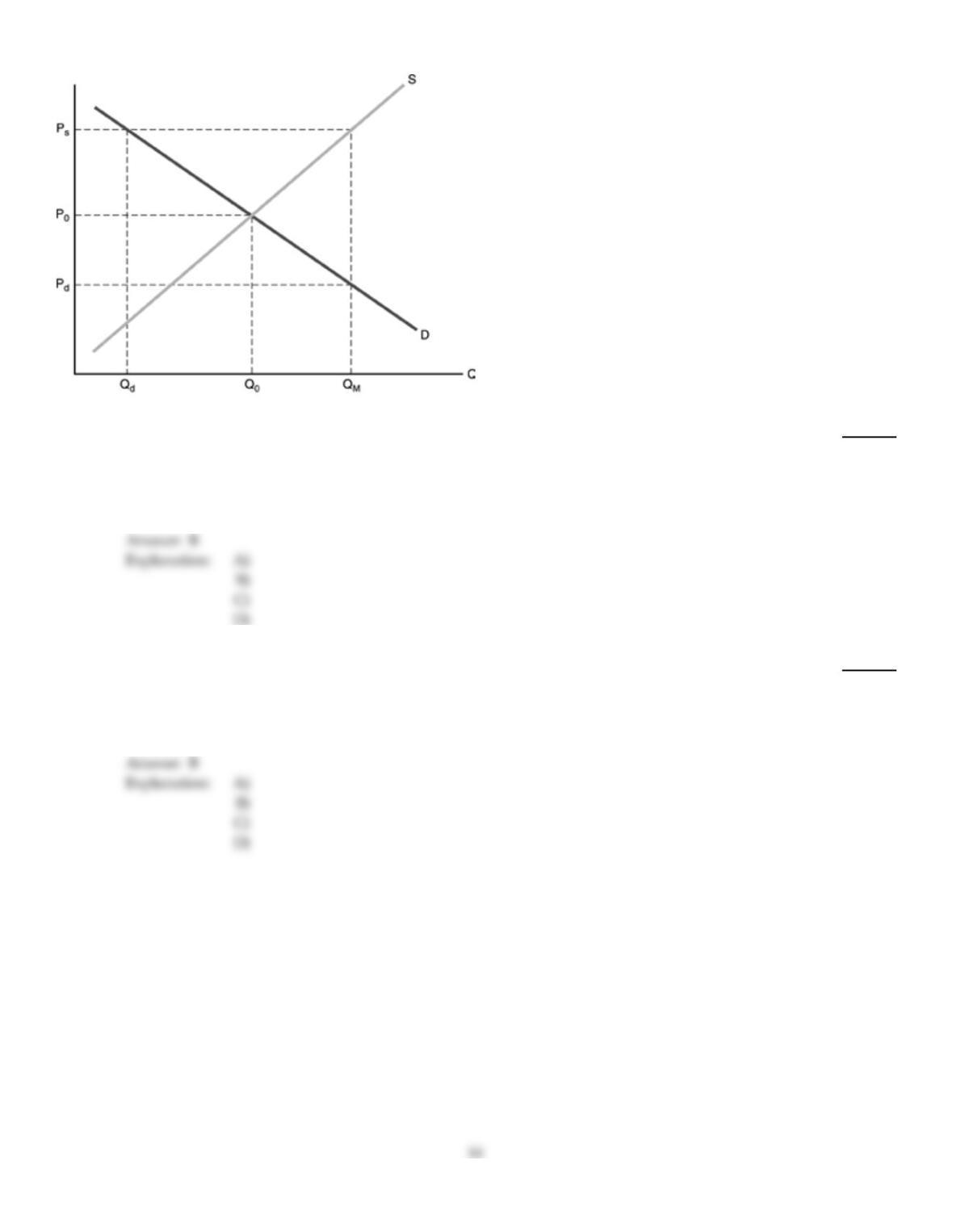
51)
Refer to the above figure. In the absence of a subsidy,
51)
A)
the price Pd would be charged and quantity QM demanded.
B)
the quantity Qo and price Po would prevail in the market.
C)
Qd would be demanded and QM would be supplied.
D)
None of the above is correct.
52)
Government spending as a percent of national income
52)
A)
has been almost constant this century.
B)
peaked during World War II.
C)
has been steadily climbing since 1850.
D)
peaked during the Reagan administration.
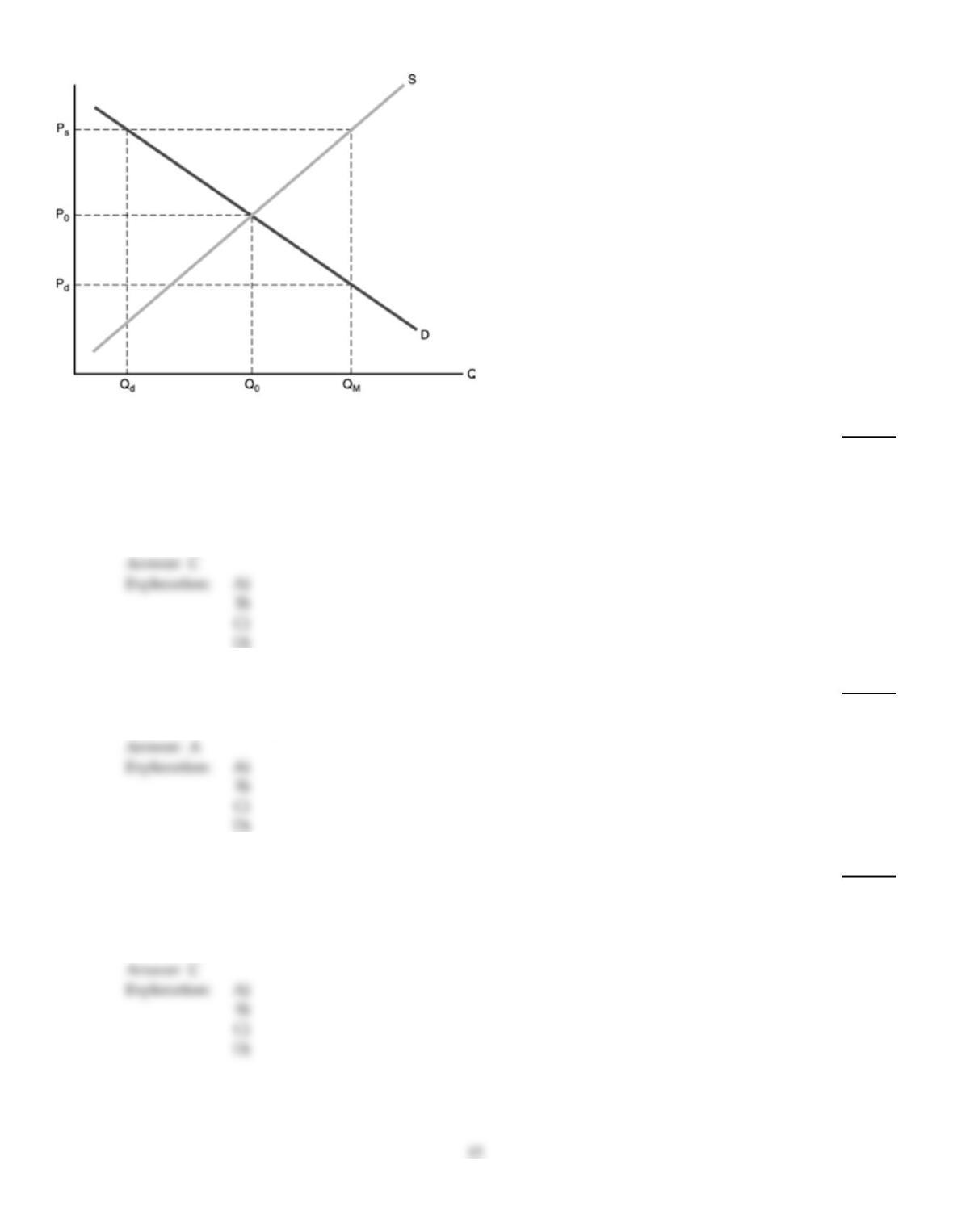
53)
In the above figure, if a Medicare subsidy that had previously been paid by the government has
now been eliminated, the result will be
53)
A)
an increase in the price received by producers, from P0 to Ps.
B)
an increase in the price paid by consumers, from P0 to Ps.
C)
a decrease in the price received by producers, from Ps to P0.
D)
a decrease in the price paid by consumers, from Ps to P0.
54)
A characteristic of a public good is
54)
A)
the free–rider problem.
B)
the exclusion principle.
C)
clear property rights.
D)
rival consumption.
55)
Public goods are desired because
55)
A)
they make supply equal to demand for private goods.
B)
we want the government to spend our tax dollars.
C)
people want and value them but the private sector will not make them available.
D)
they came in small units.
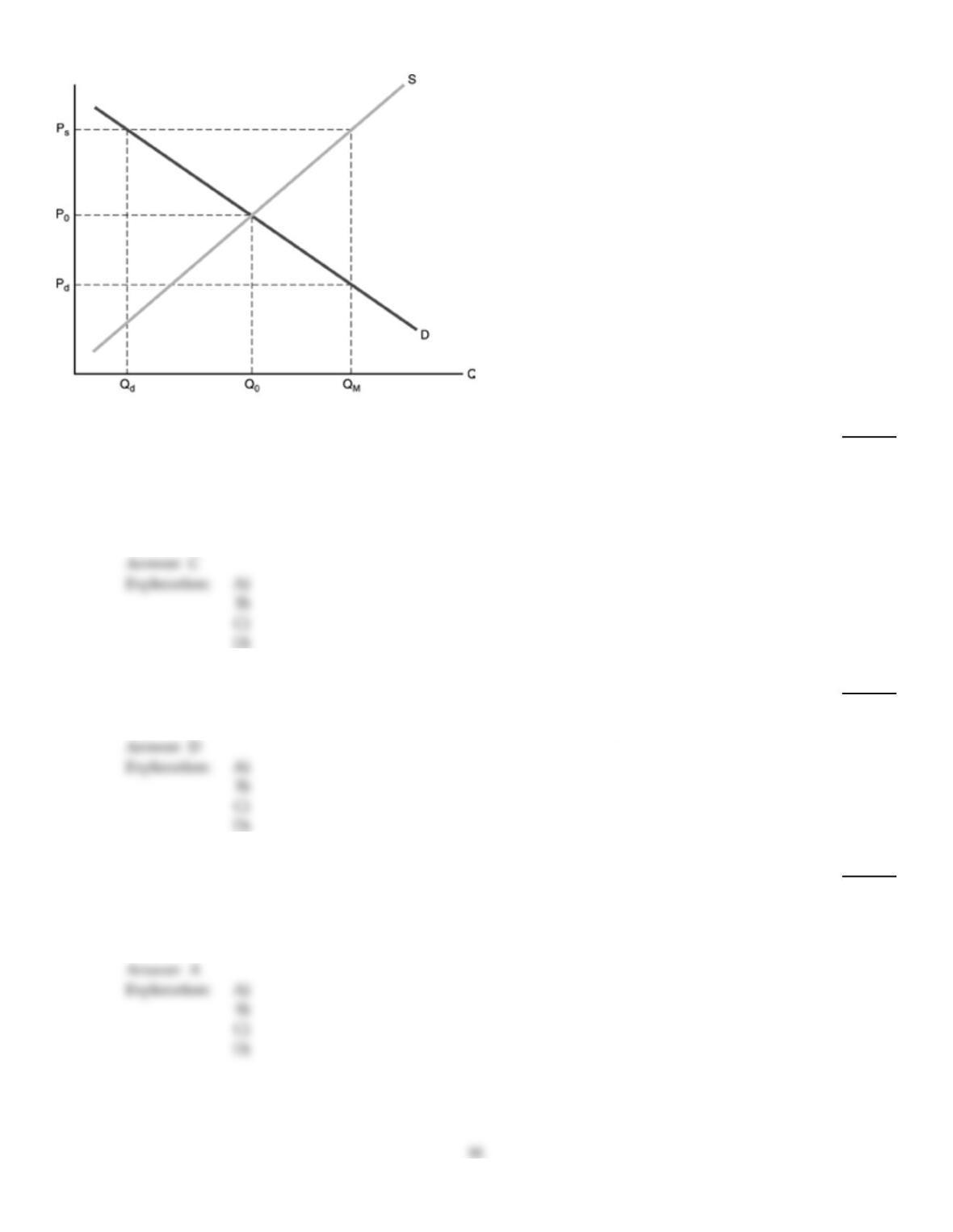
56)
In the above figure, the total dollar amount of the Medicare subsidies provided by the government
is equal to
56)
A)
the difference between Ps and P0 multiplied by QM.
B)
the difference between P0 and Pd multiplied by Qd.
C)
the difference between Ps and Pd multiplied by QM.
D)
the difference between Ps and Pd multiplied by Q0.
57)
Which of the following often involves positive external benefits?
57)
A)
tobacco smoking
B)
water pollution
C)
drunken driving
D)
inoculation programs
58)
In graphical form,the effect of imposing a tax on a good is shown as
58)
A)
a leftward shift of the market supply curve.
B)
a downward movement along the market supply curve.
C)
a rightward shift of the market supply curve.
D)
no change to the market supply curve.
59)
Graphically, the effect of a government subsidy on a good is shown as
59)
A)
a rightward shift of the market demand curve.
B)
a leftward shift of the market demand curve.
C)
a downward movement along the market demand curve.
D)
no change to the market demand curve.
60)
If U.S. consumers increase their spending on hybrid cars by 60 percent, and 60 percent more hybrid
cars are produced, this is known as the
60)
A)
proportional rule.
B)
government rule.
C)
majority rule.
D)
profit rule.
A
61)
Which of the following types of goods would most likely be classified as a government–inhibited
good?
61)
A)
tobacco
B)
heroin
C)
marijuana
D)
All of the above are correct.
D
62)
Federal antitrust laws in the United States are enforced
62)
A)
by the Department of Commerce.
B)
by the Department of Justice and by the Federal Trade Commission.
C)
solely by the Department of Justice.
D)
solely by the Federal Trade Commission.
B
A
63)
What effect have Medicare subsidies had on the consumption of medical services?
63)
A)
The consumption of medical services has increased because Medicare subsidies give people
the incentive to seek more care than they would otherwise.
B)
The consumption of medical services has been unaffected, because people don’t consider the
financial cost when seeking services related to their health.
C)
The consumption of medical services has been unaffected, because government restrictions
have prevented patients from seeking a level of care above and beyond what they would
choose if they had to pay for medical treatment out of pocket.
D)
The effect cannot be measured because it is difficult to quantify the amount of resources
devoted to our health care system.
64)
When there is an external benefit, the unregulated market
64)
A)
maximizes public welfare.
B)
reaches the most efficient solution.
C)
underproduces the good or service.
D)
overproduces the good or service.
65)
Which of the following is FALSE about public–sector decision making?
65)
A)
Decisions involve no opportunity cost.
B)
Incentives play a role in decision making.
C)
The price charged to consumers is often less than its full opportunity cost.
D)
Decisions are based on majority rule.
66)
As a share of total national income, government spending generally has
66)
A)
decreased over the last fifty years.
B)
been constant over the last fifty years.
C)
increased over the last fifty years.
D)
increased until ten years ago, and then decreased steadily.
67)
The government tries to protect the competitive economic system by passing and enforcing
67)
A)
building codes and zoning laws.
B)
tariff legislation.
C)
antitrust laws.
D)
price controls.
68)
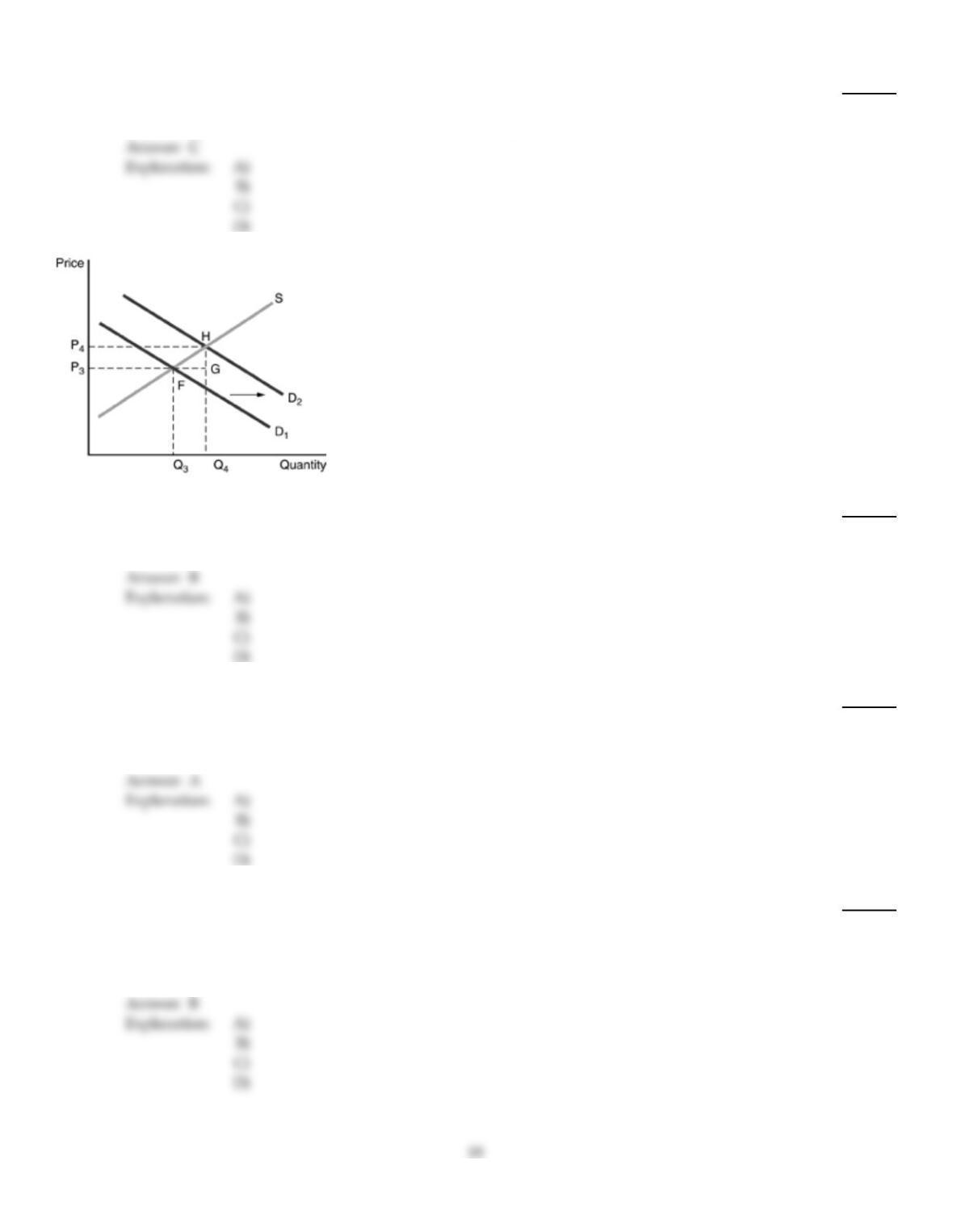
Refer to the above figure. An external benefit exists. The amount of that benefit is represented by
68)
A)
the distance between G and F.
B)
the vertical distance between D1 and D2.
C)
P3.
D)
P4.
69)
A situation in which a market economy leads to too few or too many resources going to a particular
economic activity is known as
69)
A)
a market failure.
B)
competition.
C)
excessive competition.
D)
destructive competition.
70)
A political function of government is to
70)
A)
correct for externalities.
B)
encourage the consumption of government–sponsored goods.
C)
provide public goods.
D)
encourage the workings of the price system.
71)
If external benefits are taken into account in the market
71)
A)
the supply curve would shift to the left.
B)
the demand curve would shift to the right.
C)
the supply curve would become vertical.
D)
the demand curve would shift to the left.
72)
All of the following are assumptions of both market and public–sector decision making EXCEPT
72)
A)
Decisions are motivated by individuals‘ self–interest.
B)
Opportunity costs exist in decisions.
C)
Decisions are based on majority rule.
D)
Choices reflect incentives faced by decision makers.
73)
A friend of yours receives a government voucher for an apartment in a public housing project. This
apartment represents
73)
A)
the free–rider problem.
B)
the drop–in–the–bucket problem.
C)
a government–sponsored good.
D)
a public good.
74)
Which of the following is the best example of a public good?
74)
A)
a streetlight
B)
garbage collection
C)
inoculation against a contagious disease
D)
Internet access