General Chemistry: Atoms First, 2e (McMurry and Fay)
Chapter 5 Covalent Bonds and Molecular Structure
5.1 Multiple Choice Questions
1) How many of the σ bonds in H2SO4 are coordinate covalent bonds?
A) 0
B) 2
C) 4
D) 6
2) What geometric arrangement of charge clouds is expected for an atom that has five charge
clouds?
A) tetrahedral
B) square planar
C) trigonal bipyramidal
D) octahedral
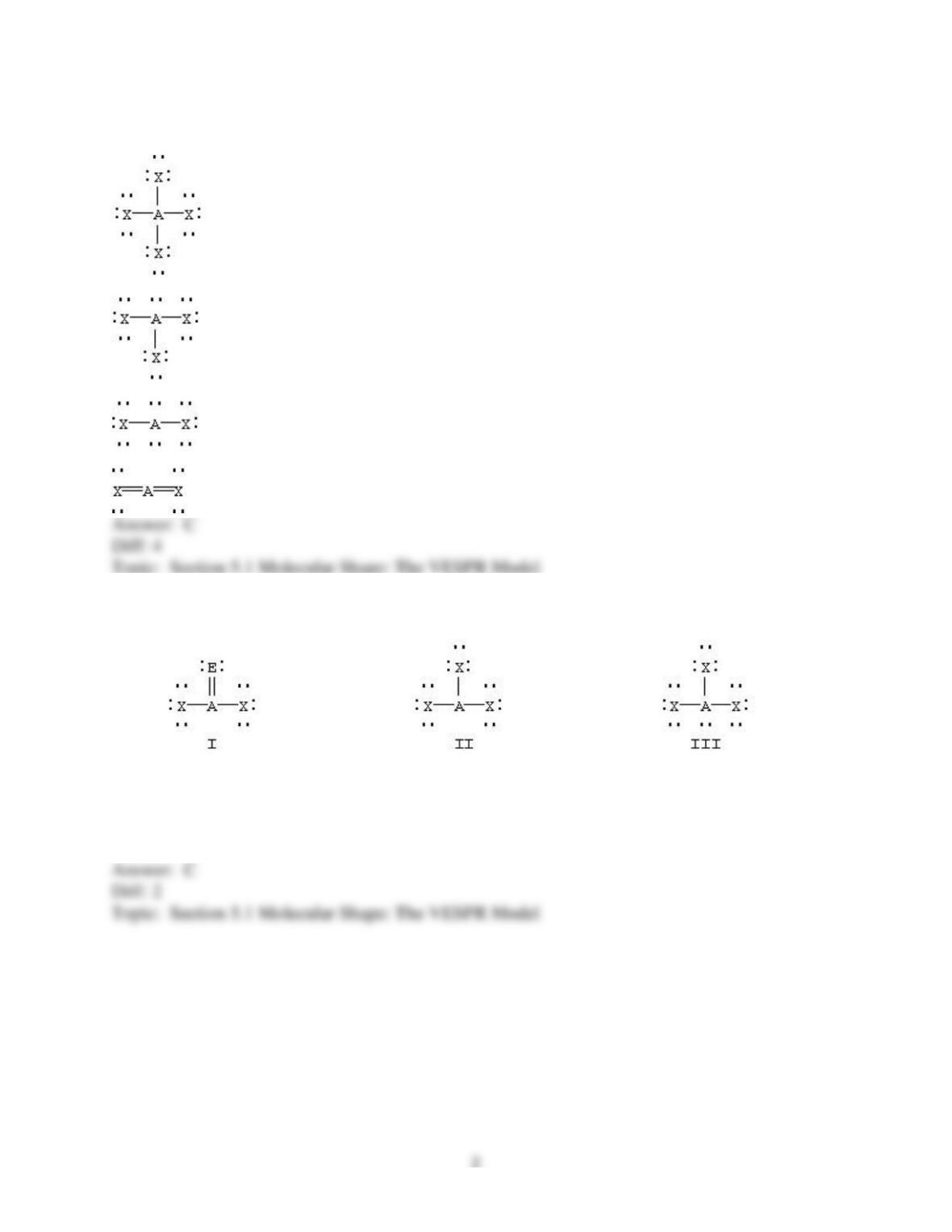
3) Based on VSEPR theory, which should have the smallest XAX bond angle?
A)
B)
C)
D)
4) Which of the following should be nonplanar?
A) only I
B) only II
C) only III
D) I and III
5) What is the molecular geometry of BrF4–?
A) seesaw
B) square planar
C) square pyramidal
D) tetrahedral
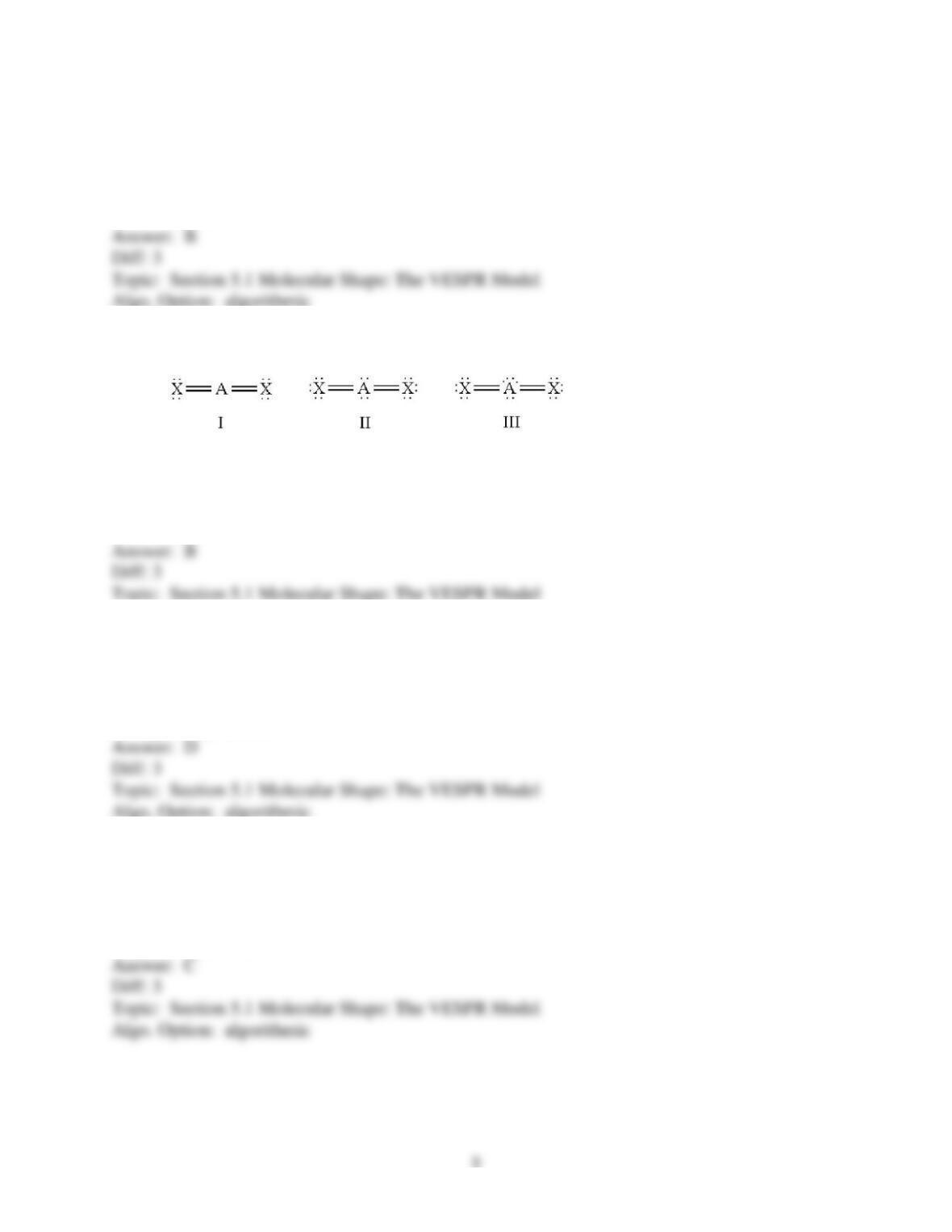
6) Which of the following should be nonlinear?
A) only I
B) only II
C) only III
D) II and III
7) What is the molecular geometry of AsCl3?
A) T-shaped
B) tetrahedral
C) trigonal planar
D) trigonal pyramidal
8) What is the O–N–O bond angle in NO3–?
A) less than 109.5°
B) 109.5°
C) 120°
D) greater than 120°
9) What is the molecular geometry of IF5?
A) octahedral
B) seesaw
C) square pyramidal
D) trigonal bipyramidal
10) Which of the following best describes ICl2–? It has a molecular geometry that is
A) linear molecular shape with no lone pairs on the I atom.
B) linear molecular shape with lone pairs on the I atom.
C) non-linear molecular shape with no lone pairs on the I atom.
D) non-linear molecular shape with lone pairs on the I atom.
11) What is the molecular geometry of TeCl4?
A) seesaw
B) square planar
C) square pyramidal
D) tetrahedral
12) What is the smallest bond angle in SF6?
A) 60°
B) 90°
C) 109.5°
D) 120°
13) Arrange in order from the smallest to the largest bond angle: CH3+, NF3, NH4+, XeF4.
A) CH3+, NF3, NH4+, XeF4
B) NF3, NH4+, XeF4, CH3+
C) XeF4, NH4+, NF3, CH3+
D) XeF4, NF3, NH4+, CH3+
14) The VSEPR model predicts the O–O–O bond angle in O3 to be
A) 90°.
B) 109.5°.
C) less than 120° but greater than 109.5°.
D) 120°.
15) Which of the following is not a valence bond concept?
A) The greater the overlap between the orbitals on two atoms, the stronger the bond.
B) Lone pair electrons are in atomic orbitals or in hybrid atomic orbitals.
C) Atomic orbitals on two atoms may overlap to form antibonding orbitals.
D) A pair of electrons in a bond is shared by both atoms.
16) A single sp3 hybrid orbital has
A) one lobe.
B) two lobes of equal size.
C) two lobes of unequal size.
D) four lobes of equal size.
17) The number of sp2 hybrid orbitals on the carbon atom in CO32– is
A) one.
B) two.
C) three.
D) four.
18) Which orbital hybridization is associated with a tetrahedral charge cloud arrangement?
A) sp
B) sp2
C) sp3
D) None of the above
19) Which of the following is not true?
A) The sp3 hybrid orbitals are degenerate.
B) An sp3 hybrid orbital may hold a lone pair of electrons.
C) An sp3 hybrid orbital may form a sigma bond by overlap with an orbital on another atom.
D) An sp3 hybrid orbital may form a pi bond by overlap with an orbital on another atom.
20) A triple bond is generally composed of
A) three π bonds.
B) two π bonds and one σ bond.
C) one π bond and two σ bonds.
D) three σ bonds.
7
21) The orbital hybridization on the carbon atom in HCN is
A) sp.
B) sp2.
C) sp3.
D) none of the above.
22) What orbital hybridization is expected for the central atom in a molecule with a trigonal
planar geometry?
A) sp
B) sp2
C) sp3
D) None of the above
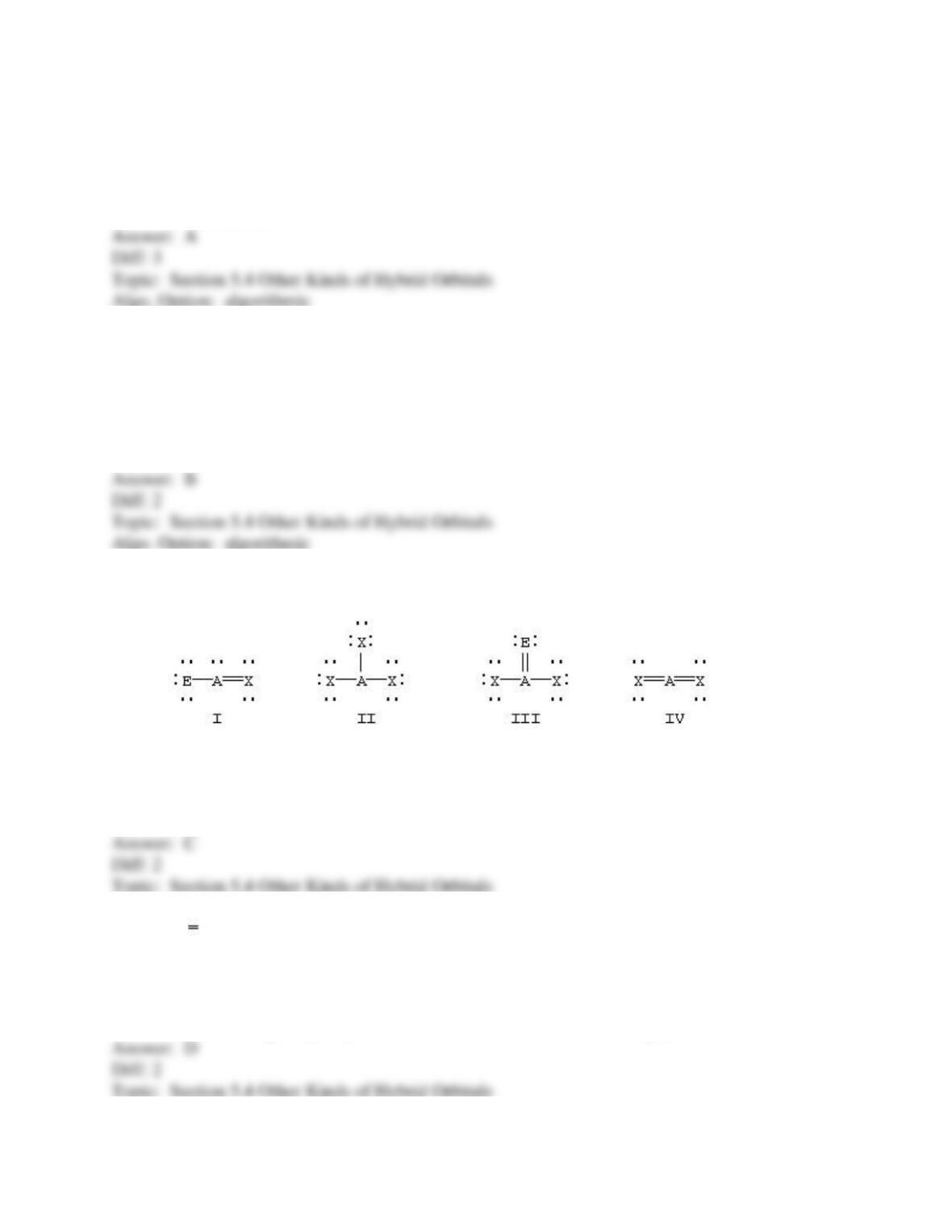
23) Which of the following would be expected to have sp2 hybridization on atom A?
A) II
B) I and III
C) I, II, and III
D) I and IV
24) The C O bond in COCl2 can be described as
A) a σ bond and a π bond, both involving sp hybrid orbitals on C.
B) a σ bond involving an sp hybrid orbital on C and a π bond involving a p orbital on C.
C) a σ bond and a π bond, both involving sp2 hybrid orbitals on C.
D) a σ bond involving an sp2 hybrid orbital on C and a π bond involving a p orbital on C.
25) What is the angle between adjacent sp3 hybrid orbitals?
A) 90°
B) 109.5°
C) 120°
D) 180°
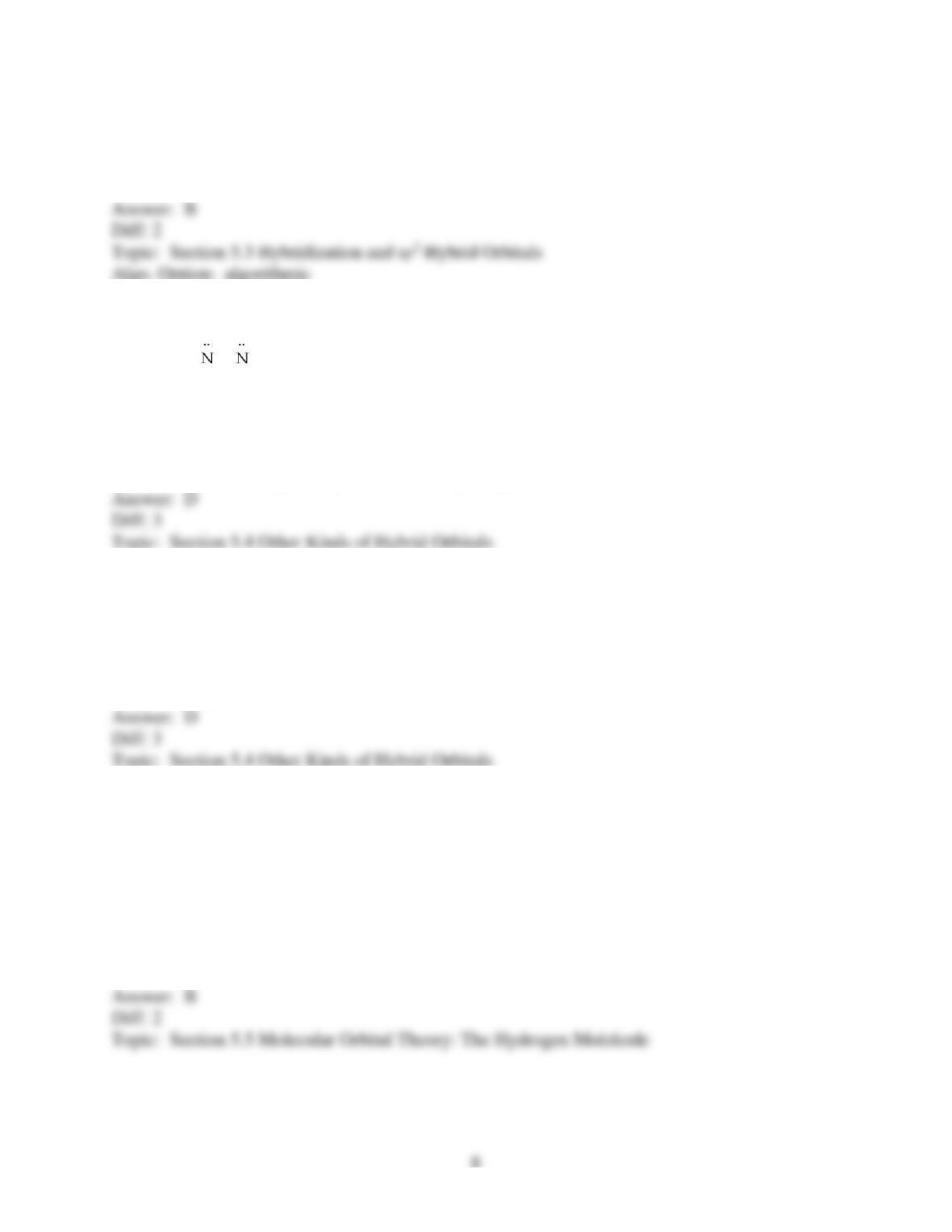
26) Which atomic orbitals are involved in bonding and which as lone pair orbitals for N2H2?
H –=– H
A) bonding: s on H, sp2 on N lone pair: p on N
B) bonding: sp2 on both H and N lone pair: p on N
C) bonding: s on H, p on N lone pair: sp2 on N
D) bonding: s on H, sp2 and p on N lone pair: sp2 on N
27) What is the hybridization on the N atom in NO2– and in NO3–?
A) sp2 for NO2– and sp3 for NO3–
B) sp3 for NO2– and sp2 for NO3–
C) sp for NO2– and sp2 for NO3–
D) sp2 for both
28) Compare the energies of molecular orbitals of homonuclear diatomic molecules with the
energies of the atomic orbitals with which they correlate.
A) Both bonding and antibonding molecular orbitals lie lower in energy than the atomic orbitals.
B) Bonding orbitals are lower and antibonding orbitals are higher in energy than the atomic
orbitals.
C) Bonding orbitals are higher and antibonding orbitals are lower in energy than the atomic
orbitals.
D) Both bonding and antibonding molecular orbitals are higher in energy than the atomic
orbitals.
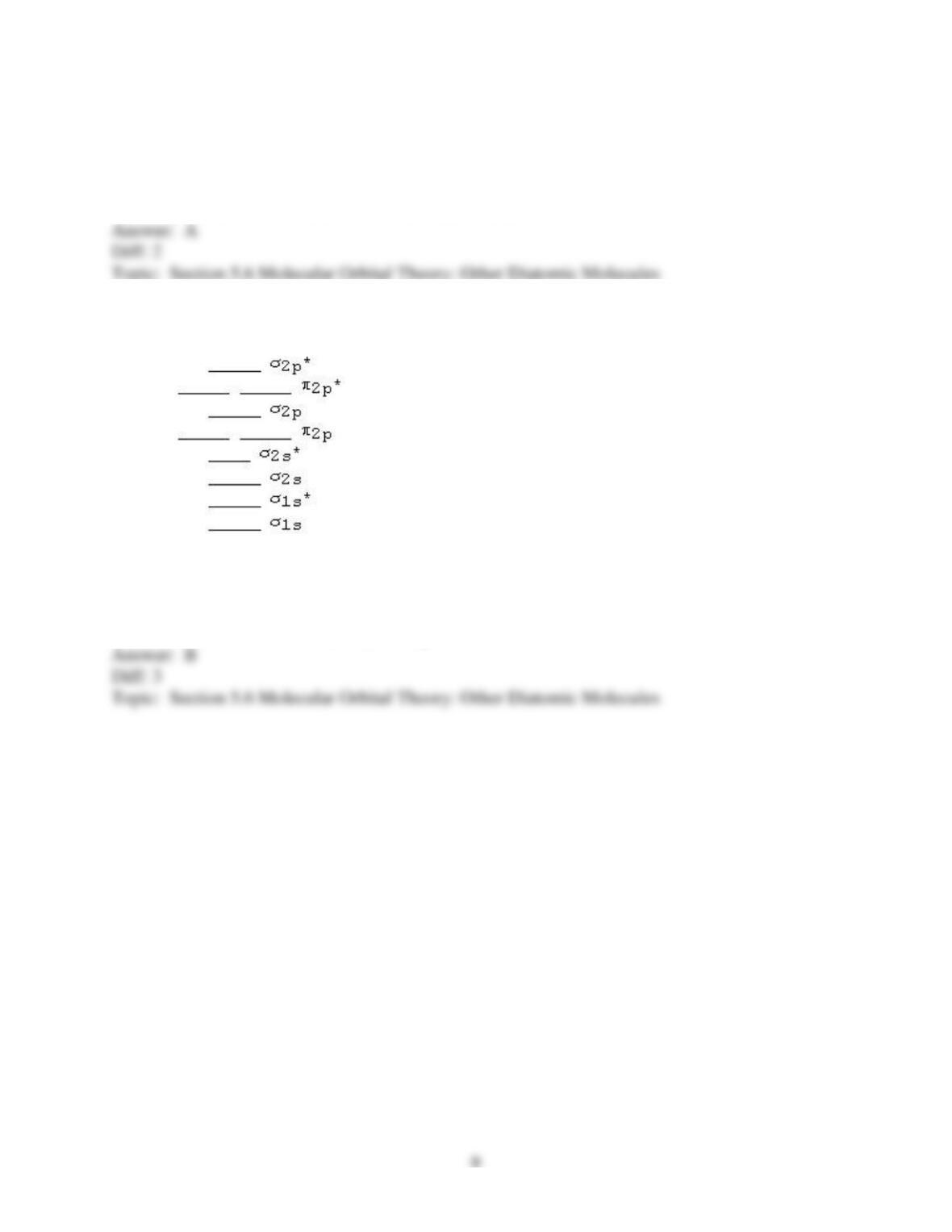
29) Which molecular orbitals for homonuclear diatomic molecules are degenerate?
A) π molecular orbitals
B) σ molecular orbitals
C) π molecular orbitals and σ molecular orbitals
D) neither π molecular orbitals nor σ molecular orbitals
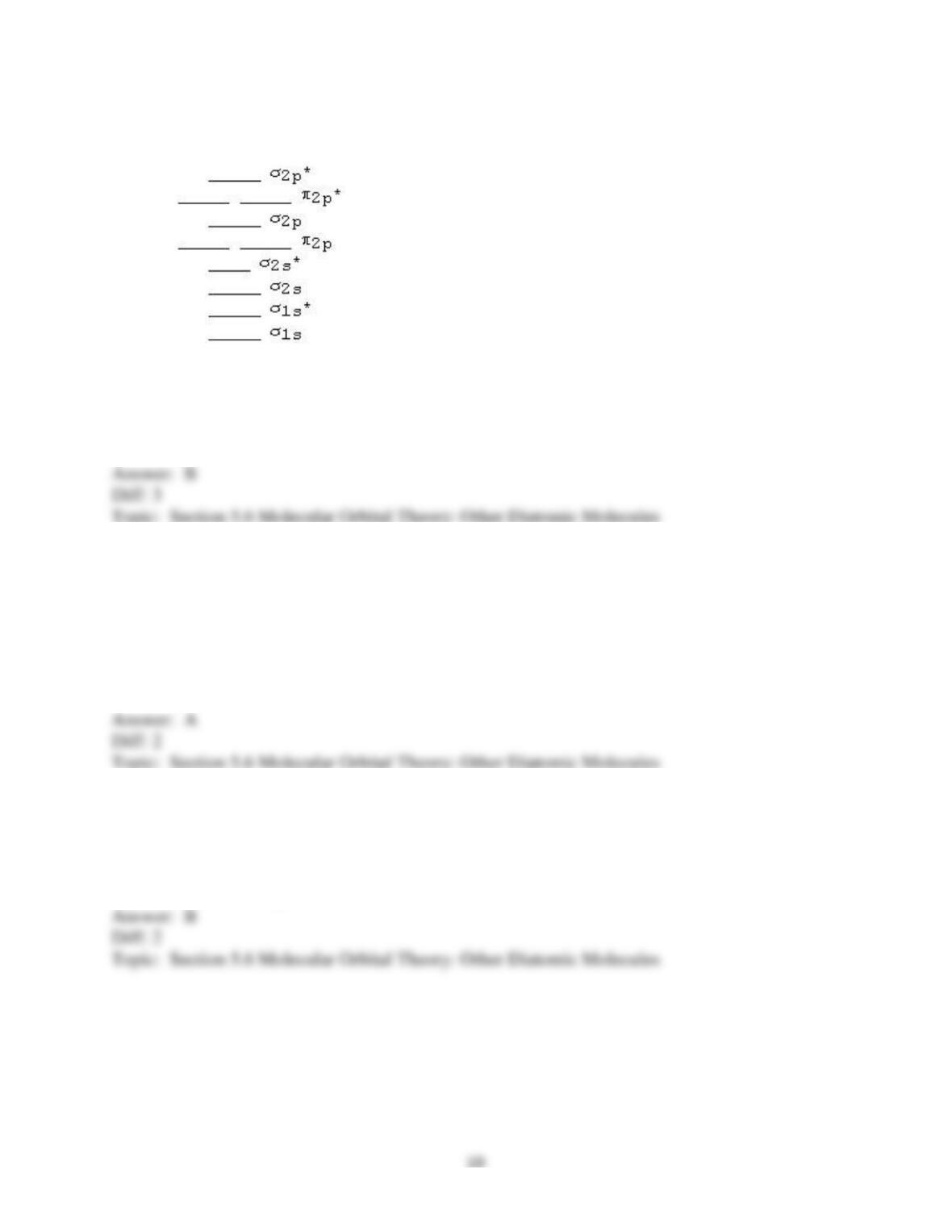
30) The MO diagram below is appropriate for B2. Based on this diagram, B2
A) has a bond order of one and is diamagnetic.
B) has a bond order of one and is paramagnetic.
C) has a bond order of two and is diamagnetic.
D) has a bond order of two and is paramagnetic.
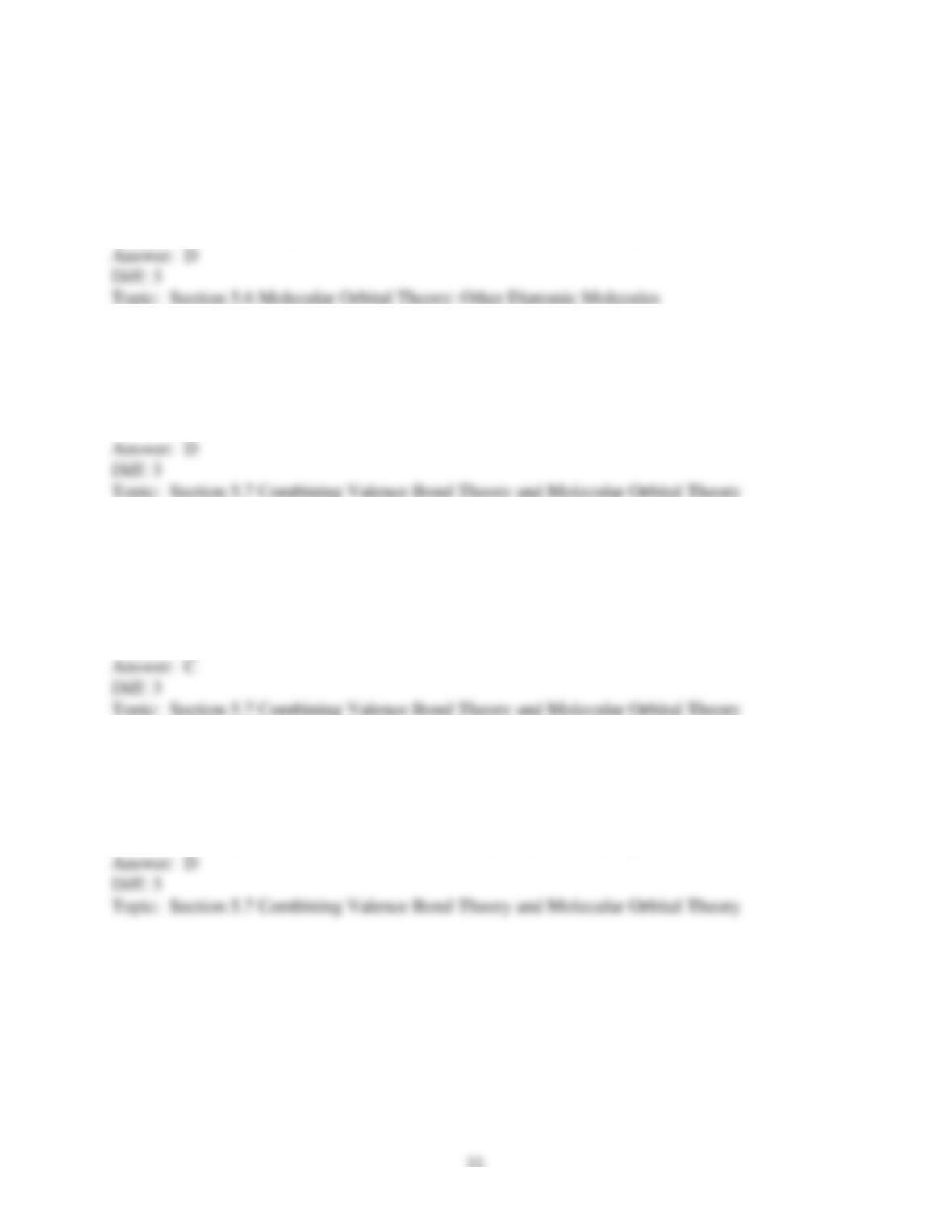
31) The following MO diagram is appropriate for Li2 and Be2. Based on this diagram,
A) both are stable and diamagnetic.
B) Li2 is stable and diamagnetic, but Be2 is unstable.
C) Be2 is stable and diamagnetic, but Li2 is unstable.
D) Be2 is stable and paramagnetic, but Li2 is unstable.
32) Given that O2 is paramagnetic and has a bond order of 2, and its highest occupied molecular
orbital is antibonding, what would be the expected bond orders for O22- and O22+?
A) 1 for O22- and 3 for O22+
B) 3/2 for O22- and 5/2 for O22+
C) 5/2 for O22- and 3/2 for O22+
D) 3 for O22- and 1 for O22+
33) The paramagnetism of O2 is explained by
A) coordinate covalent bonding.
B) molecular orbital theory.
C) resonance.
D) valence bond theory.
34) Which statement concerning any homonuclear diatomic molecule and its 1- ion must be true?
A) X2 must be more stable than X2–.
B) X2 must be less stable than X2–.
C) X2– must be paramagnetic and X2 must be diamagnetic.
D) X2– must be paramagnetic and X2 may be paramagnetic or diamagnetic.
35) Molecular orbitals extending over more than two atoms provide an explanation for
A) coordinate covalent bonding.
B) ionic bonding.
C) paramagnetism.
D) resonance.
36) The SO3 molecule can be described as having 3 S-O σ bonds and π molecular orbitals
containing
A) 2 electrons.
B) 4 electrons.
C) 6 electrons.
D) 8 electrons.
37) Which is the best description of the bonding in NO3–?
A) 3 N-O σ bonds and no N–O π bonds
B) 3 N-O σ bonds and 3 N–O π bonds
C) no N-O σ bonds and delocalized N–O π molecular orbitals extending over all four atoms
D) 3 N-O σ bonds and delocalized N–O π molecular orbitals extending over all four atoms
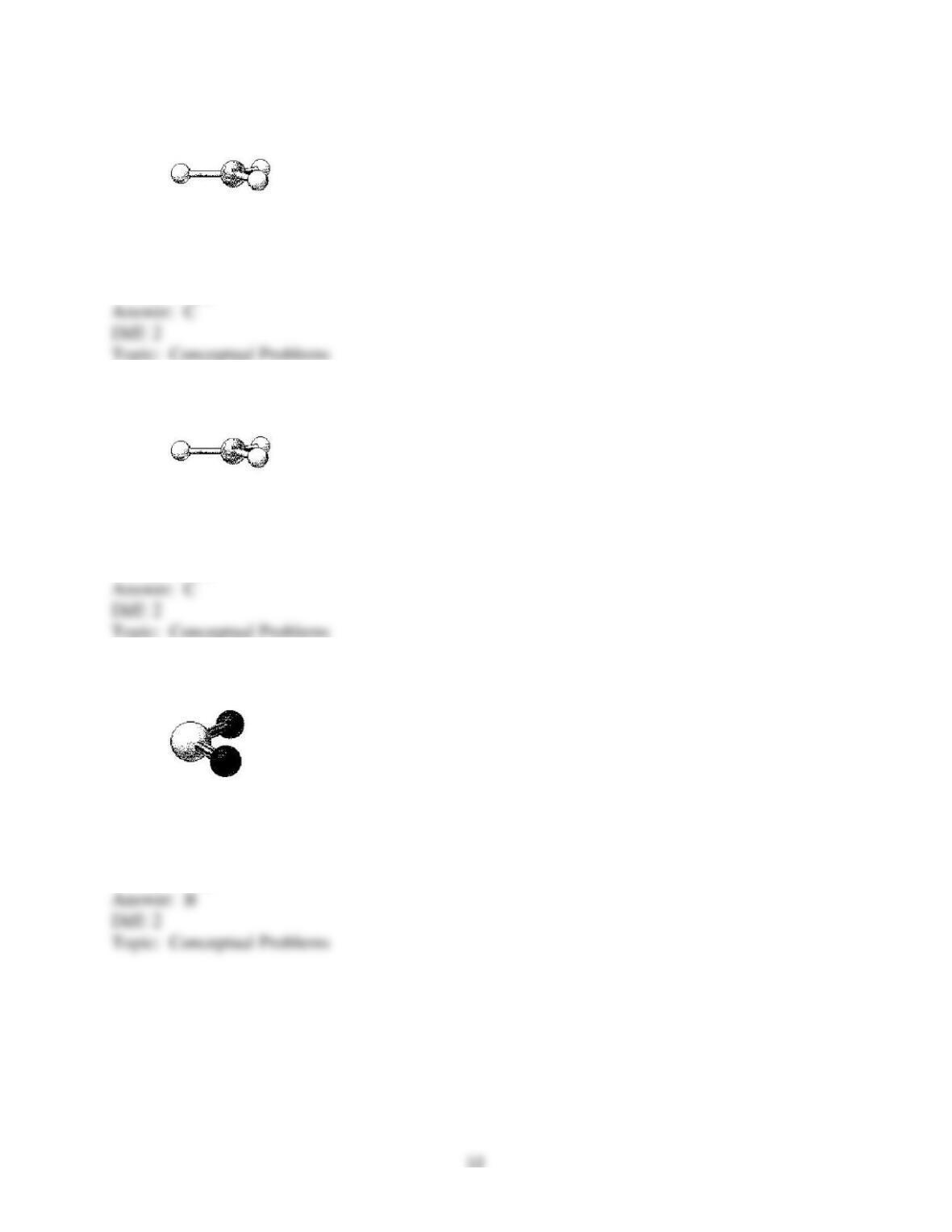
38) What is the geometry around the central atom in the following molecular model of BCl3?
A) linear
B) bent
C) trigonal planar
D) trigonal pyramidal
39) What is the geometry around the central atom in the following molecular model of NO3–?
A) linear
B) bent
C) trigonal planar
D) trigonal pyramidal
40) What is the geometry around the central atom in the following molecular model of SO2?
A) linear
B) bent
C) trigonal planar
D) trigonal pyramidal
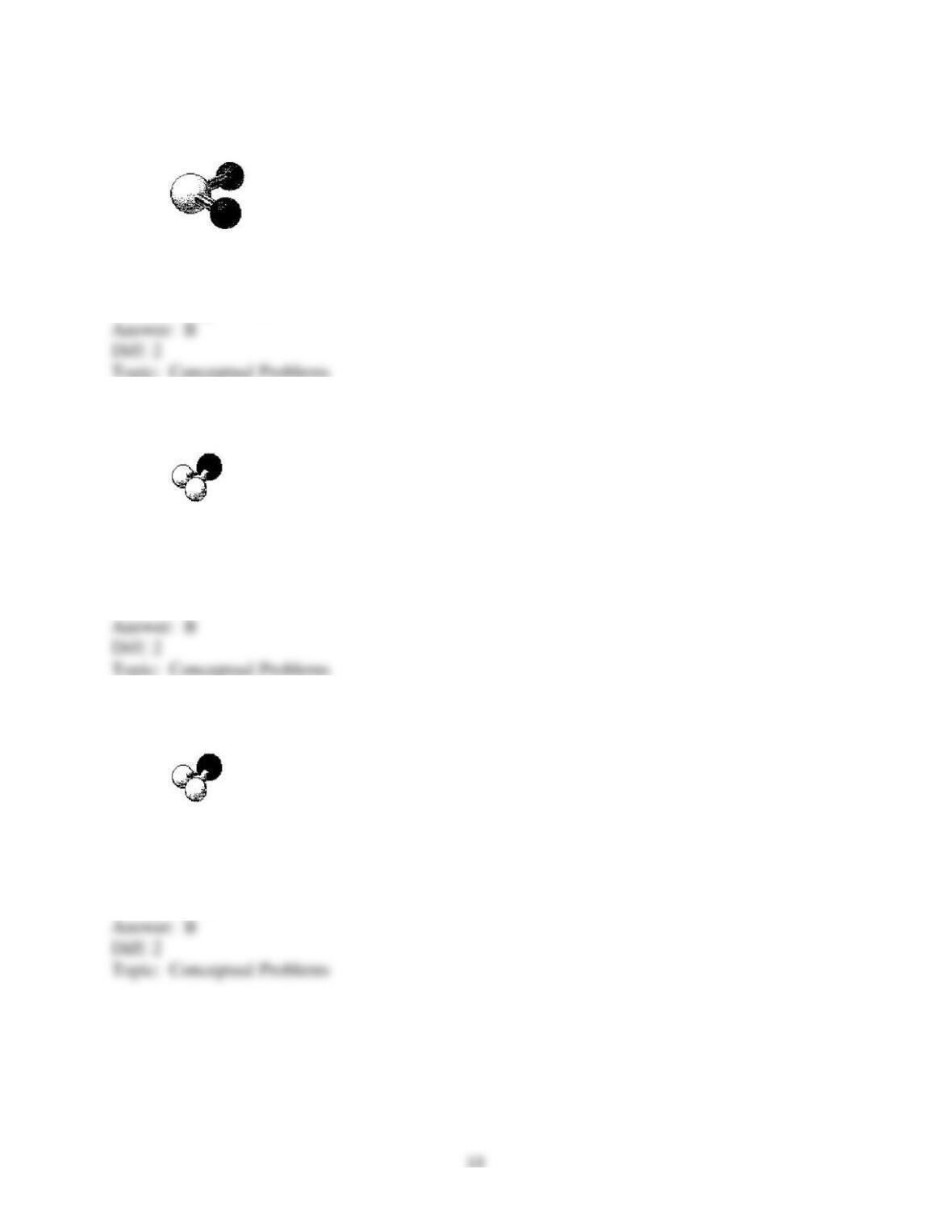
41) What is the geometry around the central atom in the following molecular model of NO2–?
A) linear
B) bent
C) trigonal planar
D) trigonal pyramidal
42) What is the geometry around the central atom in the following molecular model of H2S?
A) linear
B) bent
C) trigonal pyramidal
D) tetrahedral
43) What is the geometry around the central atom in the following molecular model of NH2–?
A) linear
B) bent
C) trigonal pyramidal
D) tetrahedral
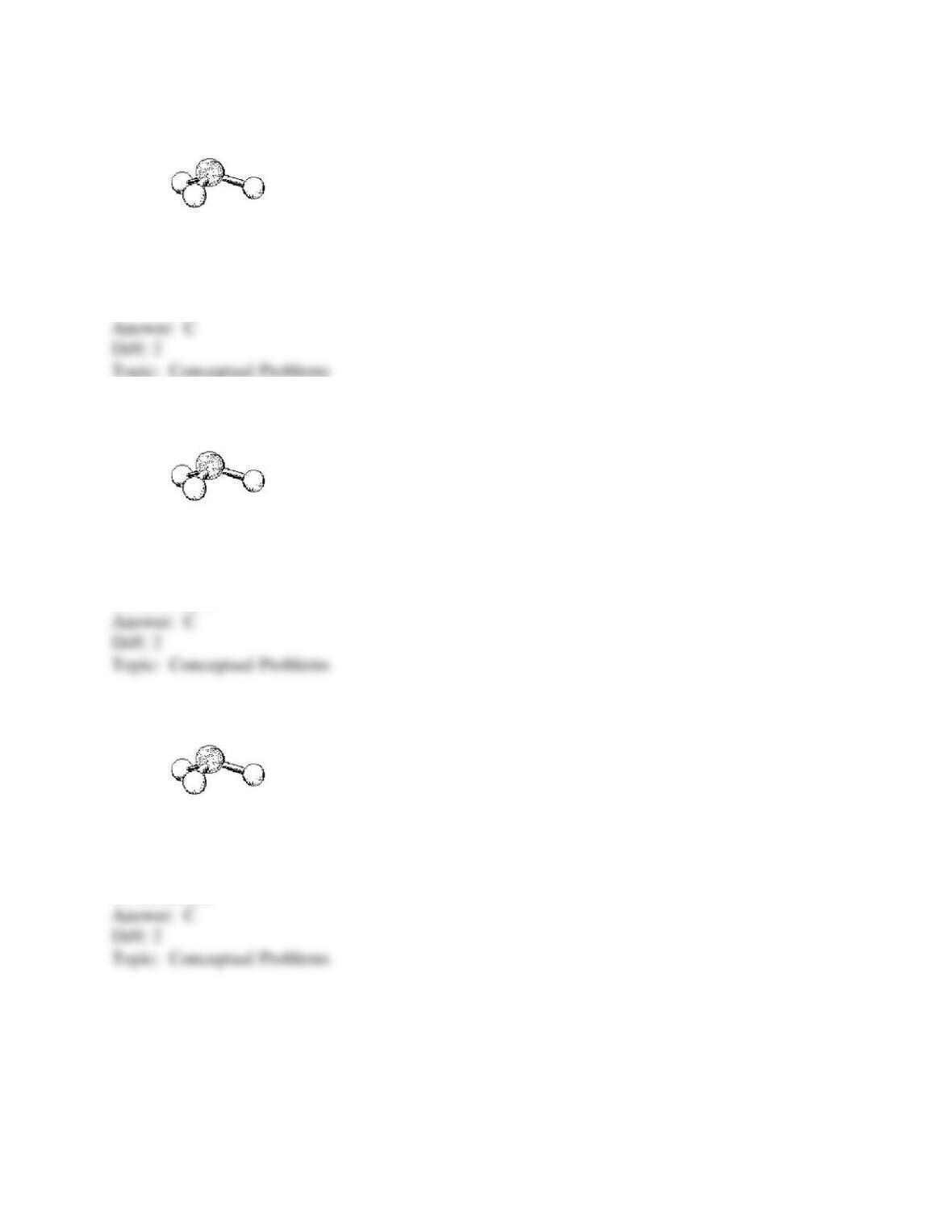
14
44) What is the geometry around the central atom in the following molecular model of PH3?
A) linear
B) bent
C) trigonal pyramidal
D) tetrahedral
45) What is the geometry around the central atom in the following molecular model of SO32-?
A) linear
B) bent
C) trigonal pyramidal
D) tetrahedral
46) What is the geometry around the central atom in the following molecular model of H3O+?
A) linear
B) bent
C) trigonal pyramidal
D) tetrahedral
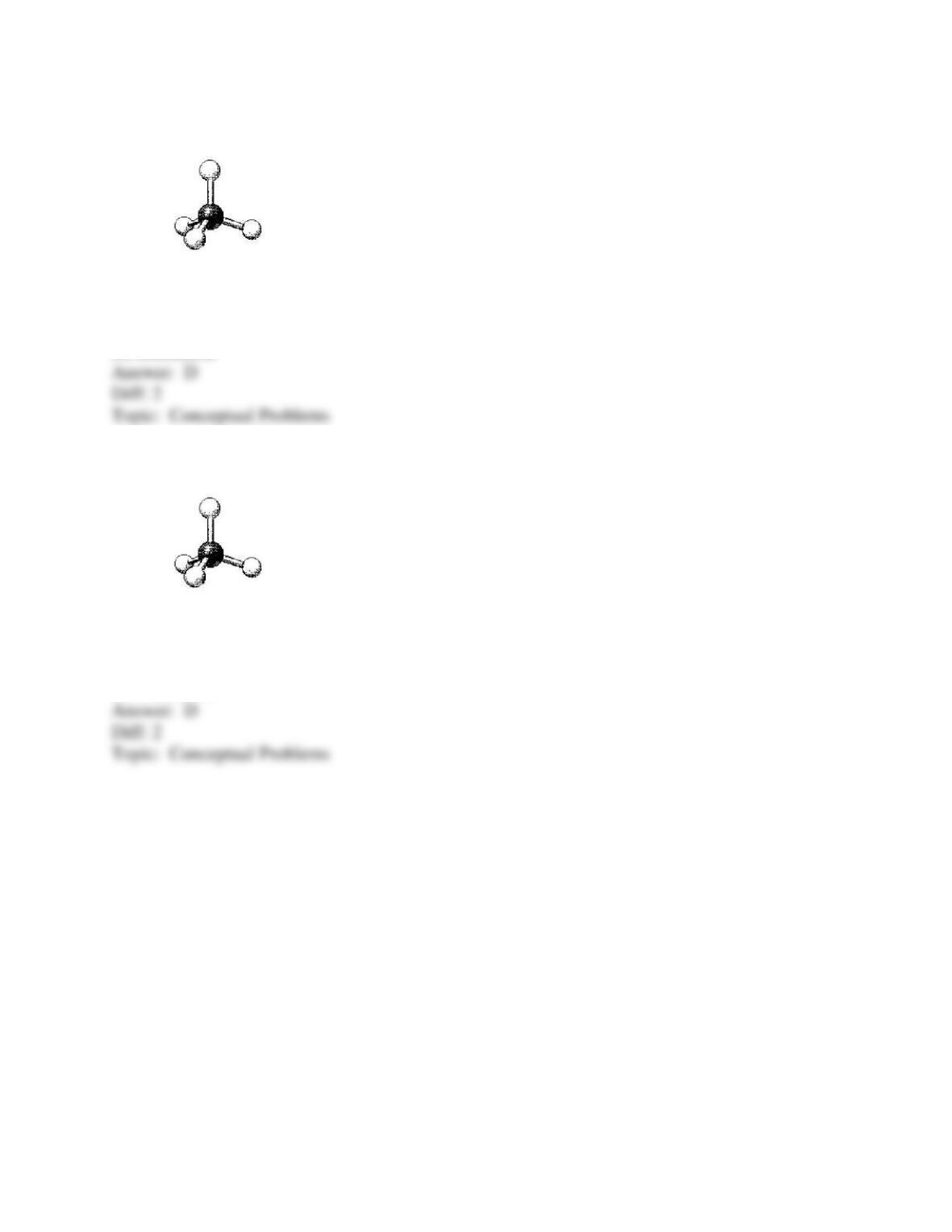
15
47) What is the geometry around the central atom in the following molecular model of CCl4?
A) linear
B) bent
C) trigonal pyramidal
D) tetrahedral
48) What is the geometry around the central atom in the following molecular model of NH4+?
A) linear
B) bent
C) trigonal pyramidal
D) tetrahedral
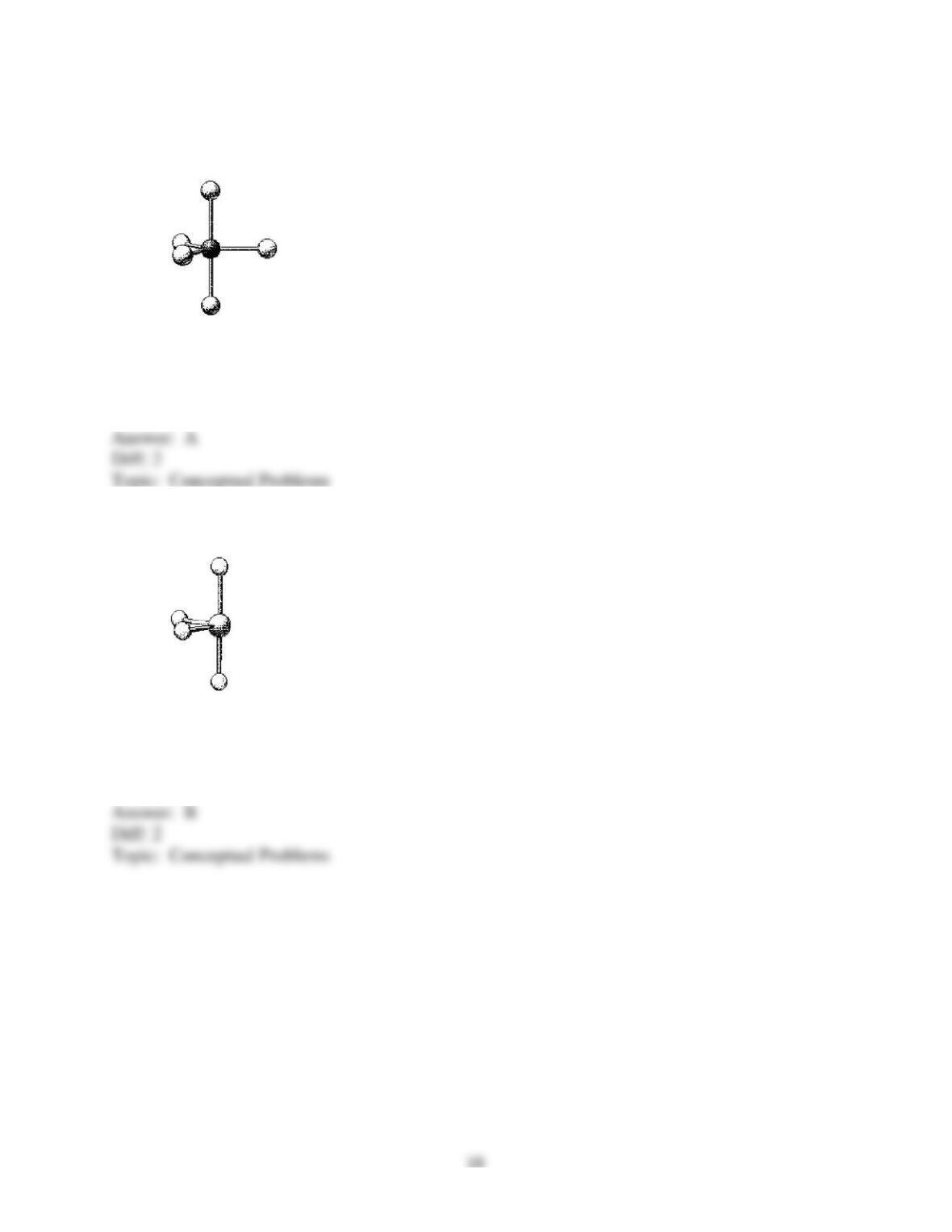
49) What is the geometry around the central atom in the following molecular model of PF5?
A) trigonal bipyramidal
B) seesaw
C) T-shaped
D) linear
50) What is the geometry around the central atom in the following molecular model of SCl4?
A) trigonal bipyramidal
B) seesaw
C) T-shaped
D) linear
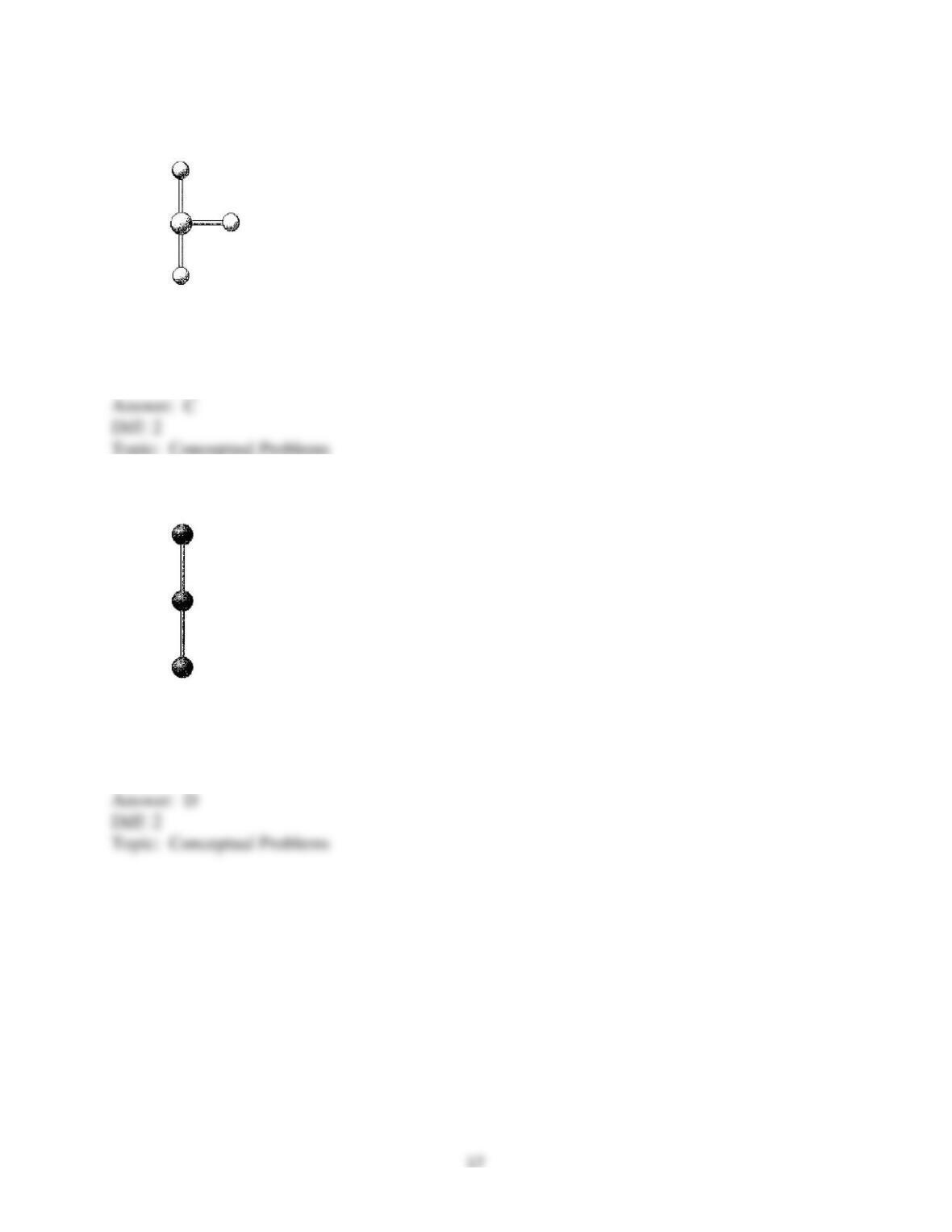
51) What is the geometry around the central atom in the following molecular model of BrF3?
A) trigonal bipyramidal
B) seesaw
C) T-shaped
D) linear
52) What is the geometry around the central atom in the following molecular model of XeF2?
A) trigonal bipyramidal
B) seesaw
C) T-shaped
D) linear
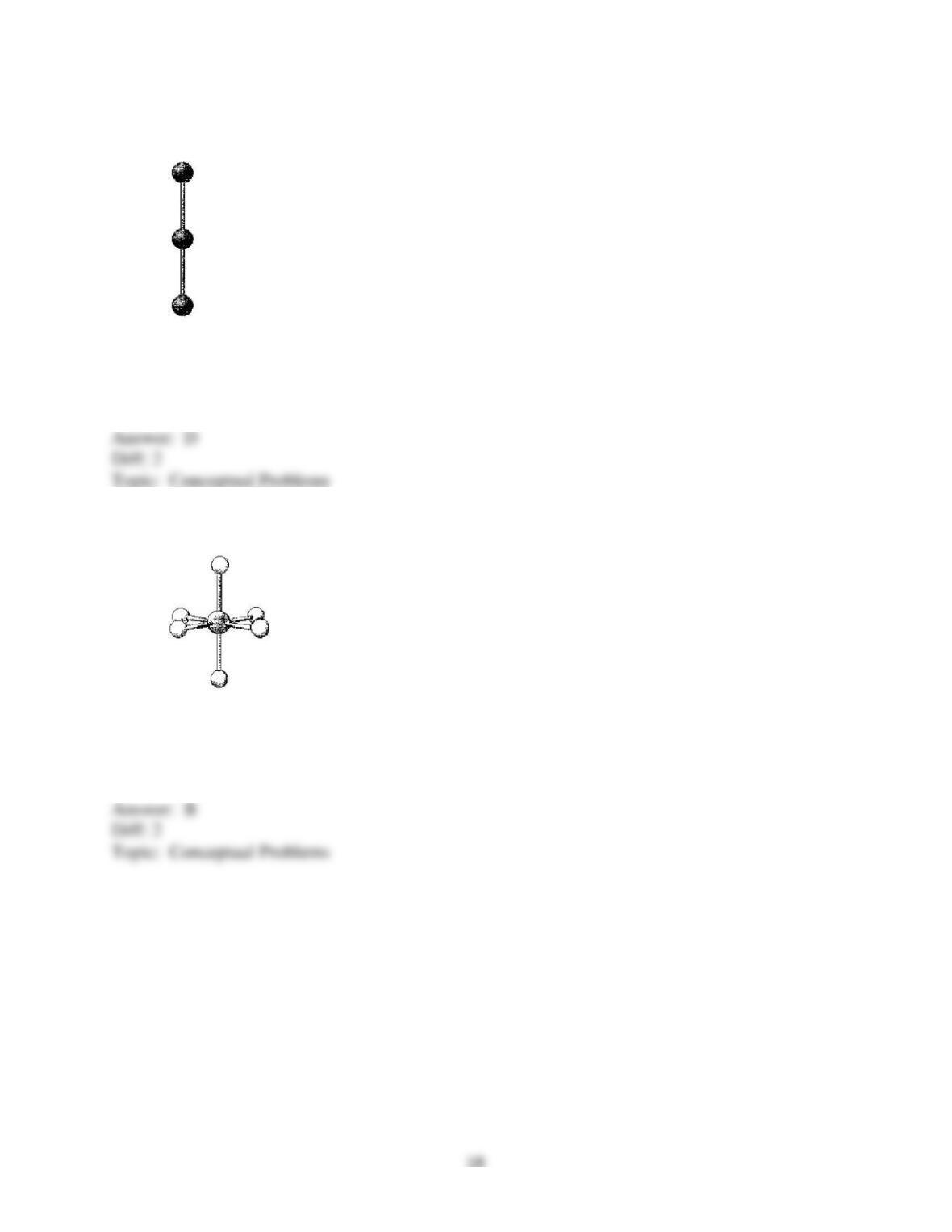
53) What is the geometry around the central atom in the following molecular model of I3–?
A) trigonal bipyramidal
B) seesaw
C) T-shaped
D) linear
54) What is the geometry around the central atom in the following molecular model of SF6?
A) trigonal bipyramidal
B) octahedral
C) square pyramidal
D) square planar
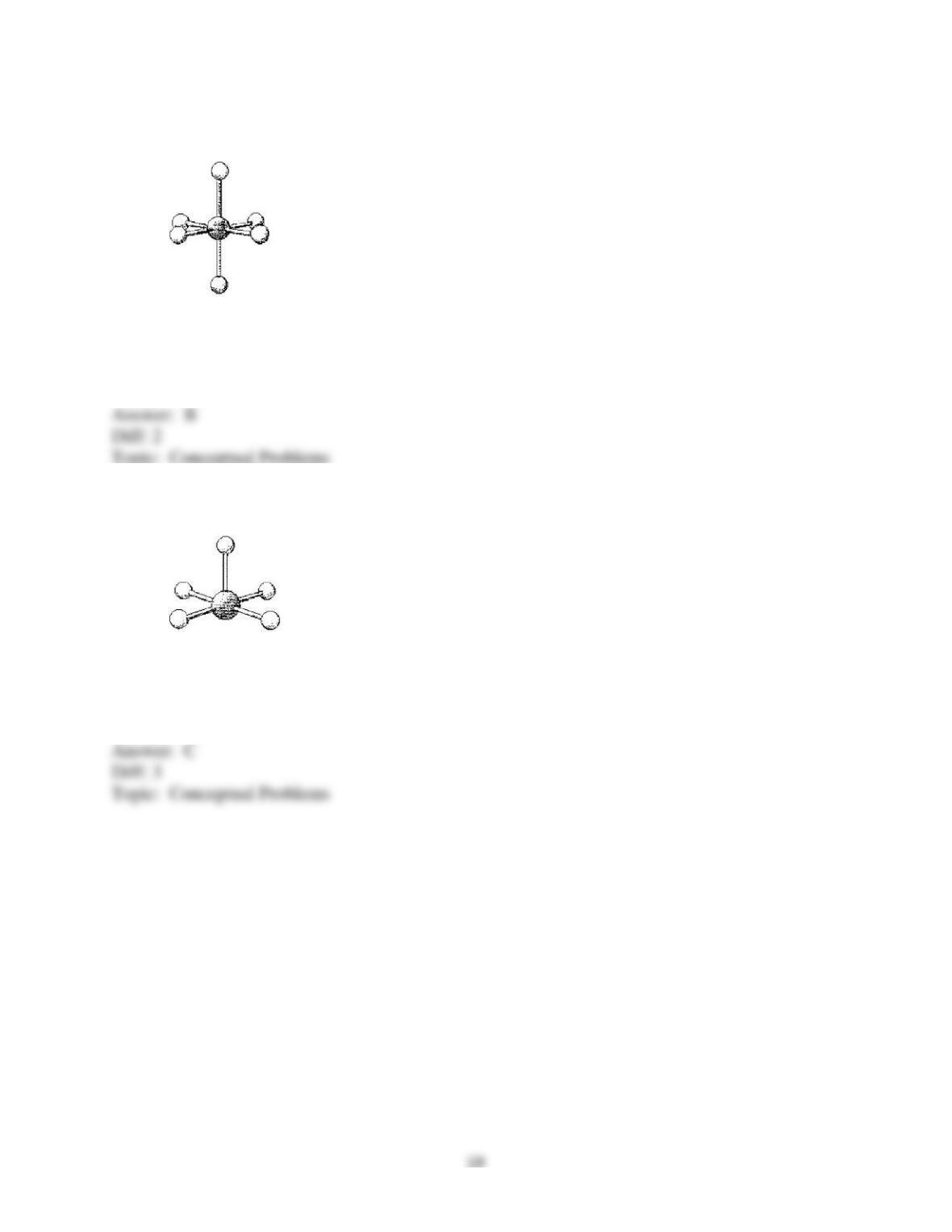
55) What is the geometry around the central atom in the following molecular model of PF6–?
A) trigonal bipyramidal
B) octahedral
C) square pyramidal
D) square planar
56) What is the geometry around the central atom in the following molecular model of BrF5?
A) trigonal bipyramidal
B) octahedral
C) square pyramidal
D) square planar
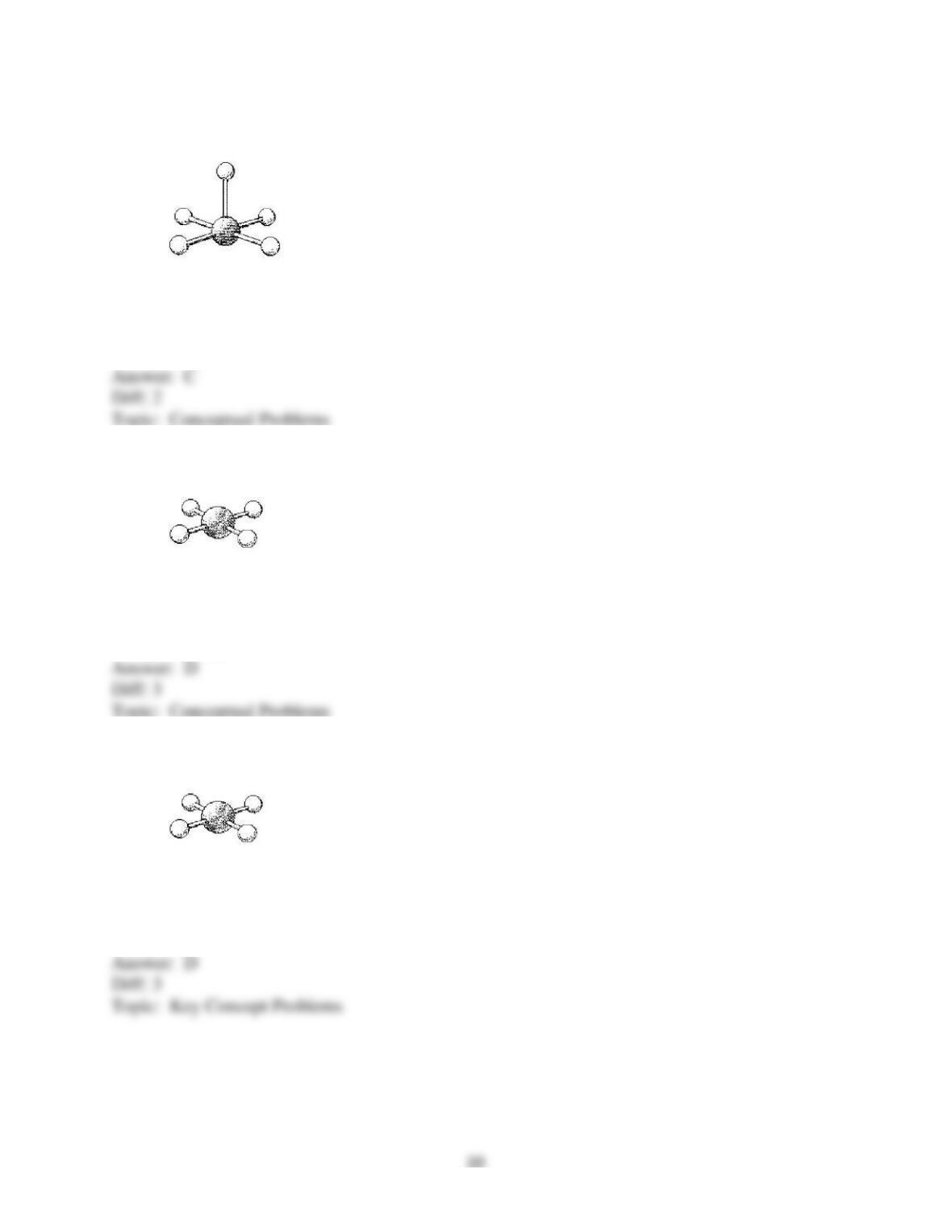
57) What is the geometry around the central atom in the following molecular model of TeF5–?
A) trigonal bipyramidal
B) octahedral
C) square pyramidal
D) square planar
58) What is the geometry around the central atom in the following molecular model of XeF4?
A) trigonal bipyramidal
B) octahedral
C) square pyramidal
D) square planar
59) What is the geometry around the central atom in the following molecular model of ICl4–?
A) trigonal bipyramidal
B) octahedral
C) square pyramidal
D) square planar