Exam
Name___________________________________
MULTIPLE CHOICE. Choose the one alternative that best completes the statement or answers the question.
1)
Let g(t) = 100 – 100e–0.01t be the number of cases of measles in a certain school t days after the first
case is reported. Which of the following best describes the spread of the disease?
1)
A)
Initially, the disease spreads quickly, but then the rate of increase slows so that the number of
cases never exceeds 100.
B)
The disease spreads quickly until the number of cases reaches 100; then gradually the number
of cases decreases.
C)
The number of cases decreases according to exponential decay.
D)
After the first day there are 100 cases, after which the number of cases decreases daily to 0.
E)
none of these
Solve the problem.
2)
In a certain country, the rate of increase of the population is proportional to the population P(t). In
fact, P'(t) = 0.23P(t). Suppose that initially the country’s population is 50,000, and that 10 years later
there are 500,000 people. Which of the following equations expresses this information
mathematically?
2)
A)
500,000 =e0.23(10)
B)
500,000 = 50,000e2.3
C)
500 =e2.3(50)
D)
10 =e2.3t
E)
none of these
3)
Let P(t) be the quantity of strontium–90 remaining after t years. Suppose the half–life of
strontium–90 is 28 years. Which of the following equations expresses the half–life information?
3)
A)
28 =1
2P0e–kt
B)
P1
2= 28P0
C)
P(28) =1
2P0
D)
28 =1
2P0
E)
none of these
4)
Sixteen pounds of a radioactive substance loses one fourth of its original mass in 2 days. The mass
m(t) remaining at time t is given by:
4)
A)
m(t) = 16e0.144t
B)
m(t) = 4e–0.693t
C)
m(t) = 16e–0.693t
D)
m(t) = 16e0.693t
5)
A high school student deposits a $500 graduation gift in a bank account that pays 4.8% interest
compounded continuously. How much will the account be worth after 18 months?
5)
A)
$1123.95
B)
$1162.71
C)
$1027.22
D)
$973.71
E)
none of these
6)
Let A'(t) = 0.3(25,000 – A(t)), A(0) = 0. Which of the following is the formula for A(t)?
6)
A)
A(t) = 25,000e–3t
B)
A(t) = 25,000(1 – 0.3t)
C)
A(t) = 25,000(1 –e–0.3t)
D)
A(t) = 25,000e(1 – 0.3t)
E)
none of these
SHORT ANSWER. Write the word or phrase that best completes each statement or answers the question.
Solve the problem.
7)
A colony of bacteria is growing at a rate proportional to the number of bacteria present. At
the beginning of an experiment there were about 103 bacteria present. In two hours, the
count rose to 3 ×10³ bacteria. At what time will there be 6 ×10³ bacteria present?
Enter just a real number rounded up to one decimal place (no units).
7)
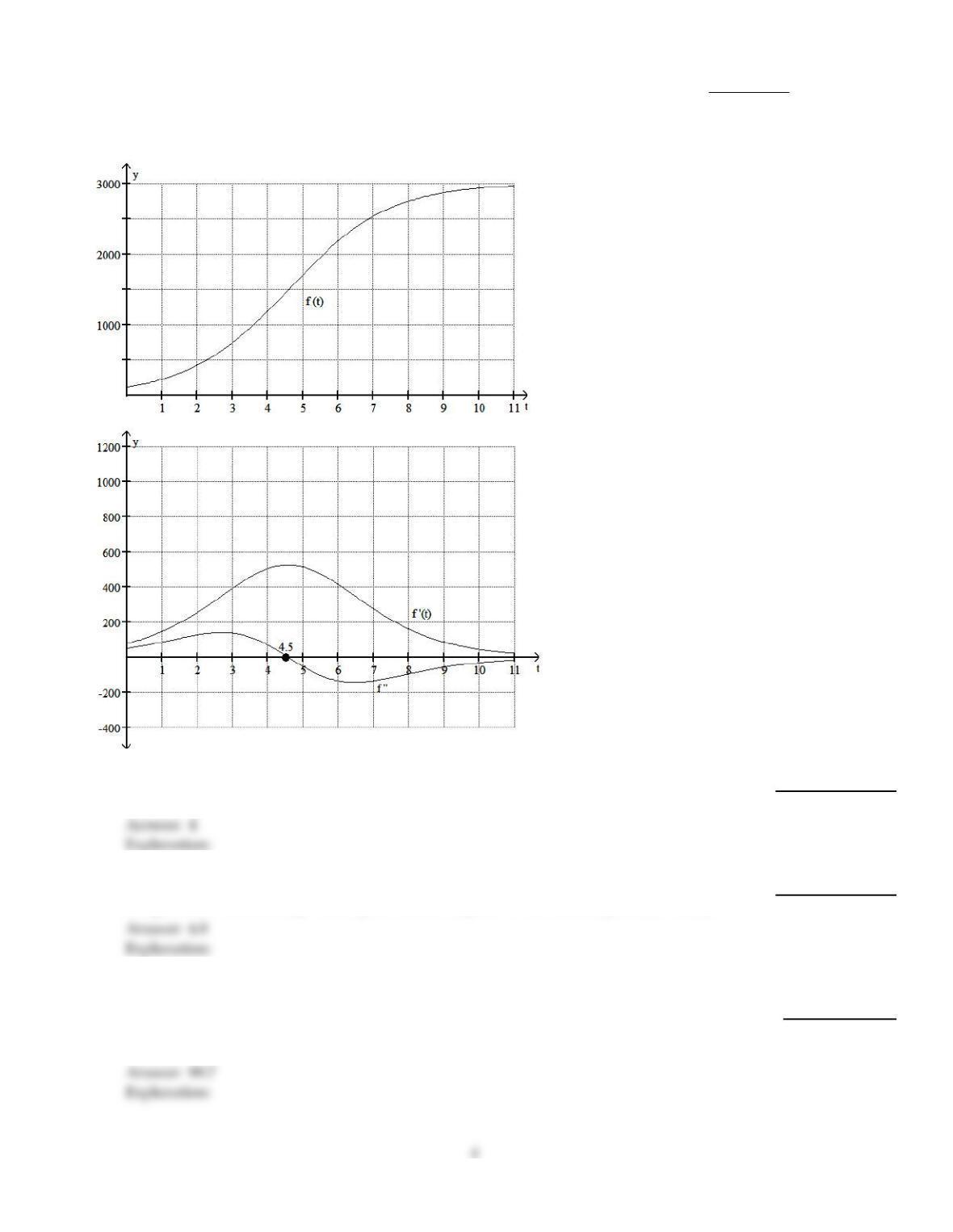
A rumor is spread by word of mouth to a potential audience of 3000 people. After t days, f(t) =3000
1 +
25e–0.7t people will
have heard the rumor. The graphs are shown below.
8)
Approximately when will 1250 people have heard the rumor? Enter just an integer (no
units).
8)
9)
How long is required for an investment of $2000 to double if the interest is 10%
compounded continuously? Enter your answer in years to one decimal place (no units).
9)
Solve the problem.
10)
Krypton 85 gas leaks into the reactor room of an electric power plant. Its half–life is 10
years. How long is it before 99.9% of the krypton decays?
Enter your answer as just a real number rounded to one decimal place (no units).
10)
11)
Find a so that y = 1 +eax2 solves the differential equation y’ = x – xy.
Enter just a reduced fraction of form a
b.
11)
12)
Suppose that the value in billions of dollars of a company is determined to be
f(t) = 0.5t + 0.2e–t where t is measured in years. What is the percentage rate of growth of
the company at time t = 0?
Enter just an integer (no units).
12)
13)
If y = 10(1 –e–2x) and y’ = a –2y, find a.
Enter just an integer.
13)
14)
A manufacturer has a demand function q =100 –p3. Determine the elasticity of demand
as a function of p.
Enter your answer exactly as P(p)
Q(p) where P, Q are polynomials in p in standard form, and
the leading coefficient of P is a reduced fraction of form a
b.
14)
15)
If the relative rate of change of a function f is always 5, what kind of equation will f be
represented by? Enter your answer in the form: f(t) = Ceb (leave C in your answer).
15)
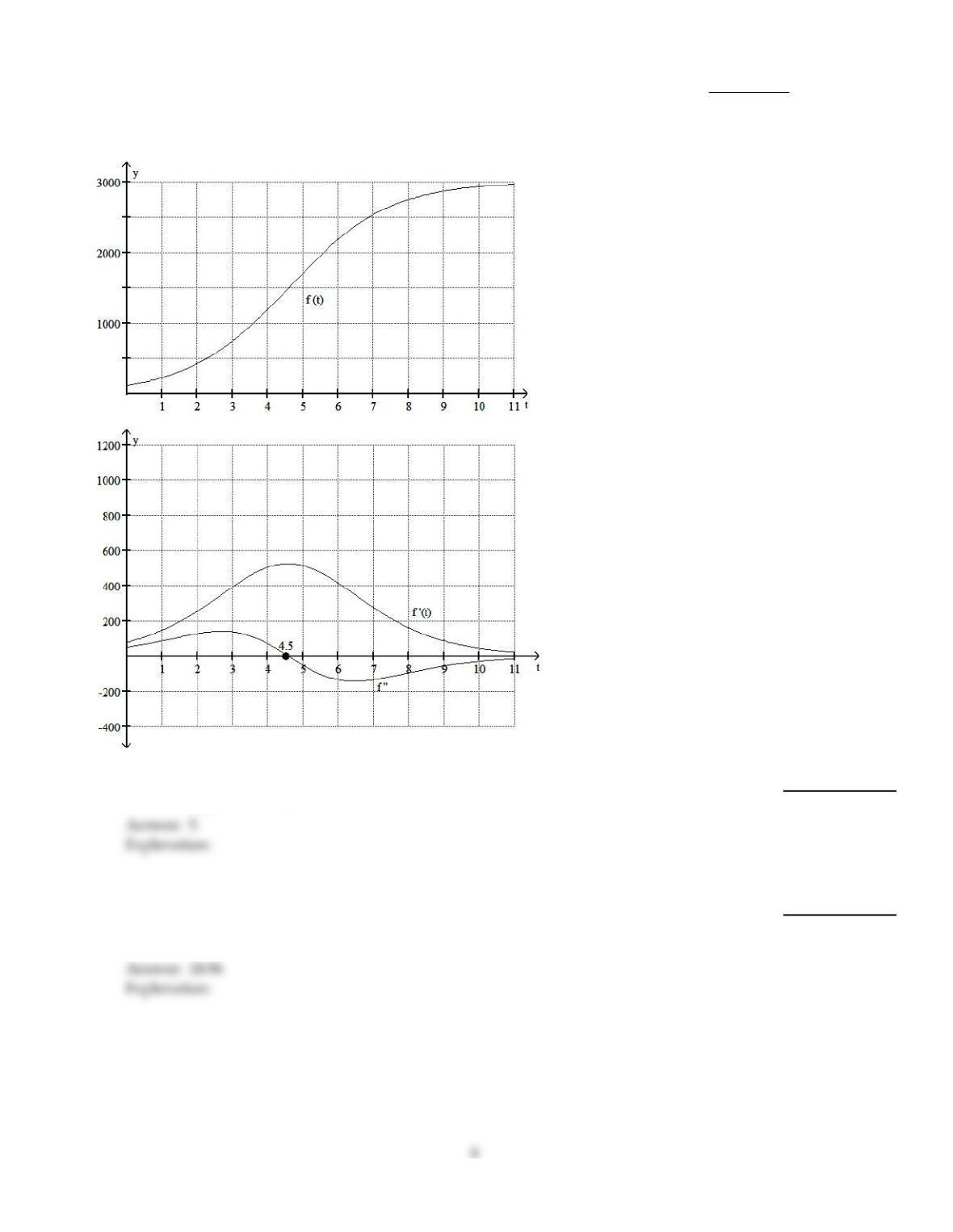
A rumor is spread by word of mouth to a potential audience of 3000 people. After t days, f(t) =3000
1 +
25e–0.7t people will
have heard the rumor. The graphs are shown below.
16)
When will the rumor be spreading at the greatest rate? Enter just an integer (round to the
nearest integer, no units)
16)
Solve the problem.
17)
Barium 140 has a half–life of 13 days. After 25 days a given sample comprises 5 grams.
How large was the original sample?
Enter your answer as a real number to two decimal places (no units).
17)

18)
A fossil was discovered that had about 70% of the 14C level found today in living matter.
Given that the decay constant for 14C is 0.00012, determine the age of the fossil.
Enter your answer exactly as just lna
b where a is a real number to one decimal place and b
is a real number to 5 decimal places.
18)
Explanation:
19)
Suppose that a school of fish in a pond grows according to the exponential law P(t) = P0ekt
and suppose that the size of the colony triples in 24 days. If the initial size of the school
was 50, when will the school contain 200 fish? Enter your answer exactly in the form
a ln b
ln c .
19)
Explanation:
20)
The population of a certain region was 10 million in 1950. By 1970, it had increased to 13.5
million. Assuming exponential growth, estimate the population in the year 2000.
Enter your answer exactly in the form aec (no units).
20)
Explanation:
21)
Potassium has a half–life of 12 hours. How long will it take for a quantity of potassium to
decay to 1
10 its original size?
Enter your answer as a real number rounded to one decimal place (no units).
21)
Explanation:
22)
A parchment is offered for sale at a Paris flea market. The owner claims it is at least 2000
years old. However, a carbon–dating test shows that 14C–12C ratio for the manuscript is
95% of the corresponding ratio for currently manufactured parchment. How old is the
manuscript? (The decay constant of 14C is 0.00012)
Enter your answer exactly in the form lna
b (no units).
22)
Explanation:
7
23)
Assume that a culture of bacteria grows at a rate proportional to its size such that if 106
bacteria are present initially, then there are 2 ×10⁶ bacteria present after 3 hours.
Determine a formula for the number of bacteria present after t hours in terms of powers of
2. (Hint: Recall that bx=e(ln b)x .)
Enter your answer exactly in the form P(x) =ab·2c/d.
23)
24)
Suppose that at any time t, a colony of fruit flies is growing at a rate equal to one half the
current size of the colony. Find a formula which gives the size of the colony at time t if
there were originally 500 fruit flies present.
Enter your answer exactly in the form: P(t) = aebt
24)
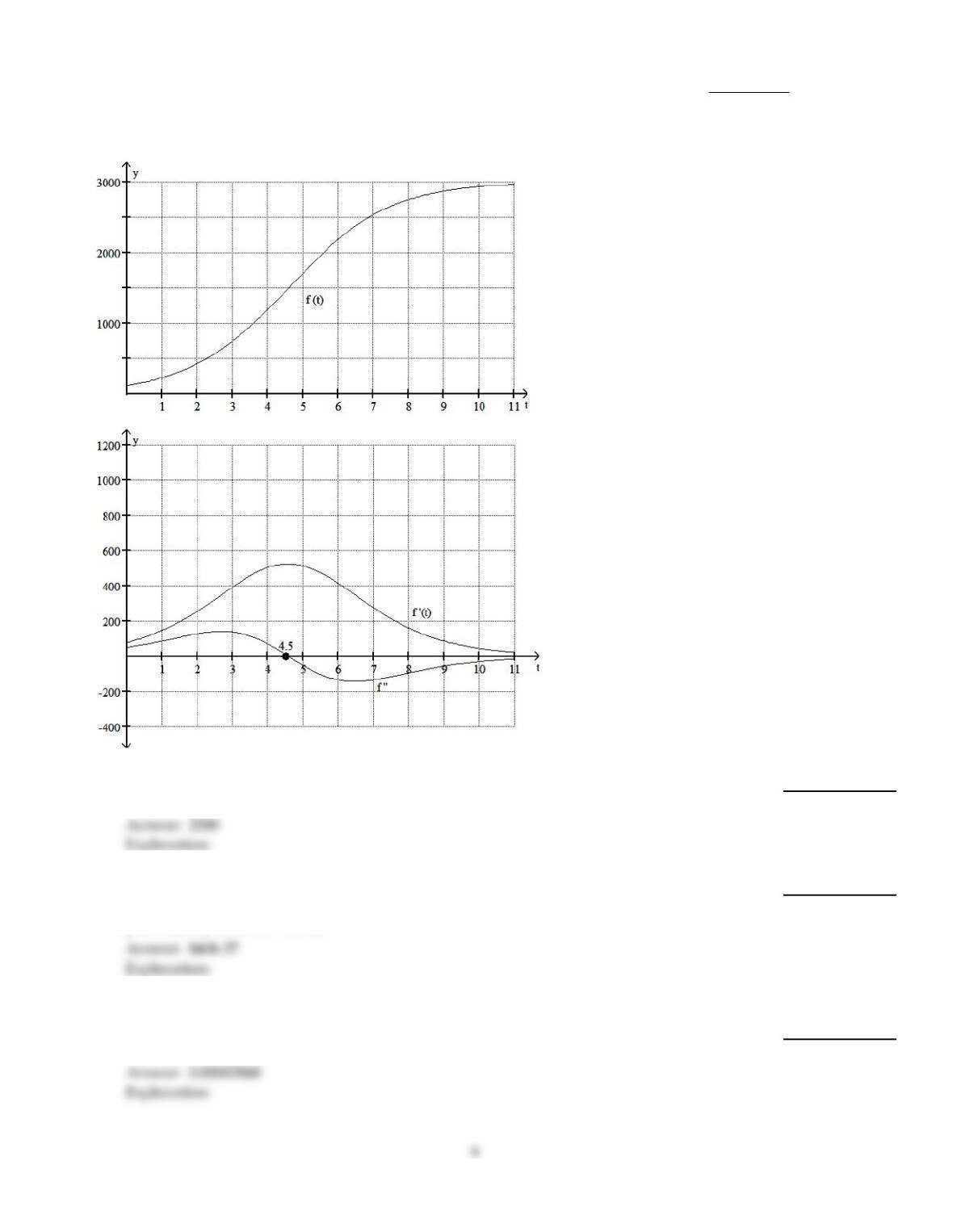
A rumor is spread by word of mouth to a potential audience of 3000 people. After t days, f(t) =3000
1 +
25e–0.7t people will
have heard the rumor. The graphs are shown below.
25)
Approximately how many people will have heard the rumor after 7 days? Enter your
answer as just an integer rounded to the nearest hundred.
25)
26)
What is the present value of an investment of $1000 payable at the end of 10 years at a 9%
rate of interest compounded continuously? Enter your answer in dollars to two decimal
places (no symbols or words).
26)
Solve the problem.
27)
Plutonium 239 has a half–life of 24,000 years. What is its decay constant?
Enter your answer as just a real number to eight decimal places.
27)
28)
The decay constant for strontium 90 is = 0.0244, where the time is measured in years.
How long will it take for a quantity P0 of strontium 90 to decay to 1
3 its original size?
Enter your answer exactly in the form lna
b where a is a reduced fraction and b is a real
number to four decimal places (no units).
28)
29)
Carbon 14 has a half–life of 5730 years. Determine its decay constant.
Enter just a real number rounded to five decimal places.
29)
30)
If y = 2(1 –e–4x) and y’ = 4 – by, find b.
Enter just an integer.
30)
31)
Suppose a manufacturer can sell q =1000
(p + 2)2– 6 units of a product when the price is p
dollars per unit. Determine the elasticity of demand, E(p), when the price is p = 8 dollars.
Enter just an integer.
31)
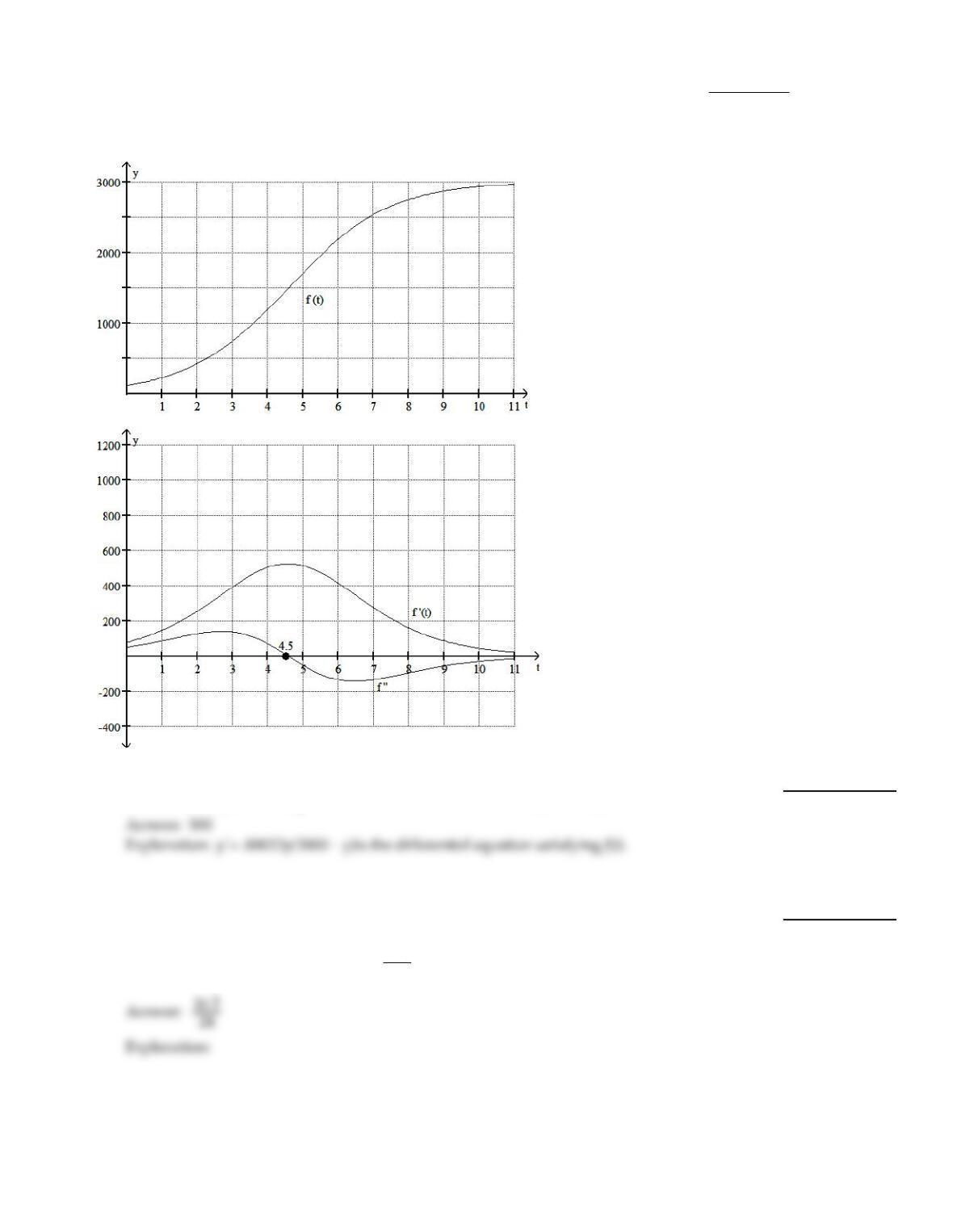
A rumor is spread by word of mouth to a potential audience of 3000 people. After t days, f(t) =3000
1 +
25e–0.7t people will
have heard the rumor. The graphs are shown below.
32)
At what rate will the rumor be spreading when half of the potential audience has heard the
rumor? Enter just an integer rounded to the nearest hundred (no units).
32)
Solve the problem.
33)
Suppose that a school of fish in a pond grows according to the exponential law P(t) =P0ekt
and suppose that the size of the colony triples in 24 days. Determine k.
Enter your answer exactly in the form ln a
b where a, b are integers.
33)
11
34)
Suppose that the value of a certain investment after t years can be approximated by the
function f(t) = 100,000e0.12t2/3. What is the dollar value of the investment after 8 years?
Enter your answer exactly in the form: aeb where a is an integer and b is a real number to
two decimal places (no units).
34)
35)
Find a so that y = 1 – ae–x solves the differential equation y’ = y – 1 + 6e–x.
Enter just an integer.
35)
36)
Mr. Jones has two investments. The first is currently worth $50,000 and has an annual
yield of 10% compounded continuously. The second is currently worth $70,000 and has an
annual yield of 8% compounded continuously. After how many years will the two
investments be worth the same amount? Enter your answer in years to one decimal place
(no units).
36)
37)
Determine the percentage rate of change of f(t) = 2t3 at t = 5.
Enter your answer as just a reduced fraction of form a
b.
37)
12
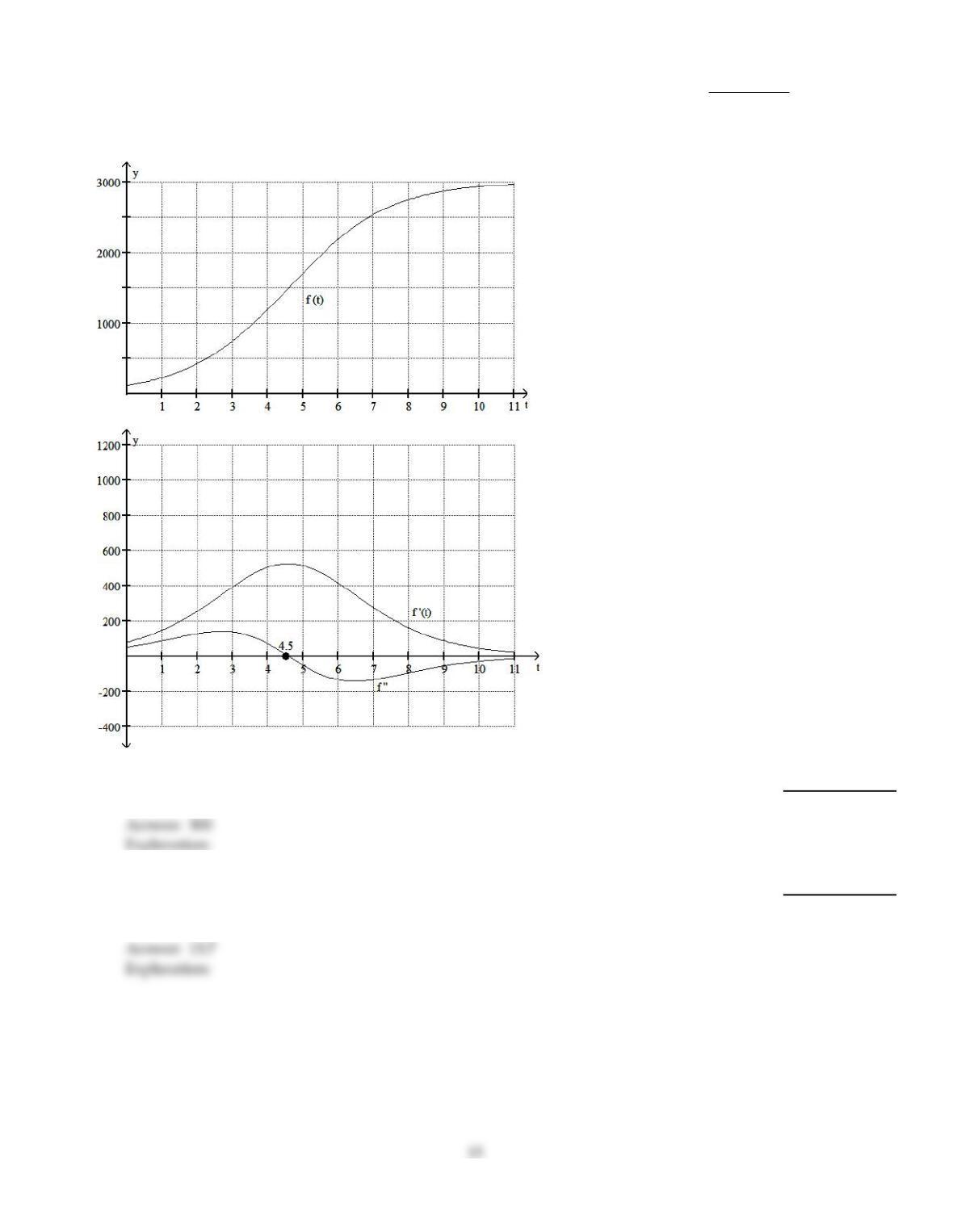
A rumor is spread by word of mouth to a potential audience of 3000 people. After t days, f(t) =3000
1 +
25e–0.7t people will
have heard the rumor. The graphs are shown below.
38)
At approximately what rate will the rumor be spreading after 7 days? Enter just an integer
rounded to the nearest hundred (no words or units).
38)
39)
What rate of interest will make an investment triple in 8 years if the interest is
compounded continuously? Enter your answer as a percent to one decimal place
(no % symbol or words).
39)
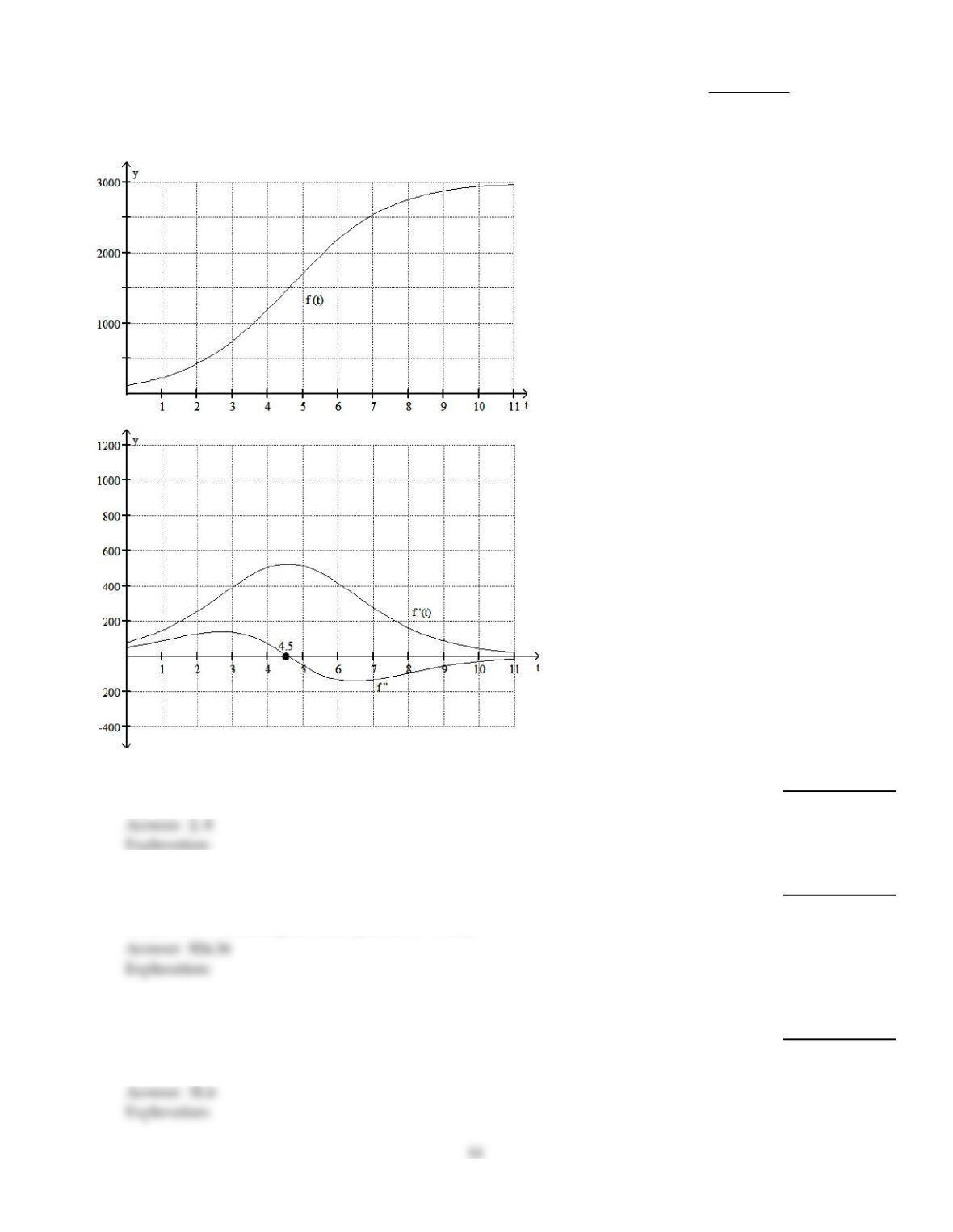
A rumor is spread by word of mouth to a potential audience of 3000 people. After t days, f(t) =3000
1 +
25e–0.7t people will
have heard the rumor. The graphs are shown below.
40)
Approximately when will the rumor be spreading at a rate of 200 people per day? Enter
just two integers a, b where a< (round to the nearest integers).
40)
41)
Suppose that $500 is deposited in a bank certificate paying 10% interest compounded
continuously. How much will the certificate be worth after 5 years? Enter your answer in
dollars to two decimal places (no symbols or words).
41)
Solve the problem.
42)
It is observed that the sales of a certain recording fall to 75% of their original level one
month after advertising stops. If this continues, what will be the sales after 4 months?
Enter just a real number rounded to one decimal place (no units or symbols).
42)
43)
A company has a demand function q= 200 – 40p. Determine the elasticity of demand as a
function of p. Enter your answer exactly as P(p)
Q(p) where P, Q are polynomials in p in
standard form.
43)
Explanation:
MULTIPLE CHOICE. Choose the one alternative that best completes the statement or answers the question.
44)
$1000 is invested at 6% interest compounded continuously. What is the value of the investment
after 5 years?
44)
A)
$1349.86
B)
$1338.23
C)
$6691.13
D)
$1822.12
E)
none of these
Explanation:
Solve the problem.
45)
The decay of 132 mg of an isotope is given by A(t) =132e–0.022t, where t is time in years. Find the
amount left after 71 years.
45)
A)
14 mg
B)
27 mg
C)
28 mg
D)
129 mg
Explanation:
46)
What will be the amount in an account with initial principal $9000 if interest is compounded
continuously at an annual rate of 5.25% for 6 years?
46)
A)
$2737.72
B)
$9485.12
C)
$9000.00
D)
$12,332.33
Explanation:
47)
You deposit $500 in a savings account paying 4% interest continuously compounded. How much
will the account be worth after 32 months?
47)
A)
$576.70
B)
$545.20
C)
$526.10
D)
$556.20
Explanation: