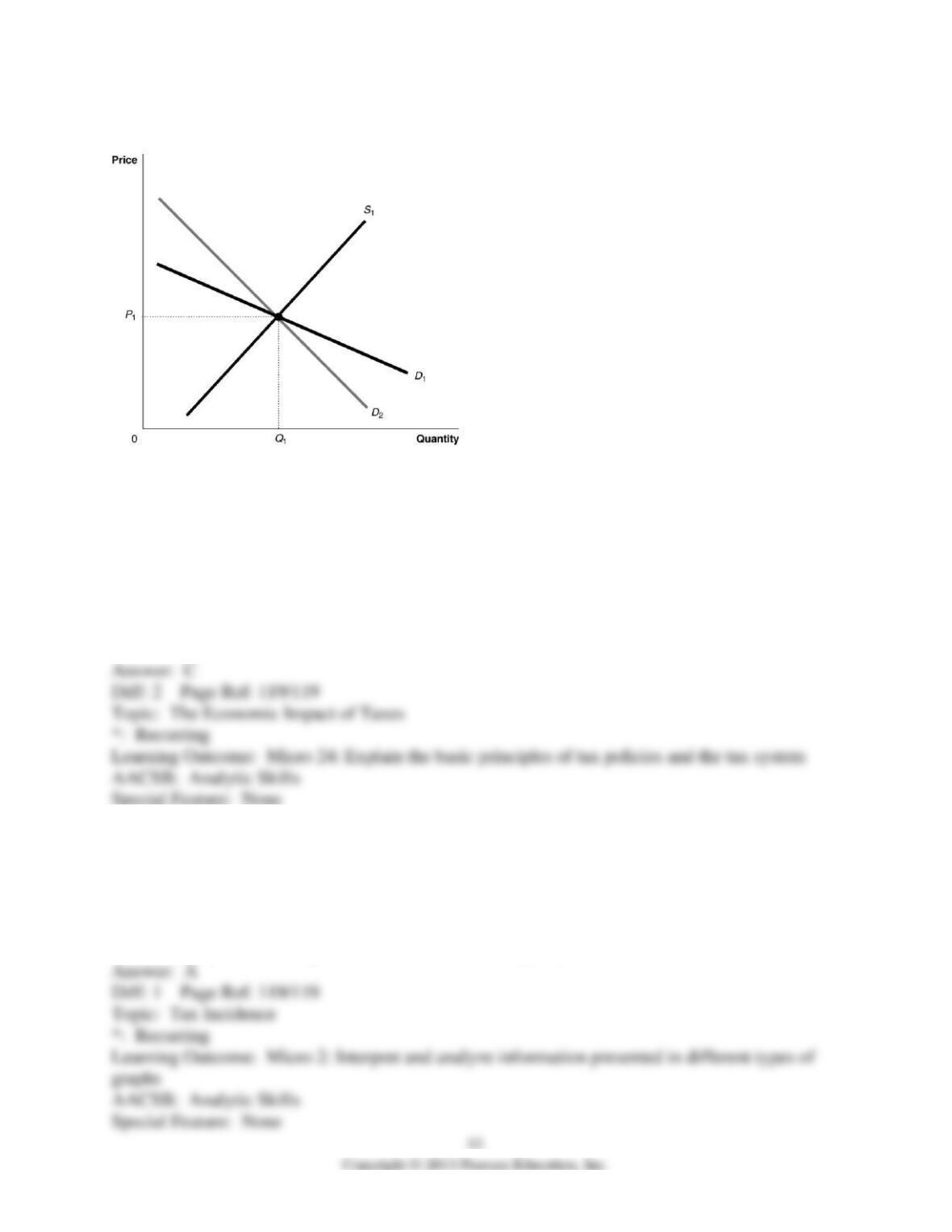
Figure 4-11
12) Refer to Figure 4-11. Suppose the market is initially in equilibrium at price P1 and then the
government imposes a tax on every unit sold. Which of the following statements best describes
the impact of the tax?
A) The consumer will bear a greater share of the tax burden if the demand curve is D1.
B) The consumer’s share of the tax burden is the same whether the demand curve is D1 or D2.
C) The consumer will bear a greater share of the tax burden if the demand curve is D2.
D) The consumer will bear the entire burden of the tax if the demand curve is D1 and the
producer will bear the entire burden of the tax if the demand curve is D2.
13) Suppose an excise tax of $0.75 is imposed on every pack of cigarettes sold and sellers are
responsible for paying this tax. How would the imposition of the tax be illustrated in a graph?
A) The supply curve for cigarettes would shift to the left by $0.75.
B) The supply curve for cigarettes would shift to the left by less than $0.75.
C) The supply curve for cigarettes would shift to the left by more than $0.75.
D) The supply curve for cigarettes would shift to the right by $0.75.
14) In Singapore the government places a $5,000 tax on the buyers of new automobiles. After the
purchase of a new car, a buyer must pay the government $5,000. How would the imposition of
the tax on buyers be illustrated in a graph?
A) The tax will shift the demand curve to the right by $5,000.
B) The tax will shift the demand curve to the left by $5,000.
C) The tax will shift both the demand and supply curve to the right by $5,000.
D) The tax will shift the supply curve to the left by $5,000.
15) A tax is imposed on employers and workers that are used to fund Social Security and
Medicare. This tax is sometimes referred to as
A) the Income Security Tax.
B) the federal income tax.
C) the ACIF.
D) the payroll tax.
16) FICA is a payroll tax imposed on employers and workers that is used to fund Social Security
and Medicare. Which of the following statements regarding the tax is true?
A) Employers are required to pay a greater share of the tax than workers but most economists
believe the burden of the tax is shared equally.
B) Congress wanted the burden of the tax to be greater for employers than for workers.
C) Most economists believe the burden of the tax falls almost entirely on workers.
D) Most economists believe the burden of the tax falls mostly on employers.
17) “Taxes are what we pay for a civilized society.” This statement was made by
A) Adam Smith.
B) Oliver Wendell Holmes.
C) Herbert Hoover.
D) Franklin Roosevelt.
18) Economists have shown that the burden of a tax is
A) greater on the buyer when the tax is collected from the buyer.
B) greater on the seller when the tax is collected from the seller.
C) greater on the buyer when the tax is collected from the seller and greater on the seller when
the tax is collected from the buyer.
D) the same whether the tax is collected from the buyer or the seller.
19) An efficient tax is
A) a tax that imposes an equal tax burden on buyers and sellers.
B) a tax that raises a maximum amount of revenue.
C) a tax that imposes a small excess burden relative to the tax revenue that it raises.
D) a tax that is used to fund research and development of new technology.
20) The division of the burden of a tax between buyers and sellers in a market is called tax
incidence.
21) A tax is efficient if it imposes a small excess burden relative to the tax revenue it raises.
22) For most goods and services, the burden of a tax is on the sellers.
23) Employers withhold several taxes from employees ‘ paychecks, one of which is FICA.
Congress requires employers to pay half of the FICA tax and workers to pay the other half. Does
this mean that the burden of the FICA tax falls evenly on employers and employees? Briefly
explain.
24) Is there a difference between the “true burden” of a tax and who is legally required to pay a
tax? Briefly explain.
25) Using a supply and demand graph, illustrate the effect of an increase in the federal cigarette
tax of $1.00 per pack, where the entire tax burden falls on the consumer. Assume the equilibrium
price before the tax is $5.00 per pack and the equilibrium quantity is 30 million packs.
After the implementation of the tax, what are the equilibrium price and equilibrium quantity?
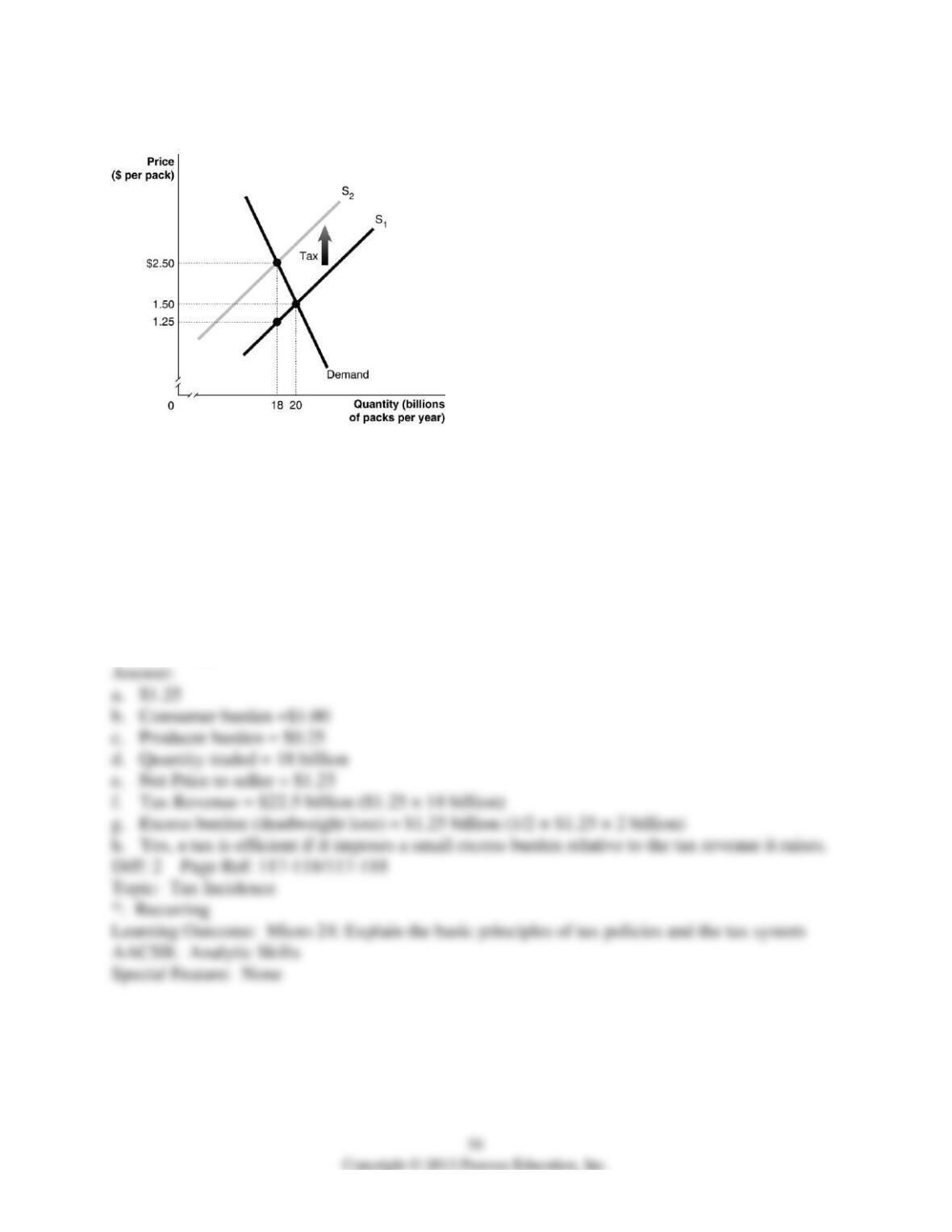
Figure 4-12
26) Refer to Figure 4-12. The figure above represents demand and supply in the market for
cigarettes. Use the diagram to answer the following questions.
a. How much is the government tax on each pack of cigarettes?
b. What portion of the unit tax is paid by consumers?
c. What portion of the unit tax is paid by producers?
d. What is the quantity sold after the imposition of the tax?
e. What is the after-tax revenue per pack received by producers?
f. What is the total tax revenue collected by the government?
g. What is the value of the excess burden of the tax?
h. Is this cigarette tax efficient?
4.5 Appendix: Quantitative Demand and Supply Analysis
1) The following equations represent the demand and supply for bird feeders.
QD = 35 – P
QS = -5 + 3P
What is the equilibrium price (P) and quantity (Q – in thousands) of bird feeders?
A) P = $10; Q = 25 thousand
B) P = $35; Q = 20 thousand
C) P = $20; Q = 20 thousand
D) P = $5; Q = 30 thousand
2) If the price of garlic is represented by equation P = 25 – QD, then the corresponding quantity
of garlic demanded is represented by the equation
A) QD = P – 25.
B) QD = P + 25.
C) QD = 25 – P.
D) QD = -25 + P.
3) If the quantity of tacos demanded is represented by the equation QD = 20 – 0.5P then the
corresponding price of tacos is represented by the equation
A) P = 0.5QD + 10.
B) P = 40 – 2QD.
C) P = 10 – 2QD.
D) P = QD + 40.
4) If the quantity of nail polish supplied is represented by the equation QS = -3 + 2P then the
corresponding price of nail polish is represented by the equation
A) P = 0.5QS + 1.5.
B) P = 2QS + 6.
C) P = 2QS – 6.
D) P = 1.5 – 0.5QS.
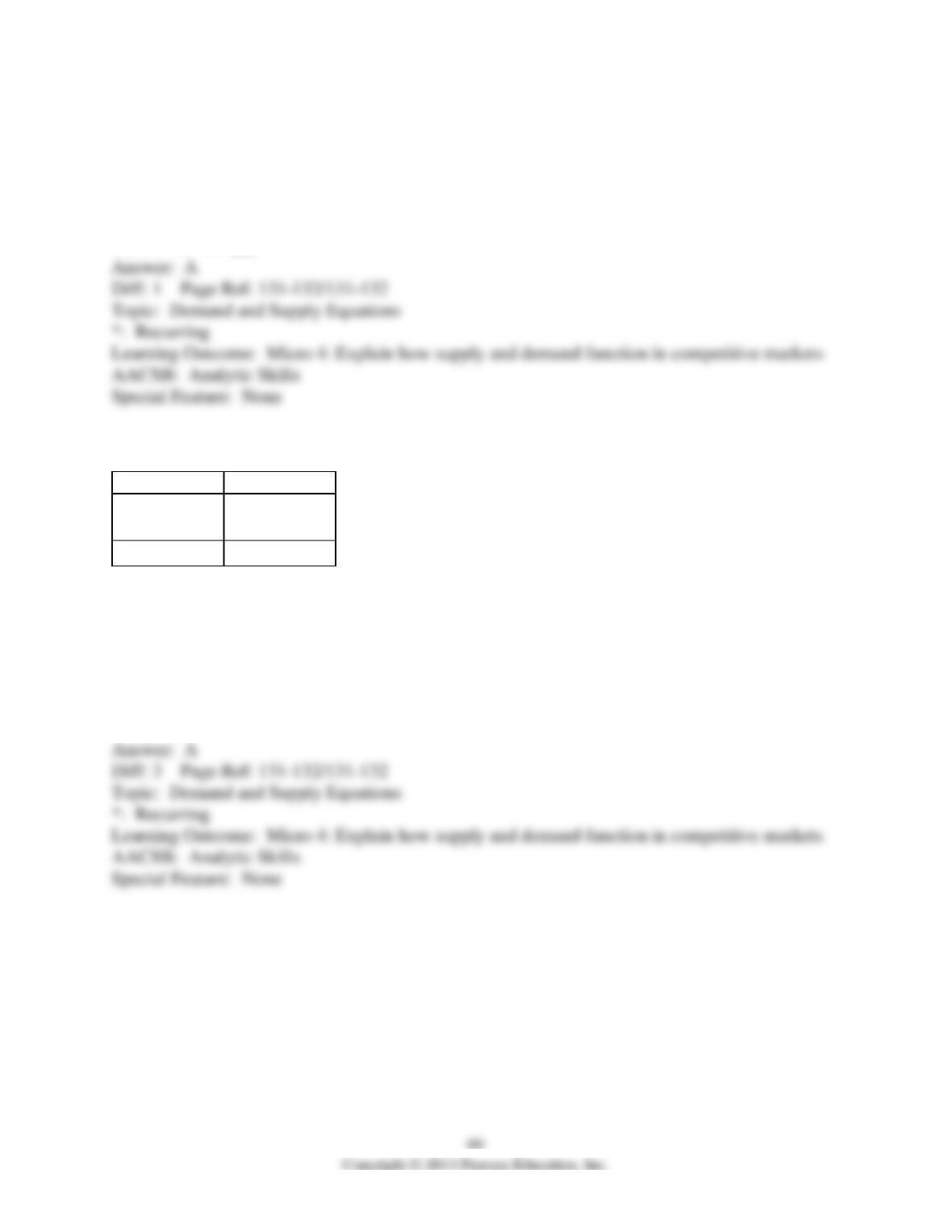
Table 4-5
Demand
Supply
P = 50 – QD
P = 10 + 1/3
QS
QD = 50 – P
QS = 3P – 30
5) Refer to Table 4-5. The equations above describe the demand and supply for Aunt Maud’s
Premium Hand Lotion. What are the equilibrium price and quantity (in thousands) for Aunt
Maud’s Lotion?
A) $20 and 30 thousand
B) $30 and 20 thousand
C) $60 and 30 thousand
D) $20 and 60 thousand
61
6) Refer to Table 4-5. The equations above describe the demand and supply for Aunt Maud’s
Premium Hand Lotion. The equilibrium price and quantity for Aunt Maud’s lotion are $20 and
30 thousand units. What is the value of consumer surplus?
A) $300 thousand
B) $450 thousand
C) $900 thousand
D) $1,500 thousand
7) Refer to Table 4-5. The equations above describe the demand and supply for Aunt Maud’s
Premium Hand Lotion. The equilibrium price and quantity for Aunt Maud’s lotion are $20 and
30 thousand units. What is the value of producer surplus?
A) $600 thousand
B) $300 thousand
C) $150 thousand
D) $30 thousand
8) Refer to Table 4-5. The equations above describe the demand and supply for Aunt Maud’s
Premium Hand Lotion. The equilibrium price and quantity for Aunt Maud’s lotion are $20 and
30 thousand units. What is the value of economic surplus in this market?
A) $600 thousand
B) $1,050 thousand
C) $1,500 thousand
D) $2,100 thousand
9) You are given the following market data for Venus automobiles in Saturnia.
Demand: P = 35,000 – 0.5Q
Supply: P = 8,000 + 0.25Q
where P = Price and Q = Quantity.
a. Calculate the equilibrium price and quantity.
b. Calculate the consumer surplus in this market.
c. Calculate the producer surplus in this market.
10) The demand and supply equations for the peach market are:
Demand: P = 24 – 0.5Q
Supply: P = -6 + 2.5Q
where P = price per bushel, and Q = quantity (in thousands).
a. Calculate the equilibrium price and quantity.
b. Suppose the government guaranteed producers a price of $24 per bushel. What would be
the effect on quantity supplied? Provide a numerical value.
c. By how much would the $24 price change the quantity of peaches demanded? Provide
a numerical value.
d. Would there be a shortage or surplus of peaches?
e. What is the size of this shortage or surplus? Provide a numerical value.