
33) If the government implements a price ceiling on insulin, this will have all of the following
effects on the market for insulin except
A) an increase in consumer surplus.
B) an increase in producer surplus.
C) an increase in deadweight loss.
D) a more efficient equilibrium
34) Government intervention in agriculture began in the Untied States in the 1930s.
35) There is a shortage of every good that is scarce.
36) All renters benefit from rent control and all landlords lose.
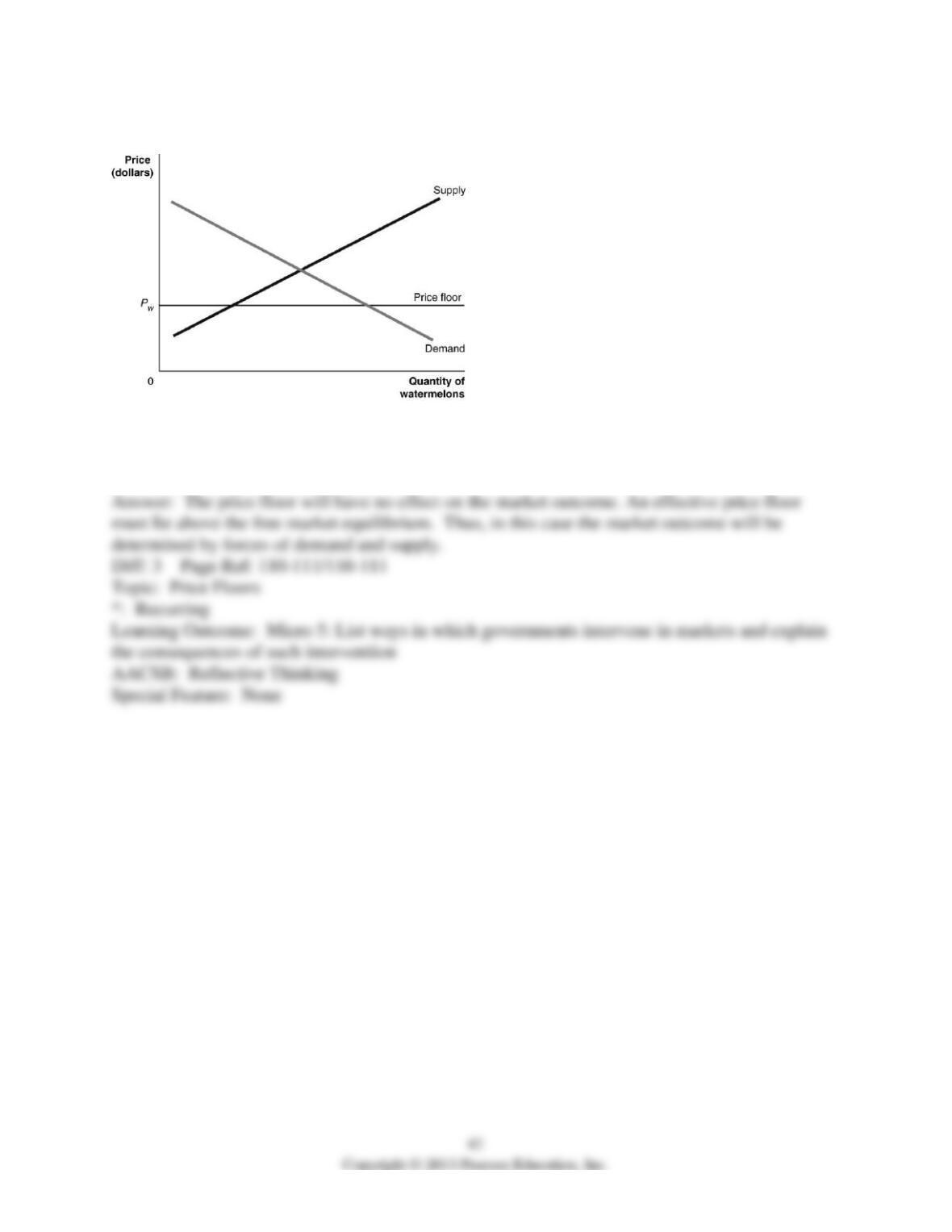
Figure 4-7
37) Refer to Figure 4-7 which shows the market for watermelons. Suppose the government
imposes a price floor of Pw. How will the price floor affect the quantity supplied, quantity
demanded and quantity exchanged?
43
Table 4-4
Price Per
Bushel
(dollars)
Quantity
Demanded
(bushels)
Quantity
Supplied
(bushels)
$3
36,000
0
6
30,000
2,000
9
25,000
5,000
12
20,000
10,000
15
16,000
16,000
18
13,000
23,000
21
8,000
30,000
24
3,000
36,000
Table 4-4 above contains information about the wheat market. Answer the following questions
based on this table.
38) Refer to Table 4-4. An agricultural price floor is a price that the government guarantees
farmers will receive for a particular crop. Suppose the federal government sets a price floor for
wheat at $21 per bushel.
a. What is the amount of shortage or surplus in the wheat market as result of the price floor?
b. If the government agrees to purchase any surplus output at $21, how much will it cost the
government?
c. If the government buys all of the farmers’ output at the floor price, how many bushels of
wheat will it have to purchase and how much will it cost the government?
d. Suppose the government buys up all of the farmers’ output at the floor price and then sells the
output to consumers at whatever price it can get. Under this scheme, what is the price at which
the government will be able to sell off all of the output it had purchased from farmers? What is
the revenue received from the government’s sale?
e. In this problem we have considered two government schemes: (1) a price floor is established
and the government purchases any excess output and (2) the government buys all the farmers’
output at the floor price and resells at whatever price it can get. Which scheme will taxpayers
prefer?
f. Consider again the two schemes. Which schem e will the farmers prefer?
g. Consider again the two schemes. Which scheme will wheat buyers prefer?
45
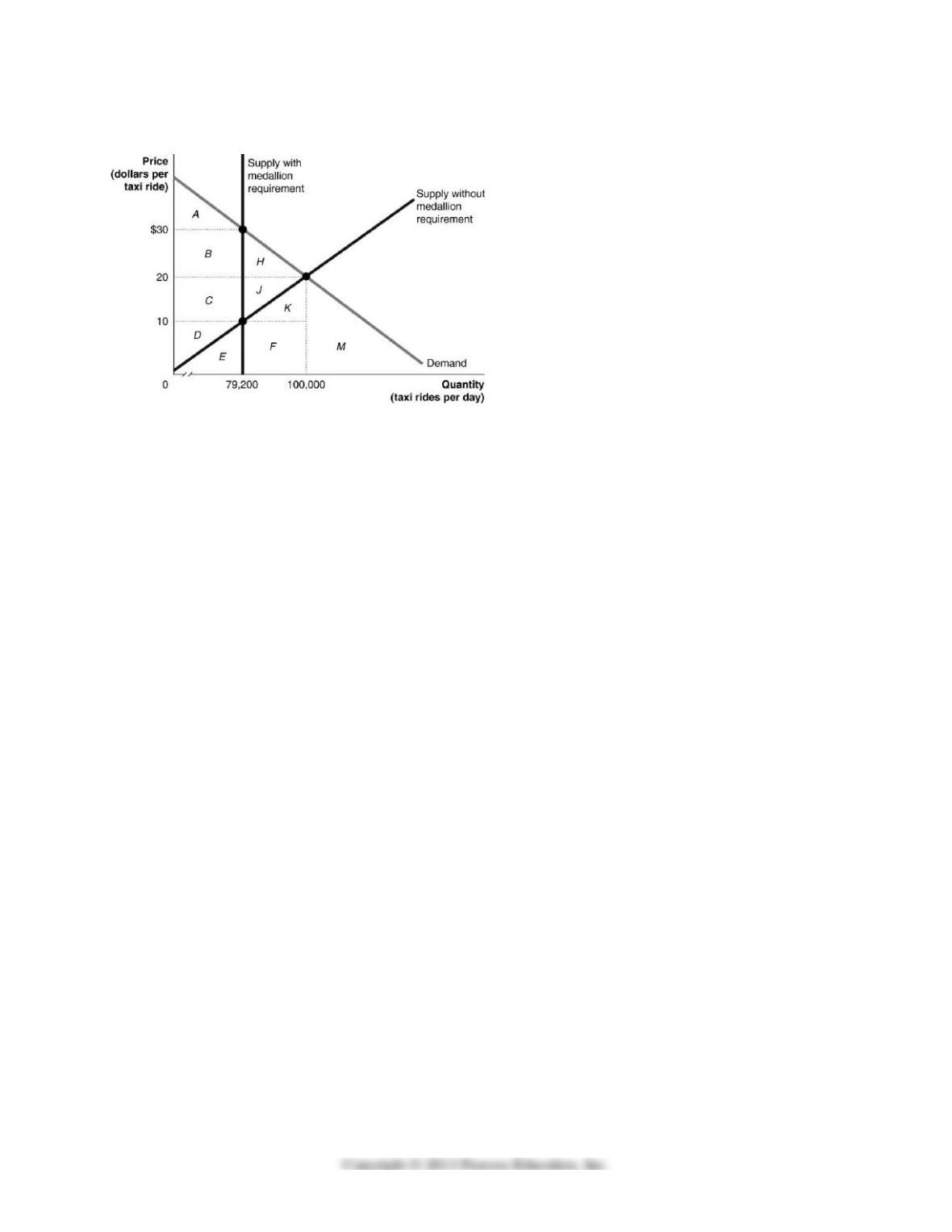
Figure 4-8
Figure 4-8 shows the market for taxi rides. The following question(s) are based on this figure.
39) Refer to Figure 4-8. To legally drive a taxicab in New York City, you must have a
medallion issued by the city government. Assume that only 13,200 medallions have been issued.
Let’s also assume this puts an absolute limit on the number of taxi rides that can be supplied in
New York City on any day, because no one breaks the law by driving a taxi without a medallion.
Assume as well that each taxi provides 6 trips per day. In that case, the quantity supplied of taxi
rides is 79,200 (or 6 rides per taxi × 13,200 taxis). This is shown in the diagram with a vertical
line at this quantity. Assume that there are no government controls on the prices that drivers can
charge for rides.
a. What would the equilibrium price and quantity be in this market if there were no medallion
requirement?
b. If there were no medallion requirement, indicate the area that represents consumer surplus.
c. If there were no medallion requirement, indicate the area that represents producer surplus.
d. If there were no medallion requirement, indicate the area that represents economic surplus.
e. What are the price and quantity with the medallion requirement?
f. With a medallion requirement in place, what area represents consumer surplus?
g. With a medallion requirement in place, what area represents producer surplus?
h. With a medallion requirement in place, what area represents the deadweight loss?
i. Based on your answers to parts (c) and (g), are taxicab drivers better off with the medallion
requirement for taxicabs than without?
j. Are consumers better off with or without the medallion requirement for taxicabs?
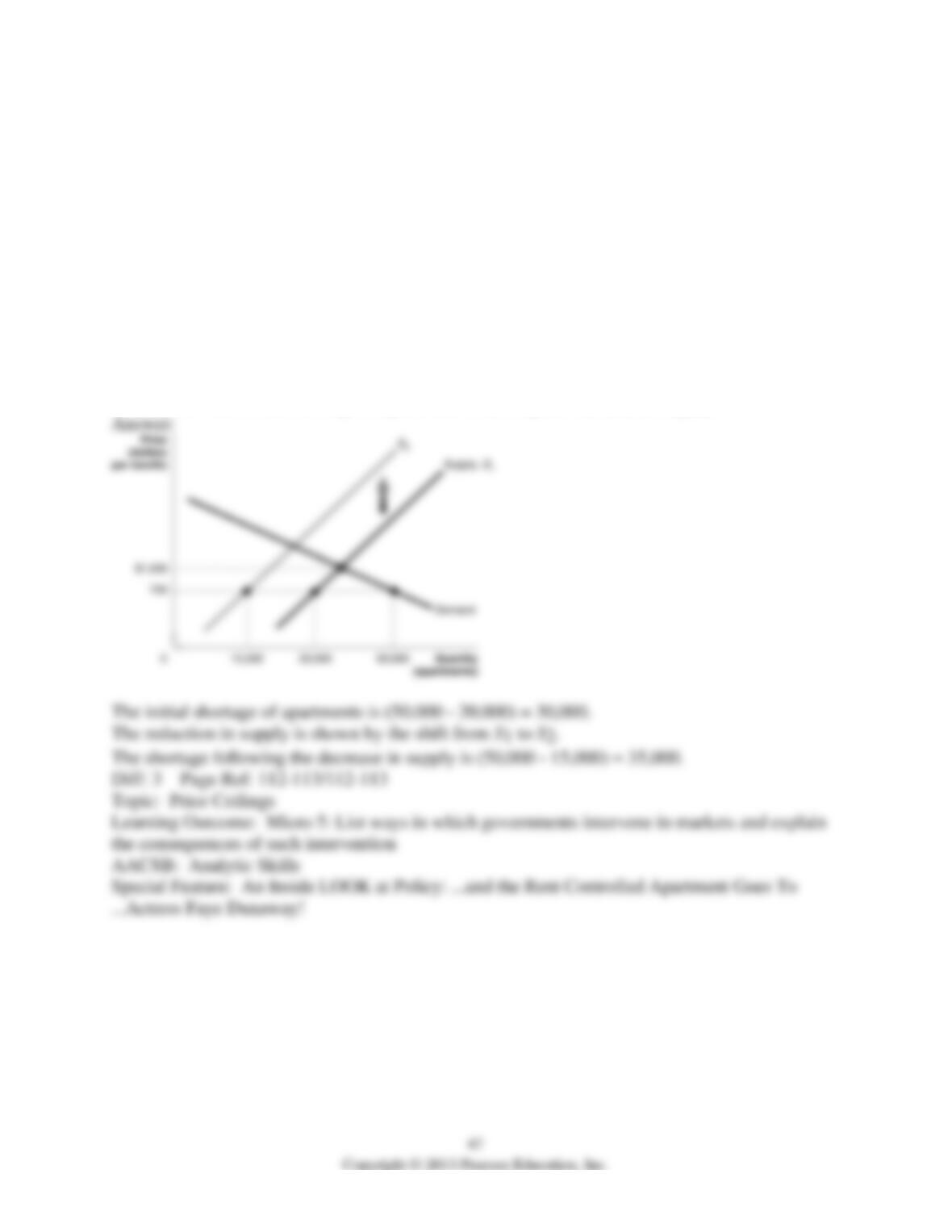
40) Using a supply and demand graph, illustrate the market for rent-controlled apartments with
the following data:
Equilibrium rent without rent control: $1,500
Rent with rent control: $700
Quantity of apartments demanded with rent control: 50,000
Quantity of apartments supplied with rent control: 20,000
What is the value of the initial shortage of apartments with rent control?
Now assume rent control leads to a reduction in the supply of apartments, and the new quantity
supplied is now 15,000. Illustrate this on your graph.
What is the value of the shortage of apartments following the decrease in supply?
4.4 The Economic Impact of Taxes
1) Tax incidence is the actual division of the
A) burden of the tax between buyers and sellers in a market.
B) tax revenues between government agencies.
C) tax revenues between the federal government and state governments.
D) population into different tax brackets.
2) Refer to Figure 4-9. What is the size of the unit tax?
A) $8
B) $5
C) $3
D) cannot be determined from the figure
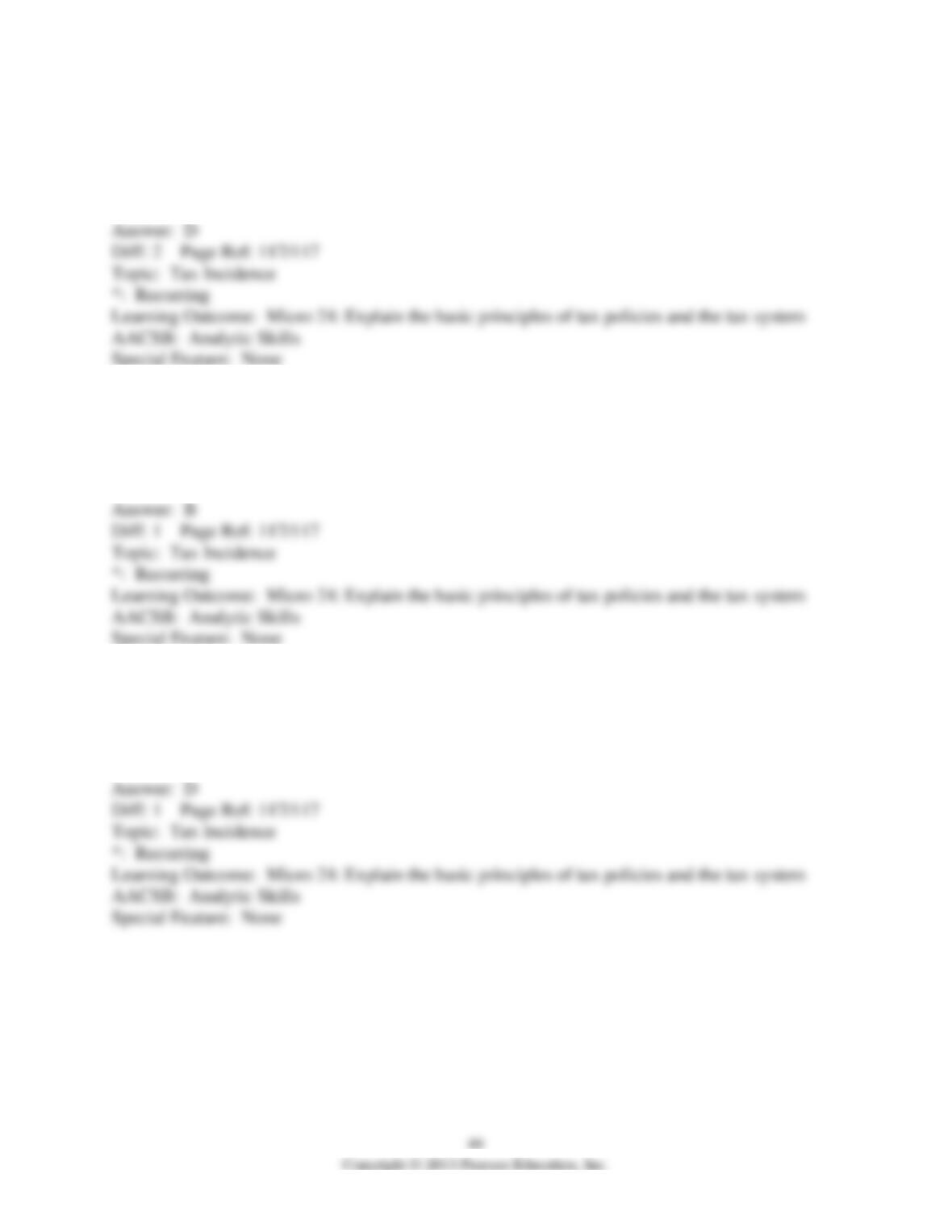
3) Refer to Figure 4-9. How much of the tax is paid by buyers?
A) $8
B) $5
C) $4
D) $3
4) Refer to Figure 4-9. The price buyers pay after the tax is
A) $12.
B) $8.
C) $5.
D) $3.
5) Refer to Figure 4-9. For each unit sold, the price sellers receive after the tax (net of tax) is
A) $12.
B) $8.
C) $4.40.
D) $3.
6) Refer to Figure 4-9. How much of the tax is paid by producers?
A) $45
B) $8
C) $3
D) $2
7) Refer to Figure 4-9. As a result of the tax, is there a loss in producer surplus?
A) Yes, because producers are not selling as many units now.
B) No, because the consumer pays the tax.
C) No, because the market reaches a new equilibrium
D) No, because producers are able to raise the price to cover their tax burden.
8) The government proposes a tax on halogen light bulbs. Sellers will bear the entire burden of
the tax if the
A) supply curve of halogen bulbs is horizontal.
B) demand curve for halogen bulbs is vertical.
C) demand curve for halogen bulbs is horizontal.
D) demand curve is downward sloping and the supply curve is upward sloping.
9) Buyers will bear the entire burden of a unit tax if the demand curve for a product is
A) horizontal.
B) vertical.
C) downward sloping.
D) upward sloping.
10) Suppose the demand curve for a product is downward sloping and the supply curve is
upward sloping. If a unit tax is imposed in the market for this product,
A) sellers bear the entire burden of the tax.
B) the tax burden will be shared among the government, buyers and sellers.
C) buyers bear the entire burden of the tax.
D) the tax burden will be shared by buyers and sellers.
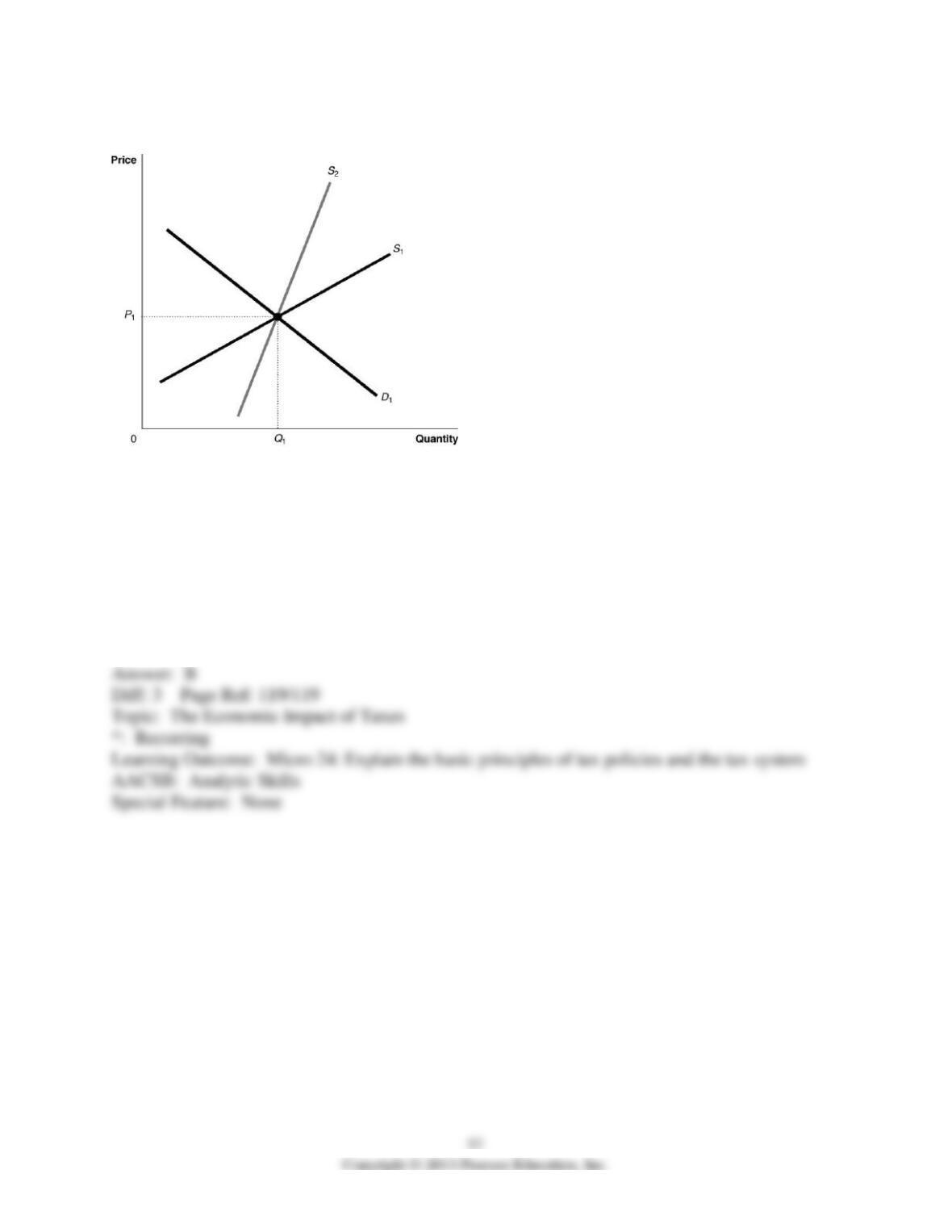
Figure 4-10
11) Refer to Figure 4-10. Suppose the market is initially in equilibrium at price P1 and now the
government imposes a tax on every unit sold. Which of the following statements best describes
the impact of the tax? For demand curve D1
A) the producer bears a smaller share of the tax burden if the supply curve is S2.
B) the producer bears a smaller share of the tax burden if the supply curve is S1.
C) the producer’s share of the tax burden is the same whether the supply curve is S1 or S2.
D) the producer bears the entire burden of the tax if the supply curve is S2 and the consumer
bears the entire burden of the tax if the supply curve is S1.