11) If, in a competitive market, marginal benefit is greater than marginal cost
A) the net benefit to consumers from participating in the market is greater than the net benefit to
producers.
B) the government must force producers to lower price in order to achieve economic efficiency.
C) the quantity sold is greater than the equilibrium quantity.
D) the quantity sold is less than the equilibrium quantity.
12) In a competitive market the ________ curve shows the marginal benefit received by
consumers and the ________ curve shows the marginal cost to producers.
A) .demand; supply
B) supply; demand
C) demand; market demand
D) supply; market supply
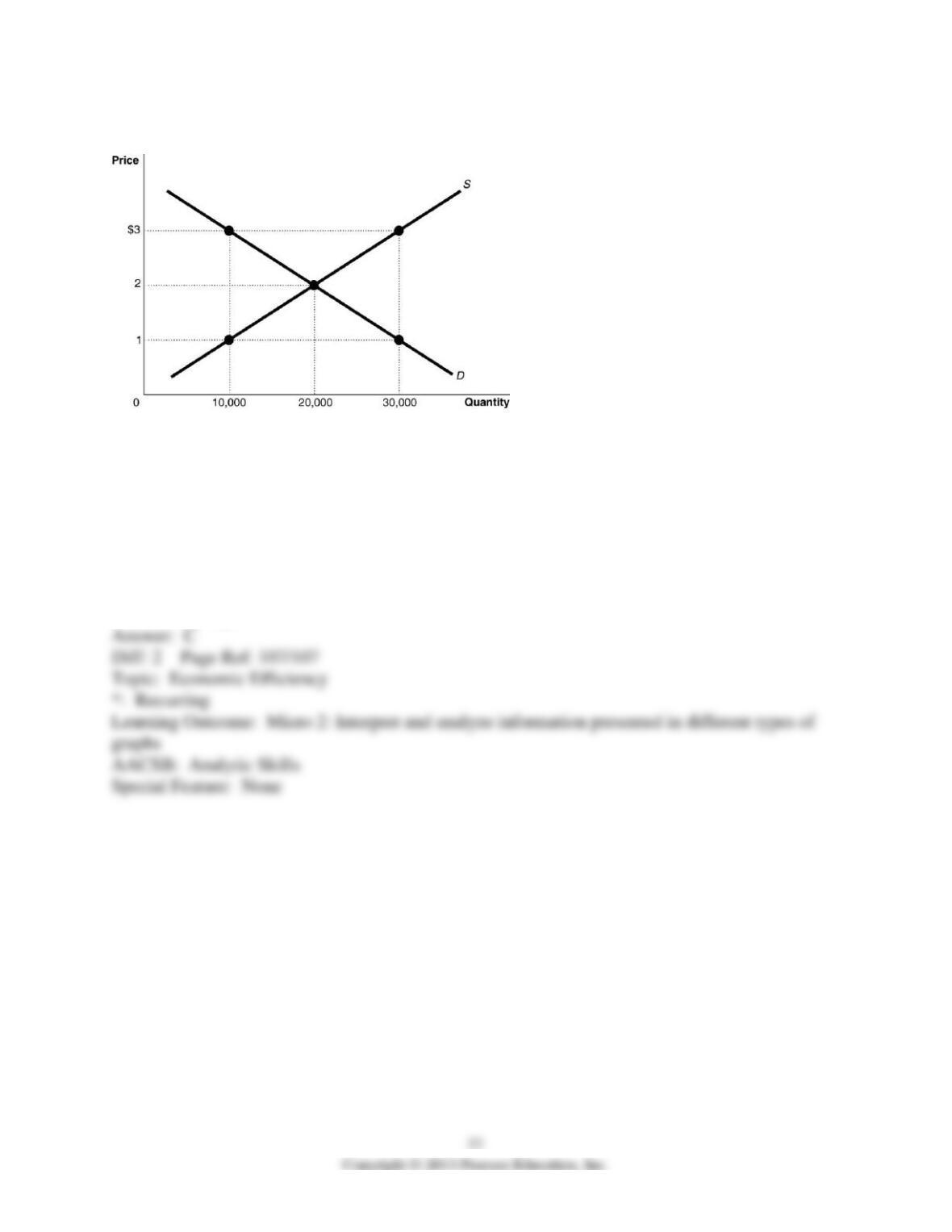
Figure 4-4
13) Refer to Figure 4-4. The figure above represents the market for iced tea. Assume that this
is a competitive market. At a price of $3
A) the marginal cost of iced tea is greater than the marginal benefit; therefore, output is
inefficiently low.
B) producers should lower the price to $1 in order to sell the quantity demanded of 10,000.
C) the marginal benefit of iced tea is greater than the marginal cost; therefore, output is
inefficiently low.
D) the marginal benefit of iced tea is greater than the marginal cost; therefore, output is
inefficiently high.
14) Refer to Figure 4-4. The figure above represents the market for iced tea. Assume that this is
a competitive market. If the price of iced tea is $1
A) the quantity supplied is less than the economically efficient quantity.
B) the quantity supplied is economically efficient but the quantity demanded is economically
inefficient.
C) economic surplus is maximized.
D) not enough consumers want to buy iced tea.
15) Refer to Figure 4-4. The figure above represents the market for iced tea. Assume that this
is a competitive market. If the price of iced tea is $3, what changes in the market would result in
an economically efficient output?
A) The price would decrease, the quantity supplied would increase, and the quantity demanded
would decrease.
B) The quantity supplied would decrease, the quantity demanded would increase and the
equilibrium price would decrease.
C) The price would decrease, the demand would increase and the supply would decrease.
D) The price would decrease, quantity demanded would increase and quantity supplied would
decrease.
24
16) Refer to Figure 4-4. The figure above represents the market for iced tea. Assume that this
is a competitive market. If 20,000 units of iced tea are sold
A) the deadweight loss is equal to economic surplus.
B) producer surplus equals consumer surplus.
C) the marginal benefit of each of the 20,000 units of iced tea equals $3.
D) marginal benefit is equal to marginal cost.
17) Refer to Figure 4-4. The figure above represents the market for iced tea. Assume that this
is a competitive market. Which of the following is true?
A) If the price of iced tea is $3 the output will be economically efficient but there will be a
deadweight loss.
B) If the price of iced tea is $3 consumers will purchase more than the economically efficient
output.
C) Both 10,000 and 30,000 are economically inefficient rates of output.
D) If the price of iced tea is $3 producers will sell 30,000 units of iced tea but this output will be
economically inefficient.
18) In a competitive market when there is no deadweight loss,
A) consumer surplus is minimized.
B) producer surplus is minimized.
C) consumer surplus plus producer surplus is minimized.
D) consumer surplus plus producer surplus is maximized.
19) Economic efficiency is achieved when there is a market outcome in which the marginal
benefit to consumers of the last unit produced is equal to its marginal cost of production and
A) economic surplus plus consumer surplus equals producer surplus.
B) consumer surplus plus producer surplus is maximized.
C) economic surplus is minimized.
D) the difference between consumer surplus and producer surplus is maximized.
20) There will be no deadweight loss if the marginal benefit to consumers is equal to the
marginal cost of production and the sum of consumer surplus and producer surplus is
maximized.
21) The difference between consumer surplus and producer surplus in a market is equal to the
deadweight loss.
22) Equilibrium in a competitive market results in the greatest amount of economic surplus from
the production of a good or service.
23) What is deadweight loss? When is deadweight loss equal to zero?
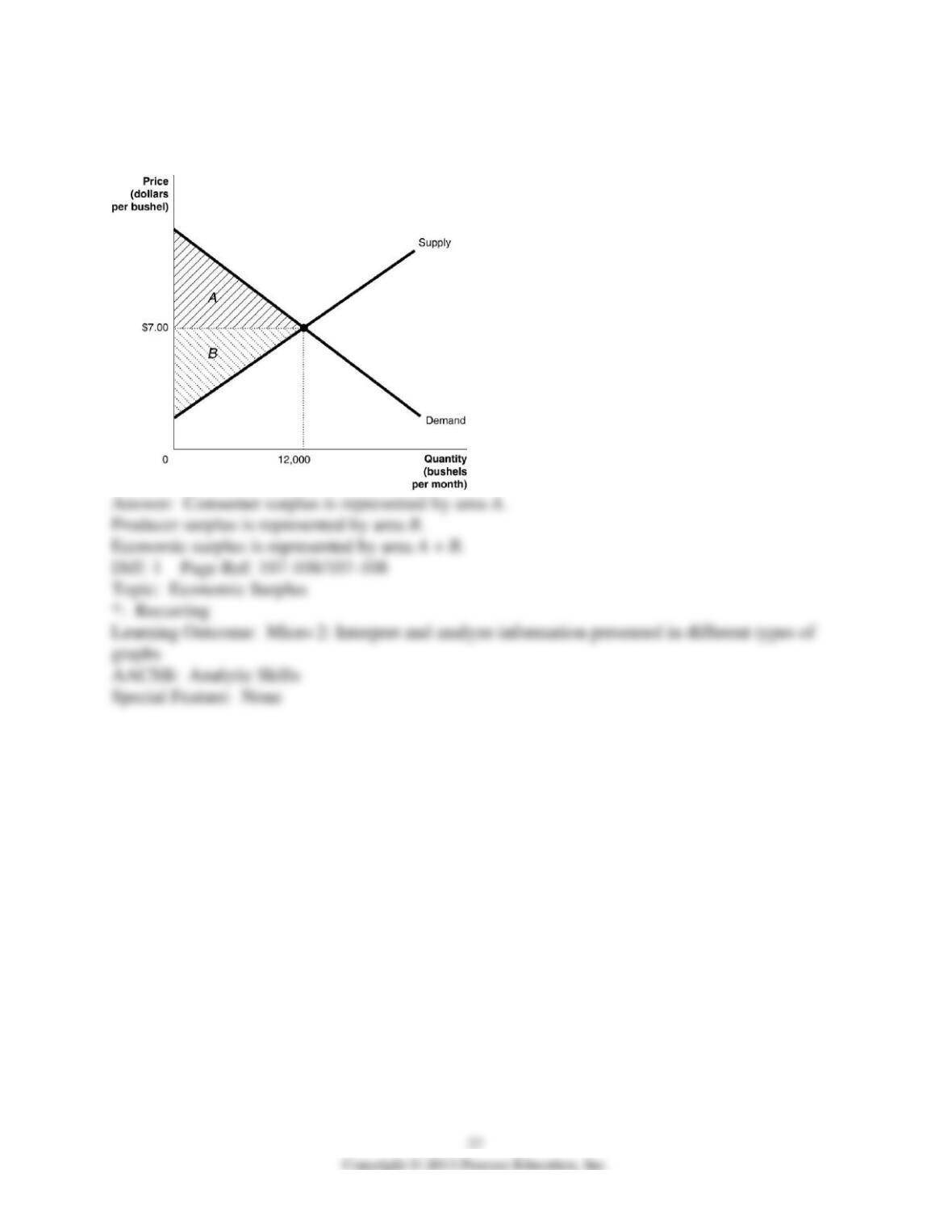
24) The graph below represents the market for alfalfa. The market price is $7.00 per bushel.
Identify the areas representing consumer surplus, producer surplus, and economic surplus.
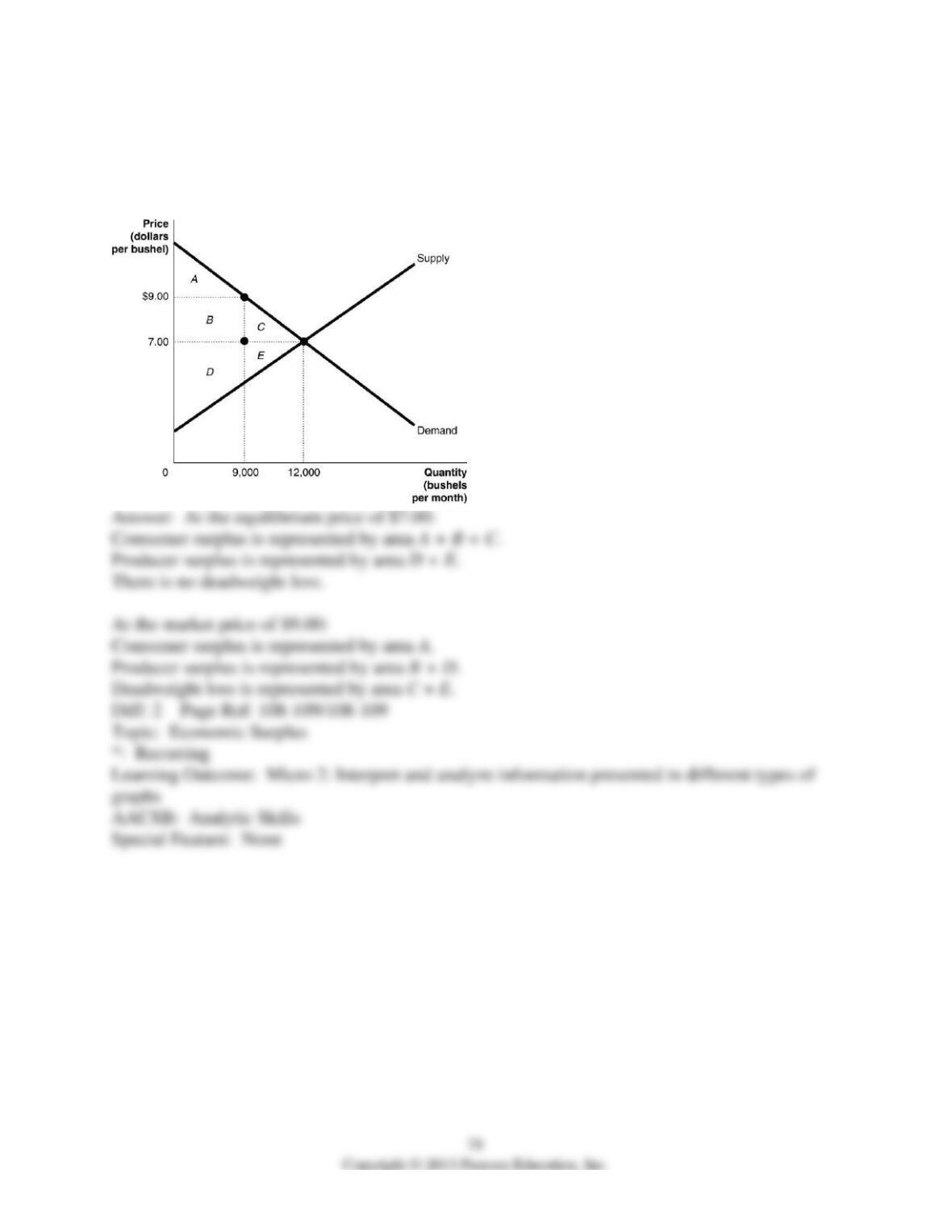
25) The graph below represents the market for alfalfa. The equilibrium price is $7.00 per bushel,
but the market price is $9.00 per bushel. Identify the areas representing consumer surplus,
producer surplus, and deadweight loss at the equilibrium price of $7.00 and at the market price of
$9.00.
4.3 Government Intervention in the Market: Price Floors and Price Ceilings
1) When ________ in a market, the total net benefit to society is maximized.
A) deadweight loss is maximized
B) a competitive equilibrium is achieved
C) consumer surplus is minimized
D) producer surplus is minimized
Table 4-3
Hourly Wage
(dollars)
Quantity of
Labor
Supplied
Quantity of
Labor
Demanded
$8.00
350,000
390,000
8.50
360,000
380,000
9.00
370,000
370,000
9.50
380,000
360,000
10.00
390,000
350,000
10.50
400,000
340,000
Table 4-3 shows the demand and supply schedules for the low-skilled labor market in the city of
Westover.
2) Refer to Table 4-3. What is the equilibrium hourly wage (W*) and the equilibrium quantity of
labor (Q*)?
A) W* = $9.00; Q* = 370,000
B) W* = $8.50; Q* = 380,000
C) W* = $8.50; Q* = 360,000
D) W* = $9.00; Q* = 740,000
3) Refer to Table 4-3. If a minimum wage of $9.50 an hour is mandated, what is the quantity of
labor demanded?
A) 380,000
B) 370,000
C) 360,000
D) 10,000
4) Refer to Table 4-3. If a minimum wage of $9.50 an hour is mandated, what is the quantity of
labor supplied?
A) 390,000
B) 380,000
C) 370,000
D) 340,000
5) Refer to Table 4-3. If a minimum wage of $9.50 is mandated there will be a
A) shortage of 10,000 units of labor.
B) surplus of 10,000 units of labor.
C) shortage of 20,000 units of labor.
D) surplus of 20,000 units of labor.
6) Refer to Table 4-3. Suppose that the quantity of labor demanded increases by 40,000 at each
wage level. What are the new free market equilibrium hourly wage and the new equilibrium
quantity of labor?
A) W = $10.00; Q = 390,000
B) W = $9.50; Q = 380,000
C) W = $8.50; Q = 380,000
D) W = $8.00; Q = 390,000
7) Which of the following is a consequence of minimum wage laws?
A) Low skilled workers benefit because minimum wage increases the number of jobs providing
low skilled workers with training.
B) Employers will be reluctant to offer low-skill workers jobs with training.
C) Producers have an incentive to offer workers non-wage benefits such as health care benefits
and convenient working hours rather than a higher wage.
D) All workers benefit when the minimum wage is increased.
8) The minimum wage is an example of
A) a subsidy for low-skilled workers.
B) a price floor.
C) a price ceiling.
D) a black market.
9) To affect the market outcome, a price floor
A) must be set above the black market price.
B) must be set above the legal price.
C) must be set above the price ceiling.
D) must be set above the equilibrium price.
10) Government intervention in agricultural markets in the U.S. began
A) during World War II to ensure that enough food was available for domestic consumption.
B) after World War I in order to assist farmers to adjust from a war-time economy to a peace-
time economy.
C) during the Great Depression.
D) during the Korean War.
11) A black market is a market where buying and selling take place
A) at prices that violate government price regulations.
B) in non-licensed shops and warehouses.
C) after regular office hours.
D) on foreign soil.
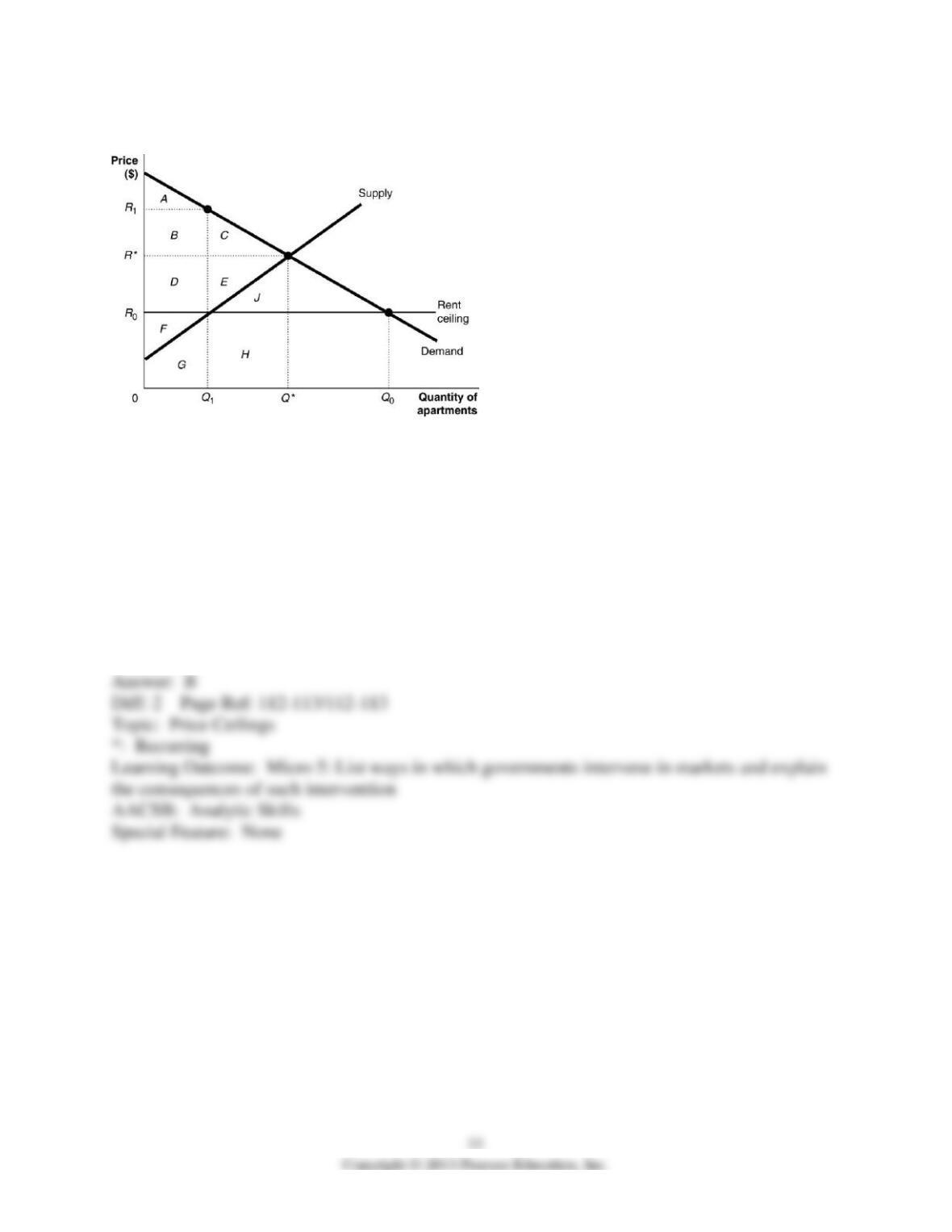
Figure 4-5
Figure 4-5 shows the market for apartments in Bay City. Recently, the government imposed a
rent ceiling at R0.
12) Refer to Figure 4-5. With rent control, the quantity supplied is Q1. Suppose apartment
owners ignore the law and rent this quantity for the highest rent they can get. What is the highest
rent they can get?
A) R*
B) R1
C) R0
D) more than R1
13) Refer to Figure 4-5. What is the area that represents consumer surplus after the imposition
of the ceiling?
A) A + B+ D
B) A + B + C
C) A + B + D + F
D) A + B + D + F + G
14) Refer to Figure 4-5. What is the area that represents the producer surplus after the
imposition of the ceiling?
A) F + G
B) F
C) D + F + G
D) A + B + D + F + G
15) Refer to Figure 4-5. What is the area that represents the portion of producer surplus
transferred to consumers as a result of the rent ceiling?
A) D + E
B) D + F
C) D
D) F
16) Refer to Figure 4-5. What area represents the deadweight loss after the imposition of the
ceiling?
A) G + H
B) J + H
C) C + E + J + H
D) C + E
17) Which term refers to a legally established maximum price that firms may charge?
A) a price ceiling
B) a subsidy
C) a price floor
D) a tariff
18) In order to be binding a price floor
A) must lie above the free market equilibrium price.
B) must lie below the free market equilibrium price.
C) must coincide with the free market equilibrium price.
D) must be high enough for firms to earn a profit.
36
19) ________ dictates the lowest wage that firms may pay for labor.
A) A maximum wage requirement
B) A minimum wage law
C) The black market wage
D) A price ceiling wage
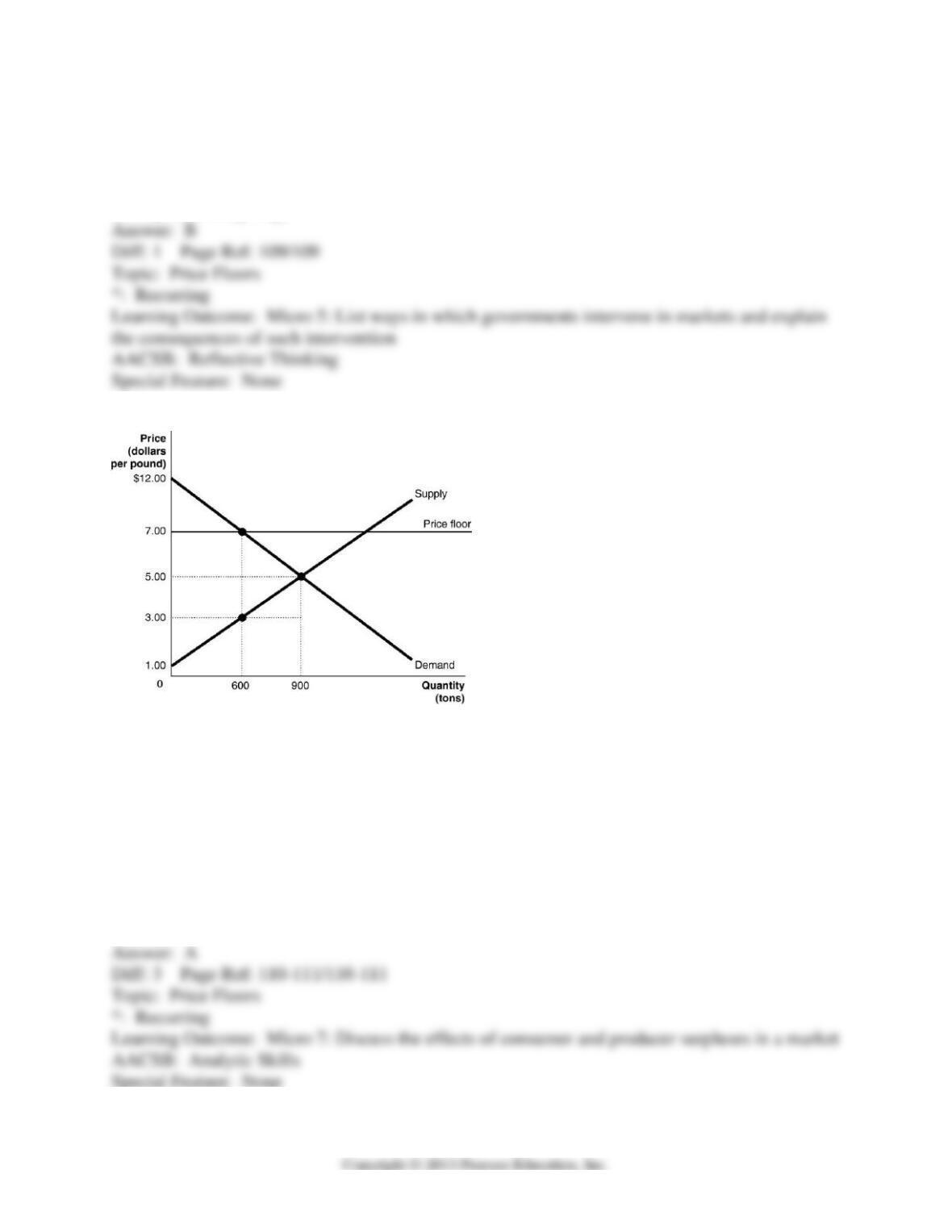
Figure 4-6
Figure 4-6 shows the demand and supply curves for the coffee market. The government believes
that the equilibrium price is too low and tries to help almond growers by setting a price floor at
$7.00.
20) Refer to Figure 4-6. What is the value of consumer surplus after the imposition of the price
floor?
A) $1,500
B) $2,700
C) 4,500
D) $5,700
21) Refer to Figure 4-6. What is the value of producer surplus after the imposition of the price
floor?
A) $3,000
B) $3,600
C) $4,200
D) $4,500
22) Refer to Figure 4-6. What is the value of the portion of consumer surplus that has been
transferred to producer surplus as a result of the price floor?
A) $1,200
B) $1,500
C) $1,800
D) $3,000
23) Refer to Figure 4-6. What is the value of the deadweight loss after the imposition of the
price floor?
A) $600
B) $1,800
C) $2,700
D) $3,300
24) Congress passed the Freedom to Farm Act in 1996. What was the purpose of this Act?
A) to encourage more people to become farmers
B) to grant free land to farmers in order to produce crops that were particularly scarce
C) to phase out the use of price ceilings in agricultural markets
D) to phase out price floors and return to a free market in agriculture
25) Because minimum wage is a price floor
A) it will be set below the market equilibrium price.
B) it will create a deadweight loss.
C) it will increase the number of jobs available in the labor market.
D) it will maximize consumer surplus.
26) Increases in the minimum wage are intended to raise the incomes of low-income workers.
Many economists favor a different policy to achieve this goal, a policy that avoids the
deadweight losses that result from the minimum wage. What is this policy?
A) distribution of food stamps to low-income consumers
B) distribution of vouchers that can be used for rent or mortgage payments
C) the Alternative Minimum Tax
D) the earned income tax credit
27) Which of the follow is a result of imposing a rent ceiling?
A) Some consumer surplus is converted to producer surplus.
B) There is an increase in the quantity of apartments supplied.
C) There is an increase in the quantity of apartments demanded.
D) The marginal benefit of the last apartment rented is less than the marginal cost of supplying it.
28) Which of the following describes the difference between “scarcity” and “shortage”?
A) There is no difference; either word can be used to describe the situation that exists when there
is less of a good or service available than people want.
B) In the economic sense, almost everything is scarce. A shortage of a good or service occurs
when the quantity demanded is greater than the quantity supplied at the current market price.
C) There is a shortage of almost everything. Scarcity occurs only if the quantity demanded of a
good or service is greater than the quantity supplied at the current market price.
D) In the economic sense, almost everything is scarce. A shortage of a good or service occurs
when the quantity demanded is greater than the quantity supplied at the equilibrium price.
29) In cities with rent controls, the actual rents paid can be ________ than the legal maximum.
One explanation for this is because there is a ________ of apartments, tenants are ________.
A) higher; shortage; often willing to pay rents higher than the law allows
B) higher; surplus; often forced to pay rents higher than the law allows
C) lower; surplus; never willing to pay rents below the legal maximum
D) lower; shortage; rarely willing to pay rents lower than the law allows
30) Which of the following is a result of government price controls?
A) Some people win and some people lose.
B) Price controls benefit poor consumers but harm producers and wealthy consumers.
C) Price controls increase economic efficiency.
D) The deadweight loss from price ceilings is greater than the deadweight loss from price floors.
31) Economists ________ that price controls are desirable.
A) are in agreement
B) are reluctant to state
C) never believe
D) only recently agree
32) If the government implements a price ceiling on insulin, this will
A) increase the price consumers will pay for insulin.
B) decrease the quantity of insulin the manufacturers will be willing to supply.
C) have to be set above the market equilibrium price to be effective.
D) encourage manufacturers to produce and sell more of insulin to increase their profits.