Microeconomics, 4e – Testbank 2 (Hubbard)
Chapter 4 Economic Efficiency, Government Price Setting, and Taxes
4.1 Consumer Surplus and Producer Surplus
1) The difference between the ________ for a good and the ________ is called consumer
surplus.
A) highest price a consumer is willing to pay; lowest price a consumer is willing to pay
B) lowest price a consumer is willing to pay; price the consumer actually pays
C) highest price a consumer is willing to pay; price the consumer actually pays
D) price the consumer actually pays; actual cost to the producer
2) New York City has about two million apartments. Of this number
A) all are subject to rent control.
B) about one-half are subject to rent control.
C) all are subject to price floors.
D) about 10 percent are subject to rent control.
3) Suppose there are two cities that have rent controlled apartments. In one city (Albany) all
apartments are subject to rent control; in the other city (Halftrack) one-half of the apartments are
rent controlled. Which of the following is most likely to be true?
A) It will be difficult to find a rent-controlled apartment in Albany or Halftrack; rents for the
Halftrack apartments not subject to controls will be higher than they would be without rent
control.
B) It will be easier to find an affordable apartment in Albany since rents will be low across the
board.
C) It will be easier to find an affordable apartment in Halftrack, either a rent-controlled
apartment or another apartment, at a reasonable price.
D) It will be impossible to rent an apartment in either city at any price.
4) Juanita goes to the Hardware Emporium to buy a new circular saw. She is willing to pay $120
for a new saw, but buys one on sale for $85. Juanita’s consumer surplus from the purchase is
A) $35.
B) $85.
C) $120.
D) $205.
5) Brett buys a new cell phone for $100. He receives consumer surplus of $80 from the
purchase. How much does Brett value his cell phone?
A) $180
B) $100
C) $80
D) $20
6) The maximum price that a buyer is willing to pay for a good measures his
A) consumer surplus.
B) marginal benefit.
C) willingness to pay.
D) producer surplus.
7) A consumer is willing to purchase a product up to the point where
A) he spends all of his income.
B) the marginal benefit is equal to the price of the product.
C) the quantity demanded is equal to the quantity supplied.
D) he is indifferent between consuming and saving.
8) The additional benefit to a consumer from consuming one more unit of a good or service
A) is equal to consumer surplus.
B) is equal to the opportunity cost of consuming the good or service.
C) is equal to marginal benefit.
D) is equal to economic surplus.
9) Which of the following statements best describes the concept of consumer surplus?
A) “I paid $89 for a microwave oven last week. This week the same store is selling the same
microwave oven for $69.”
B) “I sold my hard copy of Harry Potter and the Half-Blood Prince to a used book store for $10
even though I was willing to sell it for $5.”
C) “Target was having a sale on tube socks so I bought 5 pairs.”
D) “I was going to pay $200 for new sunglasses that I had seen at the Oakley store but I ended up
paying only $140 for the same sunglasses.”
10) Each point on a demand curve shows
A) the willingness of consumers to purchase a product at different prices.
B) the consumer surplus received from purchasing a given quantity of a product.
C) the economic surplus received from purchasing a given quantity of a product.
D) the legally determined maximum price that sellers may charge for a given quantity of a
product.
Table 4-1
Consumer
Willingness to Pay
Curly
$50
Moe
30
Larry
15
11) Refer to Table 4-1. The table above lists the highest prices three consumers, Curly, Moe,
and Larry, are willing to pay for a bottle of champagne. If the price of one of the bottles is $24
dollars
A) Curly will buy two bottles, Moe will buy one bottle and Larry will buy no bottles.
B) Curly will receive $26 of consumer surplus from buying one bottle.
C) Curly and Moe receive a total of $80 of consumer surplus from buying one bottle each. Larry
will buy no bottles.
D) Larry will receive $15 of consumer surplus since he will buy no bottles.
12) Refer to Table 4-1. The table above lists the highest prices three consumers, Curly, Moe,
and Larry, are willing to pay for a bottle of champagne. If the price of the champagne falls from
$24 to $14
A) consumer surplus increases from $32 to $53.
B) Curly will buy four bottles; Moe will buy two bottles, and Larry will buy one bottle.
C) consumer surplus will increase from $80 to $95.
D) Larry and Moe will receive more consumer surplus than Curly.
13) The additional cost to a firm of producing one more unit of a good or service is the
A) minimum cost.
B) total cost.
C) opportunity cost.
D) marginal cost.
Table 4-2
Marko’s
Polos
Marginal
Cost
(dollars)
1st shirt
$7
2nd shirt
10
3rd shirt
15
4th shirt
20
14) Refer to Table 4-2. The table above lists the marginal cost of polo shirts by Marko’s, a firm
that specializes in producing men’s clothing. If the market price of Marko’s polo shirts is $18
A) Marko’s will produce four shirts.
B) producer surplus from the first shirt is $18.
C) producer surplus will equal $22.
D) there will be a surplus; as a result, the price will fall to $7.
15) Refer to Table 4-2. The table above lists the marginal cost of polo shirts by Marko’s, a firm
that specializes in producing men’s clothing. If the price of polo shirts increases from $15 to $20
A) consumers will buy no polo shirts.
B) the marginal cost of producing the third polo shirt will increase to $20.
C) producer surplus will rise from $13 to $28.
D) there will be a surplus of polo shirts.
16) The area above the market supply curve and below the market price
A) is equal to the total amount of producer surplus in a market.
B) is equal to the marginal cost of the last unit produced.
C) is equal to the total amount of economic surplus in a market.
D) is equal to the total cost of production.
17) The area above the market supply curve and below the market price is equal to the
A) consumer surplus.
B) producer surplus.
C) marginal benefit.
D) marginal cost.
18) Consumer surplus in a market for a product would be equal to the area under the demand
curve if
A) producer surplus was equal to zero.
B) marginal cost was equal to the market price.
C) the product was produced in a perfectly competitive market.
D) the market price was zero.
19) Which of the following statements is not true?
A) Consumer surplus measures the difference between the highest price a consumer is willing to
pay for a product and the price she actually pays.
B) Marginal benefit is the additional benefit to a consumer from consuming one more unit of a
product.
C) Consumer surplus measures the net benefit from participating in a market.
D) Producer surplus measures the total benefit received by producers from participating in a
market.
20) A supply curve shows
A) the quantities sold at different prices.
B) the marginal cost of producing one more unit of a good or service.
C) the marginal benefit from buying one more unit of a good or service.
D) the total cost of producing different quantities of a good or service.
21) The willingness of consumers to buy a product at different prices is shown on a
A) demand curve.
B) supply curve.
C) production possibilities frontier.
D) marginal cost curve.
Figure 4-1
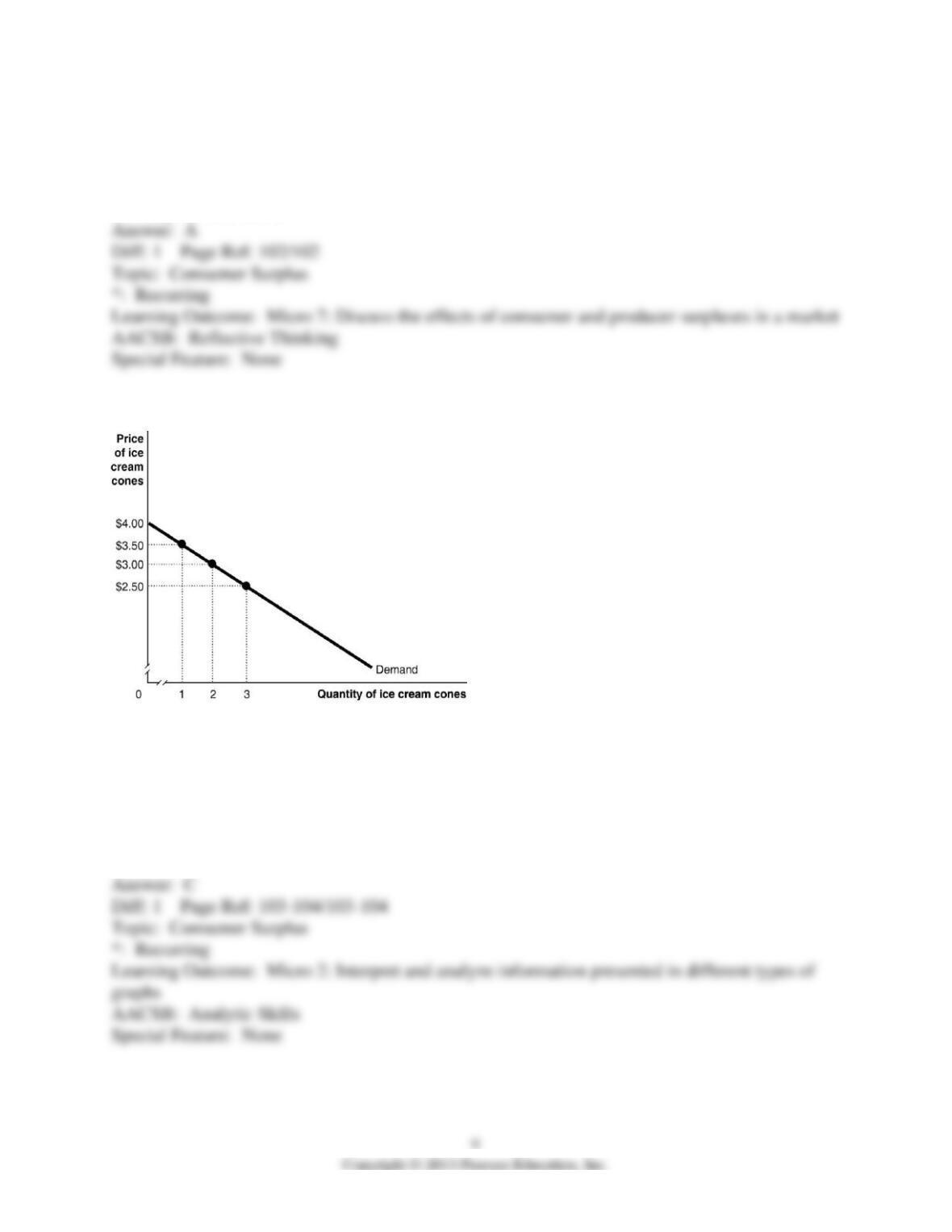
Figure 4-1 shows Kendra’s demand for ice-cream cones curve.
22) Refer to Figure 4-1. Kendra’s marginal benefit from consuming the second ice cream cone is
A) $6.50
B) $6.00
C) $3.00
D) $2.25
23) Refer to Figure 4-1. If the market price is $2.50, what is the consumer surplus on the
second ice cream cone?
A) $0.50
B) $1.50
C) $3.00
D) $10.50
24) Refer to Figure 4-1. If the market price is $2.50, what is Kendra’s consumer surplus?
A) $9.00
B) $7.50
C) $1.50
D) $0
25) Refer to Figure 4-1. What is the total amount that Kendra is willing to pay for 3 ice cream
cones?
A) $2.50
B) $7.50
C) $9.00
D) $13.50
26) Refer to Figure 4-1. If the market price is $2.50, what is the maximum number of ice cream
cones that Kendra will buy?
A) 1
B) 2
C) 3
D) 4
27) Suppliers will be willing to supply a product in all of the following situations except
A) the price received is greater than the additional cost of producing the product.
B) the price received is at least equal to the additional cost of producing the product.
C) the price received is equal to the additional cost of producing the product.
D) the price received is less than the additional cost of producing the product.
28) The difference between the lowest price a firm would have been willing to accept and the
price it actually receives from the sale of a product is called
A) producer surplus.
B) profit.
C) marginal revenue.
D) price differential.
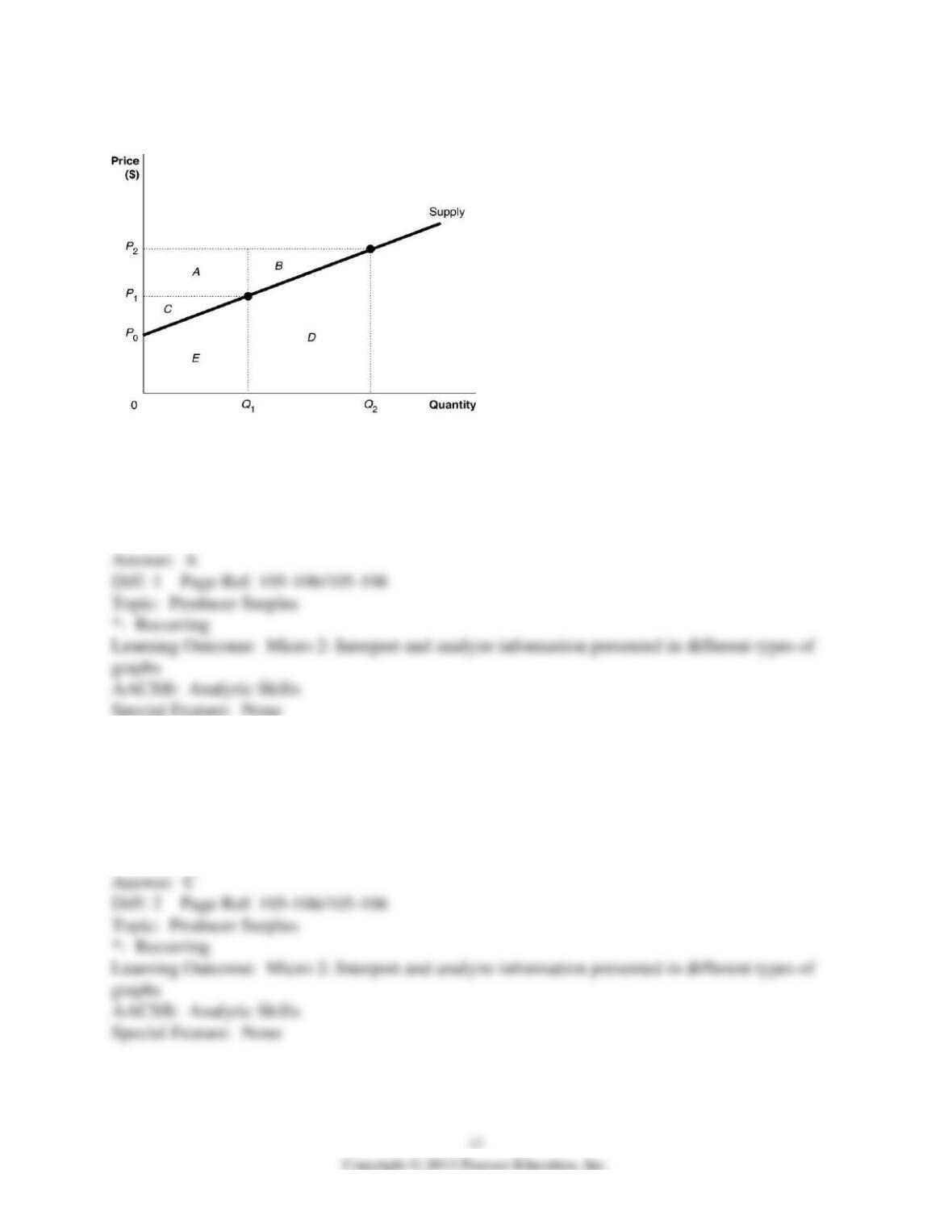
Figure 4-2
29) Refer to Figure 4-2. What area represents producer surplus at a price of P1?
A) C
B) A + C
C) C + E
D) A + C + E
30) Refer to Figure 4-2. What area represents the decrease in producer surplus when the market
price falls from P2 to P1?
A) C + E
B) A + C + E
C) A + B
D) B + D
31) Two economists from Northwestern University estimated the benefit households received
from subscribing to broadband Internet service. They found that in 2006, 47 million consumers
paid an average of $36 per month to subscribe to a broadband Internet service, and estimated the
value of total consumer surplus for these subscribers was equal to $890.5 million. Based on these
numbers, what was the average monthly consumer surplus per subscriber for broadband Internet
service?
A) $0.05
B) $0.77
C) $13.06
D) $18.95
32) Producer surplus is the difference between the highest price someone is willing to pay and
the price he actually pays.
33) The total amount of producer surplus in a market is equal to the area above the market supply
curve and below the market price.
34) The additional cost to a firm of producing one more unit of a good or service is equal to
producer surplus.
35) What is consumer surplus? Why would policy makers be interested in consumer surplus?
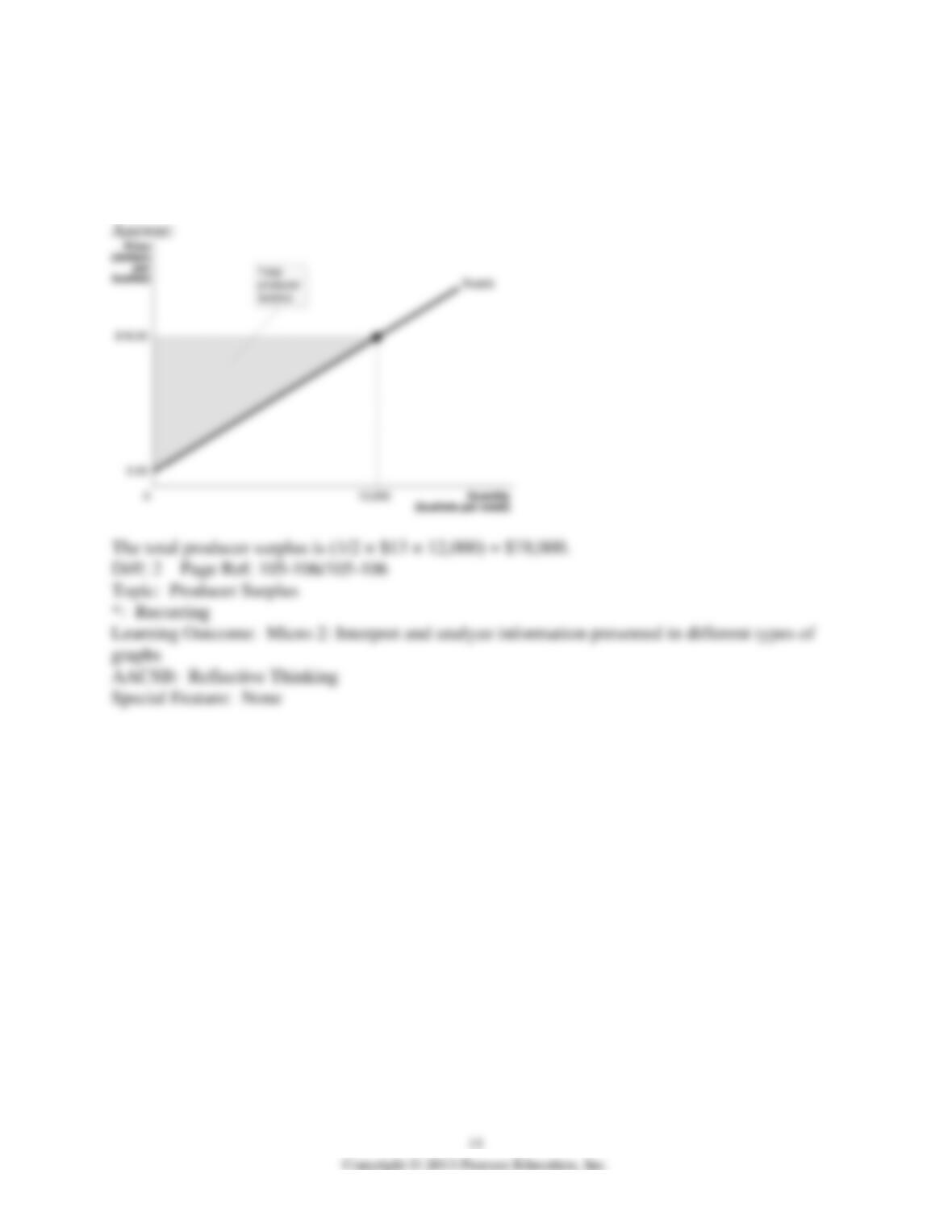
36) Assume the market price for tangerines is $18.00 per bushel. At the market price, tangerine
growers are willing to supply a quantity of 12,000 bushels per week. The quantity supplied drops
to zero when the price falls to $5.00 per bushel. Construct a graph showing this data, calculate
the total producer surplus in the market for tangerines, and show the total producer surplus on the
graph.
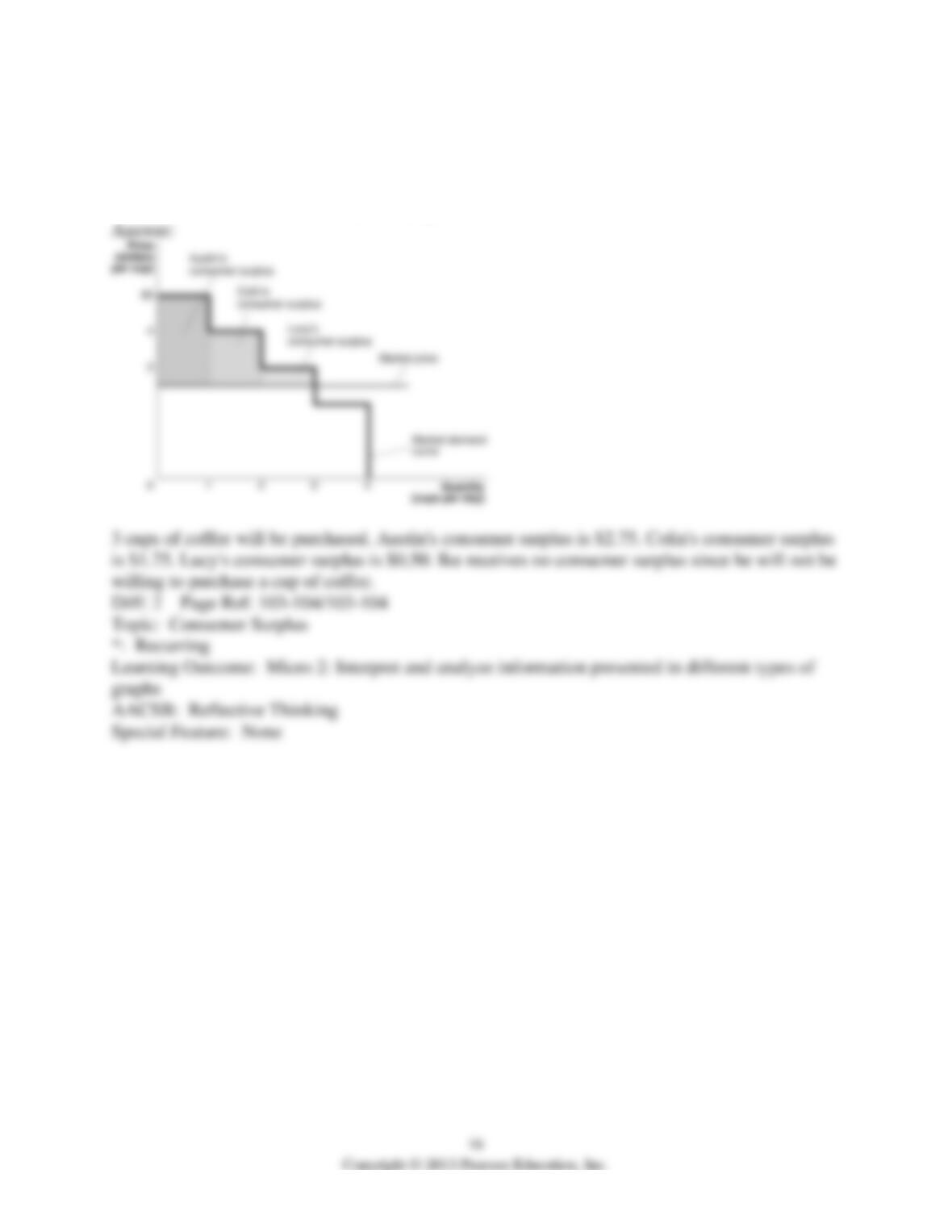
37) The market price for coffee is $2.25 per cup. Austin is willing to pay $5.00 per cup, Colin is
willing to pay $4.00 per cup, Lucy is willing to pay $3.00 per cup, and Ike is willing to pay $2.00
per cup. Construct a graph showing the consumer surplus for each cup of coffee purchased. How
many cups of coffee will be purchased? What is the value of the consumer surplus each of the
four consumers receives from their coffee purchases?
4.2 The Efficiency of Competitive Markets
1) In a competitive market equilibrium the ________ equals the ________ of the last unit sold.
A) total profit; marginal benefit
B) total cost; marginal cost
C) profit; selling price
D) marginal benefit; marginal cost
2) When the marginal benefit equals the marginal cost of the last unit sold in a competitive
market
A) the net benefit of consumers is equal to the net benefit of producers.
B) an economically efficient level of output is produced.
C) producer surplus is equal to consumer surplus.
D) total benefit is equal to total cost.
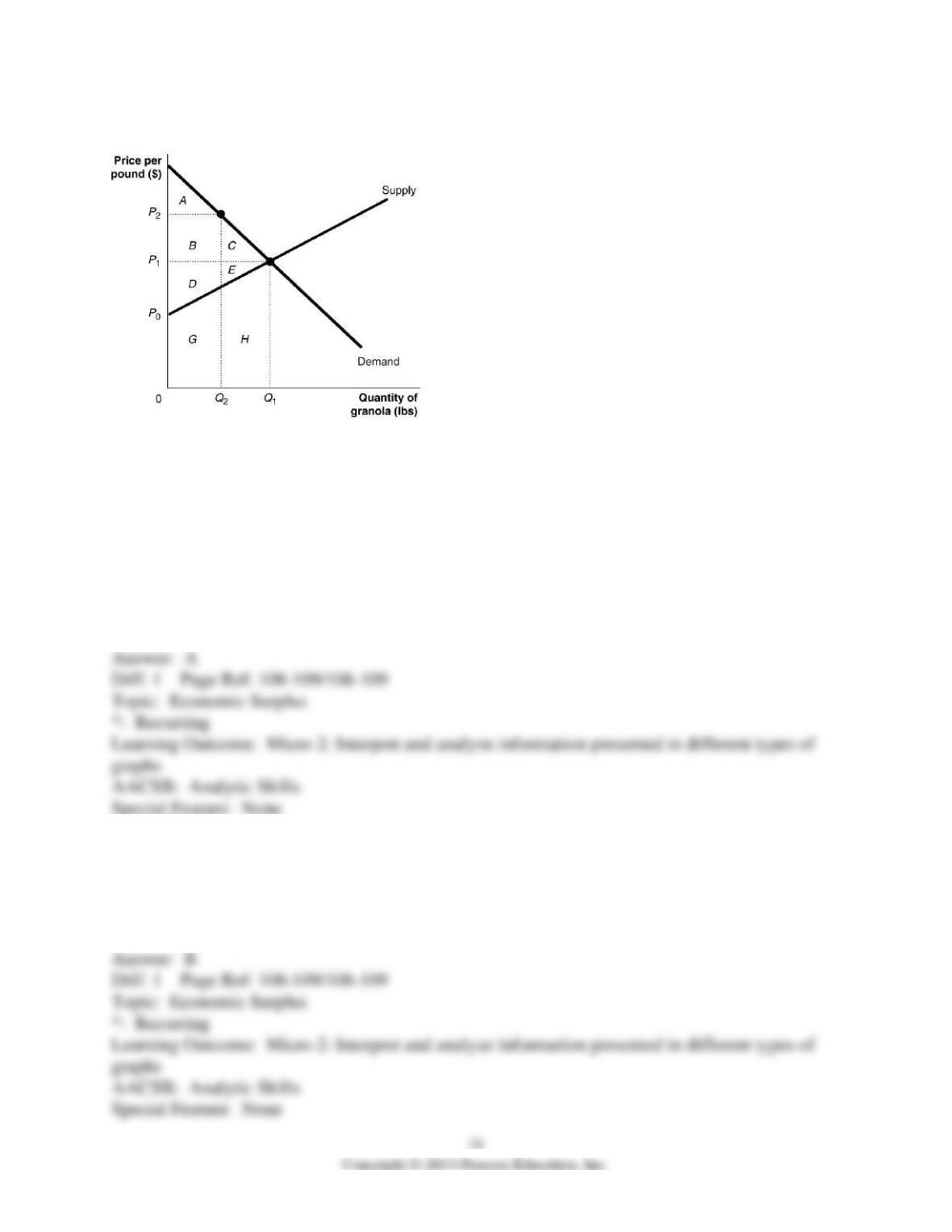
Figure 4-3
Figure 4-3 shows the market for granola. The market is initially in equilibrium at a price of P1
and a quantity of Q1. Now suppose producers decide to cut output to Q2 in order to raise the
price to P2.
3) Refer to Figure 4-3. What area represents consumer surplus at P2?
A) A
B) A + B
C) B + C
D) A + B + D + F
4) Refer to Figure 4-3. What area represents producer surplus at P2?
A) A + B + D
B) B + D
C) B + D + G
D) B + C + D + E
5) Refer to Figure 4-3. What area represents the deadweight loss at P2?
A) C + E + H
B) G + H
C) C + E
D) B + C
6) Refer to Figure 4-3. At the price P2 consumers are willing to buy the Q2 pounds of granola.
Is this an economically efficient quantity?
A) No, the marginal benefit of the last unit (Q2) exceeds the marginal cost of that last unit.
B) Yes, otherwise consumers would not buy Q2 units.
C) Yes, because the price P2 shows what consumers are willing to pay for the product.
D) No, the marginal cost of the last unit (Q2) exceeds the marginal benefit of the last unit.
7) Deadweight loss refers to
A) the opportunity cost to firms from producing the equilibrium quantity in a competitive
market.
B) the sum of consumer and producer surplus.
C) the loss of economic surplus when the marginal benefit equals the marginal cost of the last
unit produced.
D) the reduction in economic surplus resulting from not being in competitive equilibrium.
8) The sum of consumer surplus and producer surplus is equal to
A) the deadweight loss.
B) the economic surplus.
C) zero.
D) total profit.
9) Economic surplus is maximized in a competitive market when
A) demand is equal to supply.
B) the deadweight loss equals the sum of consumer surplus and producer surplus.
C) marginal benefit equals marginal cost.
D) producers sell the quantity that consumers are willing to buy.
10) ________ is defined as a market outcome in which the marginal benefit to consumers of the
last unit produced is equal to the marginal cost of production, and in which the sum of consumer
surplus and producer surplus is at a maximum.
A) Economic efficiency
B) Consumer efficiency
C) Producer efficiency
D) Deadweight efficiency