Fundamentals of Management, 10e (Robbins)
Chapter 4a Quantitative Module
1) Which role does uncertainty typically play in how managers function?
A) Uncertainty limits the amount of information that is available.
B) Uncertainty increases the amount of information that is available.
C) Uncertainty improves the quality of information that is available.
D) Uncertainty enhances the information that is available.
2) Which psychological orientation would be typical of a manager who is optimistic about her
business environment?
A) a maximin orientation
B) a minimin orientation
C) a maximax orientation
D) a minimax orientation
3) A manager is worried that if he chooses the wrong investment strategy, his company could
lose out on a great deal of money. Which strategy should he follow?
A) a maximax orientation
B) a minimin orientation
C) a maximin orientation
D) a minimax orientation
4) Which psychological orientation would be typical of a manager who is pessimistic about her
business environment?
A) a maximin orientation
B) a minimin orientation
C) a maximax orientation
D) a minimax orientation
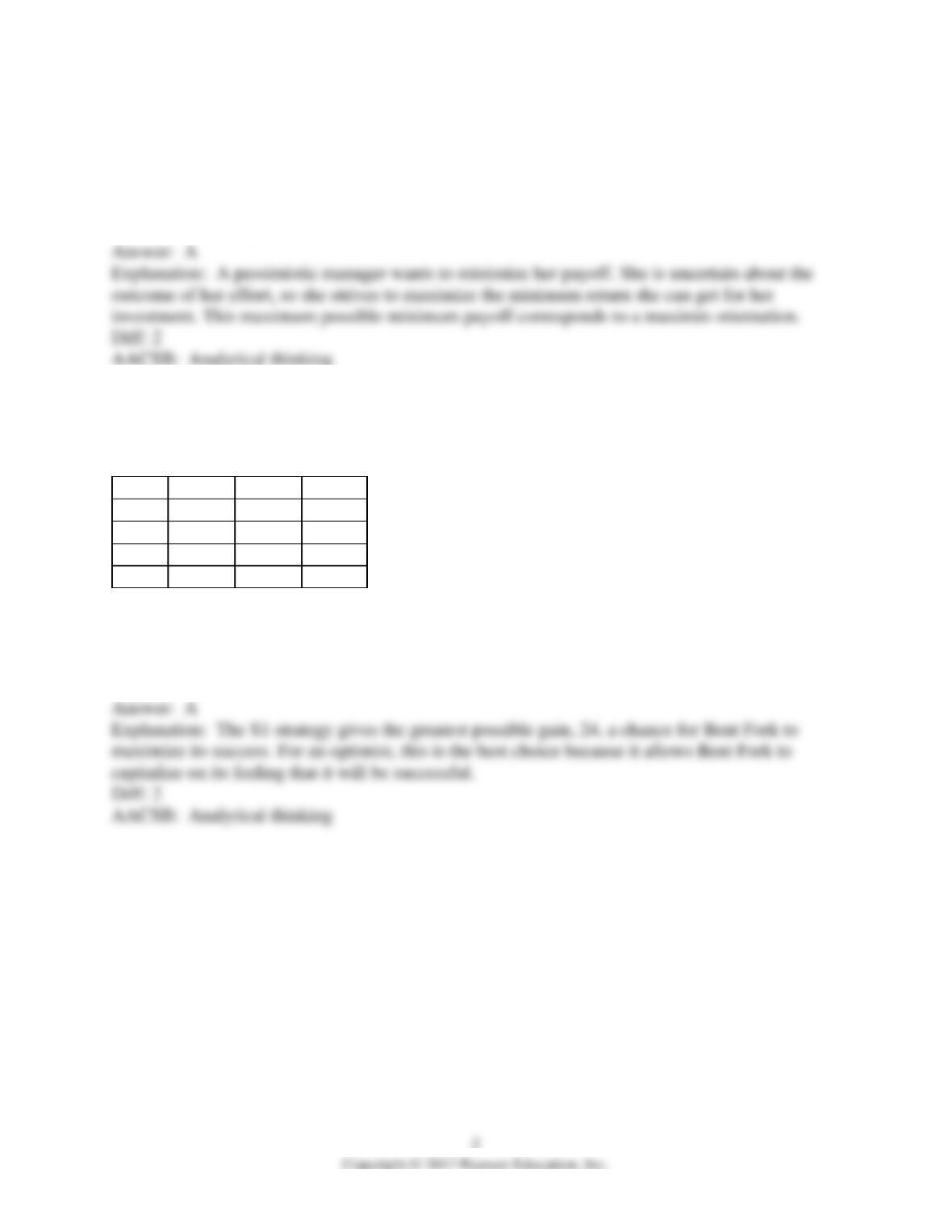
5) This payoff matrix gives potential dollar gain values in millions for strategies S1, S2, S3, and
S4 for the Bent Fork National Bank and competitive strategies CA1, CA2, and CA3 for the
Straight Spoon Bank. If Bent Fork is optimistic, which strategy will it choose?
CA1 CA2 CA3
S1 3 24 17
S2 15 16 14
S3 8 19 10
S4 20 2 11
A) S1
B) S2
C) S3
D) S4
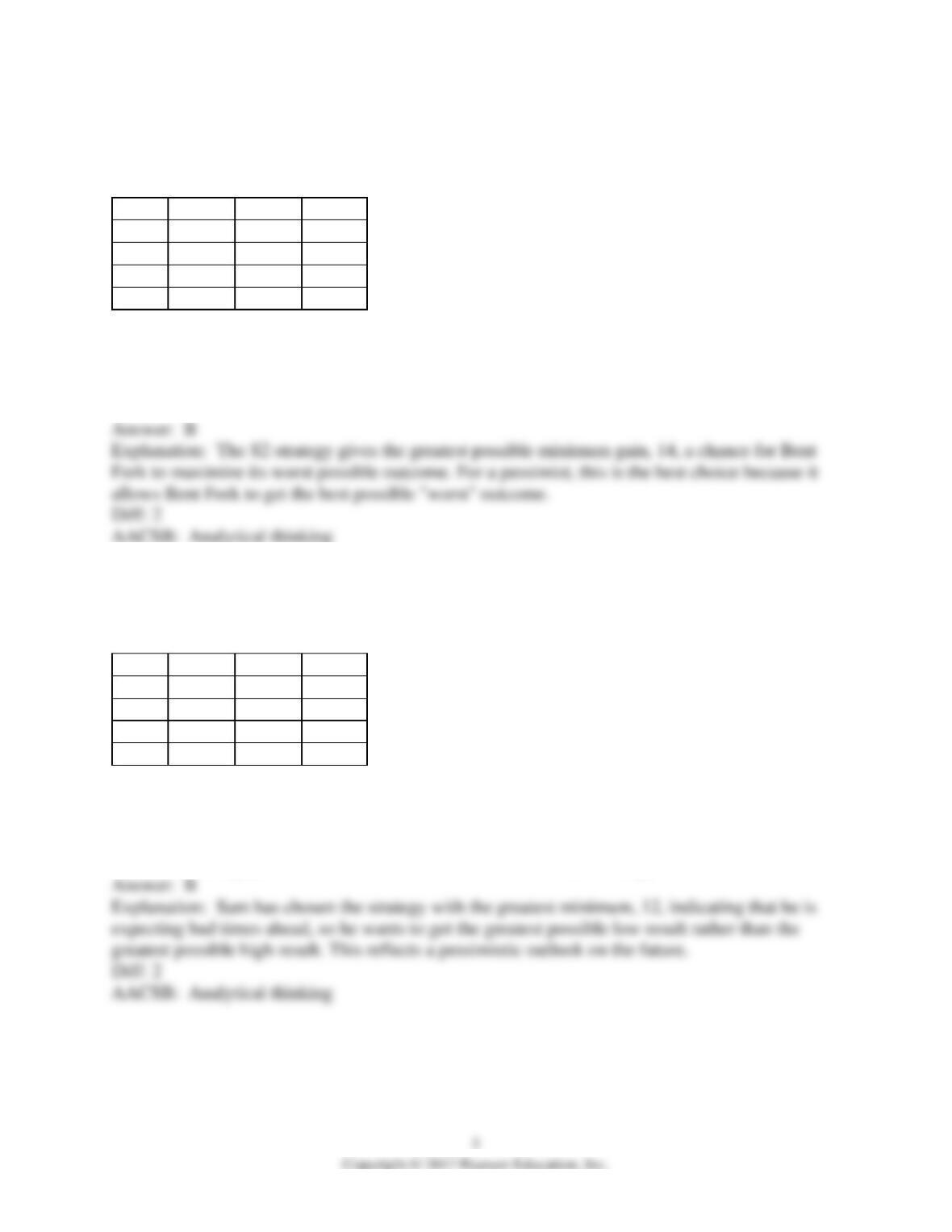
6) This payoff matrix gives potential dollar gain values in millions for strategies S1, S2, S3, and
S4 for the Bent Fork National Bank and competitive strategies CA1, CA2, and CA3 for the
Straight Spoon Bank. If Bent Fork is pessimistic, which strategy will it choose?
CA1 CA2 CA3
S1 3 24 17
S2 15 16 14
S3 8 19 10
S4 20 2 11
A) S1
B) S2
C) S3
D) S4
7) This payoff matrix gives potential dollar gain values in thousands for strategies S1, S2, S3,
and S4 for Sam’s Pizza and competitive strategies CA1, CA2, and CA3 for Pam’s Pizza. If Sam
chooses S4, how is he feeling about the business climate?
CA1 CA2 CA3
S1 13 14 7
S2 7 17 12
S3 31 29 4
S4 20 12 21
A) Sam is feeling optimistic because he has chosen a maximax strategy.
B) Sam is feeling pessimistic because he has chosen a maximin strategy.
C) Sam is feeling optimistic because he has chosen a maximin strategy.
D) Sam is feeling pessimistic because he has chosen a maximax strategy.
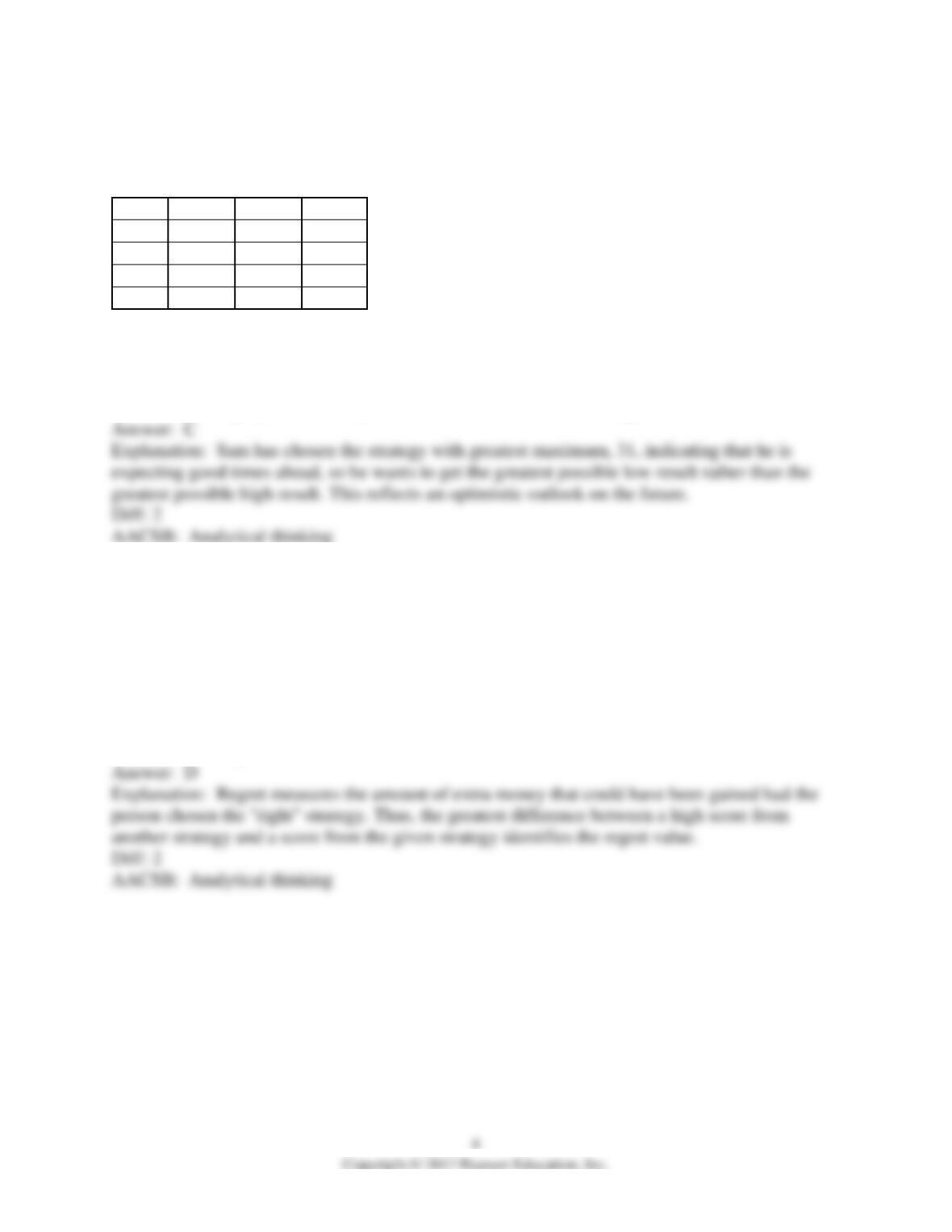
8) This payoff matrix gives potential dollar gain values in thousands for strategies S1, S2, S3,
and S4 for Sam’s Pizza and competitive strategies CA1, CA2, and CA3 for Pam’s Pizza. If Sam
chooses S3, how is he feeling about the business climate?
CA1 CA2 CA3
S1 13 14 7
S2 7 17 12
S3 31 29 4
S4 20 12 21
A) Sam is feeling pessimistic because he has chosen a maximax strategy.
B) Sam is feeling pessimistic because he has chosen a minimax strategy.
C) Sam is feeling optimistic because he has chosen a maximax strategy.
D) Sam is feeling optimistic because he has chosen a maximin strategy.
9) Which of the following best defines regret in a payoff matrix?
A) Regret refers to the difference of the sum of the values in a chosen strategy and the sum of the
best strategy.
B) Regret refers to the difference of the sum of the values in a chosen strategy and the sum of the
worst strategy.
C) Regret refers to the sum total of the sum of the values in a chosen strategy and the sum of the
best strategy.
D) Regret refers to the extra amount of money that could have been made had the person chosen
a different strategy.
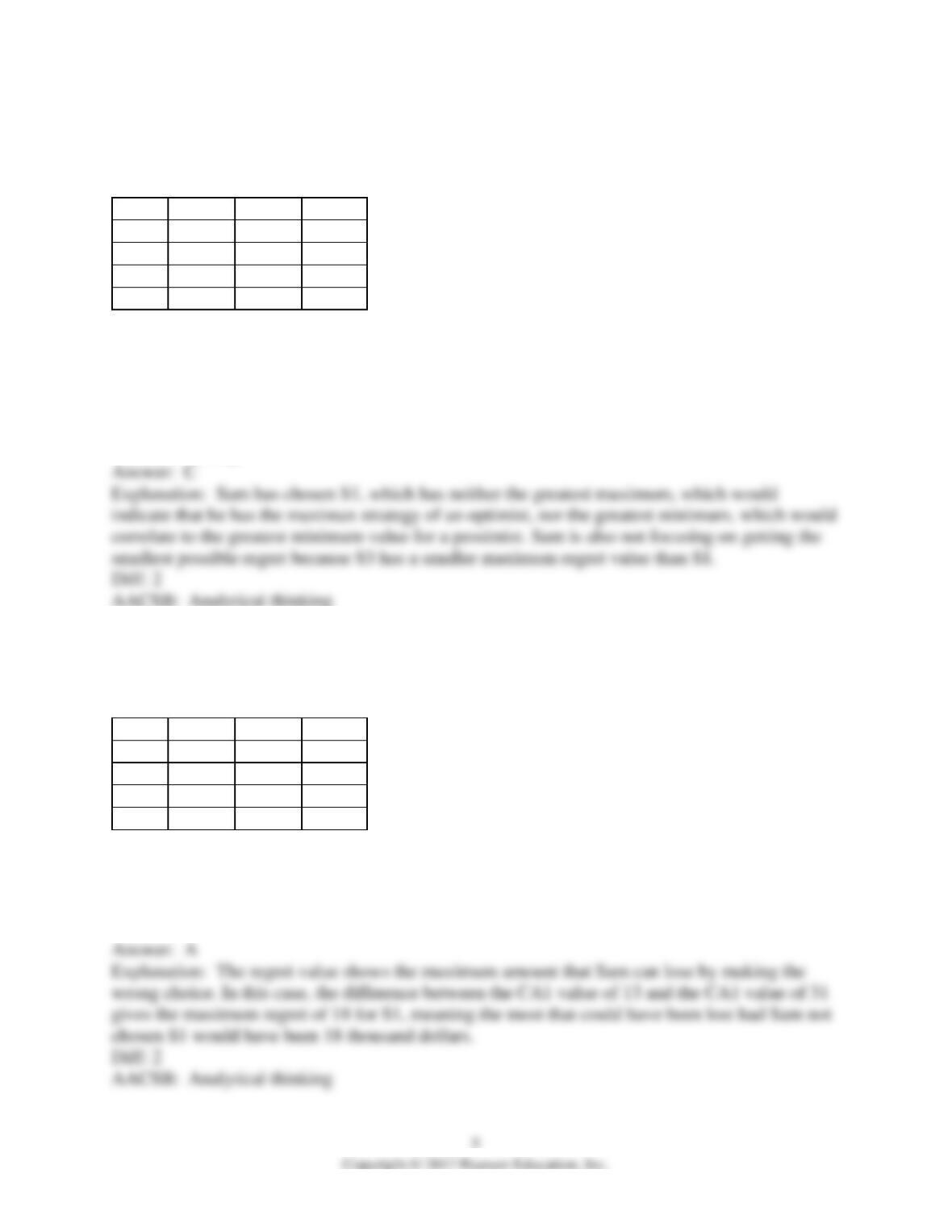
10) This payoff matrix gives potential dollar gain values in thousands for strategies S1, S2, S3,
and S4 for Sam’s Pizza and competitive strategies CA1, CA2, and CA3 for Pam’s Pizza. If Sam
chooses S1, how is he feeling about the business climate?
CA1 CA2 CA3
S1 13 14 7
S2 7 17 12
S3 31 29 4
S4 20 12 21
A) Sam is feeling pessimistic because he has chosen a maximax strategy.
B) Sam is feeling optimistic because he has chosen a maximin strategy.
C) Sam is feeling neither pessimistic nor optimistic because he has chosen neither a maximin nor
a maximax strategy.
D) Sam is feeling both pessimistic and optimistic because he has chosen both a maximin and a
maximax strategy.
11) This payoff matrix gives potential dollar gain values in thousands for strategies S1, S2, S3,
and S4 for Sam’s Pizza and competitive strategies CA1, CA2, and CA3 for Pam’s Pizza. What is
the maximum regret value for S1?
CA1 CA2 CA3
S1 13 14 7
S2 7 17 12
S3 31 29 4
S4 20 12 21
A) 18
B) 15
C) 14
D) 12
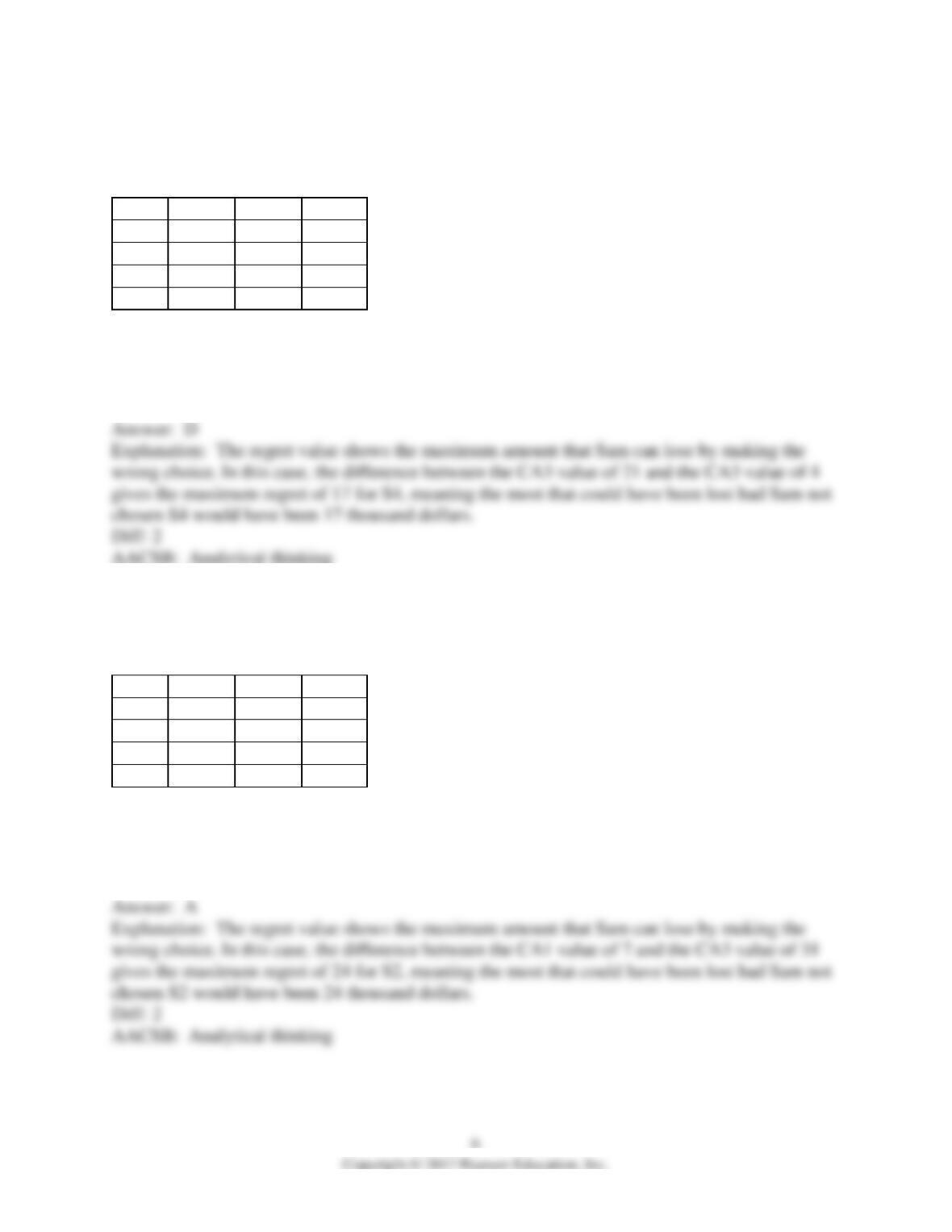
12) This payoff matrix gives potential dollar gain values in thousands for strategies S1, S2, S3,
and S4 for Sam’s Pizza and competitive strategies CA1, CA2, and CA3 for Pam’s Pizza. What is
the maximum regret value for S4?
CA1 CA2 CA3
S1 13 14 7
S2 7 17 12
S3 31 29 4
S4 20 12 21
A) 13
B) 7
C) 2
D) 17
13) This payoff matrix gives potential dollar gain values in thousands for strategies S1, S2, S3,
and S4 for Sam’s Pizza and competitive strategies CA1, CA2, and CA3 for Pam’s Pizza. What is
the maximum regret value for S2?
CA1 CA2 CA3
S1 13 14 7
S2 7 17 12
S3 31 29 4
S4 20 12 21
A) 24
B) 15
C) 5
D) 0
14) Which of the following would a manager who wants to minimize her maximum regret
choose?
A) the smallest maximum regret value
B) the smallest minimum regret value
C) the smallest difference maximum regret value and the minimum regret value
D) the greatest difference maximum regret value and the minimum regret value
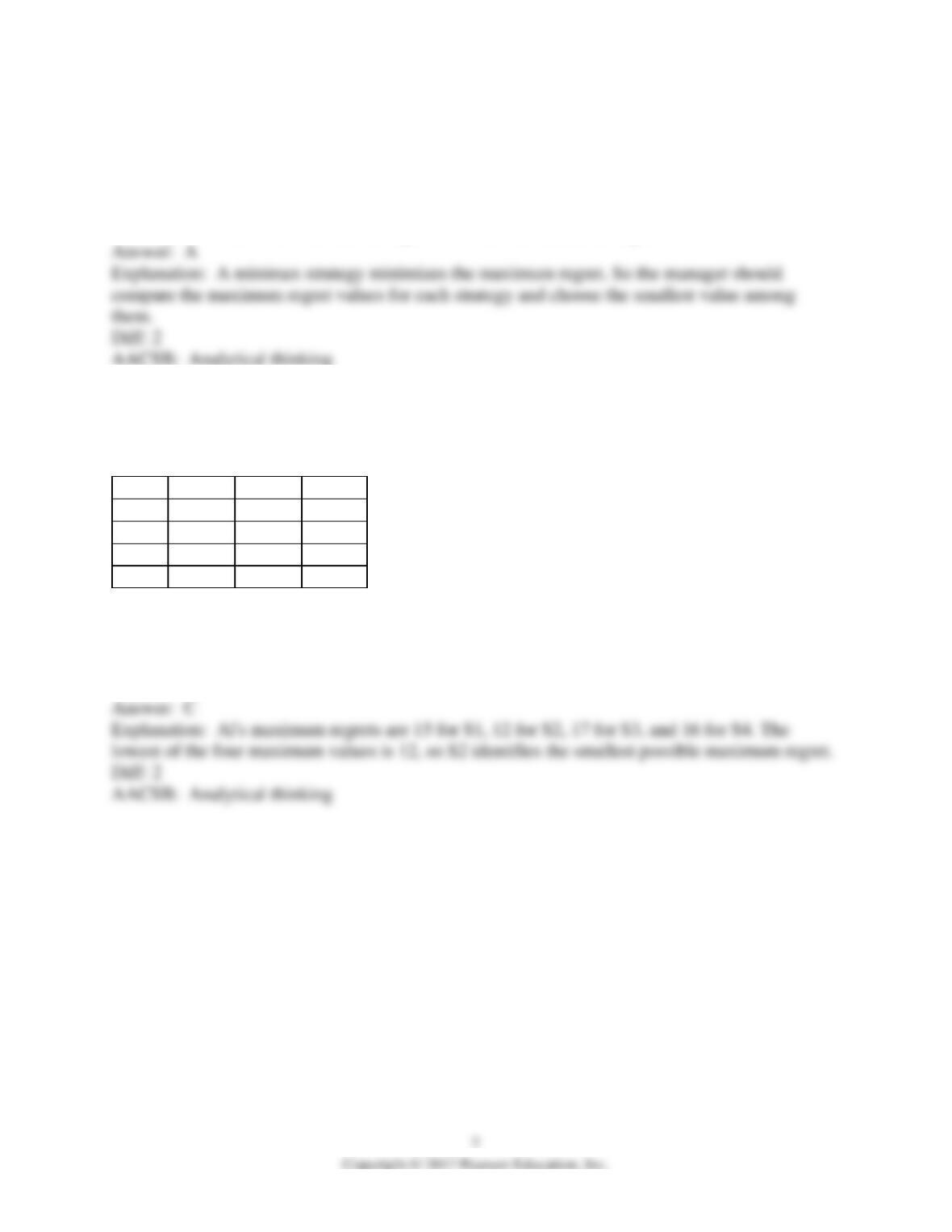
15) This regret matrix gives potential dollar values in thousands for strategies S1, S2, S3, and S4
for Al’s Fish Fry and competitive strategies CA1, CA2, and CA3 for Sal’s Fish Bake. If Al wants
to minimize his maximum regret, which strategy should he choose?
CA1 CA2 CA3
S1 3 15 9
S2 12 10 12
S3 8 9 17
S4 13 16 3
A) S4
B) S3
C) S2
D) S1
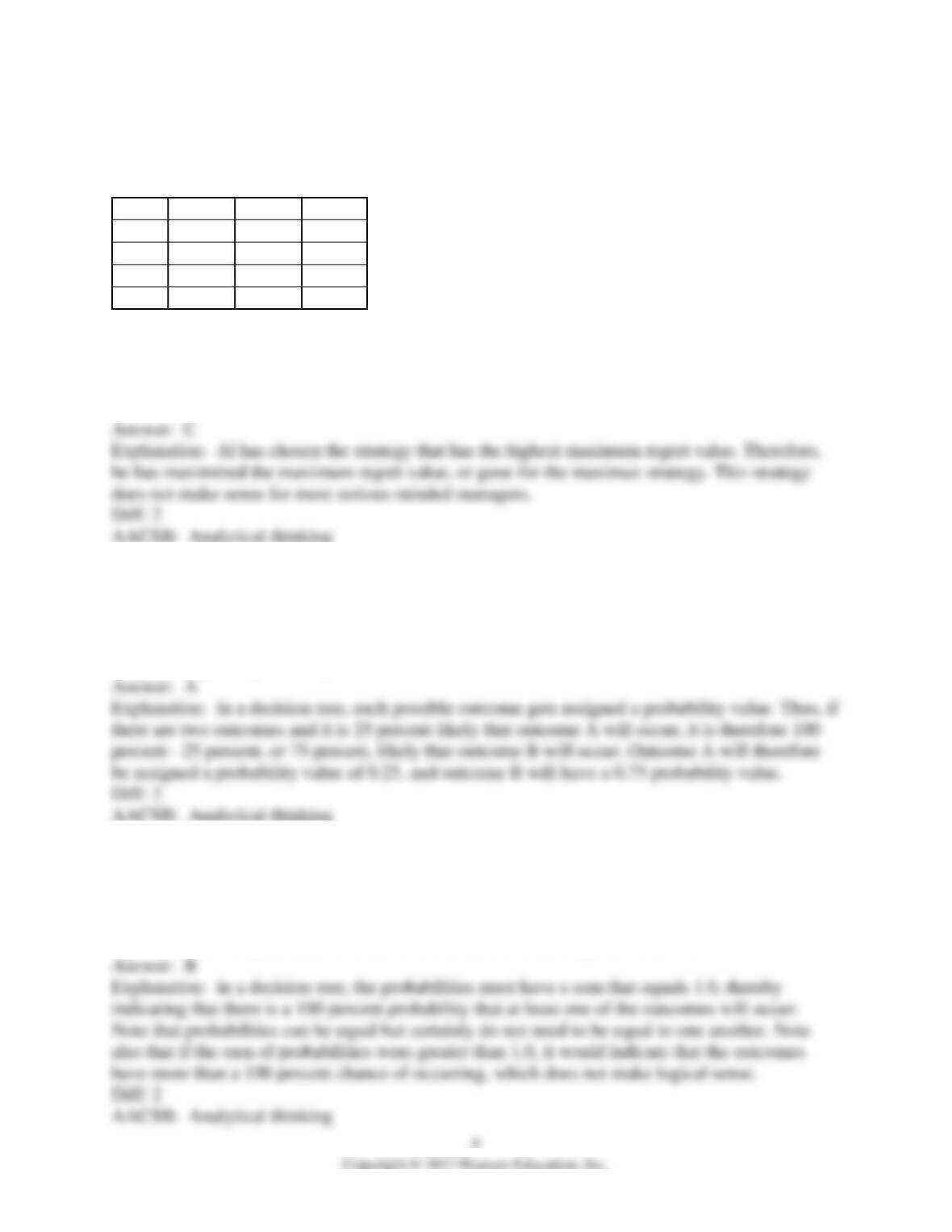
16) This regret matrix gives potential dollar values in thousands for strategies S1, S2, S3, and S4
for Al’s Fish Fry and competitive strategies CA1, CA2, and CA3 for Sal’s Fish Bake. If Al
chooses S3, what kind of strategy is he using?
CA1 CA2 CA3
S1 3 15 9
S2 12 10 12
S3 8 9 17
S4 13 16 3
A) minimax
B) maximin
C) maximax
D) minimin
17) In a decision tree, each possible outcome ________.
A) gets assigned a probability value between 0 and 1.0
B) gets assigned a probability value of 50 percent
C) gets assigned a probability value between 0 and 50 percent
D) gets assigned a probability value between 0.5 and 1.0
18) In a decision tree, which of the following is true?
A) The probabilities of all of the outcomes must be equal.
B) The sum of the probabilities of all of the outcomes must equal 1.0.
C) No outcome can have a probability that is less to 1.0.
D) The sum of the probabilities of all of the outcomes must be greater than 1.0.
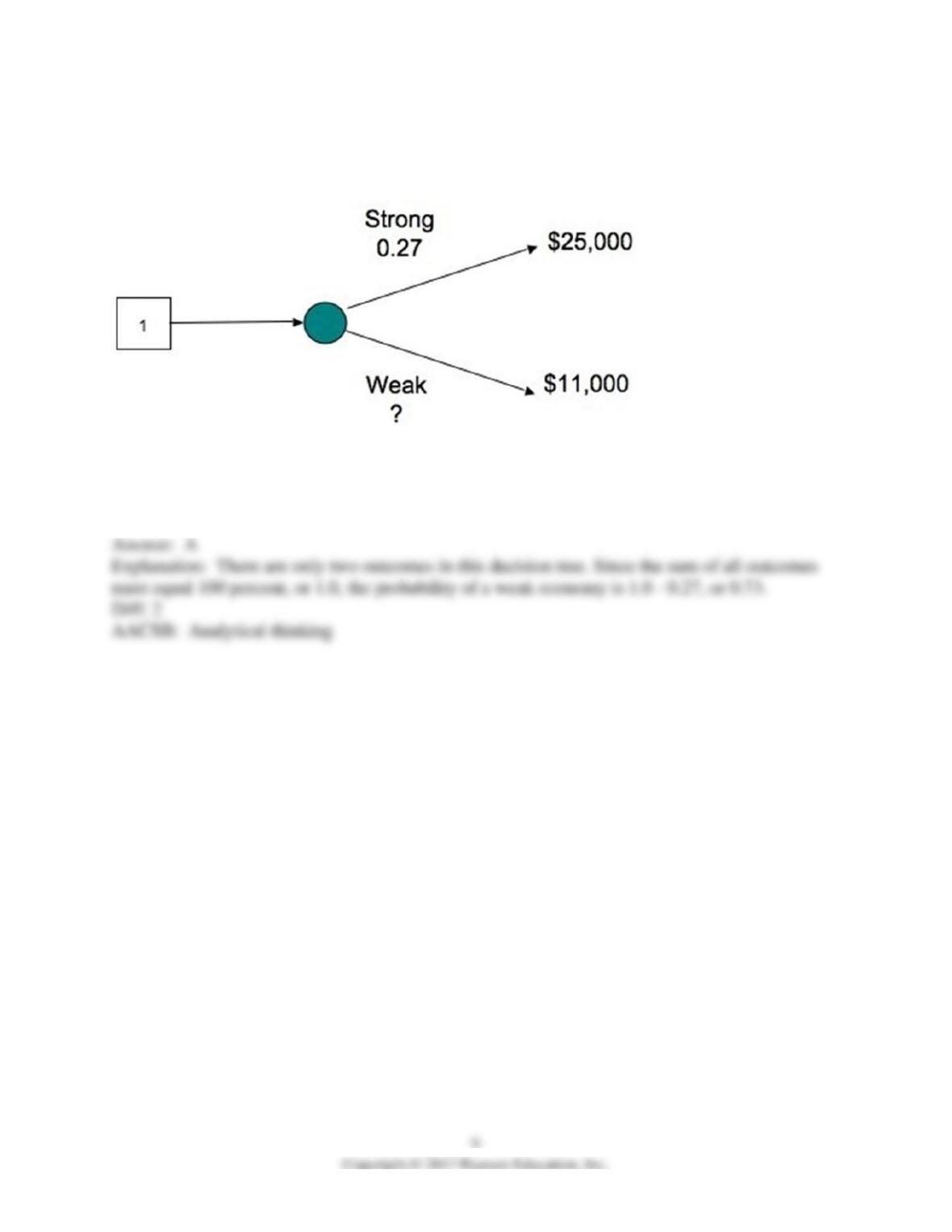
19) The decision tree shows the profit outcomes for a coffee shop in a strong and a weak
economy for next year. What is the probability that the economy will be weak in the coming
year?
A) 0.73
B) 27 percent
C) 50 percent
D) 7.3
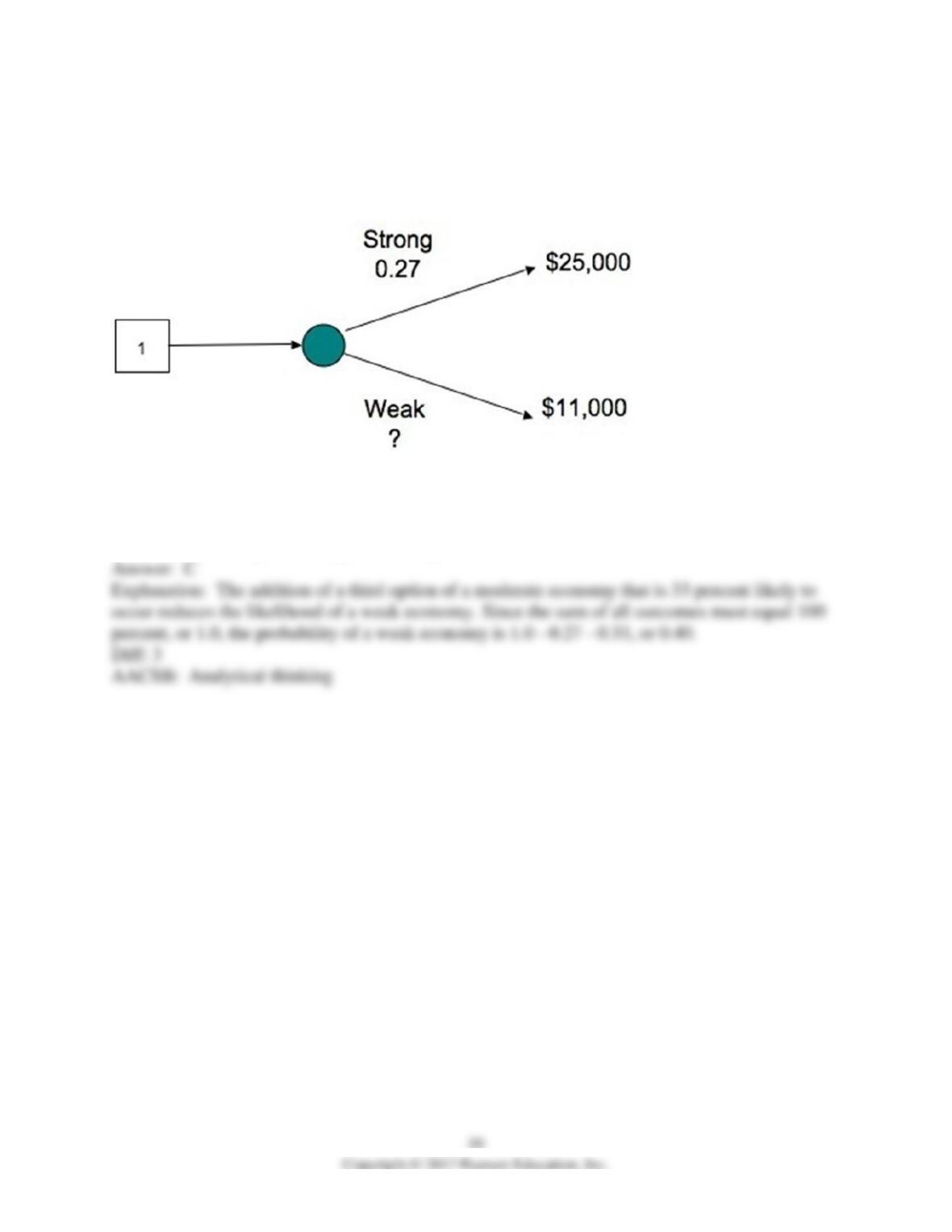
20) The decision tree shows the profit outcomes for a coffee shop in a strong and a weak
economy for next year. Suppose a third outcome is considered in which a moderate economy is
33 percent likely to occur. With this added outcome, how does the probability of a weak
economy change?
A) A weak economy is now 73 percent likely.
B) A weak economy is also 33 percent likely.
C) A weak economy is now 40 percent likely.
D) A weak economy is now 0 percent likely.
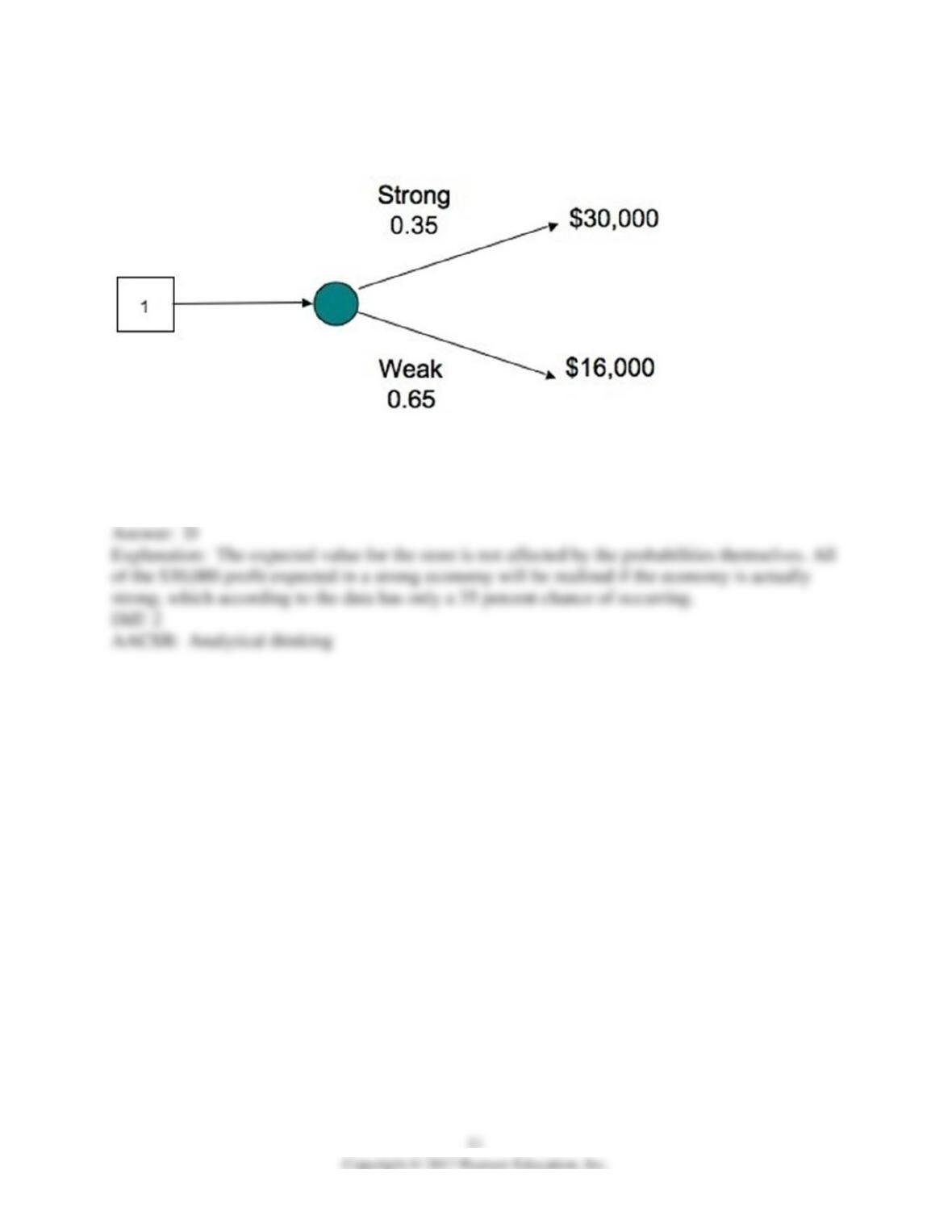
21) The decision tree shows the profit outcomes for a toy store in a strong and a weak economy
for next year. What is the expected value of the store’s profit in a strong economy?
A) $10,500
B) $15,000
C) $16,000
D) $30,000
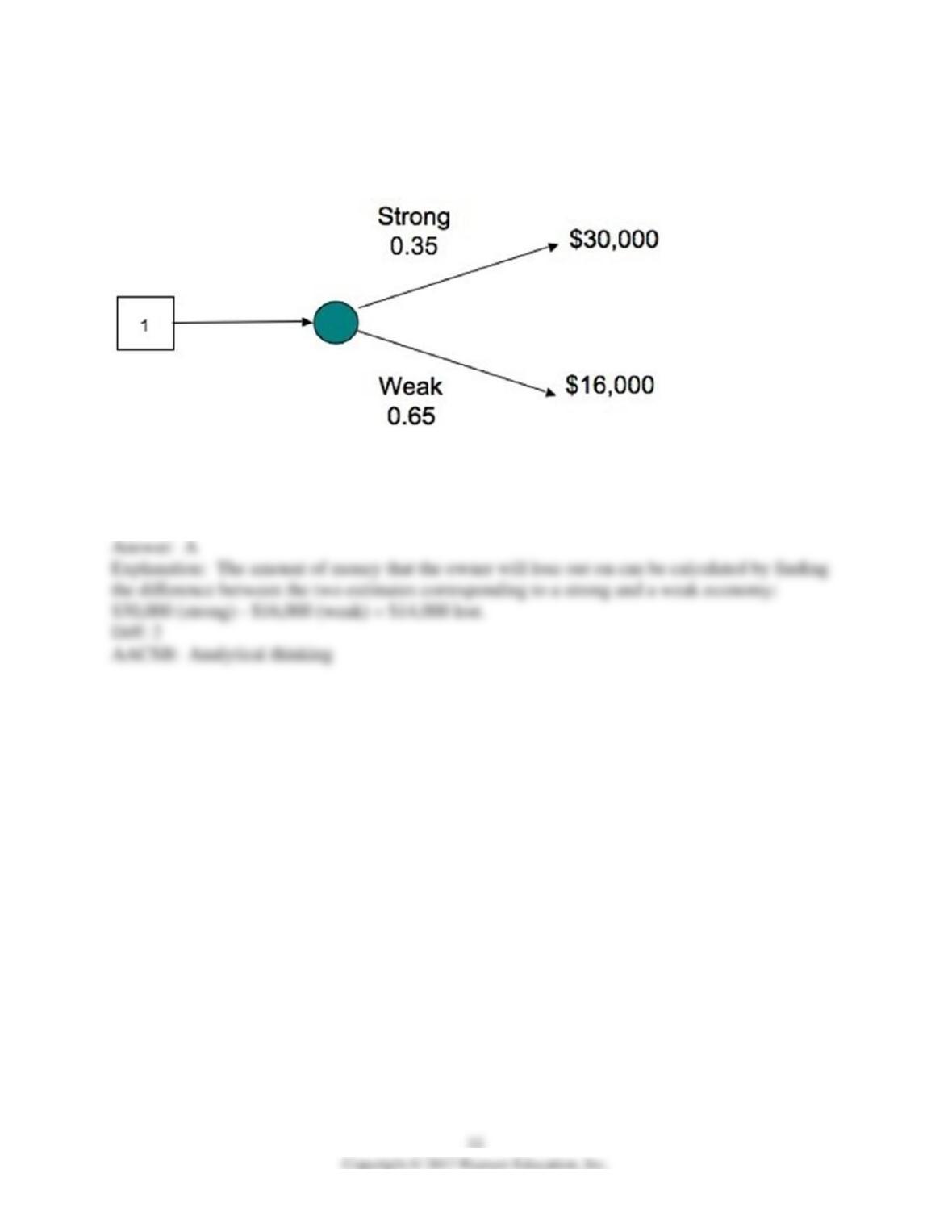
22) The decision tree shows the profit outcomes for a toy store in a strong and a weak economy
for next year. If the economy turns out to be weak, how much profit is the store likely to lose
out?
A) $14,000
B) $16,000
C) $30,000
D) $15,000
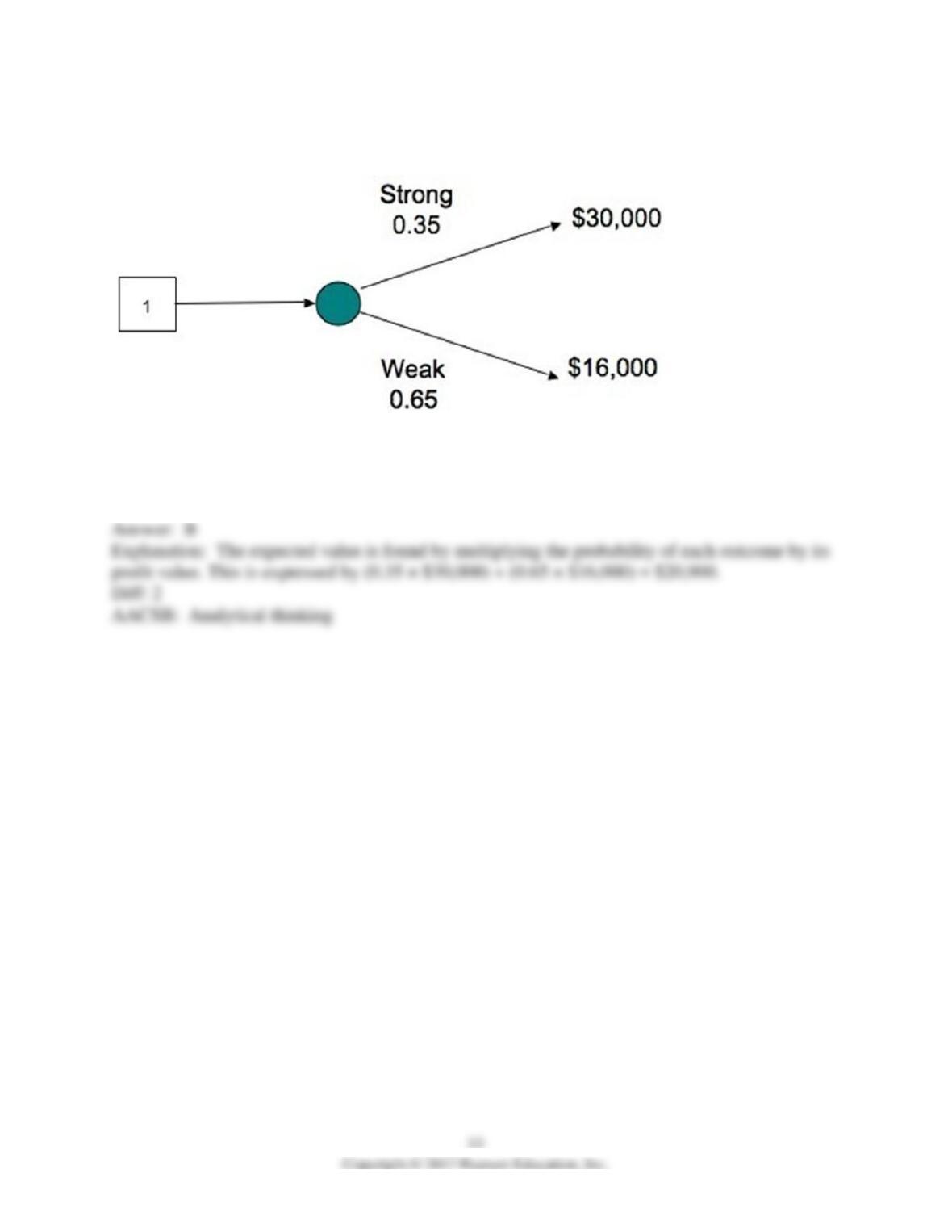
23) The decision tree shows the profit outcomes for a toy store in a strong and a weak economy
for next year. What is the expected value of profit for the store for the year?
A) $10,500
B) $20,900
C) $29,000
D) $10,400
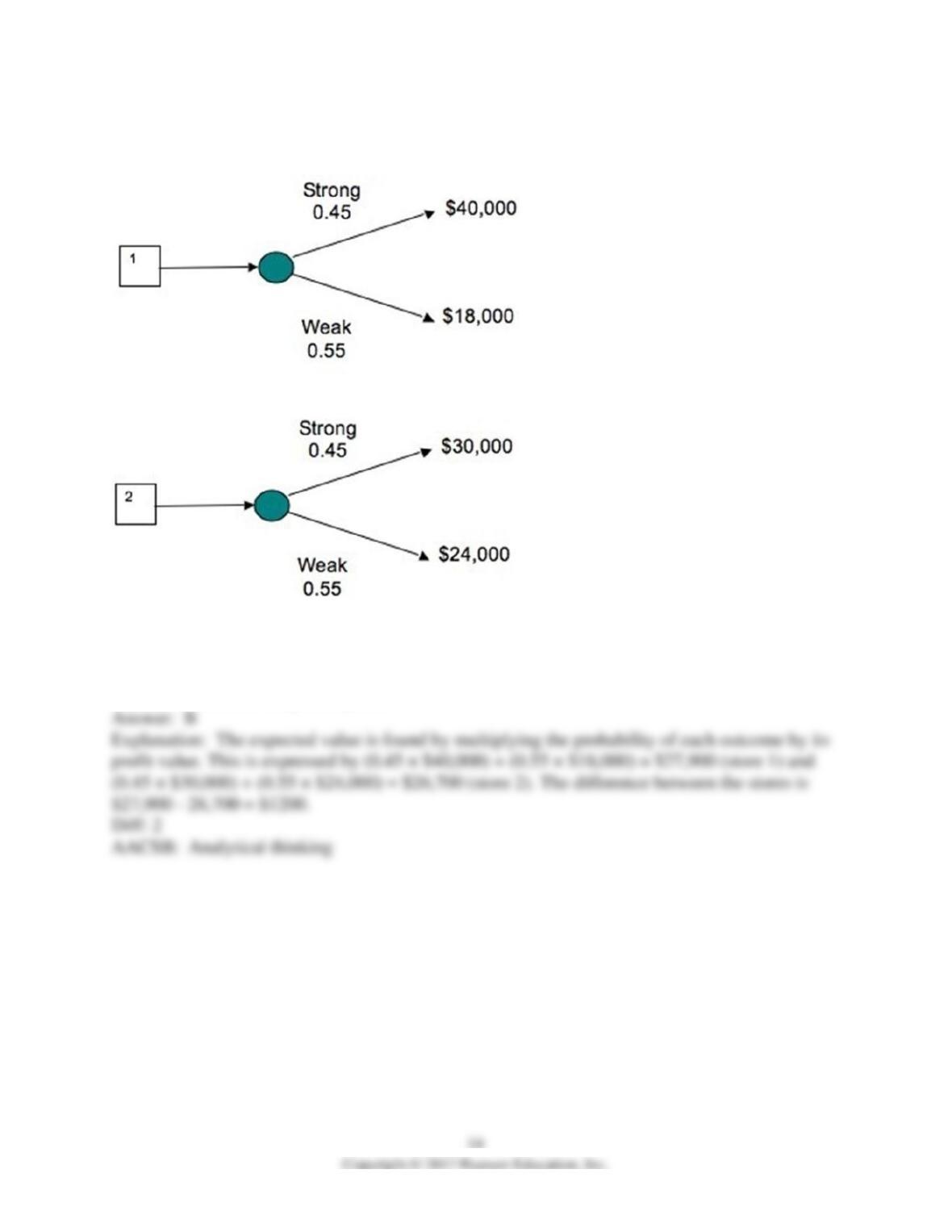
24) Decision trees show the profit outcomes for the plans for two doughnut stores in a strong and
a weak economy for the future. Which store is expected to have the greater expected profit?
A) Store 1 has a $27,900 greater profit.
B) Store 1 has a $1200 greater profit.
C) Store 2 has a $26,700 greater profit.
D) Store 2 has a $1200 greater profit.
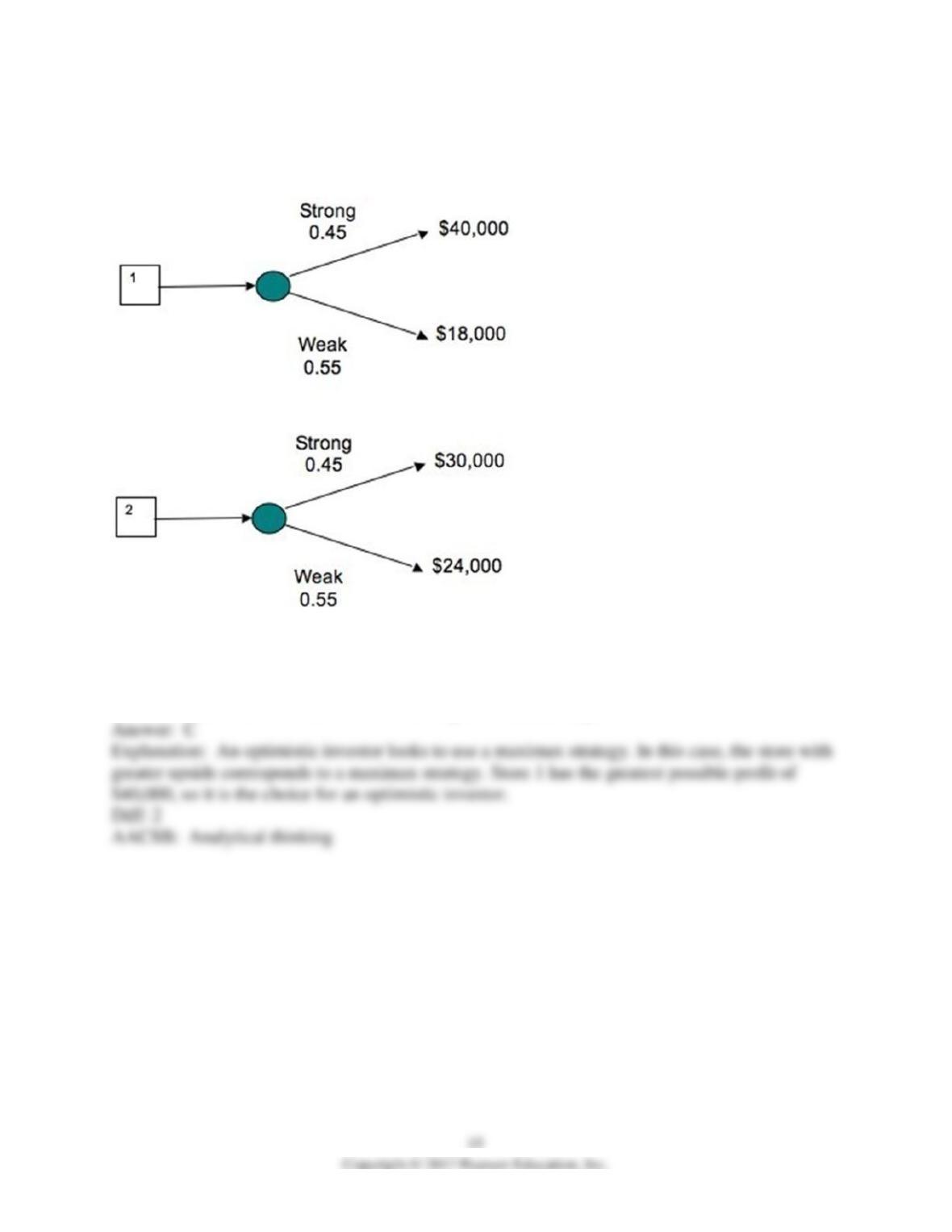
25) Decision trees show the profit outcomes for the plans for two doughnut stores in two
different locations in a strong and a weak economy for the future. If the investor interested in
building a store is optimistic, in which location should she build?
A) She should build Store 1, because it has a lower minimum profit.
B) She should build Store 2, because it has a greater maximum profit.
C) She should build Store 1, because it has a greater maximum profit.
D) She should build Store 2, because it has a greater minimum profit.
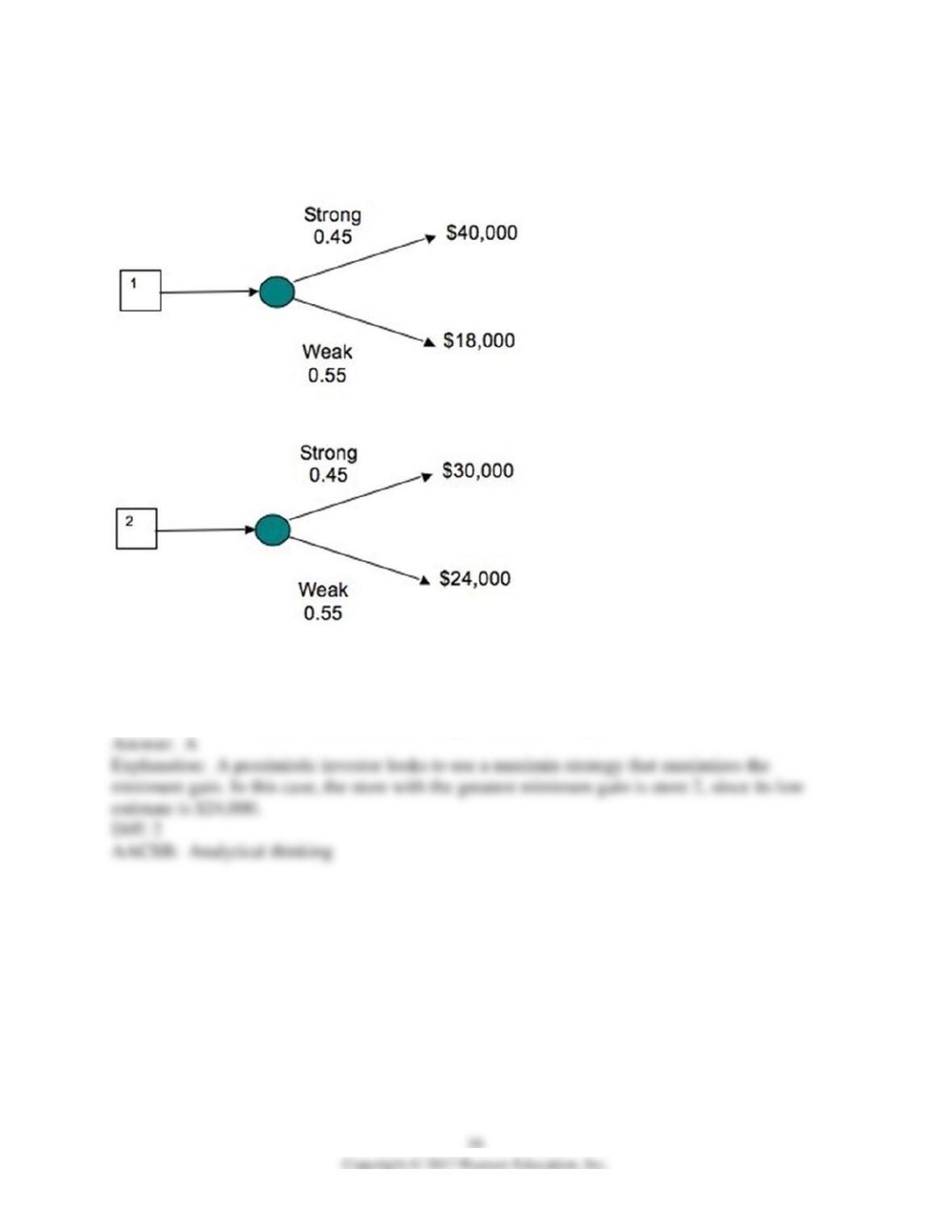
26) Decision trees show the profit outcomes for the plans for two doughnut stores in two
different locations in a strong and a weak economy for the future. If the investor interested in
building a store is pessimistic, in which location should she build?
A) She should build Store 2, because it has a greater minimum profit.
B) She should build Store 2, because it has a greater maximum profit.
C) She should build Store 1, because it has a greater maximum profit.
D) She should build Store 1, because it has a greater minimum profit.
27) For break-even analysis, which of the following is a fixed cost for a doughnut shop?
A) costs for purchasing flour and sugar
B) energy costs for ovens and heating
C) interest payments on loans
D) advertising costs
28) A manager does a break-even analysis and finds that his value for BE, the break-even point,
has decreased over time. Which of the following could be responsible for this event?
A) TFC has increased.
B) P has increased.
C) VC has decreased.
D) P has decreased.
29) Fixed costs for a product are $50,000. The product itself sells for $5.00 and it costs $3.00 to
make each product. What is the break-even point for the product?
A) 100,000
B) 10,000
C) 50,000
D) 25,000
30) Fixed costs for a product are $60,000. The product itself sells for $4.00 and it costs $1.00 to
make each product. How will the break-even point for the product change if the variable cost per
unit goes up to $1.50?
A) The break-even point will increase by 4000.
B) The break-even point will increase by 24,000.
C) The break-even point will decrease by 4000.
D) The break-even point will increase by 20,000.
31) Fixed costs for a product are $30,000. The product itself sells for $3.00 and it costs $1.50 to
make each product. How can the plant decrease the break-even point by 5000 units?
A) Increase P, the price of the item, by $0.50.
B) Increase TFC, the fixed costs for item, by $5000.
C) Decrease P, the price of the item, by $0.50.
D) Decrease TFC, the fixed costs for item, by $5000.
32) A company has a current ratio of 2.75 to 1. What should a manager in the company
conclude?
A) The company is getting the best possible return on its assets.
B) The company has too many liabilities.
C) The company is not getting the best possible return on its assets.
D) The company is not getting the best possible return on its liabilities.
33) A company has a current ratio of 0.85 to 1. What should a manager in the company worry
about?
A) The company has too many assets and is not using them efficiently.
B) The company has too much inventory.
C) The company may start to have trouble paying salaries.
D) The company is paying salaries that are too high.
34) When is the acid test an especially important test for a company’s liquidity?
A) when the economy is slow and inventory is not selling
B) when the economy is robust and inventory is selling fast
C) with companies that exclusively sell services and therefore do not have any inventory
D) with companies that exclusively sell services to the wealthy and therefore are not subject to
economic downturns
35) Which of the following characterizes a highly leveraged company?
A) high total assets relative to total debt
B) high total debt relative to total assets
C) high total debt relative to inventories
D) high total interest payments relative to total debt
36) Which of the following would cause a well-run company to become highly leveraged?
A) when the money that the company can earn investing the money that it borrows is equal to the
cost of borrowing
B) when the money that the company can earn investing the money that it borrows is
significantly less than the cost of borrowing
C) when the money that the company can earn investing the money that it borrows is
significantly greater than the cost of borrowing
D) when the money that the company can earn investing the money that it borrows is equal to
more than half of the cost of borrowing
37) Production data for the number of hours required per unit for making the Droid and iPhone
versions of cell phone components by Bizzer, a high-tech manufacturing firm, is given below.
What is the maximum number of units that the factory can make of either type of phone
component?
Monthly Product
Droid iPhone Capacity (Hours)
Design 5 8 5000
Manufacture 2.5 2.5 2500
Profit per unit $4 $6
A) 2500
B) 2000
C) 500
D) 1000