
Chapter 49 – The Circulatory System
41. When lungs evolved in vertebrates, the evolution of _____ also occurred in the
circulation of blood within those vertebrates.
42. The depolarization of the heart is initiated by the
Chapter 49 – The Circulatory System
43. A friend asks you to explain the difference between atherosclerosis and arteriosclerosis.
You say, “Well
Chapter 49 – The Circulatory System
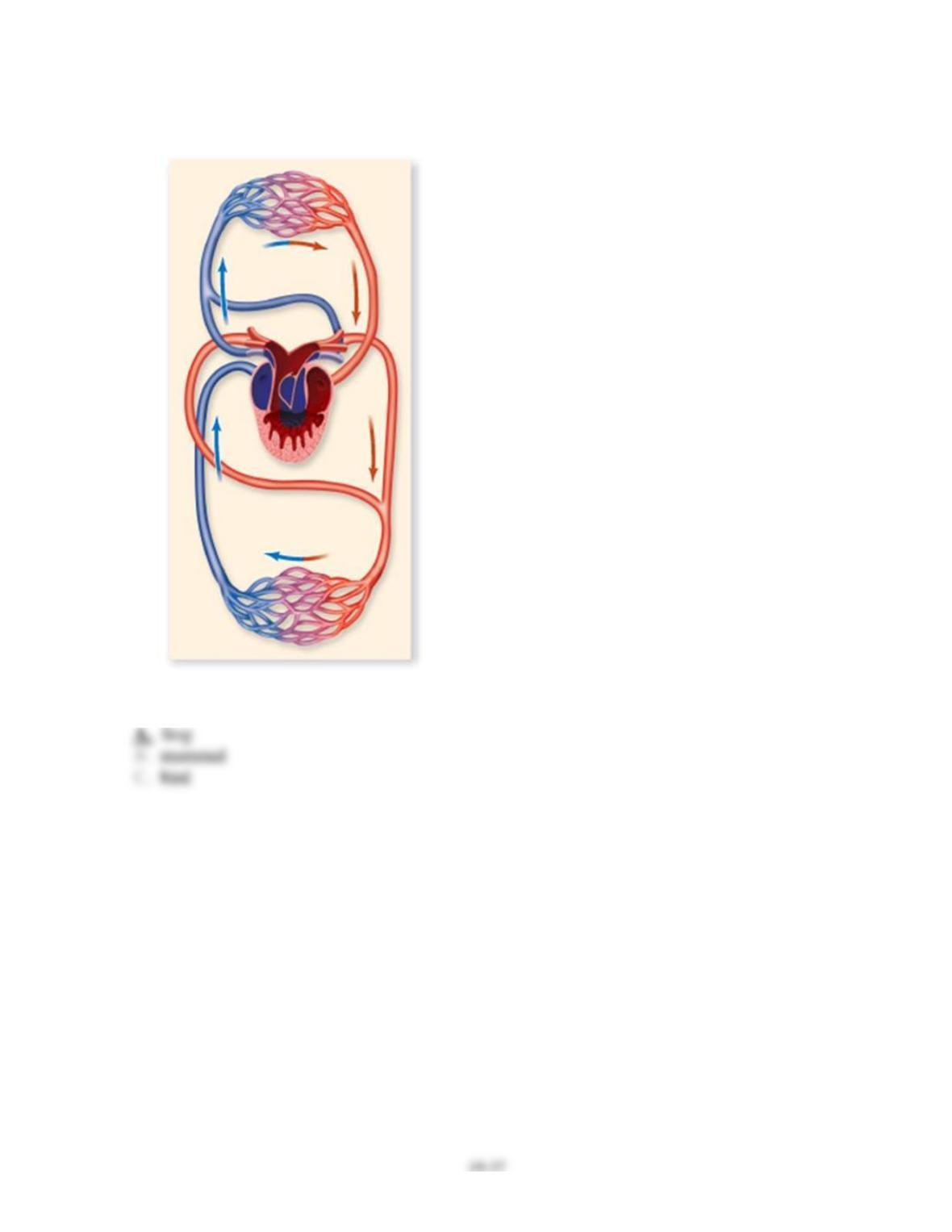
44. Which animal is likely to have the circulatory pattern shown in the figure?
Chapter 49 – The Circulatory System
45. What factor most limits a person’s maximal increase in cardiac output during exercise?
Chapter 49 – The Circulatory System
49–39
Clarify Question
What is the key concept addressed by the question?
What type of thinking is required?
Gather Content
What do you already know about the limiting factors on cardiac output? What other
information is related to the question?
Choose Answer
Given what you now know, what information is most likely to produce the correct answer?
Reflect on Process
Did your problem-solving process lead you to the correct answer? If not, where did the
process break down or lead you astray? How can you revise your approach to produce a
more desirable result?
Chapter 49 – The Circulatory System
46. The loudest sounds a nurse hears while listening to a patient’s heart through a stethoscope
are caused by
47. In a vertebrate with a four-chambered heart, the structure(s) containing blood with the
highest O2 concentration is/are the _______________.
Chapter 49 – The Circulatory System
48. A nurse takes your blood pressure during your annual examination, and she enters a
reading of 115/70 in your medical chart. These numbers mean that the
49. The P wave of the ECG represents
Chapter 49 – The Circulatory System
50. Stimulating the vagus nerve would cause
51. Myeloid stem cells give rise to all formed elements in the blood EXCEPT
52. What type of mollusk has a closed circulatory system?
Chapter 49 – The Circulatory System
53. You are taking a lab practical exam, and one station has pins in various internal structures
of a bisected mammalian heart. You can orient yourself without picking up and examining the
exterior of the heart because
Chapter 49 – The Circulatory System
49–44
Clarify Question
What is the key concept addressed by the question?
What type of thinking is required?
Gather Content
What do you already know about the structure of the mammalian heart? What other
information is related to the question?
Choose Answer
Given what you now know, what information is most likely to produce the correct answer?
Reflect on Process
Did your problem-solving process lead you to the correct answer? If not, where did the
process break down or lead you astray? How can you revise your approach to produce a
more desirable result?

Chapter 49 – The Circulatory System
True / False Questions
54. Animals with closed circulatory systems are more successful than animals with open
circulatory systems.
Chapter 49 – The Circulatory System
Clarify Question
What is the key concept addressed by the question?
What type of thinking is required?
Gather Content
What do you already know evolutionary success? What other information is related to the
question?
Choose Answer
Given what you now know, what information is most likely to produce the correct answer?
Reflect on Process
Did your problem-solving process lead you to the correct answer? If not, where did the
process break down or lead you astray? How can you revise your approach to produce a
more desirable result?

Chapter 49 – The Circulatory System
Multiple Choice Questions
55. Susie just squished a cockroach and its pale yellow hemolymph squirted out on the floor.
If Susie analyzed the hemolymph, she would expect to find all of the following EXCEPT
Chapter 49 – The Circulatory System
Clarify Question
What is the key concept addressed by the question?
What type of thinking is required?
Gather Content
What do you already know about hemolymph? What other information is related to the
question?
Choose Answer
Given what you now know, what information is most likely to produce the correct answer?
Reflect on Process
Did your problem-solving process lead you to the correct answer? If not, where did the
process break down or lead you astray? How can you revise your approach to produce a
more desirable result?