CHAPTER 49—ANIMAL REPRODUCTION
MULTIPLE CHOICE
1. Which of the following statements about the palolo worm is FALSE?
a.
Its scientific name is Eunice viridis.
b.
It is a polychaete annelid.
c.
It lives in coral reefs.
d.
It produces gamete-filled tails in its anterior end.
e.
Its tails break off once a year, in October.
2. The palolo worm _____ and individuals produce ______ offspring per reproductive event.
a.
lays eggs; few
b.
lays eggs; many
c.
gives live birth; few
d.
gives live birth; many
e.
gives live birth with eggs retained and developed internally; few
3. Which of the following statements about asexual reproduction is TRUE?
a.
The offspring are genetically identical to each other.
b.
The offspring are genetically identical to their parent.
c.
It is common in vertebrates.
d.
The offspring are genetically identical to each other and to their parent.
e.
The offspring are clones of each other but not clones of their parent.
4. Asexual reproduction can involve all of the following processes EXCEPT
a.
fission.
b.
fertilization.
c.
fragmentation.
d.
budding.
e.
parthenogenesis.
5. If humans reproduced by parthenogenesis,
a.
males would need to produce more sperm.
b.
the number of males in the population would most likely increase.
c.
the number of females in the population would most likely increase.
d.
the children would be identical to their parents.
e.
there would be no need for mitosis.
6. In ____, the parent separates into two or more offspring of approximately the same size.
a.
fission
b.
fertilization
c.
fragmentation
d.
budding
e.
parthenogenesis
7. Which of the following mechanisms increases genetic diversity?
a.
crossing-over between chromosomes during meiosis
b.
independent assortment of chromosomes during meiosis
c.
random DNA mutations
d.
crossing-over between chromosomes and independent assortment of chromosomes during
meiosis
e.
crossing-over between chromosomes, independent assortment of chromosomes during
meiosis, and random DNA mutations
8. Which of the following conditions favors sexual reproduction?
a.
stable environment
b.
uniform environments
c.
sparsely settled populations
d.
sessile animals
e.
unstable environment
9. Which of the following statements best describes the gametes of most animals?
a.
A sperm is large and motile; an egg is small and nonmotile.
b.
A sperm is small and nonmotile; an egg is large and motile.
c.
A sperm is large and nonmotile; an egg is small and motile.
d.
A sperm is small and motile; an egg is large and nonmotile.
e.
The sperm and egg are about the same size, but only the sperm is motile.
10. In humans, spermatogenesis differs from oogenesis in that
a.
spermatogenesis involves meiosis, while oogenesis involves mitosis.
b.
spermatogenesis begins at birth, while oogenesis begins at puberty.
c.
spermatogenesis has unequal cytoplasmic divisions, while oogenesis does not.
d.
spermatogenesis produces fewer numbers of gametes.
e.
spermatogenesis continues throughout a male’s life, while oogenesis ends at menopause.
11. Sperm pass through several stages during their development. The earliest stage in which the cell
becomes haploid is the
a.
sperm.
b.
spermatid.
c.
primary spermatocyte.
d.
secondary spermatocyte.
e.
spermatogonium.
12. One secondary spermatocyte ultimately produces ____ mature sperm.
a.
1
b.
2
c.
3
d.
4
e.
8
13. The mitochondria present in the sperm provide
a.
energy for the movement of the flagellum.
b.
energy for the acrosome to penetrate the egg.
c.
energy for the maturation of the sperm.
d.
nutrients for the sperm.
e.
nutrients for the developing embryo.
14. Which of the following is a correct sequence of cells in oogenesis?
a.
oogonium → primary oocyte → secondary oocyte
b.
oogonium → secondary oocyte → primary oocyte
c.
primary oocyte → secondary oocyte → oogonium
d.
primary oocyte → oogonium → secondary oocyte
e.
secondary oocyte → primary oocyte→ oogonium
15. In females, meiosis II is completed
a.
before birth.
b.
at the time of birth.
c.
when eggs are ovulated each month.
d.
at puberty.
e.
only if the egg is fertilized.
16. If the number of chromosomes in an animal’s gametes is 20, then a somatic cell from that animal
would contain ____ chromosomes.
a.
5
b.
10
c.
20
d.
40
e.
80
17. External fertilization is most common in animals living in
a.
mountains.
b.
prairies.
c.
forests.
d.
oceans.
e.
deserts.
18. Which of the following is/are (an) advantage(s) of internal over external fertilization?
a.
protection of gametes from predators
b.
protection of gametes from drying
c.
production of more offspring
d.
protection of gametes from predators and from drying
e.
protection of gametes from predators and from drying, and production of more offspring
19. During mating in frogs, the male clasps the female tightly around the body with his forelimbs. This is
termed
a.
amplexus.
b.
fertilization.
c.
copulation.
d.
fusion.
e.
marriage.
20. Which of the following statements about the fast block to polyspermy is FALSE?
a.
It occurs within seconds after fertilization.
b.
It involves a wave of electrical depolarization that spreads over the egg surface.
c.
It is not mediated by Ca2+ ions.
d.
It is more pronounced in vertebrates than in invertebrates.
e.
It is more pronounced in invertebrates than in vertebrates.
21. The cortical reaction is triggered by
a.
the acrosomal reaction.
b.
sperm entering the nucleus.
c.
a depolarization event.
d.
Ca+ ions.
e.
K+ ions
22. The presence of both male and female reproductive tissue in the same individual is termed
a.
parthenogenesis.
b.
hermaphroditism.
c.
ovipary.
d.
vivipary.
e.
ovovivipary.
23. Which of the following is an egg-laying mammalian group?
a.
monotremes
b.
eutherians
c.
polytherians
d.
metatherians
e.
marsupiums
24. In some species of sharks, babies hatch from shells within their mother’s body. This is an example of
a.
oviparity.
b.
viviparity.
c.
ovoviviparity.
d.
budding.
e.
fission.
25. In humans, the gonads do all of the following
a.
produce gametes.
b.
secrete hormones.
c.
nourish the embryo.
d.
produce gametes and secrete hormones.
e.
produce gametes, secrete hormones, and nourish the embryo.
26. A human female could ovulate about ____ times in her lifetime.
a.
40
b.
400
c.
4,000
d.
40,000
e.
400,000
27. The birth canal is the
a.
oviduct.
b.
uterus.
c.
cervix.
d.
vagina.
e.
vulva.
28. The female erectile structure analogous to the male glans penis is the
a.
labia majora.
b.
labia minora.
c.
mons pubis.
d.
cervix.
e.
clitoris.
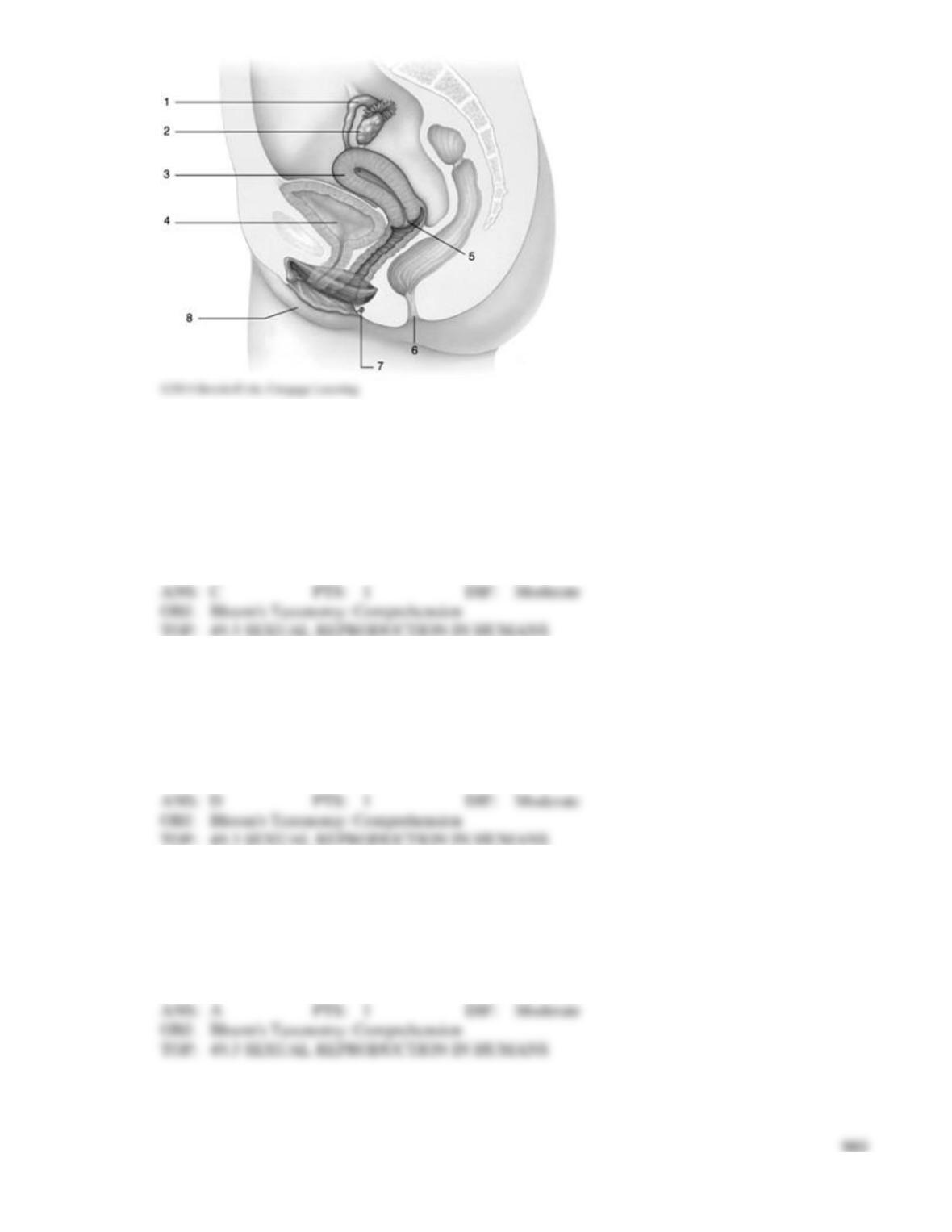
Use the figure above for the following question(s).
29. The cervix is labeled
a.
3.
b.
4.
c.
5.
d.
6.
e.
7.
30. The urinary bladder is labeled
a.
1.
b.
2.
c.
3.
d.
4.
e.
5.
31. The site of fertilization is labeled
a.
1.
b.
2.
c.
3.
d.
4.
e.
5.
32. The structure that is responsible for producing hormones is labeled
a.
1.
b.
2.
c.
3.
d.
4.
e.
5.
33. The site of implantation is labeled
a.
1.
b.
2.
c.
3.
d.
4.
e.
5.
34. The structure that is covered with cilia is labeled
a.
1.
b.
2.
c.
3.
d.
4.
e.
5.
35. The vulva includes the structure(s) labeled
a.
6.
b.
7.
c.
8.
d.
7 and 8 only.
e.
6, 7, and 8.
36. The starting point for the ovarian cycle is a
a.
primary oocyte arrested in meiosis I.
b.
primary oocyte arrested in meiosis II.
c.
primary oocyte having just completed meiosis I.
d.
secondary oocyte arrested in meiosis I.
e.
secondary oocyte arrested in meiosis II.
37. The ovarian cycle includes the
a.
luteal and secretory phases.
b.
menstrual and proliferative phases.
c.
follicular and luteal phases.
d.
follicular and proliferative phases.
e.
proliferative and secretory phases.
38. One function of the developing follicle is to
a.
stimulate ovulation.
b.
secrete progesterone.
c.
secrete estrogens.
d.
secrete gonadotropin-releasing hormone.
e.
secrete glycoproteins, which promote sperm motility.
39. In the female, the ____ serves as a TEMPORARY endocrine gland and secretes ____.
a.
pituitary; luteinizing hormone and follicle-stimulating hormone
b.
corpus luteum; estrogen and progesterone
c.
ovaries; estrogen and luteinizing hormone
d.
endometrium; estrogen and follicle-stimulating hormone
e.
uterus; luteinizing hormone and follicle-stimulating hormone
40. Ovulation typically occurs on day ____ of a 28-day ovarian cycle.
a.
1
b.
7
c.
10
d.
14
e.
28
41. In the female reproductive cycle, the endometrium is thickest
a.
during the menstrual phase.
b.
during the proliferative phase.
c.
shortly before ovulation.
d.
during ovulation.
e.
in the secretory phase.
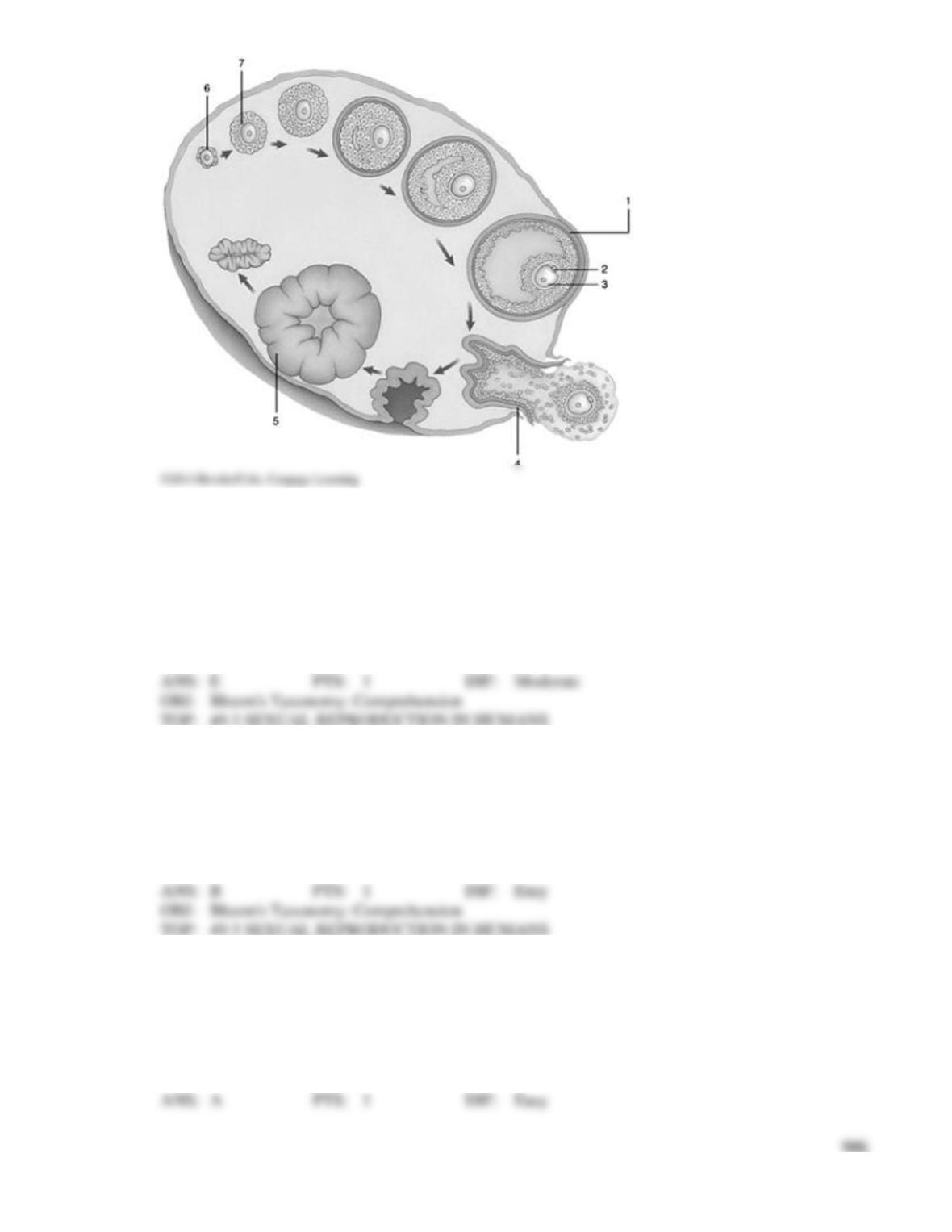
Use the figure above for the following question(s).
42. Label 1 indicates which of the following?
a.
the zona pellucida
b.
the cortical granules
c.
the vitelline coat
d.
the acrosome
e.
mature follicle
43. Label 4 indicates
a.
implantation.
b.
ovulation.
c.
menstruation.
d.
fertilization.
e.
primordial follicle.
44. The structure labeled “6” indicates
a.
a primordial follicle.
b.
a mature follicle.
c.
a primordial germ cell.
d.
a mature germ cell.
e.
an ootid.
45. The structure labeled “2” indicates
a.
the Barr body.
b.
the first polar body.
c.
the second polar body.
d.
the third polar body.
e.
the no body.
46. The structure labeled “3” indicates
a.
the primary oocyte.
b.
the secondary oocyte.
c.
the ootid.
d.
the oogonium.
e.
the mature follicle.
47. A structure whose secretions cause the uterine endometrial tissue to thicken in preparation for
pregnancy is indicated by the label
a.
1.
b.
2.
c.
3.
d.
5.
e.
7.
48. Which structures can still undergo meiosis at the time of fertilization?
a.
2
b.
3
c.
2 and 3
d.
2, 3, and 5
e.
5
49. Menstruation begins in response to
a.
rising levels of FSH and LH.
b.
rising levels of GnRH.
c.
rising levels of progesterone.
d.
falling levels of progesterone.
e.
rising levels of estrogen.
50. In a human female, an inhibition of LH would also inhibit which of the following?
a.
maturation of follicles
b.
secretion of FSH
c.
secretion of GnRH
d.
secretion of estrogen
e.
destruction of follicles
51. Menstrual flow results in the discharge of
a.
the follicle.
b.
the corpus luteum.
c.
the lining of the endometrium.
d.
surface cells from the vagina.
e.
blood from vessels on the outer side of the uterus.
52. Recent research has indicated that for human ______ vocal pitch changes may be associated with a
state of fertility.
a.
males
b.
females
c.
males and females
d.
females during menstrual cycle
e.
males during puberty
53. Sperm are produced in the
a.
epididymis.
b.
seminiferous tubules.
c.
penis.
d.
prostate gland.
e.
Vas deferens.
54. Sperm are stored in the ____ after they are produced.
a.
epididymis
b.
seminiferous tubules
c.
penis
d.
prostate gland
e.
vas deferens
55. Which of the following groups are accessory glands in males?
a.
prostate gland, bulbourethal gland, seminal vesicle.
b.
vestibular gland, seminal vesicle, prostate vesicle
c.
bulbourethal gland, prepuce, prostate gland
d.
seminal vesicle, prepuce, prostate gland
e.
prostate gland, bulbourethal gland, hypothalaumus
56. Which of the following structures in males is shared by both the urinary and reproductive systems?
a.
urinary bladder
b.
prostate gland
c.
ureter
d.
vas deferens
e.
urethra
57. In many mammalian species, including bats and most non-human primates, a bone in the penis, called
the ____, helps to maintain it in an erect state.
a.
pendulum
b.
baculum
c.
colostrum
d.
gametogonium
e.
marsupium
58. The mammalian acrosome contains enzymes that
a.
digest the zona pellucida.
b.
digest the endometrium.
c.
stimulate ovulation.
d.
stimulate sperm motility.
e.
inhibit premature ejaculation.