Campbell’s Biology, 9e (Reece et al.)
Chapter 48 Neurons, Synapses, and Signaling
Homeostasis in a complex organism requires coordination and communication among the parts of the
body. Communication occurs by either chemical signals, including hormones, or by the nervous system,
which, in humans, is made of billions of excitable cells called neurons. The basis for the excitability of
neurons is the variable permeability of their membranes to ion movement. Small, variable changes in
membrane potential are called graded potentials, and these are especially important for receiving
information. Large, patterned changes in membrane potential are called action potentials, and these are
especially important for delivering information, typically neurotransmitter chemicals released into the
synaptic connections between adjacent neurons.
Multiple-Choice Questions
1) A simple nervous system
A) must include chemical senses, mechanoreception, and vision.
B) includes a minimum of 12 effector neurons.
C) has information flow in only one direction: toward an integrating center.
D) has information flow in only one direction: away from an integrating center.
E) includes sensory information, an integrating center, and effectors.
2) Most of the neurons in the human brain are
A) sensory neurons.
B) motor neurons.
C) interneurons.
D) auditory neurons.
E) peripheral neurons.
3) The nucleus and most of the organelles in a neuron are located in the
A) dendritic region.
B) axon hillock.
C) axon.
D) cell body.
E) axon terminals.
2
4) In certain large animals, this type of neuron can extend beyond 1 meter in length.
A) glial cell in the brain
B) a sensory neuron
C) an interneuron
D) a glial cell at a ganglion
E) a neuron that controls eye movements
5) The somatic nervous system can alter the activities of its targets, the skeletal muscle fibers, because
A) it is electrically coupled by gap junctions to the muscles.
B) its signals bind to receptor proteins on the muscles.
C) its signals reach the muscles via the blood.
D) its light pulses activate contraction in the muscles.
E) it is connected to the internal neural network of the muscles.
6) The point of connection between two communicating neurons is called
A) the axon hillock.
B) the dendrite.
C) the synapse.
D) the cell body.
E) the glia.
7) In a simple synapse, neurotransmitter chemicals are released by
A) the dendritic membrane.
B) the presynaptic membrane.
C) axon hillocks.
D) cell bodies.
E) ducts on the smooth endoplasmic reticulum.
8) In a simple synapse, neurotransmitter chemicals are received by
A) the dendritic membrane.
B) the presynaptic membrane.
C) axon hillocks.
D) cell bodies.
E) ducts on the smooth endoplasmic reticulum.
9) In the communication between a motor neuron and a skeletal muscle,
A) the motor neuron is considered the presynaptic cell and the skeletal muscle is the postsynaptic cell.
B) the motor neuron is considered the postsynaptic cell and the skeletal muscle is the presynaptic cell.
C) action potentials are possible on the motor neuron but not the skeletal muscle.
D) action potentials are possible on the skeletal muscle but not the motor neuron.
E) the motor neuron fires action potentials but the skeletal muscle is not electrochemically excitable.
10) For a neuron with an initial membrane potential at -70 mV, an increase in the movement of
potassium ions out of that neuron’s cytoplasm would result in
A) the depolarization of the neuron.
B) the hyperpolarization of the neuron.
C) the replacement of potassium ions with sodium ions.
D) the replacement of potassium ions with calcium ions.
E) the neuron switching on its sodium-potassium pump to restore the initial conditions.
11) Although the membrane of a “resting” neuron is highly permeable to potassium ions, its membrane
potential does not exactly match the equilibrium potential for potassium because the neuronal membrane
is also
A) fully permeable to sodium ions.
B) slightly permeable to sodium ions.
C) fully permeable to calcium ions.
D) impermeable to sodium ions.
E) highly permeable to chloride ions.
12) The operation of the sodium-potassium “pump” moves
A) sodium and potassium ions into the cell.
B) sodium and potassium ions out of the cell.
C) sodium ions into the cell and potassium ions out of the cell.
D) sodium ions out of the cell and potassium ions into the cell.
E) sodium and potassium ions into the mitochondria.
13) A cation that is more abundant as a solute in the cytosol of a neuron than it is in the interstitial fluid
outside the neuron is
A) HCO3–.
B) Cl–.
C) Ca++.
D) Na+.
E) K+.
14) The membrane potential that exactly offsets an ion’s concentration gradient is called the
A) graded potential.
B) threshold potential.
C) equilibrium potential.
D) action potential.
E) inhibitory postsynaptic potential.
15) ATP hydrolysis directly powers the movement of
A) K+ out of cells.
B) Na+ out of cells.
C) Na+ into cells.
D) Ca++ into cells.
E) Cl– into cells.
16) Two fundamental concepts about the ion channels of a “resting” neuron are that the channels
A) are always open, but the concentration gradients of ions frequently change.
B) are always closed, but ions move closer to the channels during excitation.
C) open and close depending on stimuli, and are specific as to which ion can traverse them.
D) open and close depending on chemical messengers, and are nonspecific as to which ion can traverse
them.
E) open in response to stimuli, and then close simultaneously, in unison.
17) Opening all of the sodium channels, with all other ion channels closed which is an admittedly
artificial setting on an otherwise typical neuron should move its membrane potential to
A) -90 mV.
B) -70 mV.
C) 0 mV.
D) +30 mV.
E) +62 mV.
18) A graded hyperpolarization of a membrane can be induced by
A) increasing its membrane’s permeability to Na+.
B) decreasing its membrane’s permeability to H+.
C) decreasing its membrane’s permeability to Cl–.
D) increasing its membrane’s permeability to Ca++.
E) increasing its membrane’s permeability to K+.
19) Self-propagation and refractory periods are typical of
A) action potentials.
B) graded hyperpolarizations.
C) excitatory postsynaptic potentials.
D) threshold potentials.
E) resting potentials.
20) The “selectivity” of a particular ion channel refers to its
A) permitting passage by positive but not negative ions.
B) permitting passage by negative but not positive ions.
C) ability to change its size depending on the ion needing transport.
D) binding with only one type of neurotransmitter.
E) permitting passage only to a specific ion.
6
21) A “resting” motor neuron is expected to
A) release lots of acetylcholine.
B) have high permeability to sodium ions.
C) be equally permeable to sodium and potassium ions.
D) exhibit a resting potential that is more negative than the “threshold” potential.
E) have a higher concentration of sodium ions on the inside of the cell than on the outside.
22) The “threshold” potential of a membrane
A) is the point of separation from a living to a dead neuron.
B) is the lowest frequency of action potentials a neuron can produce.
C) is the minimum hyperpolarization needed to prevent the occurrence of action potentials.
D) is the minimum depolarization needed to operate the voltage-gated sodium and potassium channels.
E) is the peak amount of depolarization seen in an action potential.
23) Action potentials move along axons
A) more slowly in axons of large than in small diameter.
B) by the direct action of acetylcholine on the axonal membrane.
C) by activating the sodium-potassium “pump” at each point along the axonal membrane.
D) more rapidly in myelinated than in non-myelinated axons.
E) by reversing the concentration gradients for sodium and potassium ions.
24) A toxin that binds specifically to voltage-gated sodium channels in axons would be expected to
A) prevent the hyperpolarization phase of the action potential.
B) prevent the depolarization phase of the action potential.
C) prevent graded potentials.
D) increase the release of neurotransmitter molecules.
E) have most of its effects on the dendritic region of a neuron.
25) After the depolarization phase of an action potential, the resting potential is restored by
A) the opening of sodium activation gates.
B) the opening of voltage-gated potassium channels and the closing of sodium channels.
C) a decrease in the membrane’s permeability to potassium and chloride ions.
D) a brief inhibition of the sodium-potassium pump.
E) the opening of more voltage-gated sodium channels.
26) The “undershoot” phase of after-hyperpolarization is due to
A) slow opening of voltage-gated sodium channels.
B) sustained opening of voltage-gated potassium channels.
C) rapid opening of voltage-gated calcium channels.
D) slow restorative actions of the sodium-potassium ATPase.
E) ions that move away from their open ion channels.
27) Immediately after an action potential passes along an axon, it is not possible to generate a second
action potential; thus, we state that the membrane is briefly
A) hyperexcitable.
B) refractory.
C) fully depolarized.
D) above threshold.
E) at the equilibrium potential.
28) An action potential can start in the middle of an axon and proceed in both opposite directions when
A) the neuron is an inhibitory neuron and operating normally.
B) only the middle section of the axon has been artificially stimulated by an electrode.
C) the dendritic region fires an action potential.
D) it is in its typical refractory state.
E) its membrane potential is above the threshold.
29) The primary means by which a neuron can communicate to a second neuron is by
A) the frequency of its action potentials.
B) the peak of the depolarization phase of an action potential.
C) the peak of the undershoot/hyperpolarization of an action potential.
D) varying how much neurotransmitter it releases for a given action potential.
E) remaining in the depolarization phase of the action potential for an extended interval.
30) In the sequence of permeability changes for a complete action potential, the first of these events that
occurs is
A) the activation of the sodium-potassium “pump.”
B) the inhibition of the sodium-potassium “pump.”
C) the opening of voltage-gated sodium channels.
D) the closing of voltage-gated potassium channels.
E) the opening of voltage-gated potassium channels.
31) Saltatory conduction is a term applied to
A) conduction of impulses across electrical synapses.
B) an action potential that skips the axon hillock in moving from the dendritic region to the axon
terminal.
C) rapid movement of an action potential reverberating back and forth along a neuron.
D) jumping from one neuron to an adjacent neuron.
E) jumping from one node of Ranvier to the next in a myelinated neuron.
32) The surface on a neuron that discharges the contents of synaptic vesicles is the
A) dendrite.
B) axon hillock.
C) node of Ranvier.
D) postsynaptic membrane.
E) presynaptic membrane.
33) Neurotransmitters are released from axon terminals via
A) osmosis.
B) active transport.
C) diffusion.
D) transcytosis.
E) exocytosis.
34) The fastest possible conduction velocity of action potentials is observed in
A) thin, non-myelinated neurons.
B) thin, myelinated neurons.
C) thick, non-myelinated neurons.
D) thick, myelinated neurons.
35) Neural transmission across a mammalian synaptic gap is accomplished by
A) the movement of sodium and potassium ions from the presynaptic neuron into the postsynaptic
neuron.
B) impulses traveling as electrical currents across the gap.
C) impulses causing the release of a chemical signal and its diffusion across the gap.
D) impulses ricocheting back and forth across the gap.
E) the movement of calcium ions from the presynaptic into the postsynaptic neuron.
36) One possible disadvantage to a nerve net is that it might conduct impulses in two directions from the
point of the stimulus. Most of the synapses in vertebrates conduct information in only one direction
A) as a result of the nodes of Ranvier.
B) as a result of voltage-gated sodium channels found only in the vertebrate system.
C) because vertebrate nerve cells have dendrites.
D) because only the postsynaptic cells can bind and respond to neurotransmitters.
E) because the sodium-potassium pump moves ions in one direction.
37) The release of acetylcholine from the terminal of a motor neuron is most directly linked to
A) the entry of potassium into the axon terminal.
B) the exit of potassium from the axon terminal.
C) the entry of sodium into the axon terminal.
D) the exit of sodium from the axon terminal.
E) the entry of calcium into the axon terminal.
38) The observation that the acetylcholine released into the junction between a motor neuron and a
skeletal muscle binds to a sodium channel and opens it is an example of
A) a voltage-gated sodium channel.
B) a voltage-gated potassium channel.
C) a ligand-gated sodium channel.
D) a second-messenger-gated sodium channel.
E) a chemical that inhibits action potentials.
39) An inhibitory postsynaptic potential (IPSP) occurs in a membrane made more permeable to
A) potassium ions.
B) sodium ions.
C) calcium ions.
D) ATP.
E) all neurotransmitter molecules.
40) The following steps refer to various stages in transmission at a chemical synapse.
1. Neurotransmitter binds with receptors associated with the postsynaptic membrane.
2. Calcium ions rush into neuron’s cytoplasm.
3. An action potential depolarizes the membrane of the axon terminal.
4. The ligand-gated ion channels open.
5. The synaptic vesicles release neurotransmitter into the synaptic cleft.
Which sequence of events is correct?
A) 1 → 2 → 3 → 4 → 5
B) 2 → 3 → 5 → 4 → 1
C) 3 → 2 → 5 → 1 → 4
D) 4 → 3 → 1 → 2 → 5
E) 5 → 1 → 2 → 4 → 3
41) The activity of acetylcholine in a synapse is terminated by
A) its active transport across the presynaptic membrane.
B) its diffusion across the presynaptic membrane.
C) its active transport across the postsynaptic membrane.
D) its diffusion across the postsynaptic membrane.
E) its degradation by a hydrolytic enzyme on the postsynaptic membrane.
42) Adjacent neurons with direct (non-neurotransmitter) action potential transfer are said to have
electrical synapses, based on the presence of
A) tight junctions at their point of contact.
B) gap junctions at their point of contact.
C) leaky junctions at their point of contact.
D) anchoring junctions at their point of contact.
E) desmosomes at their point of contact.
43) Ionotropic receptors are found at synapses operated via
A) ligand-gated ion channels.
B) second-messenger-gated ion channels.
C) electrical synapses.
D) inhibitory, but not excitatory, synapses.
E) excitatory, but not inhibitory, synapses.
44) An example of ligand-gated ion channels is
A) the spreading of action potentials in the heart.
B) acetylcholine receptors at the neuromuscular junction.
C) cAMP-dependent protein kinases.
D) action potentials on the axon.
E) graded hyperpolarization.
45) An example of the action of metabotropic receptors is when
A) voltage-gated ion channels open.
B) voltage-gated ion channels close.
C) acetylcholine-gated sodium channels open.
D) cAMP-linked ion channels open.
E) the undershoot/after-hyperpolarization occurs.
46) Neurotransmitters categorized as inhibitory are expected to
A) act independently of their receptor proteins.
B) close potassium channels.
C) open sodium channels.
D) close chloride channels.
E) hyperpolarize the membrane.
47) When several EPSPs arrive at the axon hillock from different dendritic locations, depolarizing the
postsynaptic cell to threshold for an action potential, this is an example of
A) temporal summation.
B) spatial summation.
C) tetanus.
D) the refractory state.
E) an action potential with an abnormally high peak of depolarization.
48) When several IPSPs arrive at the axon hillock rapidly in sequence from a single dendritic location,
hyperpolarizing the postsynaptic cell more and more and thus preventing an action potential, this is an
example of
A) temporal summation.
B) spatial summation.
C) tetanus.
D) the refractory state.
E) an action potential with an abnormally high peak of depolarization.
49) Assume that a single IPSP has a negative magnitude of -0.5 mV at the axon hillock, and that a single
EPSP has a positive magnitude of +0.5 mV. For a neuron with an initial membrane potential of -70 mV,
the net effect of the simultaneous arrival of six IPSPs and two EPSPs would be to move the membrane
potential to
A) -72 mV.
B) -71 mV.
C) -70 mV.
D) -69 mV.
E) -68 mV.
50) Receptors for neurotransmitters are of primary functional importance in assuring one-way synaptic
transmission because they are mostly found on the
A) axonal membrane.
B) axon hillock.
C) dendritic membrane.
D) mitochondrial membrane.
E) presynaptic membrane.
51) Functionally, which cellular location is the neuron’s “decision-making site” as to whether or not an
action potential will be initiated?
A) axonal membranes
B) axon hillocks
C) dendritic membranes
D) mitochondrial membranes
E) presynaptic membranes
52) Neurotransmitters affect postsynaptic cells by
A) initiating signal transduction pathways in the cells.
B) causing molecular changes in the cells.
C) affecting ion-channel proteins.
D) altering the permeability of the cells.
E) All of these options are correct.
53) The primary neurotransmitter from the parasympathetic system that influences its autonomic targets
is
A) acetylcholine.
B) adenosine.
C) norepinephrine.
D) adrenaline.
E) dopamine.
54) The major inhibitory neurotransmitter of the human brain is
A) acetylcholine.
B) epinephrine.
C) glutamate.
D) nitric oxide.
E) GABA.
55) The major excitatory neurotransmitter of the human brain is
A) acetylcholine.
B) epinephrine.
C) glutamate.
D) nitric oxide.
E) GABA.
56) A neuropeptide that might function as a natural analgesic is
A) acetylcholine.
B) epinephrine.
C) endorphin.
D) nitric oxide.
E) GABA.
57) An amino acid that operates at inhibitory synapses in the brain is
A) acetylcholine.
B) epinephrine.
C) endorphin.
D) nitric oxide.
E) GABA.
58) The botulinum toxin reduces the synaptic release of
A) acetylcholine.
B) epinephrine.
C) endorphin.
D) nitric oxide.
E) GABA.
59) The heart rate decreases in response to the arrival of
A) acetylcholine.
B) epinephrine.
C) endorphin.
D) nitric oxide.
E) GABA.
60) A chemical that affects neuronal function but is not stored in presynaptic vesicles is
A) acetylcholine.
B) epinephrine.
C) endorphin.
D) nitric oxide.
E) GABA.
Art Questions
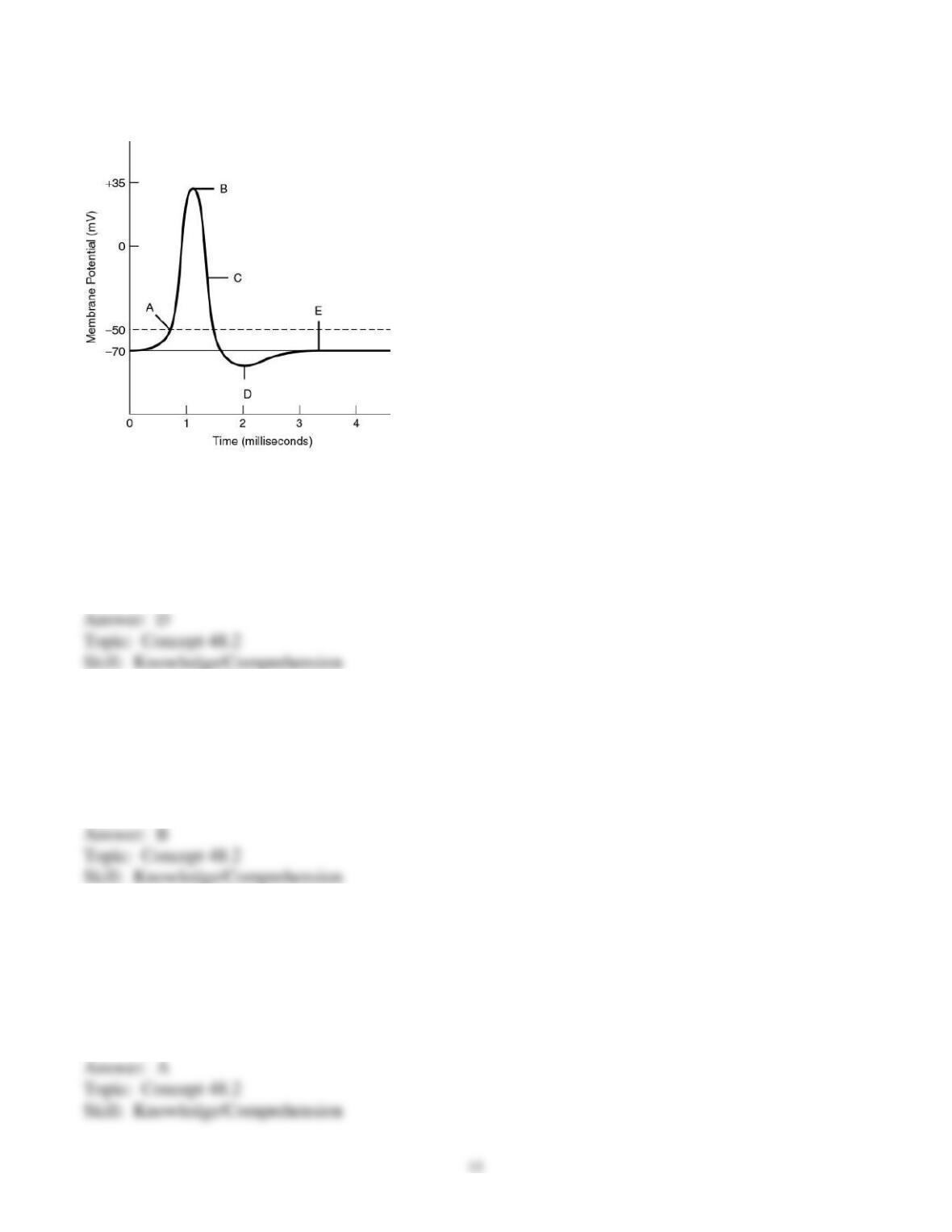
For the following questions, refer to the graph of an action potential.
61) The membrane potential is closest to the equilibrium potential for potassium at label
A) A.
B) B.
C) C.
D) D.
E) E.
62) The membrane’s permeability to sodium ions is at its maximum at label
A) A.
B) B.
C) C.
D) D.
E) E.
63) The minimum graded depolarization needed to operate the voltage-gated sodium and potassium
channels is indicated by the label
A) A.
B) B.
C) C.
D) D.
E) E.
16
64) The cell is not hyperpolarized; however, repolarization is in progress, as the sodium channels are
closing or closed, and many potassium channels have opened at label
A) A.
B) B.
C) C.
D) D.
E) E.
65) The neuronal membrane is at its resting potential at label
A) A.
B) B.
C) C.
D) D.
E) E.
Scenario Questions
66) Action potentials are normally carried in only one direction: from the axon hillock toward the axon
terminals. If you experimentally depolarize the middle of the axon to threshold, using an electronic
probe, then
A) no action potential will be initiated.
B) an action potential will be initiated and proceed only in the normal direction toward the axon
terminal.
C) an action potential will be initiated and proceed only back toward the axon hillock.
D) two action potentials will be initiated, one going toward the axon terminal and one going back toward
the hillock.
E) an action potential will be initiated, but it will die out before it reaches the axon terminal.
67) Assume that excessive consumption of ethanol increases the influx of negative chloride ions into
“common sense” neurons whose action potentials are needed for you to act appropriately and not harm
yourself or others. Thus, any resulting poor decisions associated with ethanol ingestion are likely due to
A) increased membrane depolarization of “common sense” neurons.
B) decreased membrane depolarization of “common sense” neurons.
C) more action potentials in your “common sense” neurons.
D) more EPSPs in your “common sense” neurons.
E) fewer IPSPs in your “common sense” neurons.
End-of-Chapter Questions
The following questions are from the end-of–chapter “Test Your Understanding” section in Chapter 48
of the textbook.
68) What happens when a resting neuron’s membrane depolarizes?
A) There is a net diffusion of Na+ out of the cell.
B) The equilibrium potential for K+ (EK) becomes more positive.
C) The neuron’s membrane voltage becomes more positive.
D) The neuron is less likely to generate an action potential.
E) The cell’s inside is more negative than the outside.
69) A common feature of action potentials is that they
A) cause the membrane to hyperpolarize and then depolarize.
B) can undergo temporal and spatial summation.
C) are triggered by a depolarization that reaches the threshold.
D) move at the same speed along all axons.
E) require the diffusion of Na+ and K+ through ligand-gated channels to propagate.
70) Where are neurotransmitter receptors located?
A) the nuclear membrane
B) the nodes of Ranvier
C) the postsynaptic membrane
D) synaptic vesicle membranes
E) the myelin sheath
71) Temporal summation always involves
A) both inhibitory and excitatory inputs.
B) synapses at more than one site.
C) inputs that are not simultaneous.
D) electrical synapses.
E) multiple inputs at a single synapse.
72) Why are action potentials usually conducted in one direction?
A) The nodes of Ranvier conduct potentials in one direction.
B) The brief refractory period prevents reopening of voltage-gated Na+ channels.
C) The axon hillock has a higher membrane potential than the terminals of the axon.
D) Ions can flow along the axon in only one direction.
E) Voltage-gated channels for both Na+ and K+ open in only one direction.
73) Which of the following is a direct result of depolarizing the presynaptic membrane of an axon
terminal?
A) Voltage-gated calcium channels in the membrane open.
B) Synaptic vesicles fuse with the membrane.
C) The postsynaptic cell produces an action potential.
D) Ligand-gated channels open, allowing neurotransmitters to enter the synaptic cleft.
E) An EPSP or IPSP is generated in the postsynaptic cell.