Chapter 47 – The Digestive System
Chapter 47
The Digestive System
Multiple Choice Questions
1. An animal with a gastrointestinal tract is the ___________.
2. James has been having trouble digesting lean steaks and other protein-rich foods, and these
foods seem to stay in his stomach longer than usual. James is likely lacking the enzyme
____.
Chapter 47 – The Digestive System
Clarify Question
•
What is the key concept addressed by the question?
•
What type of thinking is required?
Gather Content
•
What do you know about enzymes that digest proteins? What other information is related
to the question?
Choose Answer
•
Given what you now know, what information is most likely to produce the correct
answer?
Reflect on Process
•
Did your problem-solving process lead you to the correct answer? If not, where did the
process break down or lead you astray? How can you revise your approach to produce a
more desirable result?
47-3
3. A baby is born without the ability to make parietal cells. This baby would not be able to
___.
Clarify Question
•
What is the key concept addressed by the question?
•
What type of thinking is required?
Gather Content
•
What do you know about the function of parietal cells? What other information is related
to the question?
Choose Answer
•
Given what you now know, what information is most likely to produce the correct
answer?
Reflect on Process
•
Did your problem-solving process lead you to the correct answer? If not, where did the
process break down or lead you astray? How can you revise your approach to produce a
more desirable result?
Chapter 47 – The Digestive System
4. Because of the hepatic portal vein, the _____ is the first organ to receive most of the
products of digestion.
5. The products of fat digestion in the small intestine are reassembled into triglycerides by the
intestinal epithelium, before combining them with proteins to form ___________.
6. The pancreas does NOT secrete ______.
Chapter 47 – The Digestive System
47-5
7. The liver produces ________ that functions in emulsification of fats.
8. The rate at which an animal consumes energy at rest is called _______.
9. For many people, eating is one of life’s greatest pleasures and they spend much time
gathering, preparing and eating food. However, some of us would rather do other things with
our time and it would be great if we did not have to eat at all. Alas, eating is a necessity.
Choose the one FALSE reason why humans have to eat.
Chapter 47 – The Digestive System
Clarify Question
•
What is the key concept addressed by the question?
•
What type of thinking is required?
Gather Content
•
What do you know about essential nutrients in humans? What other information is
related to the question?
Choose Answer
•
Given what you now know, what information is most likely to produce the correct
answer?
Reflect on Process
•
Did your problem-solving process lead you to the correct answer? If not, where did the
process break down or lead you astray? How can you revise your approach to produce a
more desirable result?

Chapter 47 – The Digestive System
10. Jane and Tom are worried about their newborn baby who has just begun to nurse, but
chokes and turns blue whenever she is fed. Their baby most likely has a defect in her _____.
Chapter 47 – The Digestive System
Clarify Question
•
What is the key concept addressed by the question?
Gather Content
•
What do you know about the anatomical structure that malfunctions in choking? What
other information is related to the question?
Choose Answer
•
Given what you now know, what information is most likely to produce the correct
answer?
Reflect on Process
•
Did your problem-solving process lead you to the correct answer? If not, where did the
process break down or lead you astray? How can you revise your approach to produce a
more desirable result?
Chapter 47 – The Digestive System
47-9
11. Saliva contains the hydrolytic enzyme, salivary amylase, which initiates the breakdown
of the polysaccharide _________ into the disaccharide, maltose.
12. Most digestion in humans occurs in the first 25 centimeters of the 6-meter length of the
small intestine called the _________________.
13. Scientists in Switzerland compared the total surface area of the small intestine in different
species of bats. When the calculations were done as if the inner mucosal surface was smooth,
the average inner surface area of the intestinal tube was 9.1 cm2 in one species. The
mucosal surface area increased to 48 cm2 when the villi were factored in and reached a total
of 0.13 m2 after adding in the membrane surface area of the microvilli. Approximately what
percent of the total surface area of the small intestine in these bats can be attributed to the
membrane surface area of the microvilli?
Clarify Question
Chapter 47 – The Digestive System
•
What is the key concept addressed by the question?
• What type of thinking is required?
Gather Content
•
What do you know about microvilli? What other information is related to the question?
Choose Answer
•
Given what you now know, what information is most likely to produce the correct
answer?
Reflect on Process
•
Did your problem-solving process lead you to the correct answer? If not, where did the
process break down or lead you astray? How can you revise your approach to produce a
more desirable result?

Chapter 47 – The Digestive System
14. Diana has been fasting for a few days and decides to go for a short run before breaking
her fast. The glucose she needs for her run will come from______________________.
Chapter 47 – The Digestive System
Clarify Question
•
What is the key concept addressed by the question?
•
What type of thinking is required?
Gather Content
•
What do you know about production of glucose during fasting? What other information
is related to the question?
Choose Answer
•
Given what you now know, what information is most likely to produce the correct
answer?
Reflect on Process
•
Did your problem-solving process lead you to the correct answer? If not, where did the
process break down or lead you astray? How can you revise your approach to produce a
more desirable result?
Chapter 47 – The Digestive System
15. The rumen of the first stomach of ruminants serves as a fermentation chamber in which
bacteria and protozoa degrade
16. In horses, rodents, and lagomorphs, the digestion of cellulose by microorganisms takes
place in the
17. The vertebrate digestive system consists of
Chapter 47 – The Digestive System
47–14
18. The gastrointestinal tract does not include the ____.
19. When diet and exercise has failed to produce any significant weight loss, some patients
who are seriously overweight elect to have stomach surgery. A procedure galled gastric sleeve
surgery removes more than half of the stomach, leaving a tube (or sleeve) about the size of a
banana. Following gastric sleeve surgery, patients would have the least trouble ____.
Clarify Question
•
What is the key concept addressed by the question?
•
What type of thinking is required?
Gather Content
•
What do you know about digestion in the stomach? What other information is related to
the question?
Choose Answer
•
Given what you now know, what information is most likely to produce the correct
Chapter 47 – The Digestive System
answer?
Reflect on Process
•
Did your problem-solving process lead you to the correct answer? If not, where did the
process break down or lead you astray? How can you revise your approach to produce a
more desirable result?
20. The activities of cells in different layers of the tubular gastrointestinal tract are regulated
by clusters of nerves located in the submucosa. These nerve complexes are called
Chapter 47 – The Digestive System
21. All of the following teeth are found in adult vertebrates except
22. The gizzard is to a bird as the _____________ is/are to a mammal.
23. Food moved to the back of the mouth by the tongue causes all of the following EXCEPT

Chapter 47 – The Digestive System
24. Dorothy suffered a serious stroke that destroyed neurons in the swallowing center of her
brain. This damage to her brain would prevent _____.
Chapter 47 – The Digestive System
47–18
Clarify Question
•
What is the key concept addressed by the question?
•
What type of thinking is required?
Gather Content
•
What do you know about swallowing? What other information is related to the question?
Choose Answer
•
Given what you now know, what information is most likely to produce the correct
answer?
Reflect on Process
•
Did your problem-solving process lead you to the correct answer? If not, where did the
process break down or lead you astray? How can you revise your approach to produce a
more desirable result?
Chapter 47 – The Digestive System
47–19
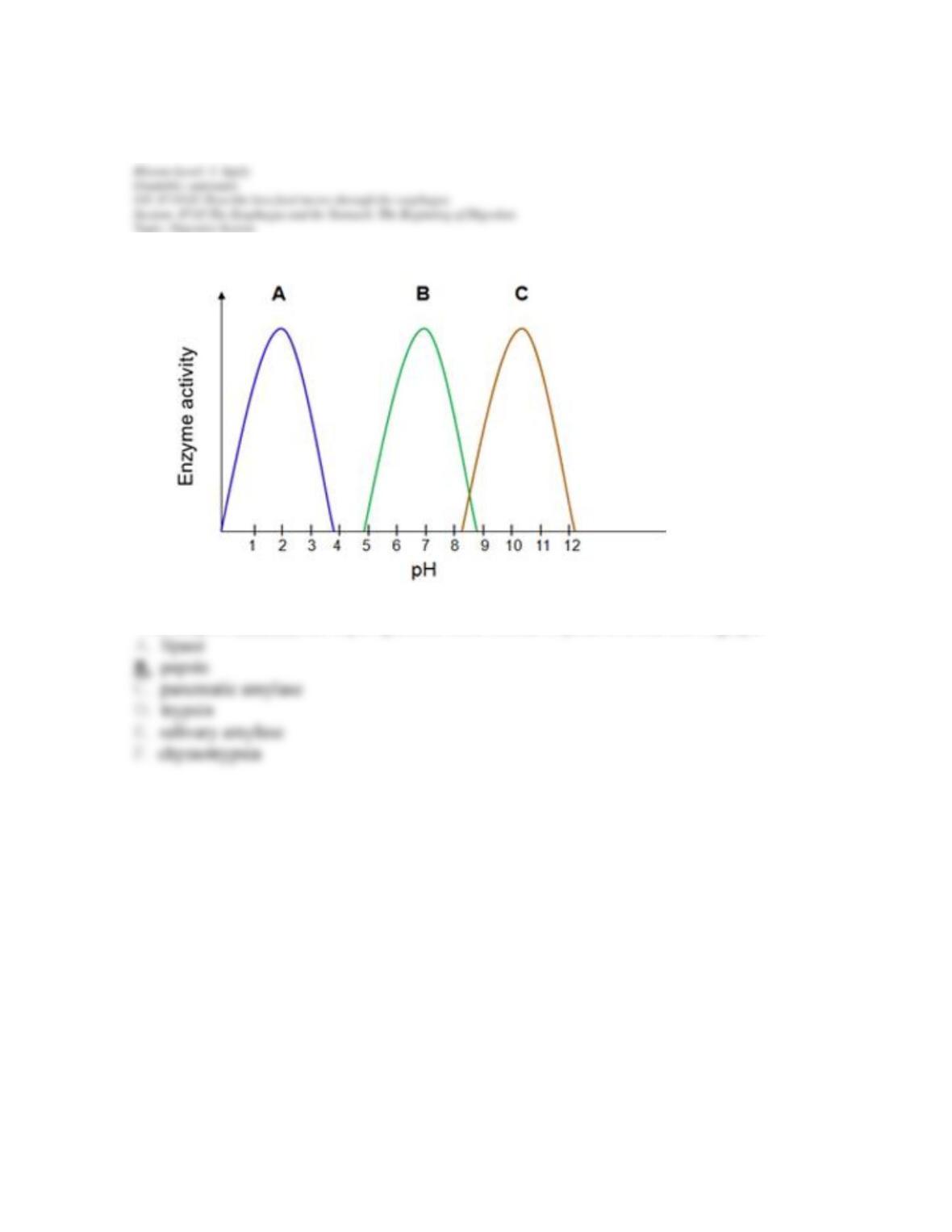
25.
The enzyme _______ has a pH optimum most similar to peak A in the above graph.
Chapter 47 – The Digestive System
Clarify Question
•
What is the key concept addressed by the question?
•
What type of thinking is required?
Gather Content
•
What do you know about optimal pH for an enzyme? What other information is related
to the question?
Choose Answer
•
Given what you now know, what information is most likely to produce the correct
answer?
Reflect on Process
•
Did your problem-solving process lead you to the correct answer? If not, where did the
process break down or lead you astray? How can you revise your approach to produce a
more desirable result?