Chapter 46 – The Musculoskeletal System
52. A lab technician is preparing to dispose of a rat and a frog that were euthanized earlier in
the day for a scientific study. Although the two animals died at the same time, the rat has rigor
mortis while the frog does not yet show any signs of it. What is the best explanation for this
time difference in the onset of rigor mortis?
Chapter 46 – The Musculoskeletal System
Clarify Question
•
What is the key concept addressed by the question?
•
What type of thinking is required?
Gather Content
•
What do you know about rigor mortis? What other information is related to the
question?
Choose Answer
•
Given what you now know, what information is most likely to produce the correct
answer?
Reflect on Process
•
Did your problem-solving process lead you to the correct answer? If not, where did the
process break down or lead you astray? How can you revise your approach to produce a
more desirable result?
Chapter 46 – The Musculoskeletal System
53. If you rub the scaled skin of a shark, it feels rough if you move your hand from tail to
head but smooth if you move from head to tail. What is a major advantage of the scales being
oriented this way?
Chapter 46 – The Musculoskeletal System
Clarify Question
•
What is the key concept addressed by the question?
•
What type of thinking is required?
Gather Content
•
What do you know about the role of friction in movement? What other information is
related to the question?
Choose Answer
•
Given what you now know, what information is most likely to produce the correct
answer?
Reflect on Process
•
Did your problem-solving process lead you to the correct answer? If not, where did the
process break down or lead you astray? How can you revise your approach to produce a
more desirable result?
54. Sarin gas is an inhibitor of an enzyme that functions in the neuromuscular junction to
break down acetylcholine. What is the most likely description of how a person would die after
inhaling this poisonous gas?
Chapter 46 – The Musculoskeletal System
Clarify Question
•
What is the key concept addressed by the question?
•
What type of thinking is required?
Gather Content
•
What do you know about the effect of inhibition of acetylcholinesterase? What other
information is related to the question?
Choose Answer
•
Given what you now know, what information is most likely to produce the correct
answer?
Reflect on Process
•
Did your problem-solving process lead you to the correct answer? If not, where did the
process break down or lead you astray? How can you revise your approach to produce a
more desirable result?
55. The masseter muscles originate on your cheekbones and insert into the posterior corners
of the mandible (the lower jaw bone) underneath your ears. Will contraction of the masseter
muscles open or close your jaw?
Clarify Question
•
What is the key concept addressed by the question?
•
What type of thinking is required?
Gather Content
•
What do you know about how muscles move a hinge joint like the jaw? What other
information is related to the question?
Choose Answer
•
Given what you now know, what information is most likely to produce the correct
answer?
Reflect on Process
•
Did your problem-solving process lead you to the correct answer? If not, where did the
process break down or lead you astray? How can you revise your approach to produce a
more desirable result?
Chapter 46 – The Musculoskeletal System
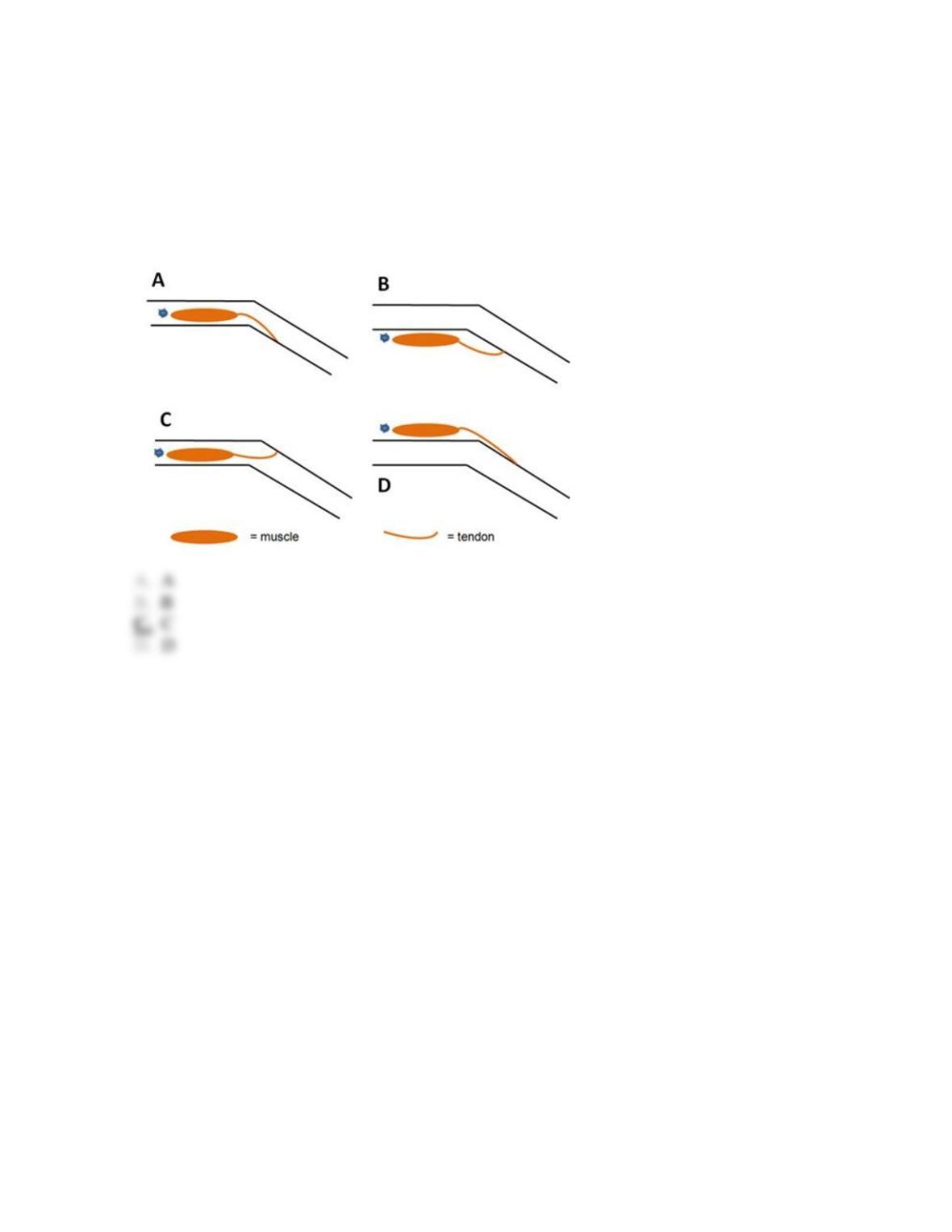
56. The figure below represents a joint in the hind leg of a grasshopper. The exoskeleton of
the leg is indicated by the two pairs of parallel black lines. A muscle that moves this leg is
fixed to the skeleton at the end marked with a blue star. When the muscle contracts, it will
pull on the tendon at its opposite end. Which configuration shows the most likely arrangement
of the exoskeleton and a muscle that increases the flexion of this leg?
Chapter 46 – The Musculoskeletal System
Clarify Question
•
What is the key concept addressed by the question?
•
What type of thinking is required?
Gather Content
•
What do you know about the orientation of a muscle in a joint? What other information
is related to the question?
Choose Answer
•
Given what you now know, what information is most likely to produce the correct
answer?
Reflect on Process
•
Did your problem-solving process lead you to the correct answer? If not, where did the
process break down or lead you astray? How can you revise your approach to produce a
more desirable result?
Chapter 46 – The Musculoskeletal System
57. Proportional to its body length, which animal below can leap the furthest?
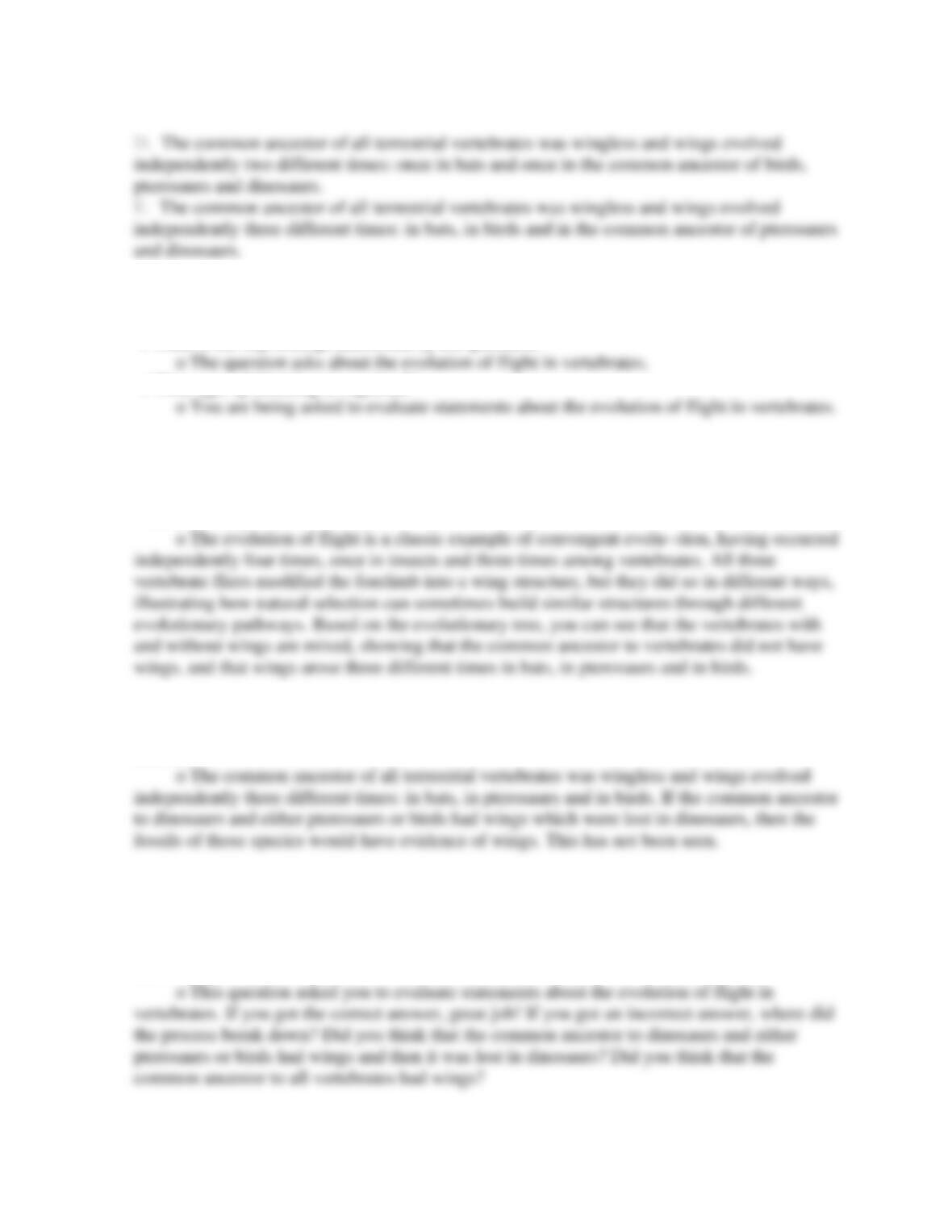
58.
Based on the above diagram and other information from your text, what is the most likely
(e.g., most parsimonious) explanation for the evolution of flight in vertebrates?
Chapter 46 – The Musculoskeletal System
Clarify Question
•
What is the key concept addressed by the question?
•
What type of thinking is required?
Gather Content
•
What do you know about the evolution of flight in vertebrates? What other information is
related to the question?
Choose Answer
•
Given what you now know, what information is most likely to produce the correct
answer?
Reflect on Process
•
Did your problem-solving process lead you to the correct answer? If not, where did the
process break down or lead you astray? How can you revise your approach to produce a
more desirable result?
Chapter 46 – The Musculoskeletal System
59. Imagine an earthworm that has no chaetae. How would the lack of chaetae affect
movement of the earthworm?
Chapter 46 – The Musculoskeletal System
Clarify Question
•
What is the key concept addressed by the question?
•
What type of thinking is required?
Gather Content
•
What do you know about the function of chaetae? What other information is related to
the question?
Choose Answer
•
Given what you now know, what information is most likely to produce the correct
answer?
Reflect on Process
•
Did your problem-solving process lead you to the correct answer? If not, where did the
process break down or lead you astray? How can you revise your approach to produce a
more desirable result?
Chapter 46 – The Musculoskeletal System
60. Many bird wings are more convex on the upper surface than they are on the lower
surface. This enables the wing to provide greater lift because