Chapter 44 – Sensory Systems
Vision differs from the other senses in two interesting ways. Although most
sensory receptor neurons are depolarized when the receive a stimulus,
rod and cone cells become hyperpolarized when they receive light. When
hyperpolarized, they stop releasing inhibitory neurotransmitter and allow the
bipolar cells to fire. A second unusual aspect is that the vision circuit seems
to be organized “backwards” — the light must pass through the layers of ganglion
and bipolar cells to reach the rods and cones.
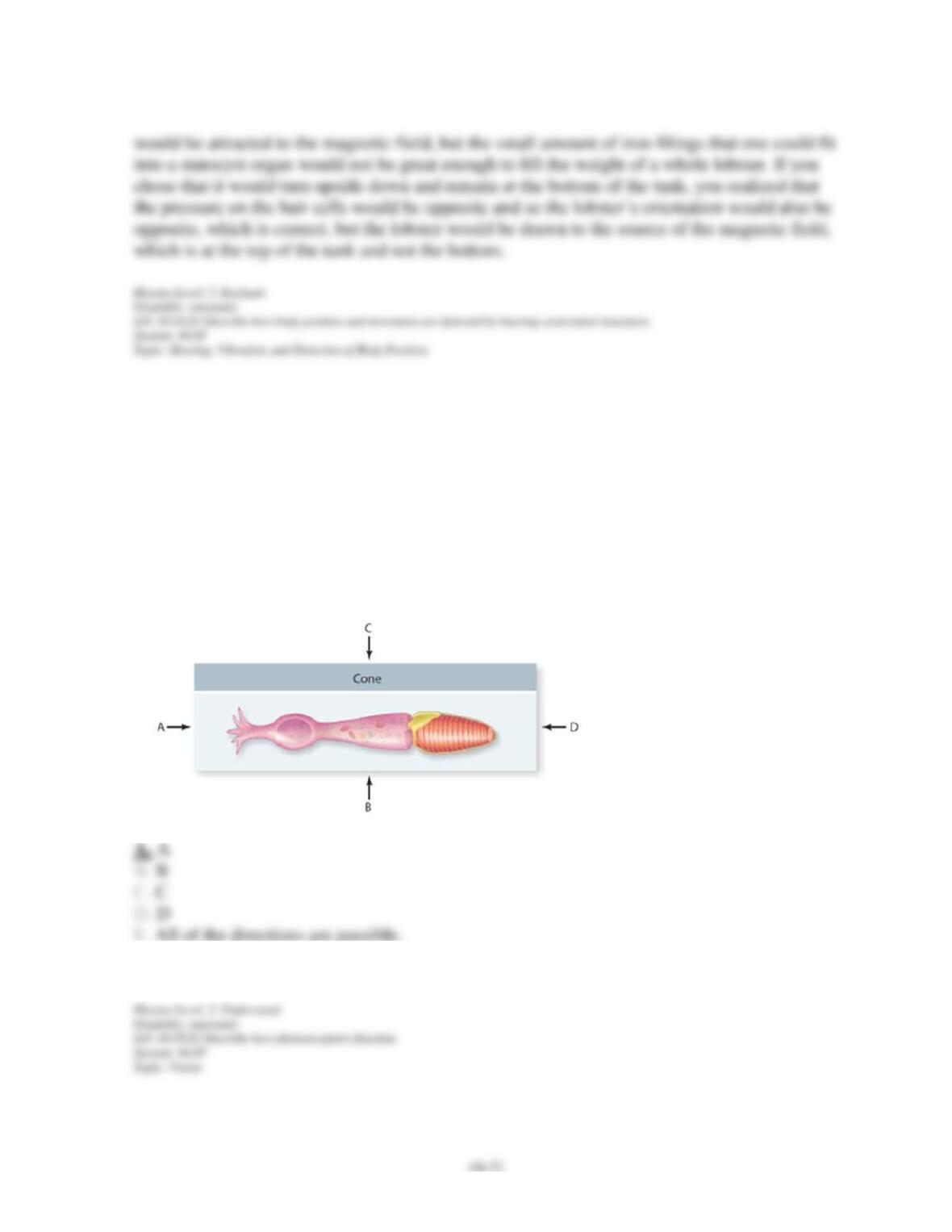
51. Which letter indicates the direction of incoming light in a typical vertebrate?
Chapter 44 – Sensory Systems
52. When a cone cell is stimulated by light, what will occur at the cell membrane?
53. Which of type of information is NOT communicated by proprioceptors?
54. What happens to a retinal photopigment when it captures a photon?

Chapter 44 – Sensory Systems
44–23
55. Which of the following statements regarding vision is NOT true?
56. Visual acuity is highest when an image is focused on what part of the retina?
Fill in the Blank Questions
Choose the letter that best describes the function of each receptor type. (You may use a letter
more than once.)
A. tonic receptors located near the surface of the skin
B. pressure sensitive receptors deep in the subcutaneous layer
C. receptors on the face and fingertips sensitive to light touch
Chapter 44 – Sensory Systems
57. Pacinian corpuscle
58. Merkle cell
59. Ruffini corpuscle
Chapter 44 – Sensory Systems
44–25
60. Meissner’s corpuscle
Multiple Choice Questions
61. All of the varied sensations we experience are due to which three categories of sensory
receptors?
True / False Questions
62. True or false: Humans are unique among animals due to our highly-evolved repertoire of
sensory receptors.
Multiple Choice Questions

Chapter 44 – Sensory Systems
63. What difference in axonal signaling determines whether we experience a mild or a strong
sensation?
Chapter 44 – Sensory Systems
44–27
Clarify Question
What is the key concept addressed by the question?
What type of thinking is required?
Gather Content
What do you already know about axonal signaling? What other information is related to
the question?
Choose Answer
Given what you now know, what information is most likely to produce the correct answer?
Reflect on Process
Did your problem-solving process lead you to the correct answer? If not, where did the
process break down or lead you astray? How can you revise your approach to produce a
more desirable result?

Chapter 44 – Sensory Systems
64. Since the optic nerve must pass through the retinal layer, we all have a blind spot devoid
of light receptors. This normally goes unnoticed, since the brain attempts to compensate for
missing sensory information by filling it in based on surrounding patterns. Which step of the
sensory pathway is represented by perceptual filling-in of the physiological blind spot?
Chapter 44 – Sensory Systems
44–29
Clarify Question
What is the key concept addressed by the question?
What type of thinking is required?
Gather Content
What do you already know about retinal signaling? What other information is related to
the question?
Choose Answer
Given what you now know, what information is most likely to produce the correct answer?
Reflect on Process
Did your problem-solving process lead you to the correct answer? If not, where did the
process break down or lead you astray? How can you revise your approach to produce a
more desirable result?

Chapter 44 – Sensory Systems
65. What information would best help you distinguish what type of sensation a sensory
neuron transmits?
Chapter 44 – Sensory Systems
44–31
Clarify Question
What is the key concept addressed by the question?
What type of thinking is required?
Gather Content
What do you already know about sensory neurons? What other information is related to
the question?
Choose Answer
Given what you now know, what information is most likely to produce the correct answer?
Reflect on Process
Did your problem-solving process lead you to the correct answer? If not, where did the
process break down or lead you astray? How can you revise your approach to produce a
more desirable result?
Chapter 44 – Sensory Systems
66. What is the primary difference in how touch sensation and hearing sensation are
conveyed?
Chapter 44 – Sensory Systems
44–33
Clarify Question
What is the key concept addressed by the question?
What type of thinking is required?
signaling into different stages and decide which aspects differ between touch and hearing.
Gather Content
What do you already know about sensory signaling? What other information is related to
the question?
Choose Answer
Given what you now know, what information is most likely to produce the correct answer?
Reflect on Process
Did your problem-solving process lead you to the correct answer? If not, where did the
process break down or lead you astray? How can you revise your approach to produce a
more desirable result?
Chapter 44 – Sensory Systems
44–34
67. Because small quantities of powerful explosives can be hidden easily, a sensor that could
detect trace amounts of illicit chemicals would be a useful tool. What animal sensory modality
is exquisitely sensitive to minute quantities of airborne chemicals?
68. Honeybees can detect a variety of odorants through olfactory receptors on their antennae.
You genetically engineer a receptor to be gated by the explosive chemical TNT, and use a
transgene to express the receptor in honeybee olfactory neurons. What would this provide to
the bee?
Chapter 44 – Sensory Systems
Clarify Question
What is the key concept addressed by the question?
What type of thinking is required?
Gather Content
What do you already know about olfaction? What other information is related to the
question?
Choose Answer
Given what you now know, what information is most likely to produce the correct answer?
Reflect on Process
Did your problem-solving process lead you to the correct answer? If not, where did the
process break down or lead you astray? How can you revise your approach to produce a
more desirable result?

Chapter 44 – Sensory Systems
69. If genetically engineered bees could express a receptor for TNT in their olfactory
neurons, what type of receptor would the TNT receptor be?
Chapter 44 – Sensory Systems
44–37
Clarify Question
What is the key concept addressed by the question?
What type of thinking is required?
Gather Content
What do you already know about olfaction? What other information is related to the
question?
Choose Answer
Given what you now know, what information is most likely to produce the correct answer?
Reflect on Process
Did your problem-solving process lead you to the correct answer? If not, where did the
process break down or lead you astray? How can you revise your approach to produce a
more desirable result?

Chapter 44 – Sensory Systems
70. If genetically engineered bees could express a receptor for TNT in their olfactory
neurons, how would the bees respond to the presence of TNT?
Chapter 44 – Sensory Systems
44–39
Clarify Question
What is the key concept addressed by the question?
What type of thinking is required?
Gather Content
What do you already know about olfaction? What other information is related to the
question?
Choose Answer
Given what you now know, what information is most likely to produce the correct answer?
Reflect on Process
Did your problem-solving process lead you to the correct answer? If not, where did the
process break down or lead you astray? How can you revise your approach to produce a
more desirable result?

Chapter 44 – Sensory Systems
71. If genetically engineered bees could express a receptor for TNT in their olfactory
neurons, how could the transgenic bees be useful for detecting explosives?