Campbell’s Biology, 9e (Reece et al.)
Chapter 44 Osmoregulation and Excretion
Animals face substantial environmental challenges in maintaining the volume and content of their body
fluids, and evolution has shaped several different solutions to these homeostatic problems.
Osmoregulatory mechanisms allow animals to achieve the balance between uptake and loss of fluids and
solutes. In particular, the impressive “natural engineering” of the mammalian kidney is a major topic in
this chapter, with emphasis on the hormonal and neural coordination of its activities. The diverse means
of disposing nitrogenous wastes are also surveyed.
Multiple-Choice Questions
1) A necropsy (postmortem analysis) of a marine sea star that died after it was mistakenly placed in
fresh water would likely show that it died because
A) it was stressed and needed more time to acclimate to the new conditions.
B) it was so hyperosmotic to the fresh water that it could not osmoregulate.
C) the sea star’s kidneys could not handle the change in ionic content presented by the fresh water.
D) its contractile vacuoles ruptured.
E) its cells dehydrated and lost the ability to metabolize.
2) Organisms categorized as osmoconformers are most likely
A) found in freshwater lakes and streams.
B) marine.
C) amphibious.
D) found in arid terrestrial environments.
E) found in terrestrial environments with adequate moisture.
3) The body fluids of an osmoconformer would be ________ with its ________ environment.
A) hyperosmotic; freshwater
B) isotonic; freshwater
C) hyperosmotic; saltwater
D) isoosmotic; saltwater
E) hypoosmotic; saltwater
4) Compared to the seawater around them, most marine invertebrates are
A) hyperosmotic.
B) hypoosmotic.
C) isoosmotic.
D) hyperosmotic and isoosmotic.
E) hypoosmotic and isoosmotic.
5) The fluid with the highest osmolarity is
A) distilled water.
B) plasma in birds.
C) plasma in mammals.
D) seawater in a tidal pool.
E) estuarine water.
6) Birds that live in marine environments and thus lack access to fresh drinking water
A) osmoregulate without using a transport epithelium for this purpose.
B) drink seawater and secrete excess ions through their kidneys only.
C) drink seawater and secrete excess ions mainly through their nasal salt glands.
D) have plasma that is isoosmotic to ocean water.
E) obtain water by eating only osmoregulating prey.
7) Osmoconforming sharks take in water, as needed,
A) by migrating to freshwater rivers to drink fresh water.
B) via osmosis, as their body cells are slightly hyperosmotic to seawater.
C) via active transport of water across the cells on their gills.
D) by water diffusion from seawater, which is hyperosmotic to the fluids in their cells.
E) by selective transport of water molecules across the wall of the gut.
8) A human who has no access to fresh water but is forced to drink seawater instead
A) will thrive under such conditions, as long as he has lived at the ocean most of his life.
B) will excrete more water molecules than taken in, because of the high load of ion ingestion.
C) will develop structural changes in the kidneys to accommodate the salt overload.
D) will find that drinking saltwater satiates his thirst.
E) will risk becoming overhydrated within 12 hours.
9) Many marine and freshwater bony fish achieve osmoregulation via
A) loss of water through the gills.
B) gain of salt through the gills.
C) loss of water in the urine.
D) no drinking of water.
E) gain of water through food.
10) Unlike most bony fishes, sharks maintain body fluids that are isoosmotic to seawater, so they are
considered by many to be osmoconformers. Nonetheless, these sharks osmoregulate at least partially by
A) using their gills and kidneys to rid themselves of sea salts.
B) monitoring dehydration at the cellular level with special gated aquaporins.
C) tolerating high urea concentrations that balance internal salt concentrations to seawater osmolarity.
D) synthesizing trimethylamine oxide, a chemical that binds and precipitates salts inside cells.
E) possessing a special adaptation that allows their cells to operate at an extraordinarily high salt
concentration.
11) The necropsy (postmortem analysis) of a freshwater fish that died after being placed accidentally in
saltwater would likely show that
A) loss of water by osmosis from cells in vital organs resulted in cell death and organ failure.
B) high amounts of salt had diffused into the fish’s cells, causing them to swell and lyse.
C) the kidneys were not able to keep up with the water removal necessary in this hyperosmotic
environment, creating an irrevocable loss of homeostasis.
D) the gills became encrusted with salt, resulting in inadequate gas exchange and a resulting
asphyxiation.
E) brain cells lysed as a result of increased osmotic pressure in this hyperosmotic environment, leading
to death by loss of autonomic function.
12) Urea is produced in the
A) liver from NH3 and CO2.
B) liver from glycogen.
C) kidneys from glucose.
D) kidneys from glycerol and fatty acids.
E) bladder from uric acid and H2O.
13) Urea is
A) insoluble in water.
B) more toxic to human cells than ammonia.
C) the primary nitrogenous waste product of humans.
D) the primary nitrogenous waste product of most birds.
E) the primary nitrogenous waste product of most aquatic invertebrates.
14) Which nitrogenous waste has the greatest number of nitrogen atoms?
A) ammonia
B) ammonium ions
C) urea
D) uric acid
15) Ammonia is likely to be the primary nitrogenous waste in living conditions that include
A) lots of fresh water flowing across the gills of a fish.
B) lots of seawater, such as a bird living in a marine environment.
C) lots of seawater, such as a marine mammal (e.g., a polar bear).
D) a terrestrial environment, such as that supporting crickets.
E) a moist system of burrows, such as those of naked mole rats.
16) Among vertebrate animals, urea
A) is made in the kidneys and immediately excreted.
B) is added to the air in the lungs to be exhaled, along with carbon dioxide.
C) is made in the liver by combining two ammonia molecules with one carbon dioxide.
D) is made in the pancreas and added to the intestinal contents, along with bile salts, for excretion.
E) is rarely the nitrogenous waste of choice.
17) The nitrogenous waste that requires the most energy to produce is
A) ammonia.
B) ammonium.
C) urea.
D) uric acid.
18) Excessive formation of uric acid crystals in humans leads to
A) a condition called diabetes, where excessive urine formation occurs.
B) a condition of insatiable thirst and excessive urine formation.
C) gout, a painful inflammatory disease that primarily affects the joints.
D) the absence of urea in the urine.
E) osteoarthritis, an inevitable consequence of aging.
19) Ammonia
A) is soluble in water.
B) can be stored in the body as a precipitate.
C) has low toxicity relative to urea.
D) is metabolically more expensive to synthesize than urea.
E) is the major nitrogenous waste excreted by insects.
20) The advantage of excreting nitrogenous wastes as urea rather than as ammonia is that
A) urea can be exchanged for Na+.
B) urea is less toxic than ammonia.
C) urea requires more water for excretion than ammonia.
D) urea does not affect the osmolar gradient.
E) less nitrogen is removed from the body.
21) The primary nitrogenous waste excreted by birds is
A) ammonia.
B) nitrate.
C) nitrite.
D) urea.
E) uric acid.
22) Which nitrogenous waste requires hardly any water for its excretion?
A) amino acids
B) urea
C) uric acid
D) ammonia
E) nitrogen gas
23) In animals, nitrogenous wastes are produced mostly from the catabolism of
A) starch and cellulose.
B) triglycerides and steroids.
C) proteins and nucleic acids.
D) phospholipids and glycolipids.
E) fatty acids and glycerol.
24) Birds secrete uric acid as their nitrogenous waste because uric acid
A) is readily soluble in water.
B) is metabolically less expensive to synthesize than other excretory products.
C) requires little water for nitrogenous waste disposal, thus reducing body mass.
D) excretion allows birds to live in desert environments.
25) Among the following choices, the most concentrated urine is excreted by
A) frogs.
B) kangaroo rats.
C) humans.
D) desert tortoises.
E) birds.
26) Materials are returned to the blood from the filtrate by which of the following processes?
A) filtration
B) ultrafiltration
C) selective reabsorption
D) secretion
E) active transport
27) Excretory structures known as protonephridia are present in
A) flatworms.
B) earthworms.
C) insects.
D) vertebrates.
E) cnidarians.
28) Excretory organs known as Malpighian tubules are present in
A) earthworms.
B) flatworms.
C) insects.
D) jellyfish.
E) sea stars.
29) The osmoregulatory/excretory system of a freshwater flatworm is based on the operation of
A) protonephridia.
B) metanephridia.
C) Malpighian tubules.
D) nephrons.
E) ananephredia.
30) Freshwater flatworms form a urine that is typically
A) of high solute concentration, in order to conserve body fluids.
B) of very low volume, in order to conserve body fluids.
C) of high solute concentration and very low volume, in order to conserve body fluids.
D) of high solute concentration and of high volume, matching their normal fluid uptake.
E) of low solute concentration and of high volume, matching their normal fluid uptake.
31) The osmoregulatory process called secretion refers to the
A) formation of filtrate at an excretory structure.
B) reabsorption of nutrients from a filtrate.
C) selective elimination of excess ions and toxins from body fluids.
D) formation of an osmotic gradient along an excretory structure.
E) expulsion of urine from the body.
32) The osmoregulatory/excretory system of an earthworm is based on the operation of
A) protonephridia.
B) metanephridia.
C) Malpighian tubules.
D) nephrons.
E) ananephredia.
33) The osmoregulatory/excretory system of an insect is based on the operation of
A) protonephridia.
B) metanephridia.
C) Malpighian tubules.
D) nephrons.
E) ananephredia.
34) Which of the following pairs of organisms excrete nitrogenous wastes in the form of uric acid?
A) mice and birds
B) insects and birds
C) lions and horses
D) humans and frogs
E) fish and turtles
35) Choose a pair that correctly associates the mechanism for osmoregulation or nitrogen removal with
the appropriate animal.
A) metanephridium flatworm
B) Malpighian tubule frog
C) kidney insect
D) flame bulb snake
E) direct cellular exchange marine invertebrate
36) An excretory system that is partly based on the filtration of fluid under high hydrostatic pressure is
the
A) flame bulb system of flatworms.
B) protonephridia of rotifers.
C) metanephridia of earthworms.
D) Malpighian tubules of insects.
E) kidneys of vertebrates.
37) The transfer of fluid from the glomerulus to Bowman’s capsule
A) results from active transport.
B) transfers large molecules as easily as small ones.
C) is very selective as to which subprotein-sized molecules are transferred.
D) is mainly a consequence of blood pressure in the capillaries of the glomerulus.
E) usually includes the transfer of red blood cells into Bowman’s capsule.
38) Within a normally functioning kidney, blood can be found in
A) the vasa recta.
B) Bowman’s capsule.
C) the loop of Henle.
D) the proximal tubule.
E) the collecting duct.
39) A person with alkalosis will likely excrete urine that has abnormally high levels of
A) bicarbonate ions.
B) sodium ions.
C) glucose.
D) ammonia.
E) NaOH.
40) The filtrate in the renal pelvis enters directly from
A) the loop of Henle.
B) the collecting duct.
C) Bowman’s capsule.
D) the proximal tubule.
E) the glomerulus.
41) Juxtamedullary nephrons can concentrate salt effectively in the renal medulla because of their long
A) loops of Henle.
B) distal convoluted tubules.
C) Bowman’s capsules.
D) proximal convoluted tubules.
E) glomeruli.
42) The filtrate in the proximal convoluted tubule of the human does not normally include
A) ions.
B) glucose.
C) plasma proteins.
D) amino acids.
E) dissolved gasses.
43) Human urine is usually more acidic than most other body fluids because
A) hydrogen ions are actively moved into the filtrate.
B) the sodium transporter exchanges one hydrogen ion for each sodium ion.
C) excreted plasma proteins are nearly all acidic ions.
D) excreted amino acids are in abundance.
E) potassium and sodium exchange generates lots of acidity.
44) The osmolarity of human urine
A) can be four times as great as normal osmolarity of human plasma.
B) is always exactly equal to plasma osmolarity.
C) is always less than plasma osmolarity.
D) is always greater than plasma osmolarity.
E) is determined primarily by the concentration of glucose.
45) A primary reason that the kidneys have one of the highest metabolic rates of all body organs is that
A) it stores the body’s excess fats.
B) it has membranes of varying permeability to water.
C) it operates an extensive set of active-transport ion pumps.
D) it is the body’s only means of shedding excess nutrients.
E) it has an abundance of myogenic smooth muscle.
46) Low selectivity of solute movement is a characteristic of
A) salt pumping to control osmolarity.
B) H+ pumping to control pH.
C) reabsorption mechanisms along the proximal tubule.
D) filtration from the glomerular capillaries.
E) secretion along the distal tubule.
47) If ATP production in a human kidney was suddenly halted, urine production would
A) come to a complete halt.
B) decrease, and the urine would be hypoosmotic compared to plasma.
C) increase, and the urine would be isoosmotic compared to plasma.
D) increase, and the urine would be hyperosmotic compared to plasma.
E) decrease, and the urine would be isoosmotic compared to plasma.
48) Compared to wetland mammals, water conservation in mammals of arid regions is enhanced by
having more
A) juxtamedullary nephrons.
B) Bowman’s capsules.
C) ureters.
D) podocytes.
E) urinary bladders.
49) Processing of filtrate in the proximal and distal tubules
A) achieves the sorting of plasma proteins according to size.
B) achieves the conversion of toxic ammonia to less toxic urea.
C) maintains homeostasis of pH in body fluids.
D) regulates the speed of blood flow through the nephrons.
E) reabsorbs urea to maintain osmotic balance.
50) In humans, the transport epithelial cells in the ascending loop of Henle
A) are the largest epithelial cells in the body.
B) are not in contact with interstitial fluid.
C) have plasma membranes of low permeability to water.
D) have 50% of their cell mass made of smooth endoplasmic reticulum.
E) are not affected by high levels of nitrogenous wastes.
51) The typical osmolarity of human blood is
A) 30 mosm/L.
B) 100 mosm/L.
C) 200 mosm/L.
D) 300 mosm/L.
E) 500 mosm/L.
52) Trauma to the human kidney could result in a urinary filtrate containing an abnormally high level of
A) fatty acids.
B) glucose.
C) salts.
D) erythrocytes.
E) vitamins.
53) When stimulated by aldosterone, the reabsorption of Na+ is increased along
A) the loop of Henle.
B) the collecting duct.
C) Bowman’s capsule.
D) the proximal tubule.
E) the distal tubule.
54) Increased ADH secretion is likely after
A) drinking lots of pure water.
B) sweating-induced dehydration increases plasma osmolarity.
C) ingestion of ethanol (drinking alcoholic drinks).
D) eating a small sugary snack.
E) blood pressure is abnormally high.
55) After blood flow is artificially reduced at one kidney, you would expect that kidney to secrete more
of the hormone known as
A) erythropoietin.
B) angiotensinogen.
C) renin.
D) antidiuretic hormone.
E) atrial natriuretic peptide.
56) After drinking alcoholic beverages, increased urine excretion is the result of
A) increased aldosterone production.
B) increased blood pressure.
C) inhibited secretion of antidiuretic hormone (ADH).
D) increased reabsorption of water in the proximal tubule.
E) the osmoregulator cells of the brain increasing their activity.
57) Osmoregulatory adjustment via the renin-angiotensin-aldosterone system can be triggered by
A) sleeping for one hour.
B) severe sweating on a hot day.
C) eating a bag of potato chips.
D) eating a pizza with olives and pepperoni.
E) drinking several glasses of water.
58) Antidiuretic hormone (ADH) functions at the cellular level by
A) stimulating the reabsorption of glucose through channel proteins.
B) triggering the synthesis of an enzyme that makes the phospholipid bilayer more permeable to water.
C) causing membranes to include more phospholipids that have unsaturated fatty acids.
D) causing an increase in the number of aquaporin molecules of collecting duct cells.
E) decreasing the speed at which filtrate flows through the nephron, leading to increased reabsorption of
water.
59) ADH and RAAS work together in maintaining osmoregulatory homeostasis through which of the
following ways?
A) ADH regulates the osmolarity of the blood and RAAS regulates the volume of the blood.
B) ADH regulates the osmolarity of the blood by altering renal reabsorption of water, and RAAS
maintains the osmolarity of the blood by stimulating Na+ reabsorption.
C) ADH and RAAS work antagonistically; ADH stimulates water reabsorption during dehydration and
RAAS causes increased excretion of water when it is in excess in body fluids.
D) both stimulate the adrenal gland to secrete aldosterone, which increases both blood volume and
pressure via its receptors in the urinary bladder.
E) by combining at the receptor sites of proximal tubule cells, where reabsorption of essential nutrients
takes place.
Art Questions
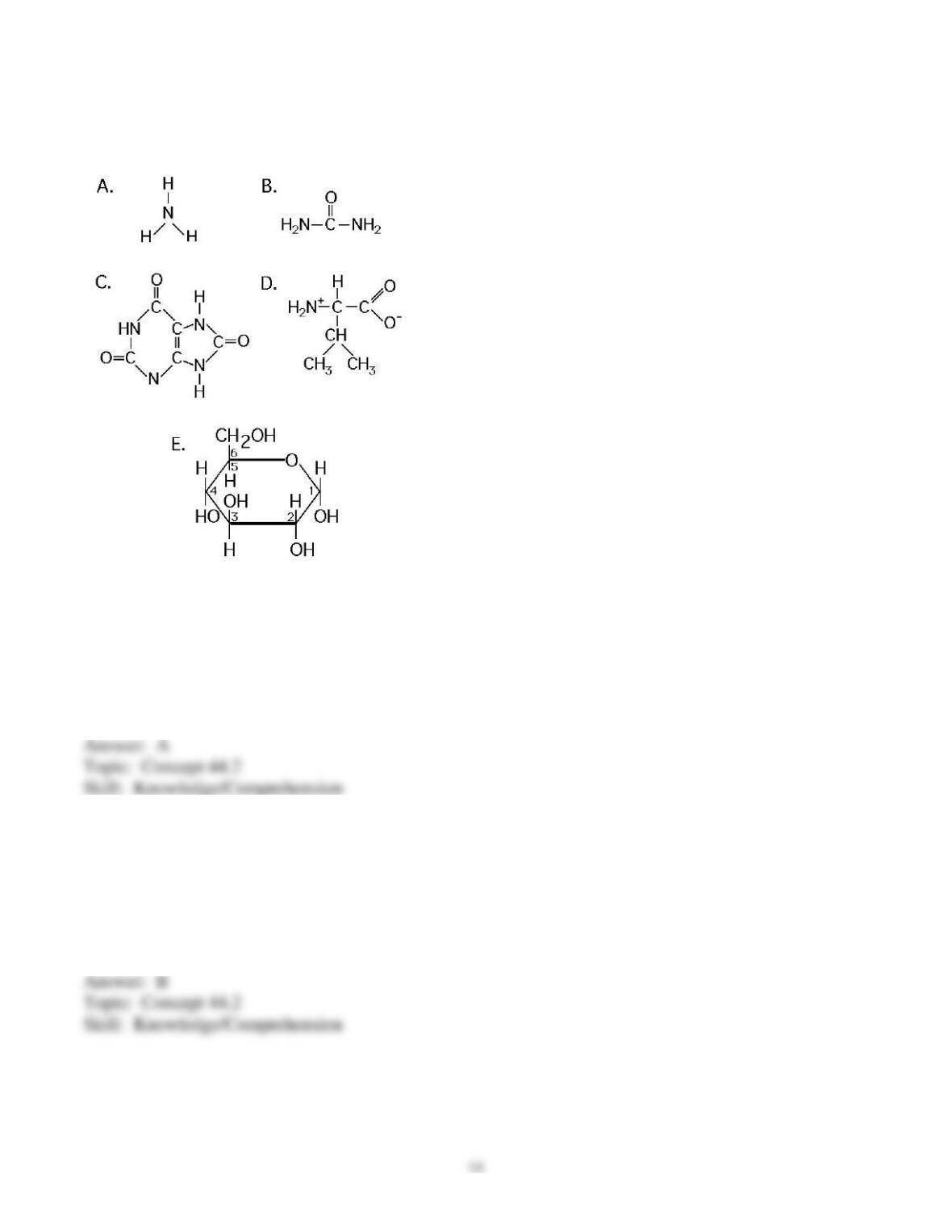
Use the following structural formulas to identify the following items.
60) Which of the following is excreted readily by aquatic animals because of its high solubility in the
respiratory medium?
A) A
B) B
C) C
D) D
E) E
61) Which of the following is synthesized by mammals, most amphibians, sharks, and some bony fishes,
and has lower toxicity than its nitrogenous substrate?
A) A
B) B
C) C
D) D
E) E
62) Which of the following is excreted as a paste by land snails, insects, birds, and many reptiles,
because of its solubility and toxicity properties?
A) A
B) B
C) C
D) D
E) E
Scenario Question
63) In a laboratory experiment with three groups of students, one group drinks pure water, a second
group drinks an equal amount of beer, and a third group drinks an equal amount of concentrated salt
solution, all during the same time period. Their urine production is monitored for several hours. Which
groups are expected to have the greatest and least amounts of urine, respectively?
A) Beer drinkers have the most; salt solution drinkers have the least.
B) Salt solution drinkers have the most; water drinkers have the least.
C) Water drinkers have the most; beer drinkers have the least.
D) Beer drinkers have the most; water drinkers have the least.
E) There will be no significant difference between these groups.
End-of-Chapter Questions
The following questions are from the end-of–chapter “Test Your Understanding” section in Chapter 44
of the textbook.
64) Unlike an earthworm’s metanephridia, a mammalian nephron
A) is intimately associated with a capillary network.
B) forms urine by changing fluid composition inside a tubule.
C) functions in both osmoregulation and excretion.
D) receives filtrate from blood instead of coelomic fluid.
E) has a transport epithelium.
65) Which process in the nephron is least selective?
A) filtration
B) reabsorption
C) active transport
D) secretion
E) salt pumping by the loop of Henle
66) Which of the following animals generally has the lowest volume of urine production?
A) a vampire bat
B) a salmon in fresh water
C) a marine bony fish
D) a freshwater bony fish
E) a shark inhabiting freshwater Lake Nicaragua
67) The high osmolarity of the renal medulla is maintained by all of the following except
A) diffusion of salt from the thin segment of the ascending limb of the loop of Henle.
B) active transport of salt from the upper region of the ascending limb.
C) the spatial arrangement of juxtamedullary nephrons.
D) diffusion of urea from the collecting duct.
E) diffusion of salt from the descending limb of the loop of Henle.
68) Natural selection should favor the highest proportion of juxtamedullary nephrons in which of the
following species?
A) a river otter
B) a mouse species living in a tropical rain forest
C) a mouse species living in a temperate broadleaf forest
D) a mouse species living in a desert
E) a beaver
69) African lungfish, which are often found in small stagnant pools of fresh water, produce urea as a
nitrogenous waste. What is the advantage of this adaptation?
A) Urea takes less energy to synthesize than ammonia.
B) Small stagnant pools do not provide enough water to dilute the toxic ammonia.
C) The highly toxic urea makes the pool uninhabitable to potential competitors.
D) Urea forms an insoluble precipitate.
E) Urea makes lungfish tissue hypoosmotic to the pool.