Chapter 43 – The Nervous System
Chapter 43
The Nervous System
Multiple Choice Questions
1. In vertebrates, the ______ nervous system is composed of the brain and the spinal cord.
2. What are the branched extensions of a neuron that receive signals called?
Chapter 43 – The Nervous System
3. What is the elongated extension of a neuron that nerve impulses travel along?
4. What are examples of cells that support neurons both structurally and functionally?
5. You dissect the brain of a mutant mouse and find that parts of the “white matter” look
gray. What is a likely cause?
Chapter 43 – The Nervous System
Clarify Question
•
What is the key concept addressed by the question?
• What type of thinking is required?
• What key words does the question contain?
Gather Content/Choose Answer
•
What do you already know about white matter? How does it relate to the question?
Consider Alternatives
•
What other information is related to the question?
Choose Answer
•
Given what you now know, what information and/or problem solving approach is most
likely to produce the correct answer?
Reflect on Process
•
Did your problem-solving process lead you to the correct answer? If not, where did the
process break down or lead you astray? How can you revise your approach to produce a
more desirable result?
Chapter 43 – The Nervous System
Nodes of Ranvier are the spaces between sections of axon enwrapped
with myelin. Because myelin creates an insulating layer that prevents
ion flow, the progress of the action potential “jumps” from node to node,
thus speeding up transmission down the axon.
6. You are studying a gene which, when mutant, causes oligodendrocytes to enwrap shorter
sections of axon, so that nodes of Ranvier are more closely spaced. What is the likely effect
on nerve impulses?
Chapter 43 – The Nervous System
Clarify Question
•
What is the key concept addressed by the question?
•
What type of thinking is required?
•
What key words does the question contain?
Gather Content/Choose Answer
•
What do you already know about nodes of Ranvier? How do they relate to nerve
impulses?
Consider Alternatives
•
What other information is related to the question?
Answer
•
Given what you now know, what information and/or problem solving approach is most
likely to produce the correct answer?
Reflect on Process
Chapter 43 – The Nervous System
•
Did your problem-solving process lead you to the correct answer? If not, where did the
process break down or lead you astray? How can you revise your approach to produce a
more desirable result?
7. What other cells should you examine for effects from this mutant gene?
Chapter 43 – The Nervous System
Clarify Question
•
What is the key concept addressed by the question?
•
What type of thinking is required?
•
What key words does the question contain?
Gather Content/Choose Answer
•
What do you already know about this mutation? Which cell type do we know it affects?
Consider Alternatives
•
What other information is related to the question?
Choose Answer
•
Given what you now know, what information and/or problem solving approach is most
likely to produce the correct answer?
Reflect on Process
•
Did your problem-solving process lead you to the correct answer? If not, where did the
process break down or lead you astray? How can you revise your approach to produce a
more desirable result?
Chapter 43 – The Nervous System
8. Rapid inward diffusion of Na+ produces a dramatic change in membrane potential. What is
this event called?
9. Nerve impulses are electrical signals measured across which structure?
Chapter 43 – The Nervous System
10. The membrane of a resting neuron is most permeable to which of the following ions?
11. When neurons are not producing electrical signals, there is still a voltage difference
across their membranes. What is this voltage called?
12. Which of the following characteristics are true for an action potential?
I-A threshold potential must be exceeded for an action potential to occur.
II-A stimulus either produces a full action potential or none at all.
III-During the refractory period it is less likely that stimuli can produce another action
potential.
Chapter 43 – The Nervous System
13. What is the process in which impulses jump from node to node?
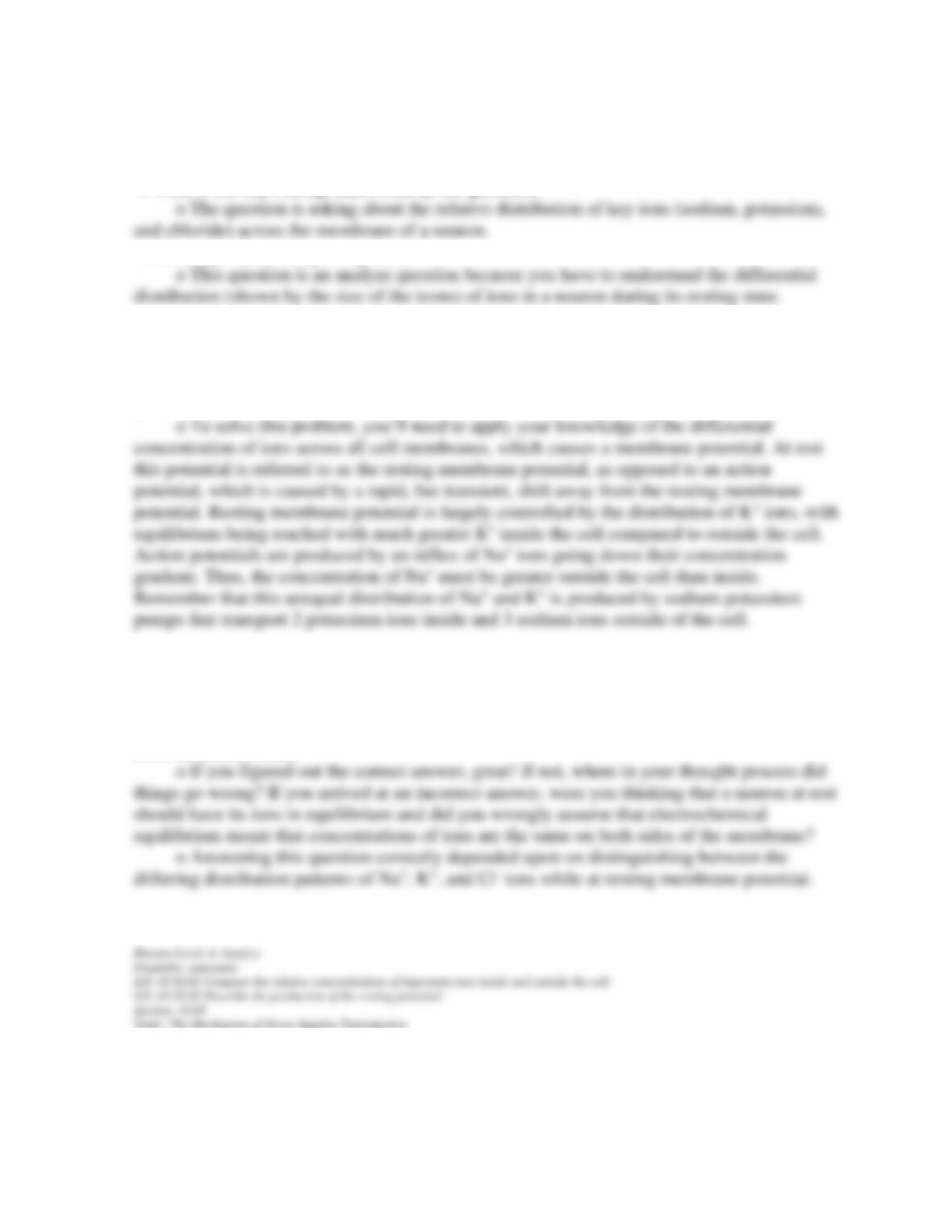
14. Which diagram correctly illustrates the distribution of ions in a resting neuron? (Note: A
larger symbol indicates a higher concentration of that ion.)
Chapter 43 – The Nervous System
Clarify Question
•
What is the key concept addressed by the question?
•
What type of thinking is required?
Gather Content/Choose Answer
•
What do you already know about ions in cells? What other information is related to the
question?
Reflect on Process
•
Did your problem-solving process lead you to the correct answer? If not, where did the
process break down or lead you astray? How can you revise your approach to produce a
more desirable result?
Chapter 43 – The Nervous System
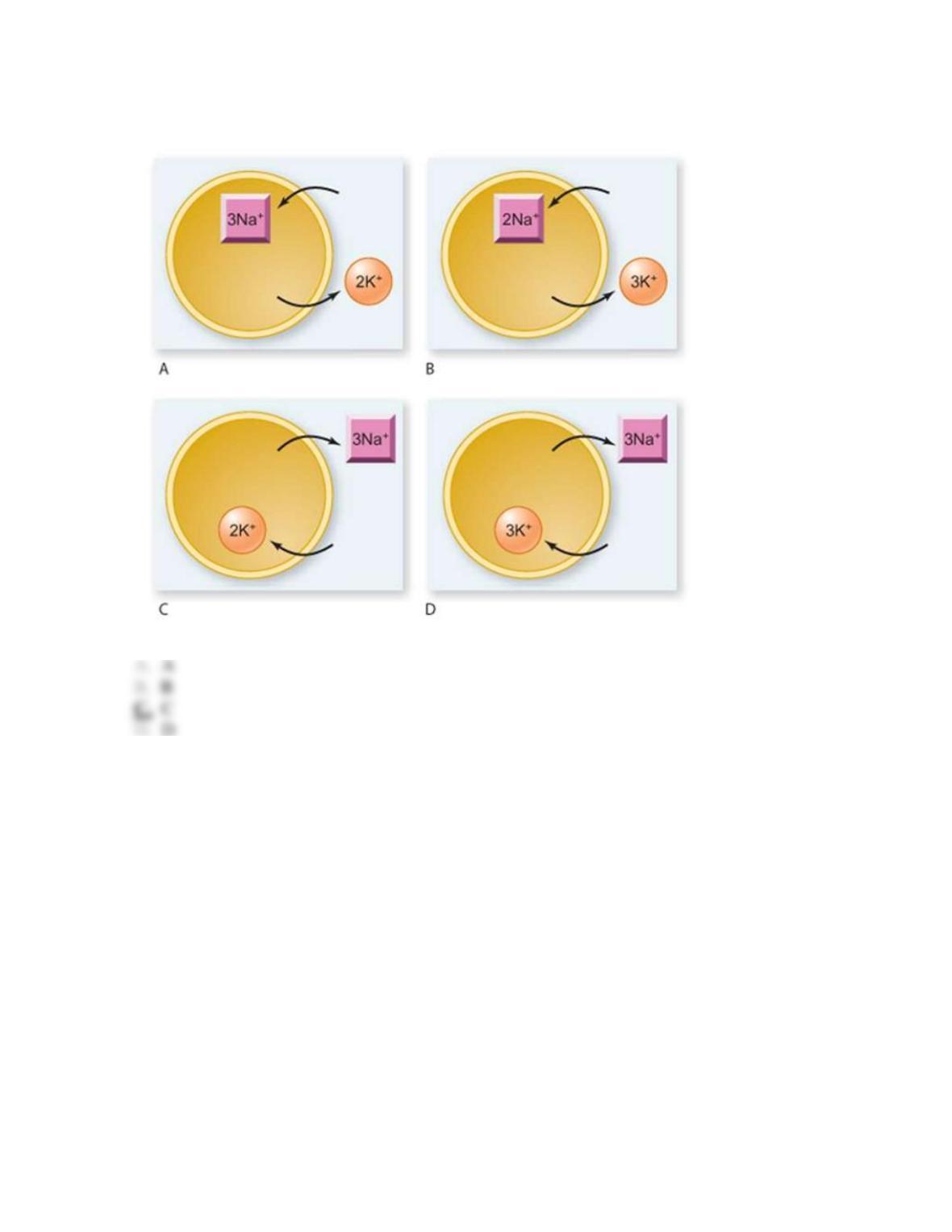
15. Which figure correctly illustrates the mechanism of action of the sodium-potassium
pump?
Chapter 43 – The Nervous System
16. What determines the direction of the voltage change that occurs at the postsynaptic
membrane?
17. At myelinated areas of the axon (i.e. between nodes of Ranvier), which of the following
statements is true?
Chapter 43 – The Nervous System
18. Which ion channel is primarily responsible for the action potential?
19. What diffuses across the narrow synaptic cleft between the presynaptic axon and the
postsynaptic cell to transmit a nerve impulse?
20. Which neurotransmitter is released from a motor neuron at the neuromuscular junction?
Chapter 43 – The Nervous System
21. When acetylcholine stimulates the opening of ligand-gated ion channels on a postsynaptic
cell, what is this event called?
22. What is the name for the gap into which neurotransmitters are released?
23. Place the following events that occur at the vertebrate neuromuscular junction in the
correct order.
I-Depolarization of the muscle fiber membrane.
II-Generation of an action potential in the neuron.
III-Stimulation of Ca2+ entry into the neuron.
IV-Release of acetylcholine into the synapse.
Chapter 43 – The Nervous System
24. Which of the following are examples of biogenic amines?
25. Place the following events involved in drug addiction in the correct sequence.
I-The synapse becomes less sensitive, and normal function can only continue in the presence
of the drug.
II-CNS responds to increased firing by decreasing the number of drug receptors on the cell
membrane.
III-Drug molecule prevents receptor endocytosis and causes overstimulation of the
postsynaptic cell.
26. Which of the following drugs has been discovered to bind to acetylcholine receptors?
Chapter 43 – The Nervous System
27. The hippocampus, amygdala, and hypothalamus are the major components of the ______
system.
28. The spinal cord is enclosed by the vertebral column and layers of protective membranes.
What are these membranes called?
29. Damage to the substantia nigra, a specific region of the basal ganglia, can produce the
resting muscle tremors characteristic of what disease?
Chapter 43 – The Nervous System
30. A region of the brain receives both sensory information from ascending nerve tracts and
motor commands from the cortex and cerebellum. This region plays an important role in
motor control. Which region is it?
31. Which area of the cerebral cortex is important for the formulation of thoughts into
speech?
32. Which animal phylum lacks a network of nerve cells for gathering information from the
environment?
Chapter 43 – The Nervous System
33. In early vertebrates, which component of the brain was devoted largely to coordinating
motor reflexes?
34. Where did information processing become increasingly centered in terrestrial
vertebrates?
35. Which region of the CNS listed below is NOT correctly paired with its function?
Chapter 43 – The Nervous System
36. Which major regions compose the contemporary vertebrate brain?
37. Which of the following structures is NOT a component of the hindbrain?
38. What is the primary function of the hindbrain in vertebrates?