Chapter 43 – The Nervous System
86. Your roommate takes up smoking, and you hate it. Use what you know about nicotine to
convince her to quit. (Check all statements that are true.)
Clarify Question
•
What is the key concept addressed by the question?
•
What type of thinking is required?
Gather Content/Choose Answer
•
What do you already know about nicotine? What other information is related to the
question?
Reflect on Process
•
Did your problem-solving process lead you to the correct answer? If not, where did the
process break down or lead you astray? How can you revise your approach to produce a
more desirable result?
Chapter 43 – The Nervous System
87. A patient of yours is injured in a car accident. The surgeon reports that while there is
damage to the dorsal roots, the spinal cord and nerves otherwise appear intact. What functions
would you expect to be affected in the patient?
Clarify Question
•
What is the key concept addressed by the question?
•
What type of thinking is required?
Gather Content/Choose Answer
•
What do you already know about dorsal root ganglia? What other information is related
to the question?
Reflect on Process
•
Did your problem-solving process lead you to the correct answer? If not, where did the
process break down or lead you astray? How can you revise your approach to produce a
more desirable result?

Chapter 43 – The Nervous System
Check All That Apply Questions
Chapter 43 – The Nervous System
88. If sympathetic and parasympathetic neurons both release acetylcholine (ACh), how can
they have antagonistic effects? (Check all that apply.)
Clarify Question
•
What is the key concept addressed by the question?
•
What type of thinking is required?
Gather Content/Choose Answer
•
What do you already know about the sympathetic and parasympathetic systems? What
other information is related to the question?
Reflect on Process
•
Did your problem-solving process lead you to the correct answer? If not, where did the
process break down or lead you astray? How can you revise your approach to produce a
more desirable result?
Multiple Choice Questions

Chapter 43 – The Nervous System
Chapter 43 – The Nervous System
89. Botulinum toxin, or “botox”, has become popular for cosmetic surgery. The toxin
prevents neurosecretory vesicles from docking at the plasma membrane and releasing
neurotransmitter. How would this toxin affect the neuromuscular junction?
Clarify Question
•
What is the key concept addressed by the question?
•
What type of thinking is required?
Gather Content/Choose Answer
•
What do you already know about the botulism? What other information is related to the
question?
Reflect on Process
•
Did your problem-solving process lead you to the correct answer? If not, where did the
process break down or lead you astray? How can you revise your approach to produce a
more desirable result?
90. You accidentally consume botulinum toxin by eating a contaminated can of sausages.
What do you predict will be the most harmful physiological effect?
Clarify Question
•
What is the key concept addressed by the question?
•
What type of thinking is required?
Gather Content/Choose Answer
•
What do you already know about botulism? What other information is related to the
question?
Reflect on Process
•
Did your problem-solving process lead you to the correct answer? If not, where did the
process break down or lead you astray? How can you revise your approach to produce a
more desirable result?
Chapter 43 – The Nervous System
91. Another toxin that also blocks neurotransmitter release is tetanus toxin; however, it
primarily affects inhibitory interneurons of the spinal cord that negatively regulate motor
neurons. Which would be symptoms of tetanus toxin poisoning?
Clarify Question
•
What is the key concept addressed by the question?
•
What type of thinking is required?
Gather Content/Choose Answer
•
What do you already know about tetanus? What other information is related to the
question?
Reflect on Process
•
Did your problem-solving process lead you to the correct answer? If not, where did the
process break down or lead you astray? How can you revise your approach to produce a
more desirable result?
Chapter 43 – The Nervous System
92. In contrast to these toxins, strychnine acts postsynaptically, to block glycine from binding
to receptors on motor neurons. Would you expect the symptoms of strychnine poisoning to be
more similar to those of botulinum or tetanus toxin?
Chapter 43 – The Nervous System
Clarify Question
•
What is the key concept addressed by the question?
•
What type of thinking is required?
Gather Content/Choose Answer
•
What do you already know about strychnine? What other information is related to the
question?
Reflect on Process
•
Did your problem-solving process lead you to the correct answer? If not, where did the
process break down or lead you astray? How can you revise your approach to produce a
more desirable result?
Chapter 43 – The Nervous System
93. How do temporal and spatial summation improve the processing power of the brain?
Clarify Question
•
What is the key concept addressed by the question?
•
What type of thinking is required?
Gather Content/Choose Answer
•
What do you already know about summation? What other information is related to the
question?
Reflect on Process
•
Did your problem-solving process lead you to the correct answer? If not, where did the
process break down or lead you astray? How can you revise your approach to produce a
more desirable result?
Chapter 43 – The Nervous System
94. K+ channels in the heart do not have binding sites for ACh, yet parasympathetic release of
ACh causes outward flux of K+ from heart cells. How does this occur?
95. What would happen if the G-protein coupled receptor in heart cells that binds to ACh had
a mutation that caused it to bind more tightly to the G-protein alpha subunit?
Chapter 43 – The Nervous System
Clarify Question
•
What is the key concept addressed by the question?
•
What type of thinking is required?
Gather Content/Choose Answer
•
What do you already know about G-proteins? What other information is related to the
question?
Reflect on Process
•
Did your problem-solving process lead you to the correct answer? If not, where did the
process break down or lead you astray? How can you revise your approach to produce a
more desirable result?
Chapter 43 – The Nervous System
Check All That Apply Questions
96. How do somatic neurons and autonomic neurons differ? (Check all that apply.)
Chapter 43 – The Nervous System
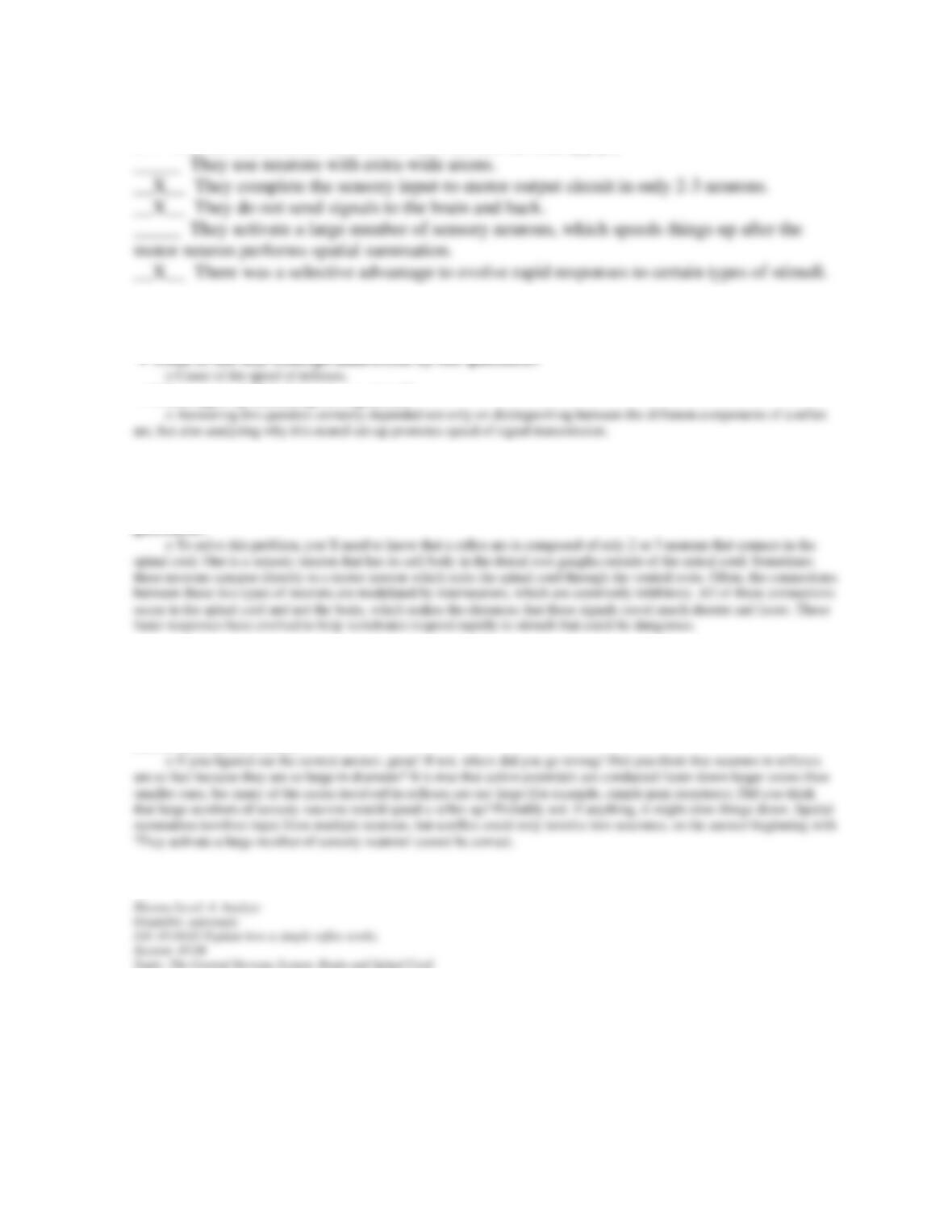
97. Why are mammalian reflexes so fast? (Check all that apply.)
Clarify Question
•
What is the key concept addressed by the question?
•
What type of thinking is required?
Gather Content/Choose Answer
•
What do you already know about reflexes? What other information is related to the
question?
Reflect on Process
•
Did your problem-solving process lead you to the correct answer? If not, where did the
process break down or lead you astray? How can you revise your approach to produce a
more desirable result?