Campbell’s Biology, 9e (Reece et al.)
Chapter 41 Animal Nutrition
Chapter 41 relates the energetic and nutritional needs of animals with the evolutionary adaptations that
optimize nutrient ingestion, digestion, absorption, and distribution of nutrients. The locations and
specializations of organs and tissues along the gastrointestinal tract are detailed, as are the regulatory
mechanisms that coordinate functions.
Multiple-Choice Questions
1) In a well-fed human eating a Western diet, the richest source of stored chemical energy in the body is
A) fat in adipose tissue.
B) glucose in the blood.
C) protein in muscle cells.
D) glycogen in muscle cells.
E) calcium phosphate in bone.
2) Animals that migrate great distances would obtain the greatest energetic benefit of storing chemical
energy as
A) proteins.
B) minerals.
C) carbohydrates.
D) amino acids.
E) fats.
3) Certain nutrients are considered “essential” in the diets of some animals because
A) only those animals use those nutrients.
B) the nutrients are subunits of important polymers.
C) these animals are not able to synthesize these nutrients.
D) the nutrients are necessary coenzymes.
E) only certain foods contain them.
4) To maintain adequate nutrition, animals require dietary access to certain amino acids. An amino acid
that is referred to as “nonessential” would be best described as one that
A) can be made by the animal’s body from other substances.
B) is not used by the animal in biosynthesis.
C) must be ingested in the diet.
D) is not readily absorbed by the gastrointestinal tract.
E) is not found in many proteins.
5) Which pair correctly associates a physiological process with the appropriate vitamin?
A) blood clotting and vitamin C
B) normal vision and vitamin A
C) synthesis of cell membranes and vitamin D
D) protection of skin from cancer and vitamin E
E) production of white blood cells and vitamin K
6) The fat-soluble vitamins include
A) vitamin A.
B) vitamin B12.
C) vitamin C.
D) iodine.
E) calcium.
7) Which pair correctly associates a biochemical process with the appropriate mineral associated with its
use in animals?
A) maintenance of bone and calcium
B) cofactor in enzymes that make ATP and magnesium
C) thyroid hormone synthesis and iron
D) nucleic acid synthesis and sulfur
E) glucose homeostasis and iodine
8) A general rule relating the capacity of a specific animal’s digestive system to provide adequate access
to substrates for biosynthesis of cellular components, as well as fuel molecules needed for ATP
production, is that the animal should have access to
A) a high-protein, low-carbohydrate diet.
B) a diet low in lipids and high in protein.
C) a low-calorie diet with a large intake of fluids, especially water.
D) a diet that matches the “food pyramid” for the species.
E) a diet that maximizes vitamins and minerals.
Use the following table showing the contents of a multivitamin supplement and its percentage of
recommended daily values (DV) to answer the following questions.
Dietary Supplement % DV
Vitamin A 70
Vitamin C 100
Vitamin D 100
Vitamin E 150
Vitamin K 13
Vitamin B1 100
Vitamin B2 100
Folic acid 100
Vitamin B12 417
Calcium 20
Phosphorus 5
Iodine 100
Magnesium 25
Zinc 100
Copper 100
Chromium 125
Molybdenum 100
Iron 0
9) The most likely reason that some of the vitamins and minerals in this supplement are found at less
than 100% is
A) that it would be chemically impossible to add more.
B) these vitamins and minerals are too large in size to reach 100%.
C) it is too easy to overdose on minerals such as phosphorus and calcium.
D) it is dangerous to overdose on fat-soluble vitamins such as A and K.
E) these supplements are meant for those who have been deprived of healthy foods.
10) A mineral that is especially important for preventing anemia is
A) zinc.
B) iron.
C) iodine.
D) molybdenum.
E) folic acid.
11) Folic acid supplements have become especially important for pregnant women because
A) folic acid supplies vitamins that only pregnant women can use.
B) the folic acid is stored in adipose tissue by pregnant women so supplements are needed to make more
available in the circulation.
C) the fetus makes high levels of folic acid.
D) folic acid deprivation is associated with neural tube abnormalities in a fetus.
E) folic acid deprivation is a cause of heart abnormalities in a newborn.
12) Excessive iron absorption and accumulation to toxic levels is associated with
A) excessive blood volume.
B) a liver abnormality that results in a decreased number of red blood cells.
C) various forms of inherited or acquired anemia.
D) the genetic disorder known as hemochromatosis.
E) menstruation and menopause.
13) Fat digestion yields fatty acids and glycerol, whereas protein digestion yields amino acids; both
digestive processes
A) are catalyzed by the same enzyme.
B) are excludible intracellular processes in most organisms.
C) add a water molecule to break bonds (hydrolysis).
D) require the presence of hydrochloric acid to lower the pH.
E) require ATP as an energy source.
14) Ingested dietary substances must cross cell membranes to be used by the body, a process known as
A) ingestion.
B) digestion.
C) hydrolysis.
D) absorption.
E) elimination.
15) In marine sponges, intracellular digestion of peptides is usually immediately preceded by
A) hydrolysis.
B) endocytosis.
C) absorption.
D) elimination.
E) secretion.
16) The large surface area in the gut directly facilitates
A) secretion.
B) absorption.
C) elimination.
D) filtration
E) temperature regulation.
17) An advantage of a complete digestive system over a gastrovascular cavity is that the complete
system
A) excludes the need for extracellular digestion.
B) allows specialized functions in specialized regions.
C) allows digestive enzymes to be more specific.
D) allows extensive branching.
E) facilitates intracellular digestion.
18) Earthworms, grasshoppers, and birds all have a
A) gastric cecae.
B) larynx.
C) crop.
D) pharynx.
E) epiglottis.
19) Because the foods eaten by animals are often composed largely of macromolecules, this requires the
animals to have mechanisms for
A) elimination.
B) dehydration synthesis.
C) enzymatic hydrolysis.
D) regurgitation.
E) demineralization.
20) In the digestive system, peristalsis is
A) a process of fat emulsification in the small intestine.
B) voluntary control of the rectal sphincters regulating defecation.
C) the transport of nutrients to the liver through the hepatic portal vessel.
D) a common cause of loss of appetite, fatigue, and dehydration.
E) smooth muscle contractions that move food along the esophagus.
21) After ingestion by humans, the first category of macromolecules to be chemically digested by
enzymes in the mouth is
A) proteins.
B) carbohydrates.
C) cholesterol and other lipids.
D) nucleic acids.
E) minerals.
22) Salivary amylase digests
A) protein.
B) starches.
C) monosaccharides.
D) glucose.
E) maltose.
7
23) Among mammals, it is generally true that
A) all types of foods begin their enzymatic digestion in the mouth.
B) after leaving the oral cavity, the bolus enters the larynx.
C) the epiglottis prevents swallowed food from entering the trachea.
D) the esophagus is a key source of digestive enzymes.
E) the trachea leads to the esophagus and then to the stomach.
24) Digestive secretions with a pH of 2 are characteristic of the
A) small intestine.
B) stomach.
C) pancreas.
D) liver.
E) mouth.
25) Pepsin is a digestive enzyme that
A) is manufactured by the pancreas.
B) helps stabilize fat-water emulsions.
C) splits maltose into monosaccharides.
D) begins the hydrolysis of proteins in the stomach.
E) is denatured and rendered inactive in solutions with low pH.
26) Upon activation by stomach acidity, the secretions of the parietal cells
A) initiate the digestion of protein in the stomach.
B) initiate the mechanical digestion of lipids in the stomach.
C) initiate the chemical digestion of lipids in the stomach.
D) include pepsinogen.
E) delay digestion until the food arrives in the small intestine.
27) The bile salts
A) are enzymes.
B) are manufactured by the pancreas.
C) emulsify fats in the duodenum.
D) increase the efficiency of pepsin action.
E) are normally an ingredient of gastric juice.
28) Complex nutrients are digested and then absorbed into the lymph or bloodstream as
A) disaccharides.
B) polymers.
C) monomers.
D) enzymes.
E) peptides.
29) An enzyme with high activity in an acidic environment is
A) amylase.
B) pepsin.
C) gastrin.
D) trypsin.
E) sucrose.
30) The absorption of fats differs from that of carbohydrates in that the
A) processing of fats does not require any digestive enzymes, whereas the processing of carbohydrates
does.
B) fat absorption occurs in the stomach, whereas carbohydrates are absorbed from the small intestine.
C) carbohydrates need to be emulsified before they can be digested, whereas fats do not.
D) most absorbed fat first enters the lymphatic system, whereas carbohydrates directly enter the blood.
E) fats, but not carbohydrates, are digested by bacteria before absorption.
31) A nutritional monomer that can be transported in the blood after a typical meal is
A) sucrose.
B) maltose.
C) fatty acid.
D) dipeptide.
E) trinucleotide.
32) For a nondiabetic person, the glucose concentration in this part of the vasculature varies more than
in any other part.
A) abdominal artery
B) coronary arteries
C) pulmonary veins
D) hepatic portal vessel
E) jugular vein
33) Glandular secretions that are released initially as inactive precursors of digestive enzymes are the
A) protein-digesting enzymes.
B) fat-solubilizing bile salts.
C) acid-neutralizing bicarbonate.
D) carbohydrate-digesting enzymes.
E) hormones such as gastrin.
34) Because adult lampreys attach onto the surface of large fish for long periods of time to feed on body
fluids, they can accomplish nutritional balance without need for a
A) liver.
B) pancreas.
C) intestine.
D) stomach.
E) gallbladder.
35) Constipation can result from the consumption of a substance that
A) contains plenty of fiber.
B) promotes water reabsorption in the large intestine.
C) speeds up movement of material in the large intestine.
D) decreases water reabsorption in the small intestine.
E) stimulates peristalsis.
36) Historically inaccurate diagnosis of acid reflux disorders and gastric ulcers has been improved by
A) pH monitoring.
B) X-ray technology.
C) the diagnosis and treatment of H. pylori infection.
D) colonoscopy.
E) sonography.
37) A hiatal hernia that disrupts the functional relationship between the smooth muscle in the esophagus
and that in the stomach would be most likely to increase the frequency of
A) gastric reflux.
B) premature entry of food into the duodenum.
C) excess secretion of pepsinogen.
D) increased stomach pH.
E) retention of food in the stomach.
38) A significant contribution of intestinal bacteria to human nutrition is the benefit of bacterial
A) production of vitamins A and C.
B) generation of gases needed for elimination.
C) absorption of organic materials.
D) production of vitamin K.
E) recovery of water from fecal matter.
39) The cells that secrete acidic fluid in the stomach are
A) the chief cells of the stomach.
B) the parietal cells of the stomach.
C) not needed for the transformation of pepsinogen to pepsin.
D) in the lumen of the stomach.
E) adding secretions along the esophagus.
40) Stomach cells are moderately well adapted to the acidity and protein-digesting activities in the
stomach by having
A) a sufficient colony of H. pylori.
B) a thick, mucous secretion and active mitosis of epithelial cells.
C) a high level of secretion by chief cells.
D) a high level of secretion from parietal cells.
E) secretions enter the stomach from the pancreas.
41) The molar teeth of herbivorous mammals are especially effective at
A) cutting.
B) ripping.
C) grinding.
D) splitting.
E) piercing.
42) A group of animals among which a relatively long cecum is likely to be found is the
A) carnivores.
B) herbivores.
C) autotrophs.
D) heterotrophs.
E) omnivores.
43) The adaptations suited to a carnivorous diet include
A) broad, flat molars.
B) a rumen.
C) ingestion of feces.
D) bile salts.
E) amylase.
44) Cattle are able to survive on a diet consisting almost entirely of plant material because
A) they are autotrophic.
B) cattle, like rabbits, re-ingest their feces.
C) they manufacture all 15 amino acids out of sugars in the liver.
D) cattle saliva has enzymes capable of digesting cellulose.
E) they have cellulose-digesting, symbiotic microorganisms in chambers of their stomachs.
45) Analysis of jawbones from the skeletal remains of a vertebrate animal reveal its dietary patterns
owing to
A) the position of muscle attachment sites.
B) the prevalence of specific kinds of teeth.
C) the size of the mouth opening.
D) the evidence of food molecules still present.
E) whether the mouth is the most anterior structure.
46) An enlarged cecum is typical of
A) rabbits, horses, and herbivorous bears.
B) carnivorous animals.
C) tubeworms that digest via symbionts.
D) humans and other primates.
E) tapeworms and other intestinal parasites.
47) Coprophagy, the nutrition-boosting ingestion of fecal material, is important for the nutritional
balance of
A) ruminants such as cows.
B) insects and arthropods.
C) rabbits and their relatives.
D) squirrels and some rodents.
E) very large animals, such as elephants.
48) PKU (phenylketonuria) is a hereditary condition in which infants and young children who ingest the
amino acid phenylalanine risk serious neurological damage. However, the risk of damage can be
substantially reduced by the severe restriction of phenylalanine in the diet. Which of the following is the
nutritional concept that forms the basis for this preventive treatment?
A) enzymatic hydrolysis
B) essential nutrients
C) symbiosis
D) dehydration synthesis
E) structural anatomy of the brain
49) When the digestion and absorption of organic molecules results in more energy-rich molecules than
are immediately required by an animal, the excess is
A) eliminated in the feces.
B) stored as starch in the liver.
C) stored as glycogen in the liver and muscles.
D) oxidized and converted to ATP.
E) hydrolyzed and converted to ADP.
50) Hypoglycemia, or low levels of glucose in the blood of a healthy human, is “corrected” by a(n)
A) increase in the secretion of insulin.
B) increase in the secretion of glucagon.
C) increase in the secretion of both insulin and glucagon.
D) decrease in the secretion of both insulin and glucagon.
E) increase in the secretion of thyroid hormones.
51) A fasting animal whose energy needs exceed those provided in its diet draws on its stored resources
in which order?
A) fat, then glycogen, then protein
B) glycogen, then protein, then fat
C) liver glycogen, then muscle glycogen, then fat
D) muscle glycogen, then fat, then liver glycogen
E) fat, then protein, then glycogen
52) Obesity in humans is most clearly linked to
A) type 1 diabetes and prostate cancer.
B) type 1 diabetes and breast cancer.
C) type 2 diabetes and muscle hypertrophy.
D) type 2 diabetes and cardiovascular disease.
E) type 2 diabetes and decreased appetite.
Art Questions
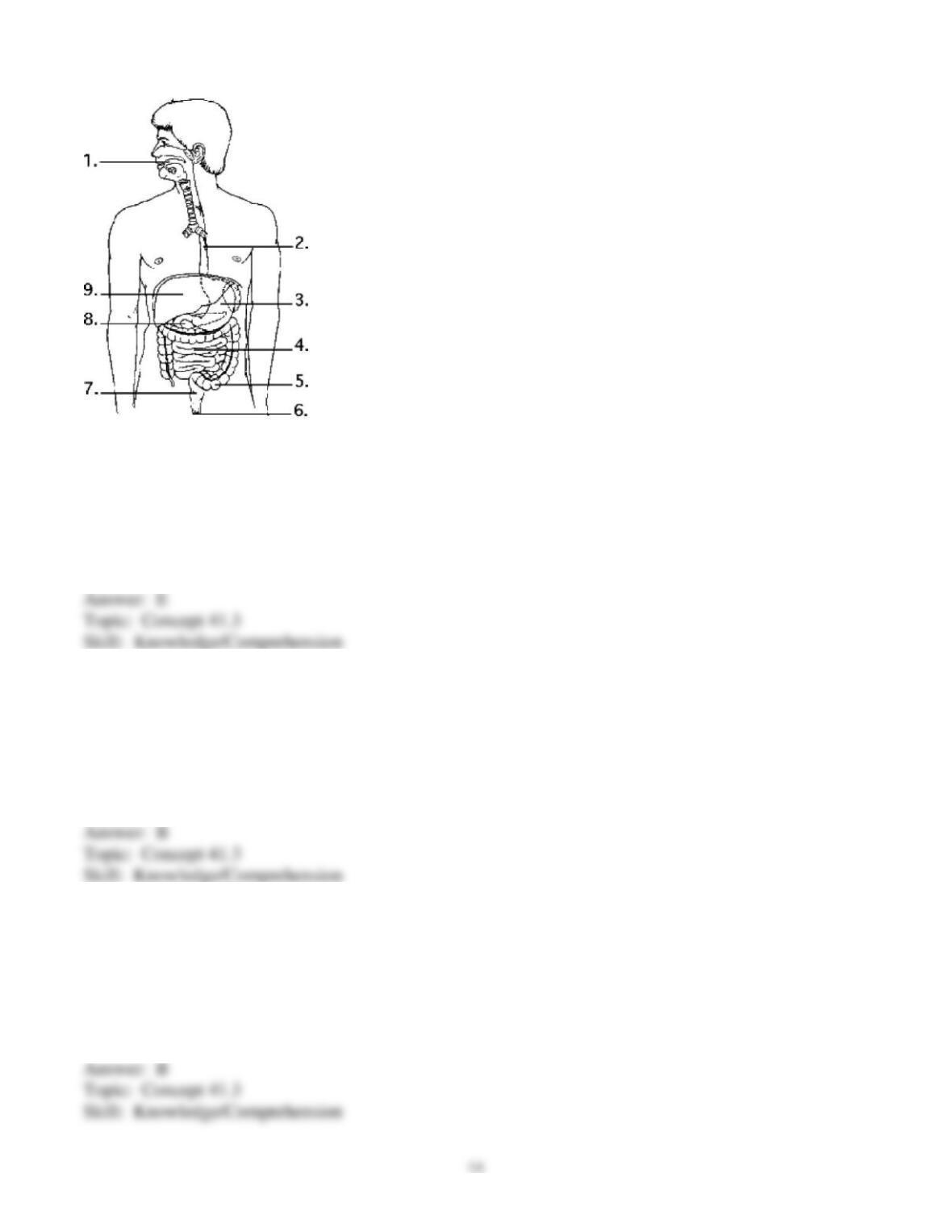
53) Examine the digestive system structures in the figure above. The agents that help emulsify fats are
produced in
A) 1
B) 2
C) 3
D) 8
E) 9
54) Examine the digestive system structures in the figure above. The highest rate of nutrient absorption
occurs at location(s)
A) 3 only.
B) 4 only.
C) 1 and 4.
D) 3 and 4.
E) 1, 3, and 4.
55) Examine the digestive system structures in the figure above. Most of the digestion of fats occurs in
section(s)
A) 3 only.
B) 4 only.
C) 1 and 4.
D) 3 and 4.
E) 1, 3, and 4.
56) Examine the digestive system structures in the figure above. Bacteria that produce vitamins as
products are residents of location
A) 3.
B) 4.
C) 5.
D) 7.
E) 8.
Scenario Questions
Use the following information to answer the questions below.
Mouse mutations can affect an animal’s appetite and eating habits. The ob gene codes for a satiety
factor, the hormone leptin. The db gene product, the leptin receptor, is required to respond to the satiety
factor.
57) Leptin is a product of adipose cells. Therefore, a very obese mouse would be expected to have
A) increased gene expression of ob and decreased expression of db.
B) increased gene expression of db and decreased expression of ob.
C) decreased transcription of both ob and db.
D) mutation of ob or db.
58) Many obese humans produce normal or increased levels of leptin without satiety, so the search for
healthy regulation of food intake should focus on
A) providing supplementary leptin.
B) inactivation of leptin.
C) overexpression of the leptin receptor gene.
D) eliminating carbohydrates from the diet.
E) inhibition of leptin receptors.
End-of-Chapter Questions
The following questions are from the end-of–chapter “Test Your Understanding” section in Chapter 41
of the textbook.
59) Which of the following animals is incorrectly paired with its feeding mechanism?
A) lion substrate feeder
B) baleen whale suspension feeder
C) aphid fluid feeder
D) clam suspension feeder
E) snake bulk feeder
60) The mammalian trachea and esophagus both connect to the
A) large intestine.
B) stomach.
C) pharynx.
D) rectum.
E) epiglottis.
61) Which of the following organs is incorrectly paired with its function?
A) stomach protein digestion
B) oral cavity starch digestion
C) large intestine bile production
D) small intestine nutrient absorption
E) pancreas enzyme production
62) Which of the following is not a major activity of the stomach?
A) mechanical digestion
B) HCl secretion
C) mucus secretion
D) nutrient absorption
E) enzyme secretion
63) After surgical removal of an infected gallbladder, a person must be especially careful to restrict
dietary intake of
A) starch.
B) protein.
C) sugar.
D) fat.
E) water.
64) If you were to jog 1 km a few hours after lunch, which stored fuel would you probably tap?
A) muscle proteins
B) muscle and liver glycogen
C) fat stored in the liver
D) fat stored in adipose tissue
E) blood proteins