Chapter 4—Valuation
MULTIPLE CHOICE
1. The value of any asset equals:
a.
the cost of maintaining an asset over its useful life
b.
the present value of all of its future benefits
c.
the book value of the asset
d.
the replacement cost of an asset
e.
none of the above
2. Typically when valuing an asset adjustments for risk are made by adjusting:
a.
the number of time periods
b.
the asset’s expected cash flows
c.
the asset’s required return
d.
the asset’s terminal value
e.
none of the above
3. All of the following terms except __________ are important in defining the cash flows associated with
a bond:
a.
coupon rate
b.
term to maturity
c.
current price
d.
beta
e.
par value
4. The fair value of a bond with annual coupon payments of $cp, a par value of $parv, an annual discount
rate of perc percent, and ten years to maturity is:
a.
$w1
b.
$fv
c.
$w2
d.
$w3
e.
none of the above
5. What is the yield to maturity of a bond with fifteen years to maturity, a cr percent coupon rate, a par
value of $par, and a price of $p that is making semiannual interest payments?
a.
w1%
b.
w2%
c.
ans%
d.
w3%
e.
none of the above
6. You observe that a one-year riskless investment offers an interest rate of p1 percent and a two-year
riskless investment offers a rate of return equal to p2 percent. Both investments are zero coupon bonds
(that is, there are only two relevant cash flows—a single cash outflow when the bond is purchased and
an inflow when the bond matures). According to the expectations theory what is the expected one-year
rate in the second year?
a.
ans%
b.
w1%
c.
w2%
d.
w3%
e.
none of the above
7. The value of long-term bonds is __________ sensitive to changes in __________ than short-term
bonds.
a.
more; interest rates
b.
more; GDP growth
c.
not; interest rates
d.
less; GDP growth
e.
less; interest rates
8. Which of the following bonds will be least negatively affected by an increase in interest rates (in
comparison with an otherwise identical bond)?
a.
A longer term bond with the same coupon rate
b.
A bond with the same time to maturity but a larger coupon rate
c.
A bond with the same time to maturity but a smaller coupon rate
d.
A longer term bond with a larger coupon rate
e.
None of the above
9. Preferred stock of Slow But Sure Inc., pays annual dividends of $d. These dividends are expected to
continue into the indefinite future. What is the fair price of Slow But Sure’s preferred stock if the
required return on this stock is perc percent?
a.
$w1
b.
$w2
c.
$ans

d.
$w3
e.
None of the above
10. Zoomers Inc. paid an annual dividend of $d yesterday. If future dividends are expected to grow at a
rate of r1 percent, and the required rate of return on this stock is r2 percent, the fair price of this stock
today is:
a.
$w1
b.
$w2
c.
$ans
d.
$w3
e.
None of the above
11. Generally, the __________ the uncertainty about an asset’s future benefits, the __________ the
discount rate investors will apply when discounting those benefits to the present.
a.
greater; lower
b.
smaller; higher
c.
greater; higher
d.
greater; more uncertain will be
e.
none of the above
12. The process of valuing an ordinary corporate bond involves __________.
a.
determining the bond’s cash flows
b.
determining an appropriate discount rate
c.
calculating the present value
d.
all of the above
e.
none of the above
13. Free cash flow represents the cash amount that a firm could distribute to __________.
a.
bondholders
b.
common stockholders
c.
preferred shareholders
d.
all of the above
e.
none of the above
14. The term structure of interest rates is the relationship between __________ to maturity and
__________ to maturity on bonds having similar risk.

a.
time; default risk
b.
discount; time
c.
FCF; yield
d.
real return; FCF
e.
time; yield
15. Common stock valuation involves use of a simple formula when dividends per share are __________.
a.
not paid
b.
not growing
c.
growing at a constant rate
d.
a and b
e.
b and c
16. With regard to bonds, which of the following statements is not accurate?
a.
The prices of long-term bonds are less sensitive to changes in interest rates than prices of
short-term bonds.
b.
As market interest rates increase, values of bonds decrease.
c.
The coupon yield is the coupon payment divided by the bond’s current market price.
d.
Bonds may be secured by collateral.
e.
All of the above statements are accurate.
17. Under the free cash flow approach to valuation:
a.
share value equals the present value of all free cash flows.
b.
share value is found by subtracting the value of debt and preferred stock from the
enterprise value.
c.
the enterprise value is found by discounting free cash flows at the required return on
equity.
d.
the share value is found by multiplying free cash flows by the firm’s weighted average cost
of capital.
e.
none of the above.
18. The variable growth common stock valuation model:
a.
finds the sum of the present value of dividends during the initial growth period and the
present value of the price of the stock at the end of the initial growth period.
b.
uses the constant growth model to find the present value of the stock during the initial
growth period.
c.
allows the analyst to specify a relatively fast growth rate during the initial period, followed
by a period of stable growth.
d.
all of the above.
e.
none of the above.
19. A simple, but naïve, method of estimating how fast a firm will grow is to:
a.
divide the firm’s return on common equity by its retention rate.
b.
calculate the firm’s historic rate of asset growth.
c.
multiply the firm’s retention rate by its return on common stock equity.

d.
take the product of the firm’s rate of asset growth and its retention rate.
e.
none of the above.
20. Price/earnings (P/E) ratios:
a.
reflect the amount investors are willing to pay for each dollar of earnings.
b.
can be calculated using either forecast or historical earnings per share.
c.
can be estimated by dividing the firm’s payout ratio by the difference between the required
return and the growth rate.
d.
all of the above.
e.
none of the above.
21. Which of the following is not a popular approach used by practitioners to value common stock?
a.
liquidation value
b.
terminal value
c.
book value
d.
price/earnings multiples
e.
none of the above
22. Looking at the current yield curve you see the following spot rates: one year r1%, two years r2%, and
three years r3%. If you assume that the yield curve is best explained by the “pure expectations theory”,
what is the expected one-year rate two years from now?
a.
r2%
b.
r3%
c.
w%
d.
ans%
23. Looking at the current yield curve you see the following spot rates: one year r1%, two years r2%, and
three years r3%. If you assume that the yield curve is best explained by the “pure expectations theory”,
what is the expected one-year rate next year?
a.
w2%
b.
r3%
c.
w%
d.
ans%
24. Moe, a private investor, purchases a six-month (182-day) T-bill with a $pv par value for $p. If Moe
holds the T-bill to maturity what is his bond equivalent yield?

a.
w1%
b.
ans%
c.
w2%
d.
w3%
25. Moe, a private investor, purchases a six-month (182-day) T-bill with a $pv par value for $p. If Moe
holds the T-bill to maturity what is his bank discount yield?
a.
w1%
b.
ans%
c.
w2%
d.
w3%
26. Consider an asset that is expected to generate $d a year, starting one year from today, growing at a rate
of g% per year forever, discounted at a rate of r1%. If you decide that the risk of the assets requires a
discount rate of r2%, how much is the asset’s present value reduced?
a.
$ w1
b.
$ ans
c.
$ w2
d.
$ w3
27. Why would a zero coupon bond be desirable?
a.
It has zero risk
b.
It eliminates interest-rate risk
c.
It eliminates price risk
d.
It eliminates re-investment rate risk
28. Which of the following bonds is the most liquid?
a.
Corporate bonds
b.
Municipal bonds
c.
Treasury bonds
d.
All have good liquidity as they are publicly traded
29. Which of the following bonds as the greatest price change for a given change in interest rates?
a.
A 2-year zero coupon bond
b.
A 10-year bond paying 5% annually
c.
A 10-year bond paying 5% semi-annually
d.
A 10-year zero coupon bond
30. According to the expectations theory, if the three-year rate is r1% per year and the two-year rate is r2%
per year, what is the expected rate for a 1-year bond two years from now?
a.
w1 %
b.
ans %
c.
w2 %
d.
w3 %
31. Consider a firm that retains rr% of its earnings, earned a return on equity of roe%, and paid a dividend
of $d. If the appropriate discount rate is r%, what is the price of the stock?
a.
$w1
b.
$w2
c.
$ans
d.
$w3
MATCHING
Match the following terms to their definitions:
a.
coupon
b.
yield to maturity
c.
coupon rate
d.
yield spread
1. a bond’s annual coupon payment divided by its par value
2. a promise to pay a fixed amount of interest to investors
3. the difference in yield-to-maturity between 2 bonds with similar maturities
4. the discount rate that equates the present value of a bond’s cash flows to its market price
Match each theory related to yield curve behavior with its main premise:
a.
Liquidity Preference theory
b.
Expectations theory
c.
Preferred Habitat theory
5. Investors should earn the same return whether they invest in long-term bonds or a series of short-term
bonds.
6. Debt market participants have a favorite term to maturity when lending or borrowing.
7. The slope of the yield curve is influenced by expected interest-rate changes and by an investor’s ability
to convert a financial asset to cash.
Match the following terms to their definitions:
a.
coupon
b.
maturity
c.
par value
d.
coupon yield
e.
bond equivalent yield
8. limited life of bonds
9. bond’s face value
10. bonds coupon / current market value
11. bond’s fixed amount of interest
12. simple-interest measures
Match the following valuation models with the model descriptions:
a.
free cash flow valuation
b.
prices/earning multiples
c.
zero growth model
d.
variable growth model
e.
constant growth model
13. the simplest approach to stock valuation
14. an approach used to value the whole firm
15. formula popularized by Myron Gordon
16. allows for shifts in expected growth rates
17. frequently used by analysts
SHORT ANSWER
1. If an investor earns g percent on an investment in a zero-coupon bond with m1 months to maturity,
what is the m-month effective rate of return or yield? What is the annual effective rate of return on this
bond (assuming 12 months per year)?
2. You are considering the purchase of a bond with a semiannual coupon of $c, ten years to maturity, a
face value of $fv, and a required rate of return of r percent every six months. What is the fair market
price of this bond?
3. You are considering the purchase of a bond with an annual coupon of $c, ten years to maturity, a face
value of $fv, and a current market price of $p.
a.
What is the annual yield to maturity for this bond?
b.
If you only believe that you will be able to collect 85 cents out of every dollar promised by the
firm, what is your expected annual rate of return on your investment?
c.
Why are the yields of high-risk bonds larger than yields on lower risk companies?
r = ytm%
b.
expected annual rate of return = arr%
may exceed expected future payments. Second, expected future cash flows must compensate
investors for risk not present in safer bonds.
4. You are considering the purchase of a bond with a semiannual coupon of $c, ten years to maturity, a
face value of $fv, and a current market price of $mp.
a.
At what price will the bond sell in the market in 6 months, immediately after the first
coupon payment, if the stated annual yield on the bond (in six months) is i percent?
b.
If you were to buy the bond now and sell it after 6 months, what rate of return would be
earned over the six-month period?
c.
If you were to manage a bond portfolio and you expected interest rates to fall more than
the market expects, would you be better off investing in short- or long-term bonds?
5. You are considering the purchase of a preferred stock that will make annual payments of $ppy per year
indefinitely into the future. How much should you be willing to pay for this stock now if it should
offer a rate of return of rr%?
6. SpeedyPay just paid its annual dividend of $d. Future dividends will grow at a rate of g percent per
year for the indefinite future. How much are you willing to pay for a share of SpeedyPay now if the
fair rate of return on this stock is r%?
7. You are considering the purchase of a stock that will make annual payments of $d per year for the next
three years. At the end of the fourth year, you believe that you will be able to sell your stock for $p,
just before the year-end dividend payment is made. How much would you be willing to pay for the
stock now if the fair rate of return is r percent?
8. As an avid business school student, you are considering a potential investment in a company that
appears to be a great value.
a.
The company is expected to earn $eps per share at the end of this year. If the fair rate of
return for this stock is r percent, what is an appropriate price per share for the stock if
the company pays out all earnings as dividends?
b.
If the company were to pay out half of its earnings as dividends and re-invest the
remainder in the company to earn roe percent, how would the value per share change?
c.
Interpret the difference between your answers to parts b. and a.
d.
If the value of roe percent in part b. were only roe1 percent, how would your answer to
part c. change?
a.
price in six months = $ansa
assume 19 periods, with a rate of ii% per period
b.
rate of return = (ending price + coupon – beginning price) / beginning price
If you predict rates will fall, you should invest in longer-term bonds to take advantage of
their more rapidly rising prices when rates fall.
9. What is the annual return for an investor purchasing a U.S. Treasury bill maturing in three months for
$p?
10. Explain the yield to maturity of a bond.
11. What information must be known to calculate the value of a bond?
12. What is the difference between the yield to maturity and the coupon yield on a bond?
13. What is interest rate risk?
14. The Rich Corporation just received a preferred stock dividend of $d per share on sh shares it owns in
the R and R Corporation. Calculate and explain the tax implications for the Rich Corporation if they
have a tax% marginal tax rate and ex% of these dividends are excluded for tax purposes. As part of
your answer, provide an effective tax rate on the dividend income.
15. Compare the valuation models for a perpetual bond, preferred stock, and common stock with zero
growth.
16. What is the most an investor should pay for the common stock of a company that most recently paid an
annual dividend of $d and has a growth rate of g%, given a required rate of turn of r%?
17. What would an investor with a 9% required rate of return be willing to pay for common stock in a
company with a current dividend of $1.58 and a growth rate of 14%?
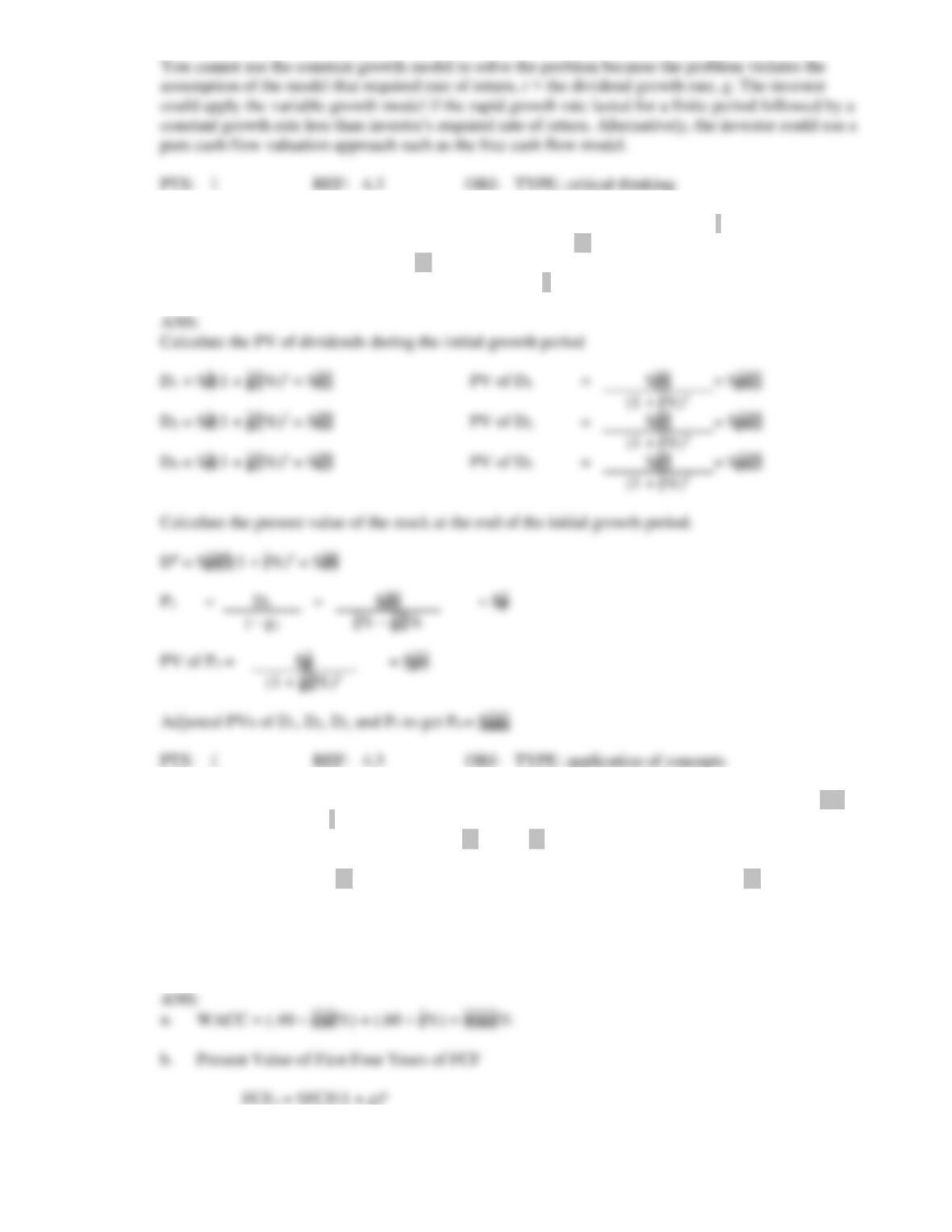
18. The Rich Corporation has just invented a cheap form of energy. Investors with a r% required rate of
return expect this company to grow at an accelerated rate of g1% per year for the next 3 years and then
continue at a constant growth rate of g2% per year. What would investors be willing to pay for the
common stock if the most recent annual dividend was $d per share?
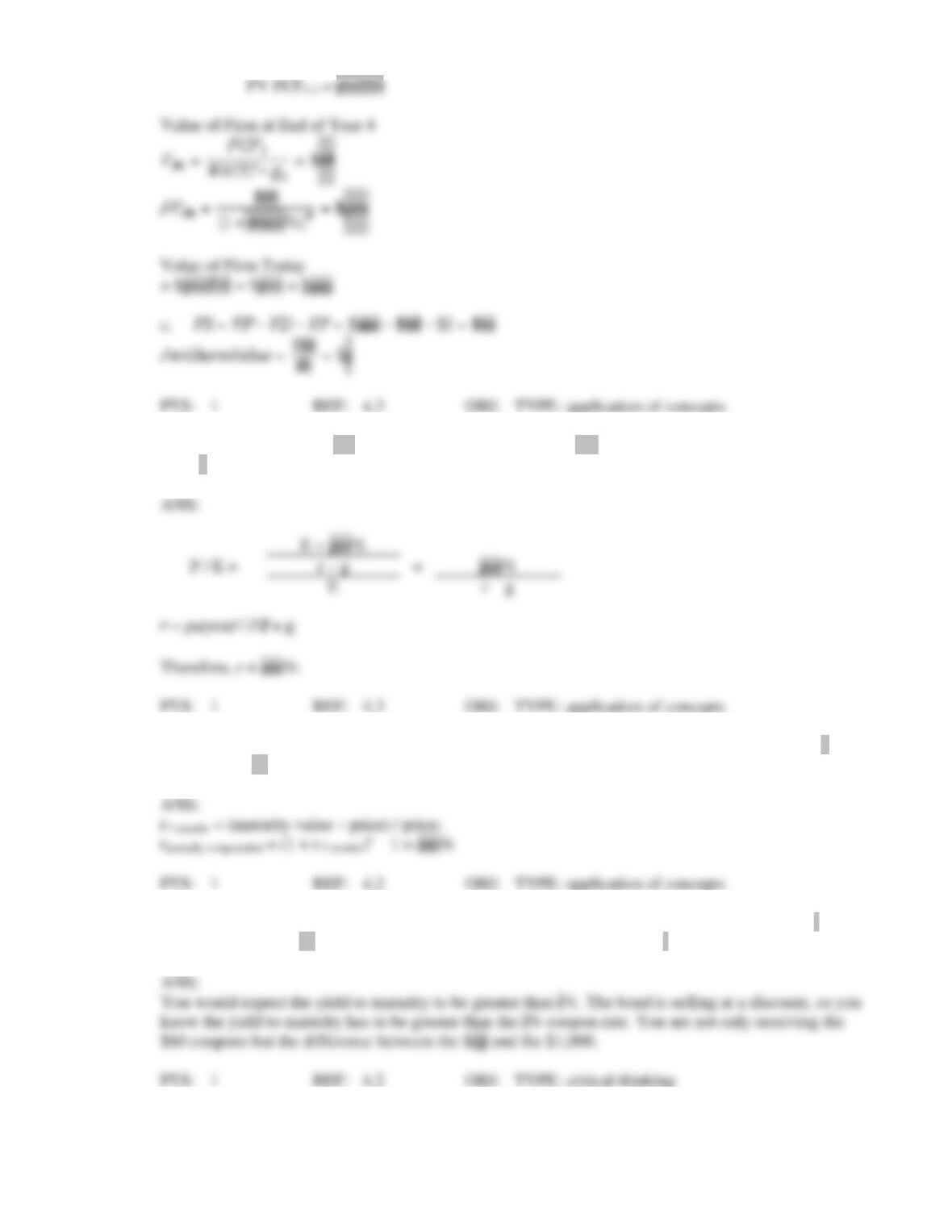
19. Shine Industries capital structure contains 40% debt and 60% equity. Its after-tax cost of debt is cod%
and investors require an r% return on the firm’s common stock. Shine has no preferred stock
outstanding and the value of its debt, VD, is vd. It has sh shares of common stock outstanding. The
firm’s free cash flow (FCF) in the immediate past year was $10,000,000 and it is expected to grow at a
compound annual rate of g1% over the next four years, beyond which it will grow at g2% annually
forever.
a.
Calculate Shine’s weighted average cost of capital (WACC).
b.
Calculate the firm’s total enterprise value, VF, today.
c.
Calculate the total share value and the per-share value, P0, of Shine’s common stock.
WACC = (.40 cod%) + (.60 r%) = wacc%
b.
Present Value of First Four Years of FCF
PV of D2
= $pd2
PV of D3
= $pd3
PV of P3 =
20. A firm has a P/E ratio of per with a dividend payout ratio of por%. The firm’s growth rate is estimated
to be g%. What rate of return is being required of this firm’s stock?
21. What is the compound annual rate of return on a 3-month Treasury bill you purchase today for $p
which pays $pp at maturity?
22. Would you expect the yield to maturity on a $1,000 par bond that has an annual coupon rate of r%, is
currently priced at $cp, and matures in 10 years to be greater or less than r% and why?
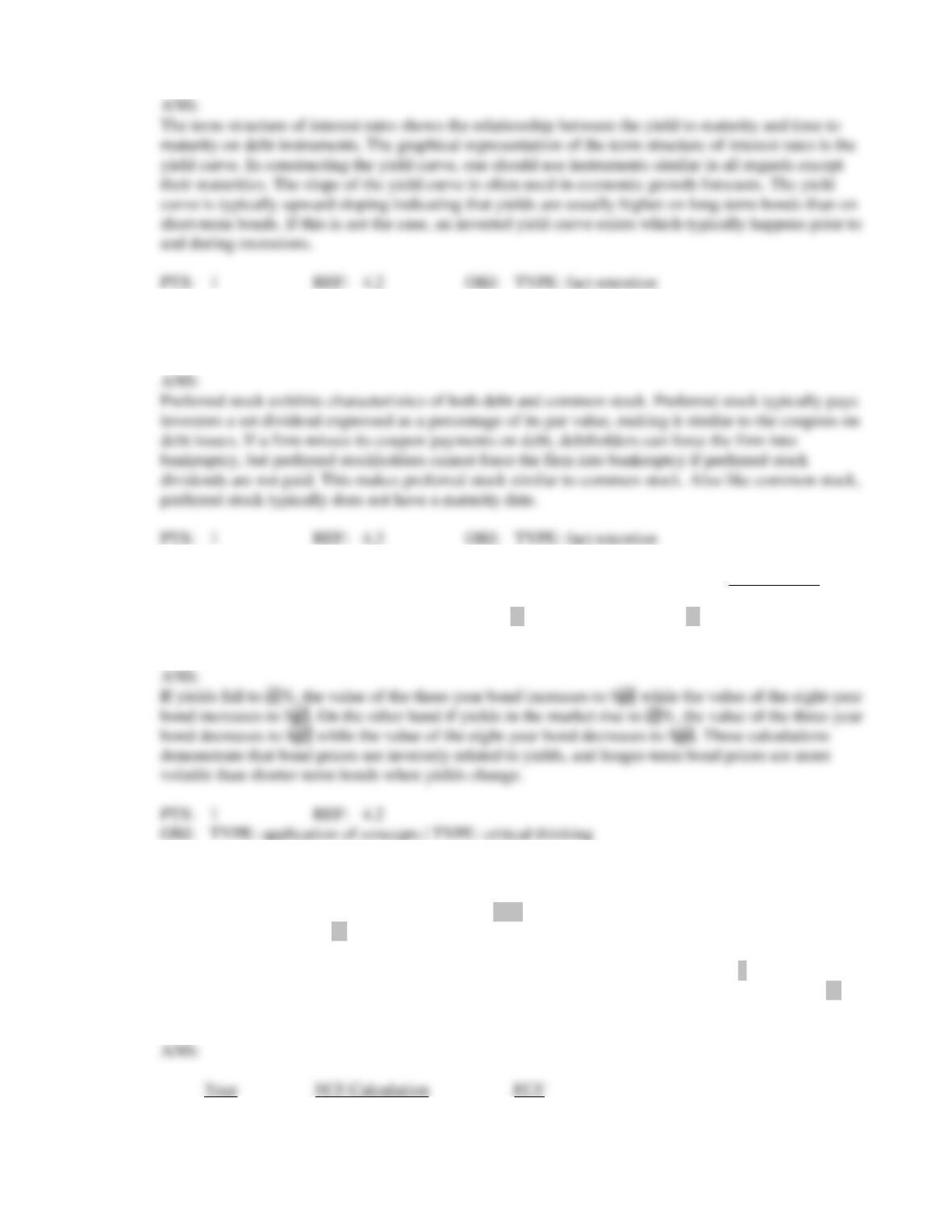
23. Discuss the term structure of interest rates, the yield curve, and its shape.
24. Firms can use debt, preferred stock, and common stock in their capital structures. Discuss how
preferred stock is like both debt and common stock.
25. Two bonds currently selling at par each have 10% coupon rates with coupons paid semiannually. One
bond has a three-year maturity while the other matures in 8 years. Show what happens to the price of
the bonds if yields to maturity in the market fall to r1% versus if they rise to r2% and discuss what this
demonstrates.
26. Toastitoes Corporation has gained success in marketing a broad line of sports-related products
designed to keep customers warm during winter sports. Its past year stock market price range was $38
– $42. At the end of the past year, the firm had $debt million in debt and no preferred stock.
Additionally, there were sh shares of common stock outstanding. At the end of the past year, its free
cash flow was calculated at $2 million. The growth rate of the firm’s revenues and operating profit was
about 10%. You expect this growth rate to continue for three years and then slow to g% due to
competitors entering the market. You find a weighted average cost of capital for Toastitoes to be cc%.
Using the free cash flow approach, what is your estimate of Toastitoes per share stock value?
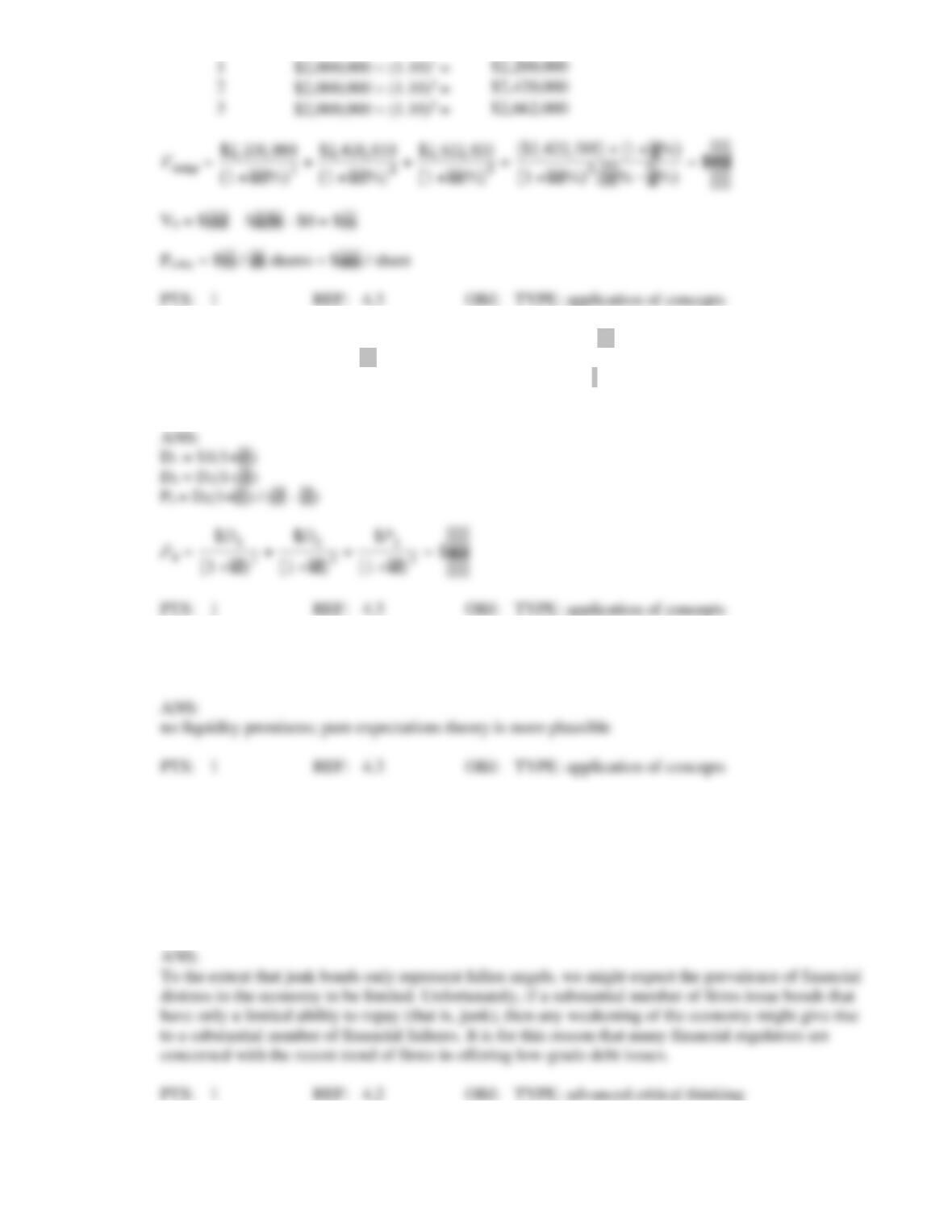
27. You expect your firm to experience a period of rapid growth of g1% per year for two years and then
slow to a constant growth of g2% per year. The most recent annual dividend paid by your firm was $1.
The market’s required rate of return on your common equity is r%. What is today’s value of your firm’s
common stock?
28. If yield curves on average were flat, what would this say about liquidity premiums in the term
structure? Would you be more or less willing to accept the pure expectations theory?
ESSAY
1. Historically, low-grade or high yield bonds (also called junk bonds) have tended to be “fallen angels.”
That is, when companies originally issued these bonds they tended to be financially strong companies
that have subsequently fallen on difficult times. Discuss what you expect to happen if lower quality
firms initially issue junk bonds.
2. How can you value the common stock in a company that does not currently pay a dividend?
3. Utilizing the free cash flow approach calculate the value of a firm’s common stock given the following
information:
Market value of debt = $debt
Market value of preferred stock = $2,500,000
Shares of common stock outstanding = 100,000
Growth rate of g1% for 3 years, followed by a g2% annual growth rate, thereafter
Estimated WACC of wacc%
Past year’s FCF = $fcf
4. Assume that after applying the free cash flow valuation model to the data for a given firm you
recognize that the constant annual growth rate for the period following the initial high-growth period is
too high. What effect would lowering this rate have on the valuation model?
5. How can the book value per share of common stock change over time?