Exam
Name___________________________________
MULTIPLE CHOICE. Choose the one alternative that best completes the statement or answers the question.
1)
Which of the following is NOT part of the passive transport process?
1)
A)
concentration gradient
B)
ATP
C)
transporter proteins
D)
aquaporins
E)
plasma membrane
2)
Which of the following statements is INCORRECT regarding prokaryotic cells?
2)
A)
They reproduce by binary fission.
B)
They lack a plasma membrane.
C)
Their DNA is not enclosed within a membrane.
D)
They typically have a circular chromosome.
E)
They lack membrane–enclosed organelles.
B
B
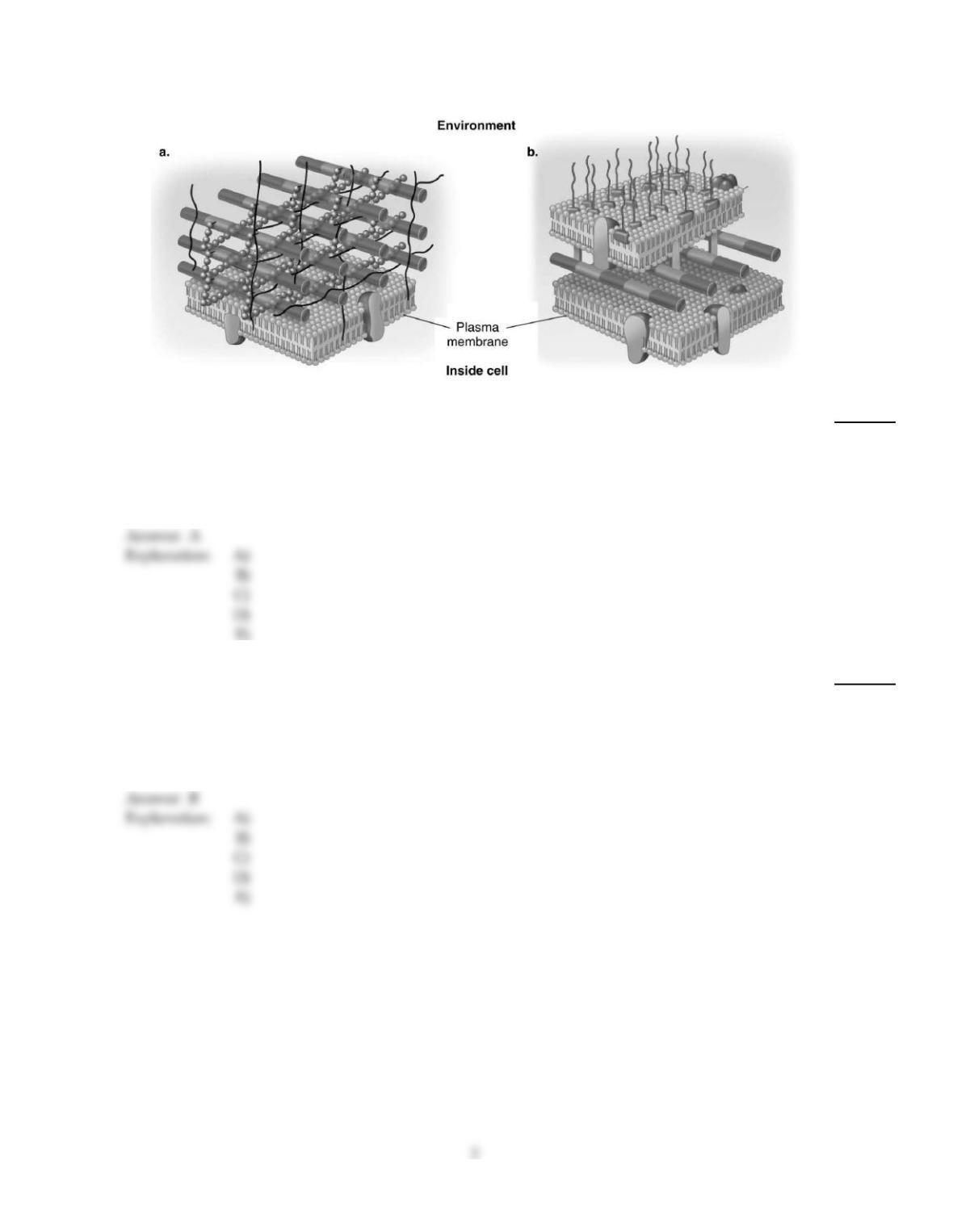
Figure 4.3
3)
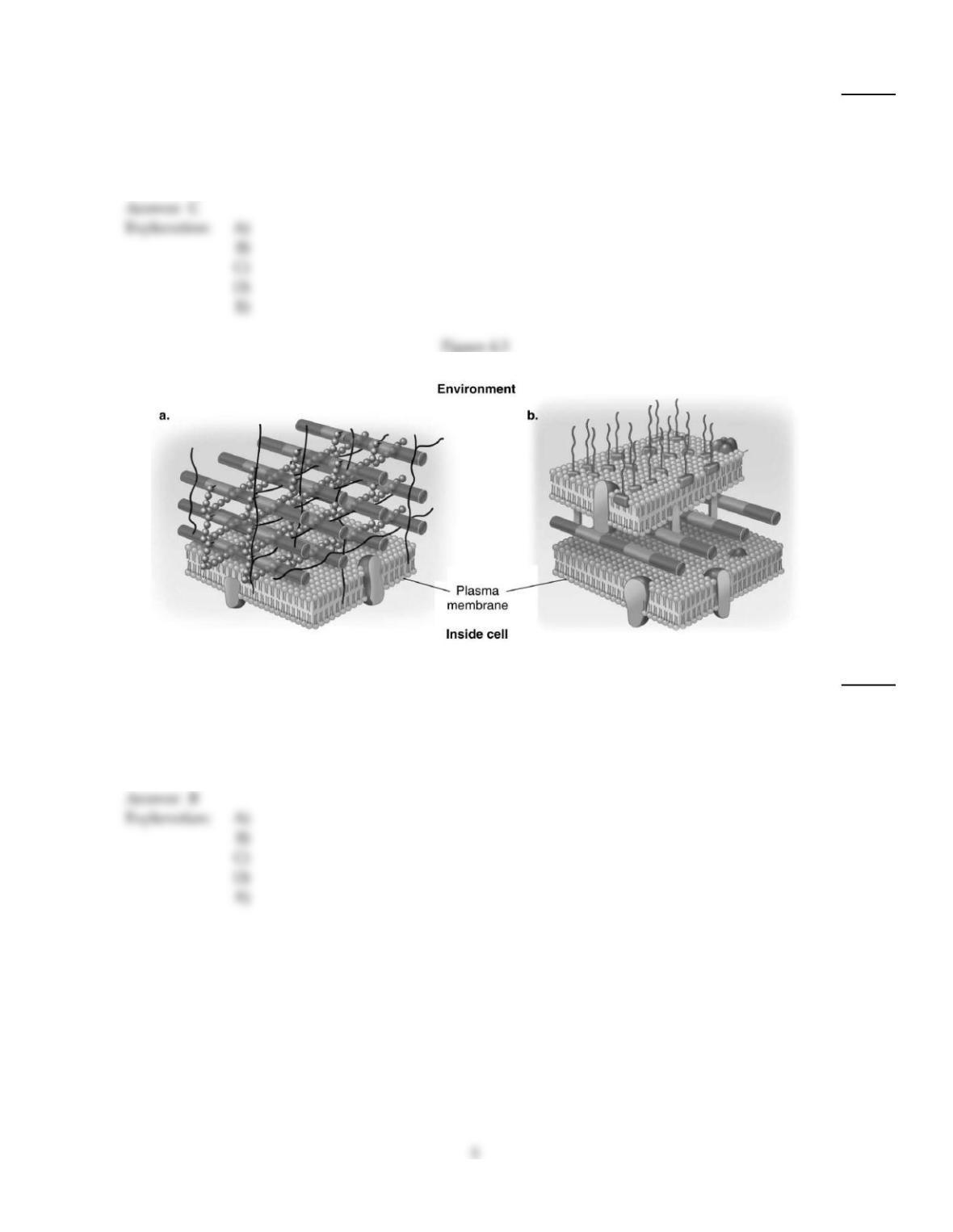
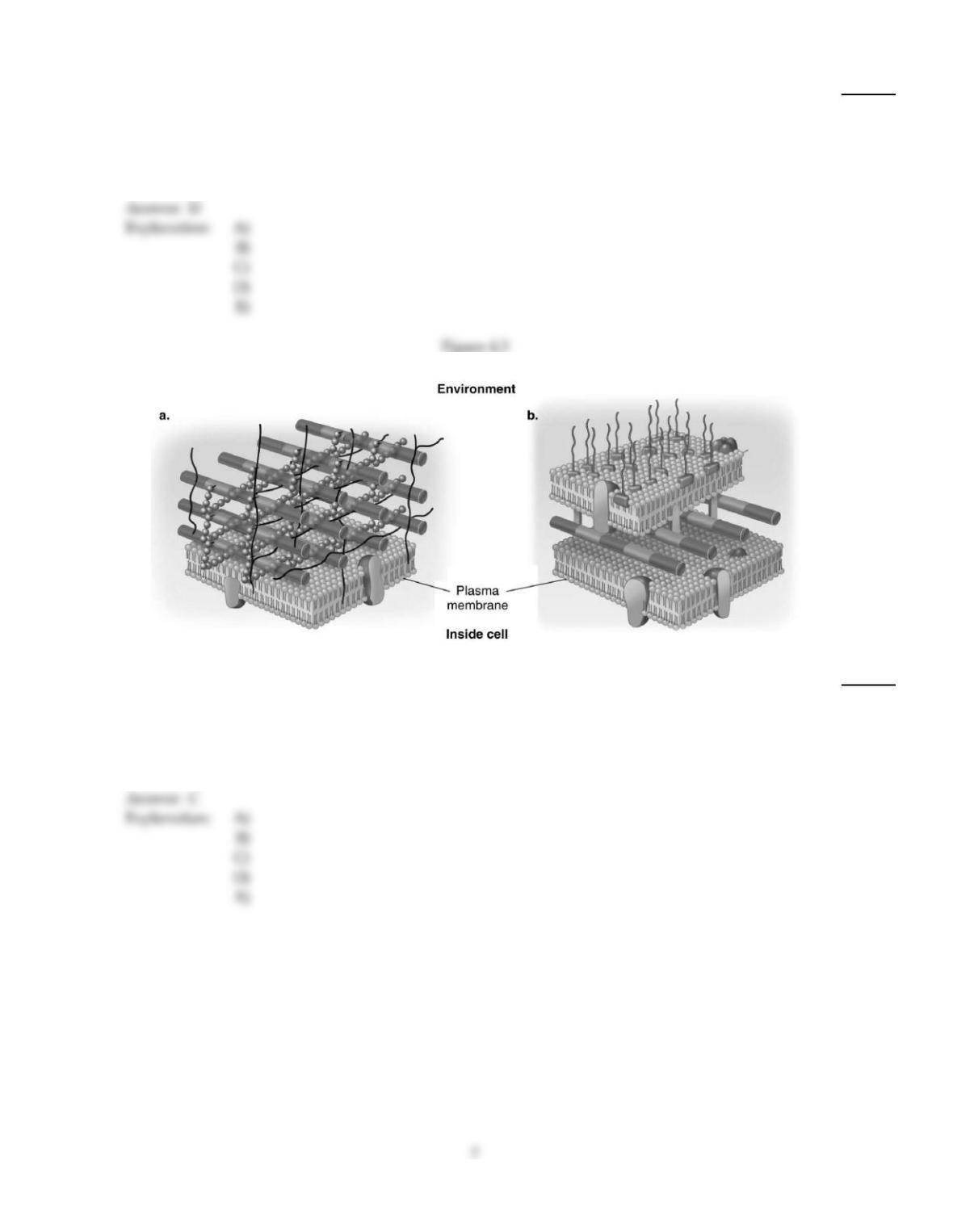
In Figure 4.3, which diagram of a cell wall contains porins?
3)
A)
a
B)
b
C)
both a and b
D)
neither a nor b
E)
The answer cannot be determined based on the information provided.
4)
In a hypertonic solution, a bacterial cell will typically
4)
A)
stay the same.
B)
plasmolyze.
C)
lyse.
D)
burst.
E)
osmolyze.
B
A
5)
Where are phospholipids most likely found in a eukaryotic cell?
5)
A)
the plasma membrane
B)
surrounding flagella
C)
ribosomes
D)
around organelles
E)
the plasma membrane, around organelles, and surrounding flagella
6)
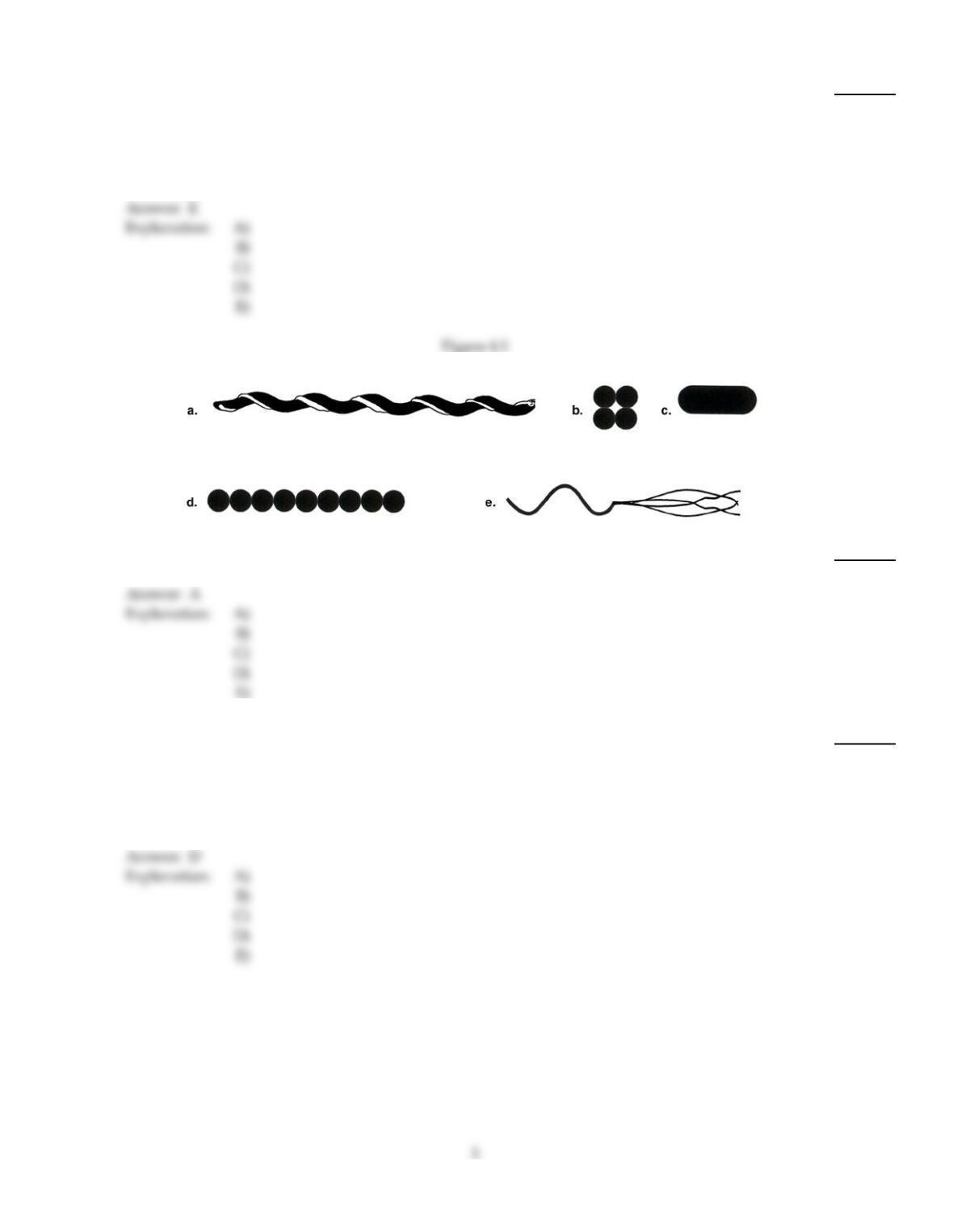
Which drawing in Figure 4.1 possesses an axial filament?
6)
A)
a
B)
b
C)
c
D)
d
E)
e
7)
What will happen if a bacterial cell is placed in distilled water with lysozyme?
7)
A)
The cell will plasmolyze.
B)
Water will leave the cell.
C)
Lysozyme will diffuse into the cell.
D)
The cell will undergo osmotic lysis.
E)
No change will result; the solution is isotonic.

8)
How do spirochetes and spirilla differ?
8)
A)
Spirilla are found in chains of cells whereas spirochetes exist as individual cells.
B)
Spirochetes do not have a cell wall but spirilla do.
C)
Spirochetes and spirilla are basically the same organisms and the terms can be used
interchangeably.
D)
Spirilla have an external flagella but spirochetes have axial filaments.
E)
Spirochetes have a rigid, corkscrew shape while spirilla are helical and more flexible.
9)
Which one of the following pairs is mismatched?
9)
A)
gas vacuoles – flotation
B)
sulfur granules – energy reserve
C)
metachromatic granules – phosphate storage
D)
lipid inclusions – energy reserve
E)
ribosomes – protein storage
E
10)
The DNA found in most bacterial cells
10)
A)
is linear in structure.
B)
is circular in structure.
C)
is surrounded by a nuclear membrane.
D)
is found in multiple copies.
E)
utilizes histones for chromosomal packaging.
B
11)
Which of the following structures is NOT found in some prokaryotic cells?
11)
A)
axial filament
B)
peritrichous flagella
C)
flagellum
D)
pilus
E)
cilium
E
D
12)
Where are phospholipids most likely found in a prokaryotic cell?
12)
A)
flagella
B)
around organelles
C)
the plasma membrane
D)
ribosomes
E)
the plasma membrane and around organelles
13)
In Figure 4.3, which diagram of a cell wall is resistant to many antibiotics (e.g., penicillin)?
13)
A)
a
B)
b
C)
both a and b
D)
neither a nor b
E)
The answer cannot be determined based on the information provided.
B
C
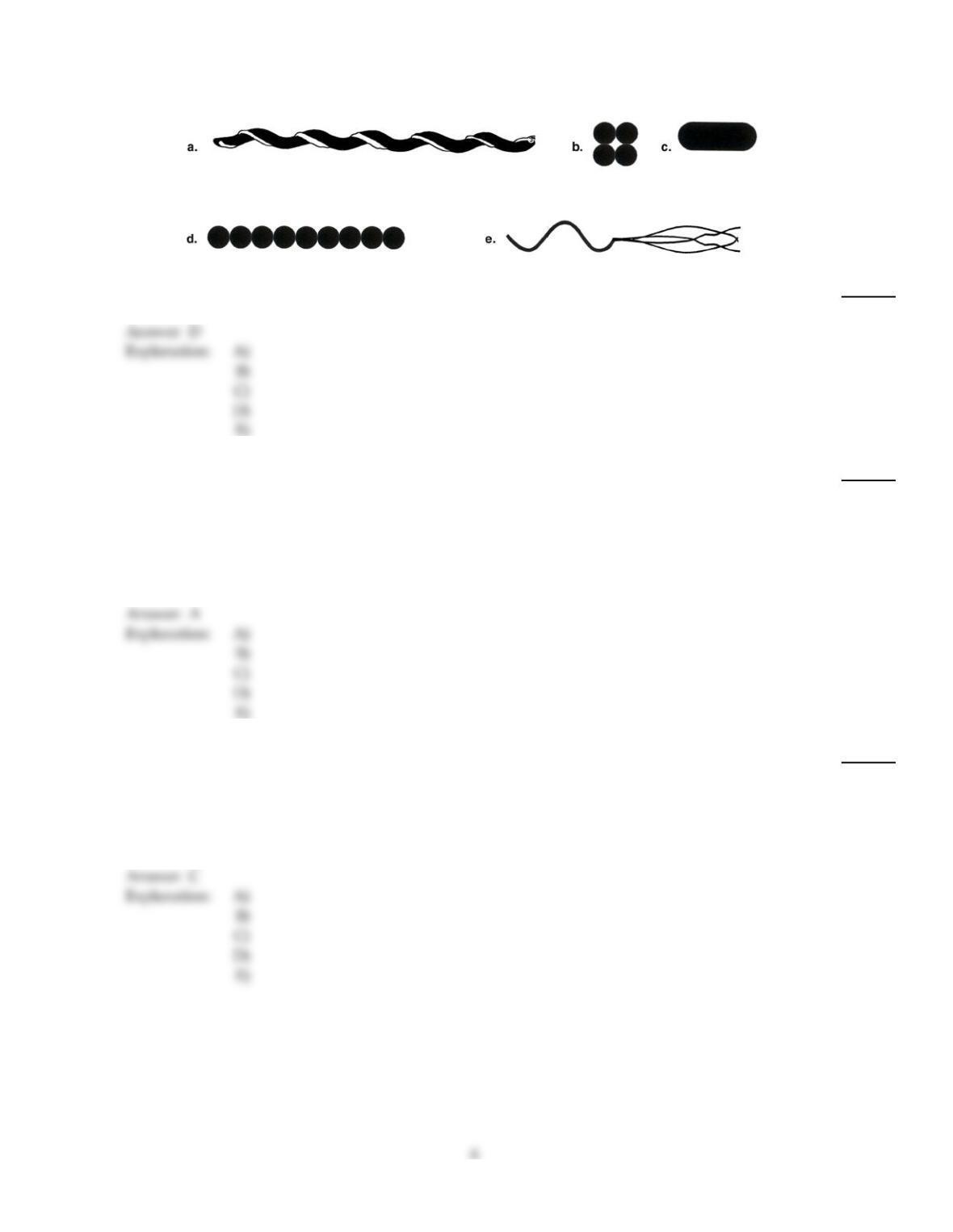
Figure 4.1
14)
Which drawing in Figure 4.1 is streptococci?
14)
A)
a
B)
b
C)
c
D)
d
E)
e
15)
Which of the following statements best describes what happens when a bacterial cell is placed in a
solution containing 5 percent NaCl?
15)
A)
Water will move out of the cell.
B)
Water will move into the cell.
C)
Sucrose will move into the cell from a higher to a lower concentration.
D)
The cell will undergo osmotic lysis.
E)
No change will result; the solution is isotonic.
16)
Antibiotics that target cell wall synthesis ultimately cause bacterial cell death as a result of
16)
A)
decreased synthesis of peptidoglycan.
B)
plasmolysis.
C)
osmotic lysis.
D)
cell shrinkage.
E)
inhibition of molecular transport.
17)
In bacteria, photosynthetic pigments are found in
17)
A)
cytoplasm.
B)
chloroplasts.
C)
ribosomes.
D)
chromatophores.
E)
mesosomes.
18)
In Figure 4.3, which diagram of a cell wall has a structure that protects against osmotic lysis?
18)
A)
a
B)
b
C)
both a and b
D)
neither a nor b
E)
The answer cannot be determined based on the information provided.
C
D
19)
Which of the following statements about gram–negative cell walls is FALSE?
19)
A)
Their Gram reaction is due to the outer membrane.
B)
They are sensitive to penicillin.
C)
They are toxic to humans.
D)
They have an extra outer layer composed of lipoproteins, lipopolysaccharides, and
phospholipids.
E)
They protect the cell in a hypotonic environment.
20)
By which of the following mechanisms can a cell transport a substance from a lower to a higher
concentration?
20)
A)
aquaporins
B)
extracellular enzymes
C)
facilitated diffusion
D)
active transport
E)
simple diffusion
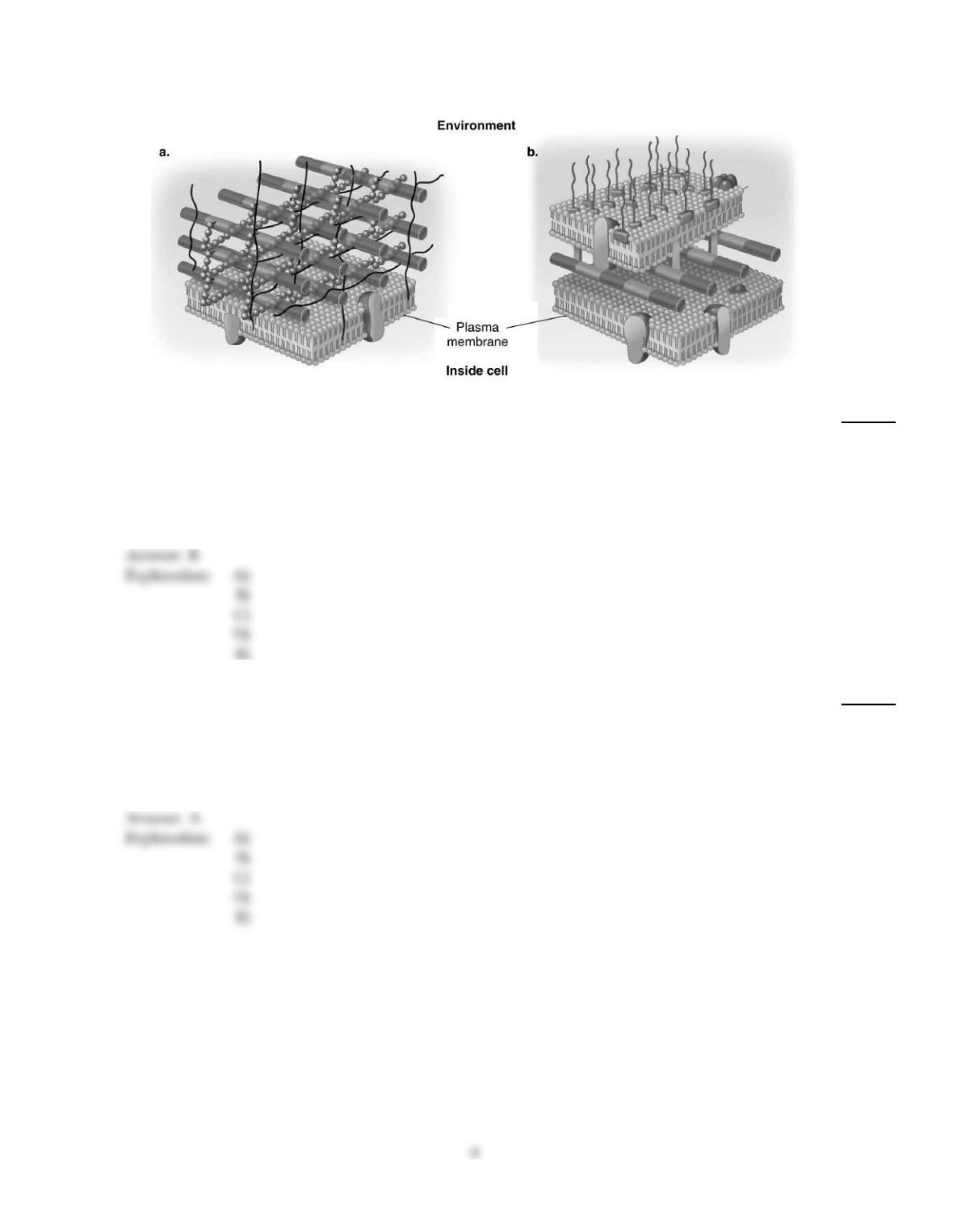
Figure 4.3
21)
In Figure 4.3, which diagram of a cell wall possesses molecules responsible for symptoms
associated with infection?
21)
A)
a
B)
b
C)
both a and b
D)
neither a nor b
E)
The answer cannot be determined based on the information provided.
22)
Which of the following is NOT a functionally analogous pair?
22)
A)
cilia – pili
B)
9+2 flagella – bacterial flagella
C)
chloroplasts – thylakoids
D)
nucleus –nucleiod region
E)
mitochondria – prokaryotic plasma membrane
A
B

23)
The terms “run” and “tumble” are generally associated with
23)
A)
cell membrane synthesis.
B)
cell wall fluidity.
C)
taxic movements of the cell.
D)
clustering properties of certain rod–shaped bacteria.
24)
Which of the following statements is correct about diffusion?
24)
A)
It may require a transport protein.
B)
It requires an expenditure of energy by the cell.
C)
It is a passive process in which molecules move from a region of higher concentration to a
region of lower concentration.
D)
It involves movement of molecules down a concentration gradient and may require a
transport protein.
E)
It is an active process in which molecules move from a region of lower concentration to one of
higher concentration.
D
C
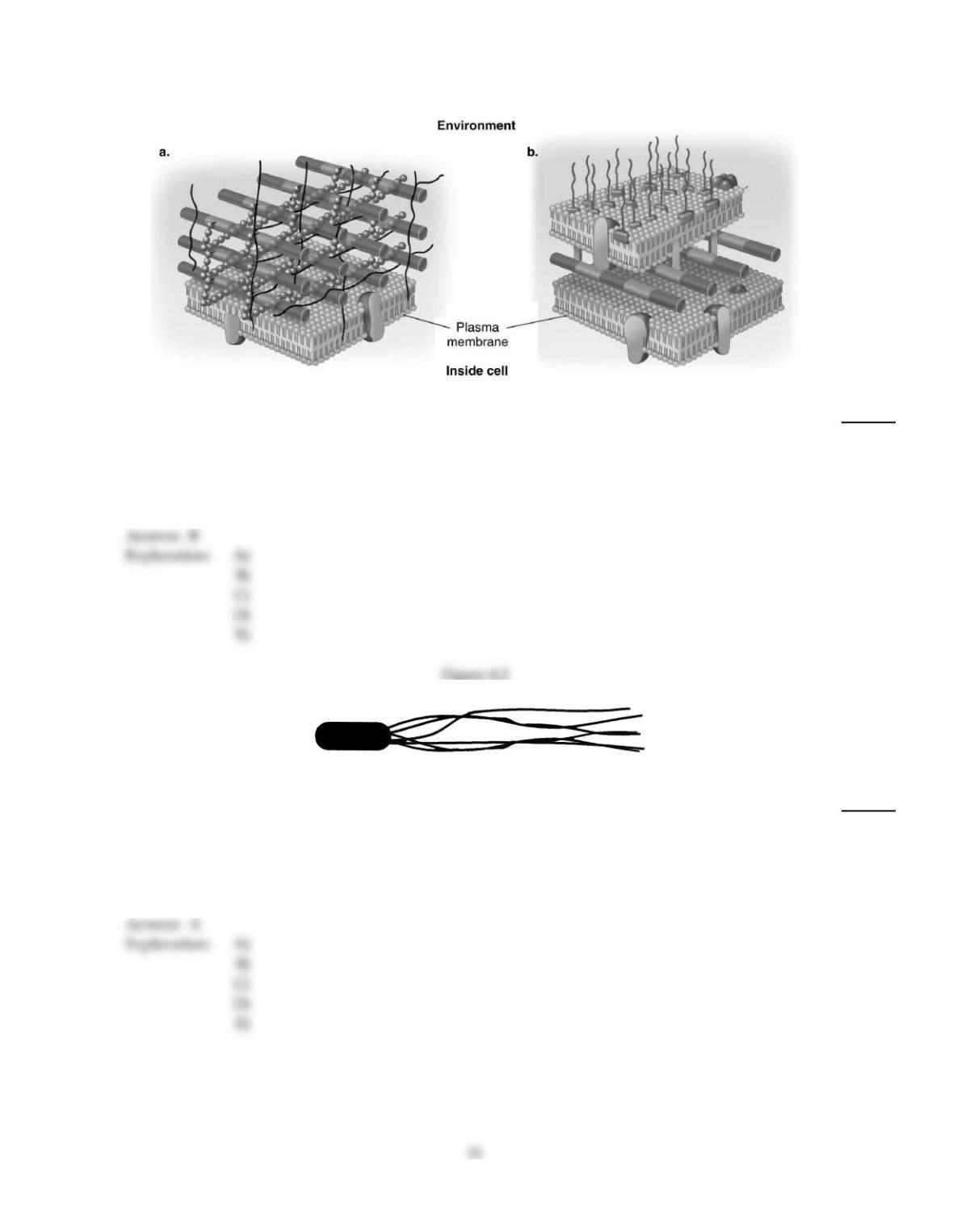
Figure 4.3
25)
In Figure 4.3, which diagram of a cell wall is a gram–negative cell wall?
25)
A)
a
B)
b
C)
both a and b
D)
neither a nor b
E)
The answer cannot be determined based on the information provided.
26)
Which of the following terms best describes the cell in Figure 4.2?
26)
A)
lophotrichous flagella
B)
monotrichous flagella
C)
axial filament
D)
amphitrichous flagella
E)
peritrichous flagella
A
B