141.
Which of the following best describes restricted cash?
142.
A common example of restricted cash includes cash set aside by the company for the
specific purpose of:
143.
The statement of cash flows reports cash flows from the activities of:
144.
Operating cash flows would exclude:
145.
Cash flows from investing do
not
include cash flows from:
146.
Which of the following is NOT correct regarding the reporting of cash?
147.
Consider the following cash flow items:
Pay amount owed to bank for previous borrowing.
Pay utility costs.
Purchase equipment to be used in operations.
Purchase office supplies.
Pay one year of rent in advance.
Pay workers’ salaries.
Pay for research and development costs.
Pay taxes to the IRS.
Sell common stock to investors.
How many of these cash flow items involve investing activities?
148.
Investing cash flows would include which of the following?
149.
Cash flows from investing activities do
not
include:
150.
Consider the following cash flow items:
Pay amount owed to bank for previous borrowing.
Pay utility costs.
Purchase equipment to be used in operations.
Purchase office supplies.
Purchase one year of rent in advance.
Pay workers’ salaries.
Pay for research and development costs.
Pay taxes to the IRS.
Sell common stock to investors.
How many of these cash flow items involve financing activities?
151.
Payment of dividends to stockholders is considered a(n):
152.
Issuing common stock for cash is considered a(n):
153.
Cash flows from financing activities include:
154.
Providing services to customers on account is considered a(n):
155.
A company might hold a large amount of cash relative to noncash assets for which of the
following reasons?
156.
The company’s ratio of cash to noncash assets increased in the current year from 20% to
30%? Which of the following represents the most likely reason for this increase?
157.
A potential risk of a company with a high ratio of cash to noncash assets is:
158.
A company’s lower ratio of cash to noncash assets most likely represents which
characteristic of management?
159.
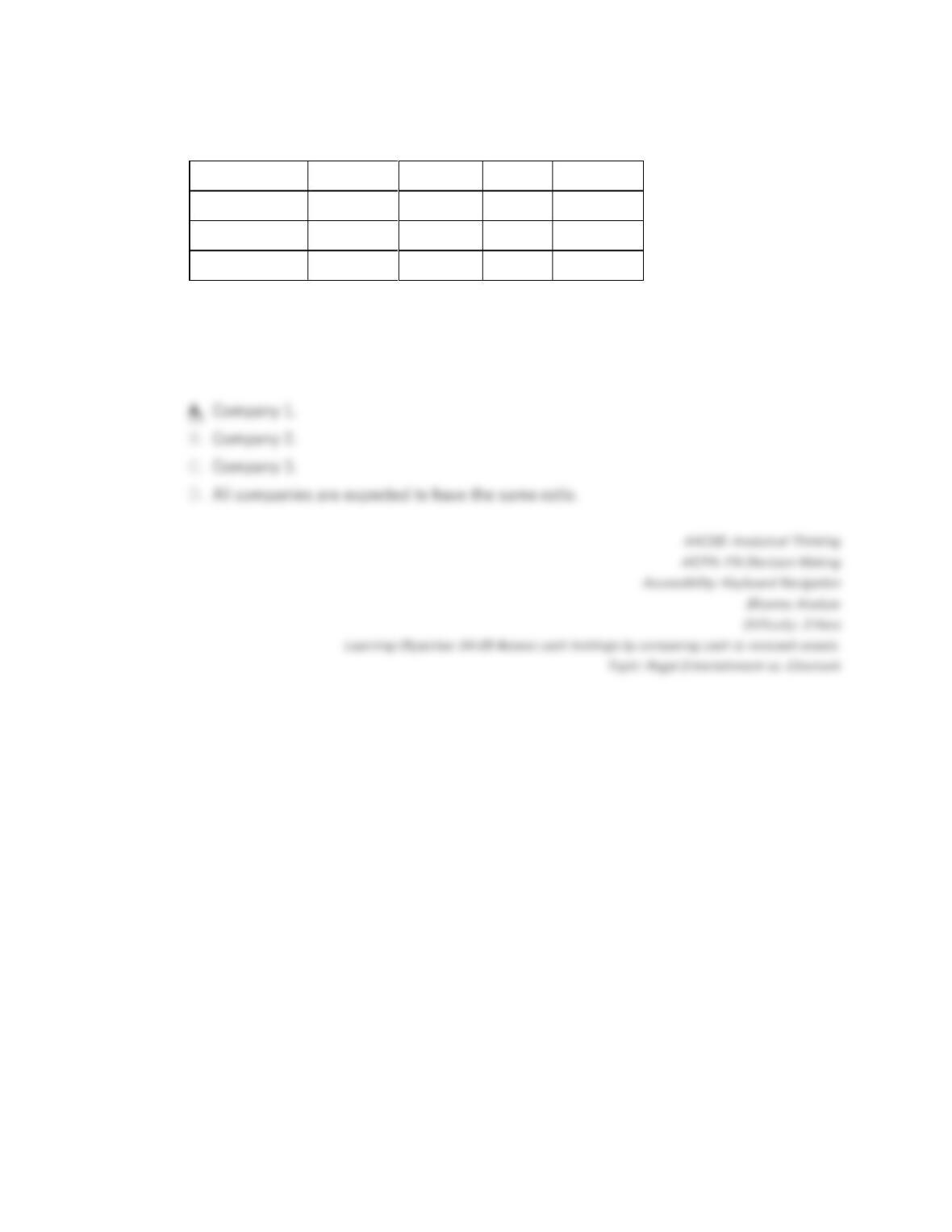
Terastar Corp. reports the following amounts:
Cash
Total Assets
Total Liabilities
$10,000
$50,000
$35,000
What is the ratio of cash to noncash assets?
4-71
160.
Below are trends in operation cash flows for three companies.
Year 1
Year 2
Year 3
Total
Company 1
$100,000
$150,000
50,000
$300,000
Company 2
100,000
100,000
100,000
300,000
Company 3
90,000
100,000
110,000
300,000
Based on an analysis of operating risk, which company’s management is likely motivated
to have the largest ratio of cash to noncash Company 1 Company 2 Company 3 assets?
Matching Questions
161.
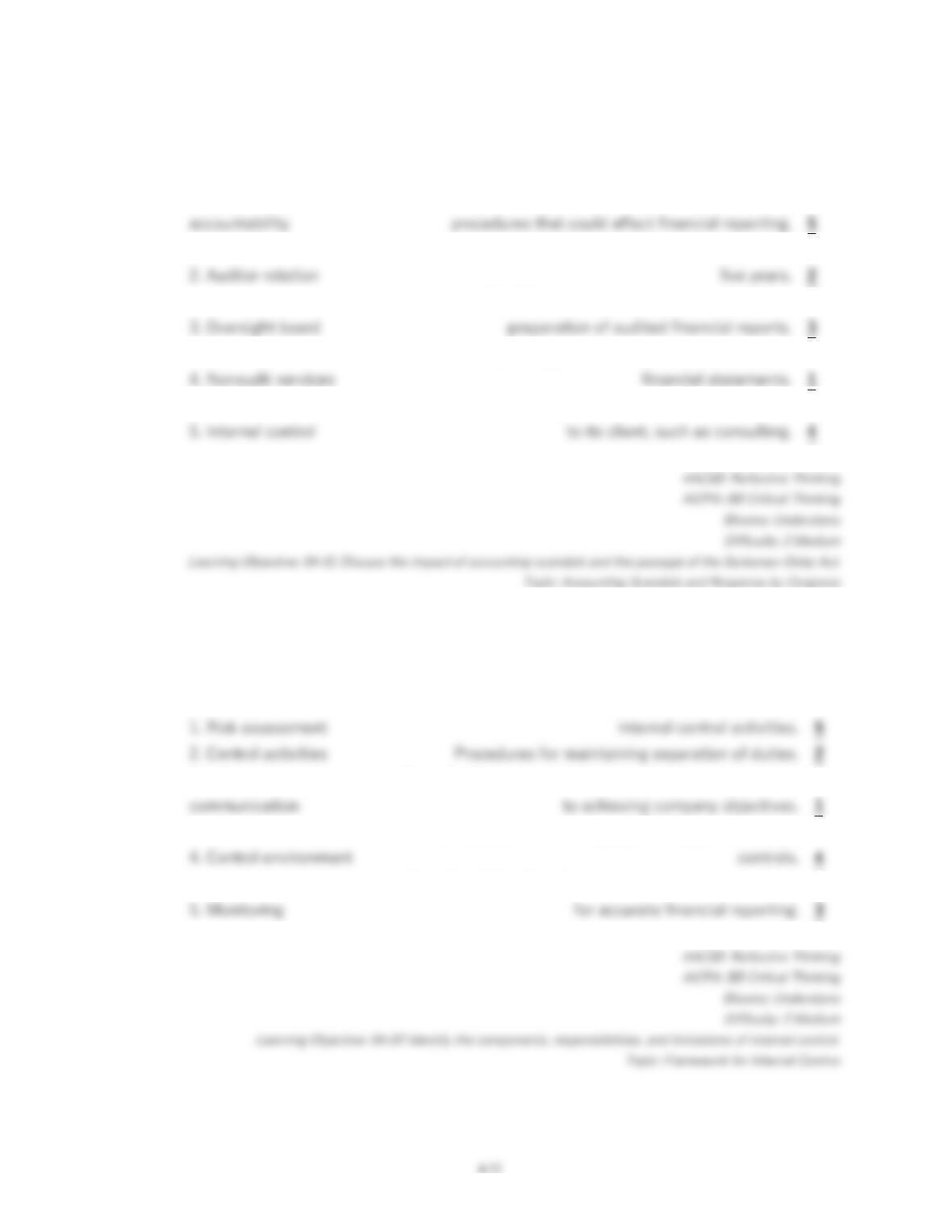
Match each provision of the Sarbanes-Oxley Act with its description.
1. Corporate executive
Management must document the effectiveness of
Lead audit partners are required to change every
PCAOB establishes standards related to the
Company management must personally certify the
Audit firm cannot provide a variety of other services
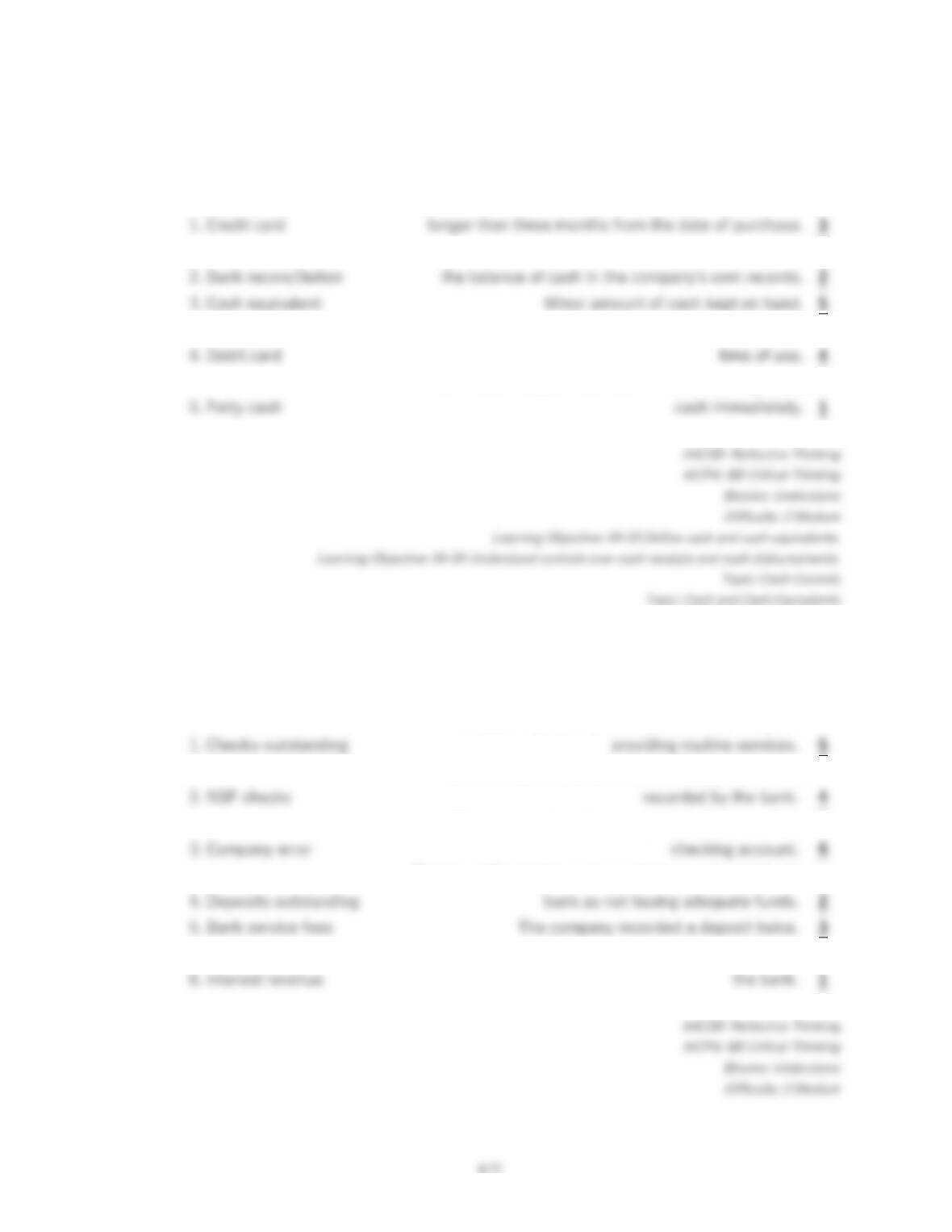
162.
Match each term associated with components of internal control with its definition.
Routine activities that are meant to continually observe
3. Information and
Formal policies to evaluate internal and external threats
Overall attitude of the company with respect to internal
Transfer of data from lower managers to top executives
163.
Match each term associated with cash and cash controls with its definition.
Short-term investments that have a maturity date no
Matches the balance of cash in the bank account with
Withdraws funds directly from the user’s account at the
Allows users to purchase items without having to pay
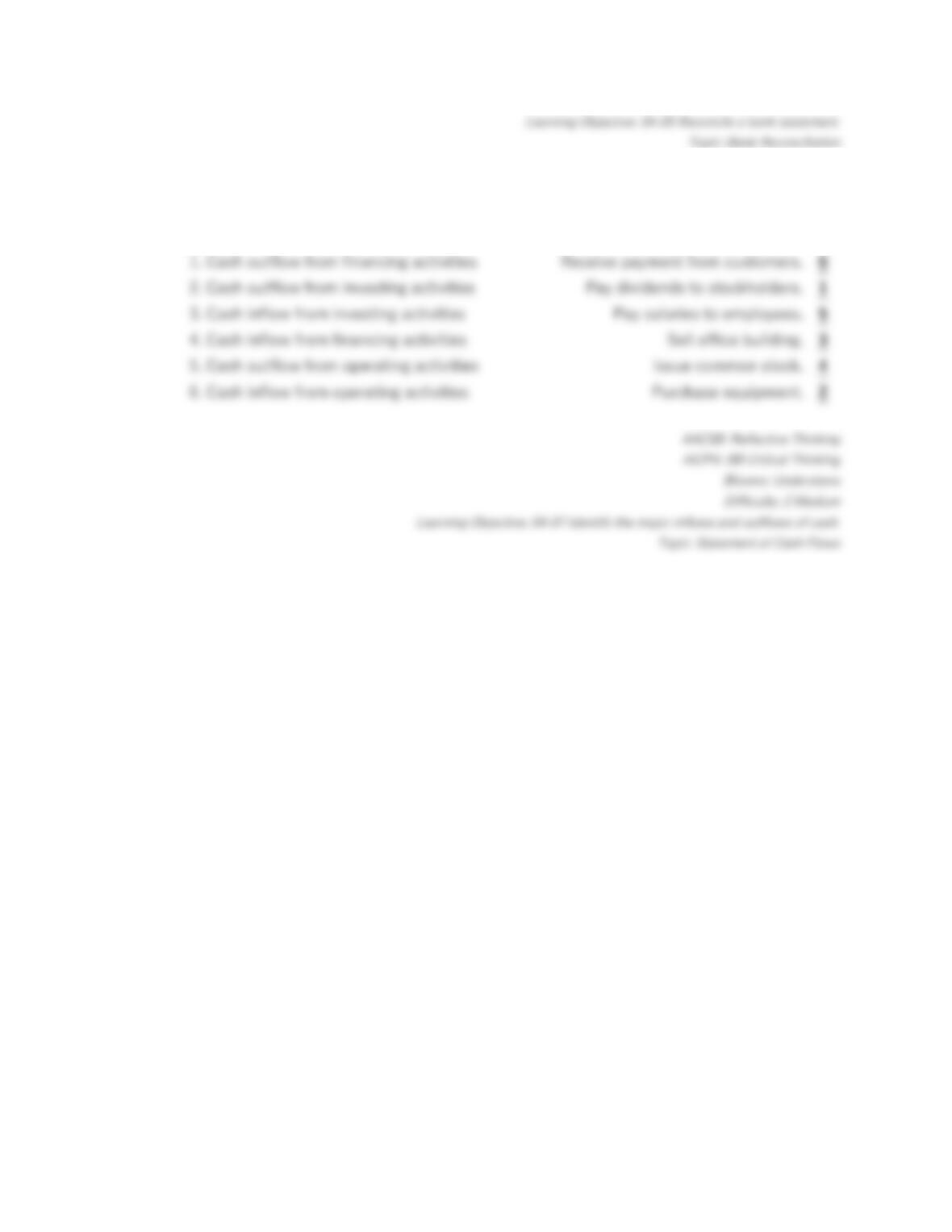
164.
Match each term related to bank reconciliations with its description.
Charges imposed by the bank to the company for
Cash receipts received by the company but not yet
Money earned on the average daily balance of the
Checks written to the company that are returned by the
Checks written by the company but not yet recorded by
4-74
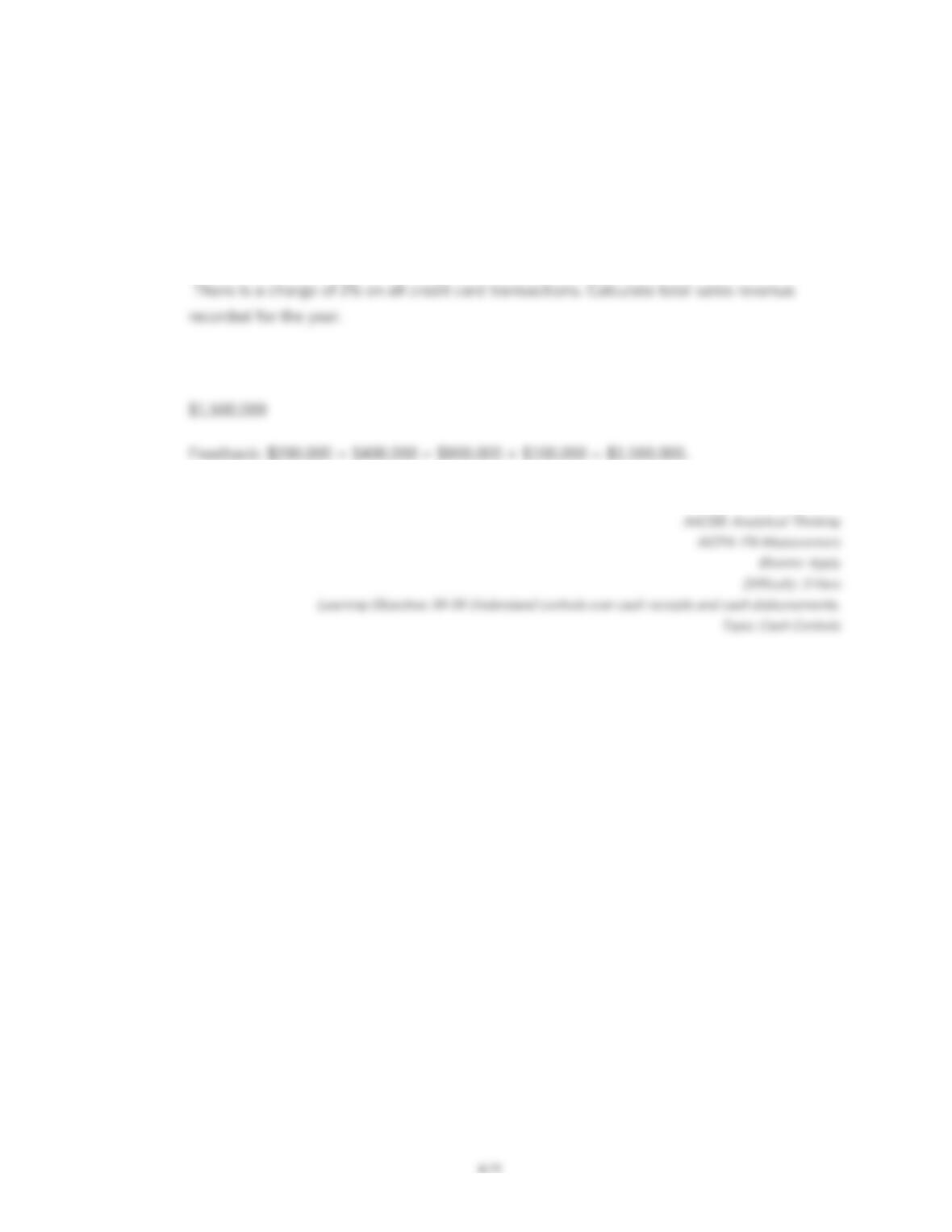
165.
Match each type of cash flow with its description.
Essay Questions
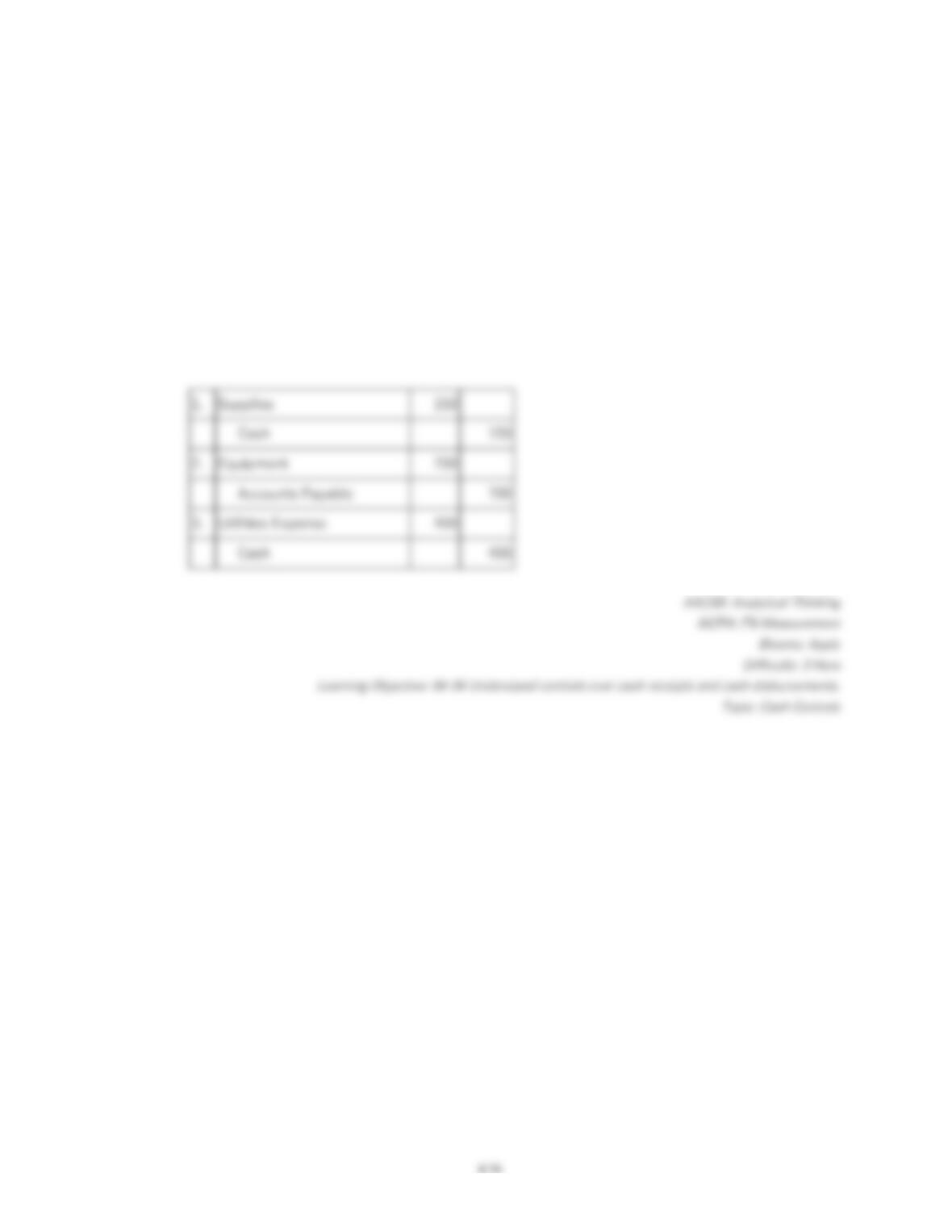
166.
A company had the following sales transactions:
1. Total debit card sales = $200,000.
2. Total credit card sales = $400,000.
3. Total cash sales = $800,000.
4. Total check sales = $100,000.
167.
A company had the following transactions:
1. Paid $150 for office supplies using a debit card.
2. Purchased office equipment costing $700 using a credit card.
3. Paid utilities bill of $400 by issuing a check.
Record each transaction.
168.
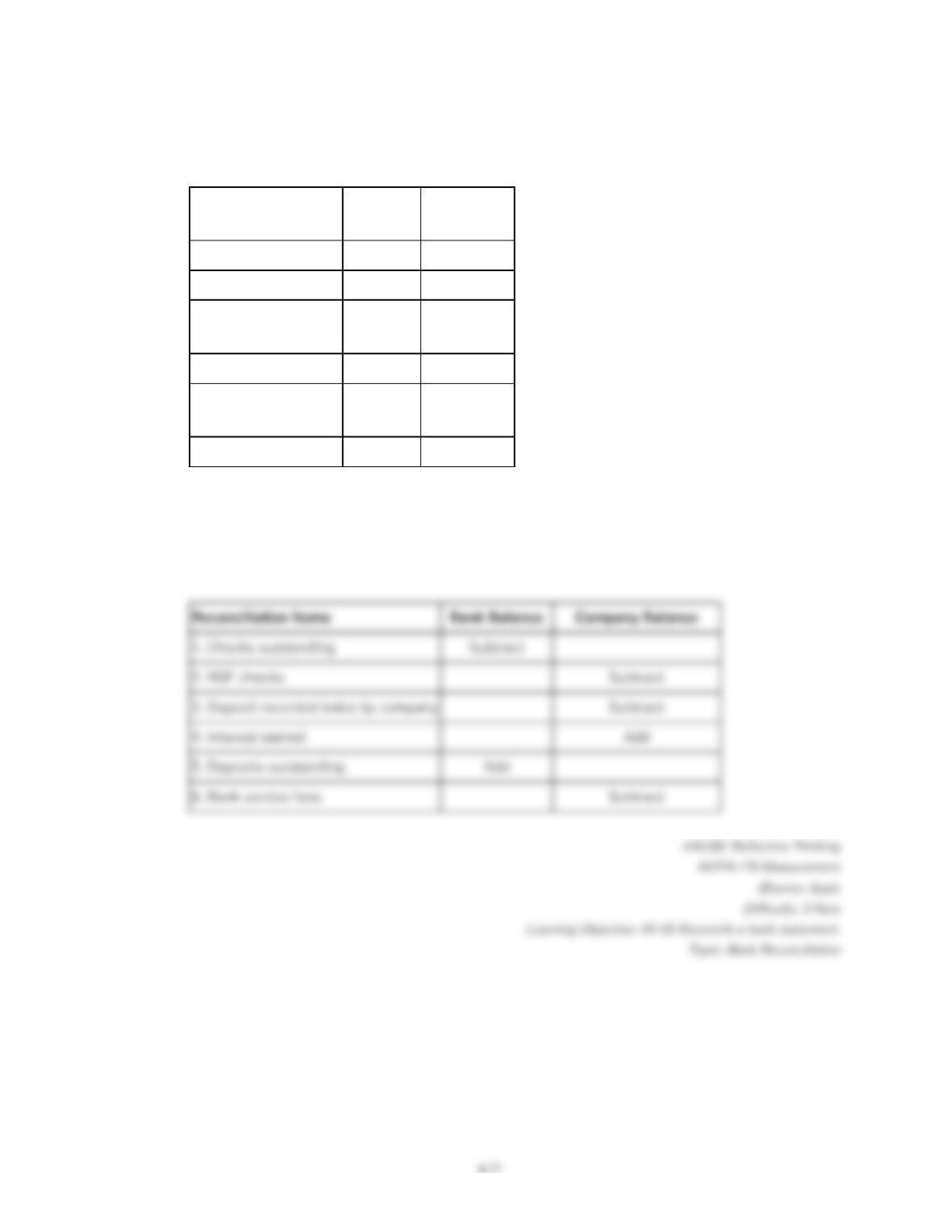
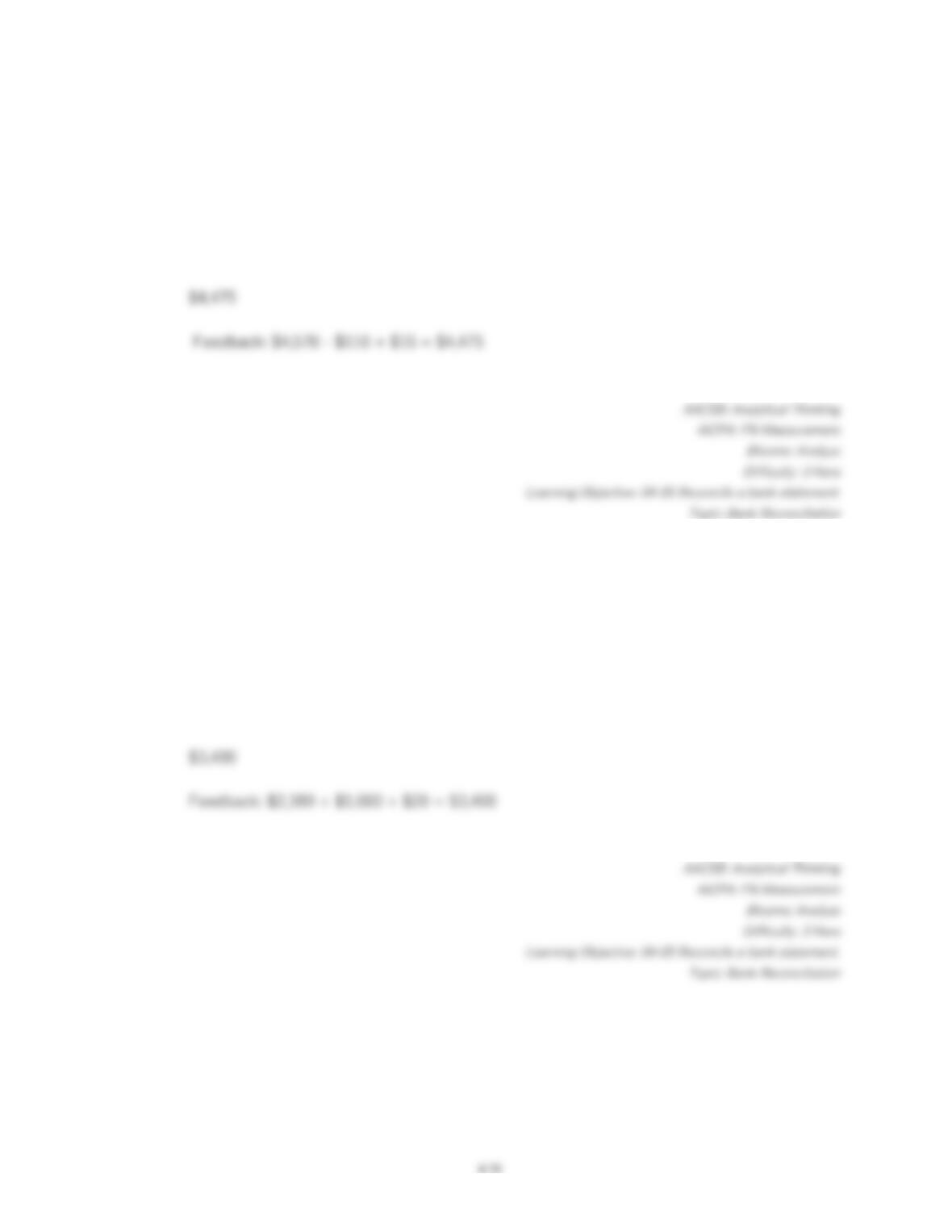
Indicate whether the firm should add or subtract each item below from its balance of cash
or the bank’s balance of cash in preparing a bank reconciliation.
Reconciliation Items
Bank
Balance
Company
Balance
1. Checks outstanding
2. NSF checks
3. Deposit recorded
twice by company
4. Interest earned
5. Deposits
outstanding
6. Bank service fees
1. Checks outstanding
2. NSF checks
3. Deposit recorded twice by company
4. Interest earned
5. Deposits outstanding
6. Bank service fees
169.
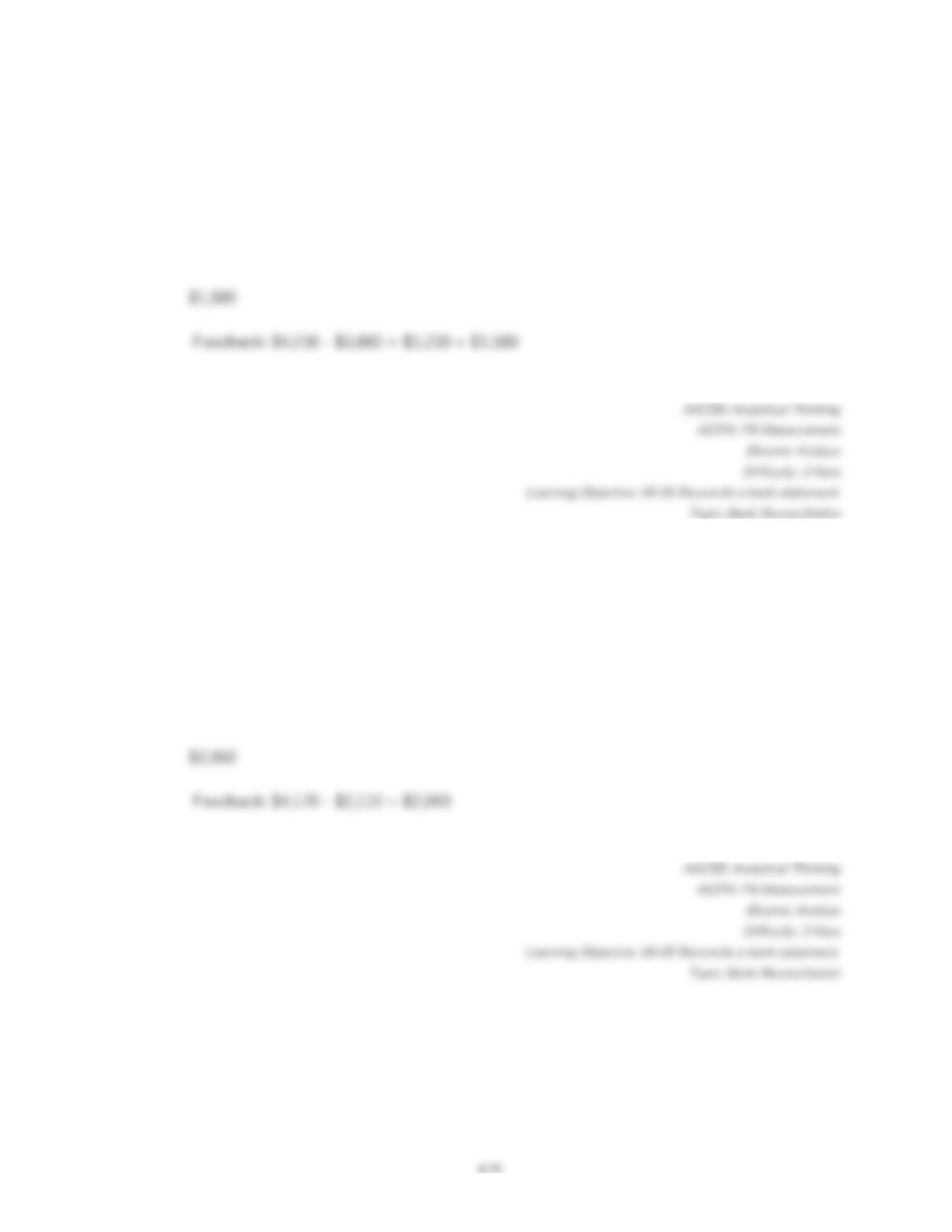
A company’s general ledger shows a cash balance of $4,570. Comparing the company’s
cash records with the monthly bank statement reveals several additional cash transactions
such as checks outstanding of $2,840, bank service fees of $110, and interest earned of
$15. Calculate the correct balance of cash.
170.
A company’s general ledger shows a cash balance of $2,380. Comparing the company’s
cash records with the monthly bank statement reveals several additional cash transactions
such as deposits outstanding of $1,760, note collected by the bank on the company’s
behalf of $1,000, and interest earned of $20. The company also finds an error by the bank
of an additional deposit of $100. Calculate the correct balance of cash.
171.
A company’s bank statement shows a cash balance of $4,230. Comparing the company’s
cash records with the monthly bank statement reveals several additional cash transactions
such as checks outstanding of $3,880, deposits outstanding of $1,230, NSF check of $300,
and service fee of $50. Calculate the correct balance of cash.
172.
A company’s bank statement shows a cash balance of $4,170. Comparing the company’s
cash records with the monthly bank statement reveals several additional cash transactions
such as checks outstanding of $2,110, NSF check of $200, interest earned of $30, service
fee of $40, and a check for $150 recorded twice by the company. Calculate the correct
balance of cash.
173.
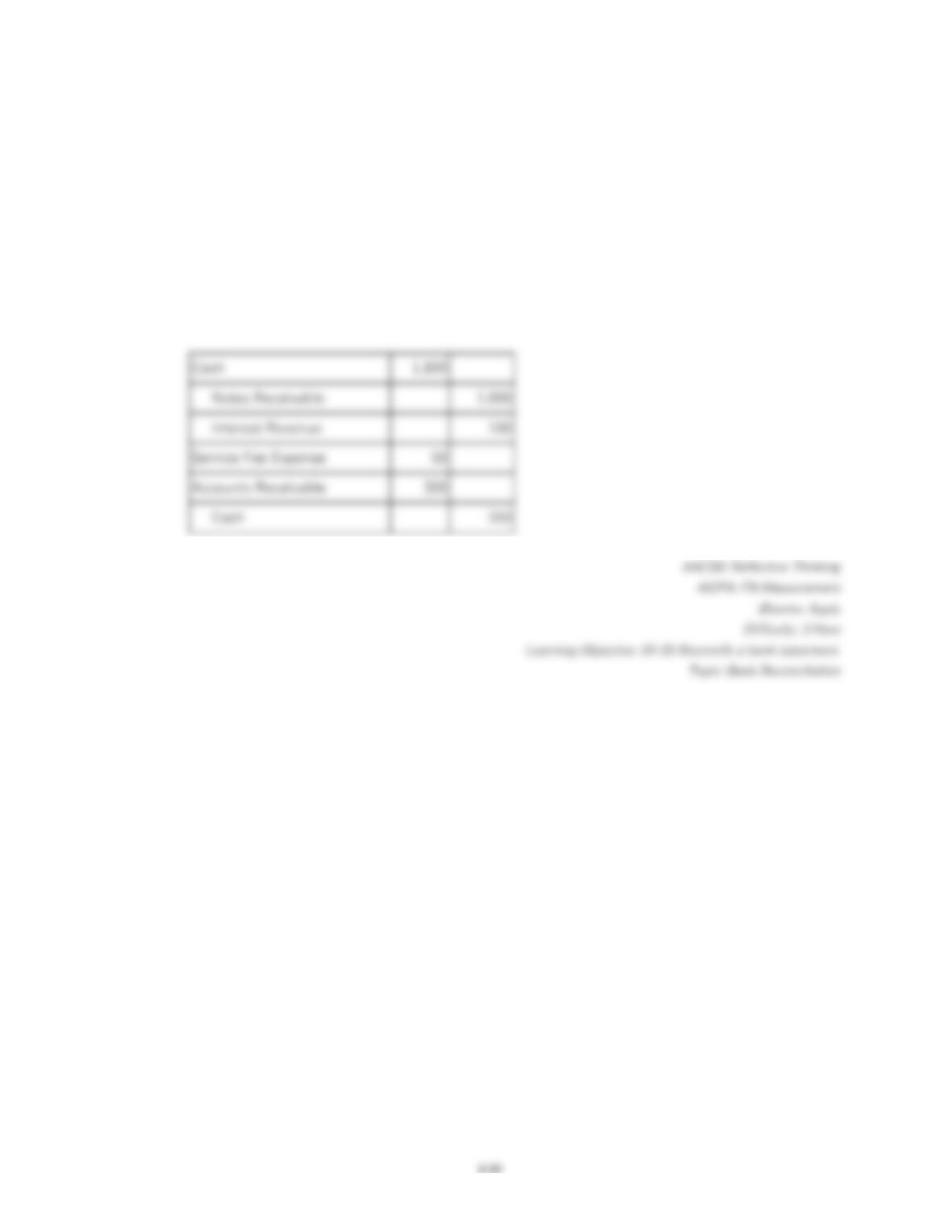
A company’s Cash account shows a balance of $3,450 at the end of the month. Comparing
the company’s Cash account with the monthly bank statement reveals several additional
cash transactions such as bank service fees ($50), an NSF check from a customer ($300),
a customer’s note receivable collected by the bank ($1,000), and interest earned ($100).
Prepare the necessary entries to adjust the balance of cash.