Chapter 4: Income Measurement and Accrual Accounting
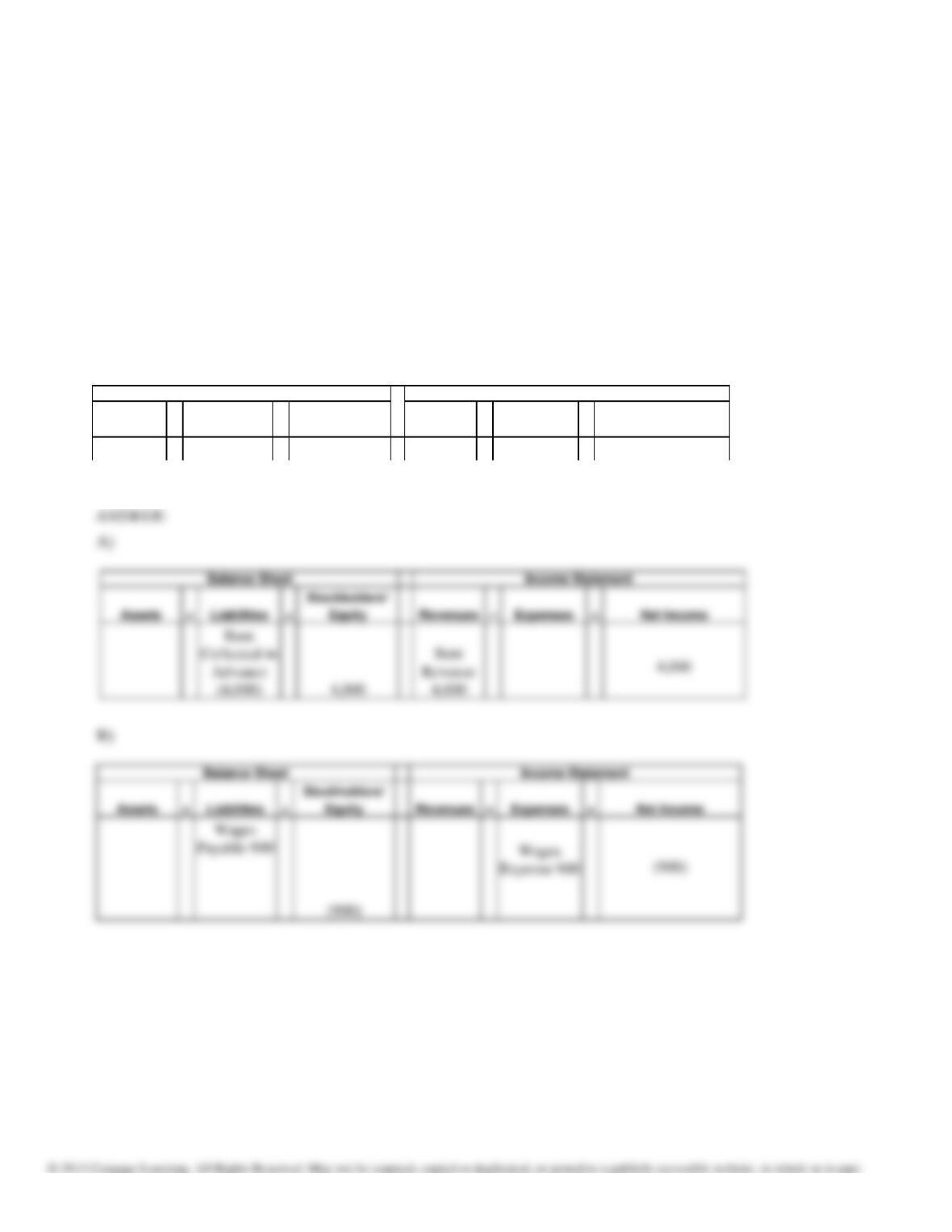
180. Super Clean operates an automatic car wash business, The Ultimate Shine. The following amounts were taken from
the company’s unadjusted trial balance at December 31, 2014:
Wages Expense 82,000
Rent Collected in Advance 8,000
Determine the effect on the accounting equation of any adjusting entries necessary at December 31, 2014, for each
of the transactions that follow.
A) The rent collected in advance represents rent for the period December 1, 2014 through January 31, 2015.
B) In addition to the wages paid during the year, employees have not been paid for the last week of December
which amounts to $900.
Balance Sheet
Income Statement
Assets
=
Liabilities
+
Stockholders’
Equity
Revenues
–
Expenses
=
Net Income
Balance Sheet
=
+
Stockholders’
Equity
Revenues
–
Expenses
=
Balance Sheet
=
+
Revenues
–
Expenses
=
Chapter 4: Income Measurement and Accrual Accounting
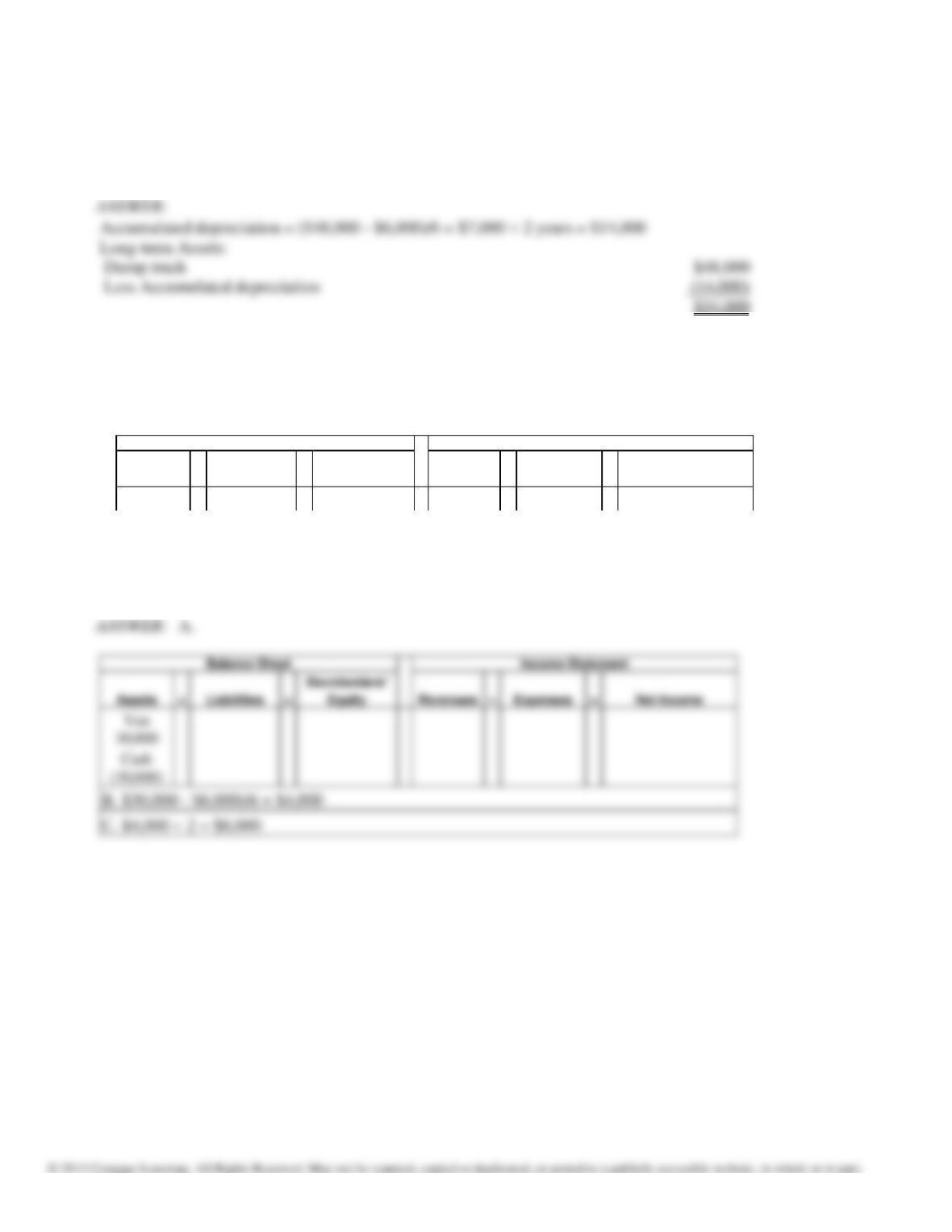
181. Agle Company purchased a dump truck at a cost of $48,000 on January 1, 2014. The truck has
an estimated useful life of 6 years and a $6,000 estimated residual value. Show how the truck
and any related amounts would appear on the December 31, 2015, balance sheet immediately
after the adjustments are recorded and posted.
182. Union Company purchased a delivery van at a cost of $30,000 cash on January 1, 2014.
The van has an estimated useful life of 6 years and a $6,000 estimated residual value.
A. What is the effect on the accounting equation of the purchase of the van?
Balance Sheet
Income Statement
Assets
=
Liabilities
+
Stockholders’
Equity
Revenues
–
Expenses
=
Net Income
B. How much depreciation expense should be reported for 2015?
C. What is the total amount of accumulated depreciation at December 31, 2015?
Balance Sheet
Income Statement
Assets
=
Liabilities
+
Revenues
–
Expenses
=
Net Income
Chapter 4: Income Measurement and Accrual Accounting
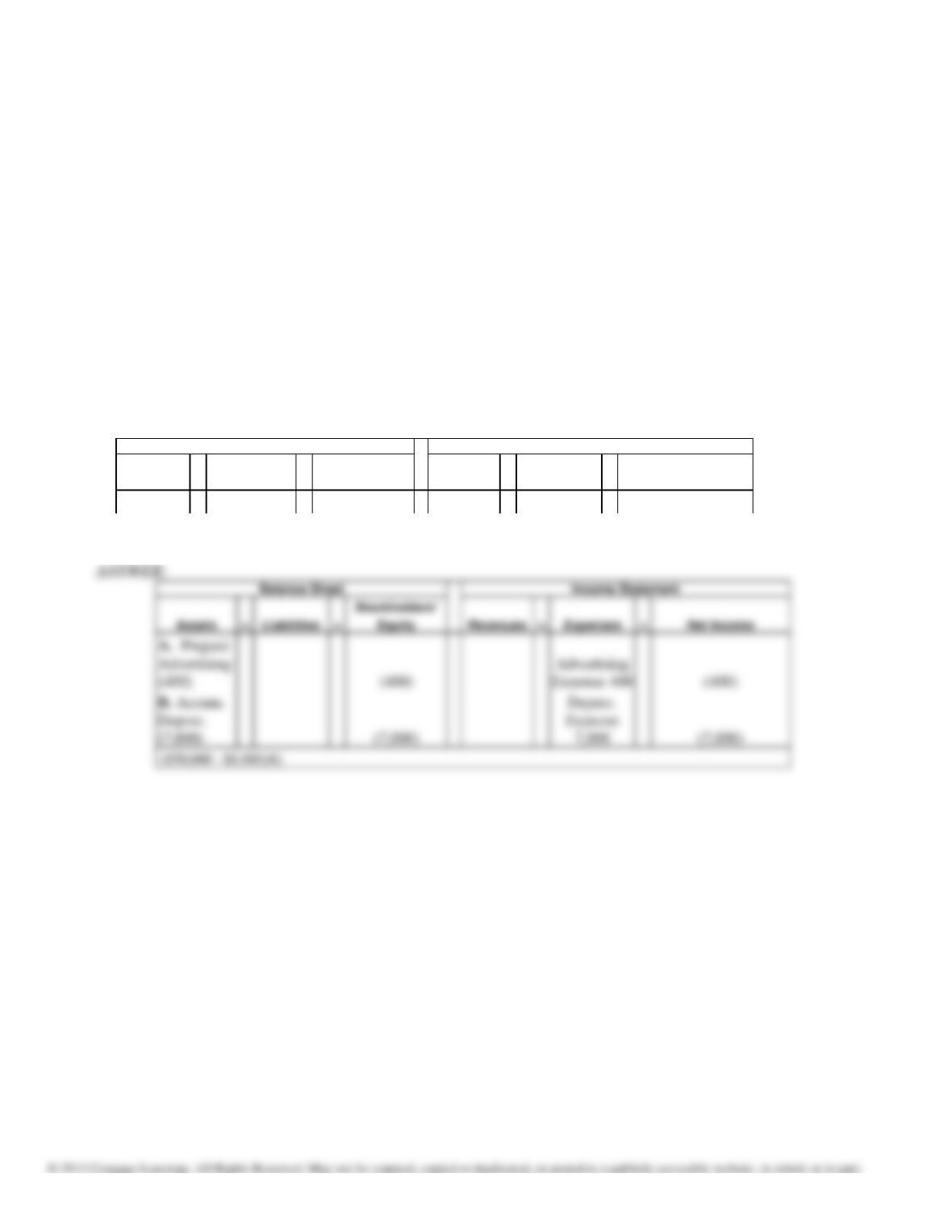
183. Marcus Roberts operates a small retail establishment. The following unadjusted amounts were taken from Roberts’
accounting records at December 31, 2015:
Accumulated Depreciation
$5,000
Machinery
50,000
Prepaid Advertising
1,200
Determine the effect on the accounting equation of the adjusting entries at December 31, 2015, for each of the
transactions that follow:
A. The advertising costs are for television commercials to be aired equally throughout December, 2015, and January
and February, 2016.
B. The machinery had an original cost of $50,000 and was purchased during 2010. The estimated useful life is 6
years with an estimated salvage value equal to $8,000. Roberts uses the straight-line method of depreciation.
Balance Sheet
Income Statement
Assets
=
Liabilities
+
Stockholders’
Equity
Revenues
–
Expenses
=
Net Income
Stockholders’
Chapter 4: Income Measurement and Accrual Accounting
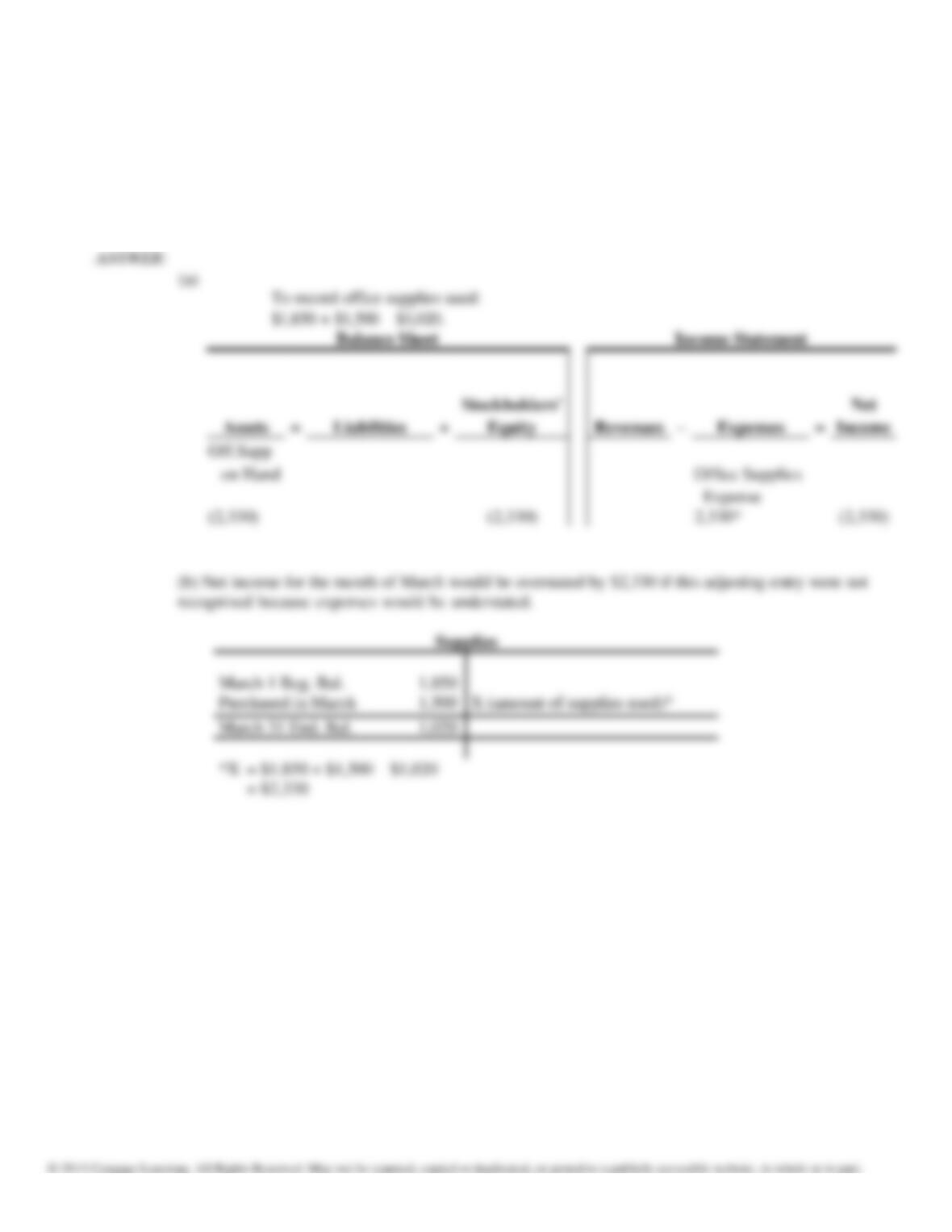
184. Quirin Corp. purchases office supplies once a month and prepares monthly financial statements. The asset account
Office Supplies on hand has a balance of $1,850 on March 1. Purchases of supplies during March amount to
$1,500. Supplies on hand at March 31 amount to $1,020.
REQUIRED: (a) Identify and analyze the necessary adjustment to be made on Quirin’s books on March 31.
(b) What will be the effect on net income for March if this adjustment is not made?
Chapter 4: Income Measurement and Accrual Accounting
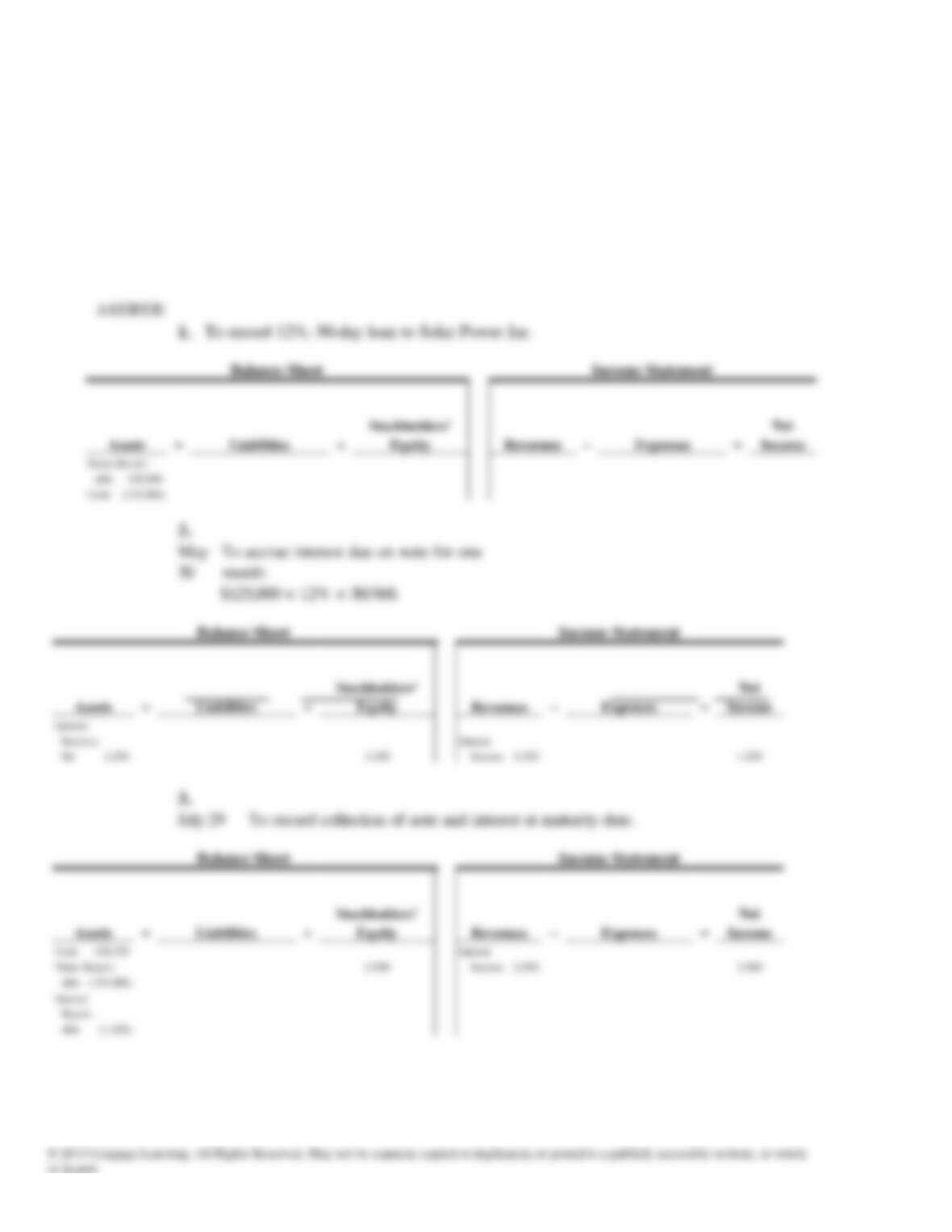
185. On May 1, 2014, Meehan Inc. lends $125,000 to Solar Power Inc. The loan will be repaid in 90 days with
interest at 12%.
REQUIRED:
1. Identify and analyze the effect of the transaction on Meehan’s books on May 1, 2014.
2. Assume that Meehan prepares quarterly statements on May 30, 2014. Prepare the adjusting entry on
Meehan’s books on May 30, 2014 regarding the loan.
3. Identify and analyze the effect of the transaction on Meehan’s books on July 29, 2014, when Solar
Power repays the principal and interest.
Chapter 4: Income Measurement and Accrual Accounting
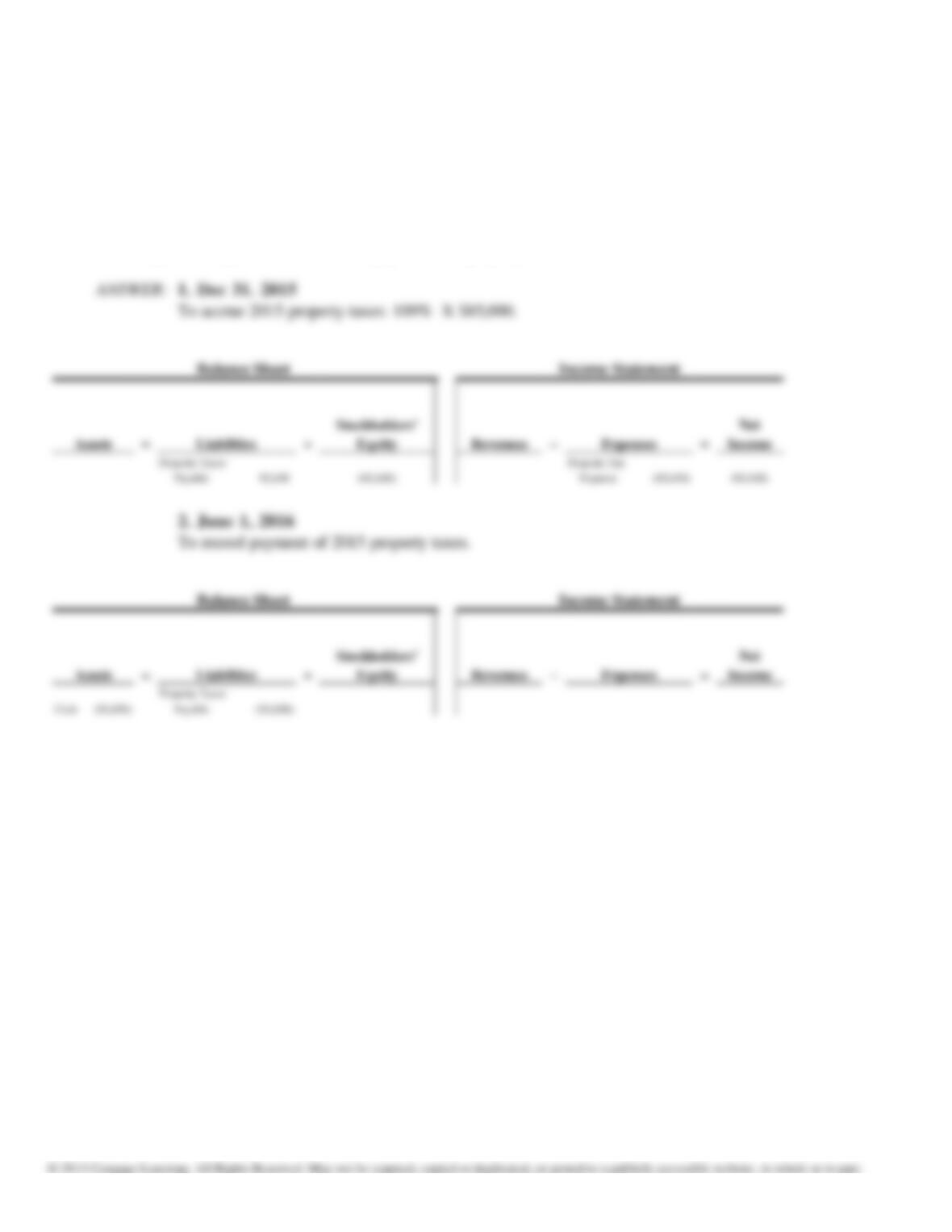
186. Marion Construction owns property in Polk County. Marion’s 2014 property taxes amounted to $85,000. Polk County
will send out the 2015 property tax bills to property owners during April 2016. Taxes must be paid by June 1, 2016.
Assume that Marion prepares adjusting entries only once a year, on December 31 for the entire year’s taxes, and that
property taxes for 2015 are expected to increase by 9% over those for 2014.
REQUIRED:
1. Identify and analyze the transaction to accrue the 2015 property taxes payable on December 31, 2015.
2. Identify and analyze the transaction to pay the 2015 property taxes on June 1, 2016.
Chapter 4: Income Measurement and Accrual Accounting
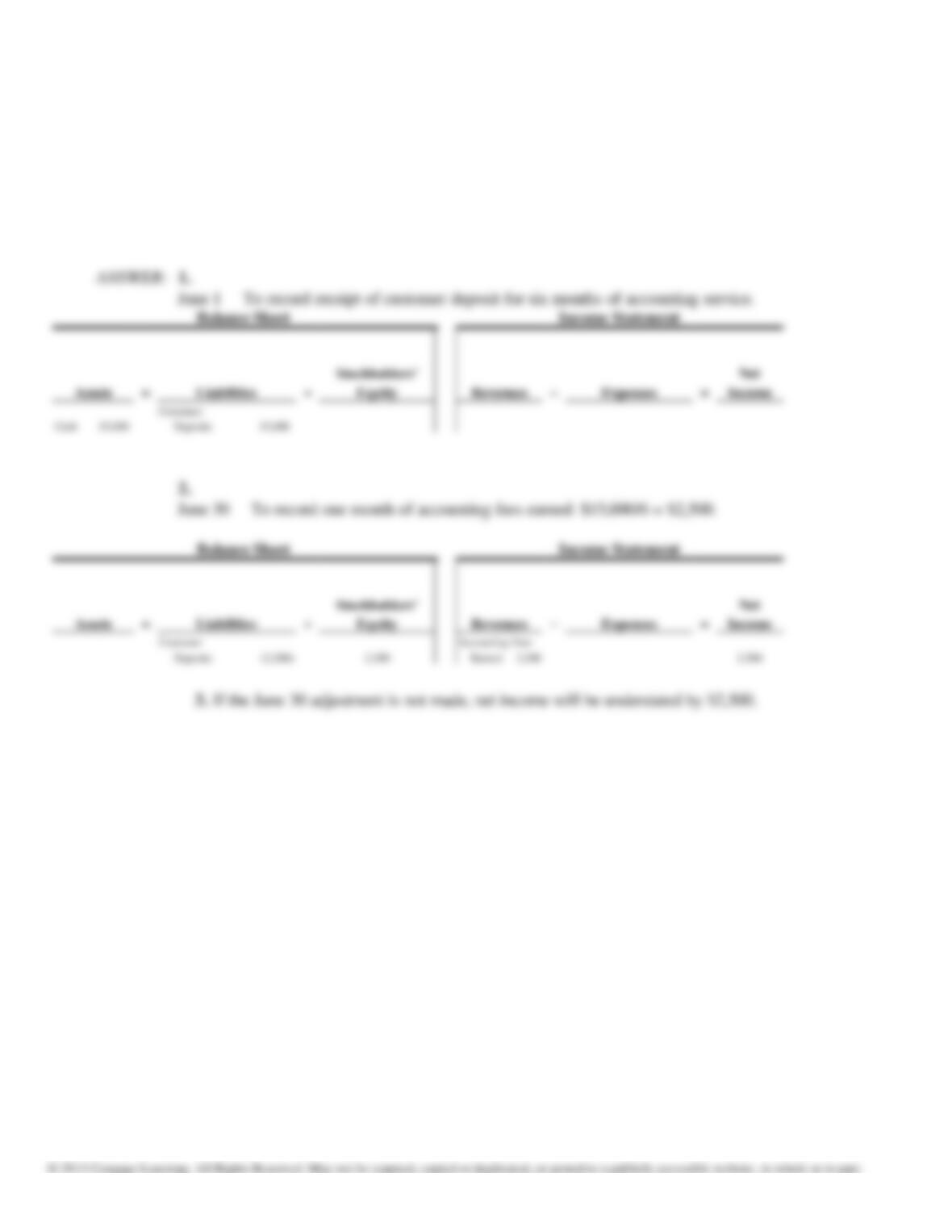
187. Brooke Accounting Services collected $15,000 from a customer on June 1 and agreed to provide accounting services
during the next six months. Brooke expects to provide an equal amount of services each month.
REQUIRED:
1. Identify and analyze the transaction for the receipt of the customer deposit on June 1.
2. Identify and analyze the adjustment needed on June 30.
3. What will be the effect on net income for June if the adjustment in (2) is not made?
Chapter 4: Income Measurement and Accrual Accounting
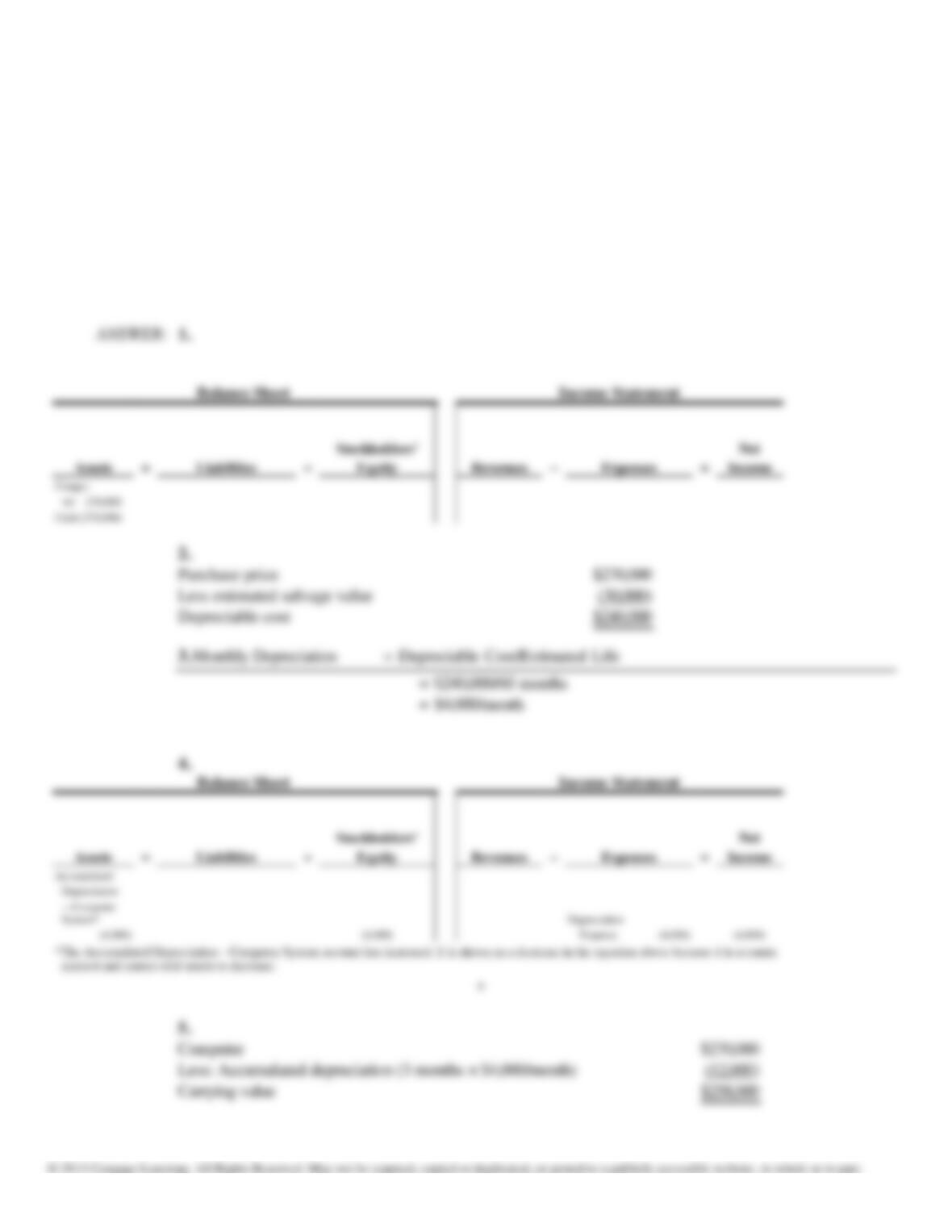
188. On October 1, 2014, Winter Corp. buys a computer system for $270,000 in cash. Assume that the computer is
expected to have a five-year life and an estimated salvage value of $30,000 at the end of that time.
REQUIRED:
1. Show how the effect of the purchase of the computer on October 1, 2014 can be identified and analyzed.
2. Compute the depreciable cost of the computer.
3. Using the straight-line method, compute the monthly depreciation.
4. Identify and analyze the adjustment for depreciation at the end of October 2014.
5. Compute the computer’s carrying value that will be shown on Winter’s balance sheet prepared on December 31,
2014.
Chapter 4: Income Measurement and Accrual Accounting
189. What two choices must be made in the measurement process for a company that acquires a piece of equipment and
needs to record it in the accounting records? Explain.
190. Describe the benefit(s) of using the accrual process as compared to the cash basis.
191. Why does the accrual basis of accounting require adjustments, while the cash basis does not?
192. Why is the cash basis of accounting too limited for proper financial reporting?
193. What is the revenue recognition principle? Are there any exceptions to this rule? If so, what are they? If not, explain
why
194. What is the matching principle? How does it relate to the revenue recognition process?
195. What role do accounting records play in the adjustment process?
Chapter 4: Income Measurement and Accrual Accounting
196. What is the significance of the timing in which cash is paid or received as it relates to the adjusting process?
197. Explain the differences between the cash and accrual basis of accounting and how the adjusting process fits in.
198. Explain the purpose of a work sheet.
199. Answer each of the following questions (a-c) with a separate short paragraph per question.
(a) What is the difference between a real account and a nominal account? Give an example of each type of account.
Why is this distinction important for the closing process?
(b) What two purposes are served in making closing entries?
(c) Why is the Dividends account closed directly to Retained Earnings rather than to the Income Summary account?

Chapter 4: Income Measurement and Accrual Accounting
Select the correct revenue recognition principle for each of the following.
a. Recognize revenue over the passage of time.
b. Recognize revenue when the customer takes possession of the product.
c. Recognize revenue when cash is collected.
d. Recognize revenue when service is performed.
200. Interest
201. Rent
202. Subscription to a magazine
203. Merchandise
204. Carpet cleaning
Match the most probable matching method to the costs listed below
a. Directly match a specific revenue
b. Indirectly match with the period during which it will provide revenue
c. Immediately recognize because no future benefits are expected.
205. Warehouse used for storing inventory goods
206. Commissions earned by sales people
207. Cost of two-year insurance policy
208. Taxes owed on income earned during the current period

Chapter 4: Income Measurement and Accrual Accounting
Match the following choices to the listed situation.
a. a deferred expense
b. a deferred revenue
c. an accrued liability
d. an accrued asset
209. One year‘s premium on truck insurance was paid in advance
210. Cash was collected from customers for rental of tents for next year
211. A warehouse building was acquired for cash
212. Income taxes are owed to the federal government at year end
213. Rent is owed by a tenant but not yet collected
For each transaction select the letter of the type of adjustment that would be required
a. Deferred expense
b. Deferred revenue
c. Accrued liability
d. Accrued asset
214. Depreciation on a delivery truck is recorded
215. Revenue is earned during the current period, although customers had paid in a previous period
216. Interest earned on notes receivable, but not yet received is recorded
217. The cost of supplies used during the current year is determined and recorded

Chapter 4: Income Measurement and Accrual Accounting
218. The cost of salaries earned by employees, but not paid at the end of the accounting period is recorded
For each transaction select the letter of the type of adjustment that would be required.
a. Deferred expense
b. Deferred revenue
c. Accrued liability
d. Accrued asset
219. Amounts earned, not received from customers are recorded
220. Magazine subscriptions are delivered during the current period, although customers had paid in a previous period
221. Interest is incurred on money borrowed from the bank, but not yet paid
222. The depreciation on office equipment used during the current year is recorded
223. The cost of commissions to salesmen that has been earned, but not paid at the end of the accounting period is
recorded
From the list of accounts below, determine whether the account would be a nominal account or a real
account.
a. nominal account
b. real account
224. Cash
225. Sales Revenue
226. Office Equipment

Chapter 4: Income Measurement and Accrual Accounting
227. Depreciation Expense
228. Prepaid Rent
229. Unearned Revenue
230. Utilities Expense
231. Interest Payable
232. A decline in purchasing power is evidenced by all of the following except:
a. inflation.
b. a continuing rise in the general level of prices in an economy.
c. buying the same amount of goods or services for a higher price a year later.
d. current value is equal to historical cost.
233. All of the following describe a revenue except:
a. a revenue can result in the inflow of assets.
b. a revenue can result in the settlement of liabilities from the delivery or distribution of goods.
c. a revenue can result in the settlement of liabilities from rendering services.
d. a revenue must involve an inflow of assets.
234. Which of the following statements is true concerning the matching principle?
a. All costs can be directly matched with revenue.
b. All costs can be indirectly matched with periods in which they provide a benefit.
c. The association of assets for a period with the liabilities necessary to generate the assets is known as the matching
principle.
d. Cost of goods sold matched with sales revenue is a classic example of direct matching under the matching
principle.

Chapter 4: Income Measurement and Accrual Accounting
235. The unit of measure in Japan is the U.S. dollar.
a. True
b. False
236. The accounting profession is currently experimenting with financial statements adjusted for the changing value of the
dollar since inflation is increasing.
a. True
b. False
237. Because of its objective nature, historical cost is the attribute used to measure many of the assets recognized on the
balance sheet.
a. True
b. False
238. The income statement tells the reader about the actual cash inflows during a period of time.
a. True
b. False
239. The statement of cash flows reflects the revenues actually earned by the business, regardless of whether cash has
been collected.
a. True
b. False
240. The justification for the accrual basis of accounting lies in the needs of financial statement users for periodic
information on the financial position and the profitability of the entity.
a. True
b. False
241. The revenue recognition principle involves two factors: paid and incurred.
a. True
b. False

Chapter 4: Income Measurement and Accrual Accounting
242. The revenue recognition principle does not pertain to long–term contracts, franchises, commodities, and installment
sales.
a. True
b. False
243. Conceptually, anytime a cost is incurred, an asset is acquired.
a. True
b. False
244. Costs incurred for purchases of merchandise result in an asset, Merchandise Inventory, and are eventually matched
with revenue at the time the product is sold.
a. True
b. False