CHAPTER 4—BIODIVERSITY AND EVOLUTION
MULTIPLE CHOICE
1. For every shark that injures or kills a person every year
a.
people kill one shark to even the score
b.
people kill about 50,000 sharks, but mainly to be used as food
c.
people kill at least 1 million sharks
d.
people kill sharks in a ratio of 5:1 for humans deaths
e.
people do not kill sharks because we cannot catch them
2. Which of the following are reasons why sharks should be considered important to humans?
a.
They never get cancer, and may provide information about how to prevent this disease.
b.
They are an important source of food
c.
They are a keystone species
d.
They never get cancer and are an important source of food
e.
They never get cancer and are a keystone species
3. Biomes are
a.
large aquatic regions of the earth with distinct climate and certain species adapted to them
b.
large terrestrial regions of the earth with distinct climate and certain species adapted to
them
c.
groups of populations living in harmony in a given ecosystem
d.
all the biological portions of the planet
e.
types of forests that are extensive and widespread on a continent
4. The variety of genes within a species or population is called the
a.
species diversity
b.
genetic diversity
c.
functional diversity
d.
ecological diversity
e.
molecular diversity
5. Which of the following statements best describes insect species as a group?
a.
They have backbones.
b.
About two million species have been identified by scientists.
c.
They are resistant to extinction.
d.
They have skin or integument similar to mammals.
e.
They do not spread human diseases.
6. Deserts, tropical forests, prairie grasslands, and coniferous forests are all examples of
a.
different species
b.
ecosystems with the highest biodiversity
c.
ecosystems with low genetic biodiversity
d.
Biomes
e.
Populations
7. Which of the following biomes are found along the 39th parallel in the United States?
a.
Chaparral
b.
Chaparral and coniferous forest
c.
Chaparral, coniferous forest and desert
d.
Chaparral, coniferous forest, desert and prairie grassland
e.
Chaparral, coniferous forest, desert, prairie grassland and deciduous forest
8. Evidence for the history of life comes from
a.
DNA analysis
b.
Fossils
c.
analysis of glacial ice core and rock samples
d.
fossils and analysis of glacial ice core and rock samples
e.
ancient sea scrolls
9. The fossil record is incomplete because
a.
Not all fossils have been found.
b.
Some fossils have decomposed.
c.
Some life forms left no fossils.
d.
Some life forms have left no fossils and some have decomposed
e.
Not all fossils have been found, some have decomposted and some life forms have left no
fossils.
10. Which of the following is true with regard to mutations?
a.
Mutations are always harmful.
b.
Mutations always provide for beneficial changes in an organism’s genetic makeup.
c.
Mutations are chosen by the organism to improve their survival.
d.
Natural selection determines the types of mutations that survive in a population.
e.
Mutations are caused only by harmful chemicals.
11. A change in the genetic composition of a population is called
a.
Emigration
b.
Mutation
c.
natural selection
d.
Evolution
e.
genetic drift
12. An adaptive trait is
a.
any heritable trait.
b.
any heritable trait that improves organisms’ chances for survival
c.
any heritable trait that improves organisms’ chances for survival and reproduction
d.
any heritable trait that improves organisms’ chances for survival and reproduction at
higher rates than other individuals in a population
e.
any inheritable trait that improves organisms’ chance for survival and reproduction at
lower rates than other individuals in a population
13. Since the mutation produced a specific wing trait that was passed on, the mutation must have occurred
a.
in wing cells
b.
in reproductive cells
c.
as a result of exposure to a chemical agent
d.
as a result of UV light
e.
because of the type of pollen the bee collected
14. The larger wingspan could be called
a.
an adaptive trait
b.
genetic variability
c.
a heritable trait
d.
an adaptive trait and a genetic variability
e.
a heritable trait, an adaptive trait and a genetic variability
15. It could be said that _____ favored the bee with the larger wingspan, and so the _____ evolved.
a.
adaptation, bee
b.
evolution, population
c.
mutation, bee
d.
natural selection, population
e.
mutation, population
16. Which of the following characteristics must be true in order for a trait to be impacted by the forces of
natural selection and then play a role in the process of biological evolution?
a.
The trait must be the result of environmental conditions.
b.
The trait must be genetically based.
c.
The trait must impact the social rank of its possessor.
d.
The trait must be a physical characteristic of the organism.
e.
The trait must be a behavioral characteristic of the organism.
17. Which of the following is true of a trait that creates a specific advantage for some organisms in the
struggle to survive?
a.
It enables individuals with the trait to leave more offspring than other members of the
population leave.
b.
It results in greater genetic diversity in the offspring of those organisms that possess it
than in those that do not possess the trait.
c.
It causes the ratio of male and female offspring produced to be equal.
d.
It results in offspring that are genetically different than the parents.
e.
It results in non-heritable traits being passed from parent to offspring.

18. Which of the following is/are thought to be in part responsible for the evolutionary success of humans?
a.
Humans possess strong opposable thumbs.
b.
Humans walk upright.
c.
Humans have complex brains, walk upright and have opposable thumbs
d.
Humans walk upright and have opposable thumbs
e.
Humans walk upright, have opposable thumbs, complex brains and can use tools
19. Genetic resistance to antibiotic drugs is an important example of
a.
an adaptive trait in humans
b.
natural selection
c.
a beneficial mutation
d.
a harmful mutation
e.
Evolution
20. How has the geological process of plate tectonics influenced the process of evolution over geologic
time?
a.
The changing location of the plates across the Earth’s surface exposes organisms to
differing concentrations of mutagens, thus increasing or decreasing the rate of evolution.
b.
The rate of evolutionary change is directly proportional to the speed with which the Earth’s
tectonic plates are moving.
c.
The changing location of the plates across the Earth’s surface results in changing climatic
environmental conditions for various communities and populations of organisms. This has
driven evolutionary change.
d.
The movement of the Earth’s geologic plates is the source of energy that ultimately drives
the process of evolution.
e.
The movement of the Earth’s geologic plates further away from the equator resulted in an
increase in the gravitational forces on the planet. This allowed for the initial accumulation
of the gases that form the Earth’s atmosphere.
21. A major factor that allowed species to adapt to new environments and form new species through
natural selection happened
a.
because Pangaea began splitting apart about 135 million years ago
b.
about 18,000 years ago when South America and North America split apart
c.
about 200-250 million years ago when India and Africa split apart
d.
happened about 250 million years ago, because Pangaea began splitting apart
e.
because Asia and North America split apart 180 million years ago
22. The advance and retreat of ice sheets
a.
happened most recently about 18,000 years ago at the lower latitudes
b.
happened most recently about 350 million years ago at the lower latitudes
c.
happened most recently about 18,000 years ago over much of the northern hemispheres
d.
happened most recently about 18,000 years ago over much of the northern hemispheres
and caused alternating periods of heating and cooling
e.
ice sheets were very stable throughout geologic time and did not advance or retreat
23. Approximately how long has there been life on planet Earth?
a.
3.5 million years
b.
35 million years
c.
350 million years
d.
3.5 billion years
e.
35 billion years
24. We can say that on a long-term basis, that the _____________principle of sustainability has especially
helped life on earth to adapt to drastic environmental conditions.
a.
wise use
b.
energy cycling
c.
nutrient cycling
d.
Energy
e.
Biodiversity
25. Which of the following statements is false?
a.
In the process called speciation, one species splits into two or more different species.
b.
Geographic and reproductive isolation occur in sequence.
c.
Sooner or later all species become extinct.
d.
By definition, the fittest animals are the largest and strongest animals.
e.
Difference environmental conditions lead to different selective pressures.
26. The process by which members of isolated populations become so different in genetic makeup that
they cannot produce live, fertile offspring if they are rejoined is best described as
a.
geographic isolation
b.
reproductive isolation
c.
evolutionary isolation
d.
endemic isolation
e.
niche isolation
27. Which of the following is not true of the process of biological extinction?
a.
The extinction of an organism can be reversed if enough government funding is provided.
b.
There has always been a certain low-level amount of ongoing background extinction
occurring.
c.
Completely natural processes can cause population extinctions.
d.
Human activities have resulted in population extinctions.
e.
a, b and c are all correct, but not d
28. Geographic isolation may result from
a.
a volcanic eruption
b.
an earthquake
c.
a mountain range
d.
all of these answers
e.
none of these answers
29. Which of the following is not true with regards to the concept of niches?
a.
A niche is the place where an organism lives.
b.
A niche is the general method by which an organism attains its energy.
c.
A species that is able to survive in a great range of environmental conditions and utilize a
wide variety of food resources is a generalist species.
d.
The giant panda feeds almost exclusively on various types of bamboo. This being the case,
these organisms are said to have a narrow specialized niche.
e.
In a rapidly-changing environment it is a great benefit to have a wide niche.
30. Which of the following organisms would best be described as a specialist species?
a.
Flies
b.
Cockroaches
c.
white-tailed deer
d.
panda bears
e.
Humans
31. An organism’s niche is analogous to its
a.
Address
b.
way of life
c.
food source
d.
trash dump
e.
all of these answers
32. Which of the following best describes an organism’s habitat?
a.
the nutrient relationships with other species
b.
the location where a species lives
c.
the types of resource requirements
d.
the range of tolerance to different physical and chemical conditions
e.
the types of competitors
33. The bird species known to forage in shrublands after they have experienced a wildfire are very
different from the bird species that forage in shrublands that have not burned. In fact, the bird species
foraging in burned shrublands are closely correlated with the age of the burn, or the number of years
that have passed since the fire. Certain birds forage at one-year post fire, different birds forage at three-
years post fire, and so on. These birds could be called
a.
foundation species
b.
keystone species
c.
generalist species
d.
indicator species
e.
newly evolved species
34. An intertidal species of seastar helps to maintain the diversity of the intertidal region by controlling the
mussel population. Without the seastar, the mussel population would crowd out other species and take
over their territory. The seastar could be called a(n)
a.
indicator species
b.
keystone species
c.
foundation species
d.
aggressive species
e.
repressor species
35. Specialist species
a.
are very adaptable
b.
tolerate a wide range of environments
c.
are more likely to become extinct
d.
eat a wide variety of food
e.
all of these answers
36. Amphibians are
a.
frogs, toads, and salamanders.
b.
fish, frogs, and salamanders.
c.
salamanders, sea anemone, and frogs
d.
clams, oysters, frogs, and toads.
e.
toads, sea urchins and frogs
37. Approximately what percentage of amphibian species is threatened with extinction and declining
worldwide?
a.
43%
b.
33%
c.
33%, 43%
d.
80%
e.
43%, 53%
38. Which of the following is not a factor that is contributing to the decline in amphibian populations?
a.
habitat loss and fragmentation
b.
viral and fungal diseases and parasites
c.
increase in UV radiation
d.
prolonged drought
e.
hunting of frogs for froglegs, a delicacy that is served in restaurants
39. It can be said that amphibian populations are declining worldwide,
a.
but only in areas that are greatly disturbed by human activities
b.
in all areas except in protected wildlife preserves, where they are increasing somewhat
c.
except in the Arctic where they are surviving okay
d.
in all areas, even in protected wildlife preserves and parks
e.
in all areas, except tropical rainforests where the very large populations can withstand
some disturbance
40. Which of the following statements is true regarding keystone species?
a.
Animals can be keystone species, but plants cannot.
b.
Top predators can be keystone species, but other animals cannot.
c.
Insects can never be keystone species because they are pests.
d.
Some keystone species are more vulnerable to extinction than other species.
e.
A species must have a very large population size in order to be a keystone species.
TRUE/FALSE
1. When local environmental conditions change, background extinction can cause loss of species.
2. In speciation, two species interbreed to form one new species.
3. The size of the planet has significant influences that impact life on the planet.
4. Houseflies would probably adapt to an environmental change much more quickly than a human.
5. Extinction results in the permanent loss of genetic diversity.
6. One of the reasons that sharks are hunted is for their fins which are widely used as a soup ingredient in
Asia.
7. It is impossible for a shark to drown.
8. Heritable traits that give an individual some advantage over other individuals in the population are
called adaptive traits.
9. Genes mutate, individuals are selected and populations evolve.
10. The biological diversity of the Earth is only a function of the number of species on the Earth.
11. Organisms develop certain traits because they need them.
12. The location of continents has greatly influenced the earth’s climate, but the location of oceanic basins
has not.
13. Ice sheets in high latitudes are known to have advanced and retreated over much of the northern
hemisphere throughout the Earth’s long history.

14. Geographic isolation and reproductive isolation can both lead to speciation.
15. Sharks are all carnivorous.
16. Cockroaches have a wide range of tolerance of environmental conditions. They are known as a
specialist species.
17. Niches are only occupied by native species.
COMPLETION
1. A(n) ____________________ includes an organism’s range of tolerance for physical and chemical
conditions.
2. Biological evolution is the process by which the genetic composition of a(n) ____________________
changes over time.
3. Most of the historic evidence that supports the scientific theory of evolution comes from
____________________.

4. ____________________ are random changes in the structure or number of DNA molecules in a cell.
5. If a species of frogs becomes threatened because they can only live in a narrow range of temperatures,
they would be classified as a(n) ____________________.
6. Mutations can occur in any cell type, however only those that occur in ____________________ are
passed on to offspring, thus allowing for evolution.
7. Current environmental conditions will dictate which traits are beneficial, and will ultimately drive
evolution through the process of ____________________.
8. The shifting of tectonic plates can cause ____________________.
9. Typically speaking, organisms that are described as ____________________ tend to have broad
niches.
10. Species that are found in only one area are called ____________________ and are especially
vulnerable to extinction.

11. Genes mutate, ____________________ are selected, and populations____________________.
12. A practice that involves cutting off fins of a shark and then returning the shark to the ocean without the
fins they need to survive is called ____________________.
13. Species whose roles have a large effect on the types and abundance of other species in an ecosystem
are called ___________ _____________.
14. ____________________ is a significant rise in extinction rates above the background level.
15. The scientific theory of evolution explains how life on earth changes over time due to changes in the
genes of____________________.
16. In the 1960’s, E.O. Wilson and other scientists developed the theory of _______________
____________________.

88
17. ____________________ occupy narrow niches.
18. Holding the pen or pencil for taking this exam is one of the things you can do as a human because you
have____________ ____________.
19. Deserts, forests, and grasslands are all examples of ____________.
MATCHING
Match the type of diversity with the proper choice below.
a.
functional diversity
c.
ecological diversity
b.
genetic diversity
d.
species diversity
1. Caribbean snails of the same population exhibit a variety of shell colors and banding patterns.
2. Coastal states in the United States typically have more ecosystems than land-locked states.
3. Some tropical forests contain thousands of producer species.
4. Nutrients typically cycle much faster in tropical areas than in polar areas.
5. Estuaries and wetlands have very high primary productivity.
6. Coral reefs are known for their very high number of species.
7. Areas with both mountain ranges and coastal ecosystems have high diversity.
8. An early fox population evolved into the grey fox and arctic fox.
SHORT ANSWER
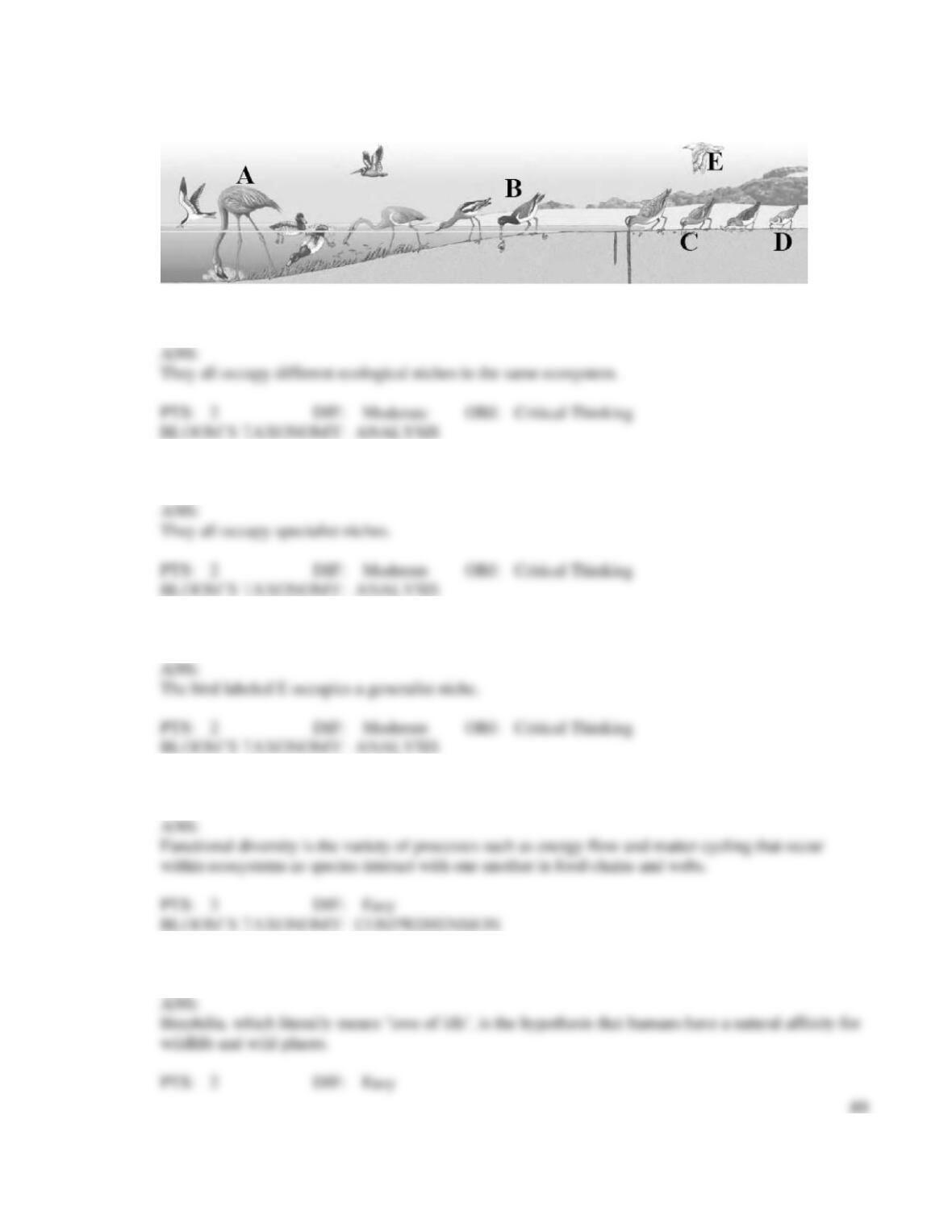
1. Look at all of the bird species shown in the diagram above. What can be said about the birds?
2. In what way are the birds labeled A, B, C, and D similar?
3. How does the bird labeled E compare with the birds labeled A, B, C, and D?
4. Briefly describe the concept of functional diversity.
5. What is meant by the term ‘biophilia’ that was coined by Edward O. Wilson?
ESSAY
1. Clearly explain the relationship between the geologic process of plate tectonics and the biological
process of evolution over geologic time.
2. Clearly explain how large-scale mass extinctions can actually lead to evolutionary opportunities.
3. Using specific examples, explain why sharks can actually be beneficial to the human population if we
change our view of their role.

4. In the 1960’s Edward O. Wilson, along with other scientists, developed the theory of island
biogeography. Explain the relevance of this theory in today’s world