Chapter 4
International Asset Pricing
Note: In the sixth edition of Global Investments, the exchange rate quotation symbols differ from previous
editions. We adopted the convention that the first currency is the quoted currency in terms of units
of the second currency.
For example, €:$ = 1.4 indicates that one euro is priced at 1.4 dollars. In previous editions we used
the reversed convention $/€ = 1.4, meaning 1.4 dollars per euro.
All problems in this test bank still use the old convention and have not been adapted to reflect the
new quotation symbols used in the 6th edition.
◼ Questions and Problems
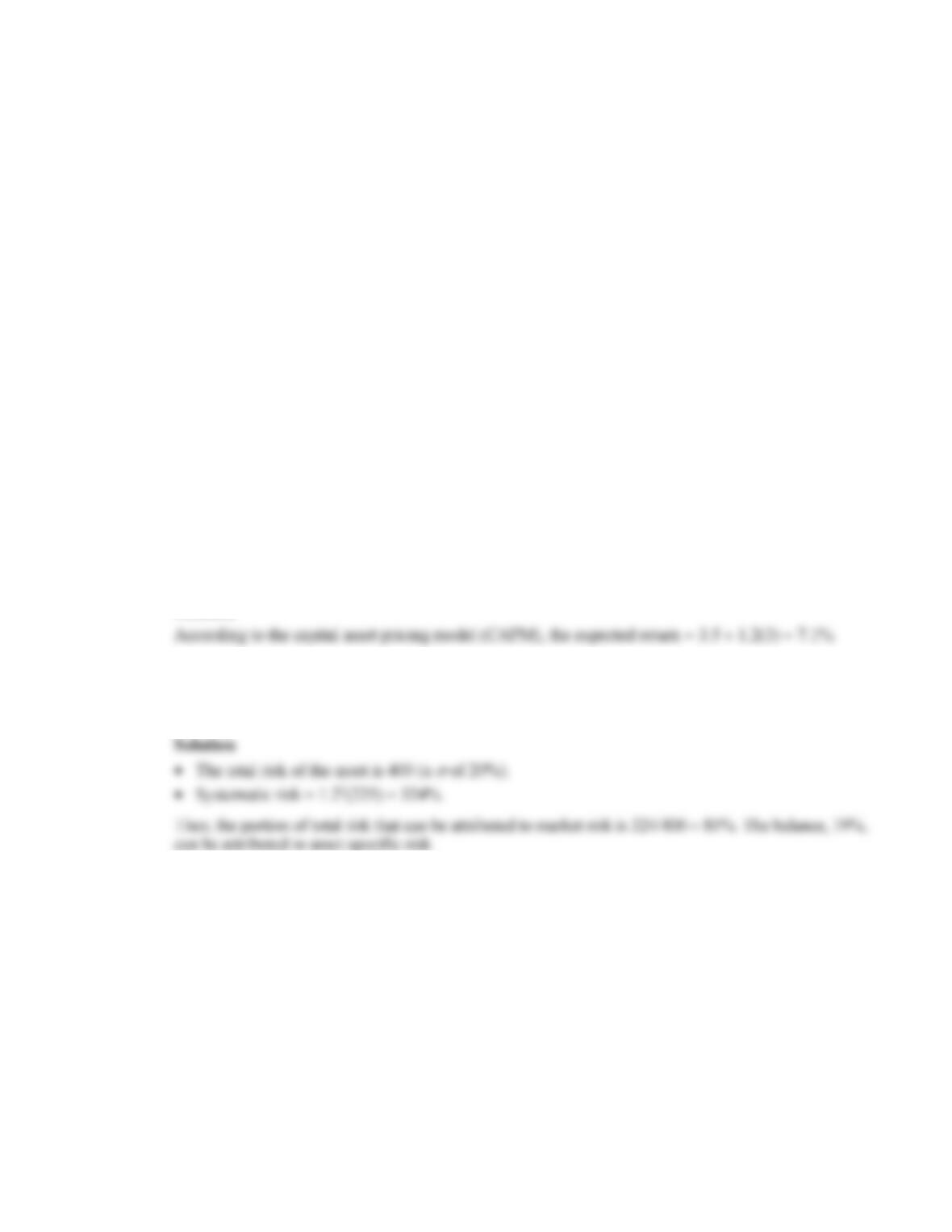
1. Consider an asset that has a beta of 1.20. If the risk-free rate is 3.5% and the market risk premium
is 3%, calculate the expected return on the asset.
Solution
2. An asset has a beta of 1.20. The variance of returns on a market index,
2,
m
is 225. If the variance of
returns for the asset is 400, what proportion of the asset’s total risk is systematic, and what proportion
is residual risk?
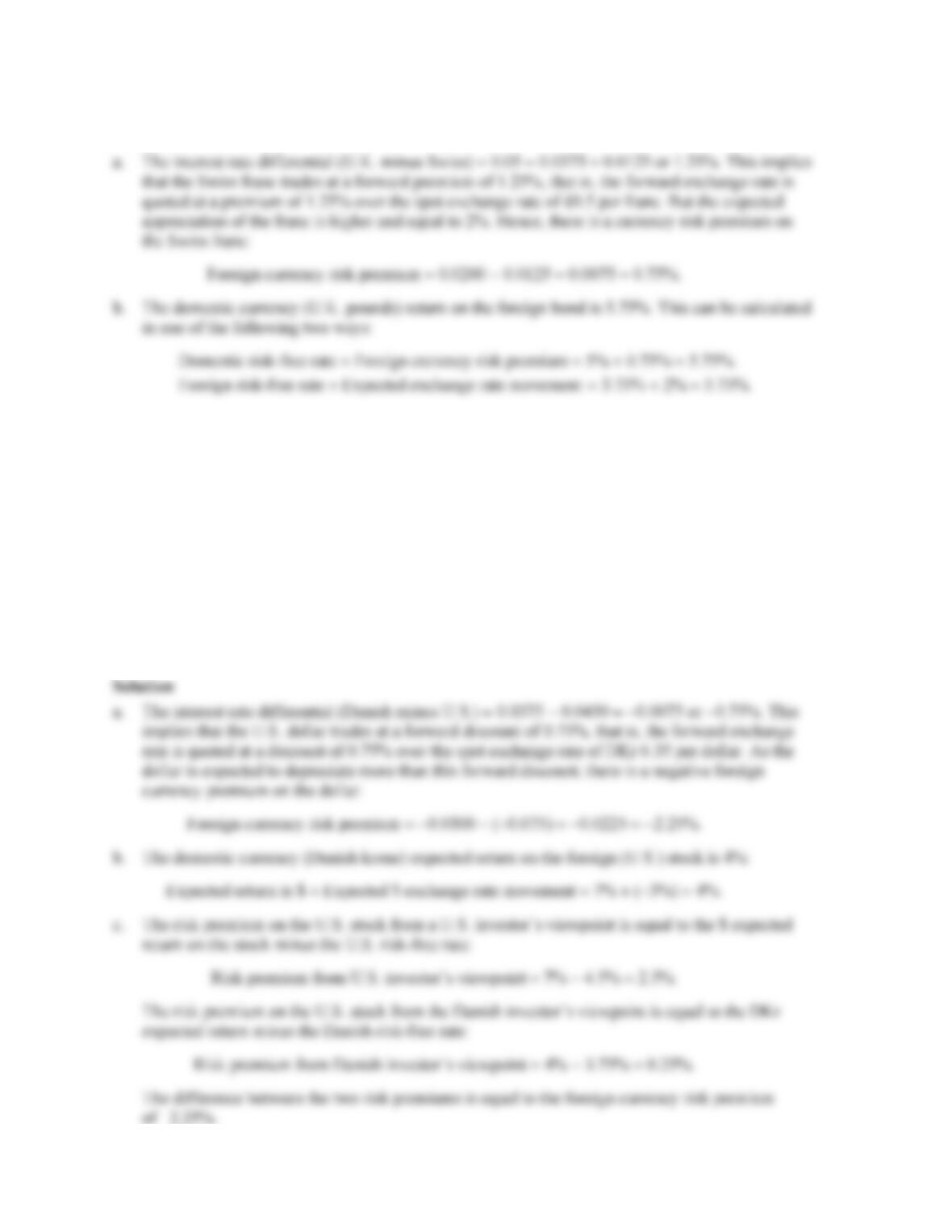
3. The interest rate on one-year risk-free bonds is 5% in the United Kingdom, and 3.75% in Switzerland.
The current exchange rate is £0.5 per Swiss franc. Suppose that you are a British investor and you
expect the Swiss franc to appreciate by 2% over the next year.
a. Calculate the foreign currency risk premium.
b. Calculate the domestic currency return on the foreign bond, assuming that your currency
appreciation expectations are met.
26 Solnik/McLeavey • Global Investments, Sixth Edition
Solution
4. Suppose that you are an investor based in Denmark, and you expect the U.S. dollar to depreciate by
3% over the next year. The interest rate on one-year risk-free bonds is 4.5% in the United States, and
3.75% in Denmark. The current exchange rate is DKr 6.35 per U.S. dollar. You buy some U.S. stocks
with an expected return of 7% in dollars.
a. Calculate the foreign currency risk premium from the Danish investor’s viewpoint.
b. Calculate the expected return on the U.S. stock from the Danish investor’s viewpoint, that is, in
Danish krone.
c. Calculate the risk premium on the U.S. stock from a U.S. viewpoint and from the Danish
investor’s viewpoint.
d. Calculate the expected return on the U.S. stock from the Danish investor’s viewpoint, assuming
that the Danish investor hedges the currency risk. Calculate the risk premium on the hedged
U.S. stock from the Danish investor’s viewpoint.
Chapter 4 International Asset Pricing 27
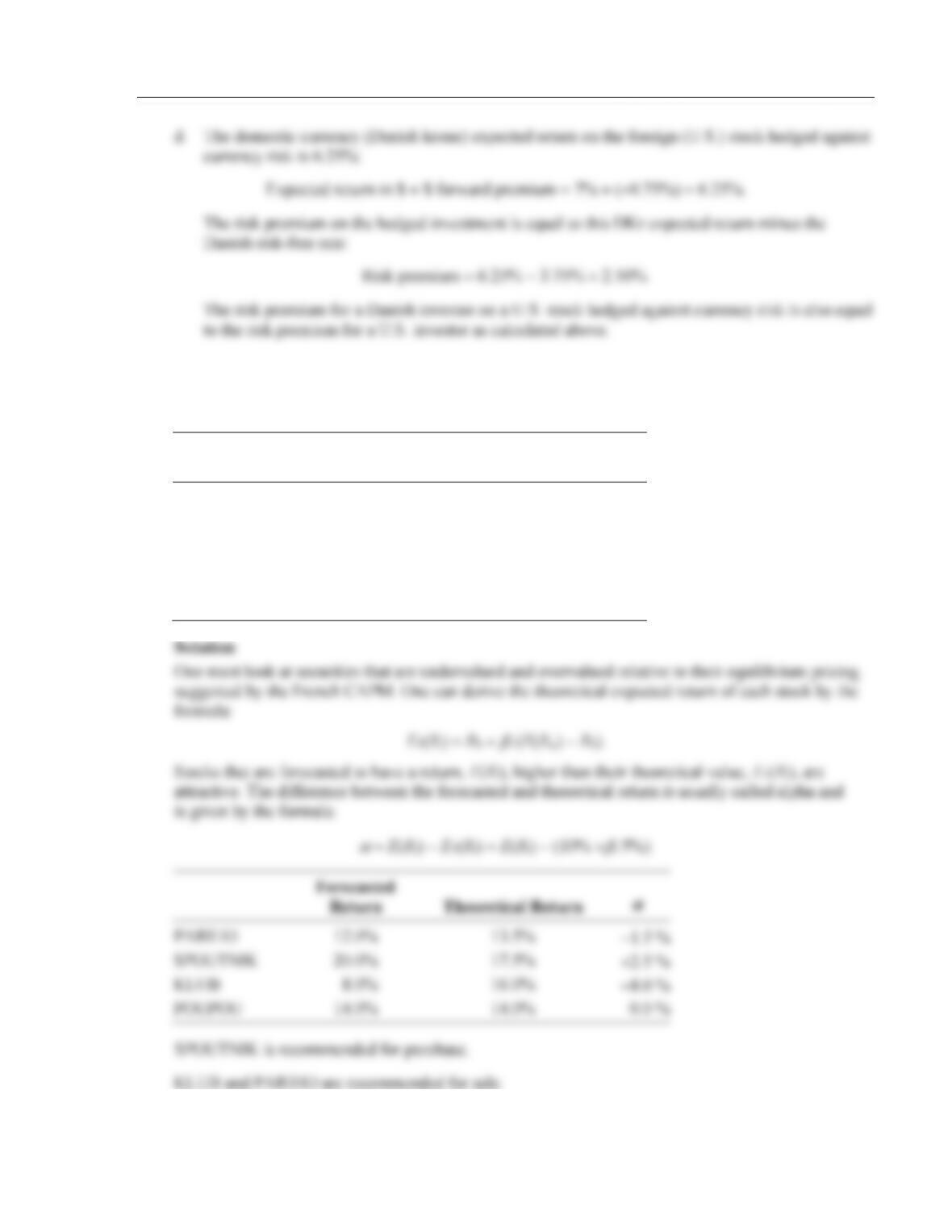
5. You are a money manager of French stocks. Your research department prepared the table below.
According to the domestic CAPM for French securities, which stocks would you recommend for
purchase and sale?
Security
Forecasted Return (€)
Domestic
Beta
Risk-Free Rate (€)
10%
0
French Market
15%
1
PARIHO
12%
0.7
SPOUTNIK
20%
1.5
KLUB
8%
1.2
POUPOU
14%
0.8

28 Solnik/McLeavey • Global Investments, Sixth Edition
6. You are a U.S. pension fund that cares about dollar return. You believe in the “multicountry approach”
to asset pricing but feel that currency premiums are equal to zero (so you do not care about currency
exposures). The multicountry approach assumes that national equity markets are priced globally and
that securities of each country are priced relative to their national market. In other words, each security
is influenced by its national market factor, which in turn is influenced by the world market factor,
and, possibly, by currency factors. This implies that the world beta of security i (
iw, or sensitivity to
the world market), is equal to the product of the local beta of security i (
i, or sensitivity to the local
market) times the world beta of its local market (
l w).
In your portfolio construction, you apply a traditional two-step procedure where, you first decide on
country allocation and then on security selection within each country.
The following are your forecasts for the coming year, the betas of stocks calculated relative to their
domestic index, as well as the betas of the national stock markets relative to the world index. All
forecasts are measured in their local currency.
Country
Forecasted
Return (%)
Domestic
Beta
World Beta
World Index (in $)
Stock Market
10
1
1.0
United States (in $)
Current Risk-Free Rate
8
Stock Market
10
1
1.0
Company A
13
1.2
Company B
9
0.9
Company C
11
1.5
France (in €)
Current Risk-Free Rate
10
Stock Market
11
1
1.2
Company D
12
0.8
Company E
12
2
Company F
11
1.1
Euro (depreciation of €)
−5
Japan (in ¥)
Current Risk-Free Rate
6
Stock Market
14
1
1.3
Company G
16
1.25
Company H
18
1.1
Company I
12
0.9
Yen (appreciation of ¥)
+5
Assume that you do not hedge currency risks.
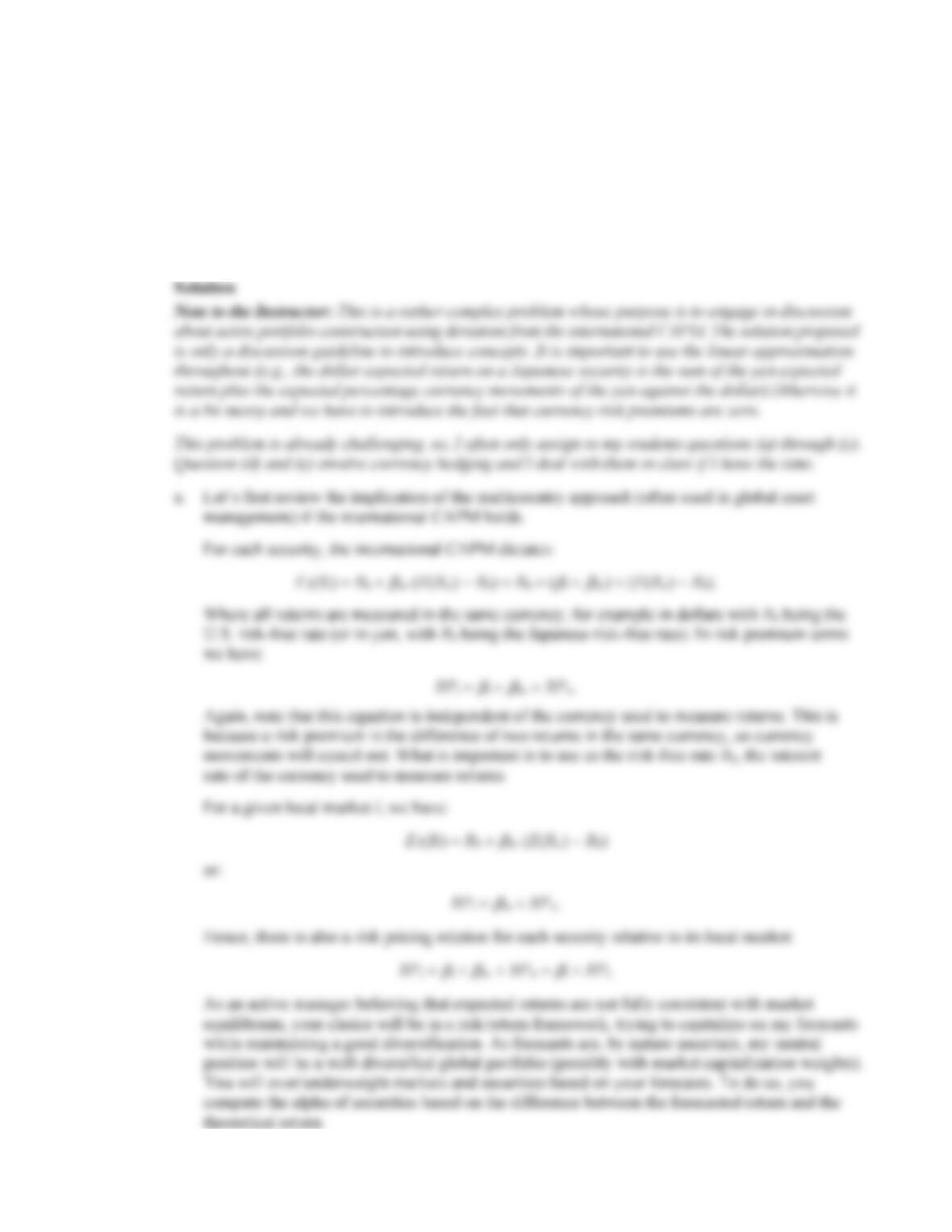
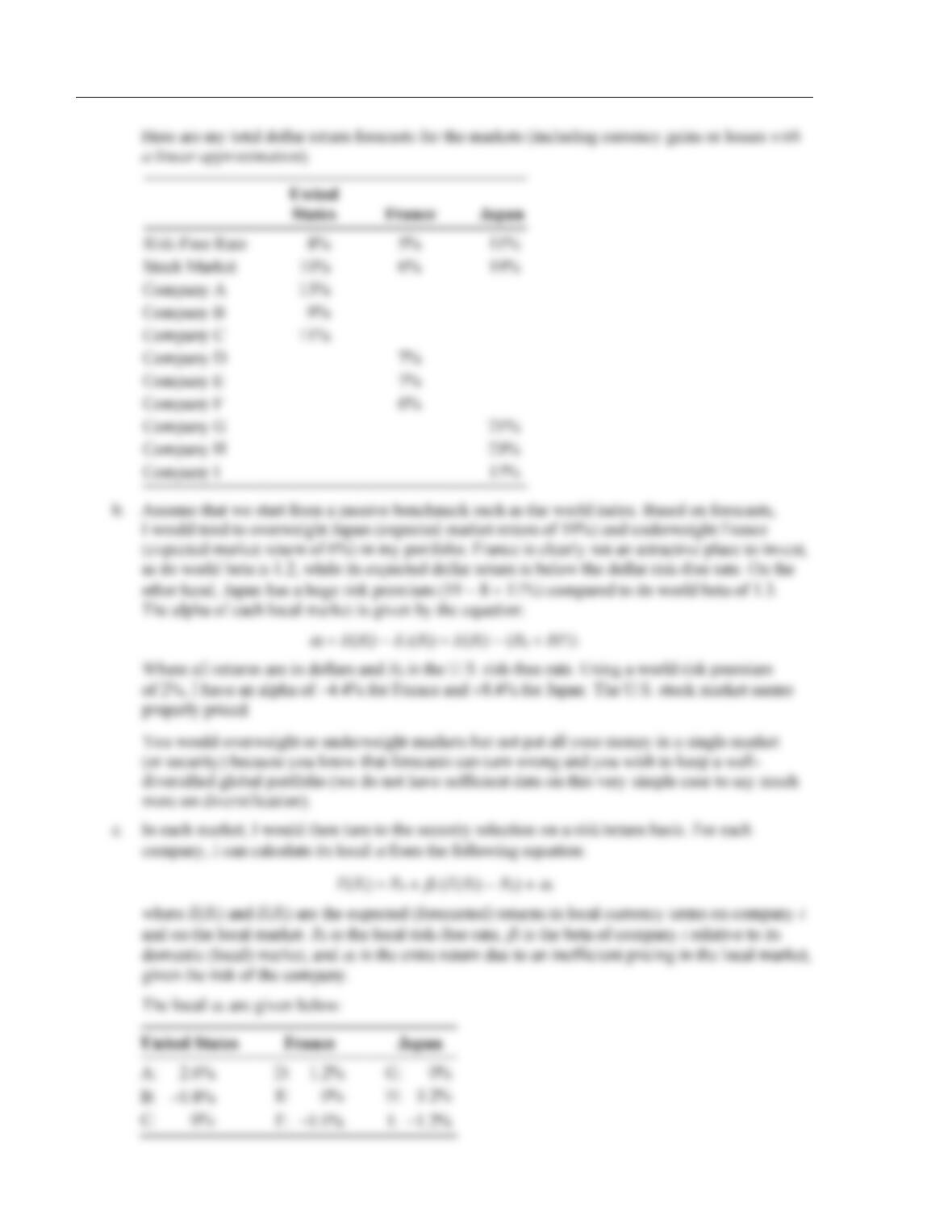
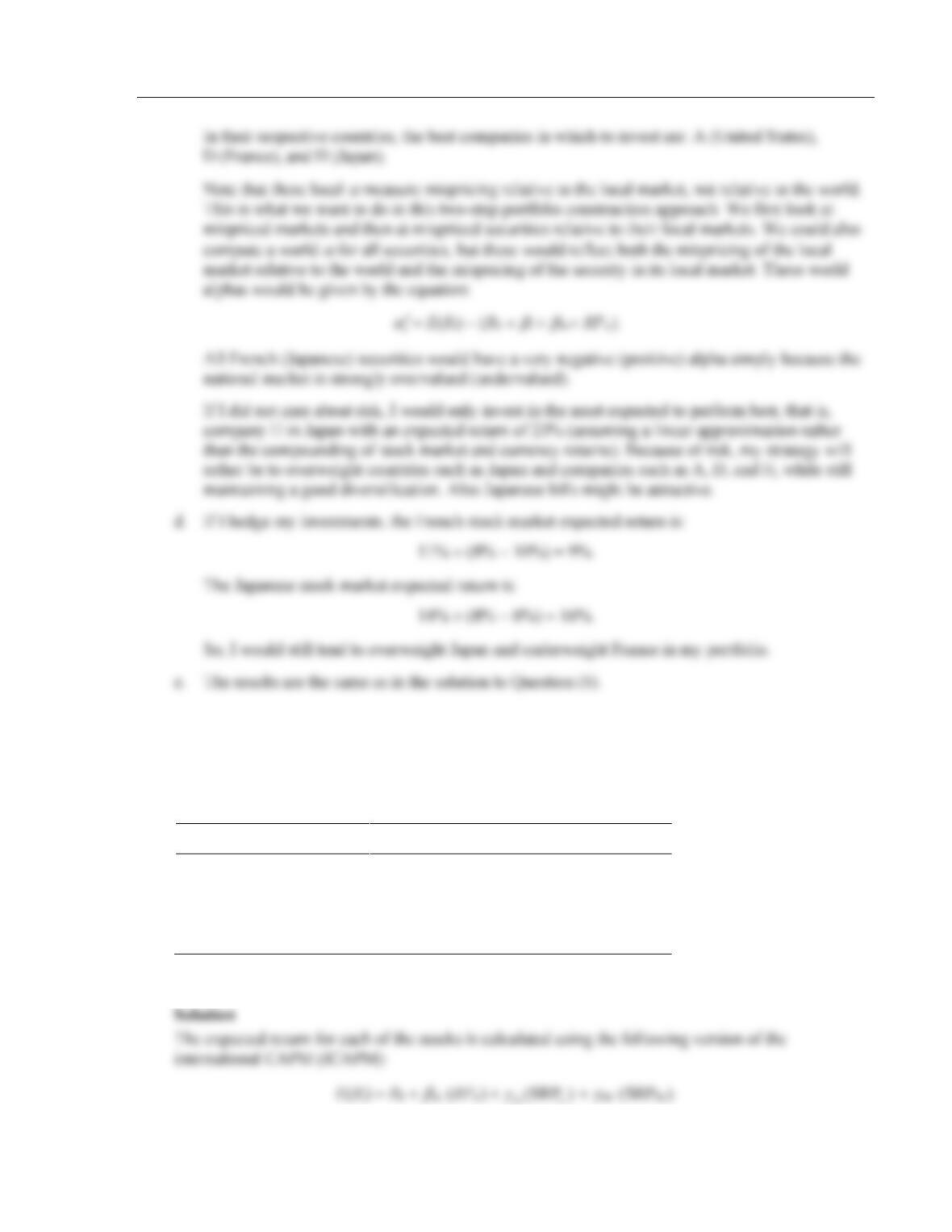
a. Write the international CAPM equations that would hold for each national market and security.
Express it in dollars and in the security’s local currency.
b. Which national market should you under/overweight in your global portfolio? [To answer this
question, you will first calculate the expected return of all three markets in dollars. You will then
compare those to the theoretical expected return suggested by the international CAPM.]
Chapter 4 International Asset Pricing 29
c. Which are the most attractive stocks in each market? [To answer this question, you will compare
the expected return of each security to its theoretical expected return suggested by the domestic
CAPM.]
Assume now that you only invest in foreign stocks that are fully hedged against currency risk.
d. Which national market should you under/overweight in your global portfolio?
e. Which are the most attractive stocks?
30 Solnik/McLeavey • Global Investments, Sixth Edition
Chapter 4 International Asset Pricing 31
7. Assume that you are a British investor who is considering investments in the German (Stocks A and
B) and Swiss (Stocks C and D) stock markets. The world market risk premium is 4.5%. The currency
risk premium on the Swiss franc is 0.5%, and the currency risk premium on the euro is 1%. The
interest rate on one-year risk-free bonds is 4% in the United Kingdom. In addition, you are provided
with the following information:
Stock
A
B
C
D
Country
Germany
Germany
Switzerland
Switzerland
w
1
0.90
1
1.5
€
1
0.80
−0.25
−1.0
SF
−0.25
0.75
1.0
−0.5
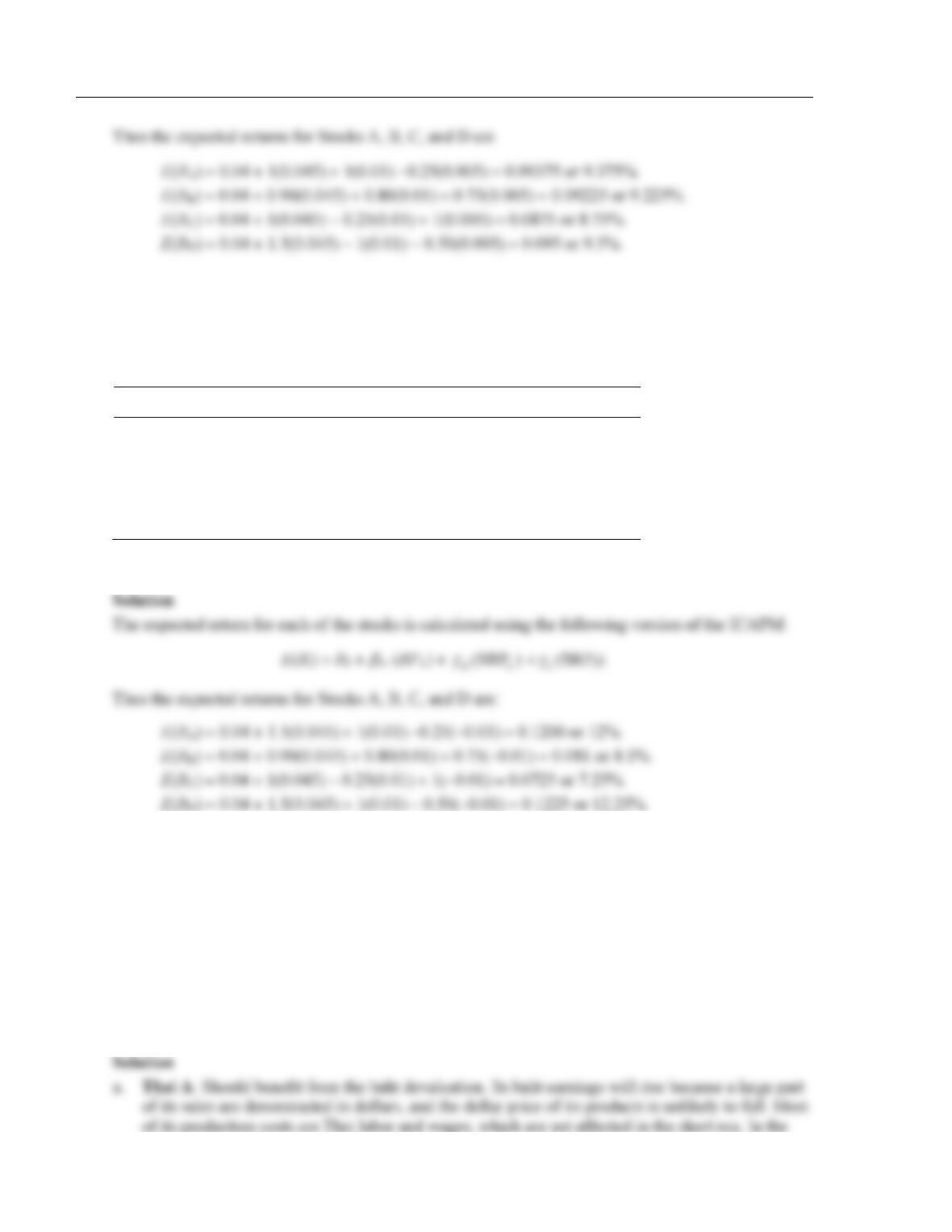
Calculate the expected return for each of the stocks. The British pound is the base currency.
32 Solnik/McLeavey • Global Investments, Sixth Edition
8. Assume that you are a U.S. investor who is considering investments in the German (Stocks A and B)
and British (Stocks C and D) stock markets. The world market risk premium is 4.5%. The currency
risk premium on the euro is 1%, and the currency risk premium on the pound is −1%. In the United
States, the interest rate on one-year risk-free bonds is 4%. In addition, you are provided with the
following information:
Stock
A
B
C
D
Country
Germany
Germany
United
Kingdom
United
Kingdom
w
1.5
0.90
1
1.5
€
1
0.80
−0.25
1.0
£
−0.25
0.75
1.0
−0.5
Calculate the expected return for each of the stocks. The U.S. dollar is the base currency.
9. Consider two Thai firms listed on the Bangkok stock exchange:
• Thai A is a mining company that exports a large part of its minerals production. Much larger
competitors can be found in Latin and North America. The market price of its production is largely
determined in dollars on the world market.
• Thai B imports various engine parts from Europe and the United States. The demand for its
product is highly price elastic. A significant rise in baht prices lowers the demand.
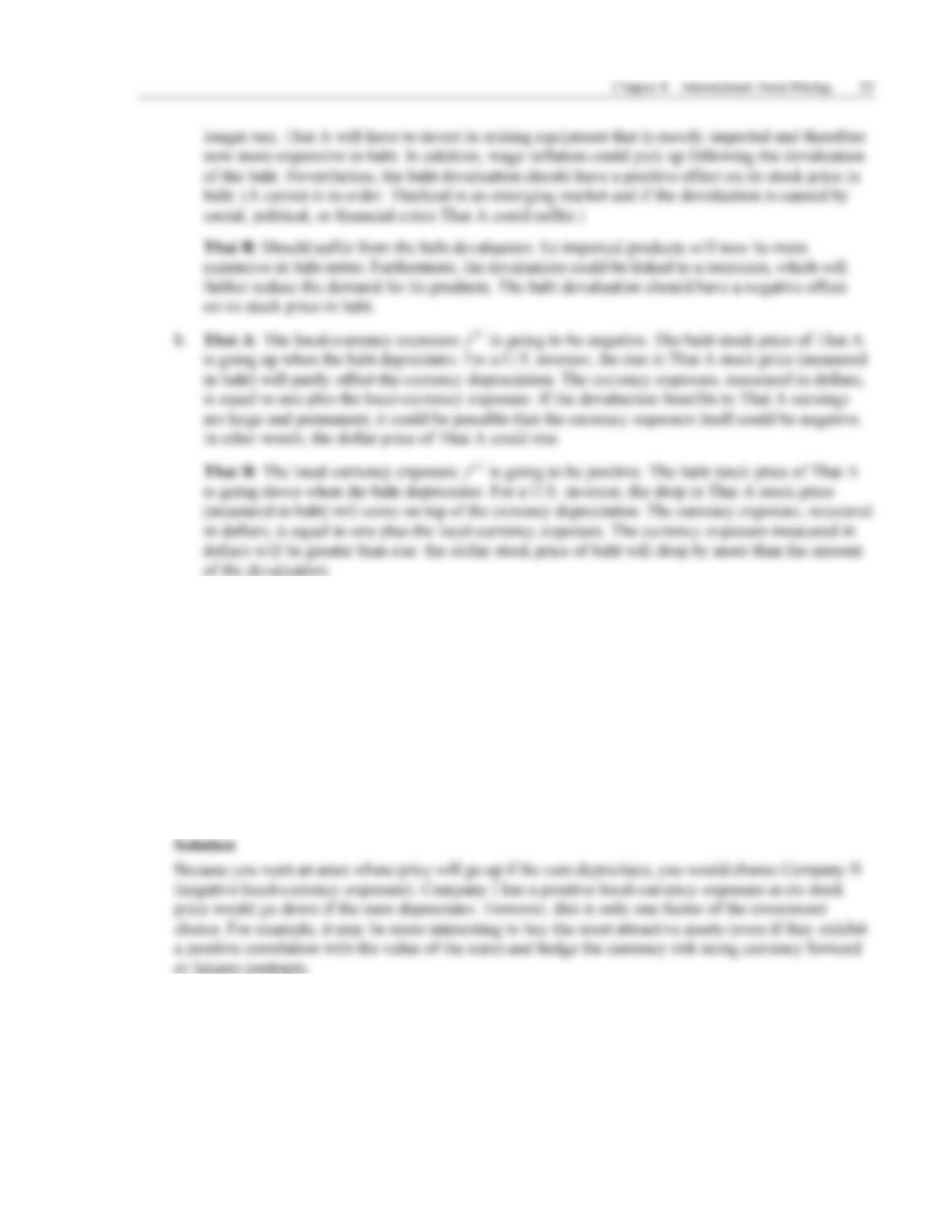
a. What will happen to the earnings and stock prices of the two companies if there is a sudden and
large devaluation of the Thai baht against major currencies?
b. What can you say about the currency exposures of the two companies (
’s)
10. Consider two European firms listed on Euronext:
• Company I: Its stock return shows a consistent positive correlation with the value of the euro.
The stock price of Company I (in euros) tends to go up when the euro appreciates relative to the
U.S. dollar.
• Company II: Its stock return shows a consistent negative correlation with the value of the euro.
The stock price of Company II (in euros) tends to go down when the euro appreciates relative to
the U.S. dollar.
An American investor wishes to buy European stocks but is unsure about whether to invest in
Company I or Company II. She is afraid of a depreciation of the euro relative to the U.S. dollar.
Which of the two investments would offer some protection against a weakening U.S. dollar?
11. Thailand limits foreign ownership of Thai companies to a maximum percentage of all the shares
issued. The limit in 2002 was generally 49%, but could be lower for some industries or firms. Once a
company has reached this limit, it starts to be traded on two different boards. Foreigners trade on the
Alien Board, while, Thai investors must still trade in the same share on the Main Board. Thai
investors are allowed to purchase shares on the Alien Board, but not to sell them. Main and Alien
Board shares are identical in all other respects.
a. Why does this segmentation ensure that the limit on foreign ownership is respected?
34 Solnik/McLeavey • Global Investments, Sixth Edition
b. Shares listed on the Alien Board trade at a fairly large premium over their Main Board
counterparts. Give some likely explanations.