58 Chapter 4 The Time Value of Money
47. If you buy a factory for $250,000 and the terms are 20 percent down, the balance to be paid off
over 30 years at a 12 percent rate of interest on the unpaid balance, what are the 30 equal annual
payments?
a.
$20,593
b.
$31,036
c.
$24,829
d.
$50,212
e.
$6,667
Chapter 4 The Time Value of Money 59
48. In its first year of operations, 1989, the Gourmet Cheese Shoppe had earnings per share (EPS) of
$0.26. Four years later, in 1993, EPS was up to $0.38, and 7 years after that, in 2000, EPS was up
to $0.535. It appears that the first 4 years represented a supernormal growth situation and since
then a more normal growth rate has been sustained. What are the rates of growth for the earlier
period and for the later period?
a.
6%; 5%
b.
6%; 3%
c.
10%; 8%
d.
10%; 5%
e.
12%; 7%
49. Steaks Galore needs to arrange financing for its expansion program. One bank offers to lend the
required $1,000,000 on a loan which requires interest to be paid at the end of each quarter. The
quoted rate is 10 percent, and the principal must be repaid at the end of the year. A second lender
offers 9 percent, daily compounding (365-day year), with interest and principal due at the end of
the year. What is the difference in the effective annual rates (EFF%) charged by the two banks?
a.
0.31%
b.
0.53%
c.
0.75%
d.
0.96%
e.
1.25%
60 Chapter 4 The Time Value of Money
50. You are currently at time period 0, and you will receive the first payment on an annual payment
annuity of $100 in perpetuity at the end of this year. Six full years from now you will receive the
first payment on an additional $150 in perpetuity, and at the end of time period 10 you will
receive the first payment on an additional $200 in perpetuity. If you require a 10 percent rate of
return, what is the combined present value of these three perpetuities?
a.
$2,349.50
b.
$2,526.85
c.
$2,685.42
d.
$2,779.58
e.
$2,975.40
Chapter 4 The Time Value of Money 61
51. Find the present value of an income stream which has a negative flow of $100 per year for 3
years, a positive flow of $200 in the 4th year, and a positive flow of $300 per year in Years 5
through 8. The appropriate discount rate is 4 percent for each of the first 3 years and 5 percent for
each of the later years. Thus, a cash flow accruing in Year 8 should be discounted at 5 percent for
some years and 4 percent in other years. All payments occur at year-end.
a.
$528.21
b.
$1,329.00
c.
$792.49
d.
$1,046.41
e.
$875.18
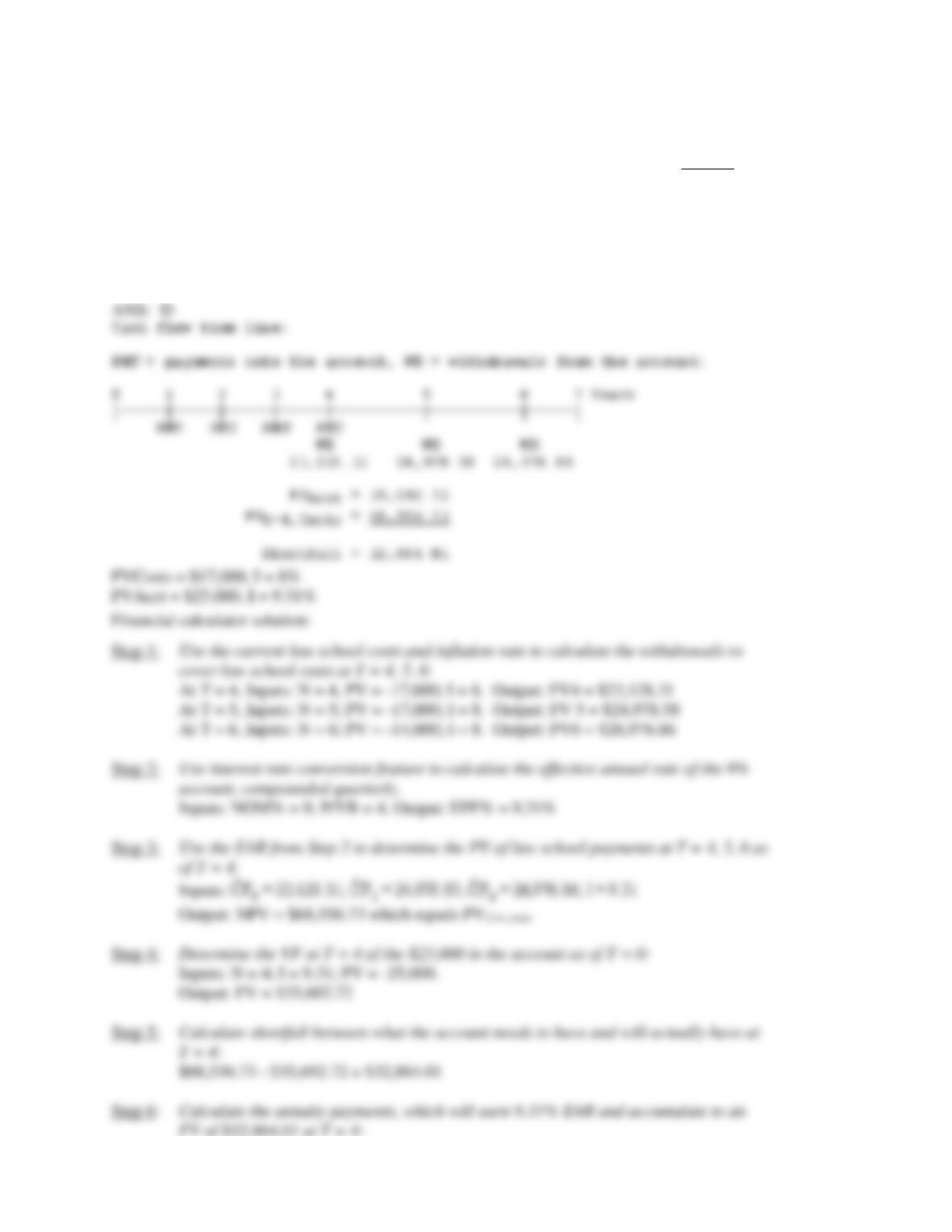
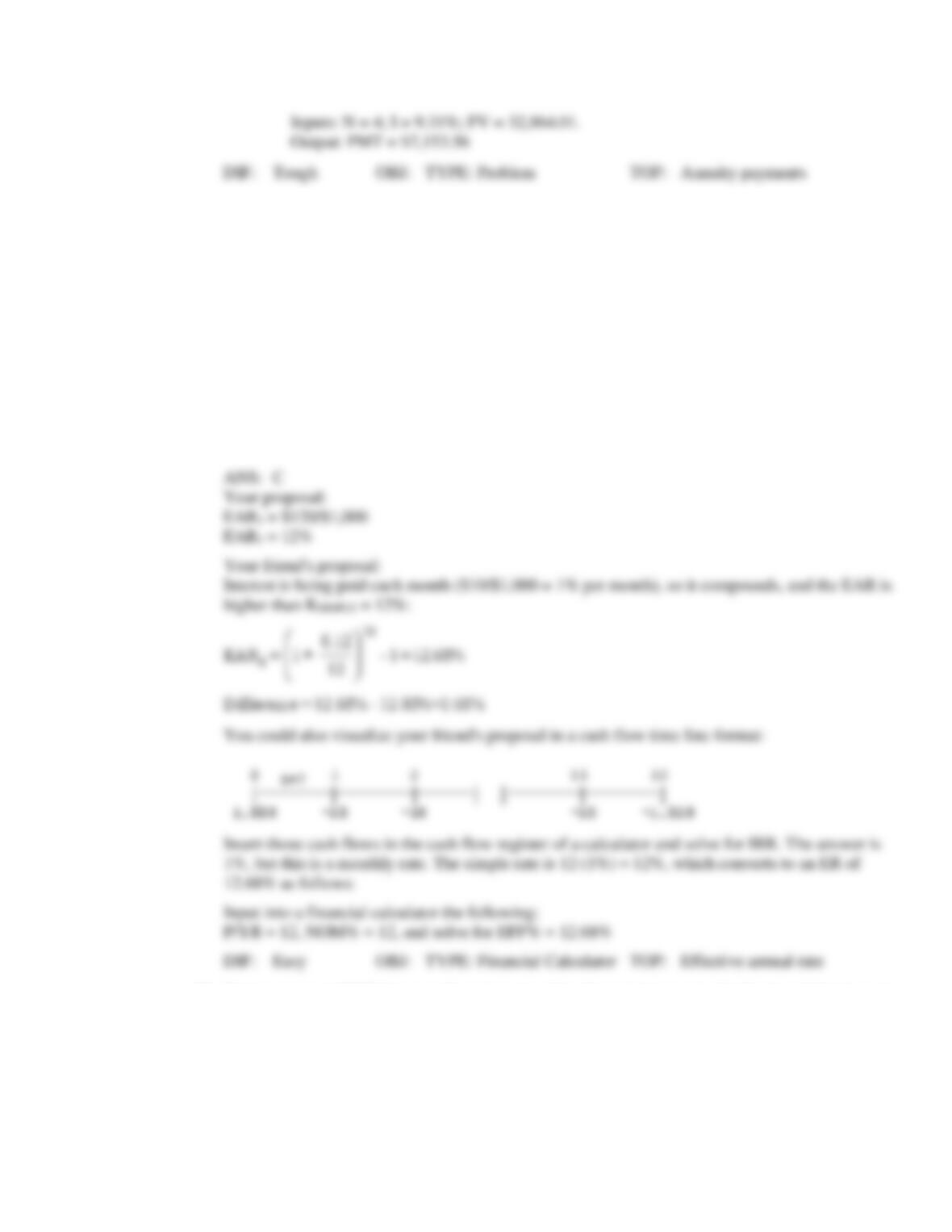
52. Assume that you are graduating, that you plan to work for 4 years, and then to go to law school
for 3 years. Right now, going to law school would require $17,000 per year (for tuition, books,
living expenses, etc.), but you expect this cost to rise by 8 percent per year in all future years.
You now have $25,000 invested in an investment account which pays a simple annual rate of 9
percent, quarterly compounding, and you expect that rate of return to continue into the future.
You want to maintain the same standard of living while in law school that $17,000 per year
would currently provide. You plan to save and to make 4 equal payments (deposits) which will be
added to your account at the end of each of the next 4 years; these new deposits will earn the
same rate as your investment account currently earns. How large must each of the 4 payments be
62 Chapter 4 The Time Value of Money
in order to permit you to make 3 withdrawals, at the beginning of each of your 3 years in law
school? (Note: (1) The first payment is made a year from today and the last payment 4 years from
today, (2) the first withdrawal is made 4 years from today, and (3) the withdrawals will not be of
a constant amount.)
a.
$13,242.67
b.
$6,562.13
c.
$10,440.00
d.
$7,153.56
e.
$14,922.85
Chapter 4 The Time Value of Money 63
Financial Calculator Section
The following question(s) may require the use of a financial calculator.
53. You want to borrow $1,000 from a friend for one year, and you propose to pay her $1,120 at the
end of the year. She agrees to lend you the $1,000, but she wants you to pay her $10 of interest at
the end of each of the first 11 months plus $1,010 at the end of the 12th month. How much higher
is the effective annual rate under your friend’s proposal than under your proposal?
a.
0.00%
b.
0.45%
c.
0.68%
d.
0.89%
e.
1.00%
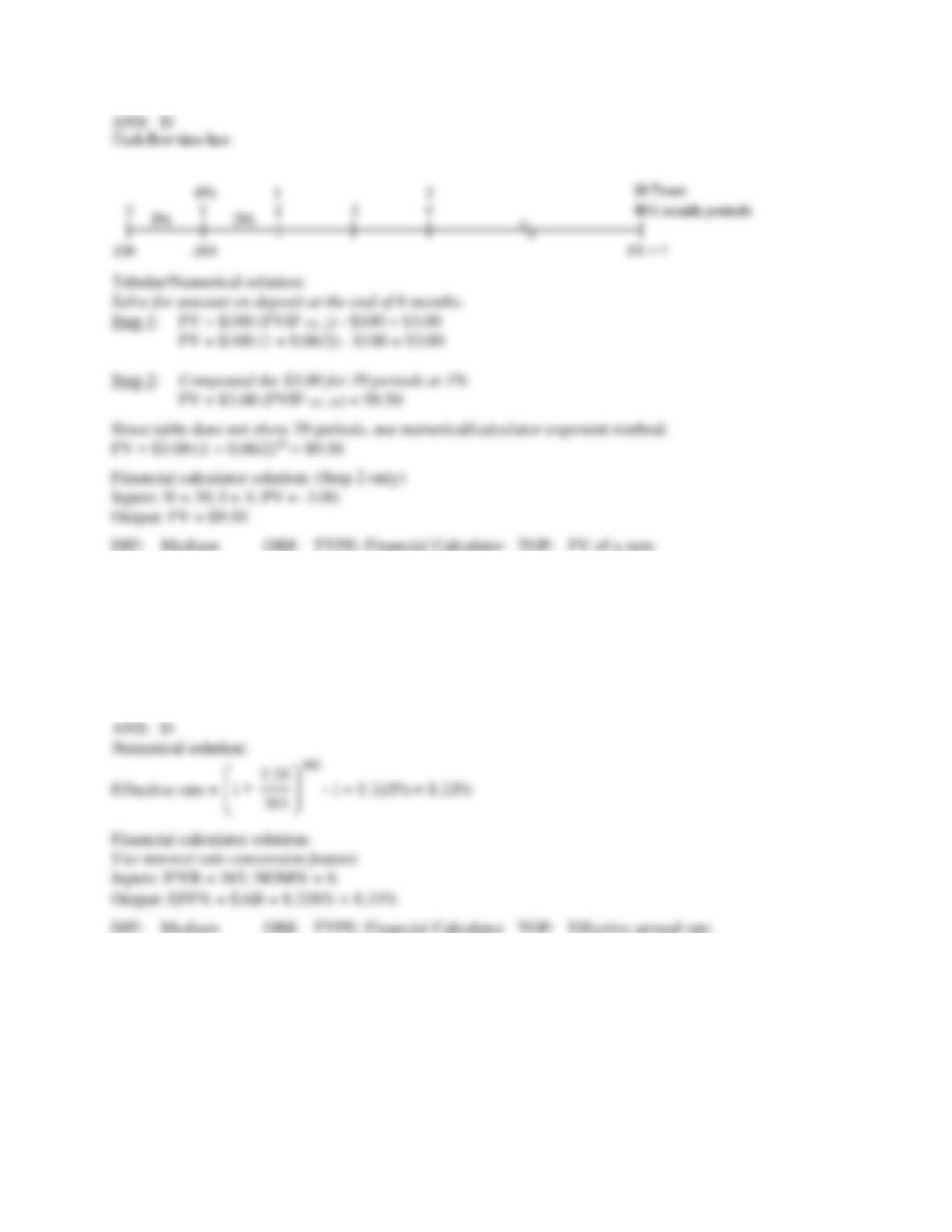
54. Suppose you put $100 into a savings account today, the account pays a simple annual interest rate
of 6 percent, but compounded semiannually, and you withdraw $100 after 6 months. What would
your ending balance be 20 years after the initial $100 deposit was made?
a.
$226.20
b.
$115.35
c.
$62.91
d.
$9.50
e.
$3.00
64 Chapter 4 The Time Value of Money
55. A bank pays a quoted annual (simple) interest rate of 8 percent. However, it pays interest
(compounds) daily using a 365-day year. What is the effective annual rate of return?
a.
7.86%
b.
7.54%
c.
8.57%
d.
8.33%
e.
9.21%
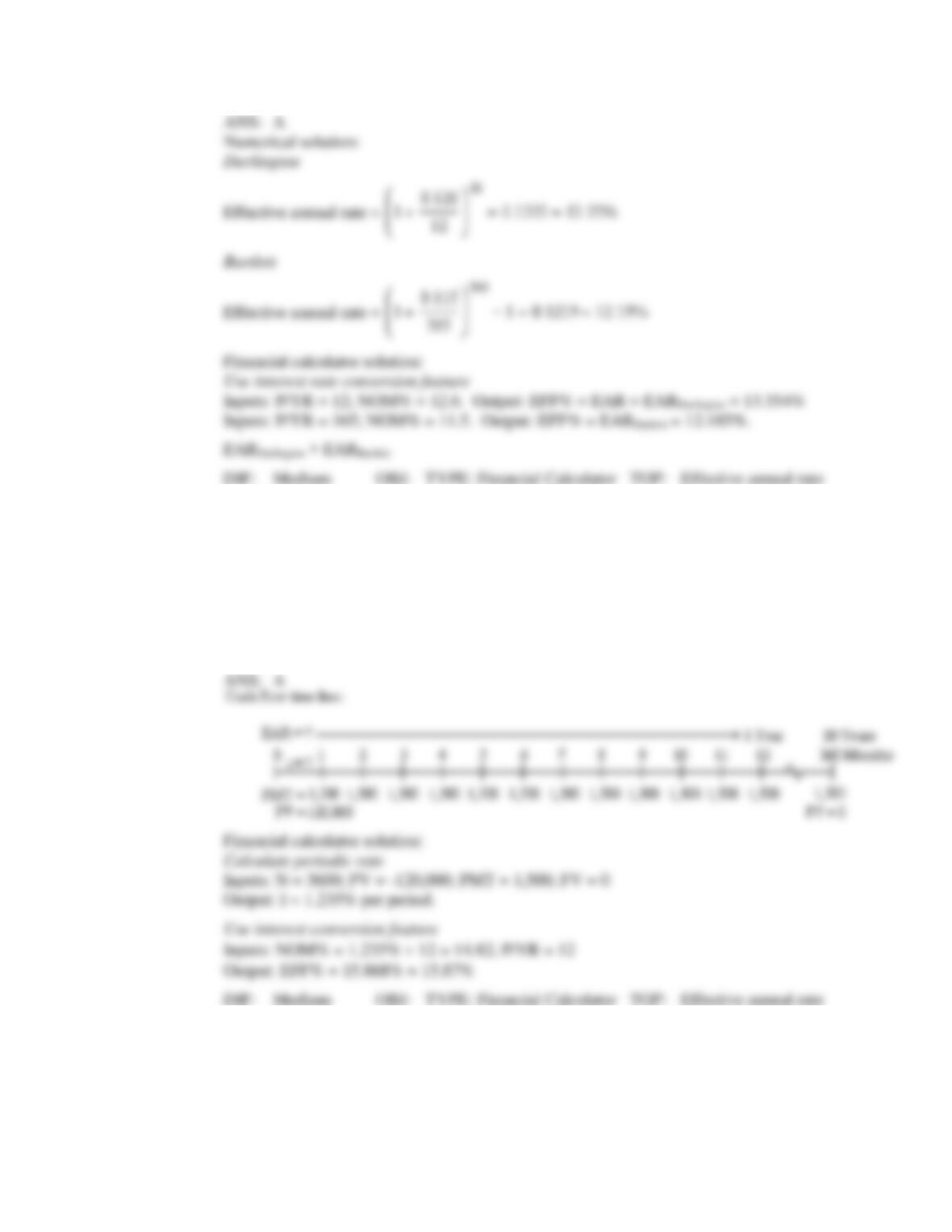
56. You can deposit your savings at the Darlington National Bank, which offers to pay 12.6 percent
interest compounded monthly, or at the Bartlett Bank, which will pay interest of 11.5 percent
compounded daily. (Assume 365 days in a year.) Which bank offers the higher effective annual
rate?
a.
Darlington National Bank.
b.
Bartlett Bank.
c.
Both banks offer the same effective rate.
d.
Cannot be determined from the information provided.
e.
Workable only if the banks use the same compounding period.
Chapter 4 The Time Value of Money 65
57. You have just taken out a 30-year, $120,000 mortgage on your new home. This mortgage is to be
repaid in 360 equal end-of-month installments. If each of the monthly installments is $1,500,
what is the effective annual interest rate on this mortgage?
a.
15.87%
b.
14.75%
c.
13.38%
d.
16.25%
e.
16.49%
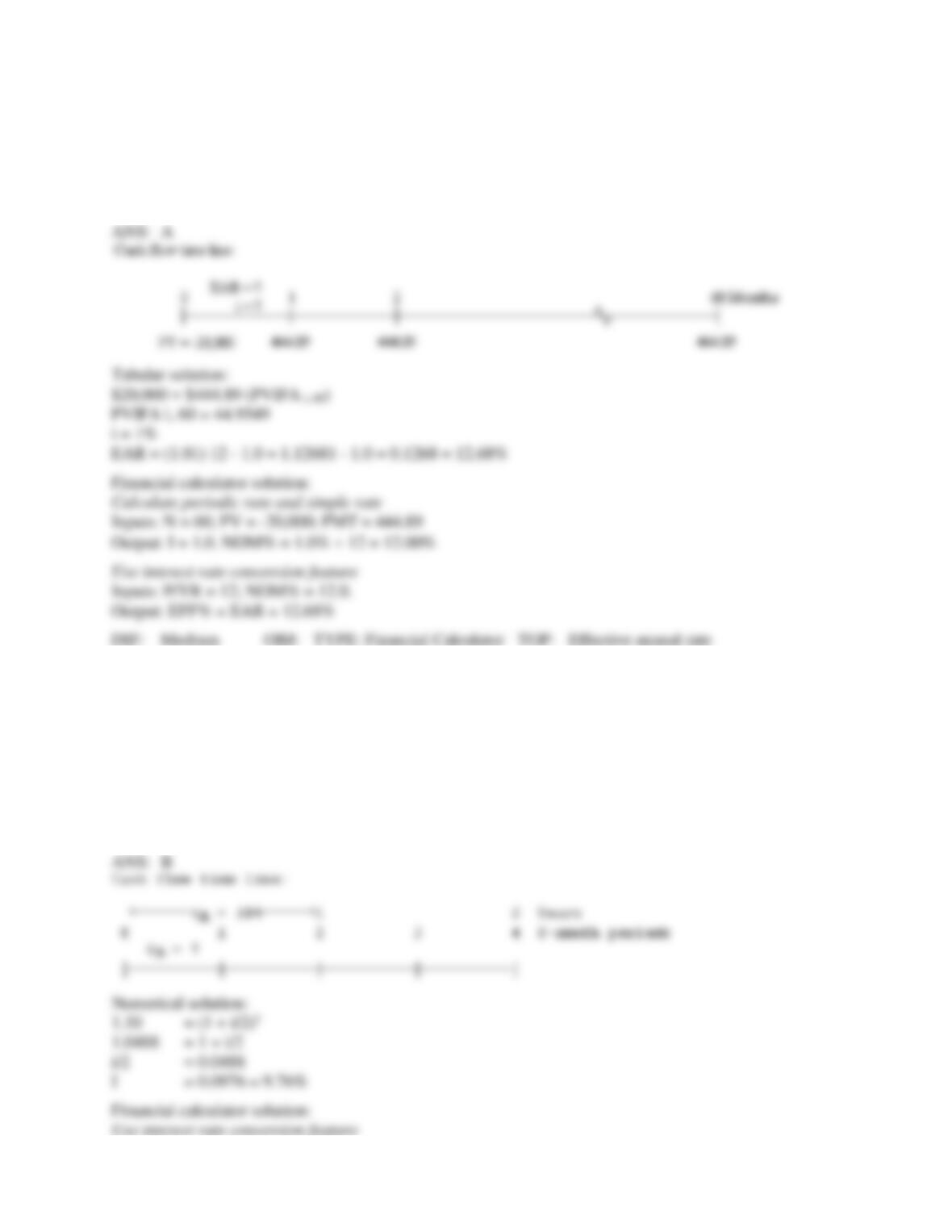
58. You have just borrowed $20,000 to buy a new car. The loan agreement calls for 60 monthly
payments of $444.89 each to begin one month from today. If the interest is compounded monthly,
then what is the effective annual rate on this loan?
66 Chapter 4 The Time Value of Money
a.
12.68%
b.
14.12%
c.
12.00%
d.
13.25%
e.
15.08%
59. Bank A offers a 2-year certificate of deposit (CD) that pays 10 percent compounded annually.
Bank B offers a 2-year CD that is compounded semi-annually. The CDs have identical risk. What
is the stated, or simple, rate that Bank B would have to offer to make you indifferent between the
two investments?
a.
9.67%
b.
9.76%
c.
9.83%
d.
9.87%
e.
9.93%
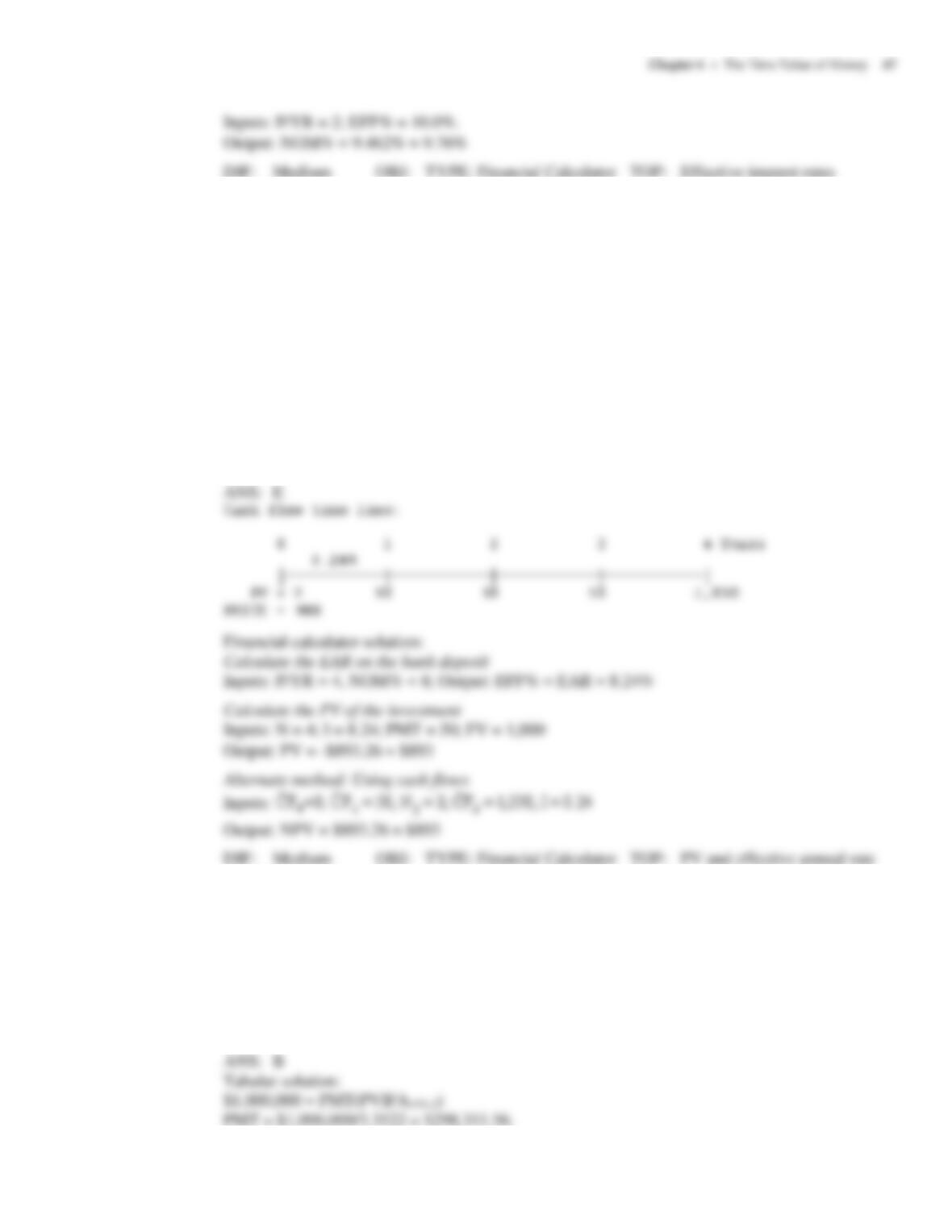
60. Assume that you inherited some money. A friend of yours is working as an unpaid intern at a
local brokerage firm, and her boss is selling some securities which call for four payments, $50 at
the end of each of the next 3 years, plus a payment of $1,050 at the end of Year 4. Your friend
says she can get you some of these securities at a cost of $900 each. Your money is now invested
in a bank that pays an 8 percent simple (quoted) interest rate, but with quarterly compounding.
You regard the securities as being just as safe, and as liquid, as your bank deposit, so your
required effective annual rate of return on the securities is the same as that on your bank deposit.
You must calculate the value of the securities to decide whether they are a good investment. What
is their present value to you?
a.
$1,000
b.
$866
c.
$1,050
d.
$901
e.
$893
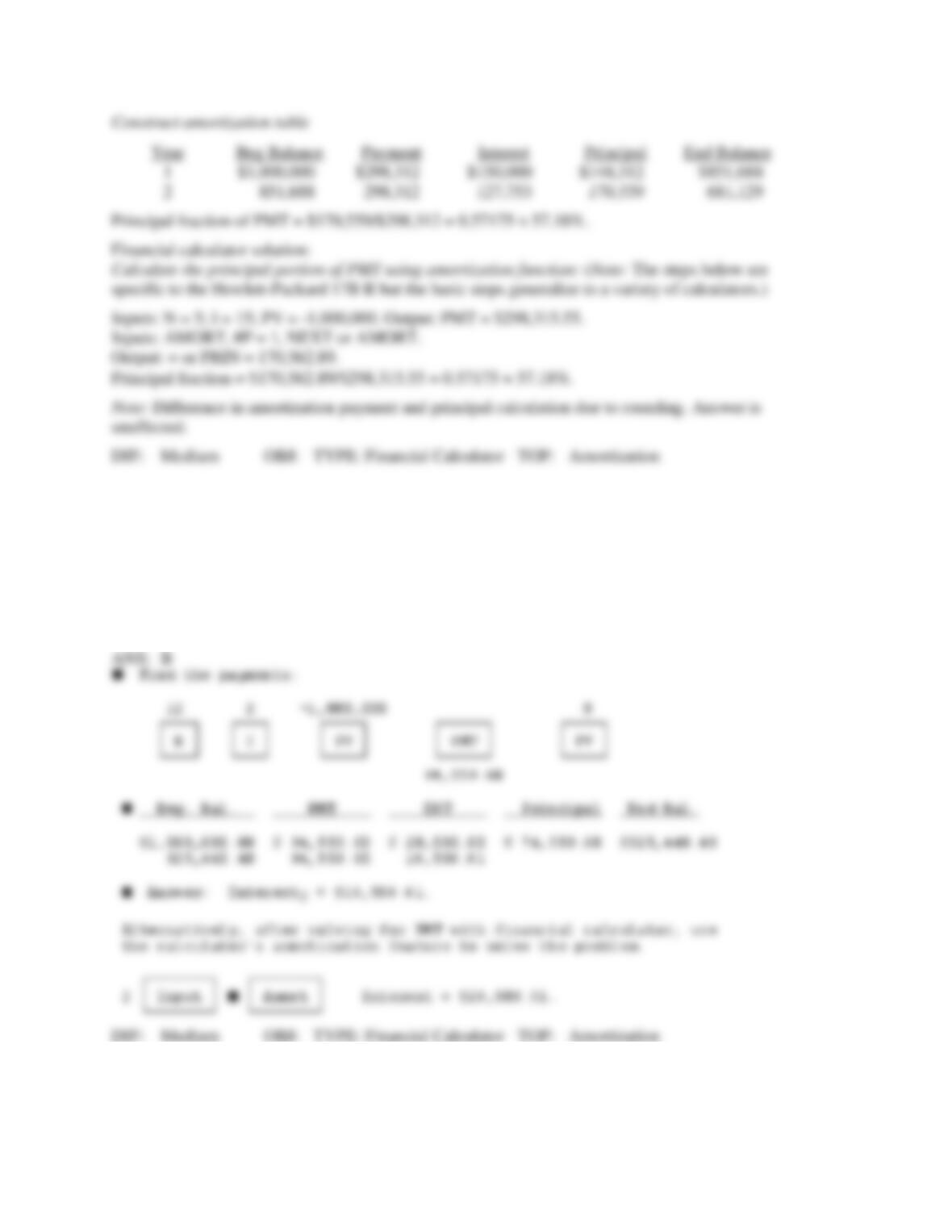
61. Your company is planning to borrow $1,000,000 on a 5-year, 15 percent, annual payment, fully
amortized term loan. What fraction of the payment made at the end of the second year will
represent repayment of principal?
a.
29.83%
b.
57.18%
c.
35.02%
d.
64.45%
e.
72.36%
68 Chapter 4 The Time Value of Money
62. The Desai Company just borrowed $1,000,000 for 3 years at a quoted rate of 8 percent, quarterly
compounding. The loan is to be amortized in end-of-quarter payments over its 3-year life. How
much interest (in dollars) will your company have to pay during the second quarter?
a.
$15,675.19
b.
$18,508.81
c.
$21,205.33
d.
$24,678.89
e.
$28,111.66
Chapter 4 The Time Value of Money 69
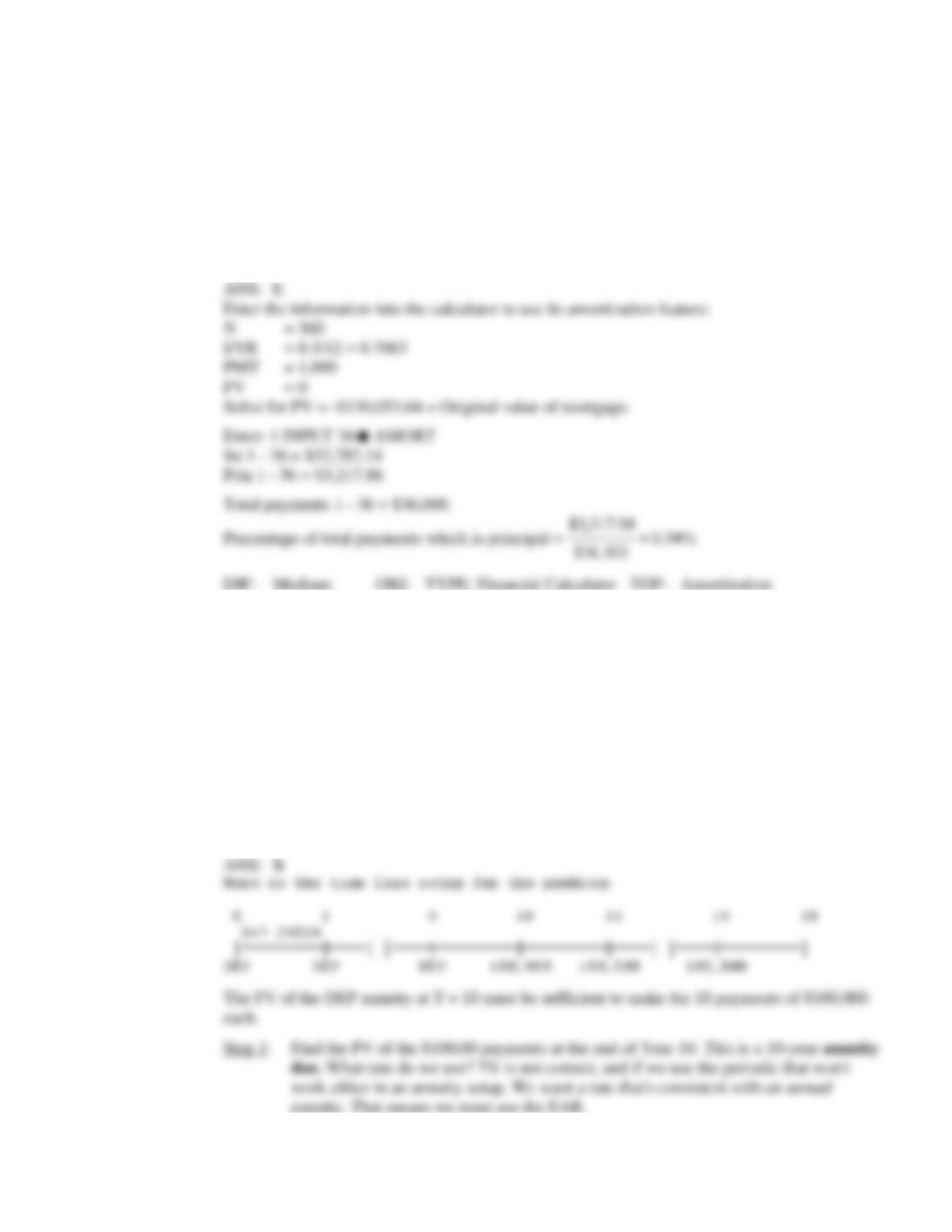
63. You have a 30-year mortgage with a simple annual interest rate of 8.5 percent. The monthly
payment is $1,000. What percentage of your total payments over the first three years goes toward
the repayment of principal?
a.
1.50%
b.
3.42%
c.
5.23%
d.
6.75%
e.
8.94%
64. Your company must make payments of $100,000 each year for 10 years, with the first payment to
be made 10 years from today. To prepare for these payments, your company must make 10 equal
annual deposits into an account which pays a simple interest rate of 7 percent, daily compounding
(360-day year). Funds will remain in the account during both the accumulation period (the first 10
years) and the distribution period (the last 10 years), and the same interest rate will be earned
throughout the entire 20 years. The first deposit will be made immediately. How large must each
deposit be?
a.
$47,821.11
b.
$49,661.86
c.
$51,234.67
d.
$52,497.33
e.
$53,262.39