Biology: A Guide to the Natural World, 5e (Krogh)
Chapter 4 Life’s Home: The Cell
1) ________ are the fundamental units of life.
A) Organelles
B) Tissues
C) Cells
D) Organisms
2) Cells contain organized structures that perform a specific function. These are known as:
A) organs.
B) organelles.
C) cytoplasm.
D) prokaryotes.
E) tissues.
3) Prokaryotic cells lack:
A) DNA.
B) proteins.
C) internal compartmentalization.
D) ribosomes.
4) Prokaryotic cells include:
A) bacteria and animal cells.
B) bacteria and plant cells.
C) bacteria and archaea.
D) archaea and fungi.
5) Which of the following expresses an accurate difference between prokaryotic and eukaryotic
cells?
A) Eukaryotes have a nucleus, but prokaryotes do not.
B) Prokaryotes have organelles, but eukaryotes do not.
C) Prokaryotes can be multicellular, but eukaryotes cannot.
D) Prokaryotic cells are larger than eukaryotes.
6) You isolate a cell with the following characteristics: (1) no nucleus, (2) only a single type of
organelle, and (3) 2 μm in size. This cell could be a/an:
A) bacterium.
B) plant cell.
C) animal cell.
D) bacterial cell or a plant cell.
E) plant cell or an animal cell.
7) Which of the following describes the difference between the cytoplasm and the cytosol?
A) The cytoplasm is the region inside the plasma membrane but outside the nucleus, whereas the
cytosol is the fluid medium inside the cell.
B) The cytoplasm is the region inside the plasma membrane that includes the nucleus, whereas
the cytosol is the fluid medium inside the cell.
C) The cytoplasm is the fluid medium inside the cell, whereas the cytosol is the region outside
the nucleus.
D) The cytoplasm is the region only outside the nucleus, and the cytosol is the region only inside
the nucleus.
8) The outer lining of a cell is the:
A) cytosol.
B) plasma membrane.
C) cytoskeleton.
D) nucleus.
9) Proteins destined to be secreted by the cell are produced:
A) by the smooth endoplasmic reticulum.
B) in the cytosol.
C) on the rough endoplasmic reticulum.
D) by the Golgi complex.
E) by free ribosomes.
10) A secretory protein that exits from the ER within a vesicle will head directly to the:
A) nucleus.
B) cytosol.
C) mitochondria.
D) Golgi complex.
E) plasma membrane.
11) What determines whether a protein will be produced on a “free ribosome” or on one attached
to the endoplasmic reticulum?
A) a chemical signal on the protein being produced
B) a special sequence of nucleotides on the mRNA molecule
C) a special sequence of amino acids on the protein being produced
D) whether the mRNA first binds to a “free ribosome” or one attached to the endoplasmic
reticulum
12) The function of the nucleus is to:
A) contain the DNA.
B) contain the cytoplasm.
C) produce proteins.
D) add sugars to proteins.
E) organize the cytoskeleton.
13) Which of the following is the correct order of events in a cell?
A) DNA makes protein; protein makes RNA.
B) Protein makes DNA; DNA makes RNA.
C) RNA makes DNA; DNA makes protein.
D) RNA makes protein; protein makes DNA.
E) DNA makes RNA; RNA makes protein.
14) Which of the following is a function of the nucleolus?
A) to allow mRNA to leave the nucleus
B) to act as the site of DNA synthesis
C) to attach polysaccharides to protein molecules
D) to synthesize ribosomal RNA
E) to synthesize messenger RNA
15) The function of ribosomes is to synthesize:
A) RNA.
B) lipids.
C) DNA.
D) proteins.
E) polysaccharides.
16) Many antibiotics work by blocking the function of ribosomes. Therefore, these antibiotics
will:
A) block DNA synthesis.
B) block protein synthesis.
C) block RNA synthesis.
D) prevent the movement of proteins through nuclear pores.
E) make the two nuclear membranes fuse into one.
17) Insulin is a protein made in large amounts in cells of the pancreas. These cells secrete insulin
into the blood, where it controls the uptake of sugar by body cells. How is insulin transported
from the ER to the surface of the cell?
A) Insulin is sent through the cavities (lumen) of the endoplasmic reticulum that attach directly
to the plasma membrane.
B) Insulin moves along tracks of cytoskeleton proteins.
C) Insulin moves through plasmodesmata to the surface of the cell.
D) Insulin is carried in small sacs of membrane (vesicles) that move from the endoplasmic
reticulum to the Golgi apparatus and then to the plasma membrane.
E) Insulin is carried by lysosomes that empty their contents outside the cell.
18) Which of the following is involved in modifying, sorting, and shipping proteins?
A) mitochondria
B) lysosomes
C) the Golgi complex
D) endoplasmic reticulum
19) Cells can increase the number or size of some organelles in response to new demands. The
amount of one organelle often is increased dramatically in the livers of alcoholics. Based on what
you know of organelle function, this organelle is the:
A) mitochondrion.
B) ribosome.
C) smooth endoplasmic reticulum.
D) nucleus.
E) Golgi apparatus.
20) Which choice below correctly matches organelle with function?
A) lysosome–energy generation
B) smooth endoplasmic reticulum–lipid production
C) mitochondria–food generation
D) cytoskeleton–recycling of materials
6
21) Tay-Sachs disease results from the accumulation of fatty deposits within neurons, when
normally they should be broken down within these cells. The organelle that would be defective
in Tay-Sachs would most likely be the:
A) lysosome.
B) Golgi complex.
C) ribosome.
D) endoplasmic reticulum.
E) mitochondrion.
22) Animal cells need oxygen most directly to:
A) produce ATP.
B) secrete enzymes.
C) produce DNA.
D) produce protein.
23) The most common form of cystic fibrosis, a fatal genetic disease, occurs when a protein
destined for the plasma membrane of the cell is destroyed. The protein is destroyed by one of the
cell’s organelles because the protein is not shaped correctly. Which organelle recognizes the
misshaped protein?
A) nucleus
B) lysosome
C) rough endoplasmic reticulum
D) Golgi complex
E) ribosome
24) People with oxidative phosphorylation disorders suffer a lack of energy that can lead to
diminished function of nerve and muscle cells. The organelle most likely to be altered in
oxidative phosphorylation disorders is the:
A) chloroplast.
B) cytoskeleton.
C) cell wall.
D) mitochondrion.
E) rough endoplasmic reticulum.
25) The 1992 film Lorenzo’s Oil told the true story of Lorenzo Odone who suffered from the
disease adrenoleukodystrophy. This disease affected an organelle in his cells called a
peroxisome. The peroxisome lacked an enzyme that controls the breakdown of a long chain fatty
acid that resulted in a buildup of the fatty acid in his brain and spinal cord. The function of
peroxisomes must be similar to the function of what other organelle?
A) mitochondrion
B) smooth endoplasmic reticulum
C) lysosome
D) Golgi complex
E) chloroplast
26) Smoker’s cough results from damage to the external structure of lung cells by tobacco
smoke. What part of the cell would you predict is damaged?
A) the Golgi complex
B) plasmodesmata
C) the mitochondria
D) cilia
E) the lysosome
27) What maintains cell shape, anchors organelles in place, and moves materials within a cell?
A) cytoskeleton
B) hydrogen bonds
C) cilia
D) Golgi complex
28) The cytoskeleton is composed of:
A) microtubules, intermediate filaments, and cilia.
B) microfilaments, intermediate filaments, and microtubules.
C) microfilaments, microtubules, and lysosomes.
D) microfilaments, cilia, and intermediate filaments.
E) microfilaments, mitochondria, and intermediate filaments.
29) Which of the following pairs is correctly matched?
A) intermediate filaments–actin
B) microfilaments–permanent
C) microtubules–tubulin
D) endomembrane system–cilia
30) Both cilia and flagella are involved in which of the following functions?
A) energy production
B) production of proteins
C) movement of cells or movement of material around a cell
D) expelling waste
E) division of the cell
31) Microfilaments:
A) stabilize the position of the nucleus.
B) act as “monorails” along which organelles move.
C) help cells move or capture prey.
D) form the structure of cilia and flagella.
32) Eukaryotic cilia and flagella:
A) are only found in single-celled organisms.
B) are both involved in sweeping the lungs clean of foreign matter.
C) occur in large numbers on the surface of the cell.
D) both have microtubules forming their underlying structure.
E) may also act as receptors for hormones.
33) Mitochondria and chloroplasts are similar to one another in that both:
A) capture the energy of the sun during photosynthesis and store it as sugar.
B) have their own DNA and their own ribosomes.
C) convert the energy of the sugar into ATP for use by the cell.
D) are present in all eukaryotic cells.
34) Which of the following are associated with energy transfer in eukaryotic cells?
A) chloroplasts and mitochondria
B) mitochondria and rough ER
C) mitochondria and smooth ER
D) chloroplasts and the cell wall
E) lysosomes and Golgi complex
35) You owe your life to chloroplasts. The reason for this is that:
A) chloroplasts supply all the ATP needed by living organisms.
B) when we eat plants, it is the chloroplasts that are the nutritious part of plant cells.
C) chloroplasts produce all the water and carbon dioxide essential for life.
D) chloroplasts produce the oxygen we breathe and ultimately are the source of most nutrients
we consume.
E) like the ancestors of mitochondria, the ancestors of chloroplasts were once bacteria taken up
by a eukaryotic cell.
36) Which of the following would you find in a plant cell but not an animal cell?
A) lysosome
B) microtubule
C) a central vacuole
D) mitochondrion
37) Cell walls can be found as part of:
A) animal cells, fungi, and protists.
B) plant cells, bacteria, fungi, and protists.
C) protists and animal cells.
D) bacterial cells.
E) plant cells.
38) The large central vacuole of plants:
A) may make up as much as 90 percent of the internal volume of the cell.
B) replaces the nucleus.
C) allows the plant to produce its own food.
D) produces proteins.
39) An important by-product of photosynthesis is:
A) glucose.
B) oxygen.
C) protein.
D) starch.
E) water.
40) Which organelles are believed to have originated from free-standing bacteria ingested by
ancient eukaryotic cells?
A) mitochondria and Golgi complex
B) lysosomes and ribosomes
C) chloroplasts and ribosomes
D) chloroplasts and lysosomes
E) mitochondria and chloroplasts
41) Plasmodesmata and gap junctions are similar in that they:
A) provide structural support to cells.
B) are both involved in protein synthesis.
C) form a protective lining around cells.
D) allow cells to communicate with each other.
42) Which of the following would be found as part of a plant cell but not an animal cell?
A) gap junction
B) ribosomes
C) chloroplasts
D) cytoskeleton
43) Plasmodesmata permit cell-to-cell communication in plants. Similar structures found in
animals are:
A) lysosomes.
B) mitochondria.
C) cell walls.
D) vacuoles.
E) gap junctions.
44) Every form of life is either a single cell or is composed of cells.
45) Only eukaryotic cells have membrane-bound organelles.
46) It is estimated that there are more bacteria in your mouth than the number of people who
have ever lived.
47) The typical animal cell is 25 micrometers in diameter.
12
48) Proteins can be modified in either the rough endoplasmic reticulum or the Golgi complex.
49) Vesicles that contain digestive enzymes are called lysosomes.
50) Lysosomes are responsible for producing ATP from the metabolism of food.
51) The rough endoplasmic reticulum is the site where lipid synthesis occurs in an animal cell.
52) The cytoskeleton is an internal scaffolding used for cellular movement.
53) Animal cells contain centrioles and chloroplasts.
54) Animal cells are surrounded by a cell wall.
55) The central vacuole is used for nutrient storage and photosynthesis in plant cells.
56) Ribosomes are found only in plant cells.
57) Without photosynthesis, most animal life on the Earth could not survive.
58) Plasmodesmata allow plant cells to communicate with each other.
59) Gap junctions are found in plant cells.
60) Tiny holes that are channels between animal cells are called gap junctions.
Match the following.
A) smooth endoplasmic reticulum
B) rough endoplasmic reticulum
C) Golgi complex
D) ribosomes
E) mitochondria
61) Modifies, stores, and ships proteins
Topic: Section 4.4
Skill: Knowledge/Comprehension
62) Serves as the site of protein synthesis
Topic: Section 4.4
Skill: Knowledge/Comprehension
63) A network of membranes studded with ribosomes
Topic: Section 4.4
Skill: Knowledge/Comprehension
64) The “power plants” of the cell
Topic: Section 4.5
Skill: Knowledge/Comprehension
65) The site of lipid synthesis
Topic: Section 4.5
Skill: Knowledge/Comprehension
66) The compartment that holds most of a eukaryotic cell’s DNA is the ________.
67) The organelles of a eukaryotic cell are suspended in its ________.
68) mRNA carries a code from the ________ to make a particular polypeptide.
69) Harmful substances are detoxified within the cell by the ________.
70) Actin forms cytoskeletal fibers called ________.
71) Most of the volume of a mature plant cell is taken up by the ________.
72) Viruses reproduce as do cells, but viruses are not considered living things. Explain why this
is the case.
73) List the sequence of organelles a protein would pass through as it moves through the
endomembrane system to the exterior of the cell.
74) Name three organelles involved in the synthesis of proteins in a cell, and describe the role
each organelle plays in the process.
75) Which organelles would not be considered part of the endomembrane system? Explain your
answer.
76) You are camping and decide you will sample some wild berries. You soon start to feel ill and
realize these berries have a toxic substance in them. On your way to the hospital, explain to your
friends which organelles, in which organ of your body, are detoxifying the toxin.
77) Nerve cells have long thin extensions of their cell membrane called axons. The cell has to get
mitochondria from the body of the cell all the way down to the end of the axon to provide energy
for nerve signal transmission. What structure in a nerve cell would be involved in moving the
mitochondria, and how would it work?
78) Compare and contrast cilia and flagella.
79) Name and describe three organelles that are common to animal and plant cells.
80) A man was under treatment for infertility. Examination of his sperm showed that his sperm
could not swim. He also suffered from chronic bronchitis and other respiratory problems in
which mucus with trapped particles was not being cleared from his lungs. From this you might
infer he has a genetic defect affecting which structures inside his cells?
81) Which structures are in a plant cell and not in an animal cell? Which organelle would you
find in an animal cell but not a plant cell?
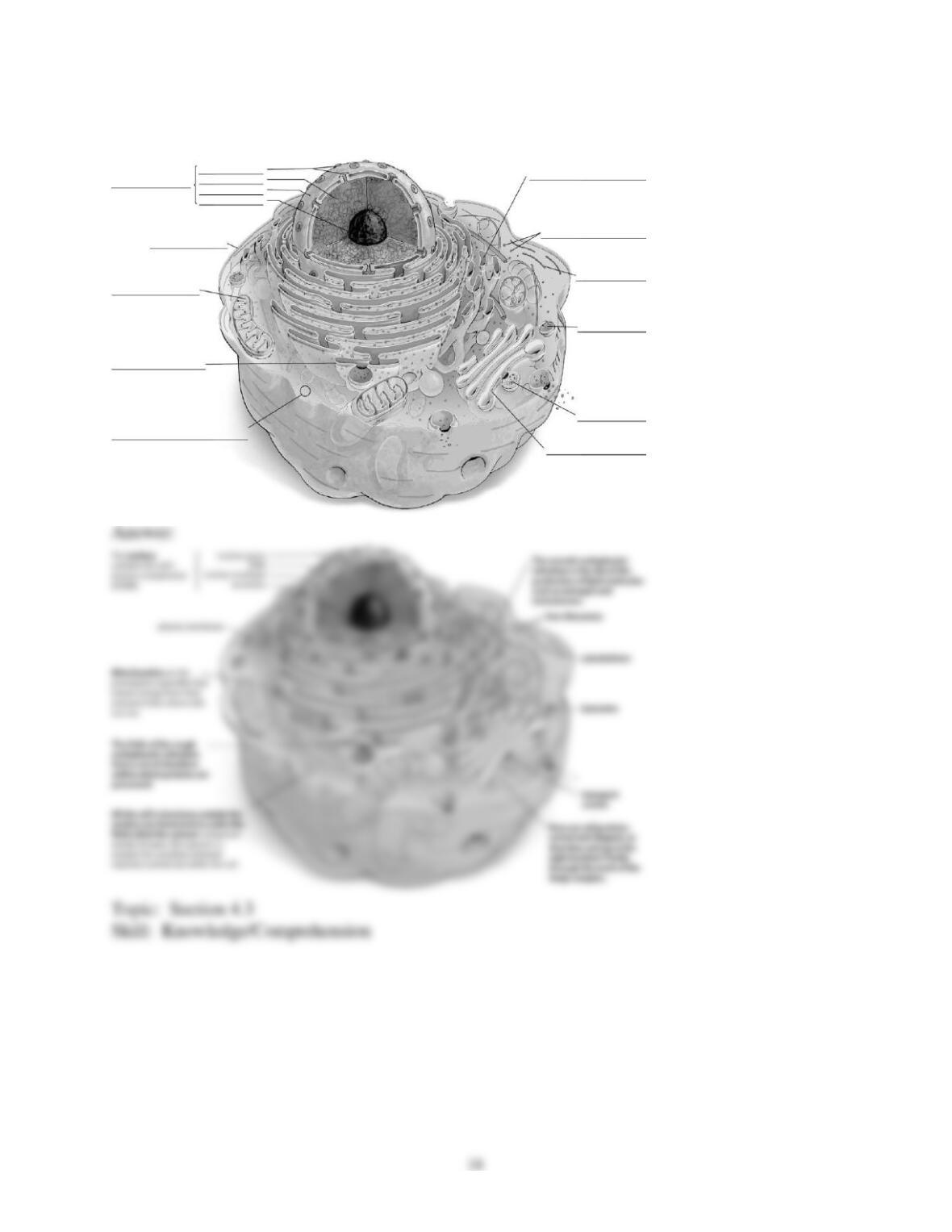
82) Label the parts of the animal cell.
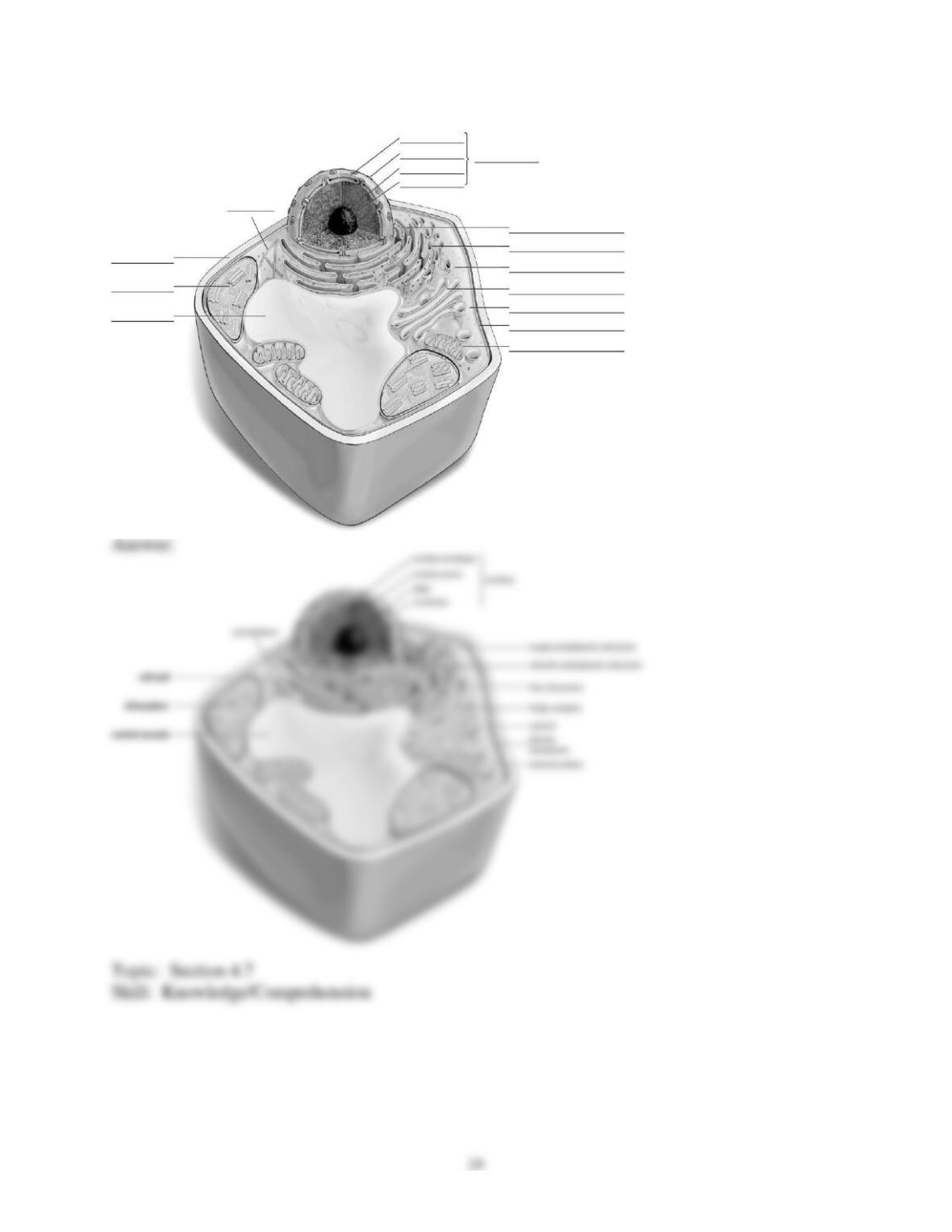
83) Label the parts of the plant cell.