Ch.4 ExponentialandLogarithmicFunctions
4.1 ExponentialFunctions
1 EvaluateExponentialFunctions
MULTIPLECHOICE.Choosetheonealternativethatbestcompletesthestatementoranswersthequestion.
Approximatethenumberusingacalculator.Roundyouranswertothreedecimalplaces.
1) 21.7
A) 3.249 B) 3.400 C) 2.890 D) 3.549
2) 2–3.3
A) 0.102 B) –6.600 C) 10.890 D) 0.402
3) 2 7
A) 6.258 B) 5.292 C) 7.000 D) 64.000
4) 2.4π
A) 15.648 B) 15.601 C) 7.540 D) 36.462
Solvetheproblem.
5) Thefunctionf(x)=600(0.5)x/80modelstheamountinpoundsofaparticularradioactivematerialstoredina
concretevault,wherexisthenumberofyearssincethematerialwasputintothevault.Findtheamountof
radioactivematerialinthevaultafter140years.Roundtothenearestwholenumber.
A) 178pounds B) 404pounds C) 525 pounds D) 171 pounds
6) Therabbitpopulationinaforestareagrowsattherateof5%monthly.Ifthereare150rabbitsinSeptember
,
findhowmanyrabbits(roundedtothenearestwholenumber)shouldbeexpectedbynextSeptember.Use
y=150(2.7)0.05t.
A) 272 B) 243 C) 285 D) 259
7) Acityisgrowingattherateof0.9%annually.Iftherewere3,619,000 residentsinthecityin1994
,
findhow
many(tothenearestten–thousand)arelivinginthatcityin2000.Usey=3,619,000(2.7)0.009t.
A) 3,820,000 B) 530,000 C) 9,770,000 D) 3,850,000
8) TheformulaS=A(1+r)t+1–1
rmodelsthevalueofaretirementaccount,whereA=thenumberofdollars
addedtotheretirementaccounteachyear,r=theannualinterestrate,andS=thevalueoftheretirement
accountaftertyears.Iftheinterestrateis6%,howmuchwilltheaccountbeworthafter10yearsif$1600is
addedeachyear?Roundtothenearestwholenumber.
A) $23,955 B) $3021 C) $17,600 D) $31,519
Page1
2 GraphExponentialFunctions
MULTIPLECHOICE.Choosetheonealternativethatbestcompletesthestatementoranswersthequestion.
Graphthefunctionbymakingatableofcoordinates.
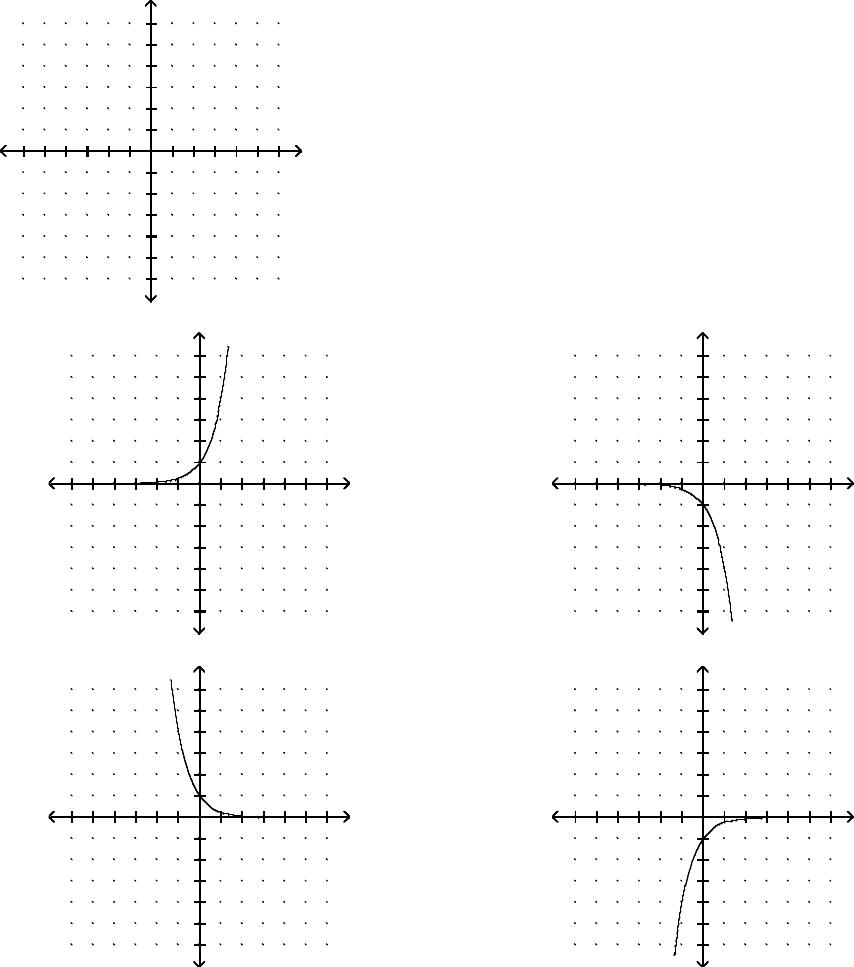
1) f(x)=4x
x
-6 -4 -2 2 4 6
y
6
4
2
-2
-4
-6
x
-6 -4 -2 2 4 6
y
6
4
2
-2
-4
-6
A)
x
-6 -4 -2 2 4 6
y
6
4
2
-2
-4
-6
x
-6 -4 -2 2 4 6
y
6
4
2
-2
-4
-6
B)
x
-6 -4 -2 2 4 6
y
6
4
2
-2
-4
-6
x
-6 -4 -2 2 4 6
y
6
4
2
-2
-4
-6
C)
x
-6 -4 -2 2 4 6
y
6
4
2
-2
-4
-6
x
-6 -4 -2 2 4 6
y
6
4
2
-2
-4
-6
D)
x
-6 -4 -2 2 4 6
y
6
4
2
-2
-4
-6
x
-6 -4 -2 2 4 6
y
6
4
2
-2
-4
-6
Page2
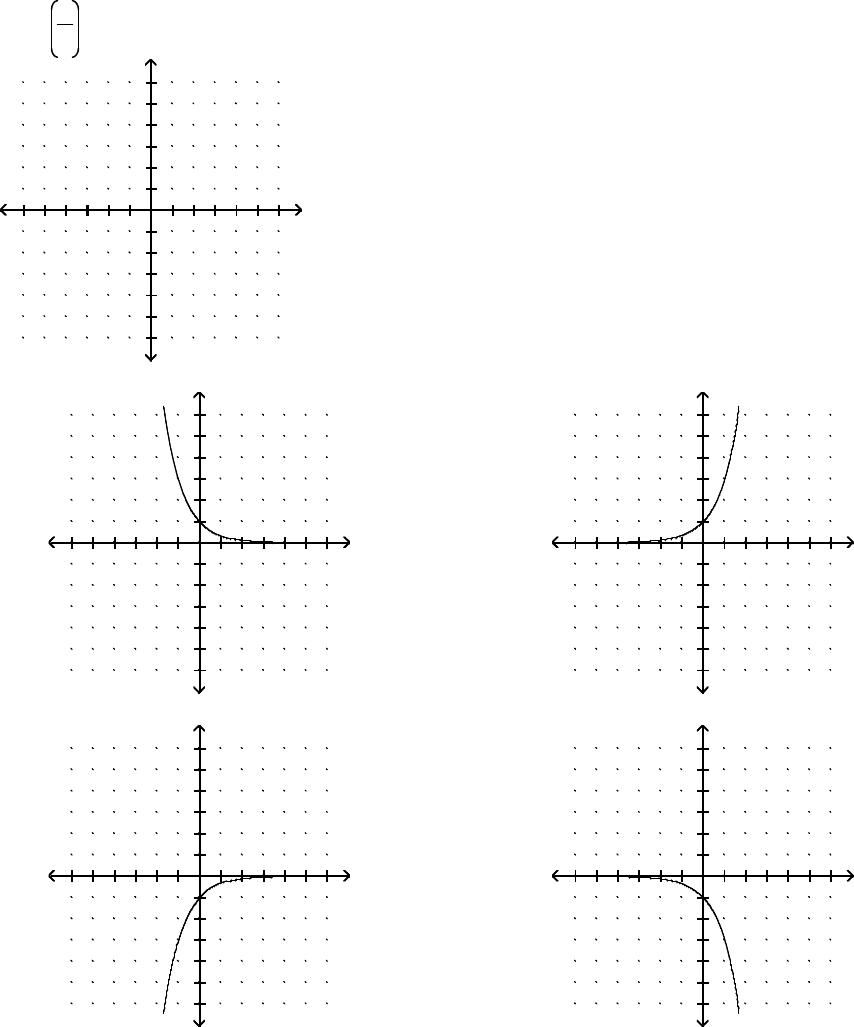
2) f(x)=1
3
x
x
-6 -4 -2 2 4 6
y
6
4
2
-2
-4
-6
x
-6 -4 -2 2 4 6
y
6
4
2
-2
-4
-6
A)
x
-6 -4 -2 2 4 6
y
6
4
2
-2
-4
-6
x
-6 -4 -2 2 4 6
y
6
4
2
-2
-4
-6
B)
x
-6 -4 -2 2 4 6
y
6
4
2
-2
-4
-6
x
-6 -4 -2 2 4 6
y
6
4
2
-2
-4
-6
C)
x
-6 -4 -2 2 4 6
y
6
4
2
-2
-4
-6
x
-6 -4 -2 2 4 6
y
6
4
2
-2
-4
-6
D)
x
-6 -4 -2 2 4 6
y
6
4
2
-2
-4
-6
x
-6 -4 -2 2 4 6
y
6
4
2
-2
-4
-6
Page3
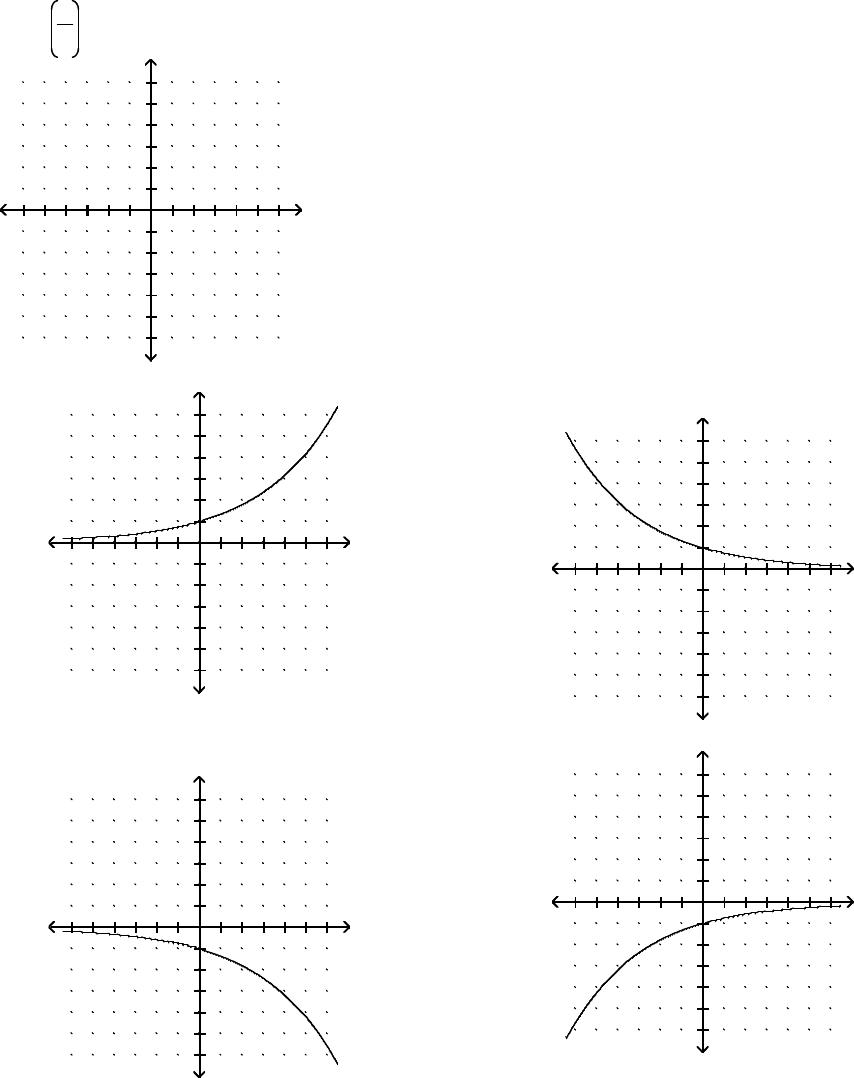
3) f(x)=4
3
x
x
-6 -4 -2 2 4 6
y
6
4
2
-2
-4
-6
x
-6 -4 -2 2 4 6
y
6
4
2
-2
-4
-6
A)
x
-6 -4 -2 2 4 6
y
6
4
2
-2
-4
-6
x
-6 -4 -2 2 4 6
y
6
4
2
-2
-4
-6
B)
x
-6 -4 -2 2 4 6
y
6
4
2
-2
-4
-6
x
-6 -4 -2 2 4 6
y
6
4
2
-2
-4
-6
C)
x
-6 -4 -2 2 4 6
y
6
4
2
-2
-4
-6
x
-6 -4 -2 2 4 6
y
6
4
2
-2
-4
-6
D)
x
-6 -4 -2 2 4 6
y
6
4
2
-2
-4
-6
x
-6 -4 -2 2 4 6
y
6
4
2
-2
-4
-6
Page4
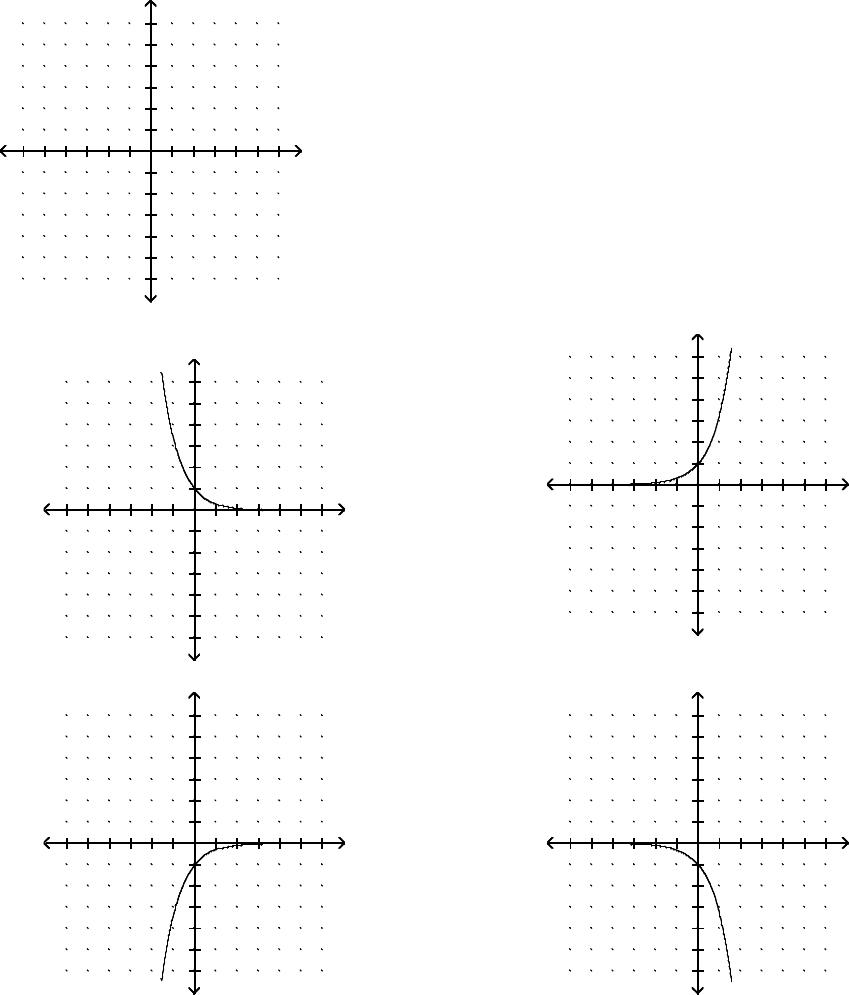
4) f(x)=0.3x
x
-6 -4 -2 2 4 6
y
6
4
2
-2
-4
-6
x
-6 -4 -2 2 4 6
y
6
4
2
-2
-4
-6
A)
x
-6 -4 -2 2 4 6
y
6
4
2
-2
-4
-6
x
-6 -4 -2 2 4 6
y
6
4
2
-2
-4
-6
B)
x
-6 -4 -2 2 4 6
y
6
4
2
-2
-4
-6
x
-6 -4 -2 2 4 6
y
6
4
2
-2
-4
-6
C)
x
-6 -4 -2 2 4 6
y
6
4
2
-2
-4
-6
x
-6 -4 -2 2 4 6
y
6
4
2
-2
-4
-6
D)
x
-6 -4 -2 2 4 6
y
6
4
2
-2
-4
-6
x
-6 -4 -2 2 4 6
y
6
4
2
-2
-4
-6
Page5
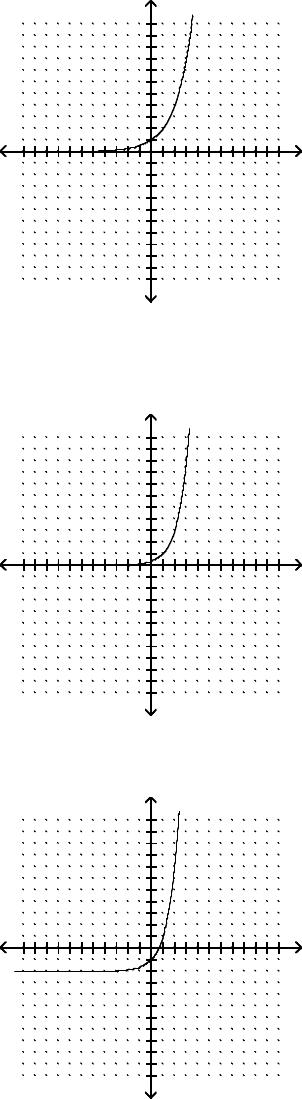
Thegraphofanexponentialfunctionisgiven.Selectthefunctionforthegraphfromthefunctionslisted.
5)
x
-10 -5 5 10
y
10
5
-5
-10
x
-10 -5 5 10
y
10
5
-5
-10
A) f(x)=2xB) f(x)=2x+1C) f(x)=2x+1 D) f(x)=2x–1
6)
x
-10 -5 5 10
y
10
5
-5
-10
x
-10 -5 5 10
y
10
5
-5
-10
A) f(x)=3x–1B) f(x)=3xC) f(x)=3x–1 D) f(x)=3x+1
7)
x
-10 -5 5 10
y
10
5
-5
-10
x
-10 -5 5 10
y
10
5
-5
-10
A) f(x)=3x–2 B) f(x)=3xC) f(x)=3x–2D) f(x)=3x+2
Page6
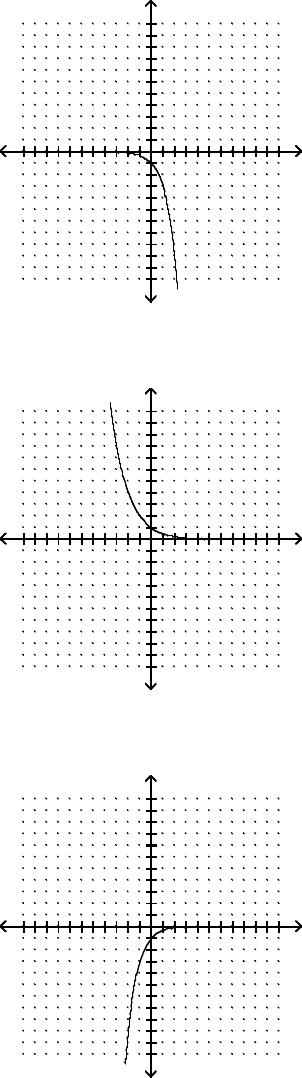
8)
x
-10 -5 5 10
y
10
5
-5
-10
x
-10 -5 5 10
y
10
5
-5
-10
A) f(x)=–3xB) f(x)=3xC) f(x)=3–xD) f(x)=–3–x
9)
x
-10 -5 5 10
y
10
5
-5
-10
x
-10 -5 5 10
y
10
5
-5
-10
A) f(x)=2–xB) f(x)=2xC) f(x)=–2xD) f(x)=–2–x
10)
x
-10 -5 5 10
y
10
5
-5
-10
x
-10 -5 5 10
y
10
5
-5
-10
A) f(x)=–3–xB) f(x)=3xC) f(x)=–3xD) f(x)=3–x
Page7
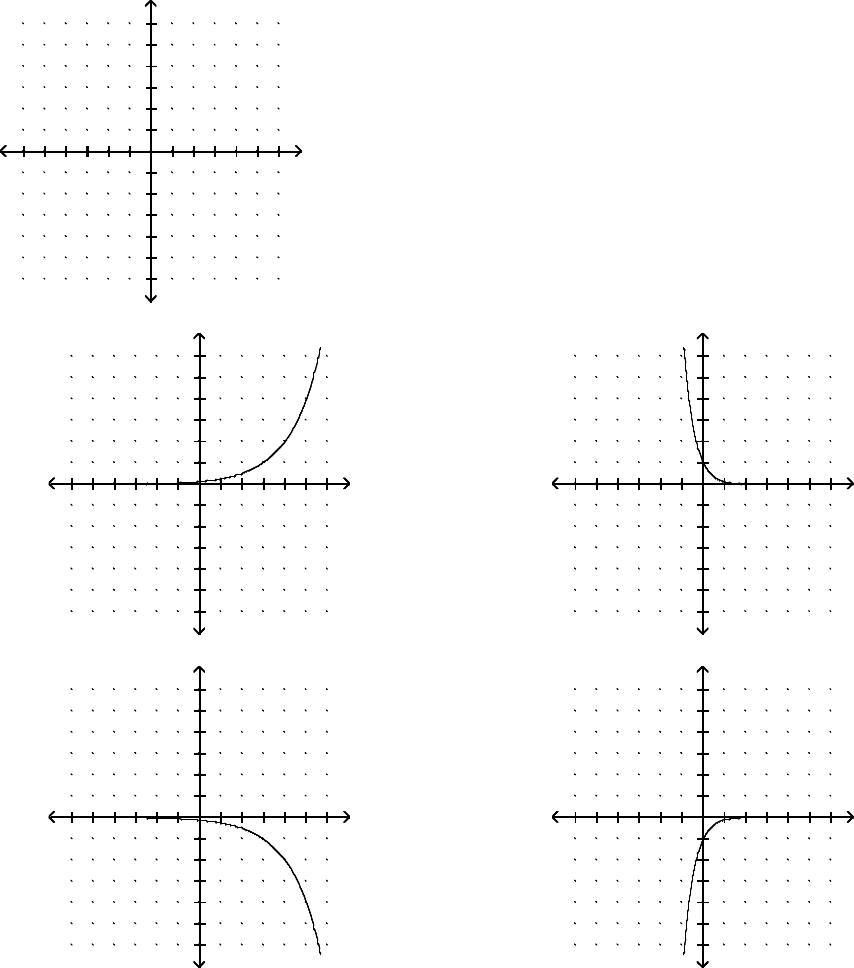
Graphthefunction.
11) Usethegraphoff(x)=2xtoobtainthegraphofg(x)=2x–3.
x
-6 -4 -2 2 4 6
y
6
4
2
-2
-4
-6
x
-6 -4 -2 2 4 6
y
6
4
2
-2
-4
-6
A)
x
-6 -4 -2 2 4 6
y
6
4
2
-2
-4
-6
x
-6 -4 -2 2 4 6
y
6
4
2
-2
-4
-6
B)
x
-6 -4 -2 2 4 6
y
6
4
2
-2
-4
-6
x
-6 -4 -2 2 4 6
y
6
4
2
-2
-4
-6
C)
x
-6 -4 -2 2 4 6
y
6
4
2
-2
-4
-6
x
-6 -4 -2 2 4 6
y
6
4
2
-2
-4
-6
D)
x
-6 -4 -2 2 4 6
y
6
4
2
-2
-4
-6
x
-6 -4 -2 2 4 6
y
6
4
2
-2
-4
-6
Page8
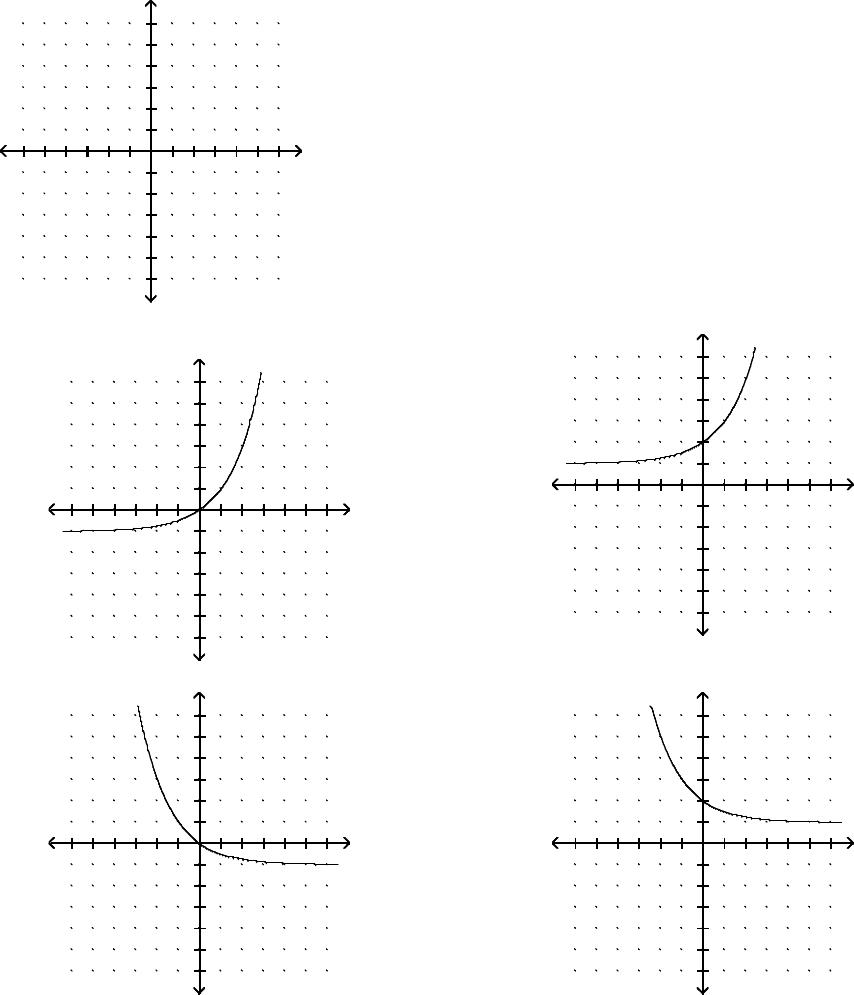
12) Usethegraphoff(x)=2xtoobtainthegraphofg(x)=2x–1.
x
-6 -4 -2 2 4 6
y
6
4
2
-2
-4
-6
x
-6 -4 -2 2 4 6
y
6
4
2
-2
-4
-6
A)
x
-6 -4 -2 2 4 6
y
6
4
2
-2
-4
-6
x
-6 -4 -2 2 4 6
y
6
4
2
-2
-4
-6
B)
x
-6 -4 -2 2 4 6
y
6
4
2
-2
-4
-6
x
-6 -4 -2 2 4 6
y
6
4
2
-2
-4
-6
C)
x
-6 -4 -2 2 4 6
y
6
4
2
-2
-4
-6
x
-6 -4 -2 2 4 6
y
6
4
2
-2
-4
-6
D)
x
-6 -4 -2 2 4 6
y
6
4
2
-2
-4
-6
x
-6 -4 -2 2 4 6
y
6
4
2
-2
-4
-6
Page9
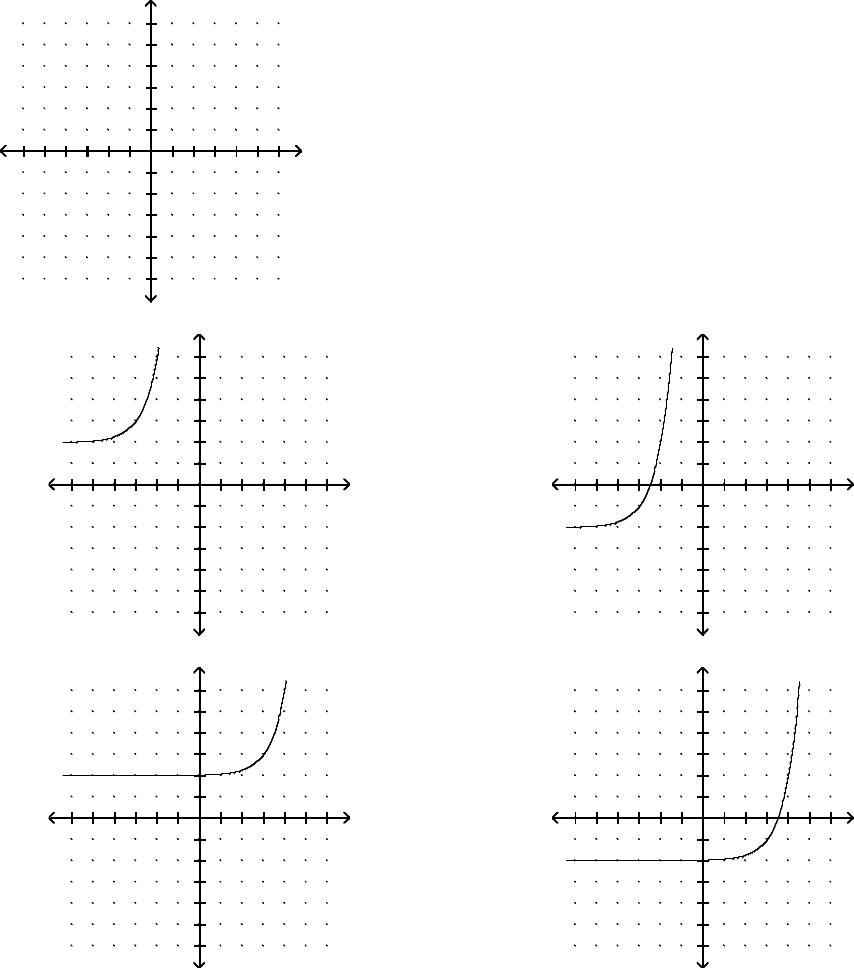
13) Usethegraphoff(x)=4xtoobtainthegraphofg(x)=4x+3+2.
x
-6 -4 -2 2 4 6
y
6
4
2
-2
-4
-6
x
-6 -4 -2 2 4 6
y
6
4
2
-2
-4
-6
A)
x
-6 -4 -2 2 4 6
y
6
4
2
-2
-4
-6
x
-6 -4 -2 2 4 6
y
6
4
2
-2
-4
-6
B)
x
-6 -4 -2 2 4 6
y
6
4
2
-2
-4
-6
x
-6 -4 -2 2 4 6
y
6
4
2
-2
-4
-6
C)
x
-6 -4 -2 2 4 6
y
6
4
2
-2
-4
-6
x
-6 -4 -2 2 4 6
y
6
4
2
-2
-4
-6
D)
x
-6 -4 -2 2 4 6
y
6
4
2
-2
-4
-6
x
-6 -4 -2 2 4 6
y
6
4
2
-2
-4
-6
Page10
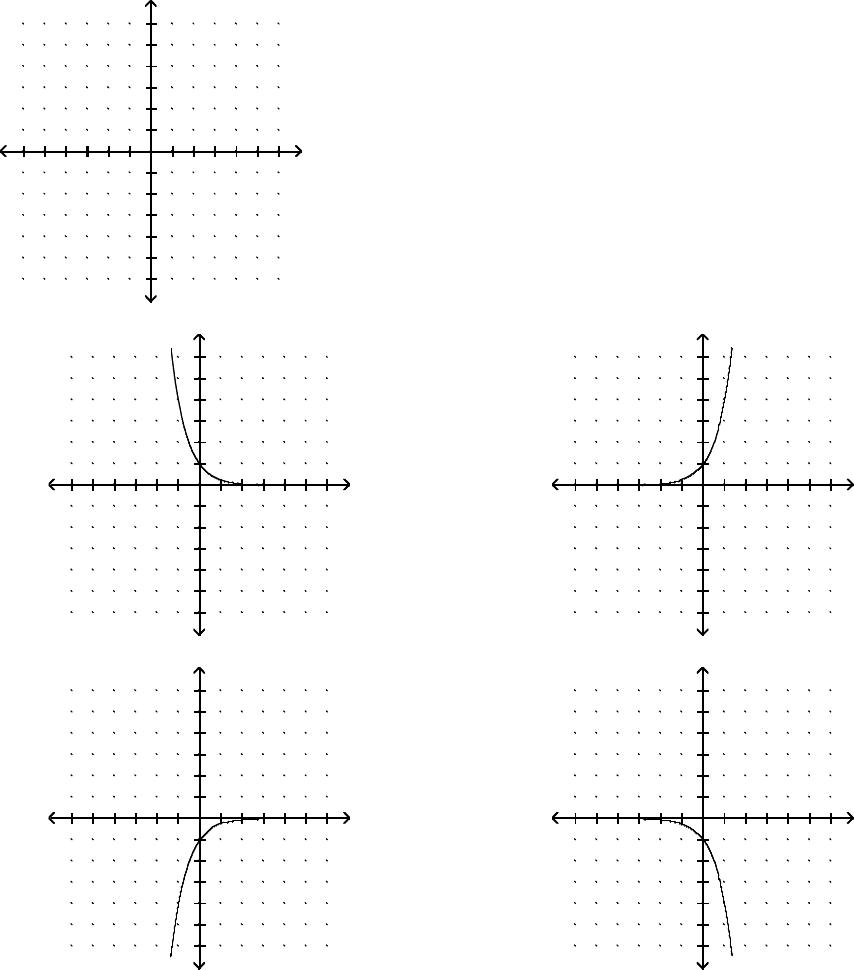
14) Usethegraphoff(x)=4xtoobtainthegraphofg(x)=4–x.
x
-6 -4 -2 2 4 6
y
6
4
2
-2
-4
-6
x
-6 -4 -2 2 4 6
y
6
4
2
-2
-4
-6
A)
x
-6 -4 -2 2 4 6
y
6
4
2
-2
-4
-6
x
-6 -4 -2 2 4 6
y
6
4
2
-2
-4
-6
B)
x
-6 -4 -2 2 4 6
y
6
4
2
-2
-4
-6
x
-6 -4 -2 2 4 6
y
6
4
2
-2
-4
-6
C)
x
-6 -4 -2 2 4 6
y
6
4
2
-2
-4
-6
x
-6 -4 -2 2 4 6
y
6
4
2
-2
-4
-6
D)
x
-6 -4 -2 2 4 6
y
6
4
2
-2
-4
-6
x
-6 -4 -2 2 4 6
y
6
4
2
-2
-4
-6
Page11
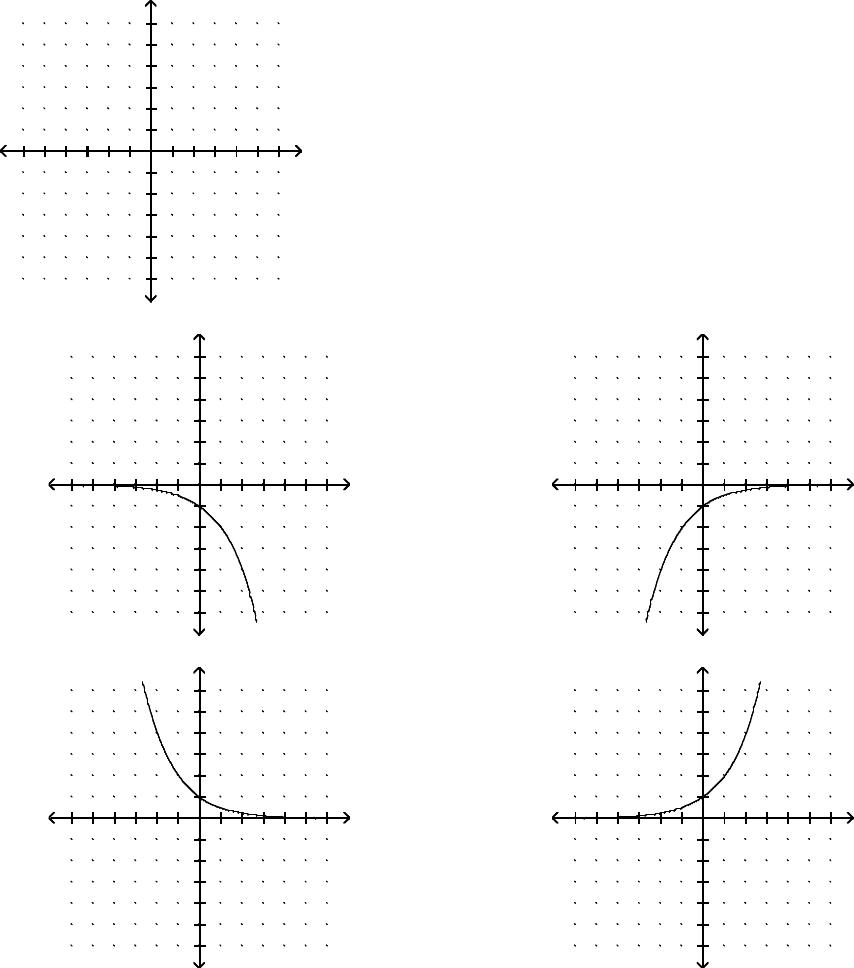
15) Usethegraphoff(x)=2xtoobtainthegraphofg(x)=–2x.
x
-6 -4 -2 2 4 6
y
6
4
2
-2
-4
-6
x
-6 -4 -2 2 4 6
y
6
4
2
-2
-4
-6
A)
x
-6 -4 -2 2 4 6
y
6
4
2
-2
-4
-6
x
-6 -4 -2 2 4 6
y
6
4
2
-2
-4
-6
B)
x
-6 -4 -2 2 4 6
y
6
4
2
-2
-4
-6
x
-6 -4 -2 2 4 6
y
6
4
2
-2
-4
-6
C)
x
-6 -4 -2 2 4 6
y
6
4
2
-2
-4
-6
x
-6 -4 -2 2 4 6
y
6
4
2
-2
-4
-6
D)
x
-6 -4 -2 2 4 6
y
6
4
2
-2
-4
-6
x
-6 -4 -2 2 4 6
y
6
4
2
-2
-4
-6
Page12
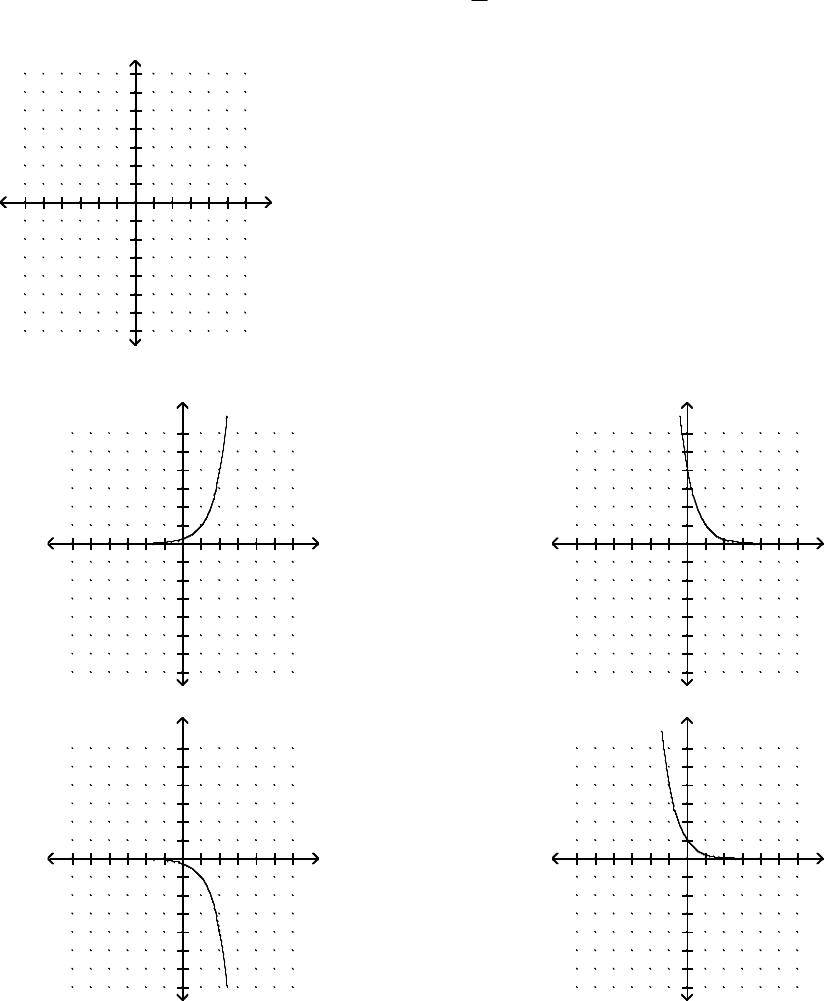
16) Usethegraphoff(x)=4xtoobtainthegraphofg(x)=1
4·4x.
x
-6 -4 -2 2 4 6
y
6
4
2
-2
-4
-6
x
-6 -4 -2 2 4 6
y
6
4
2
-2
-4
-6
A)
x
-6 -4 -2 2 4 6
y
6
4
2
-2
-4
-6
x
-6 -4 -2 2 4 6
y
6
4
2
-2
-4
-6
B)
x
-6 -4 -2 2 4 6
y
6
4
2
-2
-4
-6
x
-6 -4 -2 2 4 6
y
6
4
2
-2
-4
-6
C)
x
-6 -4 -2 2 4 6
y
6
4
2
-2
-4
-6
x
-6 -4 -2 2 4 6
y
6
4
2
-2
-4
-6
D)
x
-6 -4 -2 2 4 6
y
6
4
2
-2
-4
-6
x
-6 -4 -2 2 4 6
y
6
4
2
-2
-4
-6
Page13
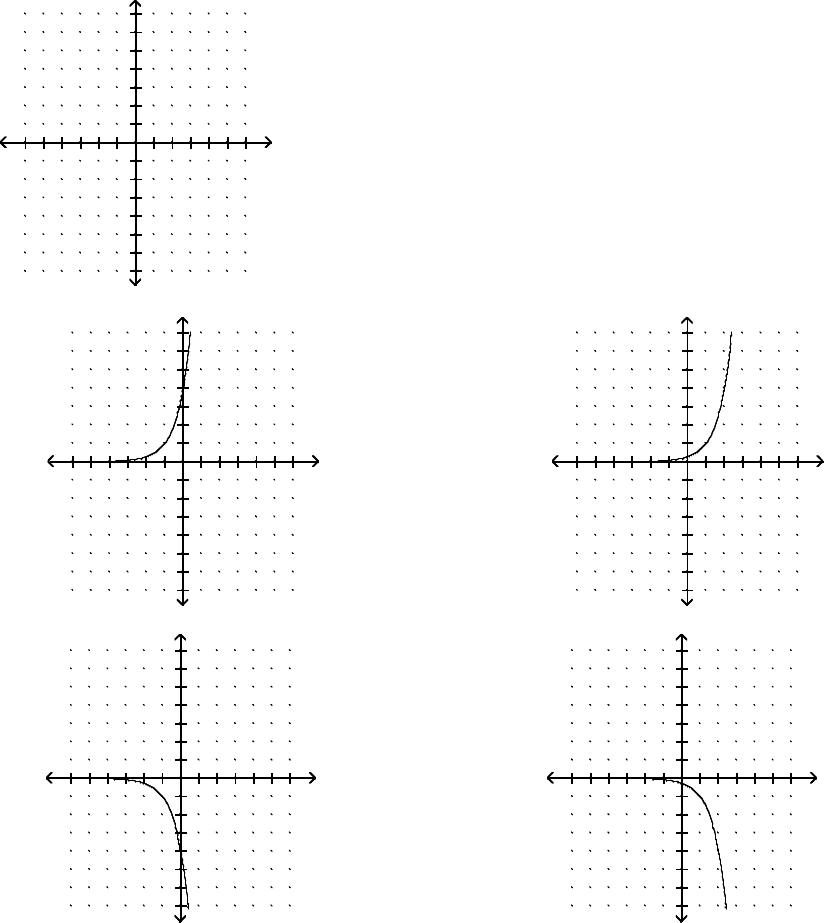
17) Usethegraphoff(x)=4xtoobtainthegraphofg(x)=4·4x.
x
-6 -4 -2 2 4 6
y
6
4
2
-2
-4
-6
x
-6 -4 -2 2 4 6
y
6
4
2
-2
-4
-6
A)
x
-6 -4 -2 2 4 6
y
6
4
2
-2
-4
-6
x
-6 -4 -2 2 4 6
y
6
4
2
-2
-4
-6
B)
x
-6 -4 -2 2 4 6
y
6
4
2
-2
-4
-6
x
-6 -4 -2 2 4 6
y
6
4
2
-2
-4
-6
C)
x
-6 -4 -2 2 4 6
y
6
4
2
-2
-4
-6
x
-6 -4 -2 2 4 6
y
6
4
2
-2
-4
-6
D)
x
-6 -4 -2 2 4 6
y
6
4
2
-2
-4
-6
x
-6 -4 -2 2 4 6
y
6
4
2
-2
-4
-6
Page14
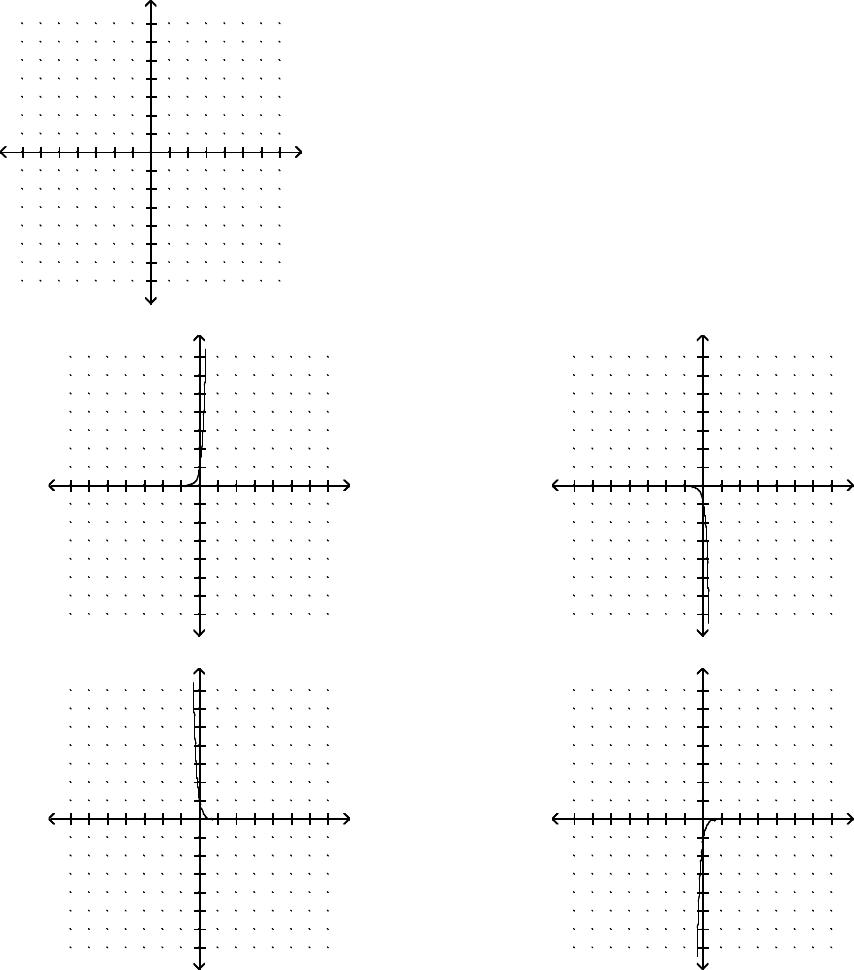
18) Usethegraphoff(x)=extoobtainthegraphofg(x)=e6x.
x
-6 -4 -2 2 4 6
y
6
4
2
-2
-4
-6
x
-6 -4 -2 2 4 6
y
6
4
2
-2
-4
-6
A)
x
-6 -4 -2 2 4 6
y
6
4
2
-2
-4
-6
x
-6 -4 -2 2 4 6
y
6
4
2
-2
-4
-6
B)
x
-6 -4 -2 2 4 6
y
6
4
2
-2
-4
-6
x
-6 -4 -2 2 4 6
y
6
4
2
-2
-4
-6
C)
x
-6 -4 -2 2 4 6
y
6
4
2
-2
-4
-6
x
-6 -4 -2 2 4 6
y
6
4
2
-2
-4
-6
D)
x
-6 -4 -2 2 4 6
y
6
4
2
-2
-4
-6
x
-6 -4 -2 2 4 6
y
6
4
2
-2
-4
-6
Page15
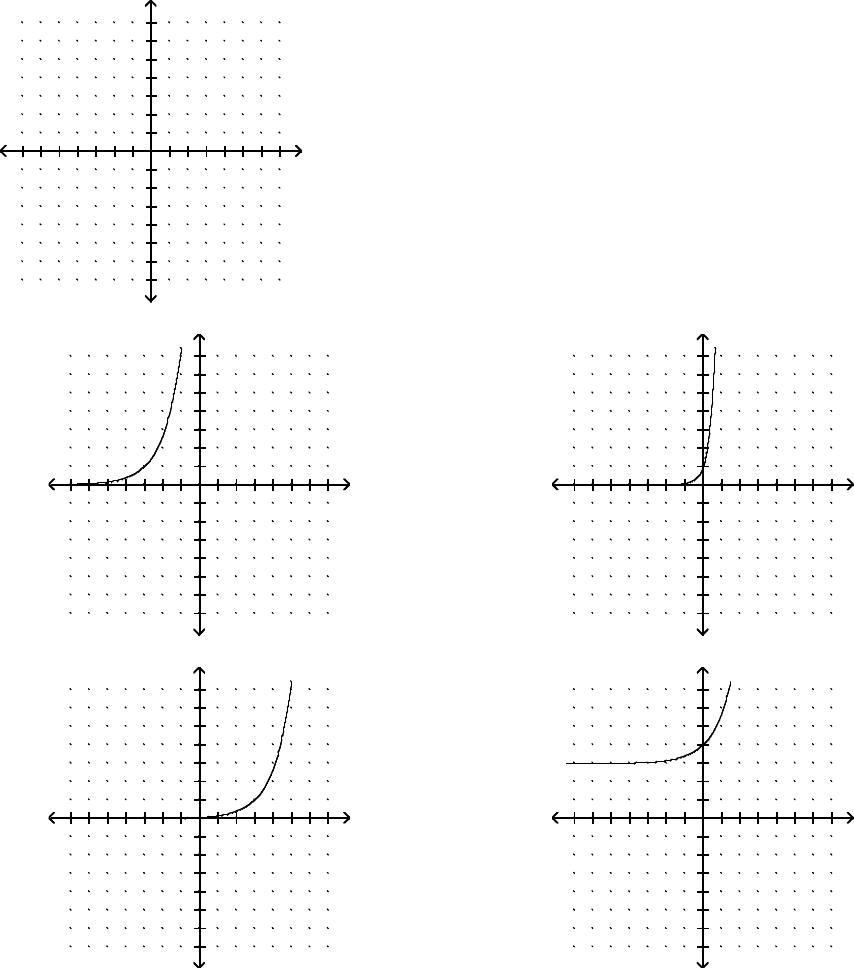
19) Usethegraphoff(x)=extoobtainthegraphofg(x)=ex+3.
x
-6 -4 -2 2 4 6
y
6
4
2
-2
-4
-6
x
-6 -4 -2 2 4 6
y
6
4
2
-2
-4
-6
A)
x
-6 -4 -2 2 4 6
y
6
4
2
-2
-4
-6
x
-6 -4 -2 2 4 6
y
6
4
2
-2
-4
-6
B)
x
-6 -4 -2 2 4 6
y
6
4
2
-2
-4
-6
x
-6 -4 -2 2 4 6
y
6
4
2
-2
-4
-6
C)
x
-6 -4 -2 2 4 6
y
6
4
2
-2
-4
-6
x
-6 -4 -2 2 4 6
y
6
4
2
-2
-4
-6
D)
x
-6 -4 -2 2 4 6
y
6
4
2
-2
-4
-6
x
-6 -4 -2 2 4 6
y
6
4
2
-2
-4
-6
Page16
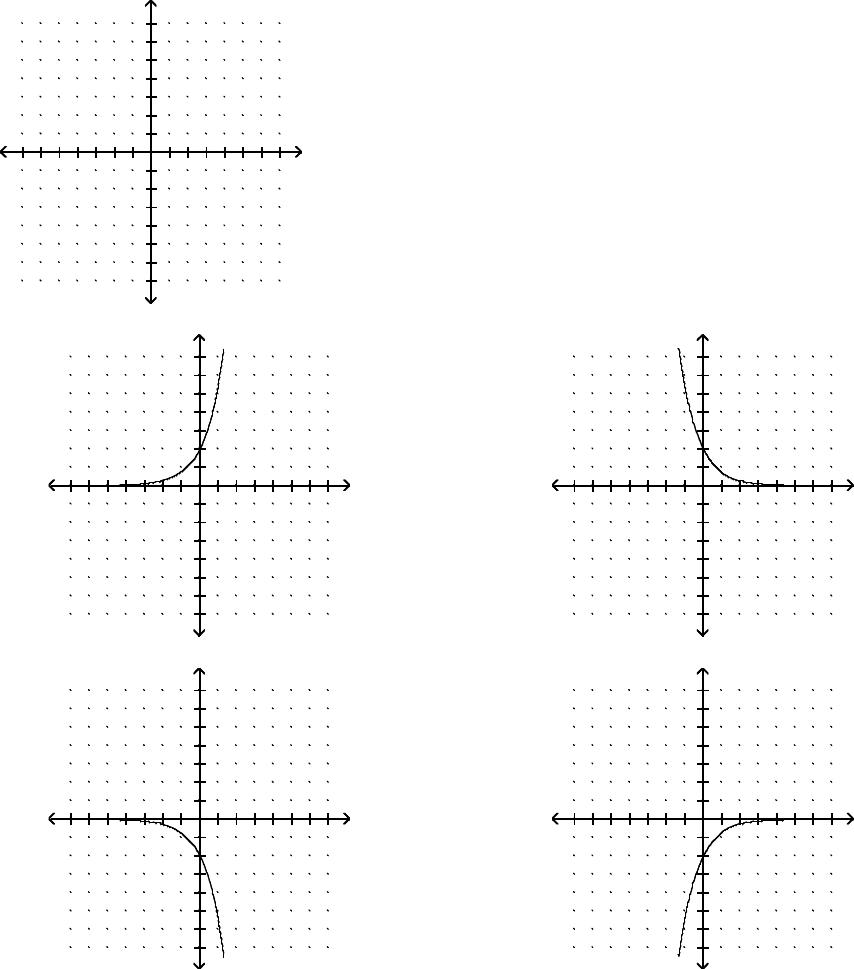
20) Usethegraphoff(x)=extoobtainthegraphofg(x)=2ex.
x
-6 -4 -2 2 4 6
y
6
4
2
-2
-4
-6
x
-6 -4 -2 2 4 6
y
6
4
2
-2
-4
-6
A)
x
-6 -4 -2 2 4 6
y
6
4
2
-2
-4
-6
x
-6 -4 -2 2 4 6
y
6
4
2
-2
-4
-6
B)
x
-6 -4 -2 2 4 6
y
6
4
2
-2
-4
-6
x
-6 -4 -2 2 4 6
y
6
4
2
-2
-4
-6
C)
x
-6 -4 -2 2 4 6
y
6
4
2
-2
-4
-6
x
-6 -4 -2 2 4 6
y
6
4
2
-2
-4
-6
D)
x
-6 -4 -2 2 4 6
y
6
4
2
-2
-4
-6
x
-6 -4 -2 2 4 6
y
6
4
2
-2
-4
-6
Page17
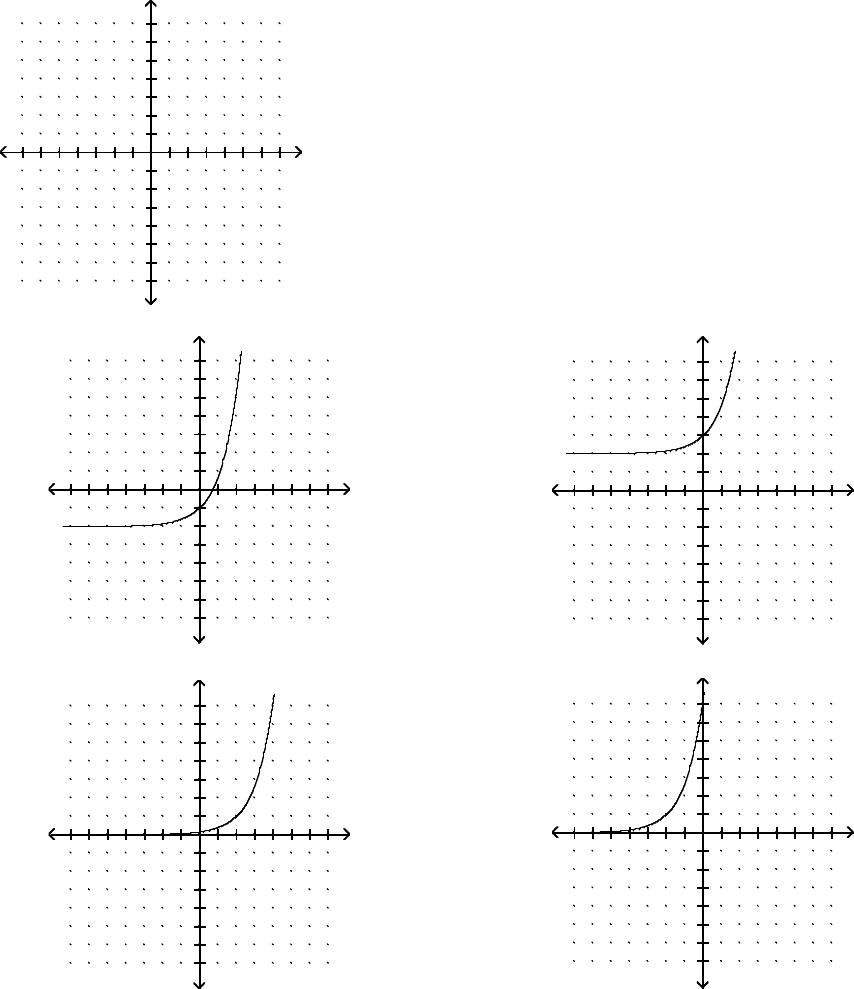
21) Usethegraphoff(x)=extoobtainthegraphofg(x)=ex–2.
x
-6 -4 -2 2 4 6
y
6
4
2
-2
-4
-6
x
-6 -4 -2 2 4 6
y
6
4
2
-2
-4
-6
A)
x
-6 -4 -2 2 4 6
y
6
4
2
-2
-4
-6
x
-6 -4 -2 2 4 6
y
6
4
2
-2
-4
-6
B)
x
-6 -4 -2 2 4 6
y
6
4
2
-2
-4
-6
x
-6 -4 -2 2 4 6
y
6
4
2
-2
-4
-6
C)
x
-6 -4 -2 2 4 6
y
6
4
2
-2
-4
-6
x
-6 -4 -2 2 4 6
y
6
4
2
-2
-4
-6
D)
x
-6 -4 -2 2 4 6
y
6
4
2
-2
-4
-6
x
-6 -4 -2 2 4 6
y
6
4
2
-2
-4
-6
Page18
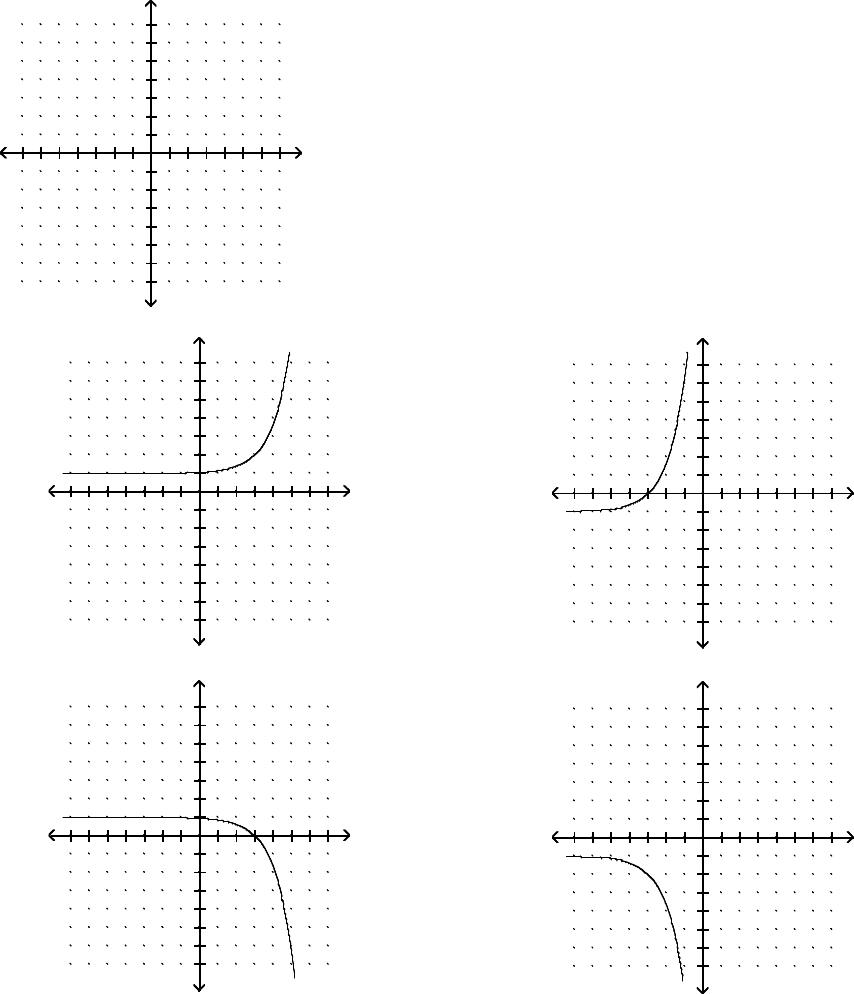
22) Usethegraphoff(x)=extoobtainthegraphofg(x)=ex–3+1.
x
-6 -4 -2 2 4 6
y
6
4
2
-2
-4
-6
x
-6 -4 -2 2 4 6
y
6
4
2
-2
-4
-6
A)
x
-6 -4 -2 2 4 6
y
6
4
2
-2
-4
-6
x
-6 -4 -2 2 4 6
y
6
4
2
-2
-4
-6
B)
x
-6 -4 -2 2 4 6
y
6
4
2
-2
-4
-6
x
-6 -4 -2 2 4 6
y
6
4
2
-2
-4
-6
C)
x
-6 -4 -2 2 4 6
y
6
4
2
-2
-4
-6
x
-6 -4 -2 2 4 6
y
6
4
2
-2
-4
-6
D)
x
-6 -4 -2 2 4 6
y
6
4
2
-2
-4
-6
x
-6 -4 -2 2 4 6
y
6
4
2
-2
-4
-6
Page19
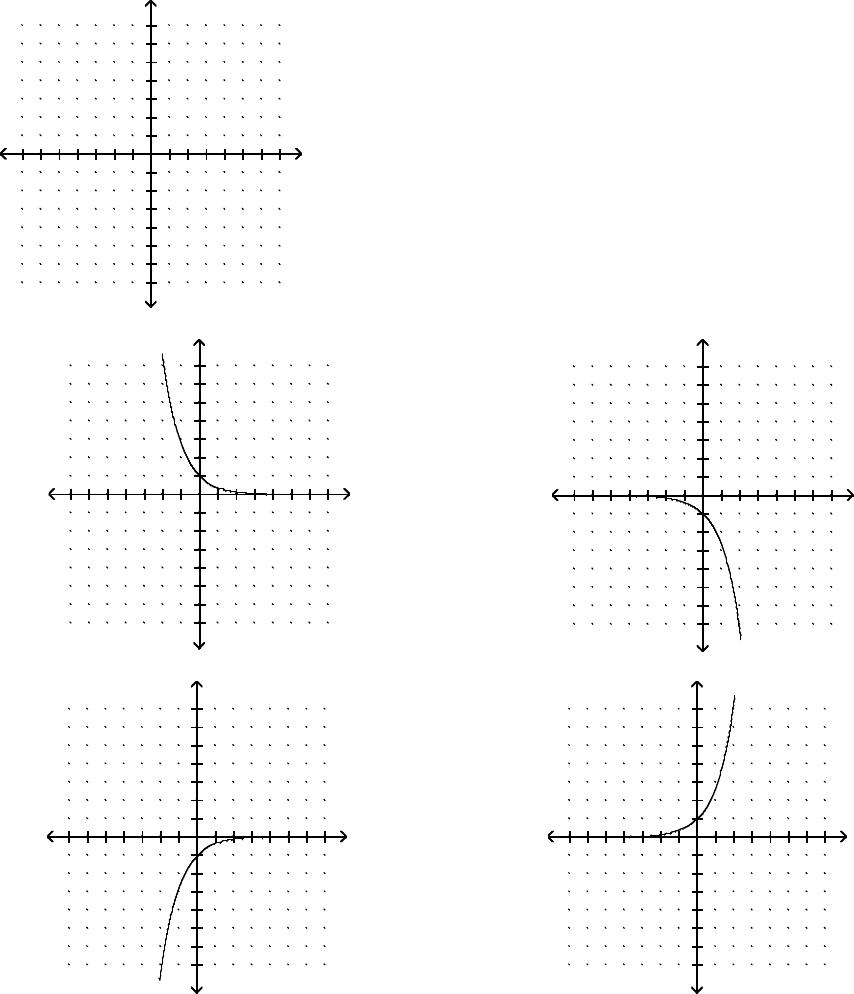
23) Usethegraphoff(x)=extoobtainthegraphofg(x)=e–x.
x
-6 -4 -2 2 4 6
y
6
4
2
-2
-4
-6
x
-6 -4 -2 2 4 6
y
6
4
2
-2
-4
-6
A)
x
-6 -4 -2 2 4 6
y
6
4
2
-2
-4
-6
x
-6 -4 -2 2 4 6
y
6
4
2
-2
-4
-6
B)
x
-6 -4 -2 2 4 6
y
6
4
2
-2
-4
-6
x
-6 -4 -2 2 4 6
y
6
4
2
-2
-4
-6
C)
x
-6 -4 -2 2 4 6
y
6
4
2
-2
-4
-6
x
-6 -4 -2 2 4 6
y
6
4
2
-2
-4
-6
D)
x
-6 -4 -2 2 4 6
y
6
4
2
-2
-4
-6
x
-6 -4 -2 2 4 6
y
6
4
2
-2
-4
-6
Page20
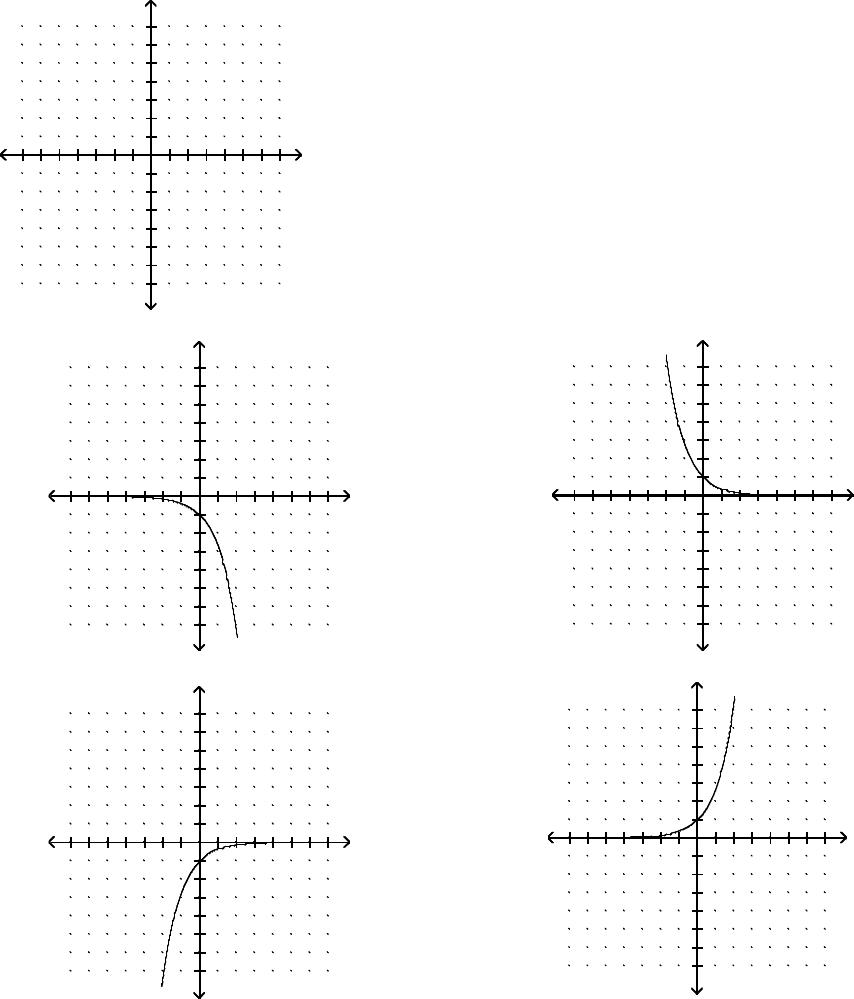
24) Usethegraphoff(x)=extoobtainthegraphofg(x)=–ex.
x
-6 -4 -2 2 4 6
y
6
4
2
-2
-4
-6
x
-6 -4 -2 2 4 6
y
6
4
2
-2
-4
-6
A)
x
-6 -4 -2 2 4 6
y
6
4
2
-2
-4
-6
x
-6 -4 -2 2 4 6
y
6
4
2
-2
-4
-6
B)
x
-6 -4 -2 2 4 6
y
6
4
2
-2
-4
-6
x
-6 -4 -2 2 4 6
y
6
4
2
-2
-4
-6
C)
x
-6 -4 -2 2 4 6
y
6
4
2
-2
-4
-6
x
-6 -4 -2 2 4 6
y
6
4
2
-2
-4
-6
D)
x
-6 -4 -2 2 4 6
y
6
4
2
-2
-4
-6
x
-6 -4 -2 2 4 6
y
6
4
2
-2
-4
-6
Page21
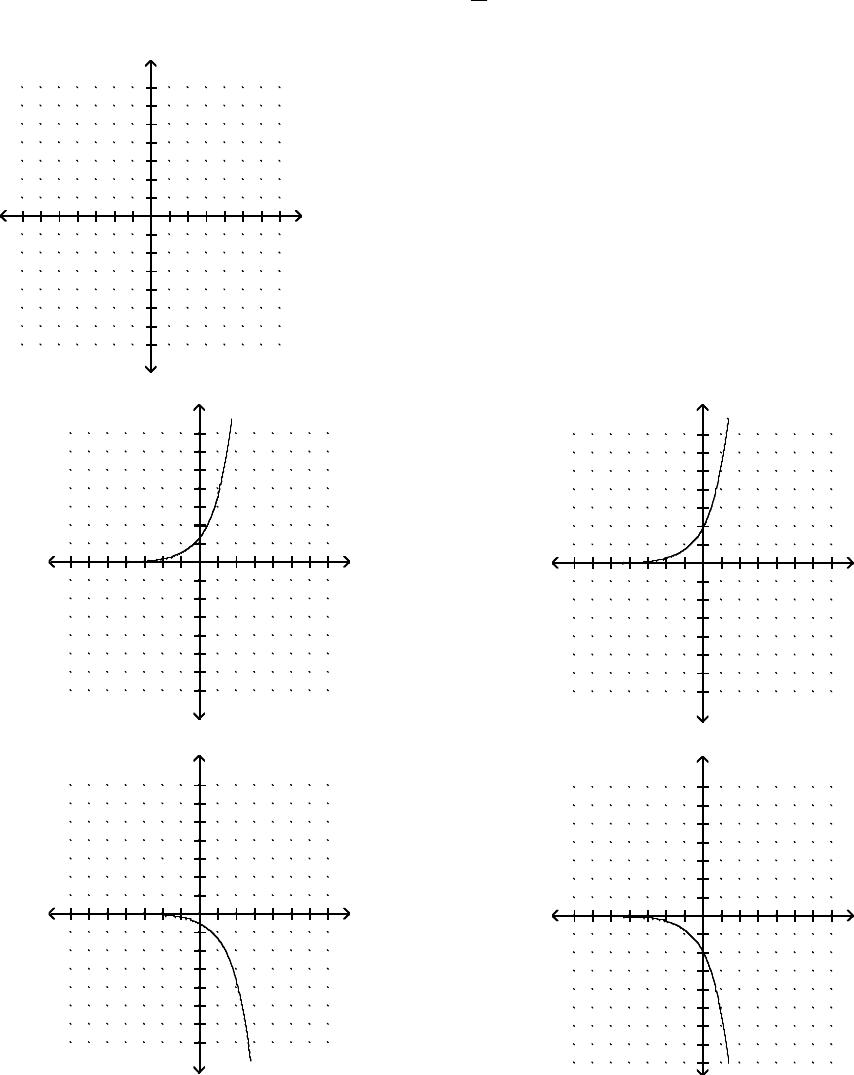
25) Usethegraphoff(x)=extoobtainthegraphofg(x)=1
2ex.
x
-6 -4 -2 2 4 6
y
6
4
2
-2
-4
-6
x
-6 -4 -2 2 4 6
y
6
4
2
-2
-4
-6
A)
x
-6 -4 -2 2 4 6
y
6
4
2
-2
-4
-6
x
-6 -4 -2 2 4 6
y
6
4
2
-2
-4
-6
B)
x
-6 -4 -2 2 4 6
y
6
4
2
-2
-4
-6
x
-6 -4 -2 2 4 6
y
6
4
2
-2
-4
-6
C)
x
-6 -4 -2 2 4 6
y
6
4
2
-2
-4
-6
x
-6 -4 -2 2 4 6
y
6
4
2
-2
-4
-6
D)
x
-6 -4 -2 2 4 6
y
6
4
2
-2
-4
-6
-8
x
-6 -4 -2 2 4 6
y
6
4
2
-2
-4
-6
-8
Page22
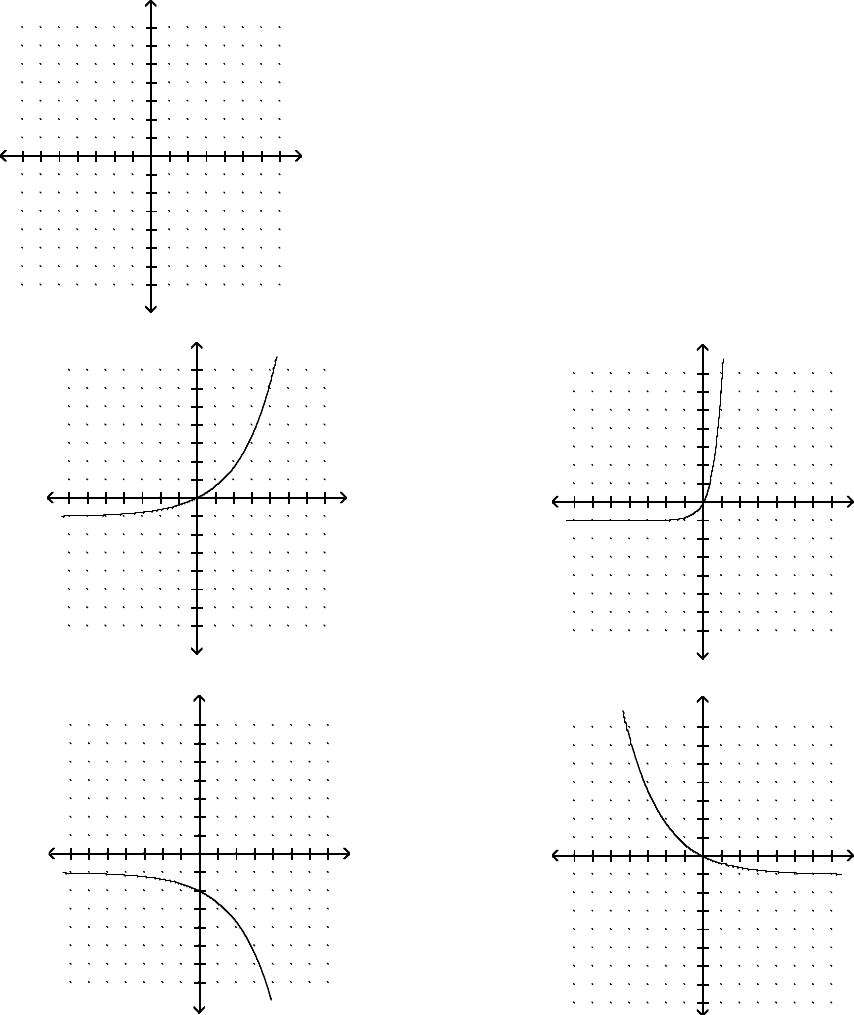
26) Usethegraphoff(x)=extoobtainthegraphofg(x)=ex/2–1.
x
-6 -4 -2 2 4 6
y
6
4
2
-2
-4
-6
x
-6 -4 -2 2 4 6
y
6
4
2
-2
-4
-6
A)
x
-6 -4 -2 2 4 6
y
6
4
2
-2
-4
-6
x
-6 -4 -2 2 4 6
y
6
4
2
-2
-4
-6
B)
x
-6 -4 -2 2 4 6
y
6
4
2
-2
-4
-6
x
-6 -4 -2 2 4 6
y
6
4
2
-2
-4
-6
C)
x
-6 -4 -2 2 4 6
y
6
4
2
-2
-4
-6
x
-6 -4 -2 2 4 6
y
6
4
2
-2
-4
-6
D)
x
-6 -4 -2 2 4 6
y
6
4
2
-2
-4
-6
-8
x
-6 -4 -2 2 4 6
y
6
4
2
-2
-4
-6
-8
3 EvaluateFunctionswithBasee
MULTIPLECHOICE.Choosetheonealternativethatbestcompletesthestatementoranswersthequestion.
Approximatethenumberusingacalculator.Roundyouranswertothreedecimalplaces.
1) e1.1
A) 3.004 B) 2.990 C) 1.296 D) 3.304
2) e–0.6
A) 0.549 B) –1.631 C) –0.549 D) 0.849
Page23

Solvetheproblem.
3) Thesizeoftheraccoonpopulationatanationalparkincreasesattherateof4.9%peryear.Ifthesizeofthe
currentpopulationis155,findhowmanyraccoonsthereshouldbein8years.Usethefunction
f(x)=155e0.049tandroundtothenearestwholenumber.
A) 229 B) 231 C) 227 D) 233
4) Thepopulationinaparticularcountryisgrowingattherateof1.5%peryear.If6,365,000peoplelivedtherein
1999,howmanywilltherebeintheyear2003?Usef(x)=y0e0.015tandroundtothenearestten–thousand.
A) 6,760,000 B) 7,430,000 C) 6,620,000 D) 8,110,000
5) ThefunctionD(h)=7e–0.4hcanbeusedtodeterminethemilligramsDofacertaindruginapatientʹs
bloodstreamhhoursafterthedrughasbeengiven.Howmanymilligrams(totwodecimals)willbepresent
after12hours?
A) 0.06mg B) 850.57 mg C) 4.16 mg D) 0.73 mg
6) Asampleof500goflead–210decaystopolonium–210accordingtothefunctiongivenbyA(t)=500e–0.032t,
wheretistimeinyears.Whatistheamountofthesampleafter60years(tothenearestg)?
A) 73g B) 3410 g C) 121 gD)53g
4 UseCompoundInterestFormulas
MULTIPLECHOICE.Choosetheonealternativethatbestcompletesthestatementoranswersthequestion.
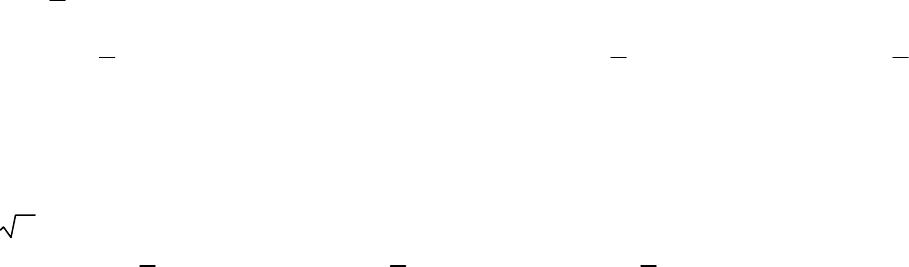
UsethecompoundinterestformulasA=P1+
r
n
ntandA=Perttosolve.
1) Findtheaccumulatedvalueofaninvestmentof$9000 at5%compoundedannuallyfor6years.
A) $12,060.86 B) $11,486.53 C) $11,250.00 D) $11,700.00
2) Findtheaccumulatedvalueofaninvestmentof$6000 at4%compoundedsemiannuallyfor8years.
A) $8236.71 B) $8211.41 C) $7029.96 D) $7920.00
3) Findtheaccumulatedvalueofaninvestmentof$1000 at12%compoundedquarterlyfor3years.
A) $1425.76 B) $1404.93 C) $1092.73 D) $1360.00
4) Findtheaccumulatedvalueofaninvestmentof$770 at3%compoundedannuallyfor16years.
A) $1235.62 B) $1199.63 C) $1116.50 D) $1139.60
5) Findtheaccumulatedvalueofaninvestmentof$2000 at8%compoundedcontinuouslyfor4years.
A) $2754.26 B) $2854.26 C) $2720.98 D) $2640.00
6) Findtheaccumulatedvalueofaninvestmentof$5000at5%compoundedmonthlyfor8years.
A) $7452.93 B) $12,911.25 C) $9093.60 D) $8060.16
7) Supposethatyouhave$3000toinvest.Whichinvestmentyieldsthegreaterreturnover10years:8.75%
compoundedcontinuouslyor8.9%compoundedsemiannually?
A) $3000investedat8.75%compoundedcontinuouslyover10 yearsyieldsthegreaterreturn.
B) $3000investedat8.9%compoundedsemiannuallyover10 yearsyieldsthegreaterreturn.
C) Bothinvestmentplansyieldthesamereturn.
Page24
8) Supposethatyouhave$5000toinvest.Whichinvestmentyieldsthegreaterreturnover8years:5.4%
compoundedmonthlyor5.5%compoundedquarterly?
A) $5000investedat5.5%compoundedquarterlyover8 yearsyieldsthegreaterreturn.
B) $5000investedat5.4%compoundedmonthlyover8 yearsyieldsthegreaterreturn.
C) Bothinvestmentplansyieldthesamereturn.
4.2 LogarithmicFunctions
1 ChangefromLogarithmictoExponentialForm
MULTIPLECHOICE.Choosetheonealternativethatbestcompletesthestatementoranswersthequestion.
Writetheequationinitsequivalentexponentialform.
1) log 525=2
A) 52=25 B) 25=25 C) 525=2D)25
2=5
2) log 5x=2
A) 52=xB)2
5=xC)5
x=2D)x
2=5
3) log
b
64=3
A) b3=64 B) 3
b
=64 C) 643=bD)64
b
=3
4) log 24=x
A) 2x=4B)x
2=4C)4
x=2D)4
2=x
2 ChangeFromExponentialtoLogarithmicForm
MULTIPLECHOICE.Choosetheonealternativethatbestcompletesthestatementoranswersthequestion.
Writetheequationinitsequivalentlogarithmicform.
1) 63=216
A) log 6216=3 B) log 216 6=3 C) log 3216 =6 D) log 63=216
2) 3–2=1
9
A) log 31
9=–2 B) log 1/3 3=–2 C) log –2
1
9=3 D) log 3–2=1
9
3) 73=x
A) log 7x=3 B) log x7=3 C) log 3x=7 D) log 73=x
4) 364=4
A) log 64 4=1
3B) log 464=1
3C) log 64 3=1
4D) log 464 =3
5) 43=y
A) log 4y=3 B) log 3y=4 C) log y4=3 D) log y3=4
6) c3=512
A) logc512=3 B) log512 c=3 C) log3512 =c D) logc3=512
Page25
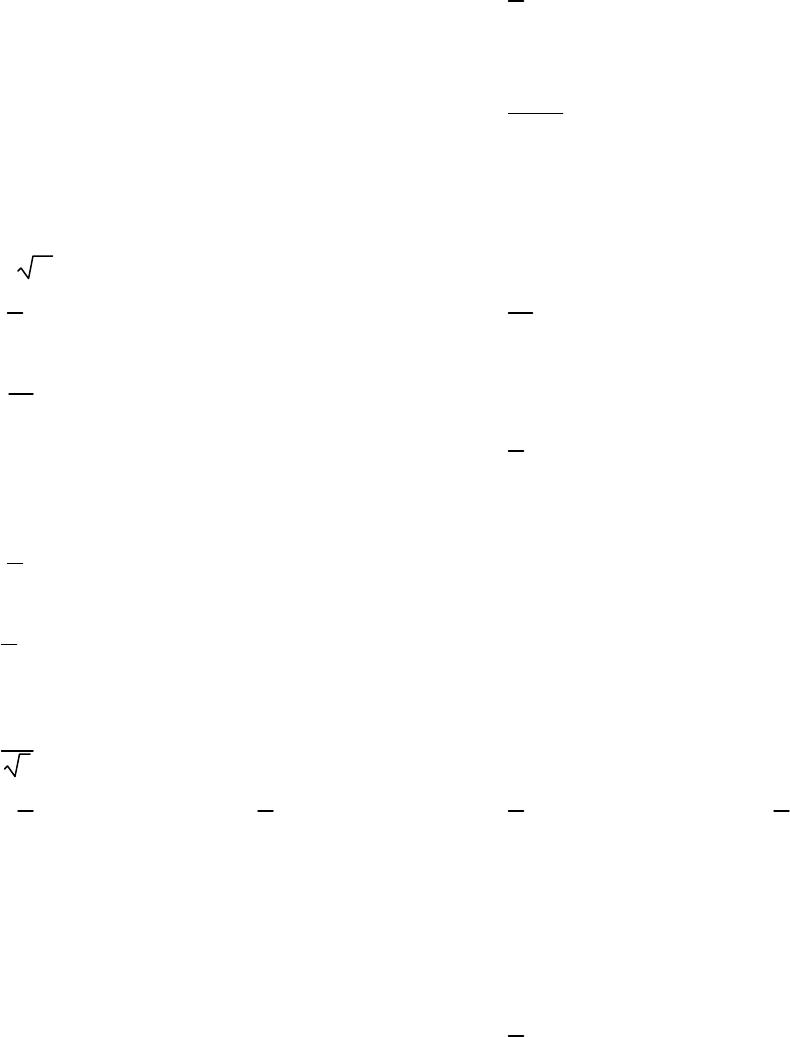
7) 10x=1000
A) log 10 1000=x B) log x1000 =10 C) log 1000 10 =x D) log 1000 x=10
3 EvaluateLogarithms
MULTIPLECHOICE.Choosetheonealternativethatbestcompletesthestatementoranswersthequestion.
Evaluatetheexpressionwithoutusingacalculator.
1) log 5125
A) 3 B) 15 C) 1
3D) 1
2) log 10 10,000
A) 4 B) 40 C) 1
10000 D) –4
3) log9729
A) 3 B) 729 C) 27 D) 9
4) log 11 11
A) 1
2B) 11 C) 1
11 D) 1
5) log 4
1
64
A) –3B)12C)
1
3D) 3
6) log 82
A) 1
3B) 6 C) 3 D) 1
7) log21
2
A) –1B)2 C)
–2D)1
8) log31
3
A) –1
2B) 1
2C) 1
3D) –1
3
4 UseBasicLogarithmicProperties
MULTIPLECHOICE.Choosetheonealternativethatbestcompletesthestatementoranswersthequestion.
Evaluatetheexpressionwithoutusingacalculator.
1) log 51
A) 0 B) 5 C) 1
5D) 1
Page26
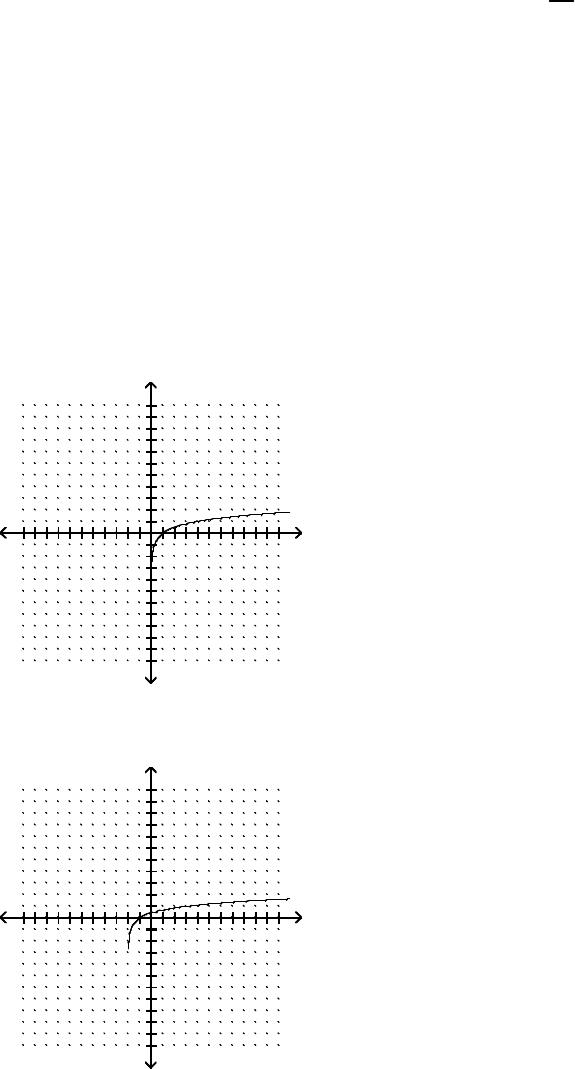
2) log 12 12
A) 1 B) 12 C) 1
12 D) 0
3) 5 log 514
A) 14 B) 5 C) 19 D) log 514
4) log 3319
A) 19 B) 3 C) 22 D) log 319
5 GraphLogarithmicFunctions
MULTIPLECHOICE.Choosetheonealternativethatbestcompletesthestatementoranswersthequestion.
Thegraphofalogarithmicfunctionisgiven.Selectthefunctionforthegraphfromtheoptions.
1)
x
-10 -5 5 10
y
10
5
-5
-10
x
-10 -5 5 10
y
10
5
-5
-10
A) f(x)=log 4x B) f(x)=log 4(x–2) C) f(x)=log 4(x+2) D) f(x)=log 4x–2
2)
x
-10 -5 5 10
y
10
5
-5
-10
x
-10 -5 5 10
y
10
5
-5
-10
A) f(x)=log 5(x+2) B) f(x)=log 5x C) f(x)=log 5(x–2) D) f(x)=log 5x+2
Page27
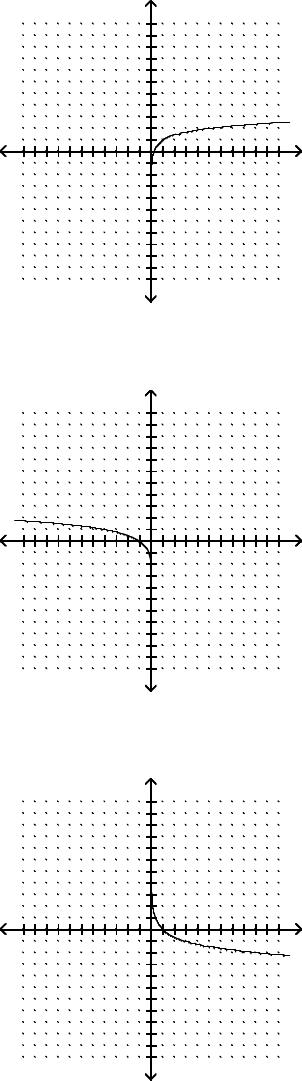
3)
x
-10 -5 5 10
y
10
5
-5
-10
x
-10 -5 5 10
y
10
5
-5
-10
A) f(x)=log 5x+1 B) f(x)=log 5x C) f(x)=log 5(x–1) D) f(x)=log 5(x+1)
4)
x
-10 -5 5 10
y
10
5
-5
-10
x
-10 -5 5 10
y
10
5
-5
-10
A) f(x)=log 4(–x) B) f(x)= – log 4x C) f(x)=1–log 4x D) f(x)=log 4x
5)
x
-10 -5 5 10
y
10
5
-5
-10
x
-10 -5 5 10
y
10
5
-5
-10
A) f(x)=–log 3x B) f(x)=log 3(–x) C) f(x)=1–log 3x D) f(x)=log 3x
Page28
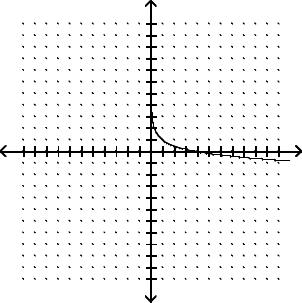
6)
x
-10 -5 5 10
y
10
5
-5
-10
x
-10 -5 5 10
y
10
5
-5
-10
A) f(x)=1–log 4x B) f(x)=log 4(–x) C) f(x)= – log 4x D) f(x)=log 4x
Page29
Graphthefunction.
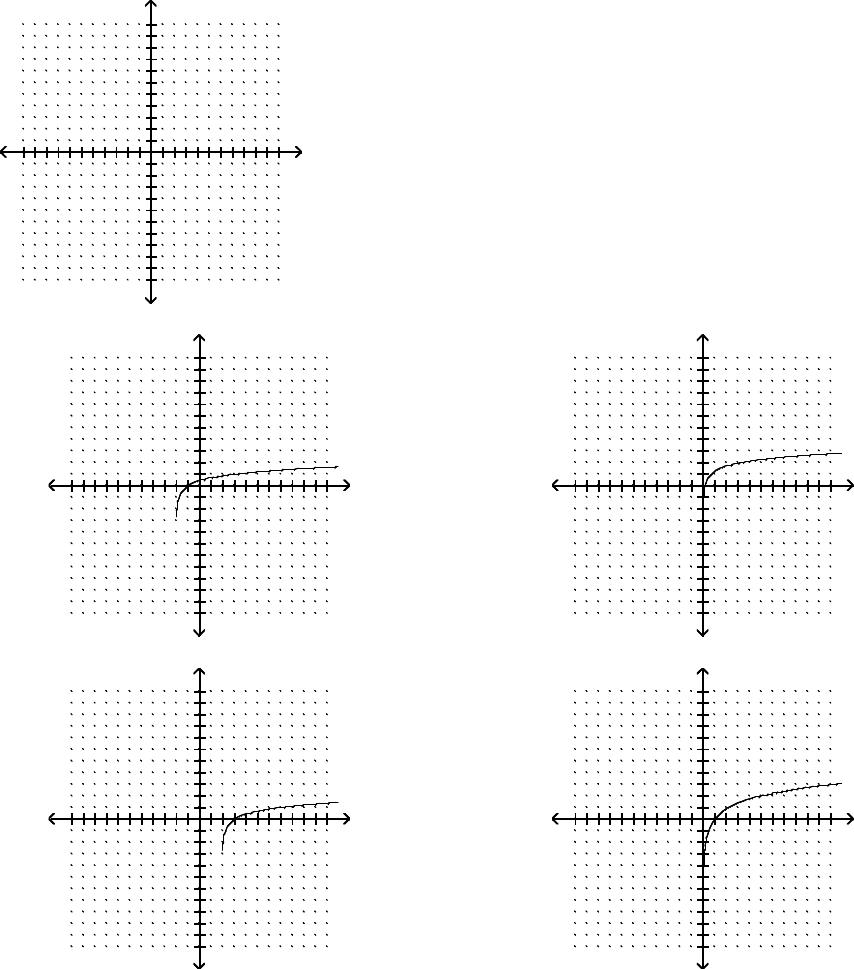
7) Usethegraphoflog 5xtoobtainthegraphoff(x)=log 5(x+2).
x
-10 -5 5 10
y
10
5
-5
-10
x
-10 -5 5 10
y
10
5
-5
-10
A)
x
-10 -5 5 10
y
10
5
-5
-10
x
-10 -5 5 10
y
10
5
-5
-10
B)
x
-10 -5 5 10
y
10
5
-5
-10
x
-10 -5 5 10
y
10
5
-5
-10
C)
x
-10 -5 5 10
y
10
5
-5
-10
x
-10 -5 5 10
y
10
5
-5
-10
D)
x
-10 -5 5 10
y
10
5
-5
-10
x
-10 -5 5 10
y
10
5
-5
-10
Page30
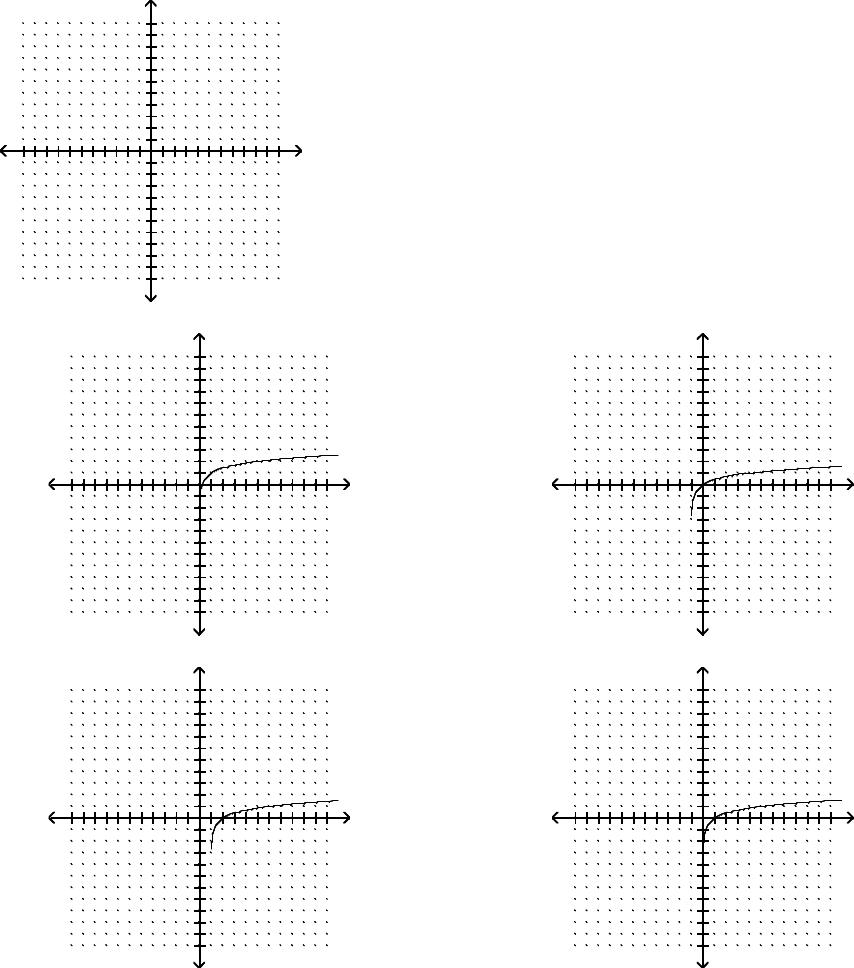
8) Usethegraphoflog 5xtoobtainthegraphoff(x)=1+log 5x.
x
-10 -5 5 10
y
10
5
-5
-10
x
-10 -5 5 10
y
10
5
-5
-10
A)
x
-10 -5 5 10
y
10
5
-5
-10
x
-10 -5 5 10
y
10
5
-5
-10
B)
x
-10 -5 5 10
y
10
5
-5
-10
x
-10 -5 5 10
y
10
5
-5
-10
C)
x
-10 -5 5 10
y
10
5
-5
-10
x
-10 -5 5 10
y
10
5
-5
-10
D)
x
-10 -5 5 10
y
10
5
-5
-10
x
-10 -5 5 10
y
10
5
-5
-10
Page31
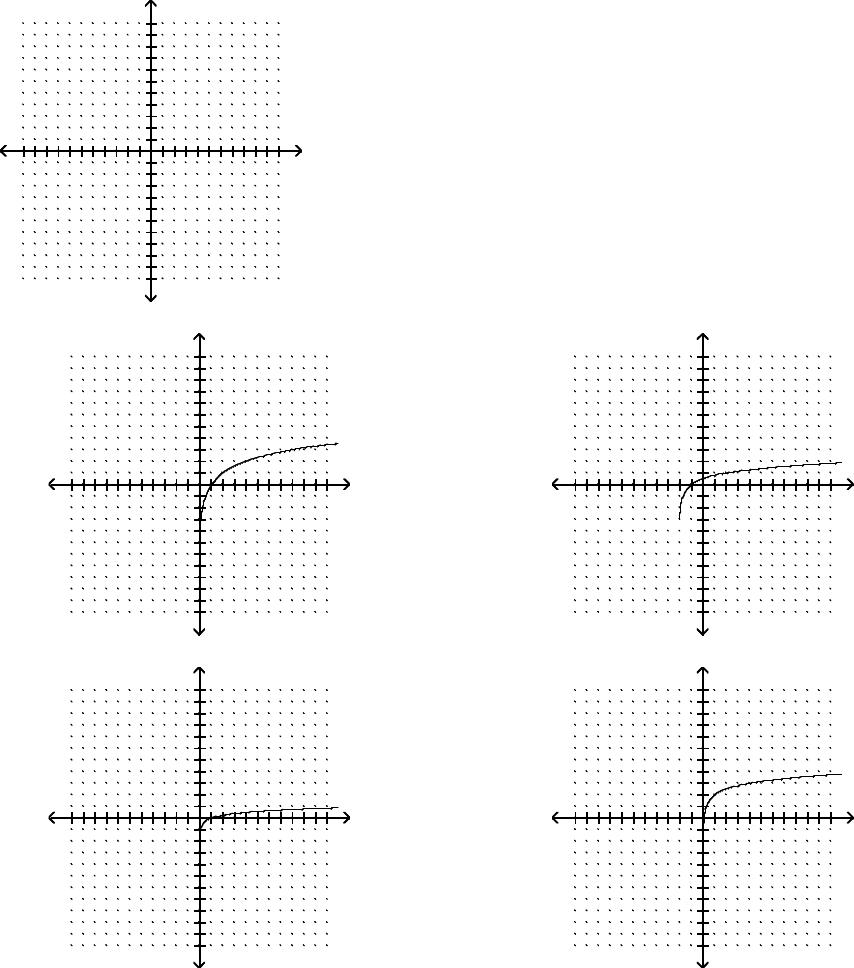
9) Usethegraphoflog 4xtoobtainthegraphoff(x)=2 log 4x.
x
-10 -5 5 10
y
10
5
-5
-10
x
-10 -5 5 10
y
10
5
-5
-10
A)
x
-10 -5 5 10
y
10
5
-5
-10
x
-10 -5 5 10
y
10
5
-5
-10
B)
x
-10 -5 5 10
y
10
5
-5
-10
x
-10 -5 5 10
y
10
5
-5
-10
C)
x
-10 -5 5 10
y
10
5
-5
-10
x
-10 -5 5 10
y
10
5
-5
-10
D)
x
-10 -5 5 10
y
10
5
-5
-10
x
-10 -5 5 10
y
10
5
-5
-10
Page32
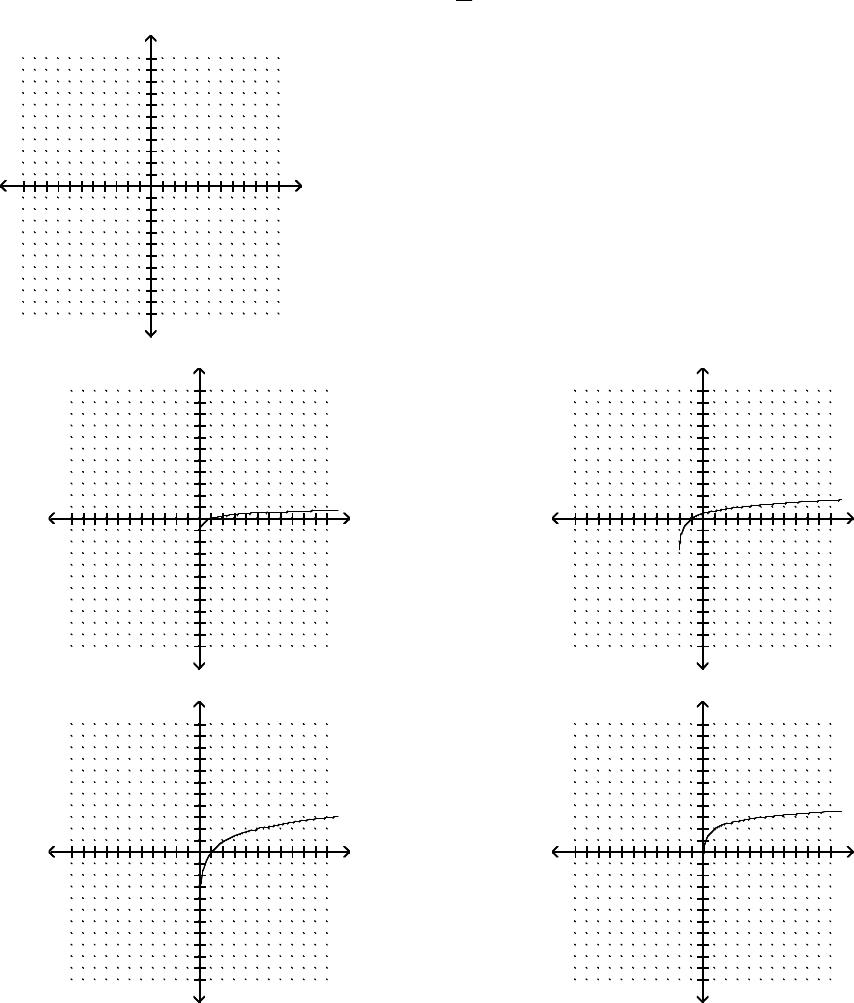
10) Usethegraphoflog 5xtoobtainthegraphoff(x)=1
2log 5x.
x
-10 -5 5 10
y
10
5
-5
-10
x
-10 -5 5 10
y
10
5
-5
-10
A)
x
-10 -5 5 10
y
10
5
-5
-10
x
-10 -5 5 10
y
10
5
-5
-10
B)
x
-10 -5 5 10
y
10
5
-5
-10
x
-10 -5 5 10
y
10
5
-5
-10
C)
x
-10 -5 5 10
y
10
5
-5
-10
x
-10 -5 5 10
y
10
5
-5
-10
D)
x
-10 -5 5 10
y
10
5
-5
-10
x
-10 -5 5 10
y
10
5
-5
-10
Page33
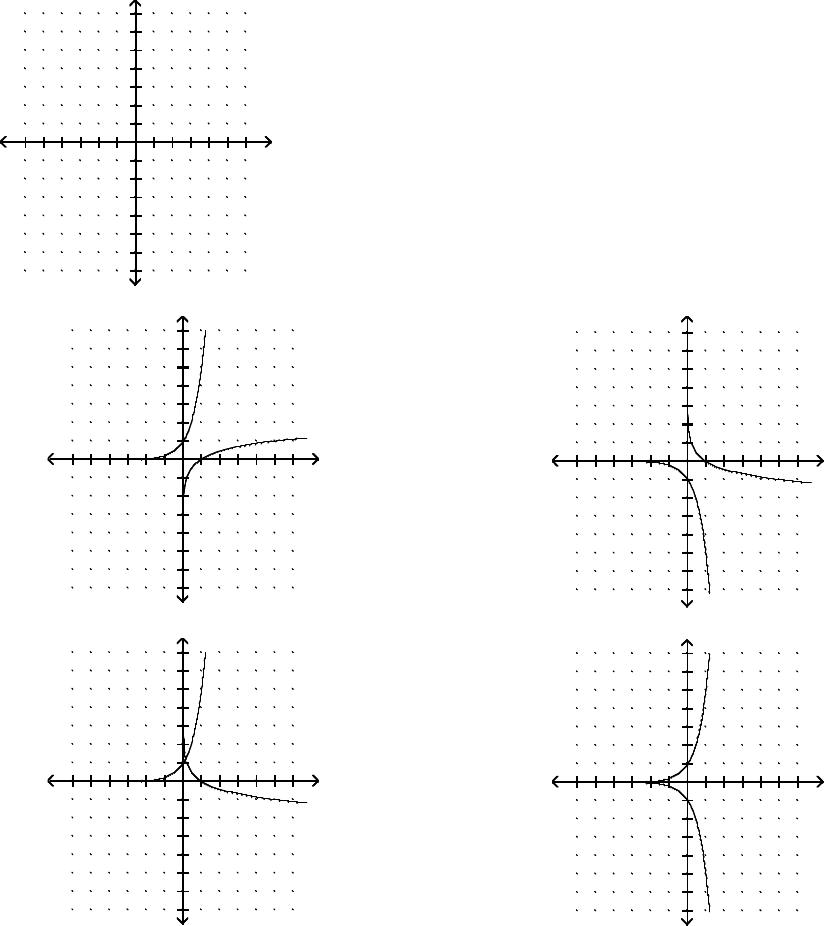
Graphthefunctionsinthesamerectangularcoordinatesystem.
11) f(x)=5xandg(x)=log5x
x
-6 6
y
6
-6
x
-6 6
y
6
-6
A)
x
-6 6
y
6
-6
x
-6 6
y
6
-6
B)
x
-6 6
y
6
-6
x
-6 6
y
6
-6
C)
x
-6 6
y
6
-6
x
-6 6
y
6
-6
D)
x
-6 6
y
6
-6
x
-6 6
y
6
-6
Page34
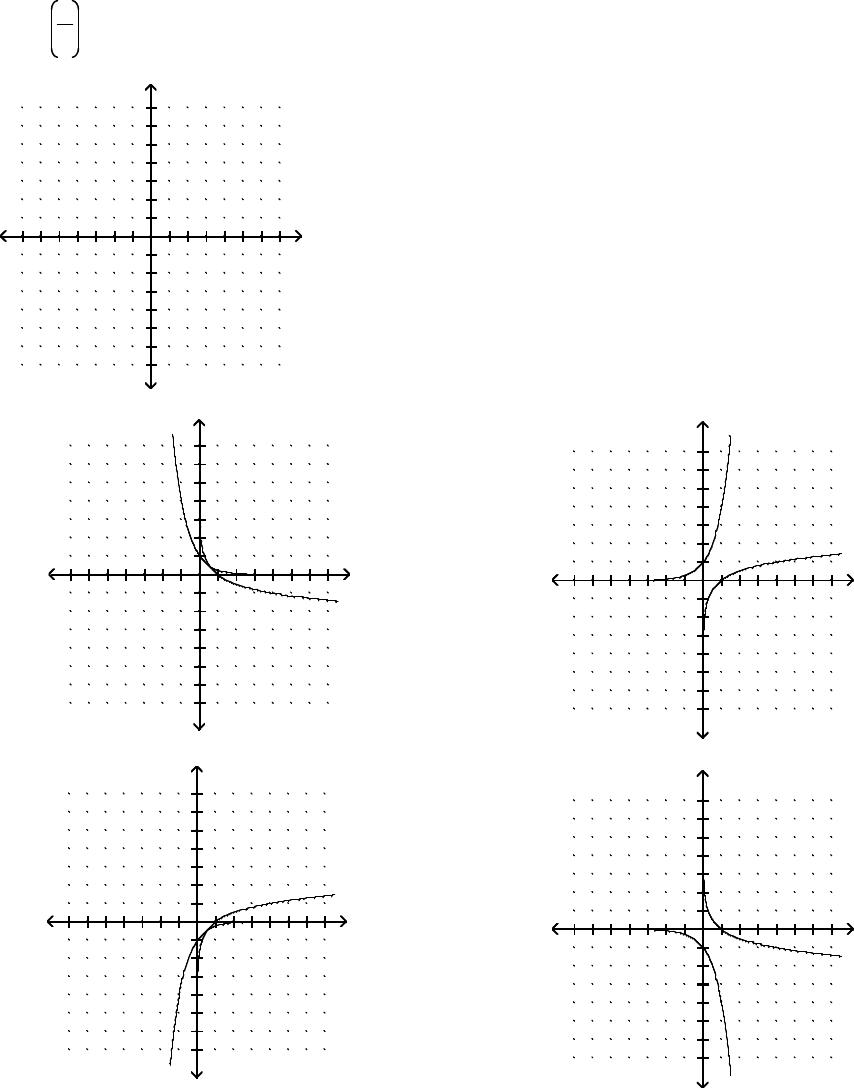
12) f(x)=1
4
xandg(x)=log1/4x
x
-6 -4 -2 2 4 6
y
6
4
2
-2
-4
-6
x
-6 -4 -2 2 4 6
y
6
4
2
-2
-4
-6
A)
x
-6 -4 -2 2 4 6
y
6
4
2
-2
-4
-6
x
-6 -4 -2 2 4 6
y
6
4
2
-2
-4
-6
B)
x
-6 -4 -2 2 4 6
y
6
4
2
-2
-4
-6
x
-6 -4 -2 2 4 6
y
6
4
2
-2
-4
-6
C)
x
-6 -4 -2 2 4 6
y
6
4
2
-2
-4
-6
x
-6 -4 -2 2 4 6
y
6
4
2
-2
-4
-6
D)
x
-6 -4 -2 2 4 6
y
6
4
2
-2
-4
-6
x
-6 -4 -2 2 4 6
y
6
4
2
-2
-4
-6
Page35
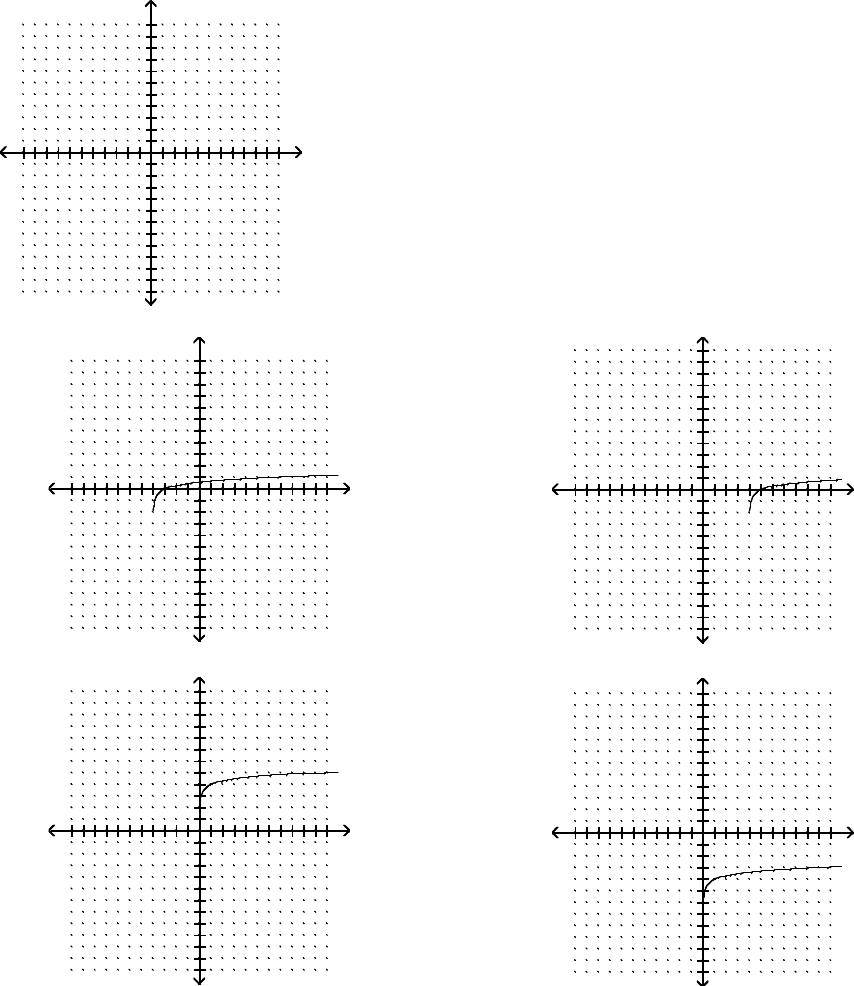
Graphthefunction.
13) Usethegraphoff(x)=logxtoobtainthegraphofg(x)=log(x+4).
x
-10 -5 5 10
y
10
5
-5
-10
x
-10 -5 5 10
y
10
5
-5
-10
A)
x
-10 -5 5 10
y
10
5
-5
-10
x
-10 -5 5 10
y
10
5
-5
-10
B)
x
-10 -5 5 10
y
10
5
-5
-10
x
-10 -5 5 10
y
10
5
-5
-10
C)
x
-10 -5 5 10
y
10
5
-5
-10
x
-10 -5 5 10
y
10
5
-5
-10
D)
x
-10 -5 5 10
y
10
5
-5
-10
x
-10 -5 5 10
y
10
5
-5
-10
Page36
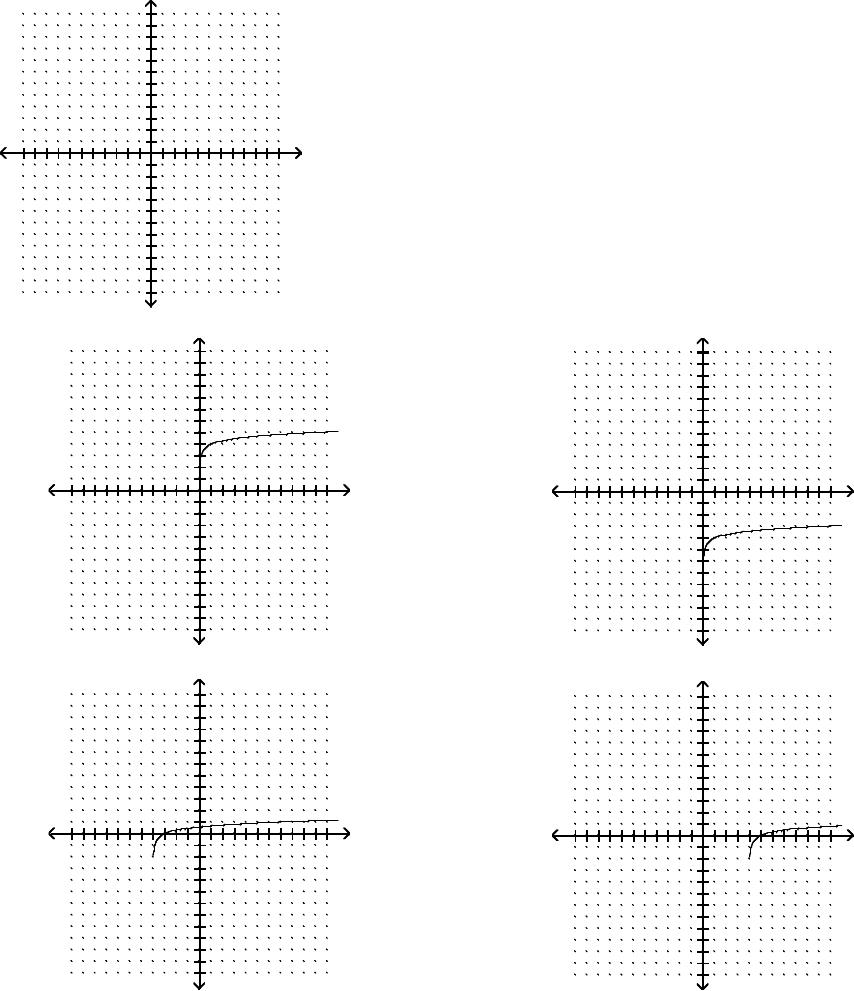
14) Usethegraphoff(x)=logxtoobtainthegraphofg(x)=logx+4.
x
-10 -5 5 10
y
10
5
-5
-10
x
-10 -5 5 10
y
10
5
-5
-10
A)
x
-10 -5 5 10
y
10
5
-5
-10
x
-10 -5 5 10
y
10
5
-5
-10
B)
x
-10 -5 5 10
y
10
5
-5
-10
x
-10 -5 5 10
y
10
5
-5
-10
C)
x
-10 -5 5 10
y
10
5
-5
-10
x
-10 -5 5 10
y
10
5
-5
-10
D)
x
-10 -5 5 10
y
10
5
-5
-10
x
-10 -5 5 10
y
10
5
-5
-10
Page37
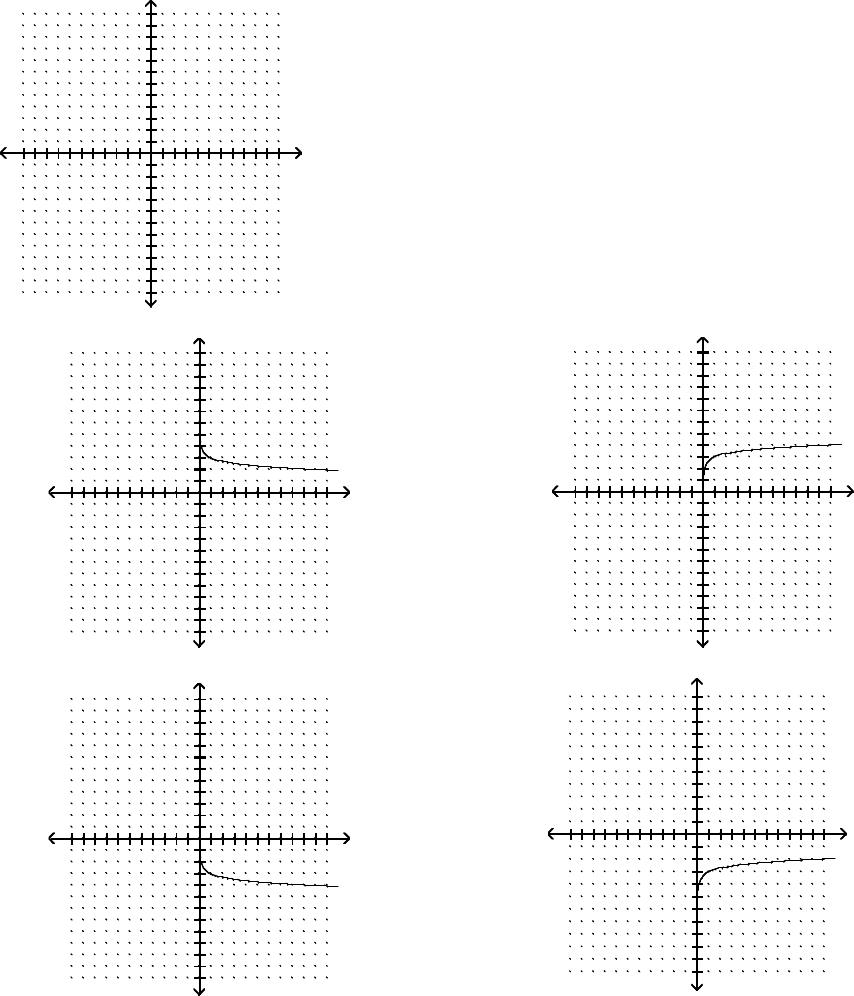
15) Usethegraphoff(x)=logxtoobtainthegraphofg(x)=3–logx.
x
-10 -5 5 10
y
10
5
-5
-10
x
-10 -5 5 10
y
10
5
-5
-10
A)
x
-10 -5 5 10
y
10
5
-5
-10
x
-10 -5 5 10
y
10
5
-5
-10
B)
x
-10 -5 5 10
y
10
5
-5
-10
x
-10 -5 5 10
y
10
5
-5
-10
C)
x
-10 -5 5 10
y
10
5
-5
-10
x
-10 -5 5 10
y
10
5
-5
-10
D)
x
-10 -5 5 10
y
10
5
-5
-10
x
-10 -5 5 10
y
10
5
-5
-10
Page38
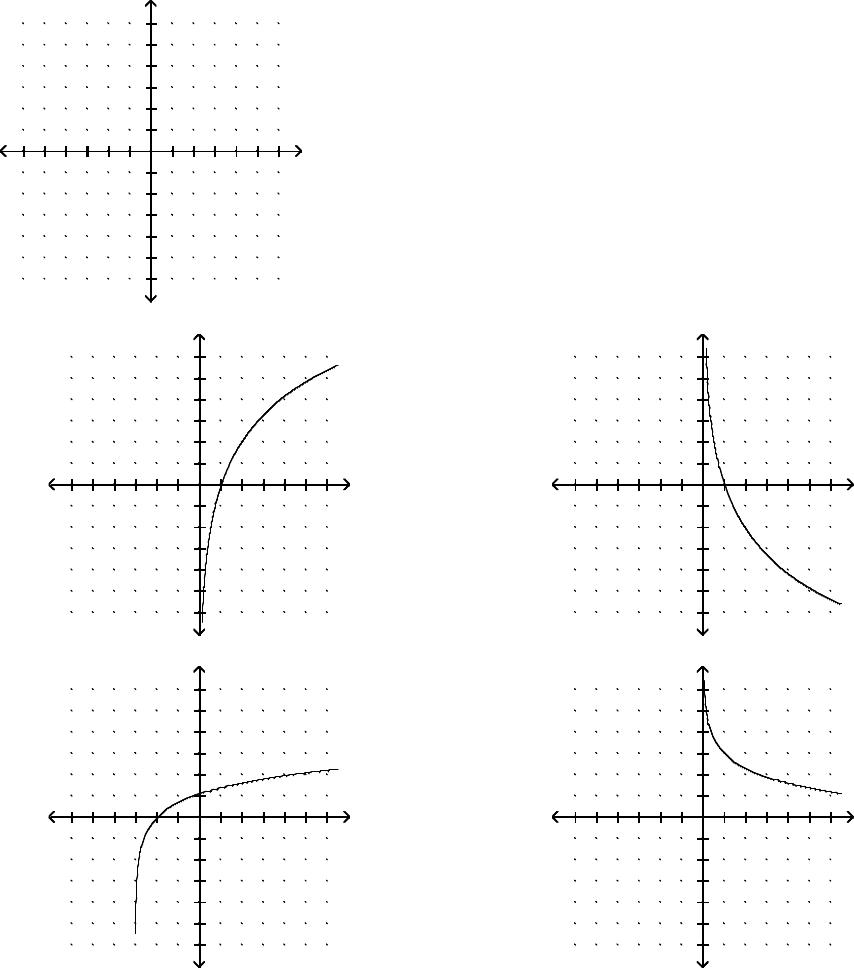
16) Usethegraphoff(x)=lnxtoobtainthegraphofg(x)=3 lnx.
x
-5 5
y
5
-5
x
-5 5
y
5
-5
A)
x
-5 5
y
5
-5
x
-5 5
y
5
-5
B)
x
-5 5
y
5
-5
x
-5 5
y
5
-5
C)
x
-5 5
y
5
-5
x
-5 5
y
5
-5
D)
x
-5 5
y
5
-5
x
-5 5
y
5
-5
Page39
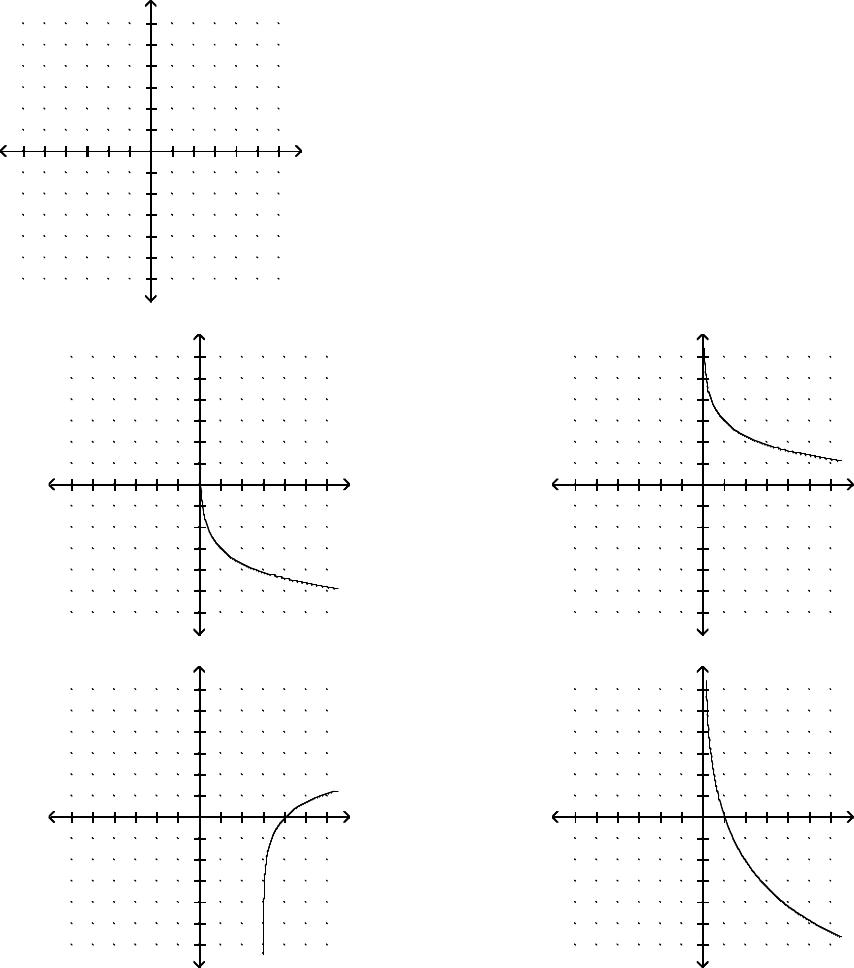
17) Usethegraphoff(x)=lnxtoobtainthegraphofg(x)= –3–lnx.
x
-5 5
y
5
-5
x
-5 5
y
5
-5
A)
x
-5 5
y
5
-5
x
-5 5
y
5
-5
B)
x
-5 5
y
5
-5
x
-5 5
y
5
-5
C)
x
-5 5
y
5
-5
x
-5 5
y
5
-5
D)
x
-5 5
y
5
-5
x
-5 5
y
5
-5
6 FindtheDomainofaLogarithmicFunction
MULTIPLECHOICE.Choosetheonealternativethatbestcompletesthestatementoranswersthequestion.
Findthedomainofthelogarithmicfunction.
1) f(x)=log 6(x+9)
A) (–9
,
∞)B)(6
,
∞)C)(9
,
∞)D)(
–∞
,
0)or(0,∞)
2) f(x)=log 3(x–8)
A) (8
,
∞)B)(
–∞
,
8)or(8
,
∞)C)(
–8
,
∞)D)(
–∞
,
0)or(0,∞)
3) f(x)=ln(4–x)
A) (–∞
,
4) B) (–∞
,
0) C) (–4
,
∞)D)(
–∞
,
4)or(4
,
∞)
Page40
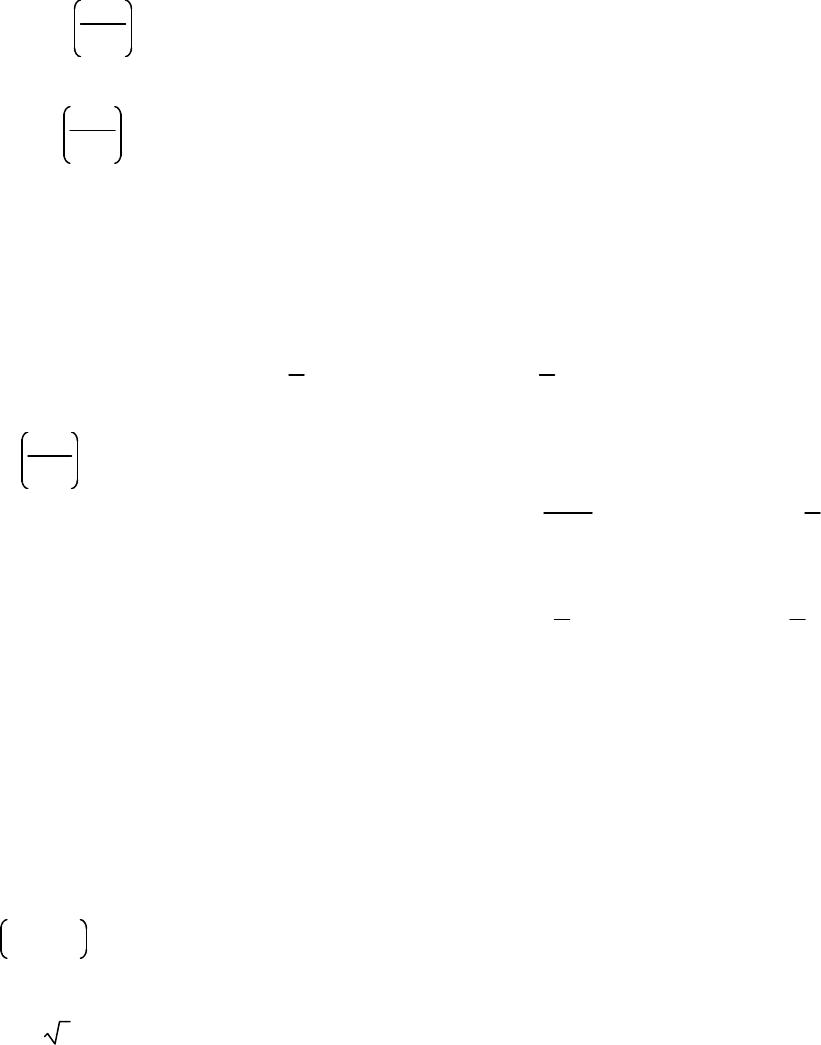
4) f(x)=log 3(x–2)2
A) (–∞
,
2)or(2
,
∞)B)(
–∞
,
0) or(0,∞)C)(
–2
,
∞)D)(2
,
∞)
5) f(x)=log 2(x+4)2
A) (–∞
,
–4)or(–4
,
∞)B)(
–∞
,
0) or(0,∞)C)(
–4
,
∞)D)(4
,
∞)
6) f(x)=log(x2–13x+36)
A) (–∞
,
4)∪(9
,
∞)B)(
–4
,
9) C) (9
,
∞)D)(
–∞
,
–4)
7) f(x)=logx+3
x–9
A) (–∞
,
–3)∪(9
,
∞)B)(
–3
,
9) C) (9
,
∞)D)(
–∞
,
–3)
8) f(x)=ln1
x+4
A) (–4
,
∞)B)(4
,
∞) C) (0,∞) D) (1,∞)
7 UseCommonLogarithms
MULTIPLECHOICE.Choosetheonealternativethatbestcompletesthestatementoranswersthequestion.
Evaluateorsimplifytheexpressionwithoutusingacalculator.
1) log10,000
A) 4 B) 1
4C) 2
5D) 40
2) log1
1000
A) –3B)3 C)1
1000 D) –1
3
3) log0.001
A) –3B)3 C)
–1
3D) 1
3
4) log106
A) 6 B) 10 C) log6D)10
6
5) 10log7
A) 7 B) 10,000,000 C) 70 D) 0.0000001
6) 9log109.8
A) 88.2 B) 882 C) 8.82 D) 20.5414
7) 6 10log9.3
A) 55.8 B) 558 C) 5.58 D) 13.3801
8) 10log5x
A) x1/5 B) x5C) 5 D) x–1/5
Page41
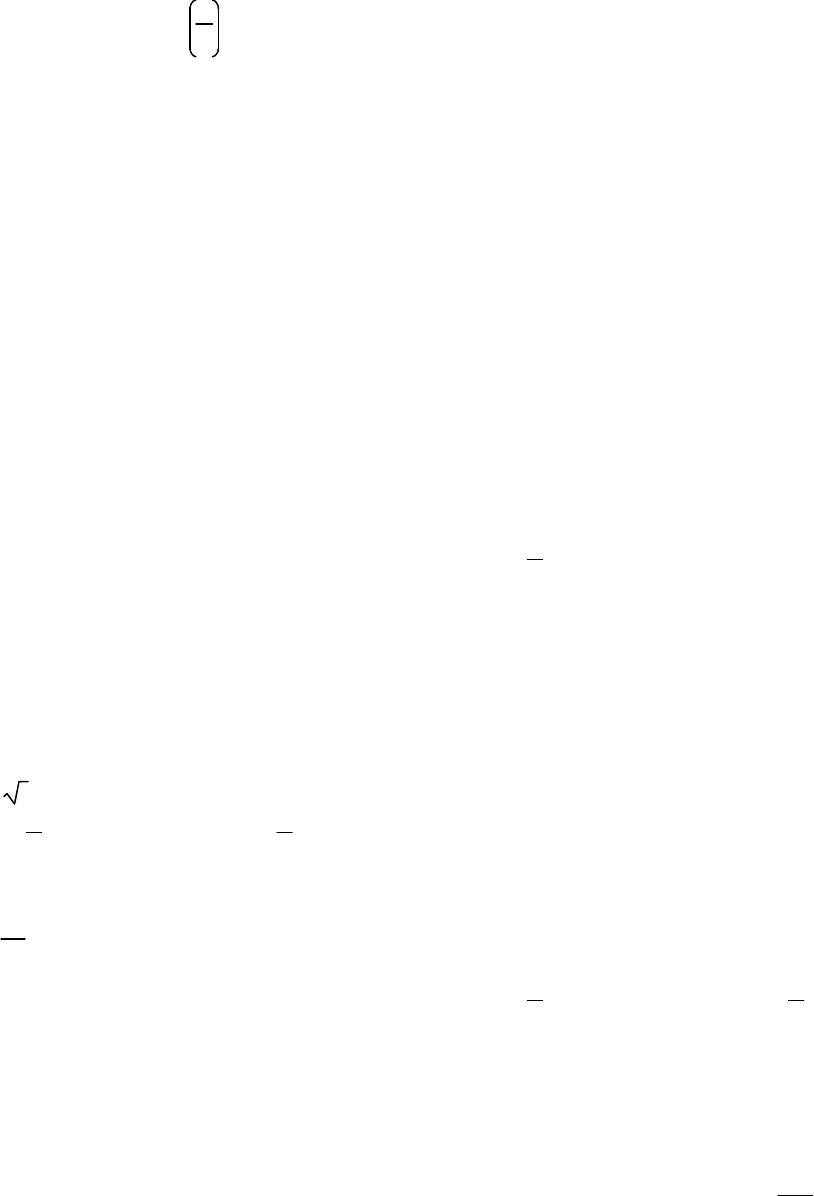
Solvetheproblem.
9) UsetheformulaR=loga
T+BtofindtheintensityRontheRichterscale,giventhatamplitudeais320
micrometers,timeTbetweenwavesis3.9seconds,andBis3.1.Roundanswertoonedecimalplace.
A) 5 B) 7.5 C) 1.9 D) 7.3
10) ThepHofasolutionrangesfrom0to14.AnacidhasapHlessthan7.PurewaterisneutralandhasapHof7.
ThepHofasolutionisgivenbypH=–logxwherexrepresentstheconcentrationofthehydrogenionsinthe
solutioninmolesperliter.FindthepHifthehydrogenionconcentrationis1x10–2.
A) 2 B) 12 C) –2D)
–12
11) ThepHofasolutionrangesfrom0to14.AnacidhasapHlessthan7.PurewaterisneutralandhasapHof7.
ThepHofasolutionisgivenbypH=–logxwherexrepresentstheconcentrationofthehydrogenionsinthe
solutioninmolesperliter.FindthepHifthehydrogenionconcentrationis2.8x10–3.
A) 2.55 B) 3.45 C) 3.55 D) 2.45
8 UseNaturalLogarithms
MULTIPLECHOICE.Choosetheonealternativethatbestcompletesthestatementoranswersthequestion.
Evaluateorsimplifytheexpressionwithoutusingacalculator.
1) lne2
A) 2 B) e C) 1
2D) 1
2) lne
A) 1 B) 0 C) e D) –1
3) ln1
A) 0 B) 1 C) e D) –1
4) ln6e
A) 1
6B) e
6C) 6 D) 6e
Evaluatetheexpressionwithoutusingacalculator.
5) ln1
e7
A) –7B)7 C)
1
7D) –1
7
6) eln271
A) 271 B) –271 C) e271 D) ln271
7) lne14x
A) 14x B) –14x C) e14x D) 1
14x
8) eln9x3
A) 9x3B) e9x3C) ln9x3D) 3
Page42
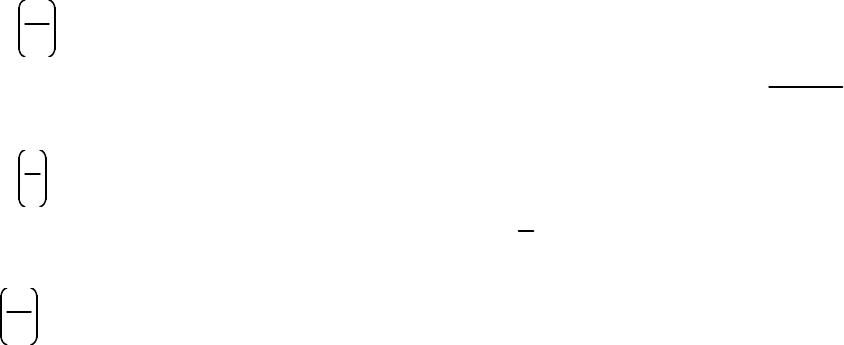
Solvetheproblem.
9) Thelongjumprecord,infeet,ataparticularschoolcanbemodeledbyf(x)=20.1+2.5ln(x+1) wherexisthe
numberofyearssincerecordsbegantobekeptattheschool.Whatistherecordforthelongjump 6yearsafter
recordstartedbeingkept?Roundyouranswertothenearesttenth.
A) 25.0feet B) 24.6 feet C) 24.1 feet D) 22.6 feet
10) Thefunctionf(x)=1+1.5ln(x+1)modelstheaveragenumberoffree–throwsabasketballplayercanmake
consecutivelyduringpracticeasafunctionoftime,wherexisthenumberofconsecutivedaysthebasketball
playerhaspracticedfortwohours.After206daysofpractice,whatistheaveragenumberofconsecutivefree
throwsthebasketballplayermakes?
A) 9consecutivefreethrows B) 10 consecutivefreethrows
C) 12consecutivefreethrows D) 13 consecutivefreethrows
4.3 PropertiesofLogarithms
1 UsetheProductRule
MULTIPLECHOICE.Choosetheonealternativethatbestcompletesthestatementoranswersthequestion.
Usepropertiesoflogarithmstoexpandthelogarithmicexpressionasmuchaspossible.Wherepossible,evaluate
logarithmicexpressionswithoutusingacalculator.
1) log 6(7·3)
A) log 67+log 63 B) log 67–log 63 C) log 621 D) ( log 67)( log 63)
2) log 7(7x)
A) 1+log 7xB)7 C)x D)1
3) log 5(25x)
A) 2+log 5xB)10+log 5x C) 2x D) 2 log 5x
4) log(100x)
A) 2+logxB)20+logx C) 2x D) 2logx
2 UsetheQuotientRule
MULTIPLECHOICE.Choosetheonealternativethatbestcompletesthestatementoranswersthequestion.
Usepropertiesoflogarithmstoexpandthelogarithmicexpressionasmuchaspossible.Wherepossible,evaluate
logarithmicexpressionswithoutusingacalculator.
1) log 3
7
13
A) log 37–log 313 B) log 37+log 313 C) log 313 –log 37D)
log 37
log 313
2) log 7
7
x
A) 1–log 7xB)7 C)
1
xD) –log 7x
3) logx
10
A) logx–1 B) logx+1C)
–10x D) 10x
Page43
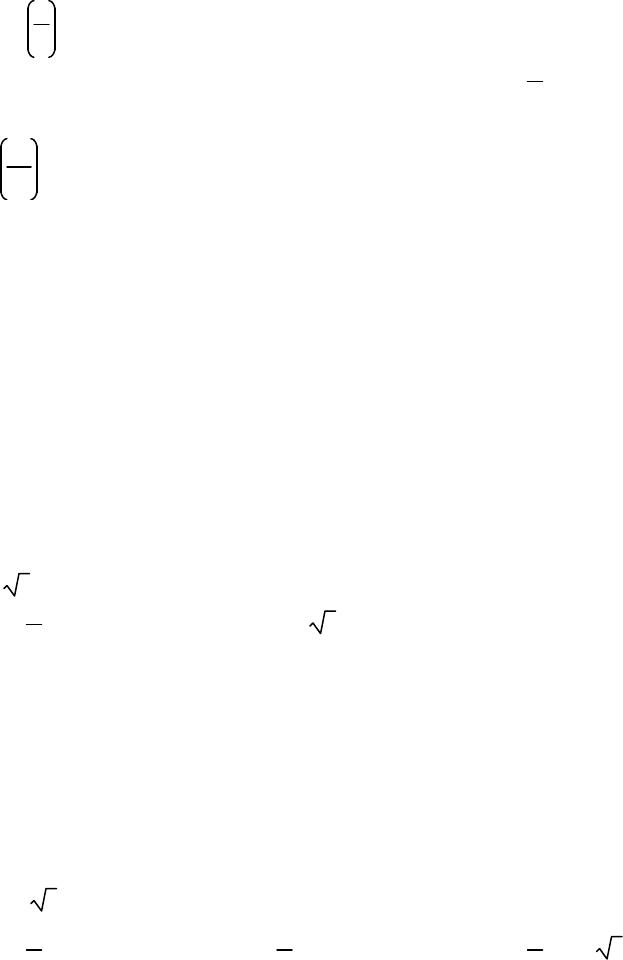
4) log 2
8
x
A) 3–log 2xB)6–log 2xC)
3
xD) –3 log 2x
5) lne2
9
A) 2–ln9B)lne2–ln9C)2
+ln9D)lne2+ln9
3 UsethePowerRule
MULTIPLECHOICE.Choosetheonealternativethatbestcompletesthestatementoranswersthequestion.
Usepropertiesoflogarithmstoexpandthelogarithmicexpressionasmuchaspossible.Wherepossible,evaluate
logarithmicexpressionswithoutusingacalculator.
1) lognx5
A) 5lognxB)
–5lognx C) nlog5xD)
–nlog5x
2) logX–2
A) –2logX B) 2logXC)
–2+logXD)2+logX
3) ln7x
A) 1
7lnxB)7lnx C) xln7D)7lnx
4) log 7x6
A) 6 log 7x B) 7 log 6xC)7logx D) 6 log 7x6
5) log 57–3
A) –3 log 57 B) 5 log 37C)
–15 log7 D) 7 log 53
6) log 8
3y
A) 1
3log 8yB)
1
8log 3yC)
1
3log 8
3yD) 3 log 8y
4 ExpandLogarithmicExpressions
MULTIPLECHOICE.Choosetheonealternativethatbestcompletesthestatementoranswersthequestion.
Usepropertiesoflogarithmstoexpandthelogarithmicexpressionasmuchaspossible.Wherepossible,evaluate
logarithmicexpressionswithoutusingacalculator.
1) logb(yz4)
A) logby+4logbzB)4logby+4 logbzC)4logbyz D) logby+logb4z
Page44
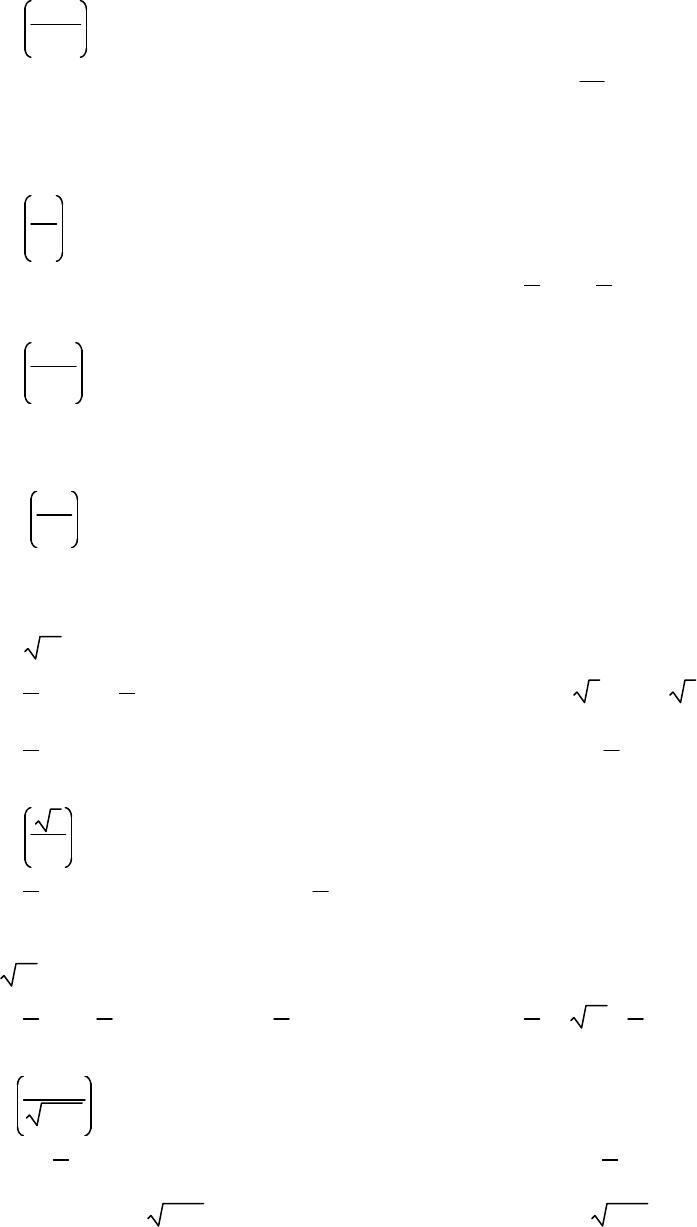
2) log 6
7·11
13
A) log 67+log 611–log 613 B) log 6(77
13 )
C) log 677–log 613 D) log 65
3) log 2
x2
y7
A) 2 log 2x–7 log 2y B) 2 log 2x+7 log 2yC)
2
7log 2(x
y) D) 7 log 2y–2 log 2x
4) log 6
x–6
x8
A) log 6(x–6)–8 log 6x B) log 6(x–6)+8 log 6x
C) 8 log 6x–log 6(x–6) D) log 6(x–6)–log 6x
5) log w
13x
2
A) log w13+log wx–log w2 B) log w11x
C) log w13x–log w2 D) log w13 +log wx+log w2
6) log 53x
A) 1
2log 53+1
2log 5x B) log 53+log 5x
C) 1
2log 53x D) log 53+1
2log 5x
7) log 5
x
125
A) 1
2log 5x–3B)15–1
2log 5x C) log 5x–3D)
–3 log 5x
8) ln3ey
A) 1
3lny+1
3B) y
3C) 1
3ln3ey+1
3D) 3lny+3
9) log5125
x–1
A) 3–1
2log5(x–1) B) 3log55–1
2log5(x–1)
C) log5125–log5x–1D) 3–log5x–1
Page45
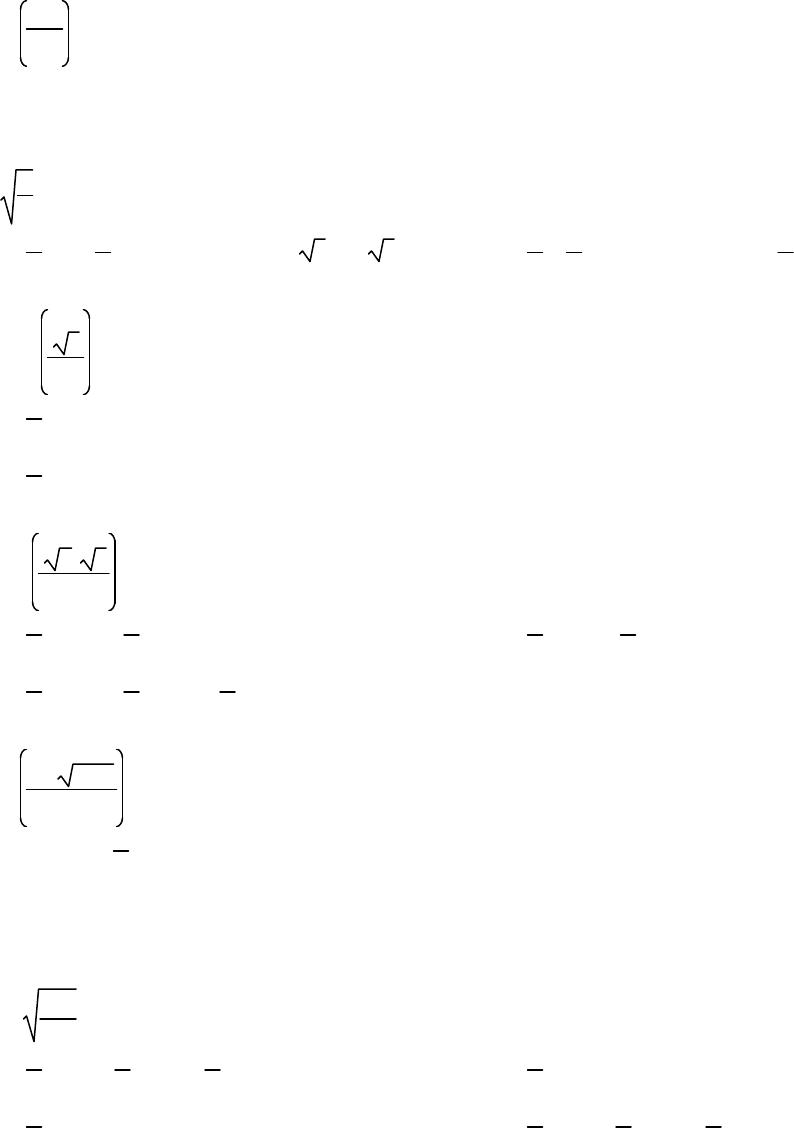
10) logbxy7
z2
A) logbx+7logby–2logbz B) logbx+7logby+2logbz
C) logbx+logby7–logbz2D) logbx+logby7+logbz2
11) lnx
y
A) 1
2lnx–1
2lnyB)lnx–lny C) 1
2lnx
yD) 1
2lnx–lny
12) log 11
73
y2x
A) 1
7log 11 3–2log 11 y–log 11 xB)7log 11 3–2log 11 y–log 11 7
C) 1
7log 11 3–2log 11 y–2log 11 x D) log 11 3–log 11 y–log 11 x
13) log 5
3p4q
t2
A) 1
3log 5p+1
4log 5q–2 log 5tB)
1
3log 5p·1
4log 5q÷2 log 5t
C) 3
5log 5p+4
5log 5q–2
5log 5t D) 3 log 5p+4 log 5q–2 log 5t
14) logax43x+5
(x–2)2
A) 4logax+1
3loga(x+5)–2loga(x–2) B) 4logax–3loga(x+5)–2loga(x–2)
C) logax4+loga(x+5)–3–loga(x–2)2D) logax4+loga(x+5)1/3–loga(x–2)2
15)
log35x4y
9
A) 4
5log3x+1
5log3y–2
5B) 1
5(log3x4+log3y–2)
C) 1
5(log3x4y–log39) D) 4
5log3x–1
5log3y+2
5
Page46
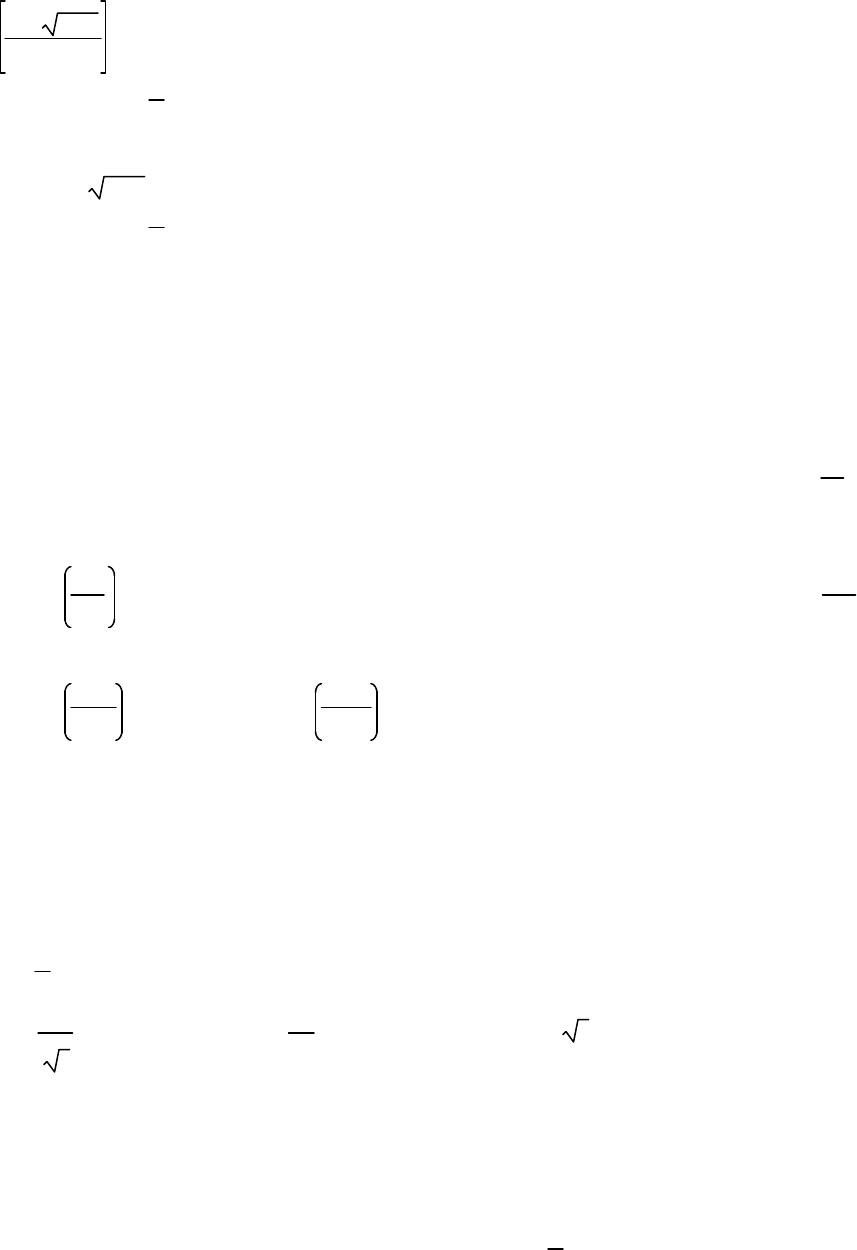
16) log3x344–x
4(x+4)2
A) log3+3logx+1
4log(4–x)–log4–2log(x+4)
B) log3+logx3+log(4–x)1/4–log4–log(x+4)2
C) log(3x344–x)–log(4(x+4)2)
D) log3+3logx+1
4log(4–x)–log4+2log(x+4)
5 CondenseLogarithmicExpressions
MULTIPLECHOICE.Choosetheonealternativethatbestcompletesthestatementoranswersthequestion.
Usepropertiesoflogarithmstocondensethelogarithmicexpression.Writetheexpressionasasinglelogarithmwhose
coefficientis1.Wherepossible,evaluatelogarithmicexpressions.
1) log cm+log cn
A) log c(mn) B) log cm·log cn C) log c(m +n) D) log c(m
n)
2) 3 log
b
m–log
b
n
A) log b
m3
nB) log bm3÷log bn C) log b(m3–n) D) log b(3m
n)
3) log 3(x+3)–log 3(x+6)
A) log 3
x+3
x+6B) log 3
x+3
x–6C) log 3–3 D) log 3(x2+9x+18)
4) 3 log x2+log x3
A) log x24 B) log x18 C) 3 log x6 D) log x2
5) log 248–log 23
A) 4 B) log 2144 C) log 245 D) log 248 1/3
6) 2lnx–1
4lny
A) lnx2
4y
B) lnx2
y4C) lnx24y D) lnx2y4
7) log10125+log108
A) 3 B) log101000 C) log10133 D) 3log1010
8) logx+log9
A) log9x B) (logx)(log9) C) logx
9D) log(x+9)
Page47
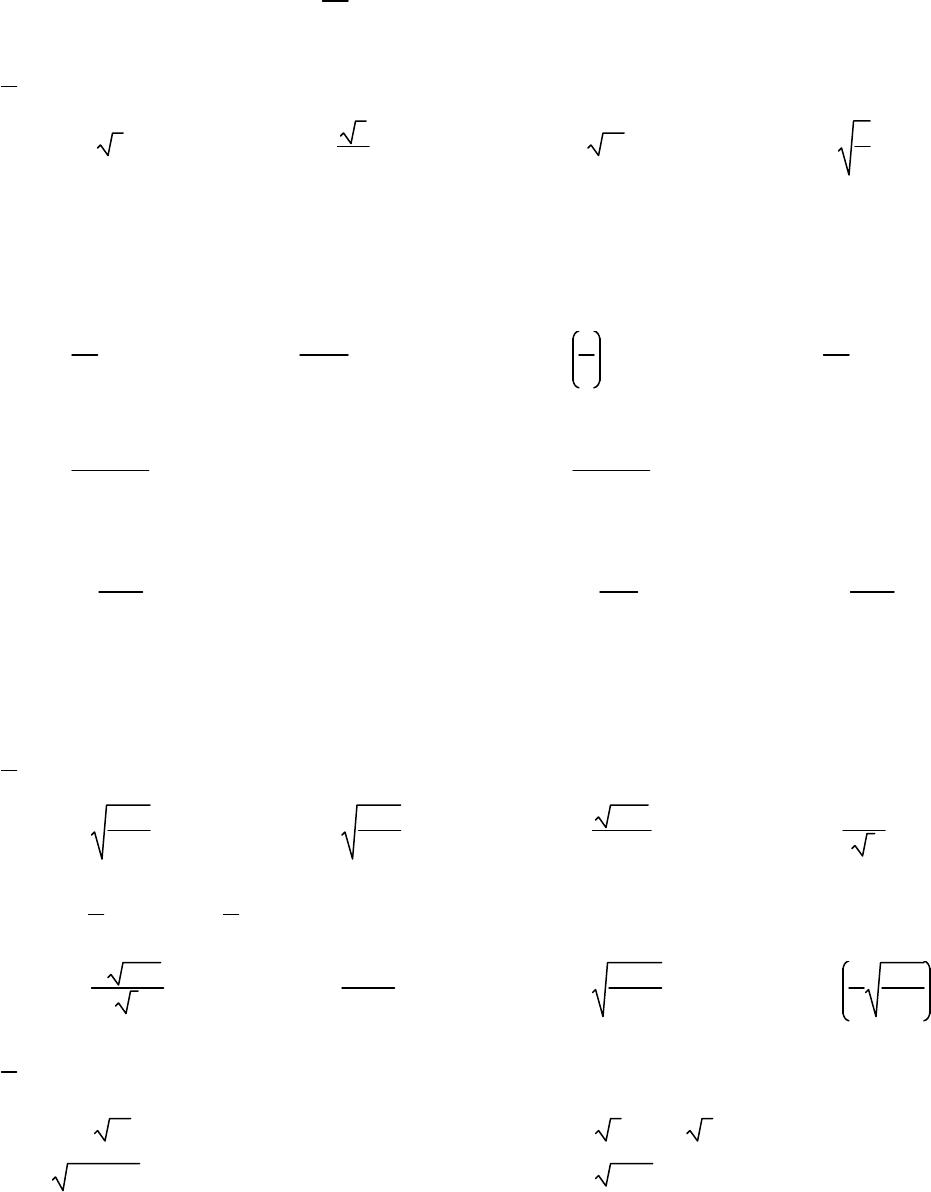
9) lnx+7lny
A) lnxy7B) lnx
y7C) ln7xy D) ln(x+7y)
10) 1
2log3x+log3y
A) log3yx B) log3
x
yC) log3xy D) log3
x
y
11) 9logby+6logbz
A) logby9z6B) 15logbyz C) logb(yz)15 D) 54logbyz
12) 9lna–7lnb
A) lna9
b7B) lna9
lnb7C) lna
b
16
D) ln9a
7b
13) 8ln(x–12)–9lnx
A) ln(x–12)8
x9B) lnx9(x–12)8C) ln8(x–12)
9x D) ln72x(x–12)
14) ( log am–log an)+4 log ak
A) log a
mk4
nB) log amk4n C) log a
m
k4nD) log a
4mk
n
15) 3 log 6x+5 log 6(x–6)
A) log 6x3(x–6)5B) log 6x(x–6)15 C) 15log 6x(x–6) D) log 6x(x–6)
16) 1
2(log5(r–5)–log5r)
A) log5r–5
rB) log5r–5
2r C) log5r–5
rD) log5r–5
r
17) 3log42+1
6log4(r–3)–1
2log4r
A) log486r–3
rB) log48r–3
12r C) log43r–9
12r D) log41
4
r–3
r
18) 1
3(log8x+log8y)
A) log83xy B) log83x+log83y
C) 3log8(xy) D) log83x+y
Page48
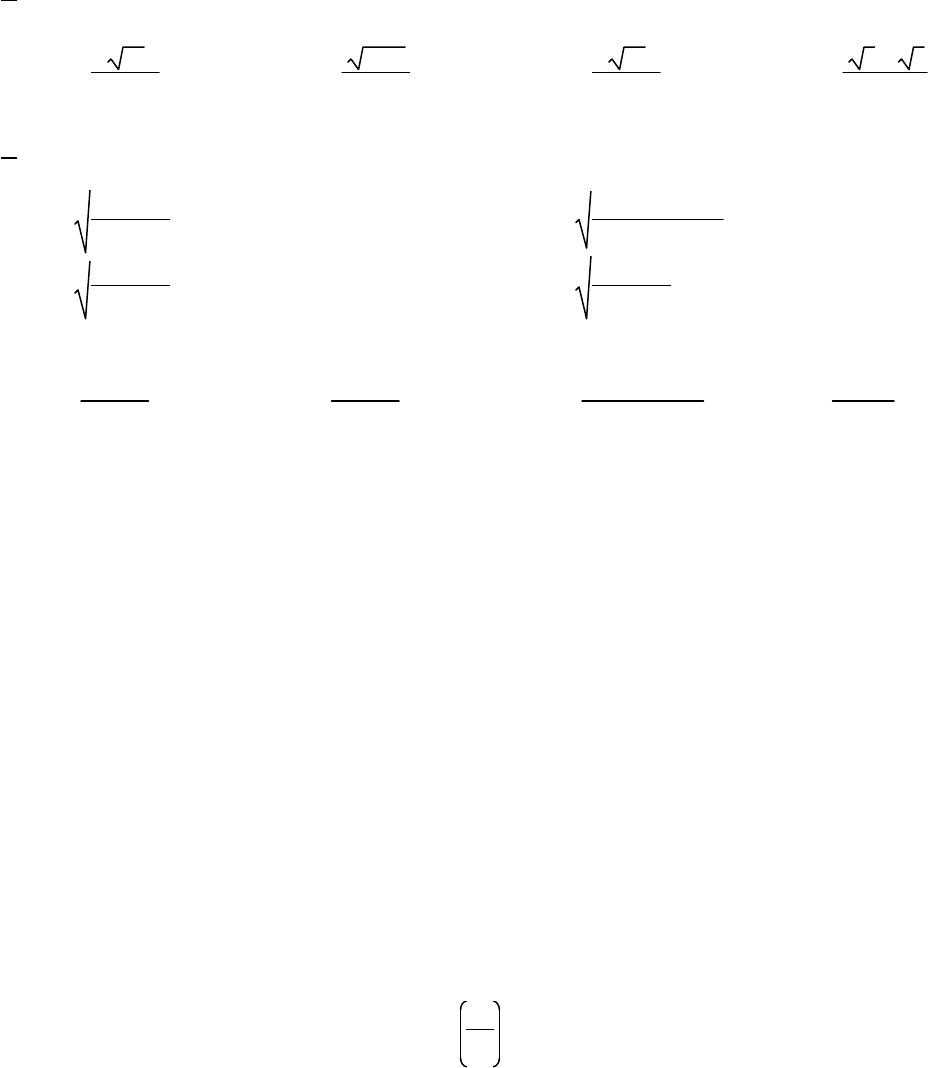
19) 1
4(log4x+log4y)–3log4(x+7)
A) log4
4xy
(x+7)3B) log4
4x+y
(x+7)3C) log4
4xy
3(x+7) D) log4
4x+4y
(x+7)3
20) 1
3[3ln(x+3)–lnx–ln(x2–3)]
A) ln3(x+3)3
x(x2–3) B) ln3(x+3)3(x2–3)
x
C) ln33(x+3)
x(x2–3) D) ln3x(x+3)3
(x2–3)
21) logx+log(x2–9)–log7–log(x–3)
A) logx(x+3)
7B) logx(x–9)
7(x–3) C) logx(x–9)(x–3)
7D) log2x+3)
10–x
6 UsetheChange–of–BaseProperty
MULTIPLECHOICE.Choosetheonealternativethatbestcompletesthestatementoranswersthequestion.
Usecommonlogarithmsornaturallogarithmsandacalculatortoevaluatetofourdecimalplaces
1) log 58
A) 1.2920 B) 0.7740 C) 1.6021 D) 0.2041
2) log 26 390
A) 1.8312 B) 0.5461 C) 4.0060 D) 1.1761
3) log 12 63.2
A) 1.6686 B) 0.5993 C) 2.8799 D) 0.7215
4) log 0.1 17
A) –1.2304 B) –0.8127 C) 0.2304 D) 2.2304
5) log π15
A) 2.3657 B) 0.4227 C) 1.6732 D) 0.6789
Solvetheproblem.
6) Usethemathematicalmodelforpowergain,G=logP0
Pi
10
,whereP0istheoutputpowerinwattsandPiis
theinputpowerinwatts.DeterminethepowergainG,indecibels,foranamplifierwithanoutputP0of19
wattsandaninputPiof1.9watts.Roundtofivedecimalplacesifnecessary.
A) 10dB B) 12.32996 dB C) 11 dB D) 15.57507 dB
Page49
4.4 ExponentialandLogarithmicEquations
1 UseLikeBasestoSolveExponentialEquations
MULTIPLECHOICE.Choosetheonealternativethatbestcompletesthestatementoranswersthequestion.
Solvetheequationbyexpressingeachsideasapowerofthesamebaseandthenequatingexponents.
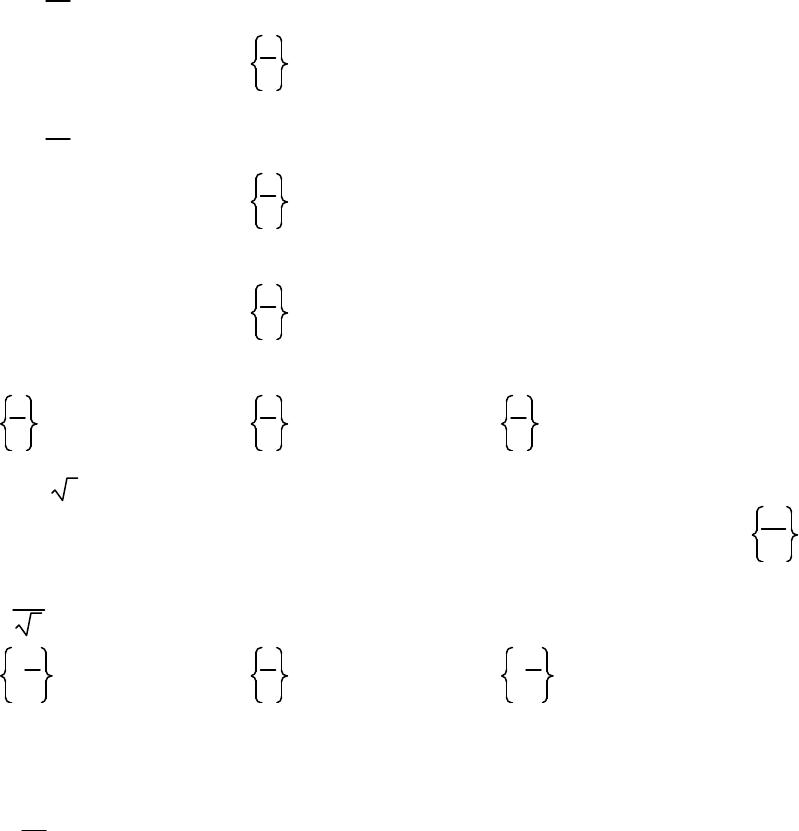
1) 4x=256
A) {4} B) {64} C) {5} D) {3}
2) 4(1+2x)=64
A) {1} B) {16} C) {4} D) {–1}
3) 2(5–3x)=1
16
A) {3} B) 1
8C) {8} D) {–3}
4) 2(3x+5)=1
16
A) {–3} B) 1
8C) {8} D) {3}
5) 3(3x–6)=27
A) {3} B) 1
9C) {9} D) {–3}
6) 729x=81
A) 2
3B) 3
2C) 4
5D) {4}
7) 9(x–3)
/
8=9
A) {7} B) {19} C) {11} D) 17
3
8) 125x=1
5
A) –1
6B) 1
6C) –1
3D) {–3}
9) 9x+1=27x–1
A) {5} B) {2} C) {4} D) {3}
10) ex+9=1
e5
A) {–14} B) {14} C) {4} D) {–4}
Page50
2 UseLogarithmstoSolveExponentialEquations
MULTIPLECHOICE.Choosetheonealternativethatbestcompletesthestatementoranswersthequestion.
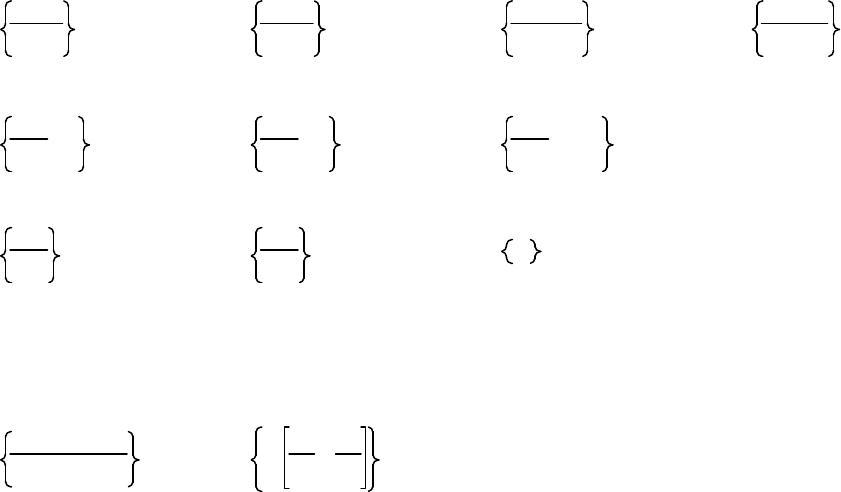
Solvetheexponentialequation.Expressthesolutionsetintermsofnaturallogarithms.
1) 7 9x=3.6
A) ln3.6
9ln7B) ln3.6
7ln9C) 9 ln3.6
ln7D) 3.6 ln9
ln7
2) 5 x+6=3
A) ln3
ln5–6 B) ln5
ln3+6 C) ln5
ln3+ln6 D) {ln3–ln5–ln6}
3) e2x=6
A) ln6
2B) ln2
6C) 3e D) {2ln6}
4) e x+7=5
A) {ln5–7} B) {e5+7} C) {e35} D) {ln12}
5) 4x+4=52x+5
A) 5ln5–4ln4
ln4–2ln5B) ln55
44–4
52C) {ln5–ln4} D) {7ln5–5ln4}
Solvetheexponentialequation.Useacalculatortoobtainadecimalapproximation,correcttotwodecimalplaces,forthe
solution.
6) 10x=3.91
A) 0.59 B) 8128.31 C) 1.36 D) 39.1
7) ex=4.5
A) 1.5 B) 0.65 C) 90.27 D) 12.24
8) 5x=18
A) 1.8 B) 4.65 C) 0.56 D) 0.88
9) 4ex=23
A) 1.75 B) 0.76 C) –1.75 D) –0.76
10) 25x=3.7
A) 0.38 B) 0.41 C) 9.44 D) 8.59
11) 3 x+8=4
A) –6.74 B) 8.79 C) 1.70 D) –0.78
12) e5x=8
A) 0.42 B) 0.20 C) 4.35 D) 10.40
13) e x+6=3
A) –4.90 B) –3.80 C) –4.75 D) 2.20
Page51
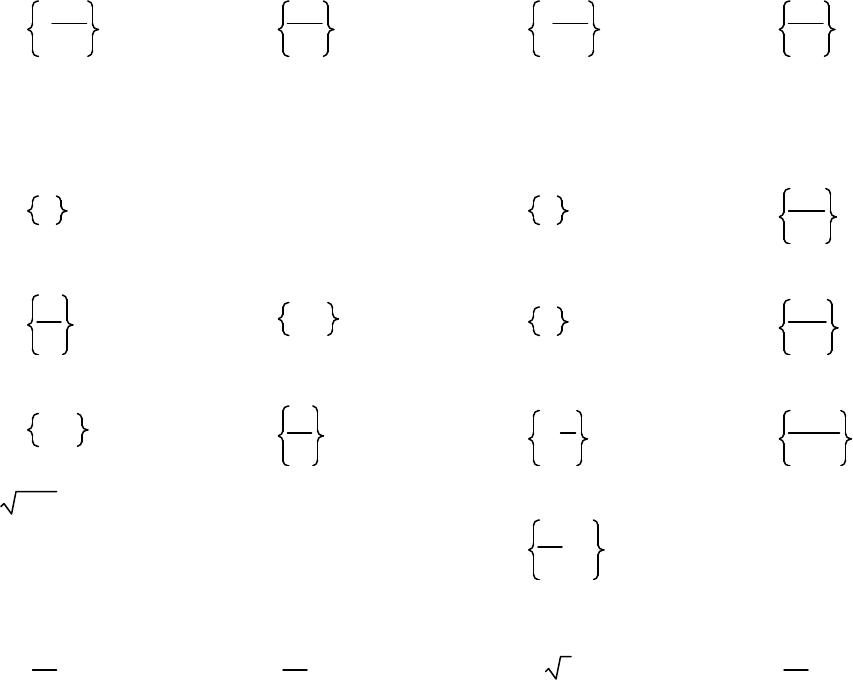
14) 7x=6x+7
A) 81.36 B) 3.36 C) 42.00 D) 40.68
15) e3x–10–10=1424
A) 5.76 B) 4.39 C) 2.42 D) 1.05
16) e2x+ex–6=0
A) 0.69 B) 0.69,1.10 C) 1.10,0.14 D) 0.14
3 UsetheDefinitionofaLogarithmtoSolveLogarithmicEquations
MULTIPLECHOICE.Choosetheonealternativethatbestcompletesthestatementoranswersthequestion.
Solvethelogarithmicequation.Besuretorejectanyvaluethatisnotinthedomainoftheoriginallogarithmic
expressions.Givetheexactanswer.
1) log 2x=5
A) {32} B) {10} C) {25} D) {2.32}
2) log 5(x+3)=3
A) {122} B) {128} C) {240} D) {246}
3) log 6(x+3)=–3
A) –647
216 B) 649
216 C) –647
729 D) 649
729
4) log 3(x+2)+log 3(x–4)=3
A) {7} B) {7
,
–5} C) {–5} D) {8}
5) lnx=7
A) e7B) {ln7} C) 7eD) 7
ln1
6) 9ln(7x)=81
A) e9
7B) e 9
/
7C) e9D) 9
ln7
7) 2+6lnx=5
A) e 1
/
2B) e3
6C) ln1
2D) 3
6ln1
8) lnx+8=9
A) {e18–8} B) {e18+8} C) e9
2+8 D) {e9–8}
9) log910+log9x=1
A) { 9
10 }B){
10
9}C){
10 9}D){
1
10 }
10) log4(x2–3x)=1
A) {4
,
–1} B) {–4
,
1} C) {4} D) {1}
Page52
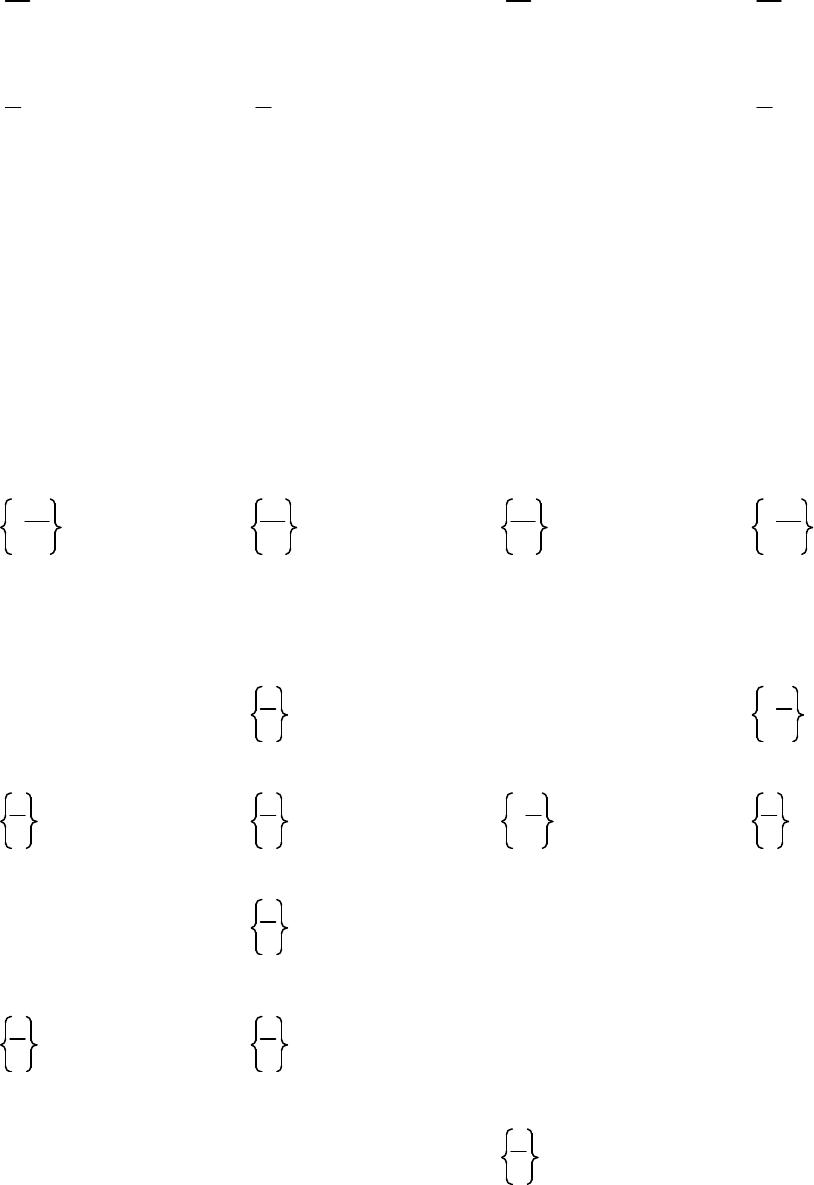
11) log2x+log2(x–3)=2
A) {4} B) {2} C) {1,–4} D) {–1,4}
12) log8(x+2)–log8x=2
A) { 2
63 } B) {8} C) { 1
32 }D){
63
2}
13) ln2+ln(x–1)=0
A) { 3
2}B){
2
3} C) {1} D) { 1
2}
14) log2(x+2)–log2(x–5)=3
A) {6} B) {1} C) {–6} D) ∅
15) log3(x+6)+log3(x–6)–log3x=2
A) {12} B) {12,–3} C) {–3} D) ∅
4 UsetheOne–to–OnePropertyofLogarithmstoSolveLogarithmicEquations
MULTIPLECHOICE.Choosetheonealternativethatbestcompletesthestatementoranswersthequestion.
Solvethelogarithmicequation.Besuretorejectanyvaluethatisnotinthedomainoftheoriginallogarithmic
expressions.Givetheexactanswer.
1) log 3(x+5)=3+log 3(x+2)
A) –49
26 B) 3
26 C) 49
26 D) –3
26
2) log 15 (x+2)=1–log 15 x
A) {3} B) {–3} C) {5} D) {–5}
3) log3x=log4+log(x–1)
A) {4} B) 3
2C) {–4} D) –4
7
4) log(x+5)=log(5x–4)
A) 9
4B) 3
2C) –9
4D) 1
4
5) log(3+x)–log(x–5)=log3
A) {9} B) 5
2C) {–9} D) ∅
6) log 8(7x–1)=log 8(5x+4)
A) 5
2B) 3
2C) {3} D) ∅
7) log 8(4x+2)=log 8(4x+5)
A) {3} B) {0} C) 7
3D) ∅
Page53
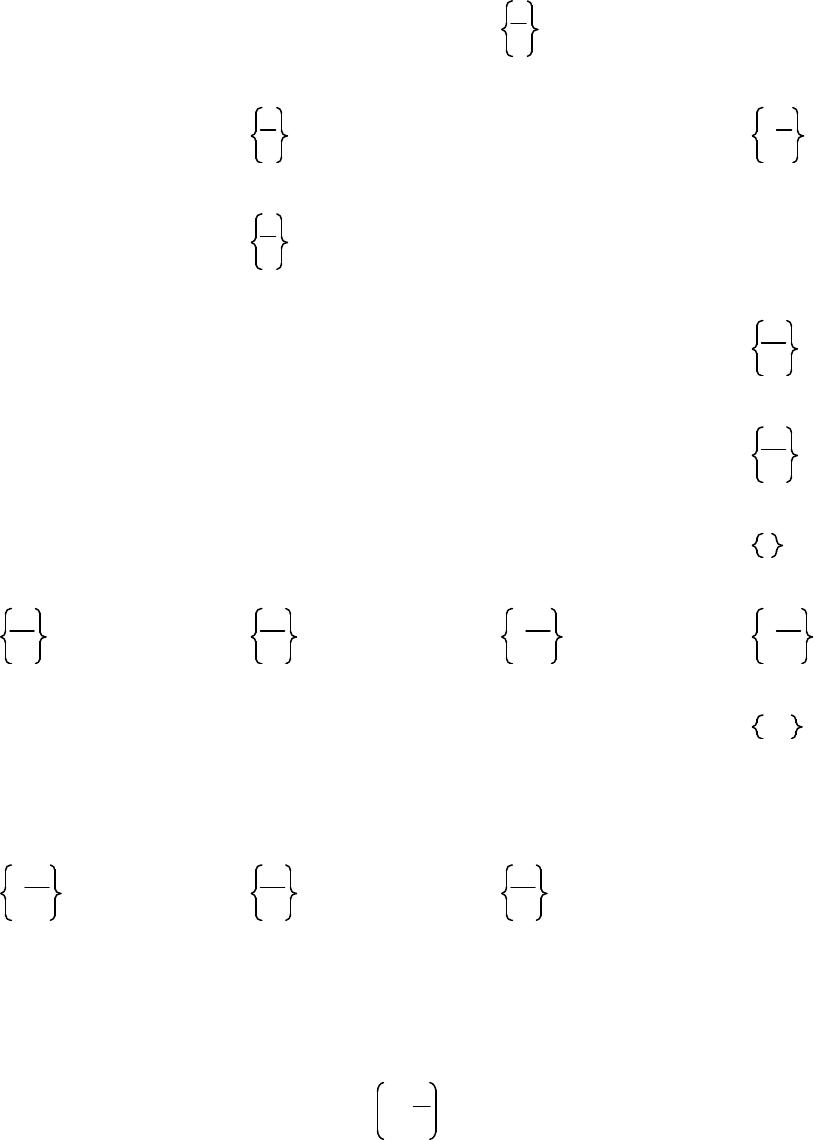
8) log 6x2=log 6(4x+32)
A) {8
,
–4} B) {8} C) 4
3D) ∅
9) log4x=log5+log(x–3)
A) {15} B) 2
3C) {–15} D) –5
3
10) log(5+x)–log(x–3)=log5
A) {5} B) 3
2C) {–5} D) ∅
11) logx+log(x–1)=log30
A) {6} B) {–5} C) {6
,
–5} D) 31
2
12) lnx+ln(x+1)=ln56
A) {7} B) {8} C) {8
,
–7} D) 57
2
13) 2logx=log16
A) {4} B) {–4} C) {±4} D) 2
14) log(x+26)–log3=log(7x+1)
A) 23
20 B) 77
4C) –23
20 D) –77
4
15) 2logx–log6=log96
A) {24} B) {–24} C) {24
,
–24} D) 288
16) ln(x–6)+ln(x+1)=ln(x–15)
A) {–3} B) {3} C) {3,–3} D) ∅
17) ln(x–10)–ln(x+7)=ln(x–4)–ln(x+9)
A) –31
2B) 31
8C) 59
2D) ∅
5 SolveAppliedProblemsInvolvingExponentialandLogarithmicEquations
MULTIPLECHOICE.Choosetheonealternativethatbestcompletesthestatementoranswersthequestion.
Solvetheproblem.
1) Findouthowlongittakesa$3000investmenttodoubleifitisinvestedat7% compoundedmonthly.Roundto
thenearesttenthofayear.UsetheformulaA=P1+r
n
nt.
A) 9.9years B) 10.1 years C) 9.7 years D) 10.3 years
2) TheformulaA=134e0.032tmodelsthepopulationofaparticularcity,inthousands,tyearsafter1998.When
willthepopulationofthecityreach168thousand?
A) 2005 B) 2006 C) 2007 D) 2008
Page54

3) Thefunctionf(x)=1+1.6ln(x+1)modelstheaveragenumberoffree–throwsabasketballplayercanmake
consecutivelyduringpracticeasafunctionoftime,wherexisthenumberofconsecutivedaysthebasketball
playerhaspracticedfortwohours.Afterhowmanydaysofpracticecanthebasketballplayermakeanaverage
of8consecutivefreethrows?
A) 78days B) 80days C) 276 days D) 278 days
4) ThepHofasolutionrangesfrom0to14.AnacidhasapHlessthan7.PurewaterisneutralandhasapHof7.
ThepHofasolutionisgivenbypH=–logxwherexrepresentstheconcentrationofthehydrogenionsinthe
solutioninmolesperliter.FindthehydrogenionconcentrationifthepH=14.
A) 10–14 B) 1014 C) 2.64 D) 0.07
5) ThepHofasolutionrangesfrom0to14.AnacidhasapHlessthan7.PurewaterisneutralandhasapHof7.
ThepHofasolutionisgivenbypH=–logxwherexrepresentstheconcentrationofthehydrogenionsinthe
solutioninmolesperliter.FindthehydrogenionconcentrationifthepH=5.4.
A) 3.98x10⁻⁶B) 3.98x10⁻⁵C) 2.51x10⁻⁵D) 2.51x10⁻⁶
6) Findouthowlongittakesa$2800investmenttoearn$400 interestifitisinvestedat9%compounded
quarterly.Roundtothenearesttenthofayear.UsetheformulaA=P1+r
n
nt.
A) 1.5years B) 1.7years C) 1.3 years D) 1.9 years
7) Cindywillrequire$19,000in2yearstoreturntocollegetogetanMBAdegree.Howmuchmoneyshouldshe
askherparentsfornowsothat,ifsheinvestsitat10%compoundedcontinuously,shewillhaveenoughfor
school?(Roundyouranswertothenearestdollar.)
A) $15,556 B) $15,702 C) $23,207 D) $12,736
8) Larryhas$2700toinvestandneeds$3100 in12 years.Whatannualrateofreturnwillheneedtogetinorderto
accomplishhisgoal,ifinterestiscompoundedcontinuously?(Roundyouranswertotwodecimals.)
A) 1.15% B) 1.48% C) 2.48% D) 3.48%
9) IfEmeryhas$1600toinvestat9%peryearcompoundedmonthly,howlongwillitbebeforehehas$2900?If
thecompoundingiscontinuous,howlongwillitbe?(Roundyouranswerstothreedecimalplaces.)
A) 6.633yrs,6.608yrs B) 0.575 yrs,0.551 yrs
C) 70.833yrs,6.83yrs D) 0.089 yrs,0.661 yrs
10) Thesizeofthecoyotepopulationatanationalparkincreasesattherateof4.8% peryear.Ifthesizeofthe
currentpopulationis194,findhowmanycoyotesthereshouldbein5years.Usey=yoe0.048tandroundto
thenearestwholenumber.
A) 247 B) 249 C) 245 D) 251
11) Thepopulationinaparticularcountryisgrowingattherateof1.8%peryear.If10,184,000peoplelivedtherein
1999,howmanywilltherebeintheyear2005?Usey=yoe0.018tandroundtothenearestten–thousand.
A) 11,350,000 B) 12,480,000 C) 11,120,000 D) 13,610,000
12) ThefunctionA=A0e–0.0077xmodelstheamountinpoundsofaparticularradioactivematerialstoredina
concretevault,wherexisthenumberofyearssincethematerialwasputintothevault.If500poundsofthe
materialareinitiallyputintothevault,howmanypoundswillbeleftafter120years?
A) 198pounds B) 297pounds C) 333 pounds D) 188 pounds
Page55

13) ThefunctionA=A0e–0.0099xmodelstheamountinpoundsofaparticularradioactivematerialstoredina
concretevault,wherexisthenumberofyearssincethematerialwasputintothevault.If500poundsofthe
materialareplacedinthevault,howmuchtimewillneedtopassforonly84poundstoremain?
A) 180years B) 185years C) 190 years D) 360 years
14) Thepopulationofaparticularcountrywas26 millionin1981;in1990
,
itwas31 million.Theexponential
growthfunctionA=26ektdescribesthepopulationofthiscountrytyearsafter1981.Usethefactthat9years
after1981thepopulationincreasedby5milliontofindktothreedecimalplaces.
A) 0.020 B) 0.179 C) 0.744 D) 0.030
15) Thepopulationofacertaincountryisgrowingatarateof2.5%peryear.Howlongwillittakeforthiscountryʹs
populationtodouble?Usetheformulat=ln2
k,whichgivesthetime,t,forapopulationwithgrowthratek,to
double.(Roundtothenearestwholeyear.)
A) 28years B) 29years C) 30 years D) 27years
4.5 ExponentialGrowthandDecay;ModelingData
1 ModelExponentialGrowthandDecay
MULTIPLECHOICE.Choosetheonealternativethatbestcompletesthestatementoranswersthequestion.
Solve.
1) Thevalueofaparticularinvestmentfollowsapatternofexponentialgrowth.Intheyear2000,youinvested
moneyinamoneymarketaccount.Thevalueofyourinvestmenttyearsafter2000isgivenbytheexponential
growthmodelA=6900e0.049t.Howmuchdidyouinitiallyinvestintheaccount?
A) $6900.00 B) $7246.52 C) $338.10 D) $3450.00
2) Thevalueofaparticularinvestmentfollowsapatternofexponentialgrowth.Intheyear2000,youinvested
moneyinamoneymarketaccount.Thevalueofyourinvestmenttyearsafter2000isgivenbytheexponential
growthmodelA=2400e0.067t.Whenwilltheaccountbeworth$3355?
A) 2005 B) 2006 C) 2007 D) 2004
3) Thevalueofaparticularinvestmentfollowsapatternofexponentialgrowth.Intheyear2000,youinvested
moneyinamoneymarketaccount.Thevalueofyourinvestmenttyearsafter2000isgivenbytheexponential
growthmodelA=3500e0.067t.Bywhatpercentageistheaccountincreasingeachyear?
A) 6.7% B) 7.1% C) 7.3% D) 7.4%
4) ThefunctionA=A0e–0.00693xmodelstheamountinpoundsofaparticularradioactivematerialstoredina
concretevault,wherexisthenumberofyearssincethematerialwasputintothevault.If300poundsofthe
materialareinitiallyputintothevault,howmanypoundswillbeleftafter90years?
A) 161pounds B) 139pounds C) 135 pounds D) 167 pounds
5) ThefunctionA=A0e–0.00866xmodelstheamountinpoundsofaparticularradioactivematerialstoredina
concretevault,wherexisthenumberofyearssincethematerialwasputintothevault.If800poundsofthe
materialareplacedinthevault,howmuchtimewillneedtopassforonly218poundstoremain?
A) 150years B) 155years C) 160 years D) 300 years
6) Thepopulationofaparticularcountrywas22 millionin1982;in1992
,
itwas30 million.Theexponential
growthfunctionA=22ektdescribesthepopulationofthiscountrytyearsafter1982.Usethefactthat10years
after1982thepopulationincreasedby8milliontofindktothreedecimalplaces.
A) 0.031 B) 0.208 C) 0.649 D) 0.041
Page56

7) Thehalf–lifeofsilicon–32is710years.If50 gramsispresentnow,howmuchwillbepresentin300 years?
(Roundyouranswertothreedecimalplaces.)
A) 37.306 B) 48.557 C) 2.673 D) 0
8) Afossilizedleafcontains15%ofitsnormalamountofcarbon14.Howoldisthefossil(tothenearestyear)?Use
5600yearsasthehalf–lifeofcarbon14.
A) 15,299 B) 21,839 C) 1311 D) 35,828
9) Anendangeredspeciesoffishhasapopulationthatisdecreasingexponentially(A=A0ekt).Thepopulation5
yearsagowas1900.Today,only1100ofthefisharealive.Oncethepopulationdropsbelow100,thesituation
willbeirreversible.Whenwillthishappen,accordingtothemodel?(Roundtothenearestwholeyear.)
A) 22yearsfromtoday B) 23 yearsfromtoday
C) 21yearsfromtoday D) 24 yearsfromtoday
10) Thepopulationofacertaincountryisgrowingatarateof2.3%peryear.Howlongwillittakeforthiscountryʹs
populationtodouble?Usetheformulat=ln2
k,whichgivesthetime,t,forapopulationwithgrowthratek,to
double.(Roundtothenearestwholeyear.)
A) 30years B) 31years C) 32 years D) 29years
2 UseLogisticGrowthModels
MULTIPLECHOICE.Choosetheonealternativethatbestcompletesthestatementoranswersthequestion.
Solvetheproblem.
1) Thelogisticgrowthfunctionf(t)=360
1+5.0e–0.14t describesthepopulationofaspeciesofbutterfliestmonths
aftertheyareintroducedtoanon–threateninghabitat.Howmanybutterflieswereinitiallyintroducedtothe
habitat?
A) 60butterflies B) 360butterflies C) 5 butterflies D) 2butterflies
2) Thelogisticgrowthfunctionf(t)=720
1+8.0e–0.26t describesthepopulationofaspeciesofbutterfliestmonths
aftertheyareintroducedtoanon–threateninghabitat.Whatisthelimitingsizeofthebutterflypopulationthat
thehabitatwillsustain?
A) 720butterflies B) 80butterflies C) 8 butterflies D) 1440 butterflies
3) Thelogisticgrowthfunctionf(t)=360
1+5.0e–0.29t describesthepopulationofaspeciesofbutterfliestmonths
aftertheyareintroducedtoanon–threateninghabitat.Howmanybutterfliesareexpectedinthehabitatafter
20months?
A) 355butterflies B) 1200 butterflies C) 360 butterflies D) 7200 butterflies
4) Thelogisticgrowthfunctionf(t)=96,000
1+3199.0e–1.6t modelsthenumberofpeoplewhohavebecomeillwitha
particularinfectiontweeksafteritsinitialoutbreakinaparticularcommunity.Howmanypeoplebecameill
withthisinfectionwhentheepidemicbegan?
A) 30people B) 96,000 people C) 3199 people D) 3200 people
Page57
5) Thelogisticgrowthfunctionf(t)=32,000
1+799e–1.2t modelsthenumberofpeoplewhohavebecomeillwitha
particularinfectiontweeksafteritsinitialoutbreakinaparticularcommunity.Howmanypeoplewereillafter
5weeks?
A) 10,736people B) 32,002 people C) 200 people D) 32,800 people
6) Thelogisticgrowthfunctionf(t)=94,000
1+3132.3e–1.3t modelsthenumberofpeoplewhohavebecomeillwitha
particularinfectiontweeksafteritsinitialoutbreakinaparticularcommunity.Whatisthelimitingsizeofthe
populationthatbecomesill?
A) 94,000people B) 188,000 people C) 3132 people D) 3133 people
3 ChooseanAppropriateModelforData
SHORTANSWER.Writethewordorphrasethatbestcompleteseachstatementoranswersthequestion.
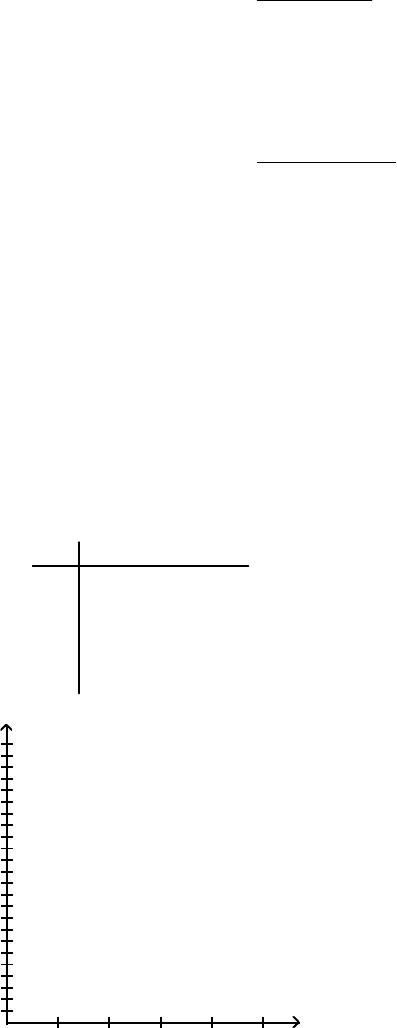
Presentdataintheformoftables.Forthedatasetshownbythetable,
a.Createascatterplotforthedata.
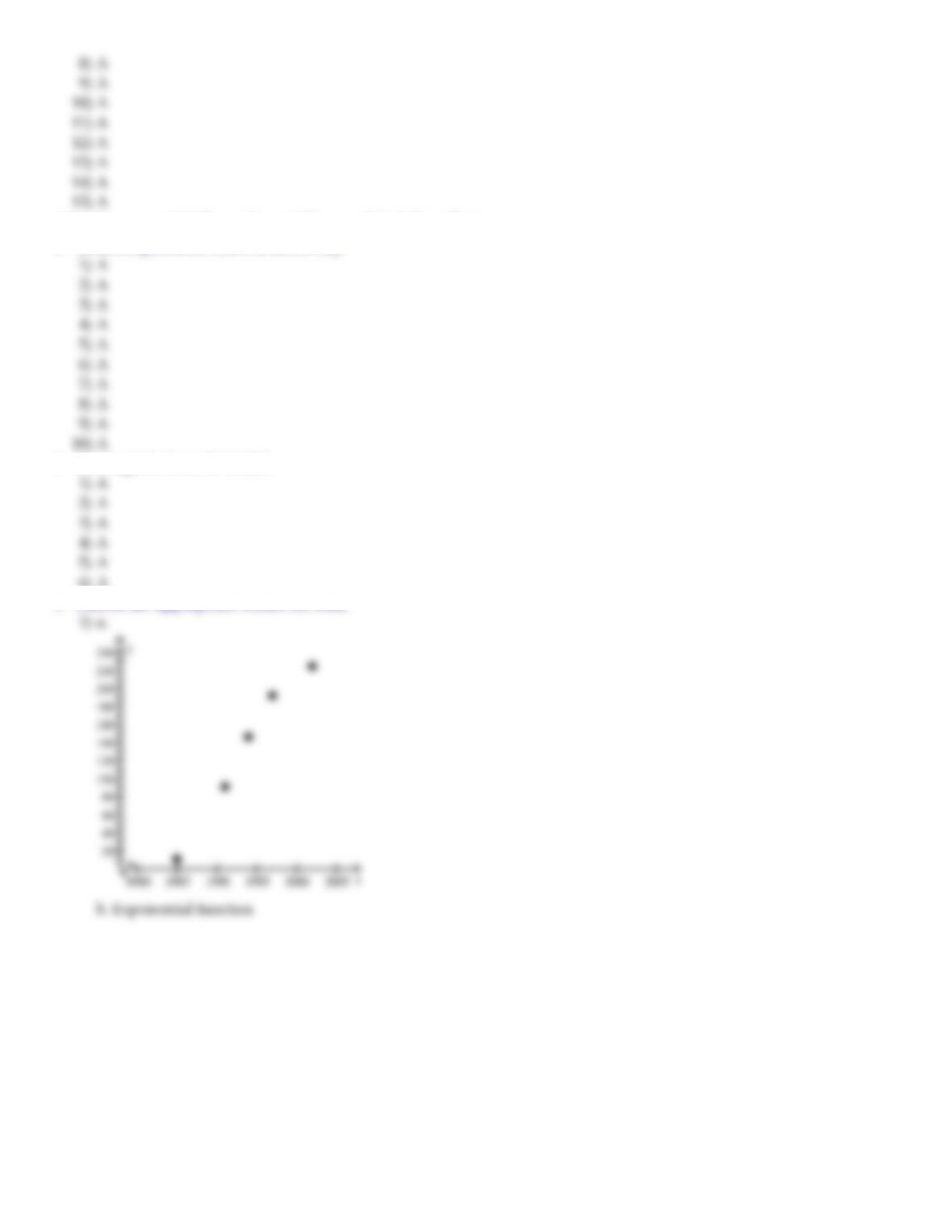
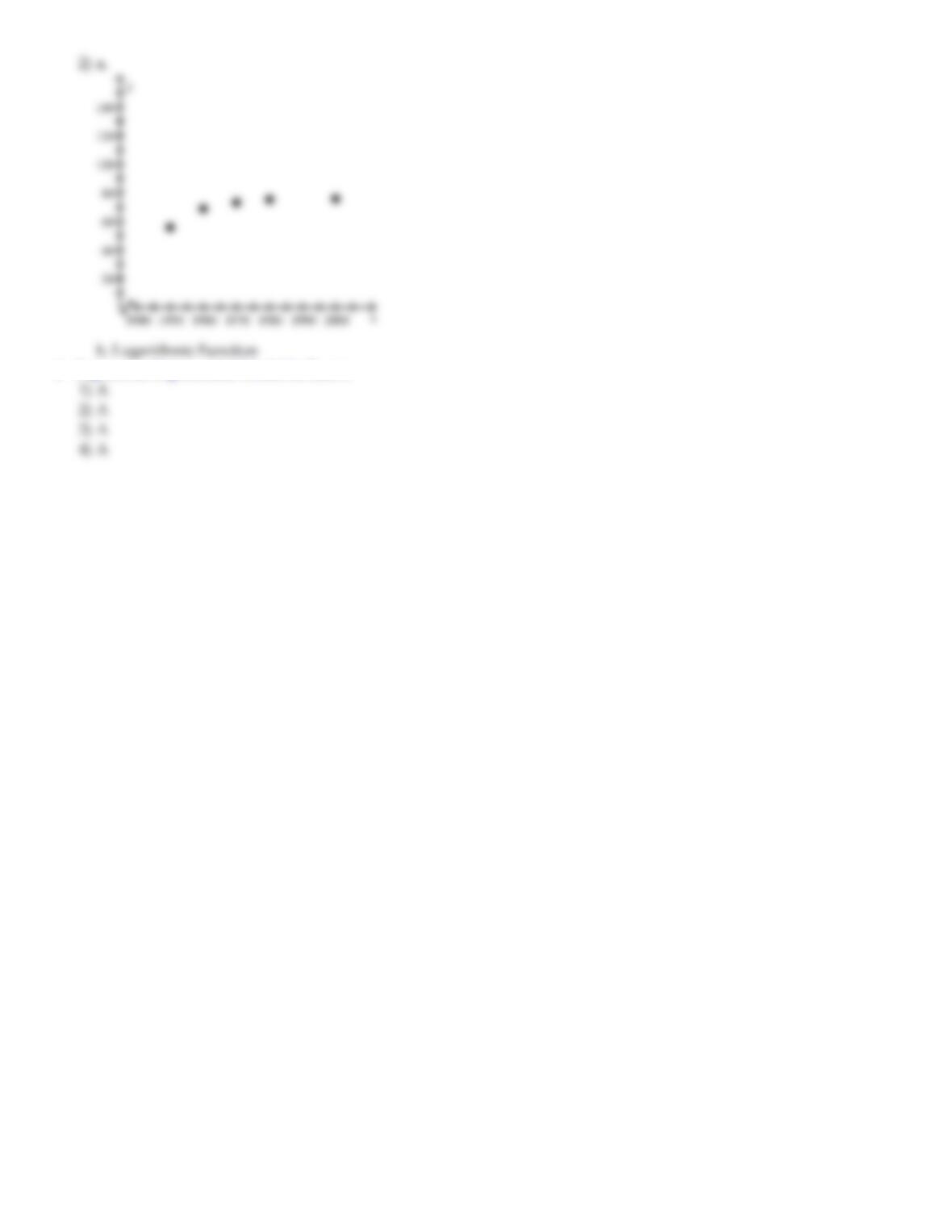
b.Usethescatterplottodeterminewhetheranexponentialfunctionoralogarithmicfunctionisthebest
choiceformodelingthedata.
1) NumberofHomesBuiltinaTownbyYear
Year NumberofHomes
1985 10
1991 92
1994 145
1997 192
2002 223
x
y
x
y
Page58
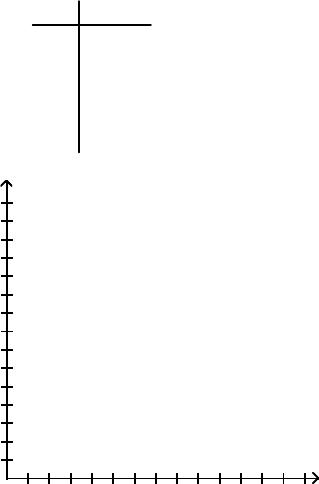
2) PercentageofPopulationLivinginthe
SouthSuburbsofaLargeCity
Year Percent
1950 55
1960 69
1970 74
1980 75
2000 77
x
y
x
y
4 ExpressanExponentialModelinBasee
MULTIPLECHOICE.Choosetheonealternativethatbestcompletesthestatementoranswersthequestion.
Rewritetheequationintermsofbasee.Expresstheanswerintermsofanaturallogarithm,andthenroundtothree
decimalplaces.
1) y=7(3)x
A) y=7exln3,y=7e1.099x B) y=3exln7,y=3e1.946x
C) y=7e3x,y=72.7181.099x D) y=(ln7)exln3,y=1.946e1.099x
2) y=41(2.3)x
A) y=41exln2.3,y=41e0.833x B) y=2.3exln41,y=2.3e3.714x
C) y=41e2.3x,y=412.7180.833x D) y=(ln41)exln2.3,y=3.714e0.833x
3) y=100(7.1)x
A) y=100exln7.1,y=100e1.960x B) y=7.1exln100,y=7.1e4.605x
C) y=100e7.1x,y=1002.7181.960x D) y=(ln100)exln7.1,y=4.605e1.960x
4) y=2.9(0.9)x
A) y=2.9exln0.9,y=2.9e–0.105x B) y=0.9exln2.9,y=0.9e1.065x
C) y=2.9e0.9x,y=2.92.718–0.105x D) y=(ln2.9)exln0.9,y=1.065e–0.105x
Page59
Ch.4 ExponentialandLogarithmicFunctions
AnswerKey
4.1 ExponentialFunctions
1 EvaluateExponentialFunctions
2 GraphExponentialFunctions
26) A
3 EvaluateFunctionswithBasee
4 UseCompoundInterestFormulas
Page60
4.2 LogarithmicFunctions
1 ChangefromLogarithmictoExponentialForm
2 ChangeFromExponentialtoLogarithmicForm
3 EvaluateLogarithms
4 UseBasicLogarithmicProperties
5 GraphLogarithmicFunctions
6 FindtheDomainofaLogarithmicFunction
Page61
7 UseCommonLogarithms
8 UseNaturalLogarithms
4.3 PropertiesofLogarithms
1 UsetheProductRule
2 UsetheQuotientRule
3 UsethePowerRule
4 ExpandLogarithmicExpressions
Page62
5 CondenseLogarithmicExpressions
6 UsetheChange–of–BaseProperty
4.4 ExponentialandLogarithmicEquations
1 UseLikeBasestoSolveExponentialEquations
2 UseLogarithmstoSolveExponentialEquations
Page63
3 UsetheDefinitionofaLogarithmtoSolveLogarithmicEquations
4 UsetheOne–to–OnePropertyofLogarithmstoSolveLogarithmicEquations
5 SolveAppliedProblemsInvolvingExponentialandLogarithmicEquations
4.5 ExponentialGrowthandDecay;ModelingData
1 ModelExponentialGrowthandDecay
2 UseLogisticGrowthModels
6) A
3 ChooseanAppropriateModelforData
Page65
4 ExpressanExponentialModelinBasee
Page66