Larson_Calculus_10e ch04sec01
MULTIPLE CHOICE
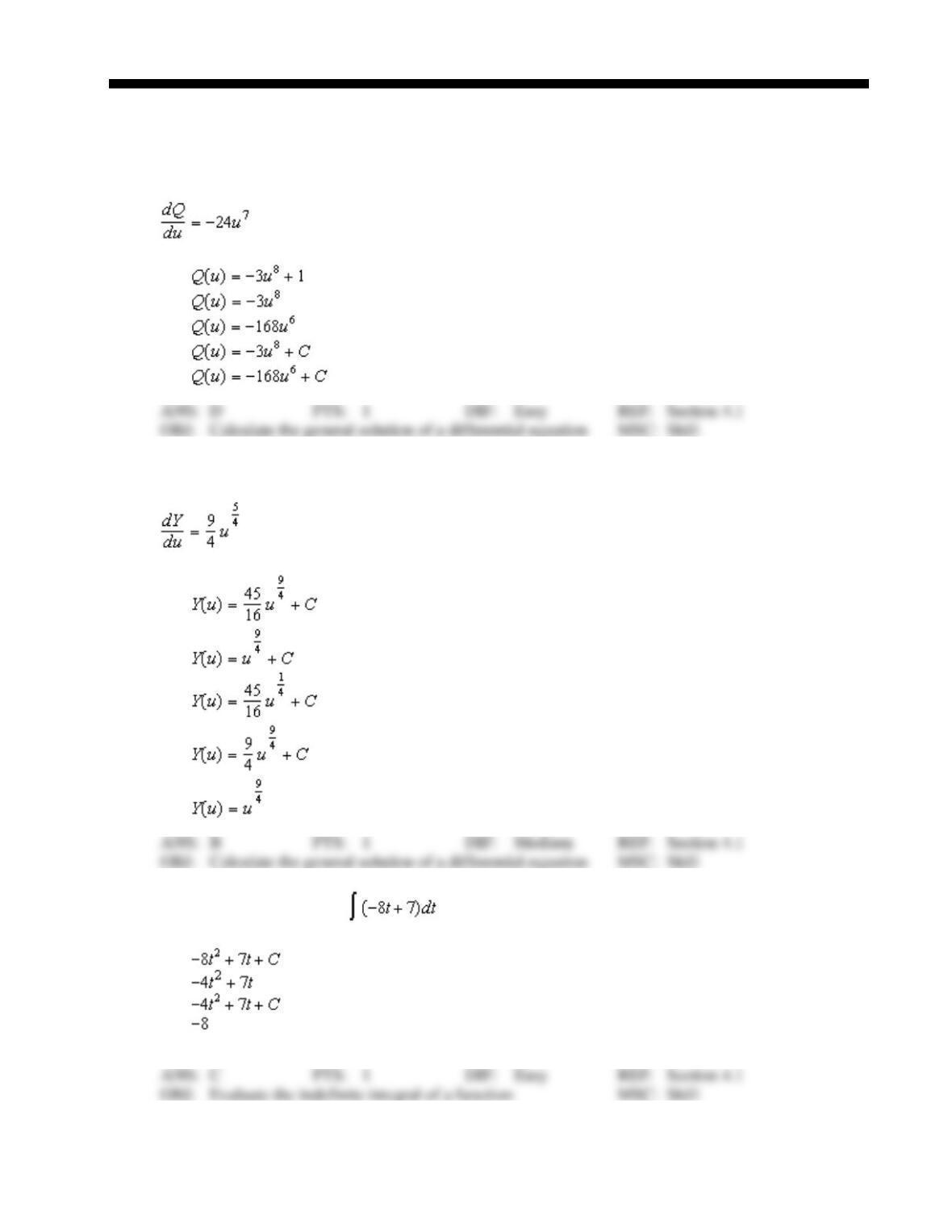
1. Find the general solution of the differential equation below and check the result by differentiation.
a.
b.
c.
d.
e.
2. Find the general solution of the differential equation below and check the result by differentiation.
a.
b.
c.
d.
e.
3. Find the indefinite integral .
a.
b.
c.
d.
e.
none of the above
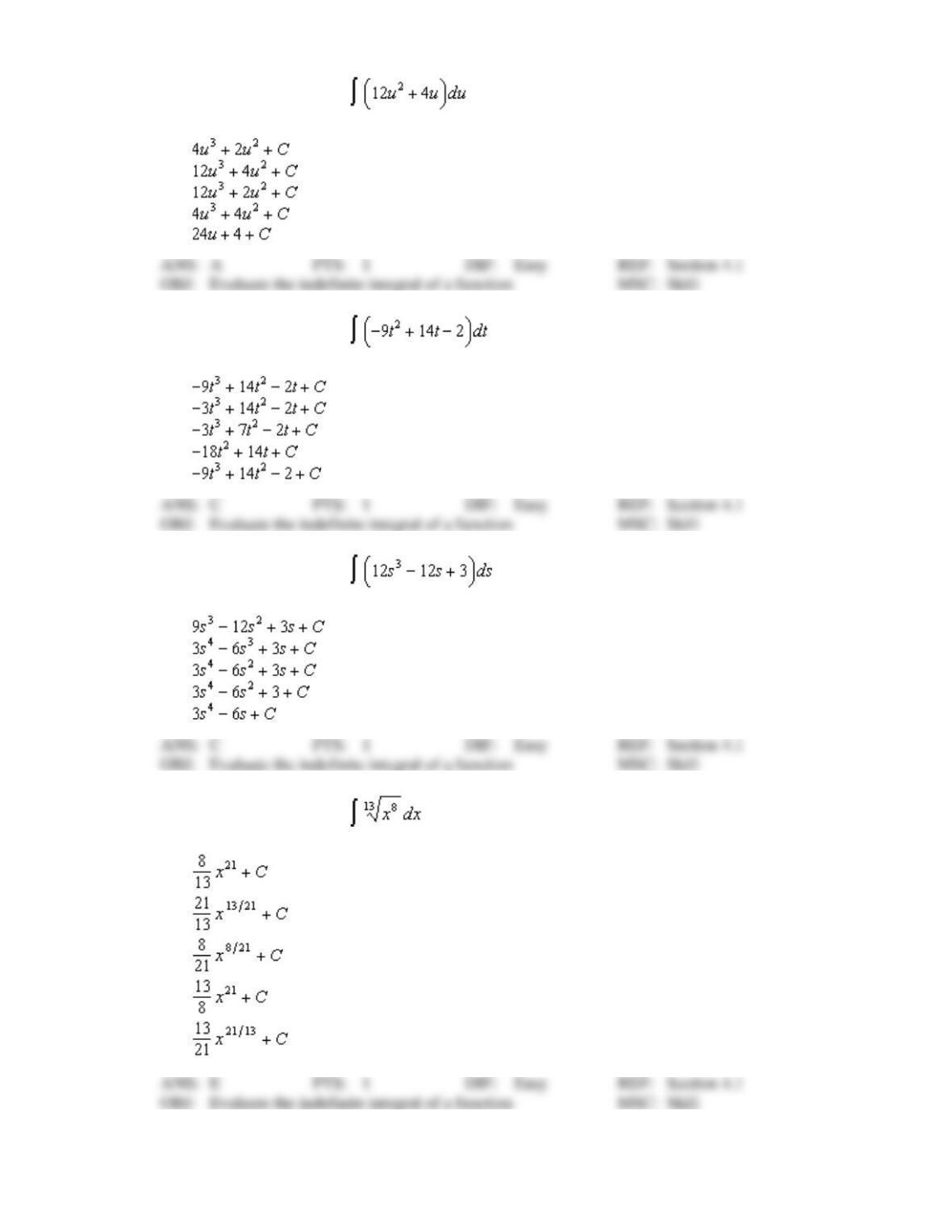
4. Find the indefinite integral .
a.
b.
c.
d.
e.
5. Find the indefinite integral .
a.
b.
c.
d.
e.
6. Find the indefinite integral .
a.
b.
c.
d.
e.
7. Find the indefinite integral .
a.
b.
c.
d.
e.
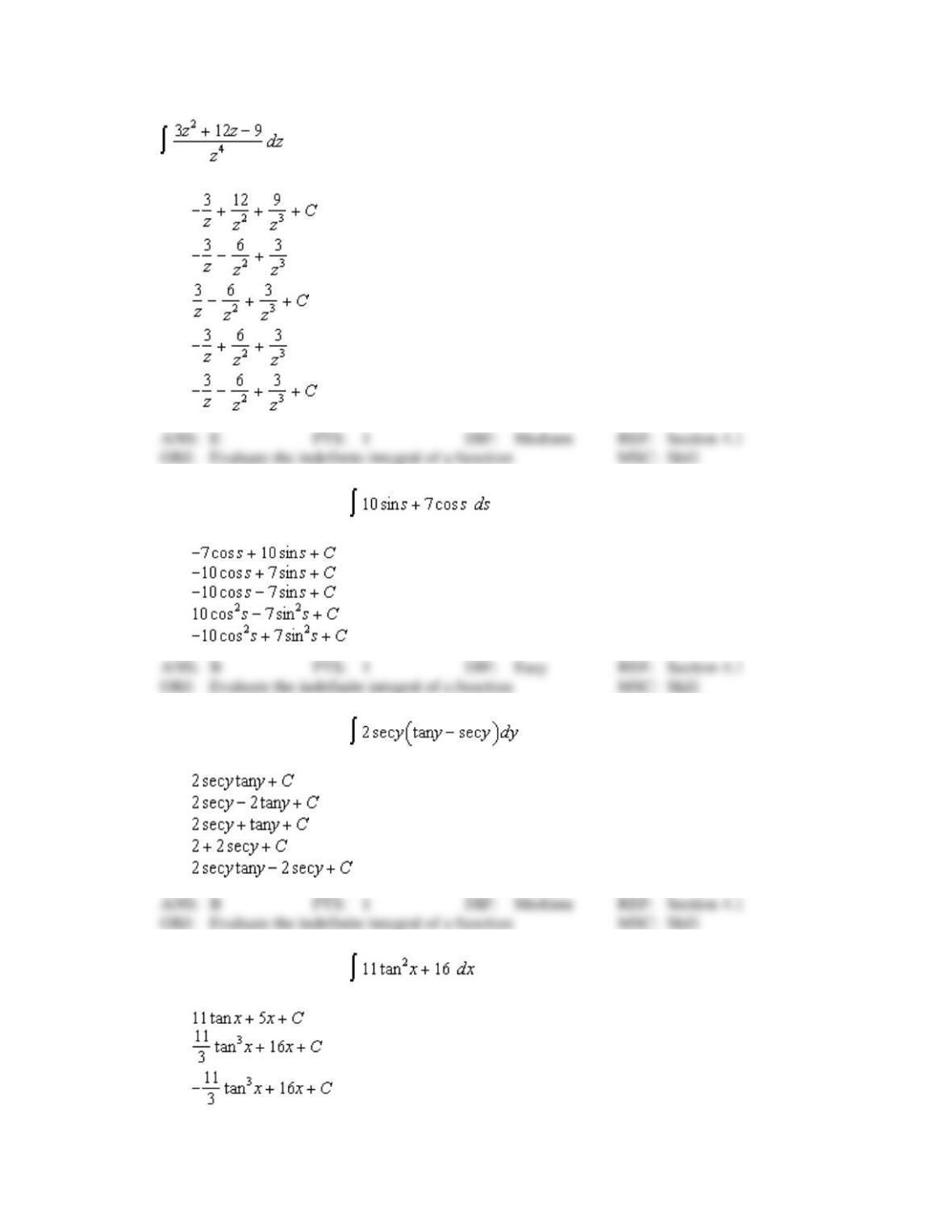
8. Find the indefinite integral and check the result by differentiation.
a.
b.
c.
d.
e.
9. Find the indefinite integral .
a.
b.
c.
d.
e.
10. Find the indefinite integral .
a.
b.
c.
d.
e.
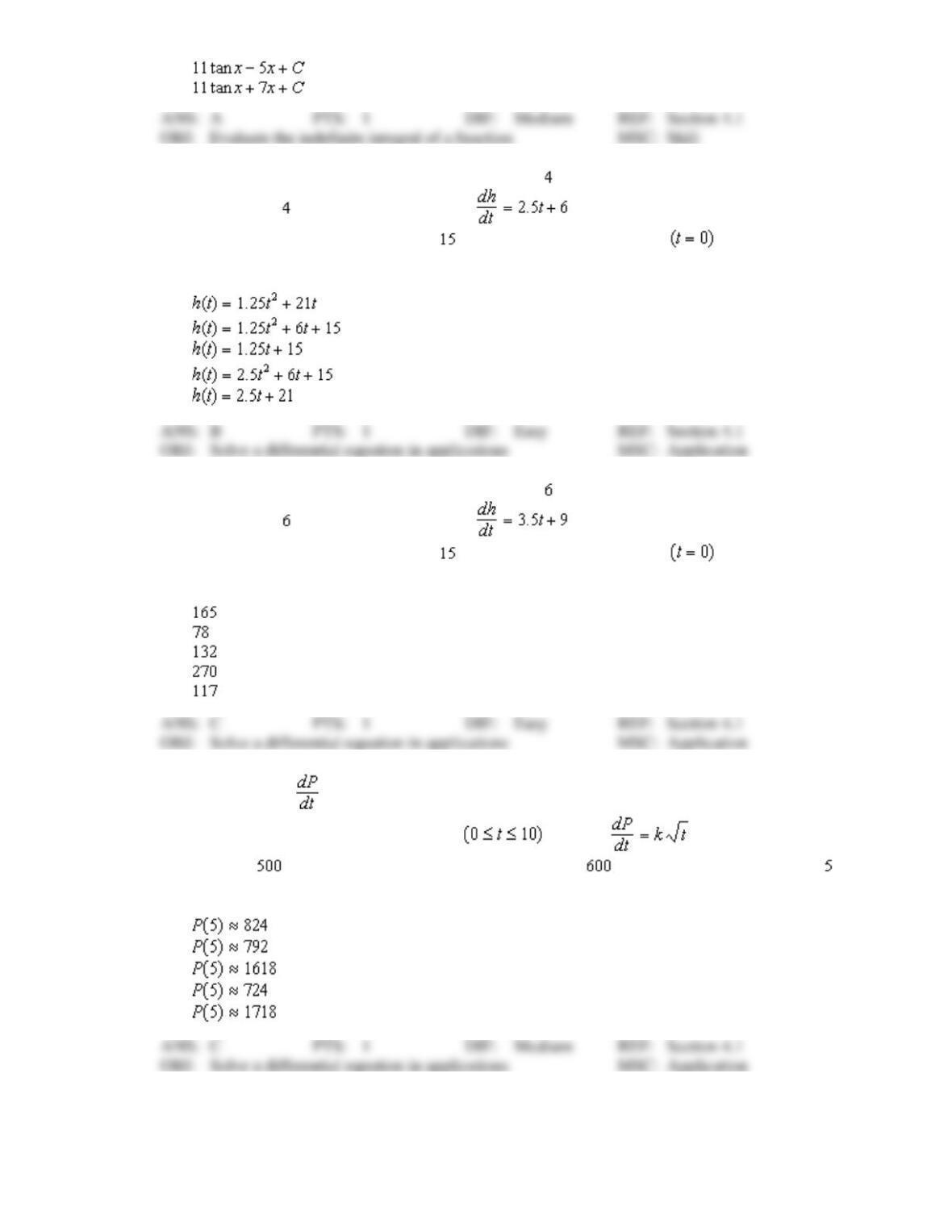
11. Find the indefinite integral .
a.
b.
c.
d.
e.
12. An evergreen nursery usually sells a certain shrub after years of growth and shaping. The growth
rate during those years is approximated by , where t is the time in years and h is the
height in centimeters. The seedlings are centimeters tall when planted . Find the height after
t years.
a.
b.
c.
d.
e.
13. An evergreen nursery usually sells a certain shrub after years of growth and shaping. The growth
rate during those years is approximated by , where t is the time in years and h is the
height in centimeters. The seedlings are centimeters tall when planted . How tall are the
shrubs when they are sold?
a.
cm
b.
cm
c.
cm
d.
cm
e.
cm
14. The rate of growth of a population of bacteria is proportional to the square root of t, where P is
the population size and t is the time in days . That is, . The initial size of the
population is . After one day the population has grown to . Estimate the population after
days. Round your answer to the nearest integer.
a.
bacteria
b.
bacteria
c.
bacteria
d.
bacteria
e.
bacteria
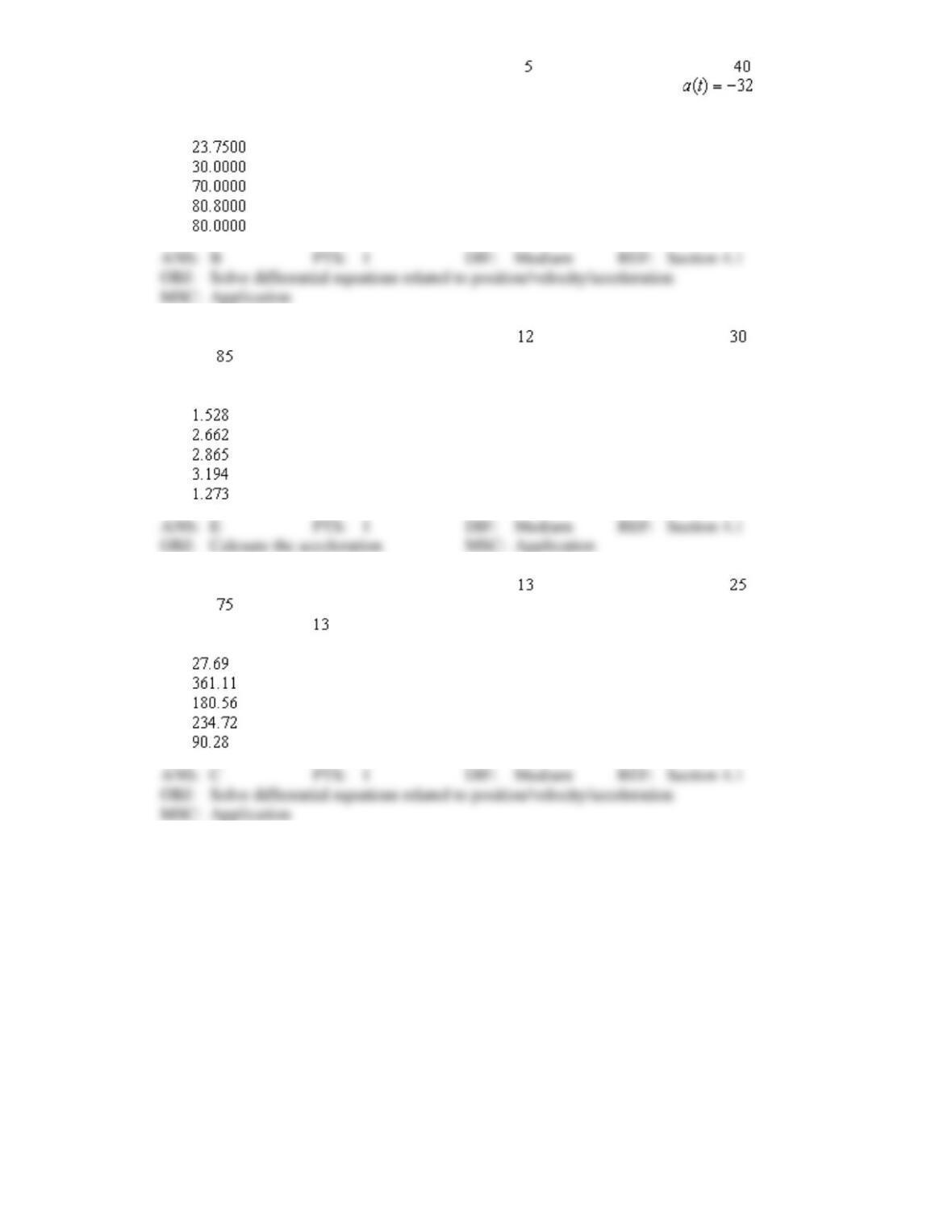
15. A ball is thrown vertically upwards from a height of ft with an initial velocity of ft per second.
How high will the ball go? Note that the acceleration of the ball is given by feet per second
per second.
a.
ft
b.
ft
c.
ft
d.
ft
e.
ft
16. The maker of an automobile advertises that it takes seconds to accelerate from kilometers per
hour to kilometers per hour. Assuming constant acceleration, compute the acceleration in meters
per second per second. Round your answer to three decimal places.
a.
m/sec2
b.
m/sec2
c.
m/sec2
d.
m/sec2
e.
m/sec2
17. The maker of an automobile advertises that it takes seconds to accelerate from kilometers per
hour to kilometers per hour. Assuming constant acceleration, compute the distance, in meters, the
car travels during the seconds. Round your answer to two decimal places.
a.
m
b.
m
c.
m
d.
m
e.
m