Chapter 4 – Completing the Accounting Cycle
77. Unearned Fees appear on the
a.
balance sheet in the current assets section
b.
balance sheet as a current liability
c.
balance sheet in the stockholders’ equity section
d.
income statement as revenue
78. Which one of the fixed asset accounts listed below will not have a related contra asset account?
a.
Office Equipment
b.
Land
c.
Delivery Equipment
d.
Building
79. Prepaid insurance is reported on the balance sheet as a
a.
current asset
b.
fixed asset
c.
current liability
d.
long-term liability
Chapter 4 – Completing the Accounting Cycle
80. The income statement is prepared from
a.
the adjusted trial balance
b.
the Income Statement columns of the end–of-period spreadsheet
c.
either the adjusted trial balance or the Income Statement columns of the end–of-period spreadsheet
d.
both the adjusted trial balance and the Income Statement columns of the end–of-period spreadsheet
81. The first item appearing on the statement of retained earnings is
a.
net income
b.
the ending balance of retained earnings
c.
dividends
d.
the beginning balance of retained earnings
82. The statement of retained earnings should be prepared
a.
before the income statement and after the balance sheet
b.
before the income statement and balance sheet
c.
after the income statement and balance sheet
d.
after the income statement and before the balance sheet
Chapter 4 – Completing the Accounting Cycle
83. The income statement should be prepared
a.
before the retained earnings statement and balance sheet
b.
after the retained earnings statement and before the balance sheet
c.
after the retained earnings statement and balance sheet
d.
after the balance sheet and before the retained earnings statement
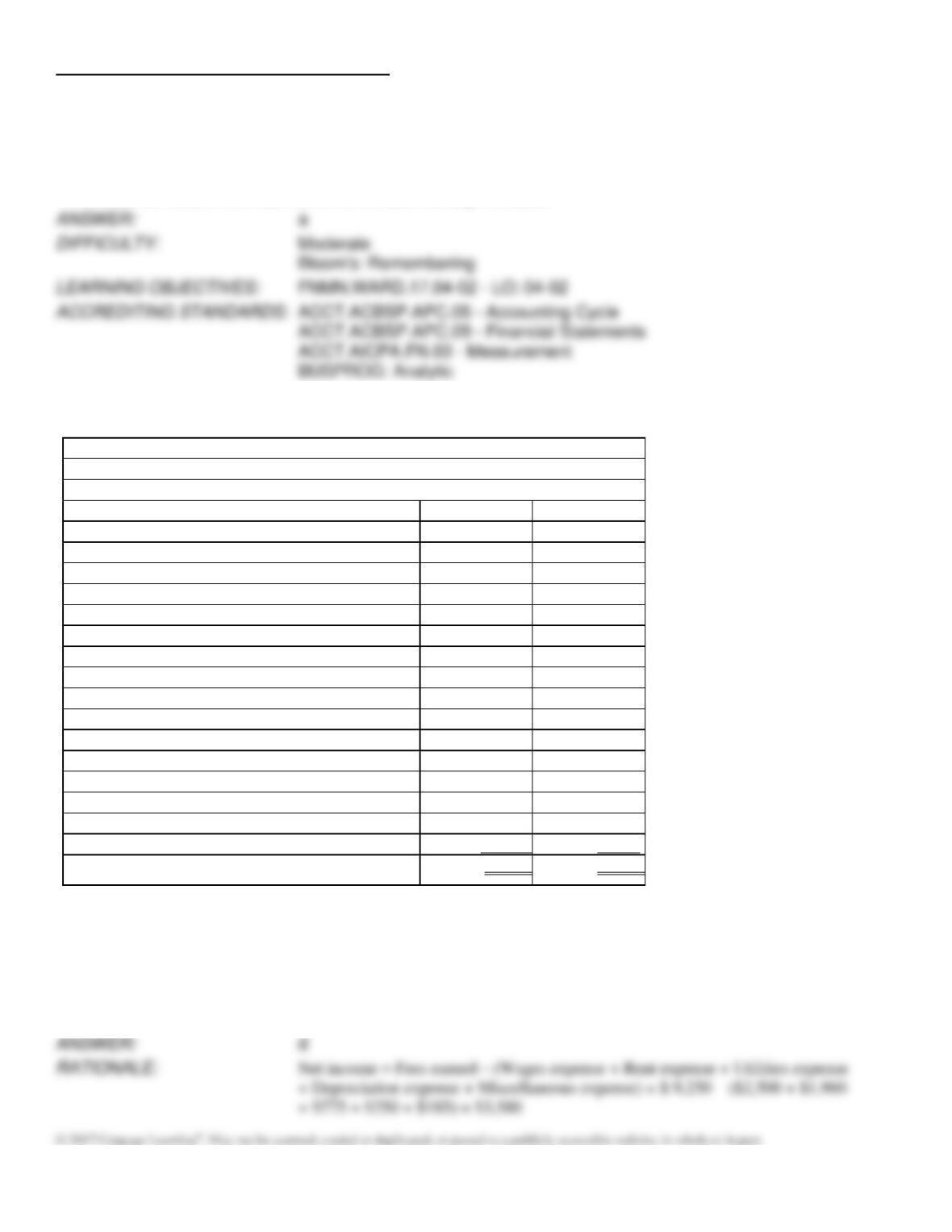
Use the adjusted trial balance for Stockton Company below to answer the questions that follow.
Stockton Company
Adjusted Trial Balance
December 31
Cash
7,530
Accounts Receivable
2,100
Prepaid Expenses
700
Equipment
13,700
Accumulated Depreciation
1,100
Accounts Payable
1,900
Notes Payable
4,300
Common Stock
1,000
Retained Earnings
12,940
Dividends
790
Fees Earned
9,250
Wages Expense
2,500
Rent Expense
1,960
Utilities Expense
775
Depreciation Expense
250
Miscellaneous Expense
185
Totals
30,490
30,490
84. Determine the net income (loss) for the period.
a.
net income $9,250
b.
net loss $790
c.
net loss $5,670
d.
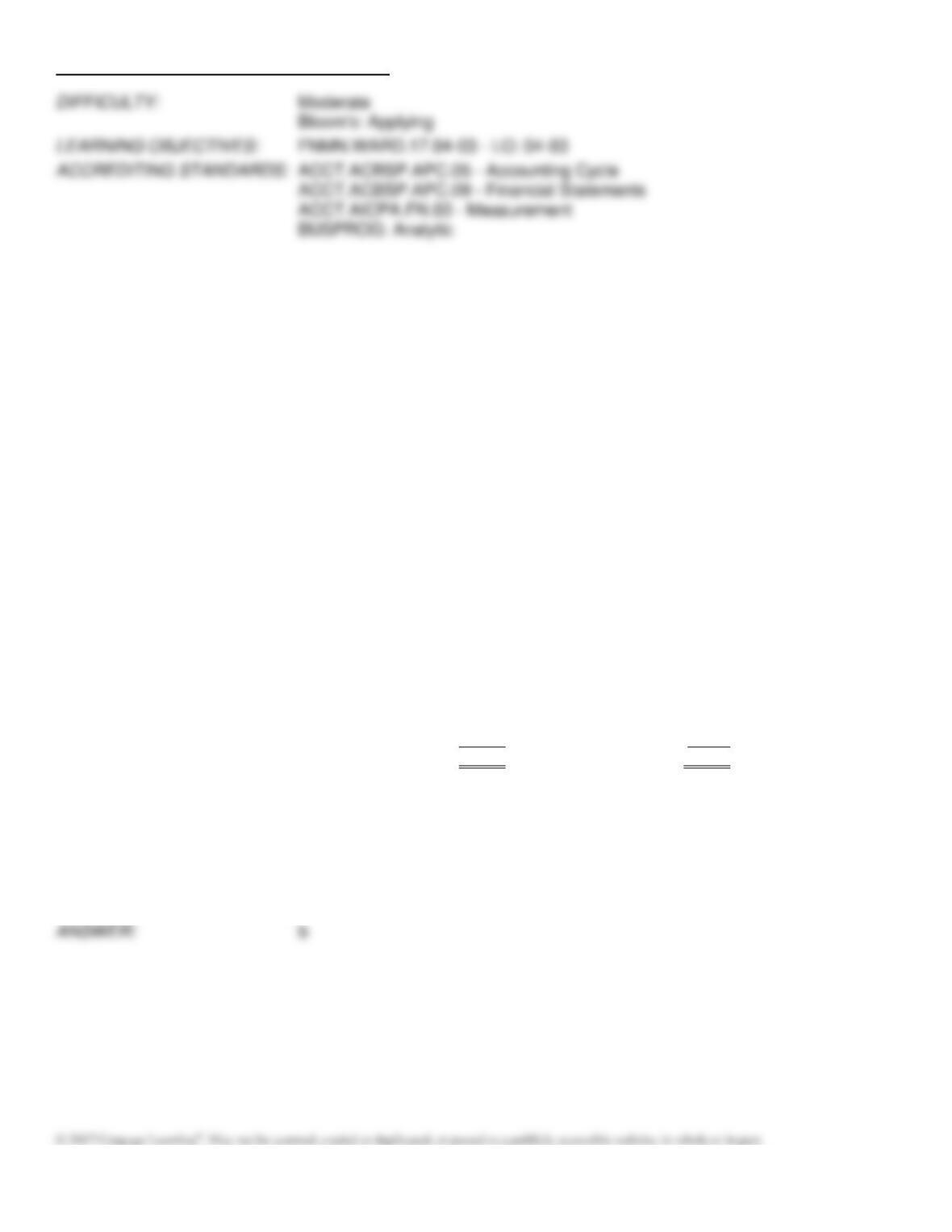
net income $3,580
+ $775 + $250 + $185) = $3,580
Chapter 4 – Completing the Accounting Cycle
85. Determine the retained earnings ending balance.
a.
$12,150
b.
$15,730
c.
$6,480
d.
$21,400
86. Determine the total assets.
a.
$25,130
b.
$16,830
c.
$22,930
d.
$24,030
87. Determine the current assets.
a.
$23,030
b.
$10,330
c.
$21,930
d.
$8,630
Chapter 4 – Completing the Accounting Cycle
88. Determine the total liabilities for the period.
a.
$1,900
b.
$6,200
c.
$4,300
d.
$20,240
89. The balance sheet should be prepared
a.
before the income statement and the retained earnings statement
b.
before the income statement and after the retained earnings statement
c.
after the income statement and the retained earnings statement
d.
after the income statement and before the retained earnings statement
90. The income statement will present
a.
revenues less expenses (ordered largest to smallest amount) with miscellaneous expense listed last
b.
revenues less expenses (ordered smallest to largest amounts) with miscellaneous expense listed last
c.
revenues less expenses (ordered in alphabetical order)
d.
revenues less expenses (order is not important)
Chapter 4 – Completing the Accounting Cycle
91. The classified balance sheet will show which asset subsections?
a.
current assets and other equity
b.
current assets and property, plant, and equipment
c.
current liabilities and short-term assets
d.
other revenues and property, plant and equipment
92. The classified balance sheet will show which liability subsections?
a.
current liabilities and long-term liabilities
b.
current liabilities and other liabilities
c.
other liabilities and long-term liabilities
d.
present liabilities and tomorrow’s liabilities
93. Debts listed as current liabilities are those that
a.
will be paid in less than one year
b.
are due to be paid in 5 to 10 years
c.
are due to be paid in more than one year
d.
are owed to the stockholders and will never be paid
Chapter 4 – Completing the Accounting Cycle
94. Stockholders’ equity is
a.
added to assets and the two are equal to liabilities
b.
added to liabilities and the two are equal to assets
c.
subtracted from liabilities and the net amount is equal to assets
d.
equal to the total of assets and liabilities
95. Balance sheet accounts
a.
represent amounts accumulated during a specific period of time
b.
are called real accounts
c.
have zero balances after the closing entries have been posted
d.
are not affected by adjustments
96. On which financial statement will Income Summary be shown?
a.
retained earnings statement
b.
balance sheet
c.
income statement
d.
no financial statement
Chapter 4 – Completing the Accounting Cycle
97. Which of the following is not true about closing entries?
a.
There are four closing entries that update the stockholders’ equity account.
b.
After the second closing entry, the income summary account is equal to the net income or loss for the period.
c.
All real accounts are closed at the end of the period.
d.
By closing nominal accounts at the end of the period to zero, it is possible to isolate next period’s information
correctly.
98. The income summary account is also called
a.
the imprest account
b.
the clearing account
c.
the adjustments account
d.
the zero-out account
99. After posting the second closing entry to the income summary account, the balance will be equal to
a.
zero
b.
stockholders’ equity
c.
revenues for the period
d.
the net income or net loss for the period
100. What is the first account that should be listed in the post closing trial balance?
a.
Income Summary
b.
Common Stock
c.
Cash
d.
Fees Earned
Chapter 4 – Completing the Accounting Cycle
101. Which of the following account groups are nominal accounts?
a.
Cash, Dividends, Wages Payable
b.
Prepaid Insurance, Equipment, Fees Earned
c.
Common Stock, Dividends, Income Summary
d.
Rent Revenue, Fees Earned, Miscellaneous Expense
102. There are four closing entries. The first one is to close revenues, the second one is to close expenses, the third one is
to close ____, and the last one is to close the ____.
a.
Income Summary; dividends account
b.
Income Summary; common stock account
c.
Income Summary; assets
d.
dividends account; Income Summary
103. Closing entries
a.
need not be journalized if adjusting entries are prepared
b.
need not be posted if the financial statements are prepared from the end-of-period spreadsheet
c.
are not needed if adjusting entries are prepared
d.
must be journalized and posted
Chapter 4 – Completing the Accounting Cycle
104. Closing entries are dated in the journal as of
a.
the date they are actually journalized, although they are generally prepared after the end of the accounting
period
b.
the last day of the accounting period
c.
the first day of the accounting period, although they are actually journalized well after the beginning of the
accounting period
d.
the first day of the subsequent accounting period
105. Which of the accounts below would be closed by posting a debit to the account?
a.
Unearned Revenue
b.
Fees Earned
c.
Dividends
d.
Miscellaneous Expense
106. Which of the following accounts should be closed to Income Summary at the end of the fiscal year?
a.
Service Revenue
b.
Equipment
c.
Prepaid Insurance
d.
Unearned Rent
Chapter 4 – Completing the Accounting Cycle
107. Which of the following accounts will not be closed to Income Summary at the end of the fiscal year?
a.
Utilities Expense
b.
Fees Earned
c.
Prepaid Insurance
d.
Insurance Expense
108. Which of the following accounts will be closed to the retained earnings account at the end of the fiscal year?
a.
Rent Expense
b.
Fees Earned
c.
Income Summary
d.
Depreciation Expense
109. The entry to close the appropriate insurance account at the end of the accounting period is
a.
debit Income Summary; credit Prepaid Insurance
b.
debit Prepaid Insurance; credit Income Summary
c.
debit Insurance Expense; credit Income Summary
d.
debit Income Summary; credit Insurance Expense
Chapter 4 – Completing the Accounting Cycle
110. Which of the following accounts ordinarily appears in the post-closing trial balance?
a.
Fees Earned
b.
Supplies Expense
c.
Dividends
d.
Unearned Rent
111. Diane’s Designs purchased a one-year liability insurance policy on March 1 of a year for $8,400 and recorded it as a
prepaid expense. Which of the following amounts would be recorded as insurance expense during the adjusting process at
the end of Diane’s first month of operations on March 31?
a.
$8,400
b.
$840
c.
$700
d.
$7,700
112. The post-closing trial balance differs from the adjusted trial balance in that it does not
a.
take into account closing entries
b.
take into account adjusting entries
c.
include balance sheet accounts
d.
include income statement accounts
Chapter 4 – Completing the Accounting Cycle
113. The following accounts were taken from the Adjusted Trial Balance columns of the end-of-period spreadsheet:
Accumulated Depreciation
$ 3,200
Fees Earned
17,400
Depreciation Expense
1,300
Insurance Expense
400
Prepaid Insurance
4,800
Supplies
900
Supplies Expense
3,800
Net income for the period is
a.
$5,500
b.
$11,900
c.
$17,400
d.
$8,700
114. A summary of selected ledger accounts appears below for Alberto’s Plumbing Services for the current calendar year-
end.
Common Stock
12/31
8,500
1/1
6,500
12/31
15,000
Retained Earnings
6/30
3,500
12/31
15,000
11/30
5,000
Income Summary
12/31
18,500
12/31
33,500
12/31
15,000
Net income for the period is
a.
$13,000
b.
$33,500
c.
$15,000
d.
$18,500
Chapter 4 – Completing the Accounting Cycle
115. Shores Sports rents canoes and kayaks. Below is the adjusted trial balance at December 31.
Debit
Credit
Cash
1,500
Accounts Receivable
2,000
Interest Receivable
100
Prepaid Insurance
1,600
Notes Receivable (Long-Term)
2,800
Equipment
15,000
Accumulated Depreciation
3,000
Accounts Payable
2,400
Accrued Expenses Payable
3,920
Income Taxes Payable
2,700
Unearned Rent Fees
500
Common Stock
7,700
Dividends
2,000
Rent Fees Earned
37,000
Furniture Rental Revenue
1,300
Wages Expense
19,000
Depreciation Expense
1,800
Utilities Expense
320
Insurance Expense
700
Maintenance Expense
9,000
Income Tax Expense
2,700
58,520
58,520
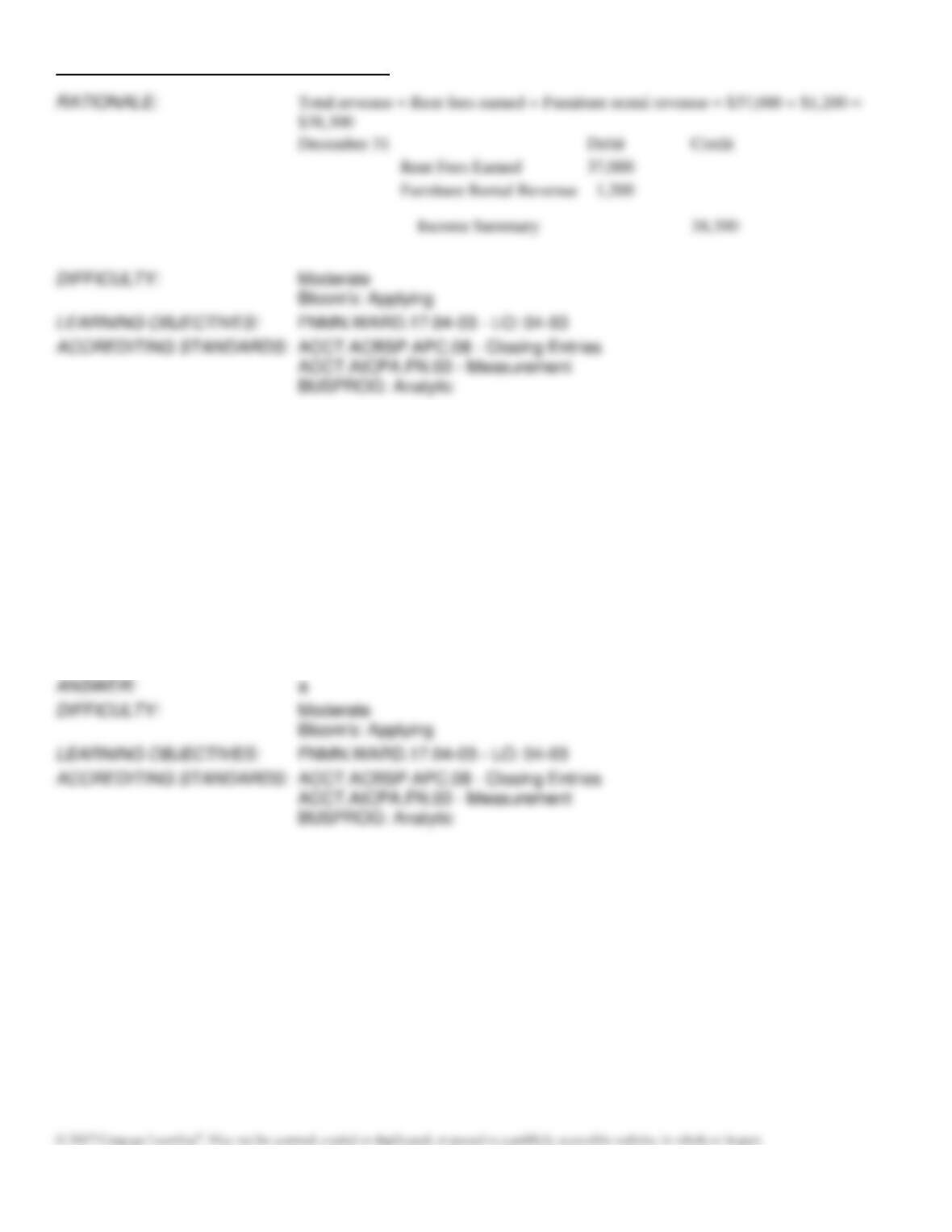
The entry required to close the revenue accounts at the end of the period includes a
a.
debit to Income Summary for $37,000
b.
credit to Income Summary for $38,300
c.
debit to Income Summary for $38,300
d.
credit to Income Summary for $37,000
Chapter 4 – Completing the Accounting Cycle
116. The journal entry to close the Fees Earned, $750, and Rent Revenue, $175, accounts during the year-end closing
process would be:
a.
Dec. 31 Fees Earned 750
Rent Revenue 175
Income Summary 925
b.
Dec. 31 Income Summary 925
Fees Earned 750
Rent Revenue 175
c.
Dec. 31 Revenues 925
Income Summary 925
d.
Dec. 31 Income Summary 925
Revenues 925
Chapter 4 – Completing the Accounting Cycle
117. Shores Sports rents canoes and kayaks. Below is the adjusted trial balance at December 31.
Debit
Credit
Cash
1,500
Accounts Receivable
2,000
Interest Receivable
100
Prepaid Insurance
1,600
Notes Receivable (long–
term)
2,800
Equipment
15,000
Accumulated Depreciation
3,000
Accounts Payable
2,400
Accrued Expenses Payable
3,920
Income Taxes Payable
2,700
Unearned Rent Fees
500
Common Stock
7,700
Dividends
2,000
Rent Fees Earned
37,000
Furniture Rental Revenue
1,300
Wages Expense
19,000
Depreciation Expense
1,800
Utilities Expense
320
Insurance Expense
700
Maintenance Expense
9,000
Income Tax Expense
2,700
Totals
58,520
58,520
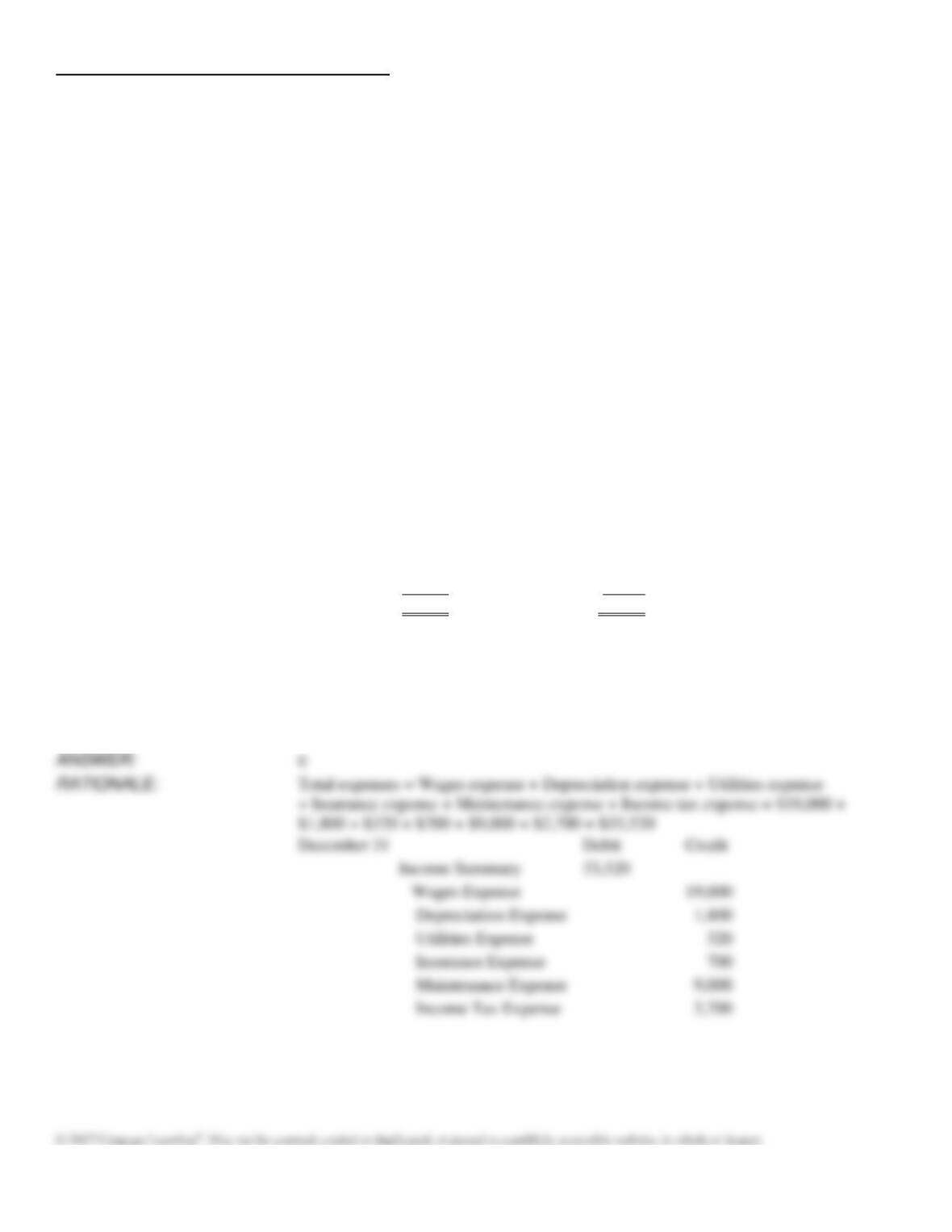
The entry required to close the expense accounts at the end of the period includes a:
a.
debit to Income Summary for $35,520
b.
credit to Income Summary for $35,520
c.
debit to Income Summary for $33,520
d.
credit to Income Summary for $33,520
Chapter 4 – Completing the Accounting Cycle
Use this end-of-period spreadsheet to answer the questions that follow.
Finley Company
End-of-Period Spreadsheet
For the Year Ended December 31
Adjusted Trial
Balance
Income Statement
Balance Sheet
Account Title
Debit
Credit
Debit
Credit
Debit
Credit
Cash
48,000
48,000
Accounts
Receivable
18,000
18,000
Supplies
6,000
6,000
Equipment
57,000
57,000
Accumulated
Depr.
18,000
18,000
Accounts
Payable
25,000
25,000
Wages
Payable
6,000
6,000
Common
Stock
30,000
30,000
Retained
Earnings
3,000
3,000
Dividends
3,000
3,000
Fees Earned
155,000
155,000
Wages
Expense
63,000
63,000
Rent Expense
27,000
27,000
Depreciation
Expense
15,000
15,000
Totals
237,000
237,000
105,000
155,000
132,000
82,000
Net Income
(Loss)
50,000
50,000
155,000
155,000
132,000
132,000
Chapter 4 – Completing the Accounting Cycle
118. The entry to close expenses would be:
a.
Wages Expense 63,000
Rent Expense 27,000
Depreciation Expense 15,000
Income Summary 105,000
b.
Expenses 105,000
Income Summary 105,000
c.
Wages Expense 63,000
Rent Expense 27,000
Depreciation Expense 15,000
Dividends 105,000
d.
Income Summary 105,000
Wages Expense 63,000
Rent Expense 27,000
Depreciation Expense 15,000
119. The journal entry to close revenues would be:
a.
debit Income Summary, $155,000; credit Fees Earned, $155,000
b.
debit Common Stock, $155,000; credit Fees Earned, $155,000
c.
debit Fees Earned, $155,000; credit Income Summary, $155,000
d.
credit Fees Earned, $155,000; credit Common Stock, $155,000
Chapter 4 – Completing the Accounting Cycle
120. The entry to close Income Summary would be
a.
debit Common Stock, $50,000; credit Income Summary, $50,000
b.
debit Income Summary, $155,000; credit Common Stock, $155,000
c.
debit Income Summary, $50,000; credit Retained Earnings, $50,000
d.
debit Common Stock, $9,000; credit Income Summary, $9,000
121. The entry to close the dividends account would be
a.
debit Retained Earnings, $3,000; credit Dividends, $3,000
b.
debit Retained Earnings, $12,000; credit Dividends, $12,000
c.
debit Dividends, $3,000; credit Retained Earnings, $3,000
d.
debit Dividends, $12,000; credit Retained Earnings, $12,000
122. The ending balance of retained earnings is
a.
$53,000
b.
$47,000
c.
$3,000
d.
$50,000
income – Dividends = $3,000 + $50,000 – $3,000 = $50,000
Chapter 4 – Completing the Accounting Cycle
123. Which of the following has steps of the accounting cycle in proper sequence (some steps may be missing)?
a.
analyze and record transactions, post transactions to the ledger, prepare a trial balance, prepare financial
statements, journalize closing entries, analyze adjustment data and prepare adjusting entries
b.
prepare a trial balance, analyze adjustment data, prepare adjusting entries, prepare financial statements,
journalize closing entries and post to the ledger, analyze and record transactions, post transactions to the ledger
c.
analyze and record transactions, post transactions to the ledger, prepare a trial balance, analyze adjustment
data, prepare adjusting entries, prepare financial statements, journalize closing entries and post to the ledger,
and prepare a post-closing trial balance
d.
prepare financial statements, journalize closing entries and post to the ledger, analyze and record transactions,
post transactions to the ledger, prepare a trial balance, analyze adjustment data, prepare adjusting entries
124. In the accounting cycle, the last step is
a.
preparing the financial statements
b.
journalizing and posting the adjusting entries
c.
preparing a post-closing trial balance
d.
journalizing and posting the closing entries
125. Of the following steps of the accounting cycle, which step should be completed first?
a.
Closing entries are journalized and posted to the ledger.
b.
Transactions are posted to the ledger.
c.
Adjusting entries are journalized and posted to the ledger.
d.
Financial statements are prepared.