Larson_Calculus_10e ch04sec06
MULTIPLE CHOICE
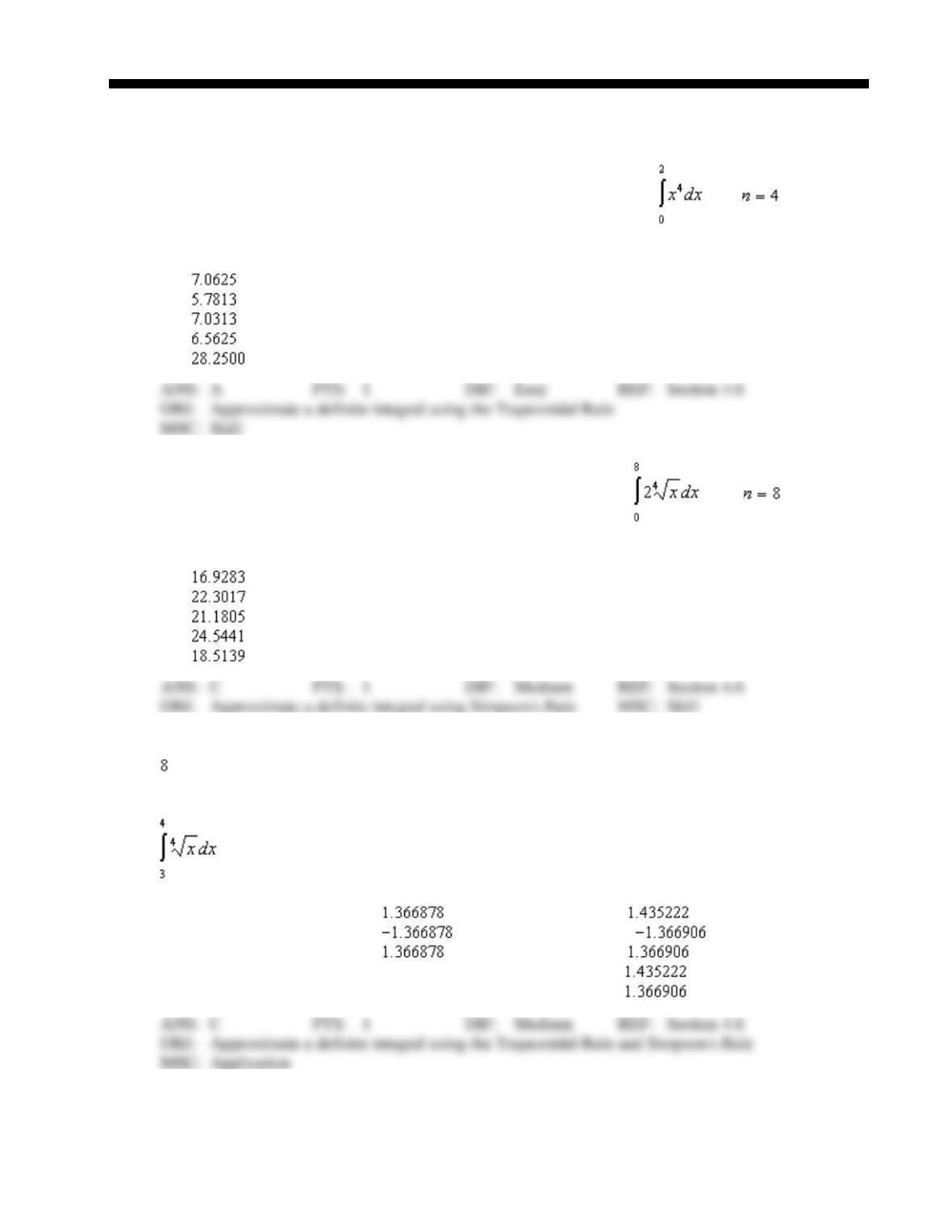
1. Use the Trapezoid Rule to approximate the value of the definite integral wth . Round
your answer to four decimal places.
a.
b.
c.
d.
e.
2. Use Simpson’s Rule to approximate the value of the definite integral with . Round
your answer to four decimal places.
a.
b.
c.
d.
e.
3. Apply the Trapezoidal Rule and Simpson’s Rule to approximate the value of the definite integral using
subintervals. Round your answer to six decimal places and compare the result with the exact value
of the definite integral.
a.
The Trapezoidal rule gives and Simpson’s rule gives .
b.
The Trapezoidal rule gives and Simpson’s rule gives .
c.
The Trapezoidal rule gives and Simpson’s rule gives .
d.
The Trapezoidal rule gives 1.366795 and Simpson’s rule gives .
e.
The Trapezoidal rule gives 1.366795 and Simpson‘s rule gives .
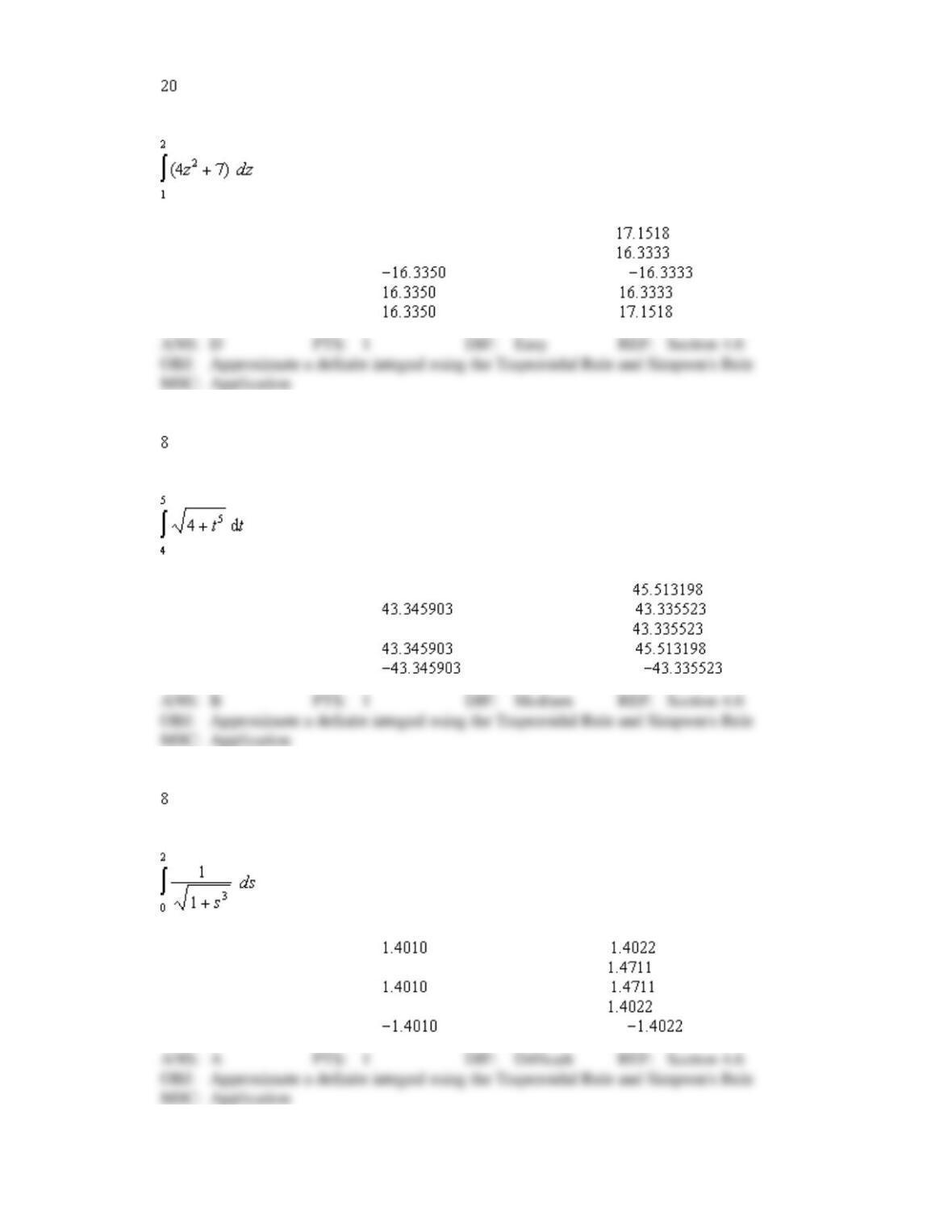
4. Apply the Trapezoidal Rule and Simpson’s Rule to approximate the value of the definite integral using
subintervals. Round your answer to six decimal places and compare the result with the exact value
of the definite integral.
a.
The Trapezoidal rule gives 16.3400 and Simpson’s rule gives .
b.
The Trapezoidal rule gives 16.3400 and Simpson’s rule gives .
c.
The Trapezoidal rule gives and Simpson’s rule gives .
d.
The Trapezoidal rule gives and Simpson’s rule gives .
e.
The Trapezoidal rule gives and Simpson’s rule gives .
5. Apply the Trapezoidal Rule and Simpson’s Rule to approximate the value of the definite integral using
subintervals. Round your answer to six decimal places and compare the result with the exact value
of the definite integral.
a.
The Trapezoidal rule gives 43.377044 and Simpson‘s rule gives .
b.
The Trapezoidal rule gives and Simpson’s rule gives .
c.
The Trapezoidal rule gives 43.377044 and Simpson’s rule gives .
d.
The Trapezoidal rule gives and Simpson’s rule gives .
e.
The Trapezoidal rule gives and Simpson’s rule gives .
6. Apply the Trapezoidal Rule and Simpson‘s Rule to approximate the value of the definite integral using
subintervals. Round your answer to six decimal places and compare the result with the exact value
of the definite integral.
a.
The Trapezoidal rule gives and Simpson’s rule gives .
b.
The Trapezoidal rule gives 1.3973 and Simpson’s rule gives .
c.
The Trapezoidal rule gives and Simpson’s rule gives .
d.
The Trapezoidal rule gives 1.3973 and Simpson’s rule gives .
e.
The Trapezoidal rule gives and Simpson’s rule gives .
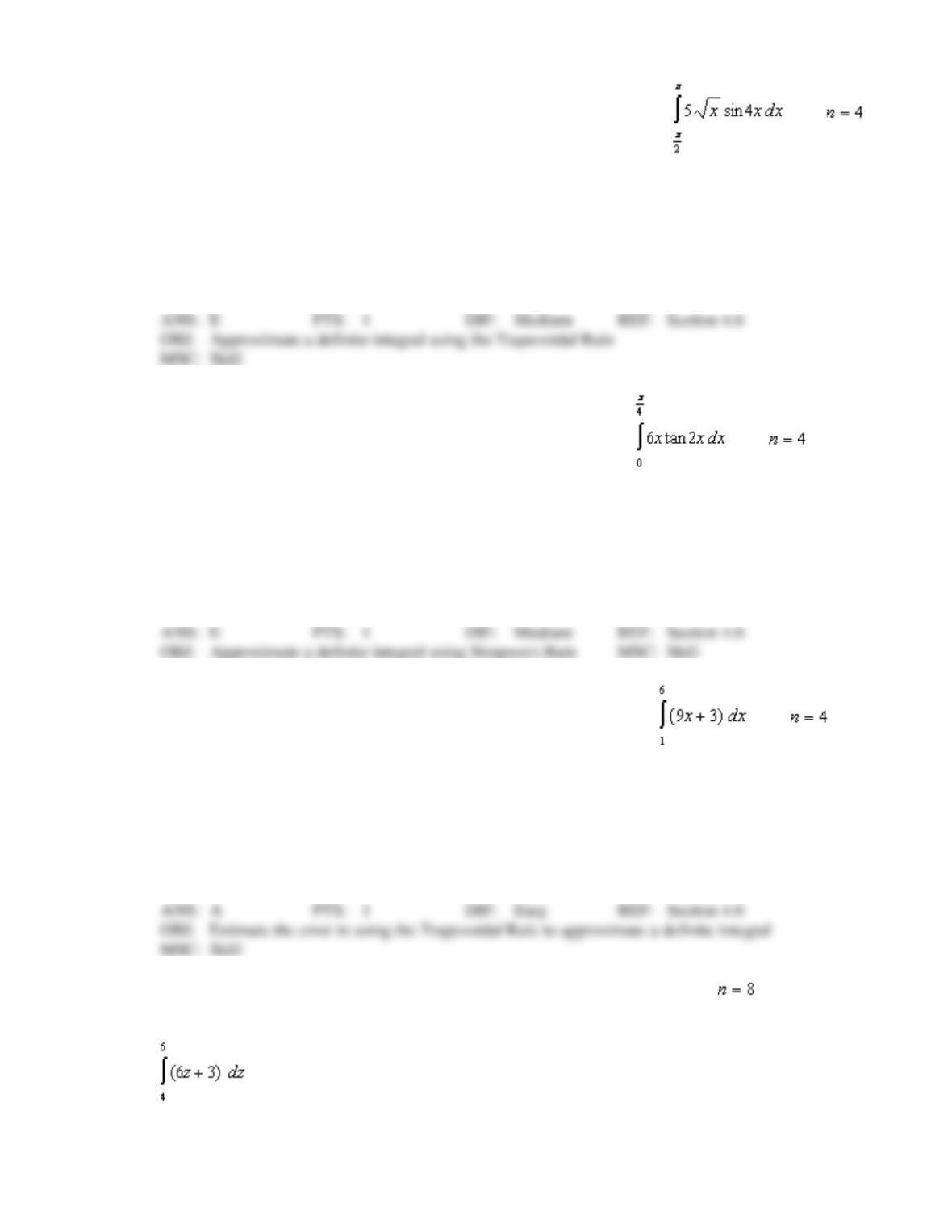
7. Use the Trapezoidal Rule to approximate the value of the definite integral with
. Round your answer to four decimal places.
a.
–8.0654
b.
–4.0327
c.
–2.0164
d.
–1.0082
e.
–0.5041
8. Use Simpson’s Rule to approximate the value of the definite integral with . Round
your answer to four decimal places.
a.
2.9784
b.
3.0627
c.
8.0100
d.
10.6800
e.
2.6700
9. Use the error formula to estimate the error in approximating the integral with
using Trapezoidal Rule.
a.
0
b.
9
c.
3
d.
6
e.
1
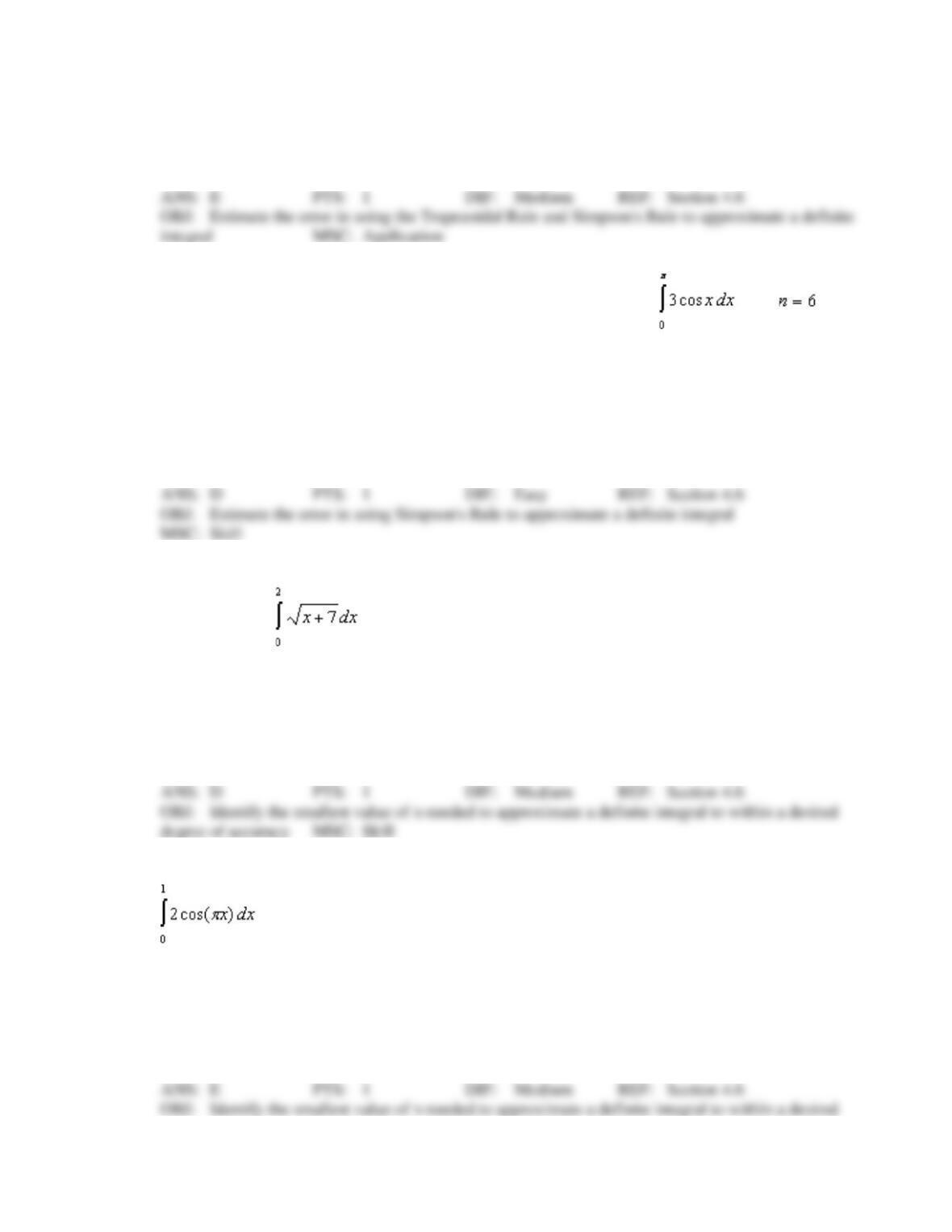
10. Estimate the error in using (a) the Trapezoidal Rule and (b) Simpson’s Rule with when
approximating the following integral.
a.
The error for the Trapezoidal Rule is 0.0051 and for Simpson’s Rule it is 0.0013.
b.
The error for the Trapezoidal Rule is 0.0000 and for Simpson’s Rule it is 0.0200.
c.
The error for the Trapezoidal Rule is 0.0204 and for Simpson’s Rule it is 0.0200.
d.
The error for the Trapezoidal Rule is 0.0204 and for Simpson’s Rule it is 0.0000.
e.
The error for the Trapezoidal Rule is 0.0000 and for Simpson’s Rule it is 0.0000.
11. Use the error formula to estimate the error in approximating the integral with using
Simpson’s Rule. Round your answer to six decimal places.
a.
0.007084
b.
0.141676
c.
0.004723
d.
0.003936
e.
0.002530
12. Find the smallest n such that the error estimate from the error formula in the approximation of the
definite integral is less than 0.00001 using the Trapezoidal Rule.
a.
49
b.
26
c.
73
d.
30
e.
15
13. Find the smallest n such that the error estimate in the approximation of the definite integral
is less than 0.00001 using Simpson’s Rule.
a.
48
b.
8
c.
11
d.
14
e.
19
14. Find the smallest n such that the error estimate in the approximation of the definite integral
is less than 0.00001 using Simpson’s Rule.
a.
10
b.
16
c.
6
d.
8
e.
13
15. Find the smallest n such that the error estimate in the approximation of the definite integral
is less than 0.00001 using the Trapezoidal Rule. Use a graphing utility to estimate the
maximum of the absolute value of the second derivative.
a.
208
b.
189
c.
196
d.
201
e.
188
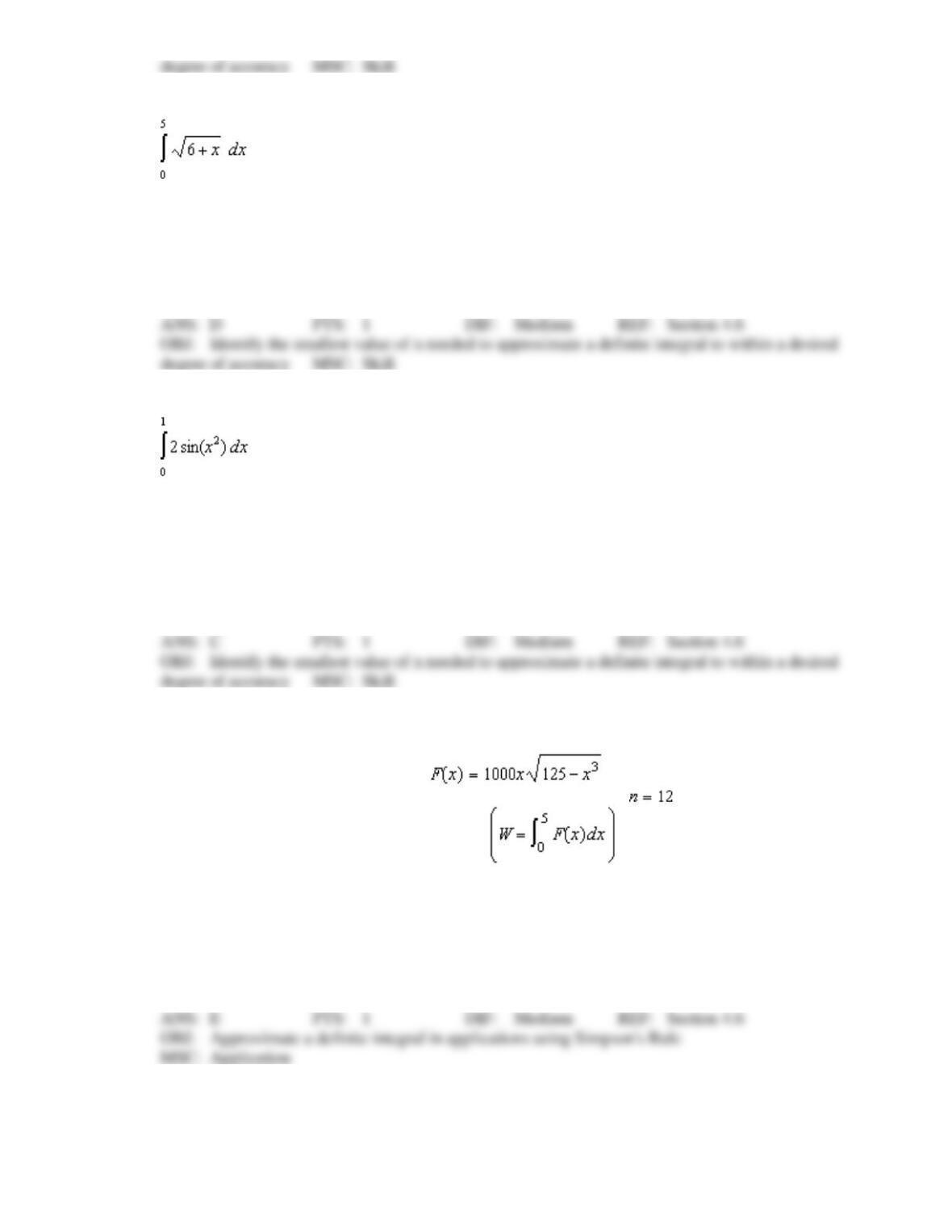
16. To determine the size of the motor required to operate a press, a company must know the
amount of work done when the press moves an object linearly 5 feet. Suppose that the
variable force to move the object is , where F is given in pounds, and x
gives the position of the unit in feet. Use Simpson’s Rule with to approximate the work
W (in foot-pounds) done through one cycle . Round your answer to nearest
unit.
a.
98,336 foot-pounds
b.
106,541 foot-pounds
c.
105,336 foot-pounds
d.
100,131 foot-pounds
e.
102,336 foot-pounds
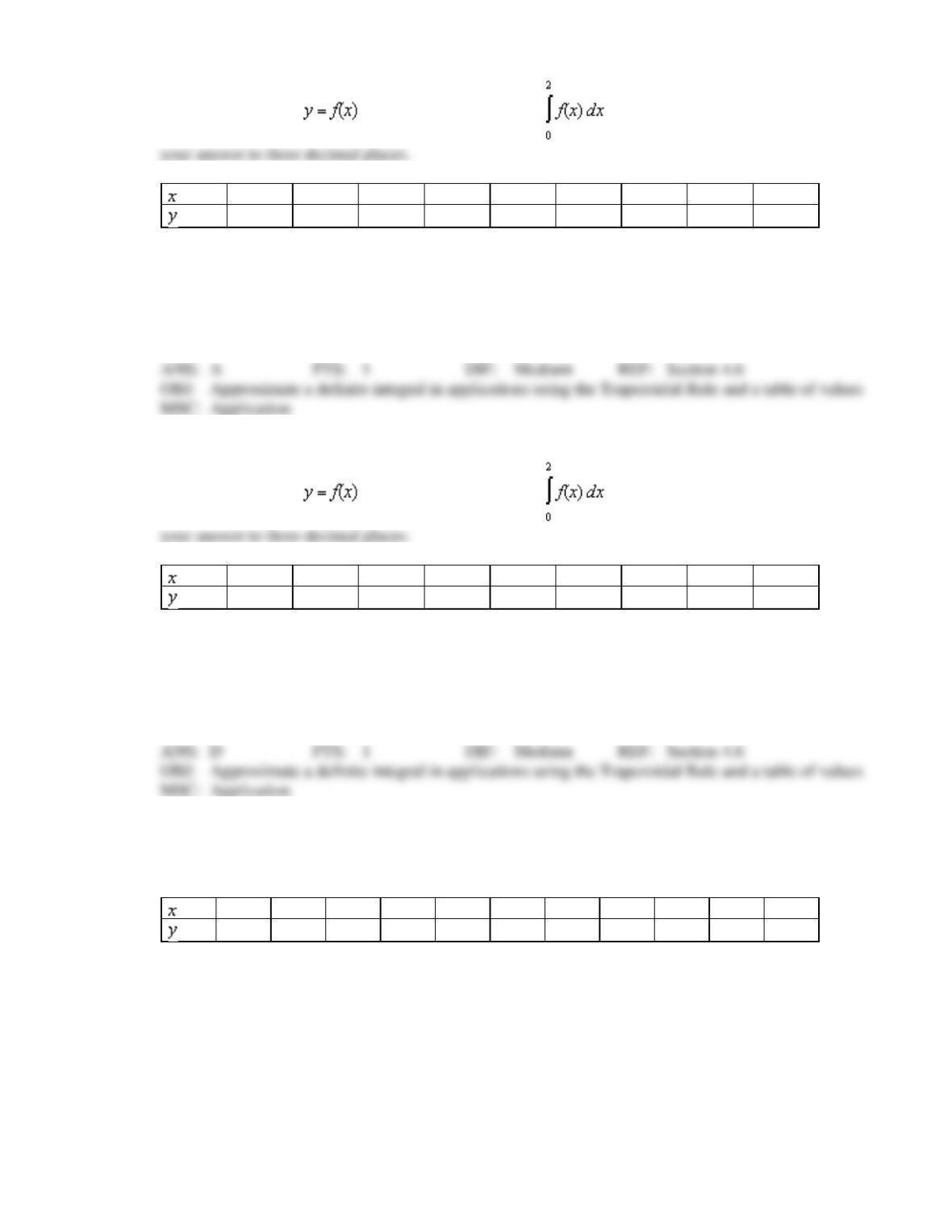
17. The table lists several measurements gathered in an experiment to approximate an unknown
continuous function . Approximate the integral using the Trapezoidal Rule. Round
0.00
0.25
0.50
0.75
1.00
1.25
1.50
1.75
2.00
4.12
4.27
4.62
6.37
6.82
7.47
7.72
8.67
8.92
a.
13.115
b.
12.000
c.
7.373
d.
104.920
e.
24.600
18. The table lists several measurements gathered in an experiment to approximate an unknown
continuous function . Approximate the integral using the Simpson’s Rule. Round
0.00
0.25
0.50
0.75
1.00
1.25
1.50
1.75
2.00
4.72
4.77
4.82
6.17
6.52
7.17
7.32
7.97
8.02
a.
12.197
b.
8.518
c.
15.975
d.
12.865
e.
11.628
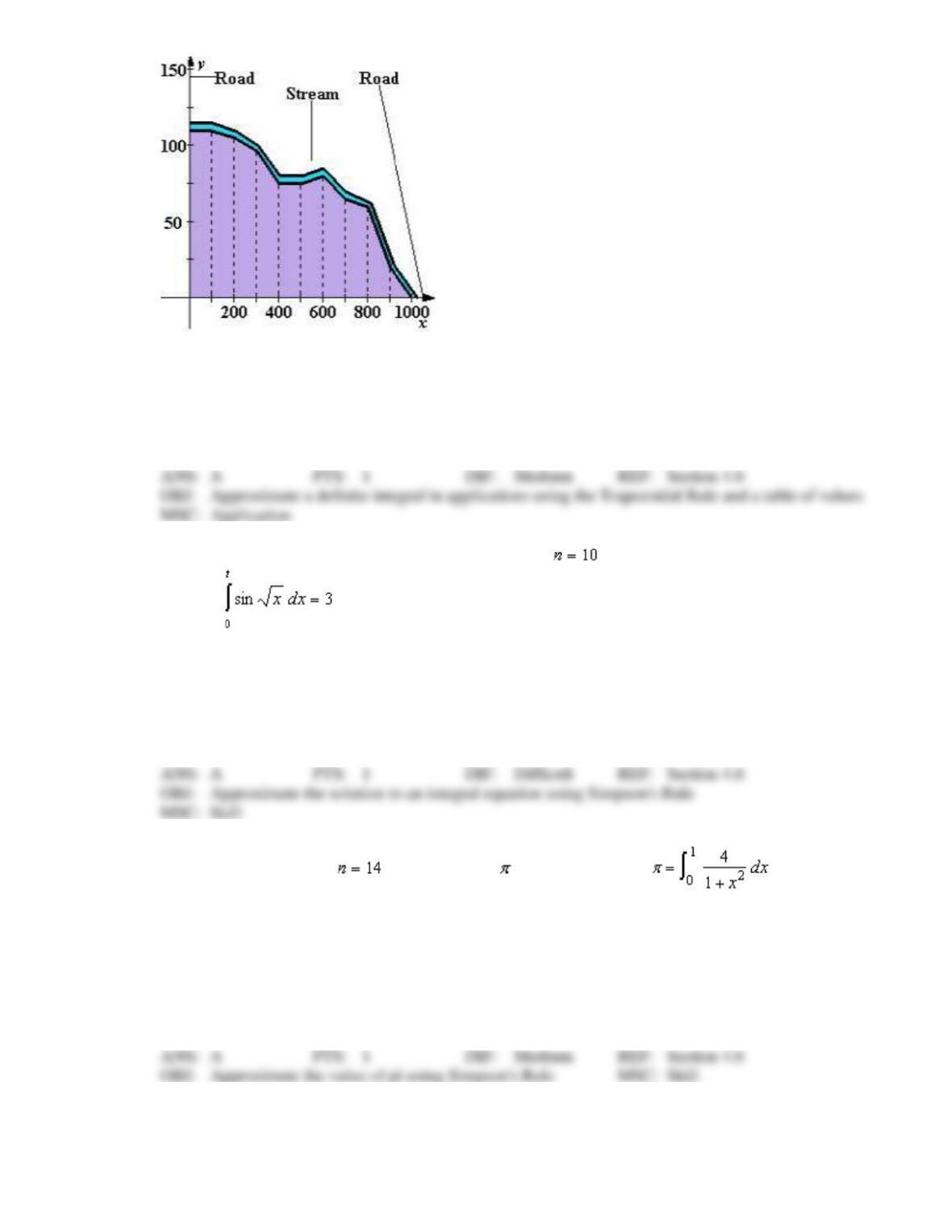
19. Use the Trapezoidal Rule to estimate the number of square meters of land in a lot where x and y are
measured in meters as shown in the figure below. The land is bounded by a stream and two straight
roads that meet at right angles.
0
100
200
300
400
500
600
700
800
900
1000
110
110
105
97
75
75
80
65
60
20
0
a.
74,200
b.
74,000
c.
73,700
d.
74,700
e.
74,400
20. Use a computer algebra system and Simpson’s Rule with to approximate t in the integral
equation . Round your answer to three decimal places.
a.
3.501
b.
3.581
c.
3.901
d.
3.529
e.
3.171
21. Use Simpson’s Rule with to approximate using the equation . Round your
answer to five decimal places.
a.
3.14159
b.
3.13595
c.
3.14723
d.
3.14381
e.
3.13937