Chapter 4: Physics of Matter
TRUE/FALSE
1. A device that measures absolute air pressure is called a barometer.
2. The difference between the pressures inside and outside a tire is called the absolute pressure.
3. The SI unit of pressure is the pascal.
4. psi is a unit of force.
5. The four states of matter are solid, fluid, gas, and plasma.
6. An ionized gas is called a plasma.
7. A plasma will conduct electricity.
8. Gases and liquids are both fluids.
9. The upward force exerted by a fluid on an object immersed in it is called the buoyant
pressure.
10. When an object floats in a liquid, the buoyant force is larger than the weight of the object.
11. The positively charged particle inside an atom is the nucleus.
12. The uncharged particle inside an atom is a neutron.
13. The central core inside an atom is the neutron.
14. The particle that orbits the central core inside an atom is the electron.
15. The number of protons in the nucleus of an atom tells which element it is.
16. An atom having a single proton in its nucleus is a hydrogen atom.
17. The element symbol C stands for cobalt.
18. The buoyant force that keeps a ship afloat is an example of Pascal’s principle.
19. The brakes in a car work because of Pascal’s principle.
20. An atomizer works because of Bernoulli’s principle.
21. A helium balloon rises because of Archimedes’ principle.
22. Air can be compressed easily because there is a great deal of empty space between air
molecules.
23. If the volume of a container is decreased while the mass and temperature of the gas inside it
stay constant, the pressure will increase.
24. The air we breathe is mostly oxygen.
25. The ratio of the density of a material to the density of water is the weight density.
26. If the outside air pressure decreases, the reading on a tire gauge connected to a tire
decreases.
27. Gravity causes the pressure in the ocean to vary with depth.
28. Water is flowing through a pipe whose cross sectional area at point A is larger than the cross
sectional area at point B. The reading on a pressure gauge connected to the pipe at point A
will be lower than the reading on a pressure gauge connected to the pipe at point B.
29. In a flowing fluid, the pressure where the fluid is moving slower is higher than the pressure
where the fluid is moving faster.
30. The gauge pressure of the water in a swimming pool at 10 ft is twice the gauge pressure of
the water at 5 ft.
31. Atmospheric pressure at an altitude of 10,000 m is exactly half of what it is at 5,000 m.
32. The force on your left palm is twice than the force on your right palm.
33. The pressure on your left palm is one half the pressure on your right palm.
34. A person weighing 200 pounds stands on snowshoes. If the area of each snowshoe is 400
square inches, the pressure on the snow is 0.25 psi.
35. A tire pressure gauge reads 30 psi when the atmospheric pressure is 14 psi. The net force on
2 square inches of the tire is 60 lbs.
36. When a 4 cubic ft block of wood floats in a fluid whose weight density is 60 pounds per
cubic foot, 3/4 of the block’s volume is submerged. The buoyant force on the block is 60
pounds.
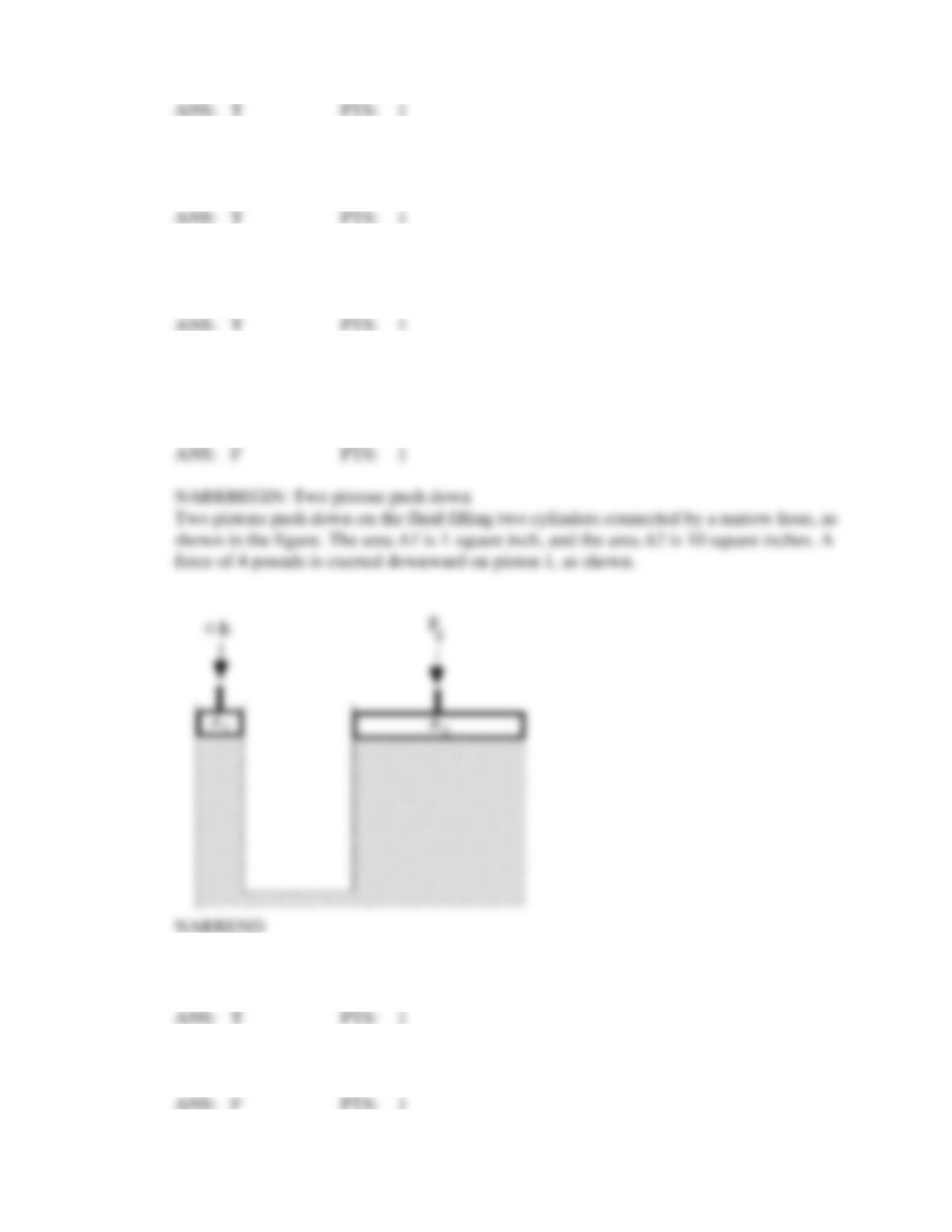
37. The pressure on A1 is 4 psi.
38. The pressure on A2 is 40 psi.

39. The force F2 needed to keep piston 2 in place is 40 pounds.
40. The altimeter in an aircraft is an aneroid barometer.
41. You measure the pressure of a tire in Atlanta, GA and find it to be 35 psi. If the tire is taken
to Denver, CO (with no other changes made) the pressure will read lower in Denver than in
Atlanta.
42. Carburetors in NASCAR race cars make use of Bernoulli’s principle.
43. Most modern aircraft use hydraulics systems to move the control surfaces on the aircraft.
This is an example of using Bernoulli’s principle.
MULTIPLE CHOICE
1. The pressure exerted by a gas is the result of
a.
the Bernoulli effect
b.
molecular collisions
c.
Pascal’s principle
d.
the ideal gas law
e.
none of the above
2. A device that measures absolute air pressure is called a
a.
manometer
b.
barometer
c.
thermometer
d.
tire gauge
e.
none of the above
3. The difference between the pressures inside and outside a tire is called
a.
absolute pressure
b.
gauge pressure
c.
atmospheric pressure
d.
psi

e.
none of the above
4. Which of the following is not a unit of pressure?
a.
atmosphere
b.
psi
c.
N/m2
d.
mm of mercury
e.
pascal
f.
none of the above
5. If the same-sized force is made to act over a smaller area, the pressure is
a.
decreased
b.
increased
c.
unchanged
d.
dependent upon the shape of the area
6. A plasma state of matter is
a.
a conducting solid
b.
a part of the blood
c.
an ionized gas
d.
a conducting liquid
e.
none of the above
7. The upward force exerted by a fluid on an object immersed in it is called
a.
gravitational force
b.
atmospheric force
c.
buoyant force
d.
weight
e.
none of the above
8. When an object floats in a liquid, the buoyant force is ____________ the weight of the
object.
a.
equal to
b.
larger than
c.
smaller than
d.
not related to
9. The positively charged particle inside an atom is the
a.
electron
b.
proton
c.
neutron
d.
nucleus
e.
none of the above
10. The uncharged particle inside an atom is the
a.
electron
b.
proton
c.
neutron
d.
nucleus
e.
none of the above
11. The central core inside an atom is the
a.
electron
b.
proton
c.
neutron
d.
nucleus
e.
none of the above
12. The particle that orbits the central core inside an atom is the
a.
electron
b.
proton
c.
neutron
d.
nucleus
e.
none of the above
13. About how big is an atom?
a.
too small to measure
b.
about a millionth of a meter across
c.
about a billionth of a meter across
d.
about a trillionth of a meter across
e.
none of the above
14. The molecule is the basic unit of all
a.
elements
c.
mixtures
b.
compounds
d.
solutions
15. DNA is a complex

a.
atom
b.
molecule
c.
life form
d.
mystery
e.
acronym
16. In the chemical formula for water, H2O, what does the “2” mean?
a.
There are two oxygen (O) atoms in a molecule of water.
b.
There are two hydrogen (H) atoms in a molecule of water.
c.
The hydrogen in water is actually deuterium.
d.
none of the above
17. What elements do the symbols H, O, C, and N stand for?
a.
hydrogen, ozone, carbon, nitrogen
b.
hydrogen, oxygen, chlorine, nitrogen
c.
hydrogen, oxygen, carbon, natrium
d.
hydrogen, oxygen, carbon, nitrogen
e.
none of the above
18. What elements do the symbols Fe, Na, Au, and Hg stand for?
a.
aluminum, nitrogen, silver, tungsten
b.
iron, sulfur, silver, ytterbium
c.
iron, sodium, silver, mercury
d.
iron, sodium, gold, mercury
e.
none of the above
19. How many elements have been identified?
a.
92
b.
104
c.
114
d.
over 200
e.
none of the above
20. The buoyant force that keeps a ship afloat is an example of
a.
Archimedes’ principle
b.
Pascal’s principle
c.
Bernoulli’s principle
d.
Torricelli’s principle
e.
none of these principles

21. The brakes in a car work because of
a.
Archimedes’ principle
b.
Pascal’s principle
c.
Bernoulli’s principle
d.
Torricelli’s principle
e.
none of these principles
22. An atomizer works because of
a.
Archimedes’ principle
b.
Pascal’s principle
c.
Bernoulli’s principle
d.
Torricelli’s principle
e.
none of these principles
23. A helium balloon rises because of
a.
Archimedes’ principle
b.
Pascal’s principle
c.
Bernoulli’s principle
d.
Torricelli’s principle
e.
none of these principles
24. Two inflated balloons are of identical size and shape, but one is filled with hydrogen, the
other helium. Which has the larger buoyant force on it?
a.
neither—the buoyant forces must be equal
b.
the helium balloon
c.
the hydrogen balloon
d.
It can’t be determined.
25. When you suck through a straw, the force that makes the liquid go up the straw is
a.
a suction force
b.
due to surface tension
c.
due to the pressure of the atmosphere
d.
antigravity
26. The ratio of the density of a material to the density of water is the
a.
mass density
b.
weight density
c.
specific gravity
d.
buoyant force
e.
none of the above
27. A solid object labeled A weighs more than another solid object labeled B. Which of the
following are true?
a.
A occupies more volume than B.
b.
A has a greater weight density than B.
c.
A has a greater specific gravity than B.
d.
A has greater volume but lesser weight density than B.
e.
none of the above
28. If the outside air pressure decreases, the reading on a tire gauge connected to a tire
a.
stays the same
b.
increases
c.
decreases
d.
can not be determined
29. Water is flowing through a pipe whose cross sectional area at point A is larger than the cross
sectional area at point B. The reading on a pressure gauge connected to the pipe at point A
will be _____________ the reading on a pressure gauge connected to the pipe at point B.
a.
the same as
c.
lower than
b.
higher than
d.
unrelated to
30. The gauge pressure of the water in a swimming pool at 10 ft is ____________ the gauge
pressure of the water at 5 ft.
a.
1/4
b.
1/2
c.
equal to
d.
2 times
e.
4 times
31. The pressure at the bottom of aquarium A is greater than that at the bottom of aquarium B.
Why might this be?
a.
A is filled with fresh water, B has the same amount of salt water.
b.
A is filled to a greater depth than B.
c.
A has greater volume than B.
d.
The bottom of aquarium A has smaller area than that of B.
e.
none of the above
32. When people get into a small boat it settles lower in the water and
a.
the buoyant force increases as a result of more water being displaced
b.
the net force on the boat again becomes zero
c.
the pressure on the bottom of the boat becomes greater because it is deeper in the
water
d.
all of the above
33. The force on your left palm is __________ the force on your right palm.
a.
1/4
b.
1/2
c.
equal to
d.
2 times
e.
4 times
34. The pressure on your left palm is ____________ the pressure on your right palm.
a.
1/4
b.
1/2
c.
equal to
d.
2 times
e.
4 times
35. A person weighing 200 pounds stands on snowshoes. If the area of each snowshoe is 400
square inches, the pressure on the snow is
a.
0.25 psi
b.
0.5 psi
c.
2 psi
d.
4 psi
e.
none of the above
36. A tire pressure gauge reads 30 psi when the atmospheric pressure is 14 psi. The net force on
2 square inches of the tire is
a.
28 lbs
b.
32 lbs
c.
60 lbs
d.
88 lbs
e.
none of these