Copyright © 2014 Pearson Education, Inc.
9) The British government has a consol bond outstanding that pays ₤100 in interest each year.
Assuming that the current interest rate in Great Britain is 5% and that you will receive your first
interest payment one year from now, then the value of the consol bond is closest to:
A) ₤1000
B) ₤1100
Answer: D
Explanation: D) PVP = C/r = 100/.05 = 2000
Diff: 1
Section: 4.5 Perpetuities and Annuities
Answer: B
Explanation: B) PVP = C/r = 100/.05 = 2000 + 100 immediate interest payment = ₤2100
Diff: 2
Section: 4.5 Perpetuities and Annuities
Copyright © 2014 Pearson Education, Inc.
12) If the current rate of interest is 8%, then the future value 20 years from now of an investment
that pays $1000 per year and lasts 20 years is closest to:
A) $45,762
B) $36,725
C) $9,818
D) $93,219
Answer: A
Explanation: A) FV = C/r((1+r)N -1) = 1000/0.08((1+0.08)20 – 1)
FV = $45,762
Diff: 1
Section: 4.5 Perpetuities and Annuities
Copyright © 2014 Pearson Education, Inc.
14) Since your first birthday, your grandparents have been depositing $1000 into a savings
account on every one of your birthdays. The account pays 4% interest annually. Immediately
after your grandparents make the deposit on your 18th birthday, the amount of money in your
savings account will be closest to:
A) $25,645
B) $36,465
C) $12,659
D) $18,000
Answer: A
Explanation: A) FV = C/r((1+r)N -1) = 1000/0.04((1+0.04)18 – 1)
FV = $25,645
Diff: 2
Section: 4.5 Perpetuities and Annuities
Answer: C
Explanation: C) PV growing Perpetuity = C/r – g = 100/(.11 – .06) = $2000
Diff: 1
Section: 4.5 Perpetuities and Annuities
Copyright © 2014 Pearson Education, Inc.
Use the information for the question(s) below.
Assume that you are 30 years old today, and that you are planning on retirement at age 65. Your
current salary is $45,000 and you expect your salary to increase at a rate of 5% per year as long
as you work. To save for your retirement, you plan on making annual contributions to a
retirement account. Your first contribution will be made on your 31st birthday and will be 8% of
this year’s salary. Likewise, you expect to deposit 8% of your salary each year until you reach
age 65. Assume that the rate of interest is 7%.
17) The present value (at age 30) of your retirement savings is closest to:
A) $87,000
B) $108,000
C) $46,600
D) $75,230
Answer: A
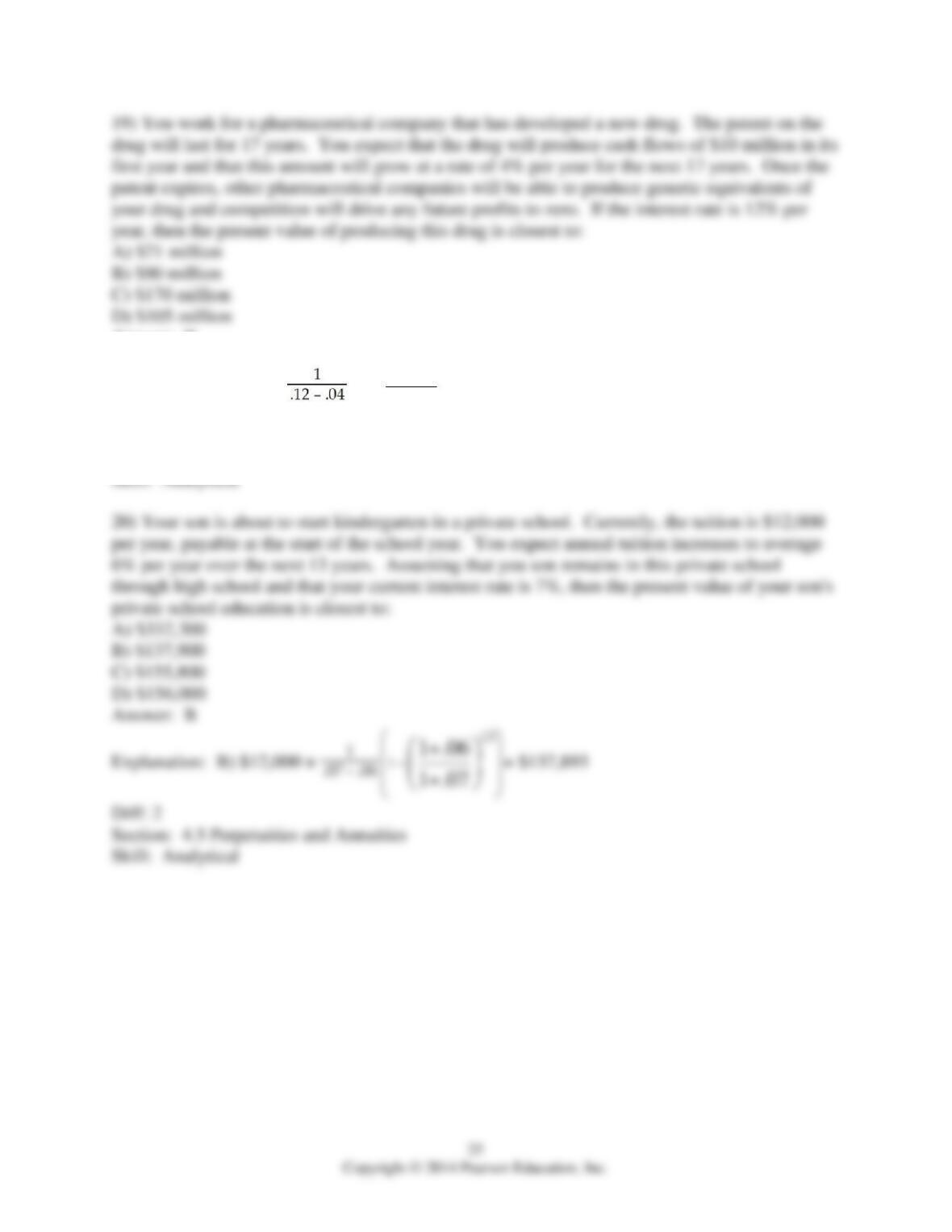
Explanation: A) First deposit = .08 × $45,000 = $3,600
$3,600 ×
−
+
+
07.1
05.1 35
1
= $87,003
Diff: 2
Section: 4.5 Perpetuities and Annuities
Copyright © 2014 Pearson Education, Inc.
19) You work for a pharmaceutical company that has developed a new drug. The patent on the
drug will last for 17 years. You expect that the drug will produce cash flows of $10 million in its
first year and that this amount will grow at a rate of 4% per year for the next 17 years. Once the
patent expires, other pharmaceutical companies will be able to produce generic equivalents of
your drug and competition will drive any future profits to zero. If the interest rate is 12% per
year, then the present value of producing this drug is closest to:
A) $71 million
B) $90 million
C) $170 million
D) $105 million
Answer: B
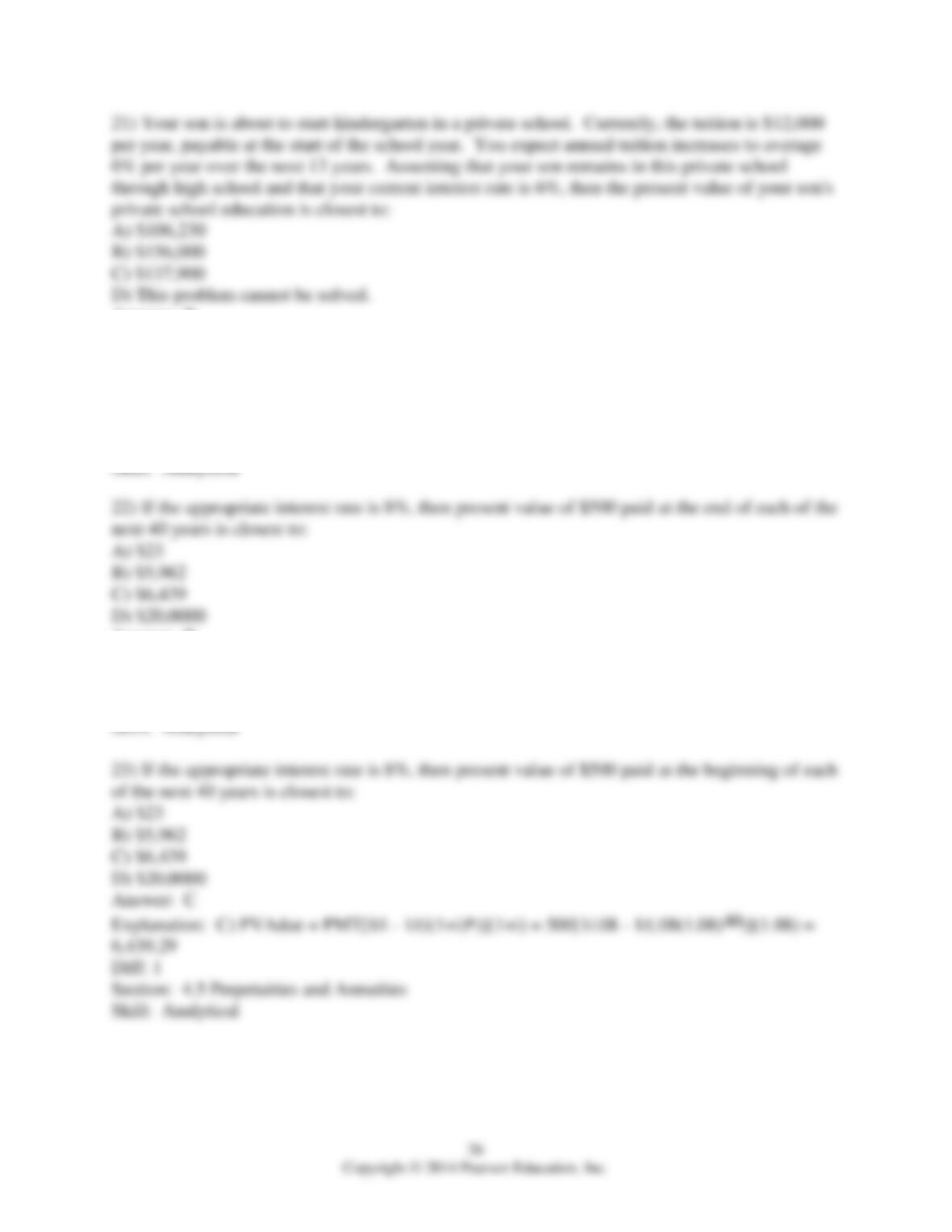
Explanation: B) $10 ×
−
+
+
12.1
04.1 17
1
= $89.53 million
Diff: 2
Section: 4.5 Perpetuities and Annuities
Copyright © 2014 Pearson Education, Inc.
21) Your son is about to start kindergarten in a private school. Currently, the tuition is $12,000
per year, payable at the start of the school year. You expect annual tuition increases to average
6% per year over the next 13 years. Assuming that your son remains in this private school
through high school and that your current interest rate is 6%, then the present value of your son’s
private school education is closest to:
A) $106,230
B) $156,000
C) $137,900
D) This problem cannot be solved.
Answer: B
Explanation: B) This is a bit of a trick question. The PV of a growing annuity formula is
undefined since r = g. But since r = g, the growth in the payments is exactly offset by the
current interest rate. Therefore the answer is 12,000 × 13 = $156,000. You could also
individually discount each of the 13 payments and arrive at the same answer.
Diff: 3
Section: 4.5 Perpetuities and Annuities
Answer: B
Explanation: B) PVA = PMT[1/i – 1/(i(1+i)n)] = 500[1/.08 – 1/(.08(1.08)40)] = 5,962.31
Diff: 1
Section: 4.5 Perpetuities and Annuities
Copyright © 2014 Pearson Education, Inc.
24) Dagny Taggart is a graduating college senior and she is considering the costs of going to
medical school. Beginning next fall, Dagny expects medical school tuition to run $45,000 for the
first year and she estimates that tuition will increase by 6% each year. If Dagny is able to invest
her money in an account paying 8% interest per year, then the present value to Dagny of four
years of medical school tuition is closest to:
A) $149,045
B) $155,930
C) $162,095
D) $180,000
Answer: C
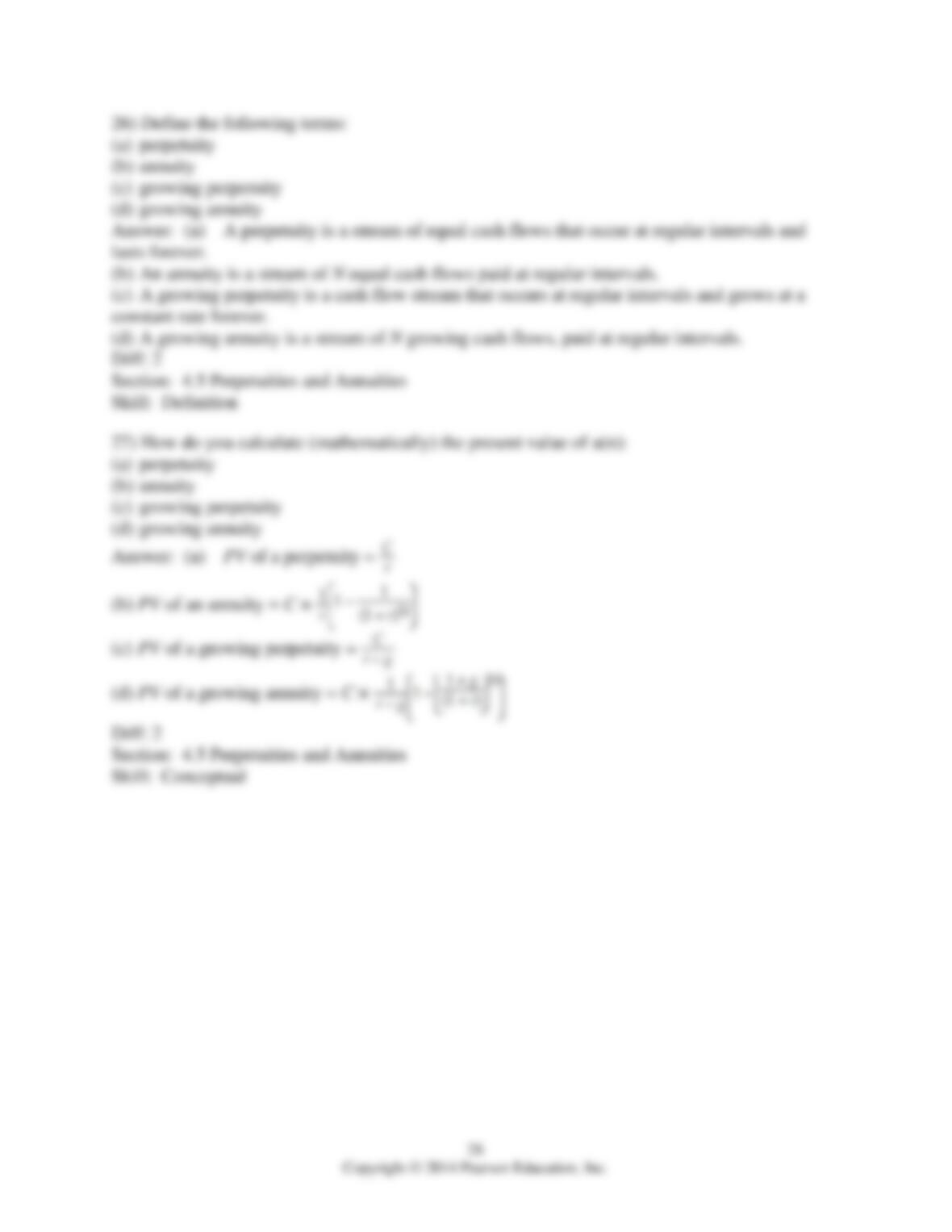
Explanation: C) PVAgrew = PMT
= 45,000 = $162,093.03
Diff: 2
Section: 4.5 Perpetuities and Annuities
Copyright © 2014 Pearson Education, Inc.
26) Define the following terms:
(a) perpetuity
(b) annuity
(c) growing perpetuity
(d) growing annuity
Answer: (a) A perpetuity is a stream of equal cash flows that occur at regular intervals and
lasts forever.
(b) An annuity is a stream of N equal cash flows paid at regular intervals.
(c) A growing perpetuity is a cash flow stream that occurs at regular intervals and grows at a
constant rate forever.
(d) A growing annuity is a stream of N growing cash flows, paid at regular intervals.
Diff: 2
Section: 4.5 Perpetuities and Annuities
29
Copyright © 2014 Pearson Education, Inc.
Use the information for the question(s) below.
Suppose that a young couple has just had their first baby and they wish to ensure that enough
money will be available to pay for their child’s college education. Currently, college tuition,
books, fees, and other costs, average $12,500 per year. On average, tuition and other costs have
historically increased at a rate of 4% per year.
28) Assuming that college costs continue to increase an average of 4% per year and that all her
college savings are invested in an account paying 7% interest, then the amount of money she will
need to have available at age 18 to pay for all four years of her undergraduate education is
closest to:
Answer: This is a two step problem.
Step #1 determine the cost of the first year of college.
FV = PV(1 + i)N = $12,500(1.04)18 = $25,322.71
Step #2 figure out the value for four years of college.
PV of a growing annuity due = C × (1 + r)
= $25,322.71 ×
−
+
+
07.1
04.1 4
1
(1 + .07) = $97,110.01
Diff: 3
Section: 4.5 Perpetuities and Annuities
Skill: Analytical
Use the information for the question(s) below.
Assume that you are 30 years old today, and that you are planning on retirement at age 65. Your
current salary is $45,000 and you expect your salary to increase at a rate of 5% per year as long
as you work. To save for your retirement, you plan on making annual contributions to a
retirement account. Your first contribution will be made on your 31st birthday and will be 8% of
this year’s salary. Likewise, you expect to deposit 8% of your salary each year until you reach
age 65. Assume that the rate of interest is 7%.
29) The future value at retirement (age 65) of your savings is:
Answer: First deposit = .08 × $45,000 = $3,600
$3,600 ×
−
+
+
07.1
05.1 35
1
(1.07)35 = $928,895
Diff: 3
Section: 4.5 Perpetuities and Annuities
Skill: Analytical
30
Copyright © 2014 Pearson Education, Inc.
30) Assume that you are 30 years old today, and that you are planning on retiring at age 65.
Your current salary is $45,000 and you expect your salary to increase at a rate of 5% per year as
long as you work. To save for your retirement, you plan on making annual contributions to a
retirement account. Your first contribution will be made on your 31st birthday and will be 8% of
this year’s salary. Likewise, you expect to deposit 8% of your salary each year until you reach
age 65. At retirement (age 65) you will begin withdrawing equal annual payments to pay for
your living expenses during retirement (on your 65th birthday). If you expect to die one day
before your 101st birthday (Your last withdraw will be on your 100th birthday) and if the annual
rate of return is 7%, then how much money will you have to spend in each of your golden years
of retirement?
Answer: $71,260
First deposit = .08 × $45,000 = $3,600
$3,600 ×
−
+
+
07.1
05.1 35
1
(1.07)35 = $928,895
so,
N = 36
I = 7
PV = 928,895
FV = 0
Compute PMT = 71260
Diff: 3
Section: 4.5 Perpetuities and Annuities
Skill: Analytical
4.6 Solving Problems with a Spreadsheet or Calculator
1) Which of the following is NOT a valid time value of money function in Excel?
A) PMT
B) NPER
C) I
D) FV
Answer: C
Diff: 1
Section: 4.6 Solving Problems with a Spreadsheet or Calculator
Skill: Conceptual
Copyright © 2014 Pearson Education, Inc.
2) Suppose that you deposit $10,000 in an account that pays 6% interest and you want to know
how much will be in your account at the end of 10 years. To solve this problem in Microsoft
Excel, you would use which of the following Excel formulas?
A) =FV(.06,10000,0,10)
B) =PV(.06,10000,0,10)
C) =FV(.06,10,0,10000)
D) =PV(.06,10,0,10000)
Answer: C
Diff: 2
Section: 4.6 Solving Problems with a Spreadsheet or Calculator
Answer: A
Explanation: A) =PV(.05,5,4000,0,0)
Diff: 2
Section: 4.6 Solving Problems with a Spreadsheet or Calculator
32
Copyright © 2014 Pearson Education, Inc.
5) Henry Rearden is saving for retirement and has determined that to live comfortably he must
save $3 million by his 65 birthday. Henry just turned 30 today, and he has decided that starting
today and continuing on every birthday up to and including his 65th birthday, he will deposit the
same amount into an individual retirement account (IRA). If Henry can earn 8% on his IRA, then
the amount he must set aside each year to make sure that he will have $3 million in his account
on his 65th birthday is closest to:
A) $16,035
B) $17,410
C) $83,335
D) $85,715
Answer: A
Diff: 3
Section: 4.6 Solving Problems with a Spreadsheet or Calculator
Skill: Analytical
4.7 Non-Annual Cash Flows
1) You are interested in purchasing a new automobile that costs $35,000. The dealership offers
you a special financing rate of 6% APR (0.5%) per month for 48 months. Assuming that you do
not make a down payment on the auto and you take the dealer’s financing deal, then your
monthly car payments would be closest to:
A) $729
B) $822
C) $842
D) $647
Answer: B
Explanation: B) PV = 35000
I = .5
N = 48
FV = 0
Compute Payment = $821.98
Diff: 2
Section: 4.7 Non-Annual Cash Flows
Skill: Analytical
Copyright © 2014 Pearson Education, Inc.
2) You are considering purchasing a new home. You will need to borrow $250,000 to purchase
the home. A mortgage company offers you a 15 year fixed rate mortgage (180 months) at 9%
APR (0.75% month). If you borrow the money from this mortgage company, your monthly
mortgage payment will be closest to:
A) $2,585
B) $660
C) $2,535
D) $1,390
Answer: C
Explanation: C) PV = 250000
I = 0.75
N = 180
FV = 0
Compute PMT = $2535.67
Diff: 2
Section: 4.7 Non-Annual Cash Flows
Answer: C
Explanation: C) PV = C/r (1 – (1 + r)-N) = 250/.02 (1 – (1 + 0.02)-80)
PV = $9,936.13
Diff: 1
Section: 4.7 Non-Annual Cash Flows
Copyright © 2014 Pearson Education, Inc.
5) If the current rate of interest is 8% APR, then the future value of an investment that pays $500
every two years and lasts 20 years is closest to:
A) $10,979
B) $10,661
C) $22,881
D) $20,000
Answer: B
Explanation: C) FV = C/r ((1 + r)N-1) = 500/.1664 ((1 + 0.1664)10-1)
FV = 10,978.91
Diff: 1
Section: 4.7 Non-Annual Cash Flows
Skill: Analytical
4.8 Solving for the Cash Payments
1) The British government has just issued a new consol bond that sells for £1000 and pays
interest of 8%. The annual interest payment on this bond must be:
A) £80
B) £8
C) £1000
D) £12,500
Answer: A
Explanation: A) £1000 × .08 = £80
Diff: 1
Section: 4.9 The Internal Rate of Return
35
Copyright © 2014 Pearson Education, Inc.
3) You are saving for retirement. To live comfortably, you decide that you will need $2.5
million dollars by the time you are 65. If today is your 30th birthday, and you decide, starting
today, and on every birthday up to and including your 65th birthday, that you will deposit the
same amount into your savings account. Assuming the interest rate is 5%, the amount that you
must set aside each and every year on your birthday is closest to:
A) $71,430
B) $27,680
C) $26,100
D) $26,260
Answer: C
Explanation: C) PV (age 29) = 2500000/(1.05)36 = 431643.54
PV = 431,643.54
FV = 0
I = 5
N = 36
Compute PMT = $26,086
Diff: 3
Section: 4.9 The Internal Rate of Return
Skill: Analytical
4.9 The Internal Rate of Return
1) You have an investment opportunity that will cost you $10,000 today, but return $12,500 to
you in one year. The IRR of this investment opportunity is closest to:
A) 80%
B) 125%
C) 20%
D) 25%
Answer: D
Explanation: D) IRR = – 1 = 0.25 or 25%
Diff: 1
Section: 4.9 The Internal Rate of Return
Skill: Analytical
Copyright © 2014 Pearson Education, Inc.
2) You are looking for a new truck and see the following advertisement. “Own a new truck! No
money down. Just five easy annual payments of $8000.” You know that you can get the same
truck from the dealer across town for only $31,120. The interest rate for the deal advertised is
closest to:
A) 9%
B) 8%
C) 8.5%
D) 10%
Answer: A
Explanation: A) PV = 31120
FV = 0
N = 5
PMT = -8000
Compute I = 8.9965%
Diff: 2
Section: 4.9 The Internal Rate of Return
37
Copyright © 2014 Pearson Education, Inc.
4) You are considering investing in a security that will pay you $80 in interest at the end of each
of the next 10 years. If this security is currently selling for $588.81, then the IRR for investing in
this security is closest to:
A) 6.0%
B) 7.0%
C) 6.5%
D) 5.0%
Answer: A
Explanation: A) PV = -588.81
PMT = 80
N = 10
FV = 0
Compute I = 5.99989
Diff: 2
Section: 4.9 The Internal Rate of Return
Skill: Analytical
Use the following information to answer the question(s) below.
Nielson Motors is considering an opportunity that requires an investment of $1,000,000 today
and will provide $250,000 one year from now, $450,000 two years from now, and $650,000
three years from now.
5) The Internal Rate of return of this project is closest to:
A) 10.2%
B) 12.2%
C) 14.2%
D) 16.2%
Answer: C
Explanation: B) NPV = 0 = -1,000,000 + 250,000/(1.142)1 + 450,000/(1.142)2 +
650,000/(1.142)3
Diff: 2
Section: 4.9 The Internal Rate of Return
Skill: Analytical
Copyright © 2014 Pearson Education, Inc.
4.10 Appendix: Solving for the Number of Periods
1) After your grandmother retired, she purchased an annuity contract for $250,000 that will pay
her $25,000 at the end of every year until she dies. The appropriate interest rate for this annuity
is 8%. The number of years that your grandmother must live in order to get more value out of
the annuity than what she paid for it is closest to:
A) 21
B) 16
C) 8
D) 10
Answer: A
Explanation: A) PV = 250000
FV = 0
I = 8
PMT = – 25000
Compute N = 21
Diff: 2
Section: 4.10 Appendix: Solving for the Number of Periods
39
Copyright © 2014 Pearson Education, Inc.
3) You have an $8,000 balance on your credit card, which charges 18% interest annually (1% per
month). If you can afford to pay $100 per month, how many months will it take to pay the credit
card in full?
A) 170 months
B) 14 months
C) 162 months
D) You will never get the card paid off at that rate.
Answer: D
Explanation: C) You are paying $120 (8000*0.015) in interest each month – paying $100 per
month won’t reduce the balance.
Diff: 2
Section: 4.10 Appendix: Solving for the Number of Periods
Skill: Analytical