Chapter 4: Completing the Accounting Cycle
116.
Evan Roberts owns a business, Shores Sports that rents canoes and kayaks. Below is the adjusted trial balance at
December 31.
Debit
Credit
Cash
1,500
Accounts Receivable
2,000
Interest Receivable
100
Prepaid Insurance
1,600
Notes Receivable (long-term)
2,800
Equipment
15,000
Accumulated Depreciation
3,000
Accounts Payable
2,400
Accrued Expenses Payable
3,920
Income Taxes Payable
2,700
Unearned Rent Fees
500
Evan Roberts, Capital
7,700
Evan Roberts, Drawing
2,000
Rent Rees Earned
37,000
Furniture Rental Revenue
1,200
Interest Revenue
100
Wages Expense
19,000
Depreciation Expense
1,800
Utilities Expense
320
Insurance Expense
700
Maintenance Expense
9,000
Income Tax Expense
2,700
58,520
58,520
The entry required to close the revenue accounts at the end of the period includes a
a.
debit to Income Summary for $37,000 b. credit to Income Summary for $38,300
c. debit to Income Summary for $38,200 d. credit to Income Summary for $37,000
Chapter 4: Completing the Accounting Cycle
117.
Evan Roberts owns a business, Shore Sports, that rents canoes and kayaks. Below is the adjusted trial balance at
December 31.
Debit
Credit
Cash
1,500
Accounts Receivable
2,000
Interest Receivable
100
Prepaid Insurance
1,600
Notes Receivable (long-term)
2,800
Equipment
15,000
Accumulated Depreciation
3,000
Accounts Payable
2,400
Accrued Expenses Payable
3,920
Income Taxes Payable
2,700
Unearned Rent Fees
500
Evan Roberts, Capital
7,700
Evan Roberts, Drawing
2,000
Rent Fees Earned
37,000
Furniture Rental Revenue
1,200
Interest Revenue
100
Wages Expense
19,000
Depreciation Expense
1,800
Utilities Expense
320
Insurance Expense
700
Maintenance Expense
9,000
Income Tax Expense
2,700
Totals
58,520
58,520
The entry required to close the expense accounts at the end of the period includes a:
a.
a debit to Income Summary for $35,520
b.
a credit to Income Summary for $35,520
c.
a debit to Income Summary for $33,520
d.
a credit to Income Summary for $33,520
c
ACCT.WARD.16.04-03 – 04–03
Chapter 4: Completing the Accounting Cycle
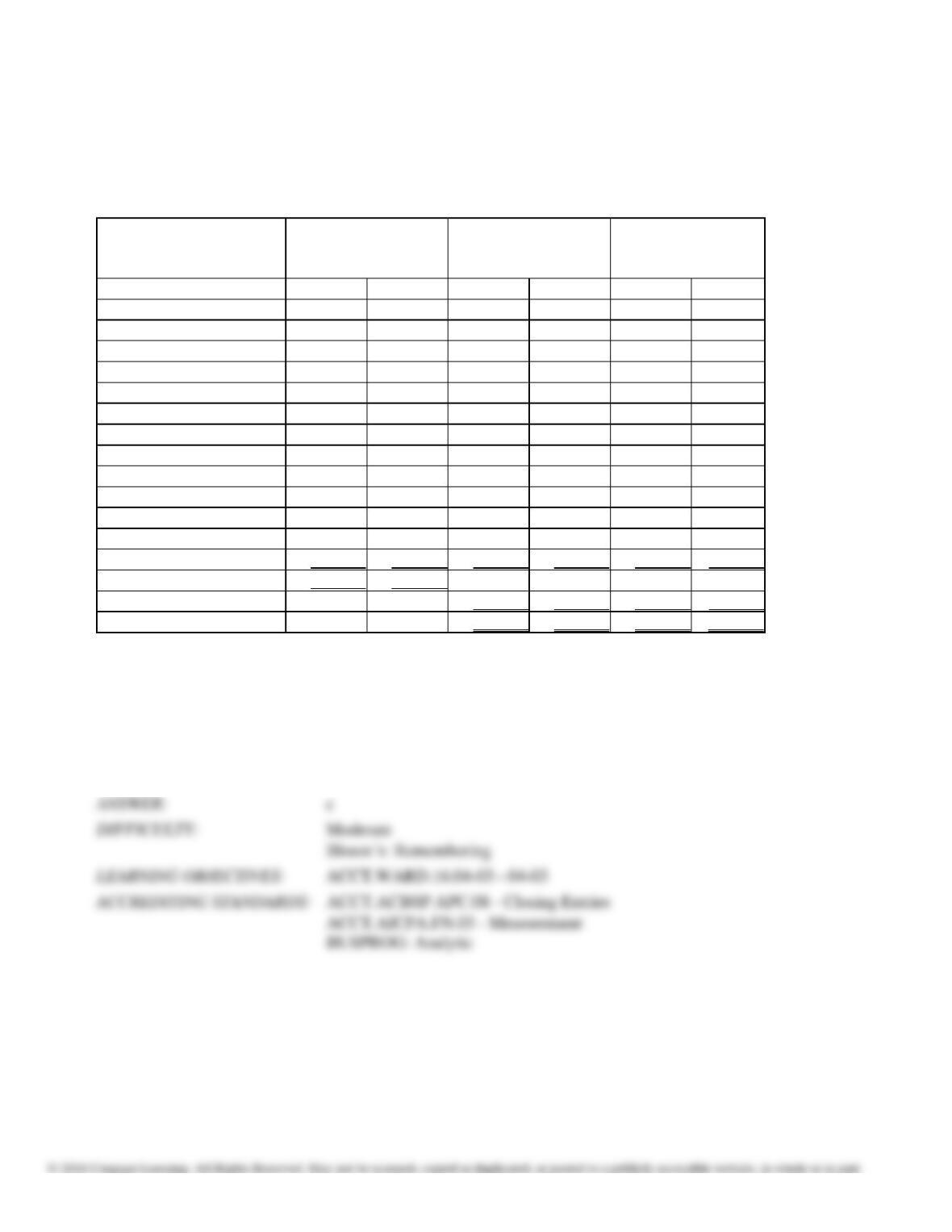
Use the following end-of-period spreadsheet below to answer the questions that follow.
Finley Company
End-of-Period Spreadsheet
For the Year Ended December 31
Adjusted Trial
Balance
Income Statement
Balance Sheet
Account Title
Debit
Credit
Debit
Credit
Debit
Credit
Cash
48,000
48,000
Accounts Receivable
18,000
18,000
Supplies
6,000
6,000
Equipment
57,000
57,000
Accumulated Depreciation
18,000
18,000
Accounts Payable
25,000
25,000
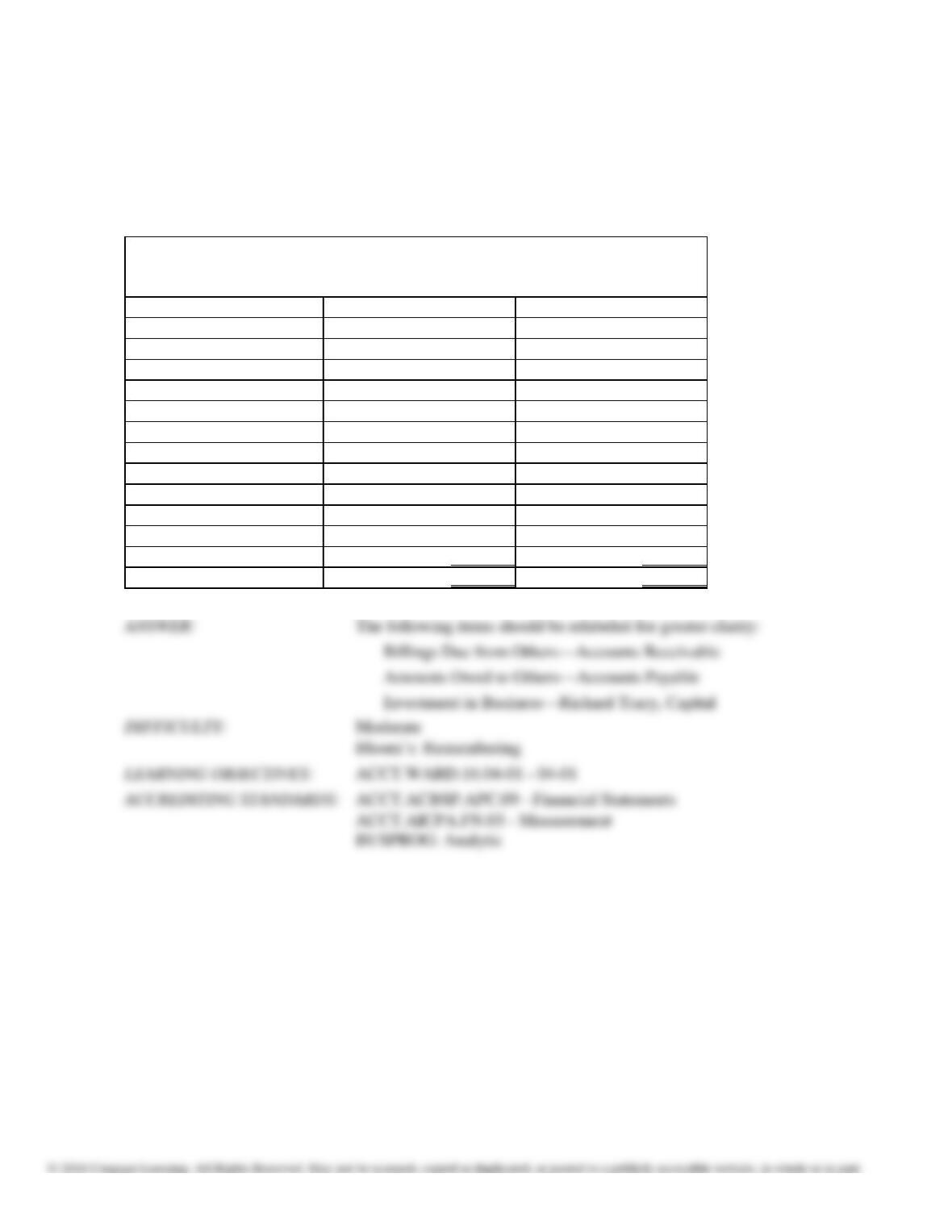
Wages Payable
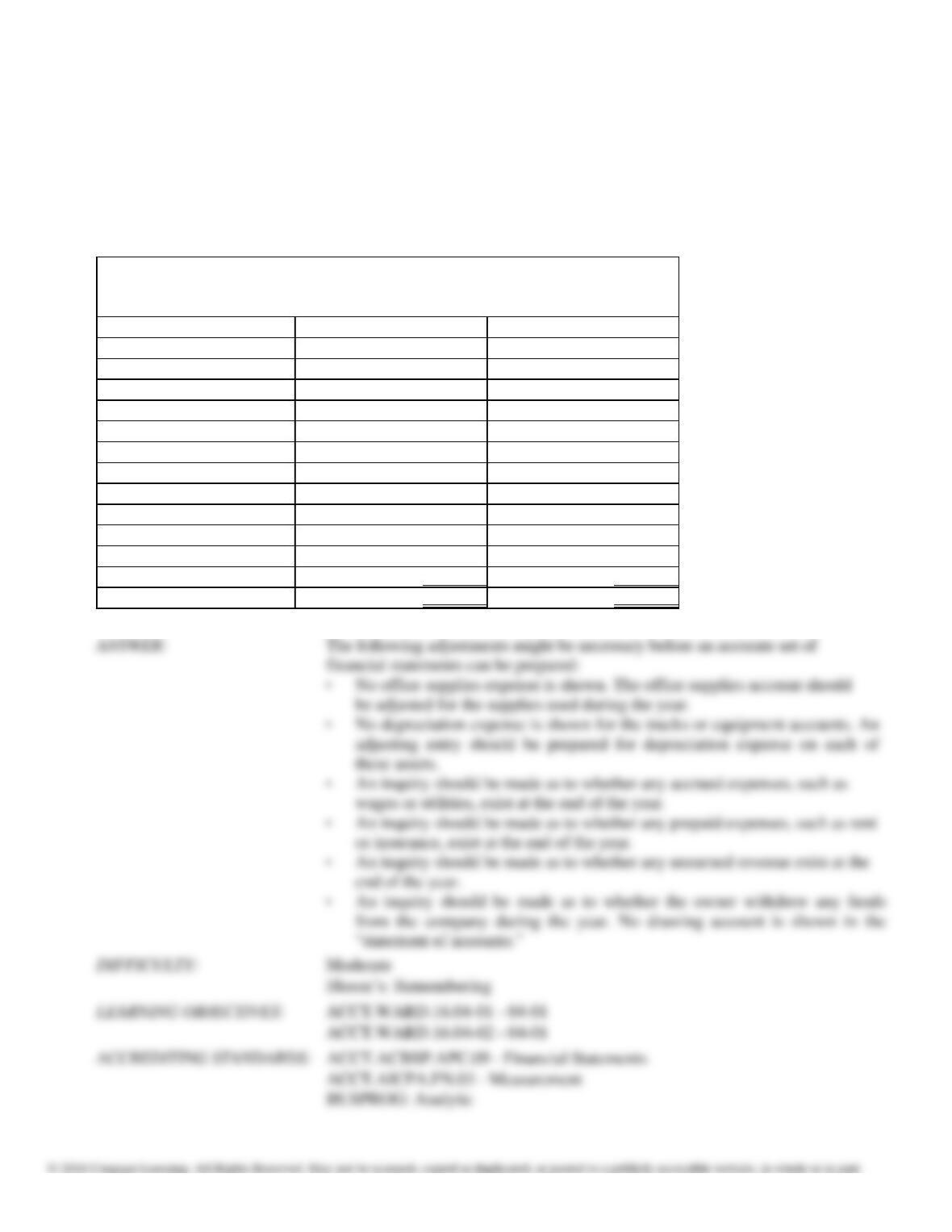
6,000
6,000
C. Finley, Capital
33,000
33,000
C. Finley, Drawing
3,000
3,000
Fees Earned
155,000
155,000
Wages Expense
63,000
63,000
Rent Expense
27,000
27,000
Depreciation Expense
15,000
15,000
Totals
237,000
237,000
105,000
155,000
132,000
82,000
Net Income (Loss)
50,000
50,000
155,000
155,000
132,000
132,000
118.
The journal entry to close revenues would be:
a.
debit Income Summary, $155,000; credit Fees Earned, $155,000
b.
debit C. Finley, Capital, $155,000; credit Fees Earned, $155,000
c.
debit Fees Earned, $155,000; credit Income Summary, $155,000
d.
credit Fees Earned, $155,000; credit C. Finley, Capital, $155,000
Chapter 4: Completing the Accounting Cycle
119.
The entry to close expenses would be:
a.
Wages Expense 63,000
Rent Expense 27,000
Depreciation Expense 15,000
Income Summary 105,000
b.
Expenses 105,000
Income Summary 105,000
c.
Wages Expense 63,000
Rent Expense 27,000
Depreciation Expense 15,000
C. Finley, Drawing 105,000
d.
Income Summary 105,000
Wages Expense
63,000
Rent Expense
27,000
Depreciation Expense
15,000
120.
The entry to close income summary would be
a.
debit C. Finley, Capital, $50,000; credit Income Summary, $50,000
b.
debit Income Summary, $155,000; credit C. Finley, Capital, $155,000
c.
debit Income Summary, $50,000; credit C. Finley, Capital, $50,000
d.
debit C. Finley, Capital, $9,000; credit Income Summary, $9,000
Chapter 4: Completing the Accounting Cycle
121.
The entry to close C. Finley, Drawing would be
a.
debit C. Finley, Capital, $3,000; credit C. Finley, Drawing, $3,000
b.
debit C. Finley, Capital, $12,000; credit C. Finley, Drawing, $12,000
c.
debit C. Finley, Drawing, $3,000; credit C. Finley, Capital, $3,000
d.
debit C. Finley, Drawing, $12,000; credit C. Finley, Capital, $12,000
122.
The ending balance in C. Finley, Capital is
a. $33,000
b. $80,000
c. $30,000
d. $83,000
123.
Which of the following has steps of the accounting cycle in proper sequence (some steps may be missing)?
a.
analyze and record transactions, post transaction to the ledger, prepare a trial balance, prepare
financial
statements, journalize closing entries, analyze adjustment data and prepare adjusting entries
b.
prepare a trial balance, analyze adjustment data, prepare adjusting entries, prepare financial statements,
journalize closing entries and post to the ledger, analyze and record transactions, post transactions to
the
ledger
c.
analyze and record transactions, post transactions to the ledger, prepare a trial balance, analyze adjustment
data, prepare adjusting entries, prepare financial statements, journalize closing entries and post to the
ledger,
and prepare a post-closing trial balance
d.
prepare financial statements, journalize closing entries and post to the ledger, analyze and record
transactions, post transactions to the ledger, prepare a trial balance, analyze adjustment data,
prepare
adjusting entries
Chapter 4: Completing the Accounting Cycle
124.
In the accounting cycle, the last step is
a.
preparing the financial statements
b.
journalizing and posting the adjusting entries
c.
preparing a post-closing trial balance
d.
journalizing and posting the closing entries
125.
Of the following steps of the accounting cycle, which step should be completed first?
a.
Closing entries are journalized and posted to the ledger.
b.
Transactions are posted to the ledger.
c.
Adjusting entries are journalized and posted to the ledger.
d.
Financial statements are prepared.
126.
Of the following steps of the accounting cycle, which step should be completed last?
a.
An adjusted trial balance is prepared.
b.
Transactions are posted to the ledger.
c.
An unadjusted trial balance is prepared.
d.
Adjusting entries are journalized and posted to the ledger.
Chapter 4: Completing the Accounting Cycle
127.
The accounting cycle requires three trial balances be done. In what order should they be prepared?
a.
post-closing, unadjusted, adjusted
b.
unadjusted, post-closing, adjusted
c.
unadjusted, adjusted, post-closing
d.
post-closing, adjusted, unadjusted
128.
During the end-of-period processing, which of the following best describes the logical order of steps?
a.
preparation of adjustments, adjusted trial balance, financial statements
b.
preparation of income statement, adjusted trial balance, balance sheet
c.
preparation of adjusted trial balance, cross-referencing, journalizing
d.
preparation of adjustments, adjusted trial balance, posting
129.
A fiscal year for a business
a.
ordinarily begins on the first day of a month and ends on the last day of the following twelfth month
b.
is determined by the federal government
c.
always begins on January 1 and ends on December 31 of the same year
d.
should end at the height of the business’s annual operating cycle
Chapter 4: Completing the Accounting Cycle
130.
The natural business year is a
a.
fiscal year that ends when business activities are at their lowest point
b.
calendar year that ends when business activities are at their lowest point
c.
fiscal year that ends when business activities are at their highest point
d.
calendar year that ends when business activities are at their highest point
131.
The end-of-period spreadsheet
a.
is an integral part of the accounting cycle
b.
eliminates the need to rewrite the financial statements
c.
is a working paper that is required
d.
is used to summarize account balances and adjustments for the financial statements
132.
Which one of the steps below is not aided by the preparation of the end–of-period spreadsheet?
a.
preparing the adjusted trial balance
b.
posting to the general ledger
c.
preparing the financial statements
d.
preparing the closing entries
Chapter 4: Completing the Accounting Cycle
133.
An end-of-period spreadsheet includes columns for
a.
adjusting entries
b.
closing entries
c.
reversing entries
d.
adjusting and closing entries
134.
When the end-of-period spreadsheet is complete, the adjustment columns should have
a.
total credits greater than total debits if a net income was earned
b.
total debits greater than total credits if a net loss was incurred
c.
total debits greater than total credits if a net income was earned
d.
total debits are equal to total credits
135.
The difference between the totals of the debit and credit columns of the Adjusted Trial Balance columns on
the
end-of-period spreadsheet
a.
is the amount of net income or loss
b.
indicates there is an error on the work sheet
c.
is the amount of retained earnings
d.
is the difference between revenue and expenses
Chapter 4: Completing the Accounting Cycle
136.
Net income appears on the end-of-period spreadsheet in the
a.
debit column of the Balance Sheet columns
b.
debit column of the Adjustments columns
c.
debit column of the Income Statement columns
d.
credit column of the Income Statement columns
137.
A net loss appears on the end–of-period spreadsheet in the
a.
debit column of the Balance Sheet columns
b.
credit column of the Balance Sheet columns
c.
debit column of the Income Statement columns
d.
credit column of the Adjustments columns
138.
After net income is entered on the end–of-period spreadsheet, the Balance Sheet Debit and Credit columns must
a.
be the same amount as the total amount of the Income Statement Debit and Credit columns
b.
equal each other
c.
be the same amount as the total amount in the Adjusted Trial Balance Debit and Credit columns
d.
not be equal to each other and need not be the same total amounts as any other pair of columns on the
work
sheet
Chapter 4: Completing the Accounting Cycle
139.
Which of the statements below indicates that a company earned a net income for the period?
a.
The sum of the credits exceeds the sum of the debits in the Balance Sheet columns on the end-of-period
spreadsheet
b.
The sum of the credits exceeds the sum of the debits in the Income Statement columns on the end–of-period
spreadsheet
c.
The sum of the debits exceeds the sum of the credits in the Income Statement columns on the end-of-period
spreadsheet
d.
Cash inflows exceed cash outflows
140.
Which of the items below would appear in the Income Statement columns of the end–of-period spreadsheet?
a.
Cash
b.
Prepaid Insurance
c.
Unearned Revenue
d.
Net Loss
141.
Which of the accounts below would not appear in the balance sheet columns of the end-of-period spreadsheet?
a.
Terry James, Drawing
b.
Service Revenue
c.
Unearned Revenue
d.
Terry James, Drawing and Unearned Revenue
Chapter 4: Completing the Accounting Cycle
142.
Which of these accounts would appear in the Balance Sheet columns of the end-of-period spreadsheet?
a.
Consulting Revenue
b.
Prepaid Insurance
c.
Rent Expense
d.
Fees Earned
143.
Daniel’s end-of-period spreadsheet at the end of July has $4,950 in the Balance Sheet Credit column for
Accumulated Depreciation. The end-of-period spreadsheet at the end of August has $7,600 in the Balance
Sheet
Credit column for Accumulated Depreciation. What was the amount of the depreciation expense
adjustment for
the month of August?
a. $12,550
b. $7,600
c. $4,950
d. $2,650
144.
Which of the items below does not appear on the end-of-period spreadsheet?
a.
adjusting entries
b.
the unadjusted trial balance
c.
closing entries
d.
the drawing account
Chapter 4: Completing the Accounting Cycle
145.
An indication that the end–of-period spreadsheet columns are in balance and the spreadsheet is complete is
a.
the word “Total” written at the bottom of each pair of columns
b.
the double rule under each pair of columns
c.
the circles around each total
d.
the final figures written in ink
146.
After all of the account balances have been extended to the Balance Sheet columns of the work sheet, the totals of
the debit and credit columns are $36,755 and $32,735, respectively. What is the amount of net income or net loss
for the period?
a.
$4,020 net income
b.
$36,755 net loss
c.
$4,020 net loss
d.
$32,735 net income
Chapter 4: Completing the Accounting Cycle
147.
After all of the account balances have been extended to the Income Statement columns of the work sheet, the
totals of the debit and credit columns are $77,500 and $83,900, respectively. What is the amount of the net
income
or net loss for the period?
a.
$6,400 net income
b.
$6,400 net loss
c.
$83,900 net income
d.
$77,500 net loss
148.
On September 1, the company pays rent for twelve months in advance and debits an asset account. At year end,
the adjusting entry on the work sheet would
a.
increase an expense account
b.
decrease a liability account
c.
increase an asset account
d.
decrease an expense account
Chapter 4: Completing the Accounting Cycle
149.
On March 1, a company collects revenue in advance for the next twelve months and credits a
liability
account. The adjusting entry at year end on the work sheet would
a.
increase a liability account
b.
decrease an asset account
c.
decrease a revenue account
d.
decrease a liability account
150.
Which of the following is not an essential part of the accounting records?
a.
the journal
b.
the ledger
c.
the chart of accounts
d.
the end-of-period spreadsheet
151.
After all of the account balances have been extended to the Balance Sheet columns of the work sheet, the totals of
the debit and credit columns show debits of $37,686 and the credits of $41,101. This indicates that
a.
neither net income or loss can be calculated because it is found on the income statement
b.
the company has a net loss of $3,415 for the period
c.
the company has a net income of $3,415 for the period
d.
the amounts are out of balance and need to be corrected
Chapter 4: Completing the Accounting Cycle
152.
The income statement columns in the end–of-period spreadsheet show that debits are equal to $55,800 and
credits
are $77,520. What does this information mean to the accountant?
a.
net income of $21,720
b.
net loss of $21,720
c.
the accounts are out of balance, indicating an error has been made
d.
the accounts have not been updated
Chapter 4: Completing the Accounting Cycle
153.
You evaluate loan requests as part of your job at Eastwood National Bank. One loan request you received is
from
Surfer Dude Supplies, a small proprietorship. Richard Tracy, the owner, is requesting $105,000 and
brings you a
trial balance (or statement of accounts) for his first year of operations ended December 31.
REQUIRED: While you are willing to work with Richard, how would you explain to him that a complete
set of
financial statements from his accountant would be more useful for evaluating the loan request?
Chapter 4: Completing the Accounting Cycle
154.
You have just accepted your first job out of college, which requires you to evaluate loan requests at
Eastwood
National Bank. The first loan request you receive is from Richard Enterprises, a small
proprietorship. Richard
Tracy, the owner, is requesting $105,000 and brings you the following trial balance
(or statement of accounts) for
his first year of operations ended December 31.
What three accounts do you think should be relabeled for greater clarity?
Richard Enterprises
Statement of Accounts
December 31
Cash
$ 2,050
Billings Due from Others
15,070
Office Supplies
7,470
Trucks
36,370
Equipment
8,090
Amounts Owed to Others
$ 2,850
Investment in Business
33,500
Service Revenues
73,650
Wages Expense
30,050
Rent Expense
7,330
Insurance Expense
2,400
Utilities Expenses
700
Miscellaneous Expenses
470
Totals
$110,000
$110,000
Chapter 4: Completing the Accounting Cycle
155.
You have just accepted your first job out of college, which requires you to evaluate loan requests at Eastwood
National Bank. The first loan request you receive is from Richard Enterprises, a small proprietorship. Richard
Tracy, the owner, is requesting $105,000 and brings you the following trial balance (or statement of accounts)
for
his first year of operations ended December 31.
Which of the following accounts do you think might need to be adjusted before an accurate set of financial
statements could be prepared?
Richard Enterprises
Statement of Accounts
December 31
Cash
$ 2,050
Billings Due from Others
15,070
Office Supplies
7,470
Trucks
36,370
Equipment
8,090
Amounts Owed to Others
$ 2,850
Investment in Business
33,500
Service Revenues
73,650
Wages Expense
30,050
Rent Expense
7,330
Insurance Expense
2,400
Utilities Expense
700
Miscellaneous Expenses
470
$110,000
$110,000
Chapter 4: Completing the Accounting Cycle
156.
The balances for the accounts listed below appear in the Adjusted Trial Balance columns of the end–of-period
spreadsheet (work sheet). Indicate whether each balance should be extended to (a) an Income Statement column
or (b) a Balance Sheet column.
1.
Dobson, Capital
2.
Dobson, Drawing
3.
Depreciation Expense
4.
Accumulated Depreciation
5.
Fees Earned
6.
Unearned Fees
7.
Supplies
8.
Supplies Expense
157.
The end-of-period spreadsheet (work sheet) for the current year for Jamal Company shows Balance Sheet
columns with a debit total of $630,430 and a credit total of $614,210. This is before the amount for net income
or
net loss has been included. In preparing the income statement from the end–of-period spreadsheet, what is the
amount of net income or net loss?