37. When a 4 cubic ft block of wood floats in a fluid whose weight density is 60 pounds per
cubic foot, 3/4 of the block’s volume is submerged. The buoyant force on the block is
a.
60 lbs
b.
120 lbs
c.
180 lbs
d.
240 lbs
e.
none of the above
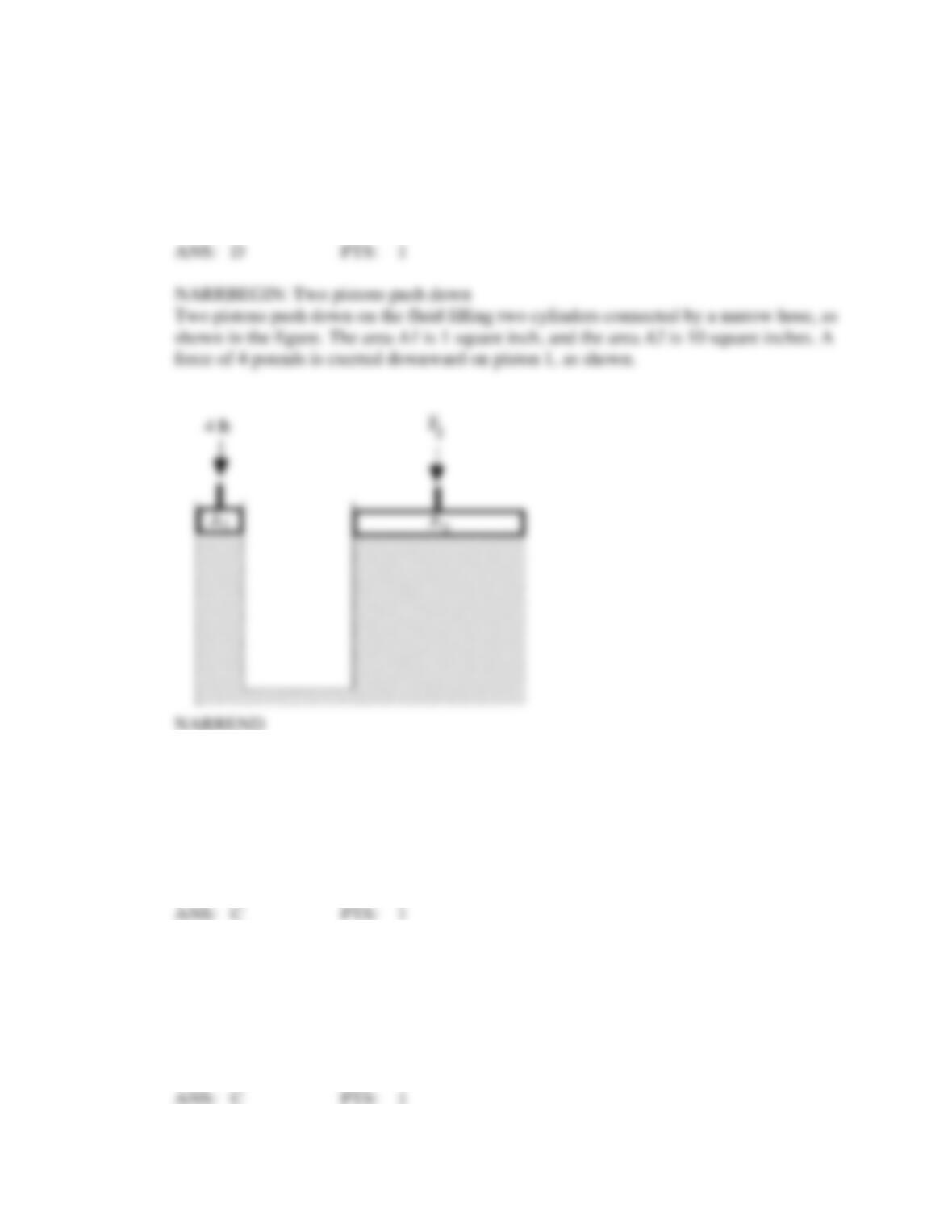
38. The pressure on A1 in psi is
a.
0.25
b.
0.4
c.
4
d.
10
e.
40
39. The pressure on A2 in psi is
a.
0.25
b.
0.4
c.
4
d.
10
e.
40
40. The force F2 in pounds needed to keep piston 2 in place is
a.
0.25
b.
0.4
c.
4
d.
10
e.
40
41. If pressure inside a cylinder with a circular hatch is 2 atm and the radius of the entrance
hatch is 12 inches, what force does the air exert on the hatch ? Recall that the area of a
circle is pr2
a.
24 lb
b.
288 lb
c.
904.8 lb
d.
1,300.6 lb
e.
13,300.6 lb
42. The cabin pressure of a passenger jet cruising at high altitude (30,000 ft) is about 1 atm. and
the pressure outside is about 0.3 atm. What is the outward force on a window measuring 1
foot by 1 foot.
a.
10.3 lb
d.
1,481.8 lb
b.
100.3 lb
e.
2,116.8 lb
c.
1,000.3 lb
43. The absolute pressure is:
a.
the gauge pressure plus 1 atmosphere
b.
the gauge pressure plus the atmospheric pressure
c.
the gauge pressure minus the atmospheric pressure
d.
the atmospheric pressure plus 14.7 psi
44. The hydraulic system in modern aircraft is an example of:
a.
Bernoulli’s principle
c.
Archimedes’ principle
b.
Pascal’s principle
d.
Galileo’s principle
MULTIPLE RESPONSE
1. Normal atmospheric pressure is
a.
14.7 psi
b.
1 N/m2
c.
zero
d.
760 mm of mercury
e.
101,000 pascals
f.
none of the above
2. The nucleus of an atom contains
a.
protons
c.
electrons
b.
neutrons
d.
all of the above
3. The absolute pressure depends on
a.
the weight of the fluid
c.
the cross sectional area
b.
the atmospheric pressure
d.
the gauge pressure
COMPLETION
1. A device that measures absolute air pressure is called a __________.
2. The difference between the pressures inside and outside a tire is called __________.
3. The SI unit of pressure is __________.
4. The four states of matter are __________, __________, __________, and __________.
5. An ionized gas is a state of matter called a __________.
6. The three common phases of matter on earth are ________, ___________, and _______.
7. When a liquid boils and changes to a gas, it is said to have undergone a change of
________.
8. Graphite, diamond and buckminsterfullerene are different forms of the element _______.
9. The upward force exerted by a fluid on an object immersed in it is called __________.
10. When an object floats in a liquid, the buoyant force is __________ the weight of the object.
11. When an object floats in a liquid, the buoyant force is __________ the weight of the liquid
displaced by the object.
12. The buoyant force that keeps a ship afloat is an example of __________ principle.
13. The brakes in a car work because of __________ principle.
14. An atomizer works because of __________ principle.
15. A helium balloon rises because of __________ principle.
16. The mass density of an object equals its _____ divided by its ________.
17. The ratio of the density of a material to the density of water is the __________.
18. The pressure exerted by a gas is the result of __________.
19. Normal atmospheric pressure is about __________.
20. If the outside air pressure decreases, the reading on a tire gauge connected to a tire
__________.
21. Water is flowing through a pipe whose cross sectional area at point A is larger than the cross
sectional area at point B. The reading on a pressure gauge connected to the pipe at point A
will be __________ the reading on a pressure gauge connected to the pipe at point B.
22. The gauge pressure of the water in a swimming pool at 10 ft is __________ the gauge
pressure of the water at 5 ft.
23. The force on your left palm is __________ the force on your right palm.
24. The pressure on your left palm is __________ the pressure on your right palm.
25. A person weighing 200 pounds stands on snowshoes. If the area of each snowshoe is 400
square inches, the pressure on the snow is __________ psi.
26. A tire pressure gauge reads 30 psi when the atmospheric pressure is 14 psi. The net force on
2 square inches of the tire is __________.
27. When a 4 cubic ft block of wood floats in a fluid whose weight density is 60 pounds per
cubic foot, 3/4 of the block’s volume is submerged. The buoyant force on the block is
__________.
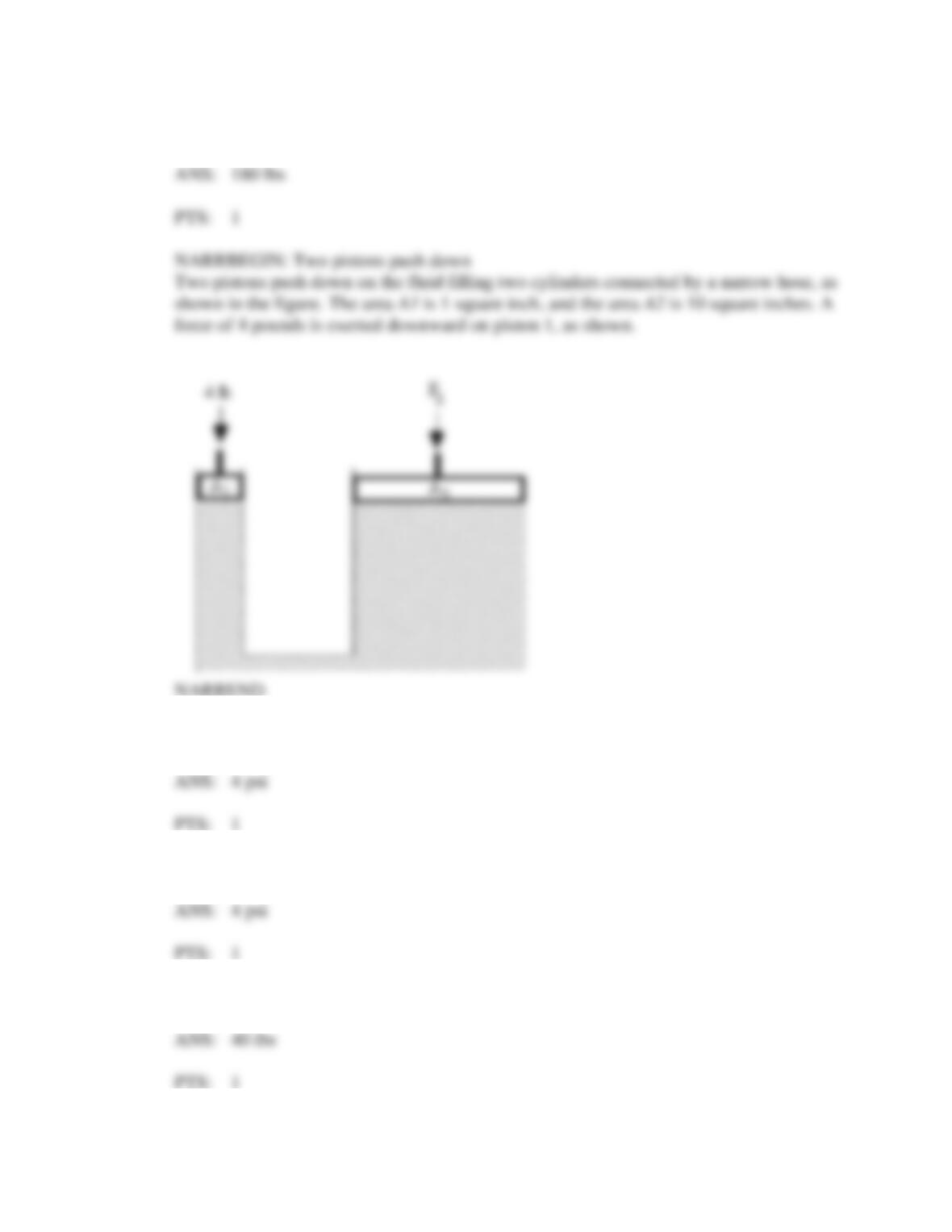
28. The pressure on A1 is __________.
29. The pressure on A2 is __________.
30. The force F2 needed to keep piston 2 in place is __________.
31. As an aircraft gains altitude, the outside air pressure __________ with height.
32. As a pressurized aircraft gains altitude, the difference between the outside air pressure and
the pressure inside the aricraft _____________ with height
33. As a pressurized aircraft gains altitude, the force acting on the boarding door due to the
difference between the outside air pressure and the pressure inside the aircraft
_____________ with height
MATCHING
Match each item with the correct statement below.
a.
absolute pressure
i.
liquid
b.
atom
j.
mixture
c.
atmosphere
k.
molecule
d.
barometer
l.
neutron
e.
buoyant force
m.
plasma
f.
electron
n.
proton
g.
gas
o.
specific gravity
h.
gauge pressure
1. a device that measures air pressure
2. an ionized gas
3. each is composed of two or more atoms
4. the relative pressure between two places
5. a combination of different elements or compounds
6. the upward force exerted by a fluid on anything immersed in it
7. the smallest unit of a chemical element
8. the mass density of a substance divided by the mass density of water
9. particle that orbits the nucleus in an atom
10. a unit of measure for pressure
11. a constituent part of the nucleus of an atom
PROBLEM
1. A person weighing 180 pounds stands on snowshoes. If the total area of the 2 snowshoes is
900 square inches, what is the pressure on the snow?
2. The gauge pressure inside a pressure cooker is 13 psi. What is the net force on the lid of the
pressure cooker if the lid’s area is 110 square inches?
3. A rock brought back from the moon weighs 4 pounds and has a volume of 0.02 cubic feet.
What is the rock’s weight density?
4. A rectangular stack of lead bricks measures 2 m by 3 m by 4 m. The mass density of lead is
11,340 kilograms per cubic meter. What is the total mass of the stack of lead?
5. A submarine dives to a depth of 50 meters in the ocean.
(a) What is the gauge pressure at this depth?
(b) What is the force acting on a hatch that has an area of 2.5 square meters?
6. The body of a swimmer occupies a volume of 2 cubic feet. What is the buoyant force when
the swimmer is immersed in water? (The weight density of water is 62.4 pounds per cubic
foot.)
7. A gold brick measuring 0.25 ft by 0.33 ft by 1 ft is submerged in water. The weight density
of gold is 1,200 pounds per cubic foot and the weight density of water is 62.4 pounds per
cubic foot.
(a) What is the weight of the gold brick?
(b) What is the buoyant force on the gold brick?
(c) What is the net force on the gold brick?
8. The cabin pressure of a passenger jet cruising at high altitude (30,000 ft) is about 1 atm. and
the pressure outside is about 0.3 atm. What is the outward force acting on a door measuring
1 meter by 2 meters? (Hint: convert metric to English units in this problem using the
conversion factor m2 to ft2 in the Table of Conversion Factors)