
27)
Each of the following statements concerning the gram–positive cell wall is true EXCEPT
27)
A)
it protects the cell in a hypertonic environment.
B)
it is sensitive to lysozyme.
C)
it maintains the shape of the cell.
D)
it is sensitive to penicillin.
E)
it contains teichoic acids.
28)
Which of the following organelles most closely resembles a prokaryotic cell?
28)
A)
mitochondrion
B)
cell wall
C)
Golgi complex
D)
vacuole
E)
nucleus
29)
Which of the following statements is TRUE?
29)
A)
A cell can produce many endospores.
B)
Endospores allow a cell to survive environmental changes.
C)
A cell produces one endospore and keeps growing.
D)
Endospores are for reproduction.
E)
Endospores are easily stained in a Gram stain.
30)
Which of the following pairs is mismatched?
30)
A)
mitochondria ATP production
B)
lysosome digestive enzymes
C)
Golgi complex secretion
D)
centrosome food storage
E)
endoplasmic reticulum internal transport
31)
Bacteria are a commonly used organism for studies of genetic material in the research laboratory.
The nucleic acids must first be isolated from the cells for these studies. Which of the following
would most likely be used to lyse the bacterial cells for nucleic acid isolation?
31)
A)
alcohol
B)
mycolic acid
C)
polymixins
D)
lysozyme
E)
water
32)
You have isolated a motile, gram–positive cell with no visible nucleus. You can safely assume that
the cell
32)
A)
has 9 pairs + 2 flagella.
B)
lives in an extreme environment.
C)
has a mitochondrion.
D)
has a cell wall.
E)
has cilia.
33)
Which of the following are NOT energy reserves?
33)
A)
sulfur granules
B)
carboxysomes
C)
polysaccharide granules
D)
lipid inclusions
E)
metachromatic granules

34)
Oxygen crosses a plasma membrane
34)
A)
through simple diffusion.
B)
with the help of a nonspecific transporter.
C)
by osmosis.
D)
through facilitated diffusion.
E)
through porins.
35)
Which of the following is NOT found in mitochondria and prokaryotes?
35)
A)
ATP–generating mechanism
B)
binary fission
C)
cell wall
D)
70S ribosomes
E)
circular chromosome
36)
Fimbriae and pili differ in that
36)
A)
there are only one or two pili per cell.
B)
pili are used for motility.
C)
pili are used to transfer DNA.
D)
pili are used for transfer of DNA and motility.
E)
pili are used for attachment to surfaces.
37)
Which of the following is NOT a typical characteristic of most bacterial plasma membranes?
37)
A)
contains cholesterol
B)
contains proteins
C)
composed of a phospholipid bilayer
D)
site of energy production
E)
is selectively permeable
38)
Which of the following have a cell wall?
38)
A)
animal cells
B)
mycoplasmas
C)
L forms
D)
protoplasts
E)
fungi
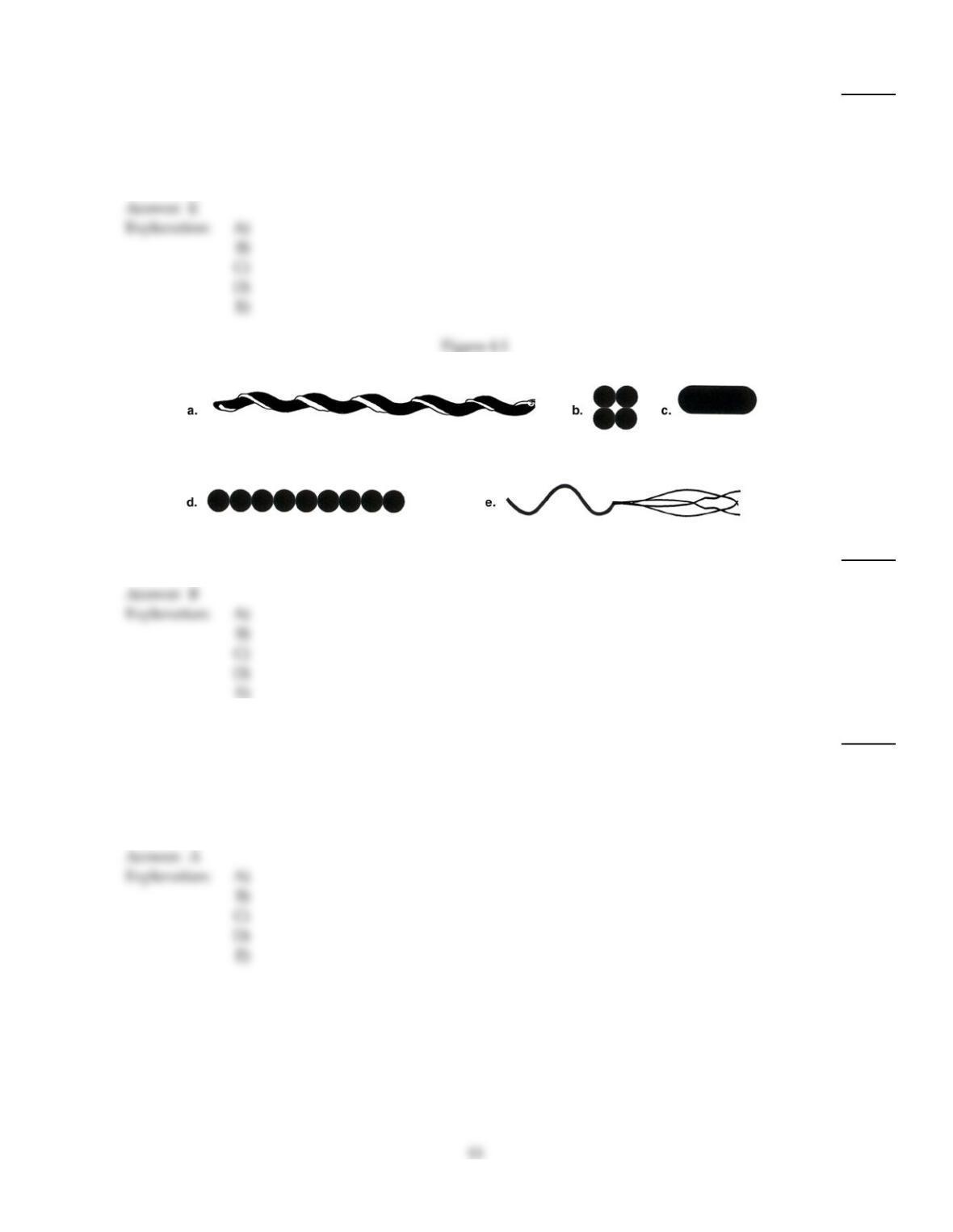
39)
Which drawing in Figure 4.1 is a tetrad?
39)
A)
a
B)
b
C)
c
D)
d
E)
e
40)
Which structure acts like an “invisibility cloak” and protects bacteria from being phagocytized?
40)
A)
capsule
B)
cell wall
C)
fimbriae
D)
slime layer
E)
cell membrane
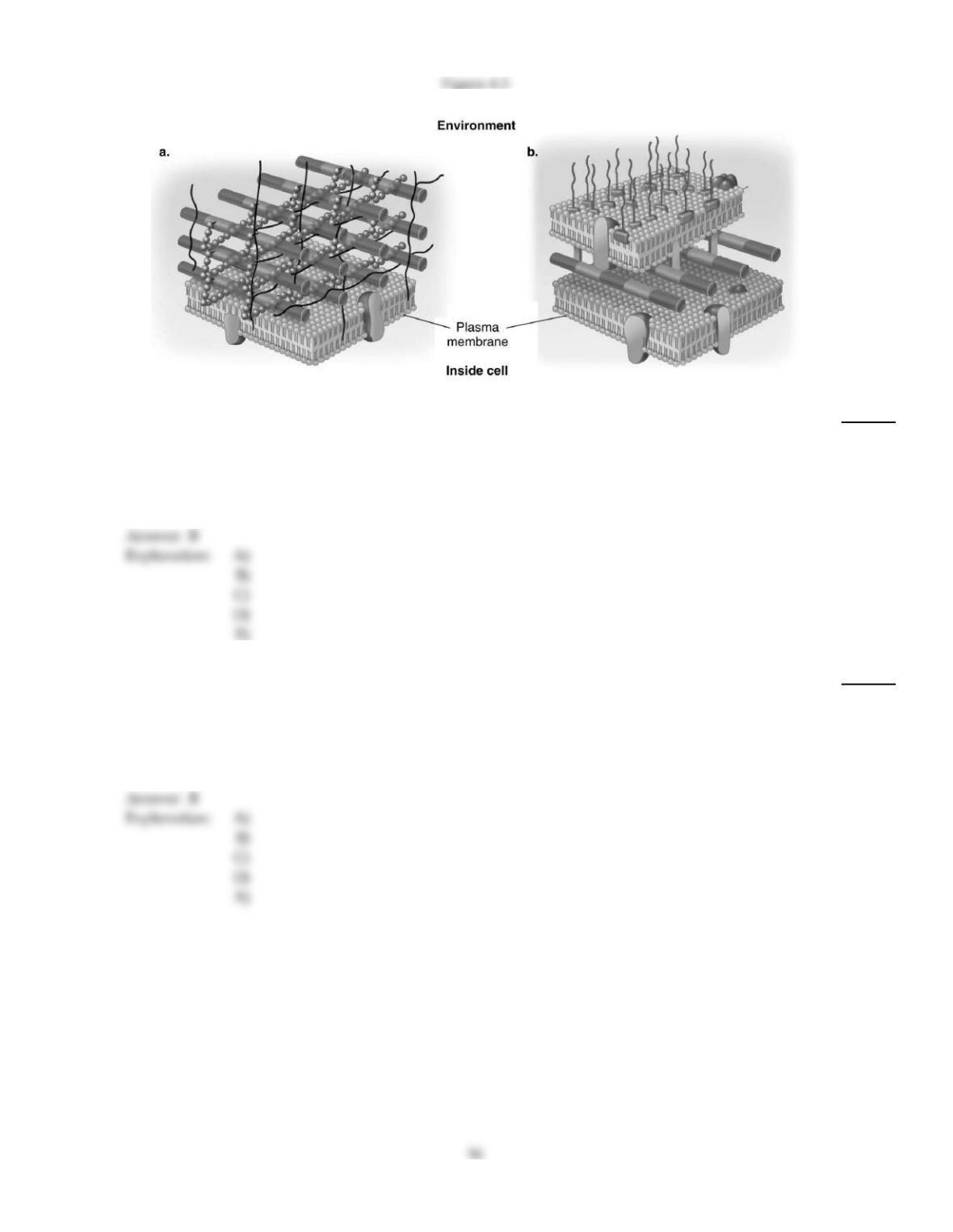
41)
In Figure 4.3, which diagram of a cell wall is decolorized by alcohol?
41)
A)
a
B)
b
C)
both a and b
D)
neither a nor b
E)
The answer cannot be determined based on the information provided.
B
42)
The difference between simple diffusion and facilitated diffusion is that facilitated diffusion
42)
A)
moves materials from a lower to a higher concentration.
B)
requires transporter proteins.
C)
requires ATP.
D)
does not require ATP.
E)
moves materials from a higher to a lower concentration.
B
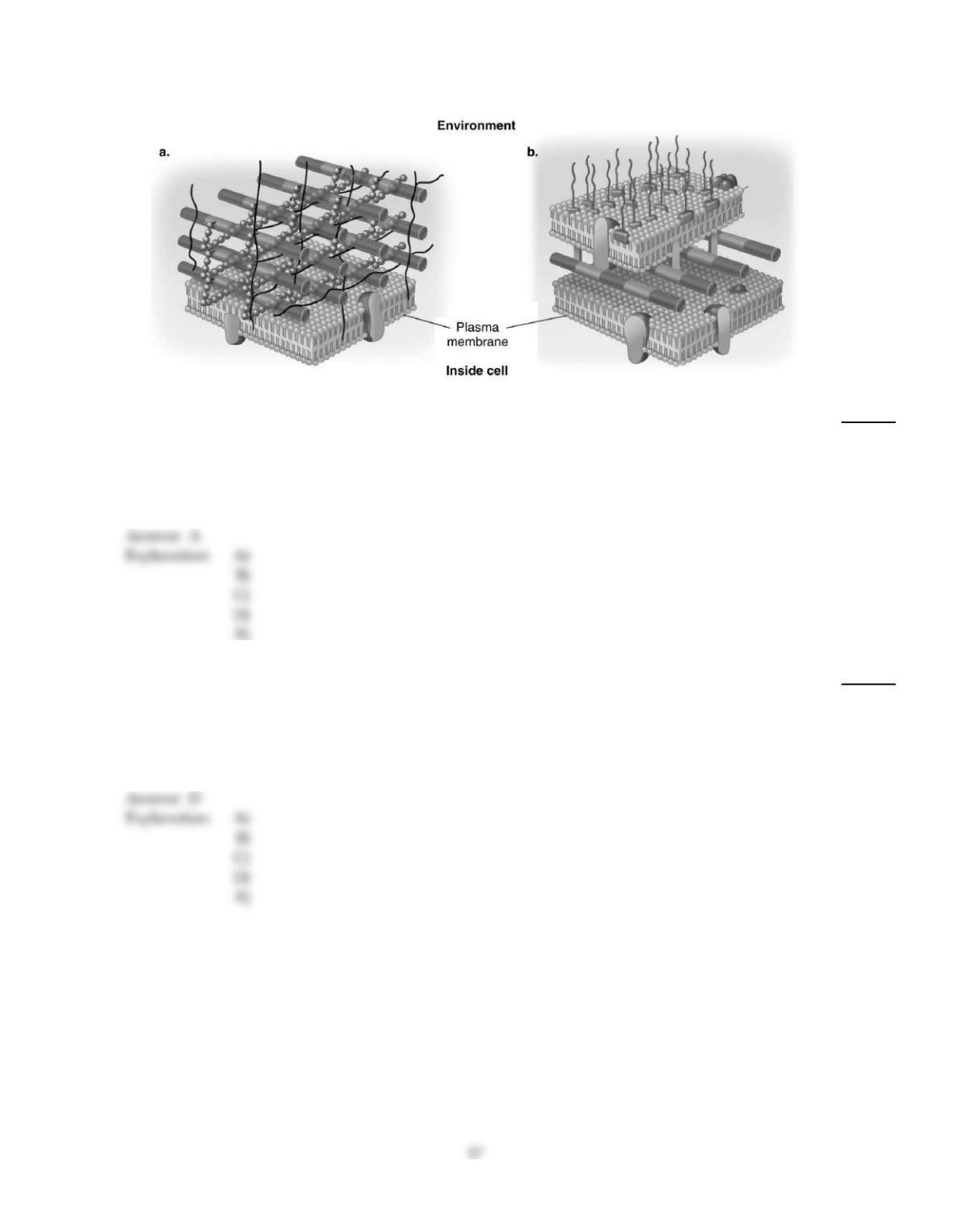
Figure 4.3
43)
In Figure 4.3, which diagram of a cell wall contains teichoic acids?
43)
A)
a
B)
b
C)
both a and b
D)
neither a nor b
E)
The answer cannot be determined based on the information provided.
44)
Functions of the glycocalyx include all of the following EXCEPT
44)
A)
biofilm formation.
B)
source of nutrition.
C)
increased virulence.
D)
binary fission.
E)
protection against dehydration.
D
A
45)
A gram–positive bacteria suddenly acquires resistance to the antibiotic methicillin. This trait most
likely occurred due to
45)
A)
meisosis.
B)
conjugation.
C)
binary fission.
D)
transformation.
E)
transduction.
TRUE/FALSE. Write ‘T’ if the statement is true and ‘F’ if the statement is false.
46)
Many enzymes in both prokaryotic and eukaryotic cells are compartmentalized within organelles.
46)
47)
Spheroplasts, protoplasts, and mycoplasms are bacterial cells without cell walls.
47)
48)
Cells placed in a hypotonic solution tend to lose water due to osmotic pressure.
48)
49)
If you observe rod–shaped red cells after the Gram stain, you can assume their cell walls contain
endotoxin.
49)
50)
The cell walls of bacteria are responsible for the shape of the bacteria and the difference in the
Gram stain reaction.
50)
51)
Antibiotics that target the cell wall are an effective treatment against many pathogenic bacteria.
51)
52)
The number of organelles such as chloroplasts, mitochondria, and rough endoplasmic reticulum is
the same in all eukaryotic cells.
52)
53)
The internal structure of eukaryotic cilia and flagella are the same.
53)

54)
Small, hydrophobic molecules pass through a cell membrane most easily by diffusion.
54)
55)
Endospores are a reproductive structure.
55)
ESSAY. Write your answer in the space provided or on a separate sheet of paper.
56)
Compare and contrast the characteristics of a typical prokaryotic and eukaryotic cell.
57)
Provide evidence to substantiate the hypothesis that eukaryotic cells evolved from prokaryotic cells.
58)
Compare and contrast gram–positive and gram–negative cell walls with regard to (a) sensitivity to
antimicrobial agents, (b) resistance to phagocytosis, (c) chemical composition, and (d) decolorization by alcohol.
59)
What is a biofilm and what role does biofilm play in disease?
Answer Key
Testname: C4
20

Answer Key
Testname: C4