Exam
Name___________________________________
MULTIPLE CHOICE. Choose the one alternative that best completes the statement or answers the question.
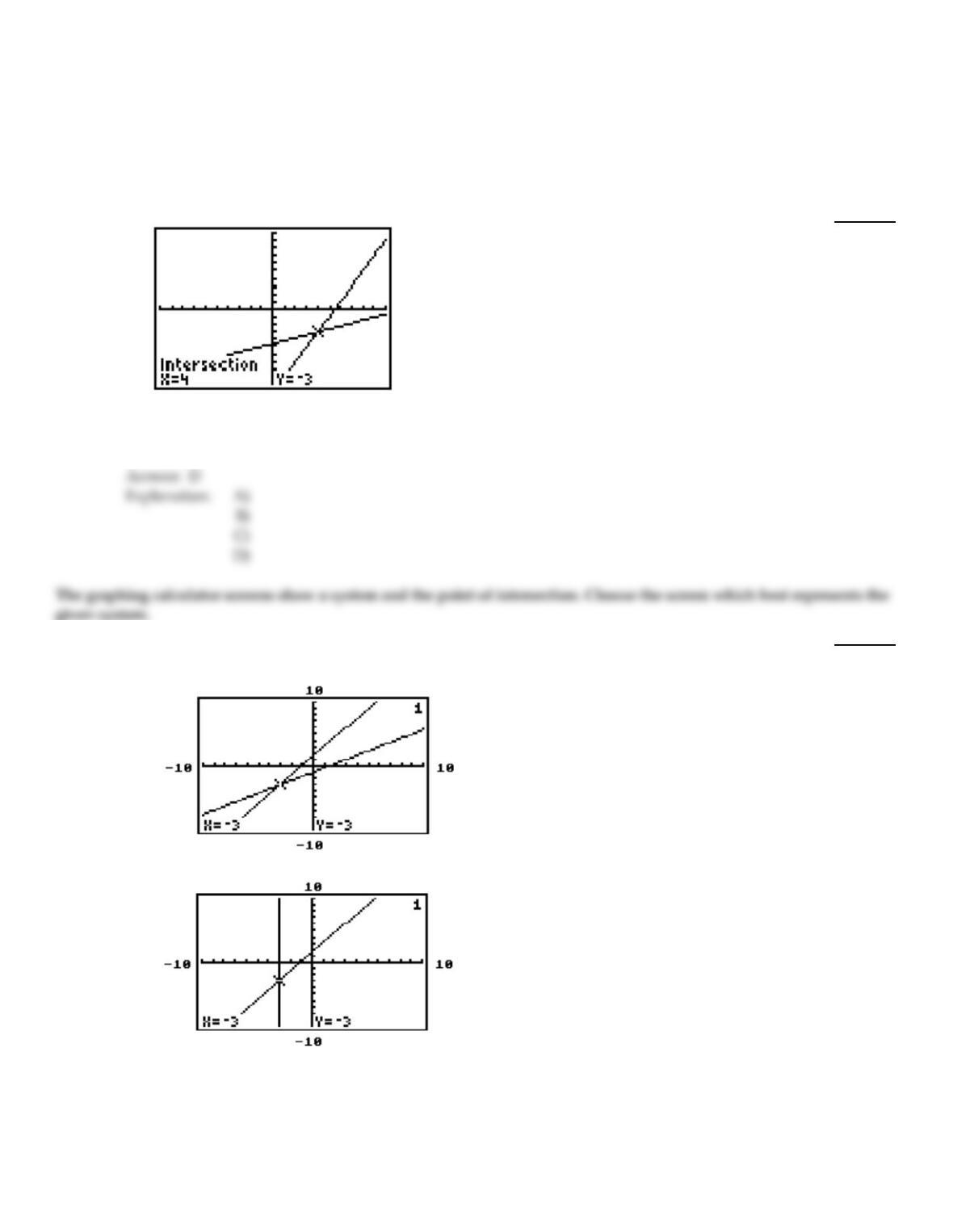
Find the equations of the system shown on the graphing calculator screen.
1)
10
–10 10
–10
1)
A)
x + y = 1
x – 3y = –9
B)
3x – y = 9
5x + y = 7
C)
y = 2x + 1
y = –0.3x – 5.9
D)
y = 0.4x – 4.6
y = 2x – 11
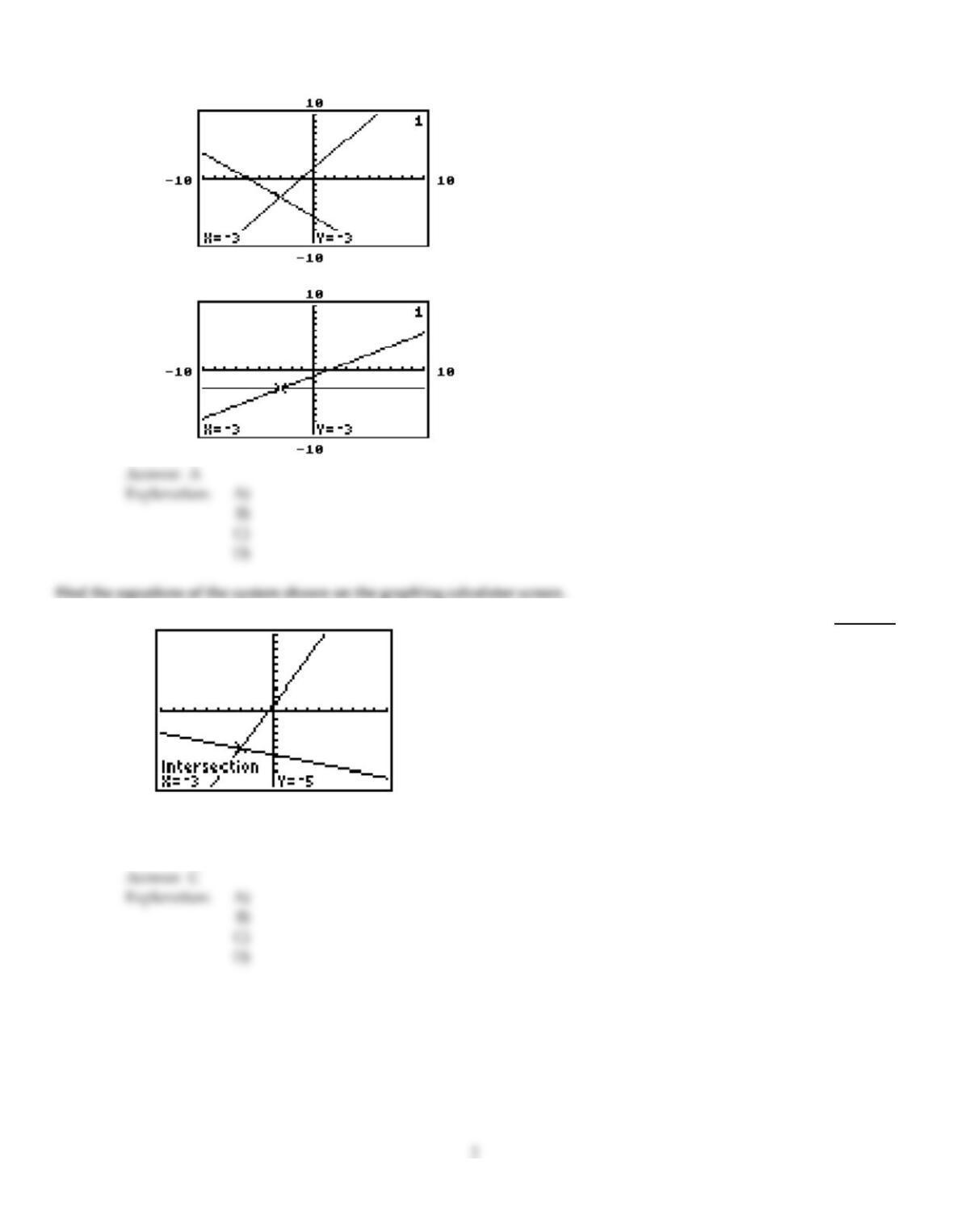
2)
2x – 3y = 3
3x – 2y + 3 = 0
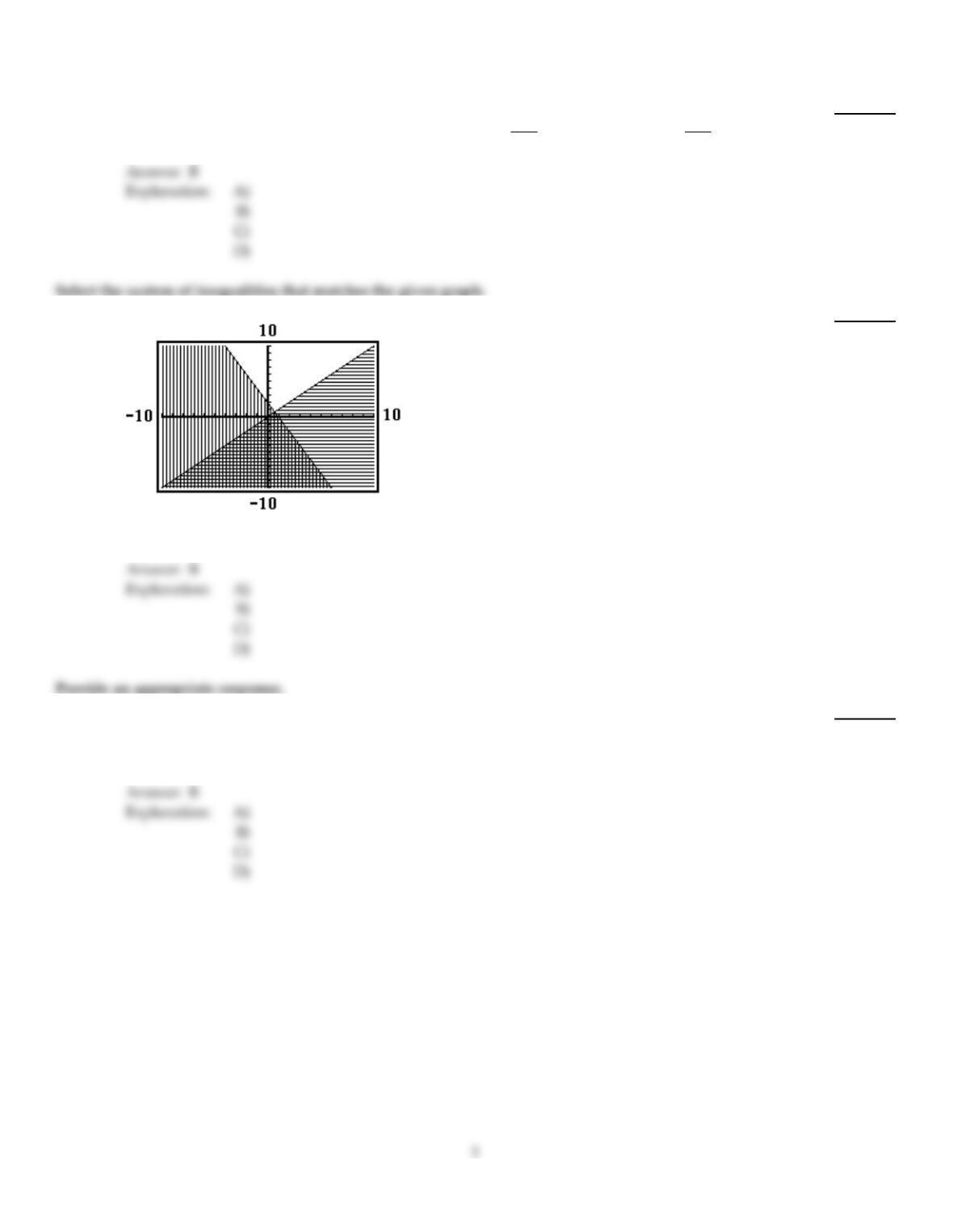
2)
A)
B)
1
C)
D)
3)
10
–10 10
–10
3)
A)
y = 0.4x – 4.6
y = –0.3x – 5.9
B)
y = 2x – 1
y = 0.3x – 5.9
C)
y = 2x + 1
y = –0.3x – 5.9
D)
x + y = 1
x – 3y = –9
Choose the correct response.
4)
Which expression represents the monetary value of x 100–dollar bills?
4)
A)
100+ x dollars
B)
100x dollars
C)
x
100 dollars
D)
100
x dollars
5)
5)
A)
y x
y –2x + 2
B)
y x
y –2x + 2
C)
y x
y –2x + 2
D)
y x
y –2x + 2
6)
Without actually graphing, determine which one of the following systems of inequalities has no
solution.
6)
A)
x 2
y 3
B)
x + y <2
x + y >3
C)
x >2
y<3
D)
x + y 2
x – y 3
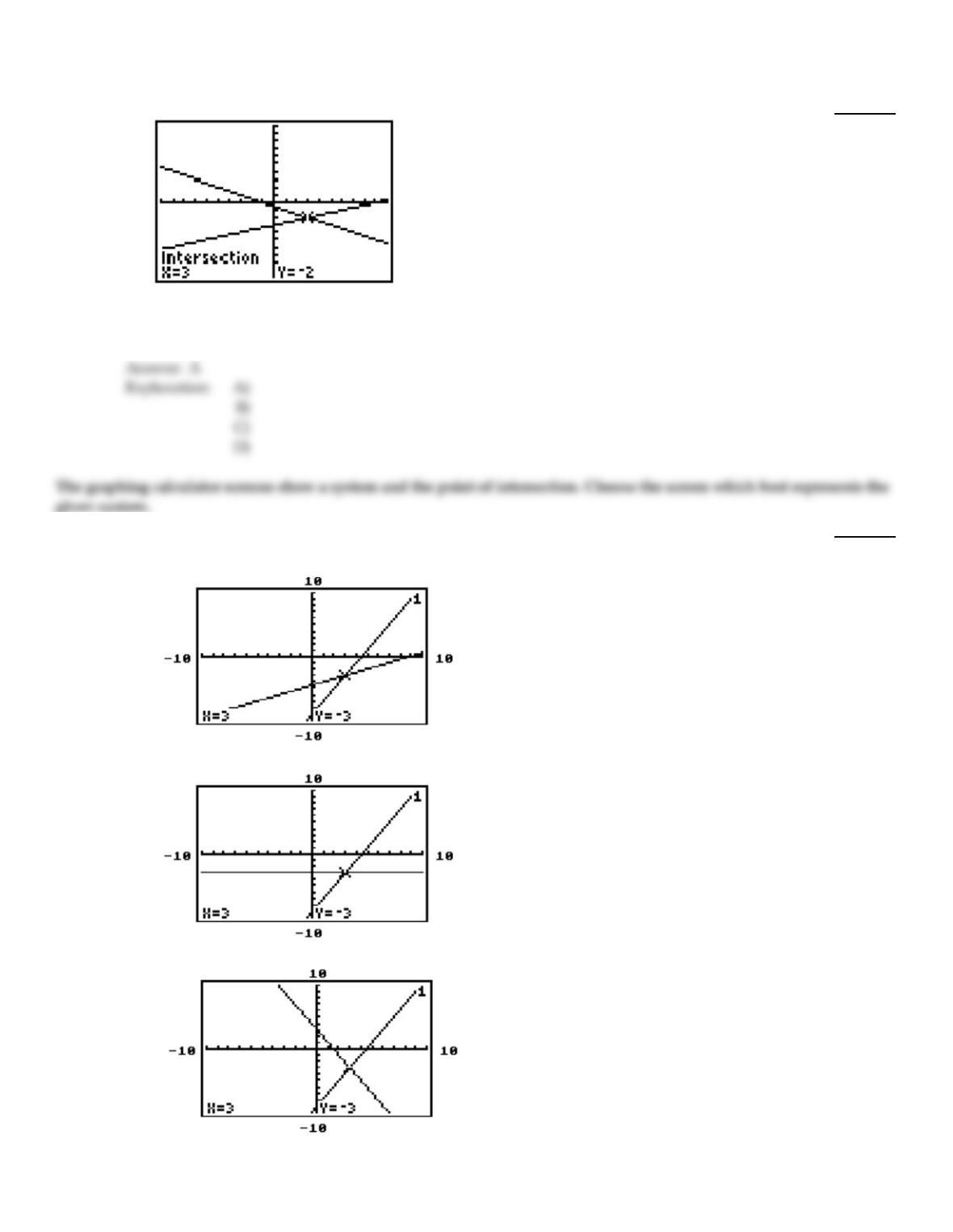
Find the equations of the system shown on the graphing calculator screen.
7)
10
–10 10
–10
7)
A)
x – 3y = 9
x + 2y = –1
B)
x + y = 1
x – 3y = –9
C)
3x – y = 9
5x + y = 7
D)
5x + y = 7
x + 2y = –1
8)
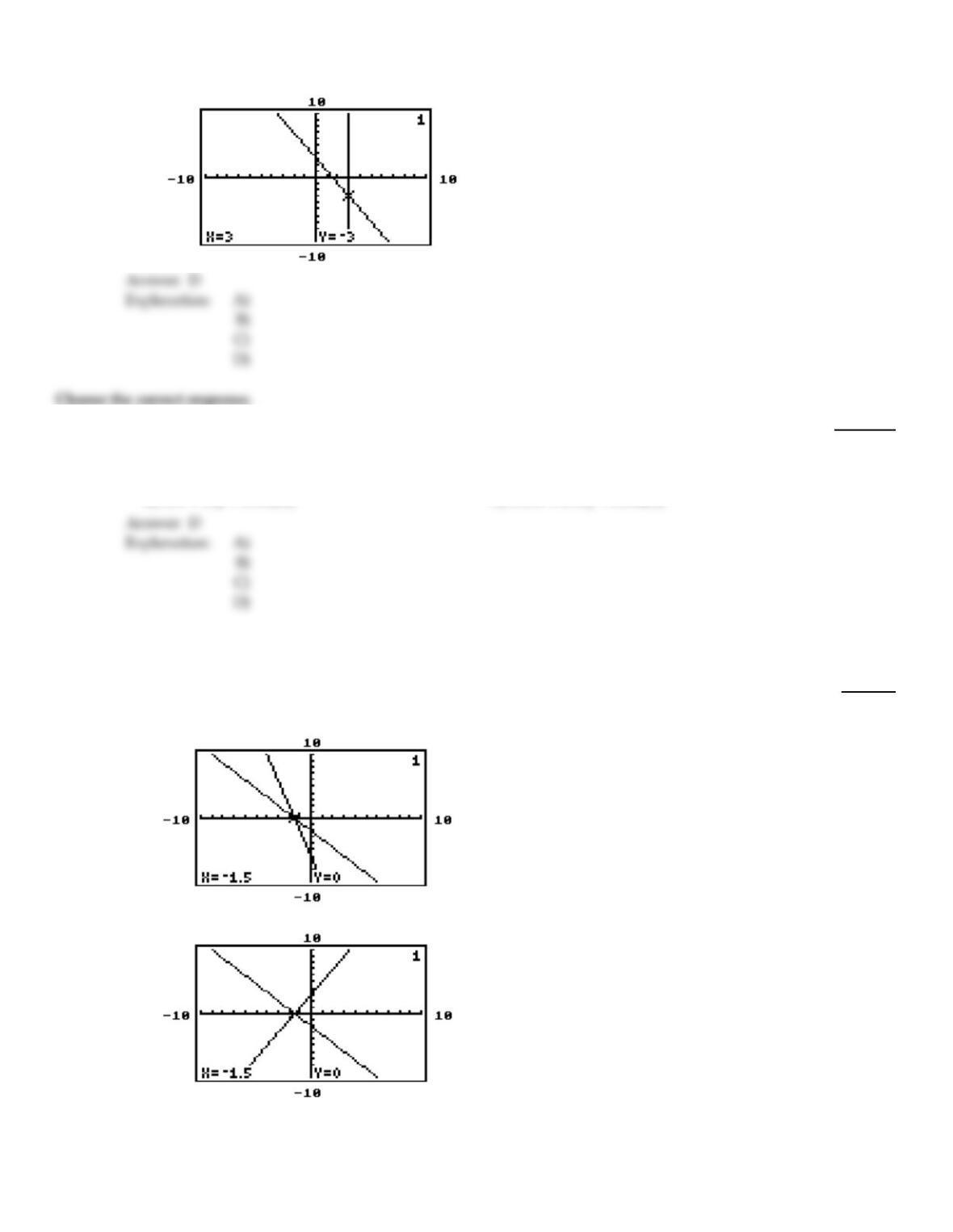
x = 3
2x + y = 3
8)
A)
B)
C)
4
D)
9)
Suppose that x ounces of a 25% acid solution are mixed with y ounces of a 35% solution to obtain 63
ounces of a 32% solution. One equation in a system for solving this problem is x + y =63. Which of
the following is the other equation?
9)
A)
0.35x + 0.25y = 0.32(63)
B)
35x + 25y = 32
C)
25x + 35y = 0.32(63)
D)
0.25x + 0.35y = 0.32(63)
D
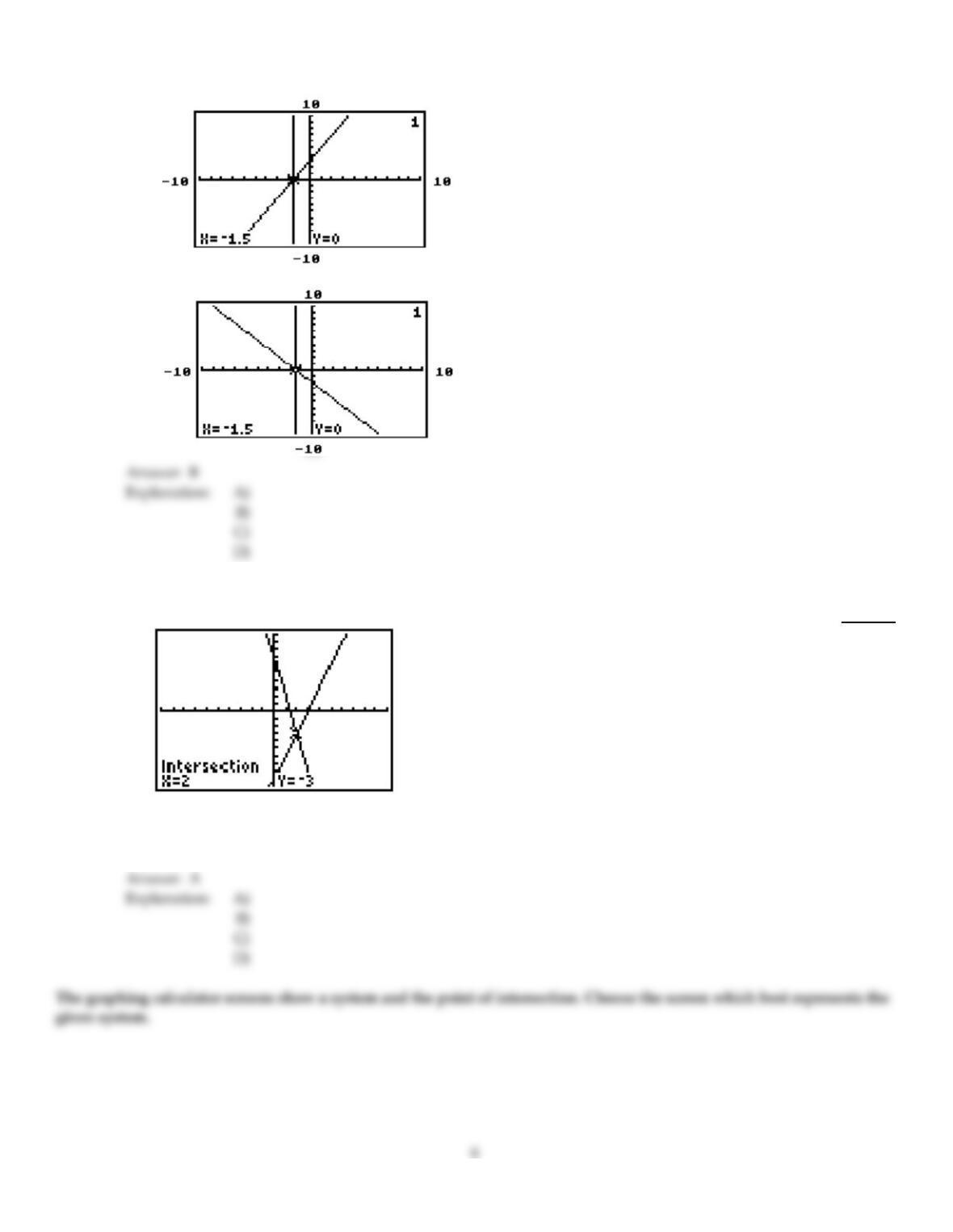
The graphing calculator screens show a system and the point of intersection. Choose the screen which best represents the
given system.
10)
y = 2x + 3
4x + 3y = –6
10)
A)
B)
5
D
C)
D)
Find the equations of the system shown on the graphing calculator screen.
11)
10
–10 10
–10
11)
A)
3x – y = 9
5x + y = 7
B)
5x + y = 7
x + 2y = –1
C)
3x + y = 9
5x – y = 7
D)
x + y = 1
x – 3y = –9
12)
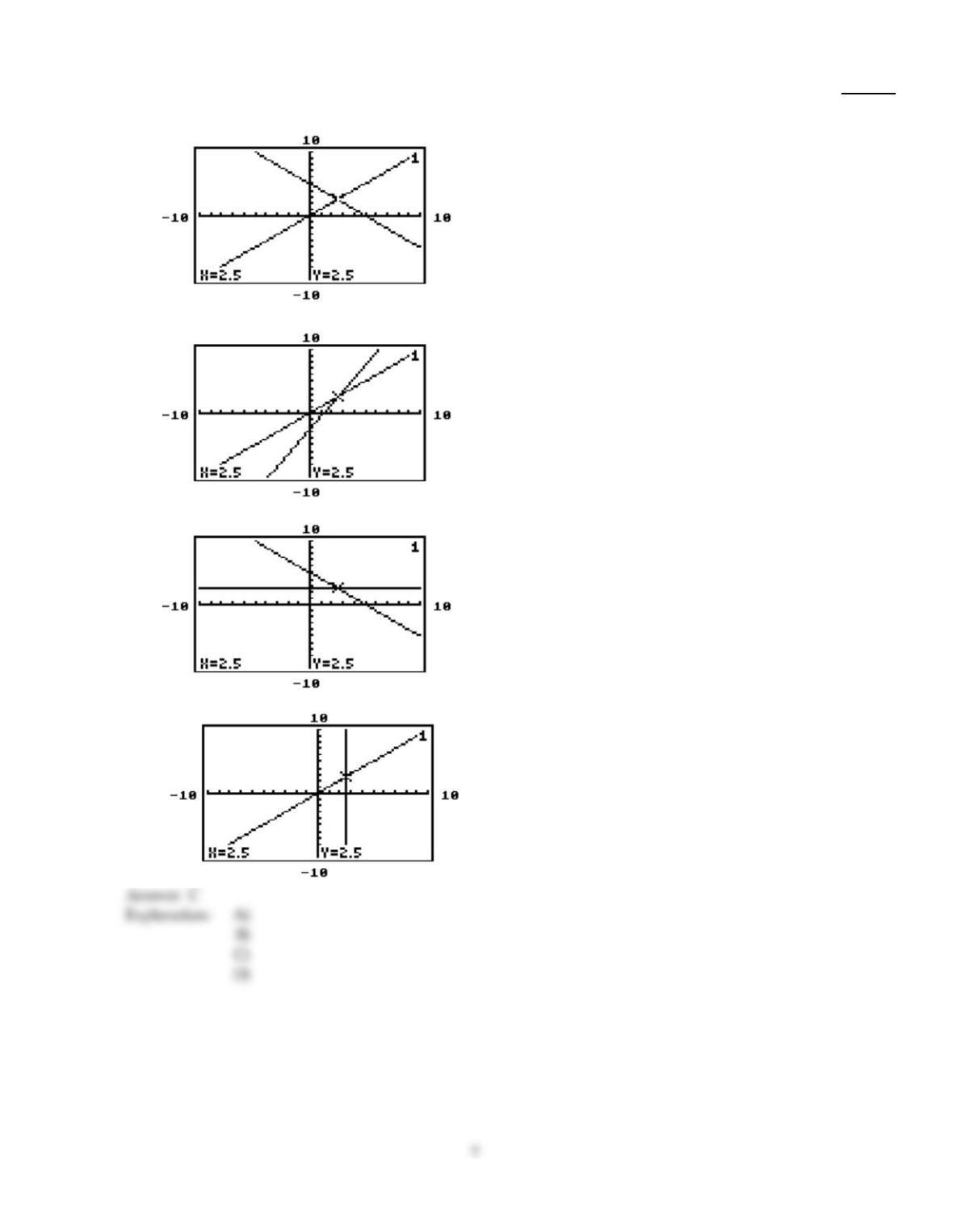
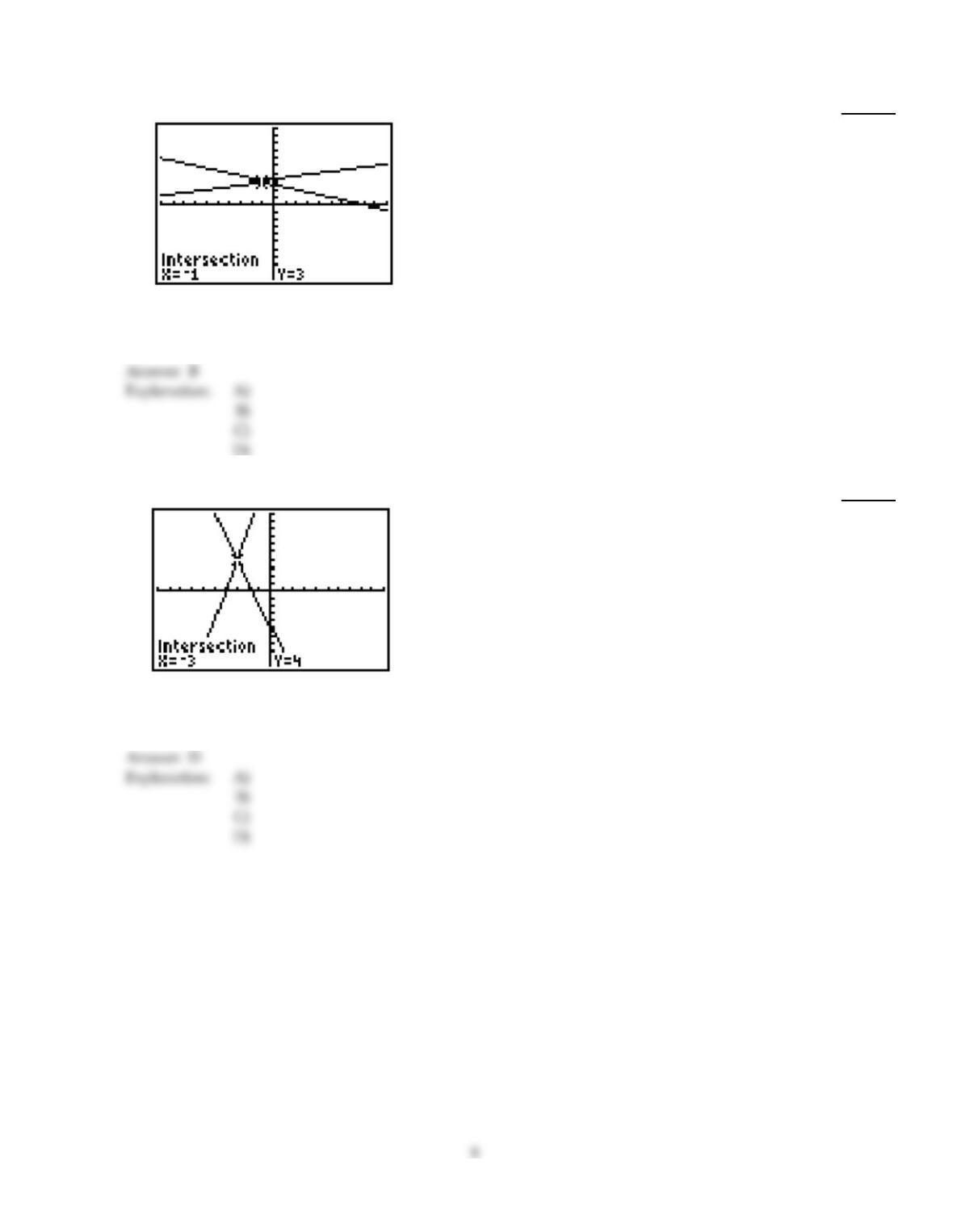
y = 2.5
x + y = 5
12)
A)
B)
C)
D)
Find the equations of the system shown on the graphing calculator screen.
13)
10
–10 10
–10
13)
A)
5x – y = 20
2x + y = 1
B)
x – 5y = –16
x + 3y = 8
C)
y = 2x + 1
y = –0.3x – 5.9
D)
x + y = 1
x – 3y = –9
14)
10
–10 10
–10
14)
A)
x + y = 1
x – 3y = –9
B)
5x + y = 7
x + 2y = –1
C)
3x – y = 9
5x + y = 7
D)
4x – y = –16
3x + y = –5
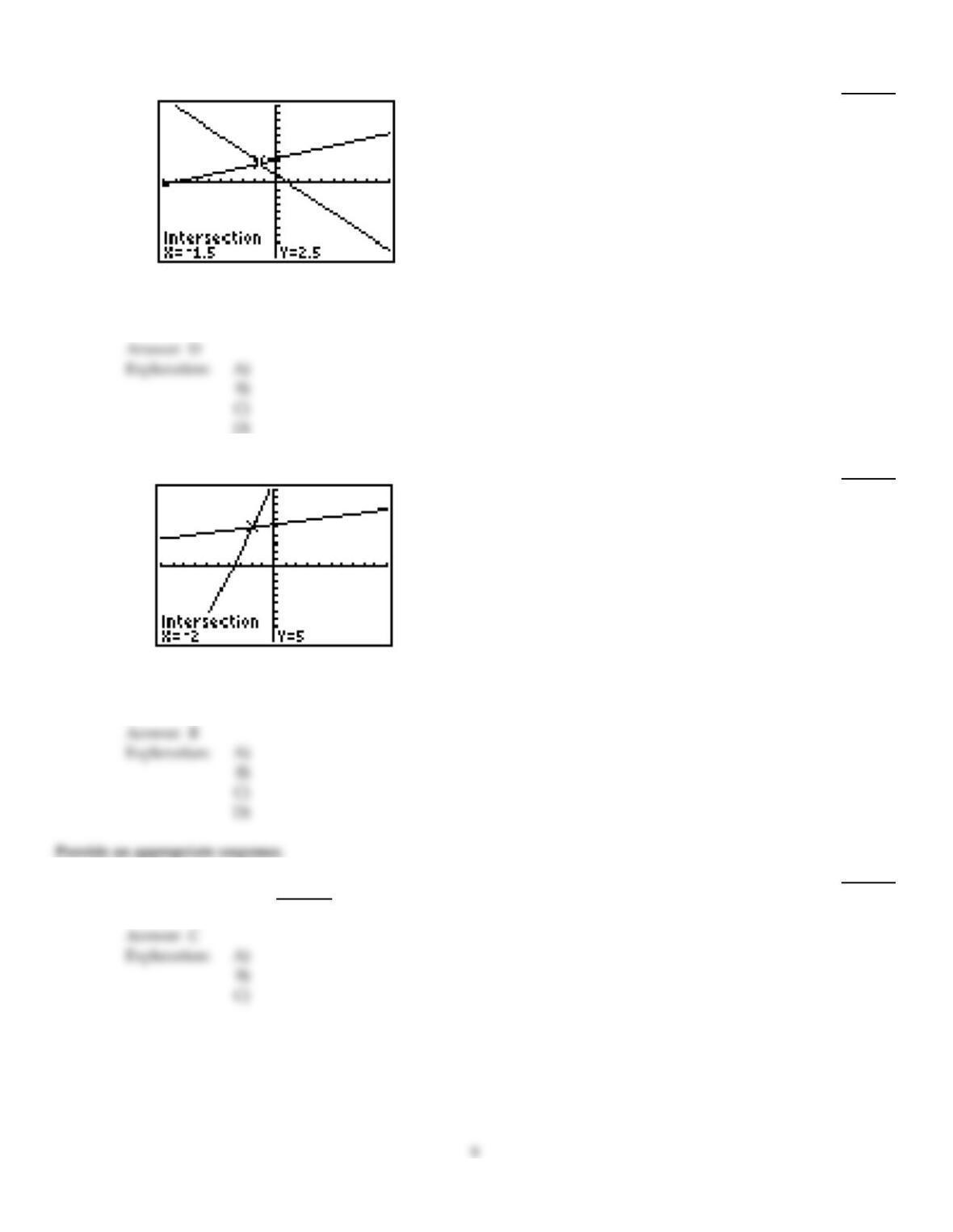
15)
10
–10 10
–10
15)
A)
5x + y = 20
2x – y = 1
B)
x + y = –1
x + 3y = –9
C)
y = 2x + 1
y = –0.3x – 5.9
D)
x + y = 1
x – 3y = –9
16)
10
–10 10
–10
16)
A)
x + y = 1
x – 3y = –9
B)
y = 0.2x + 5.4
y = 3x + 11
C)
y = 2x + 1
y = –0.3x – 5.9
D)
y = 0.4x – 4.6
y = –0.3x – 5.9
17)
When two linear equations are solved for y and the slopes are equal and the y–intercepts are
different, the lines are ?
17)
A)
One Graph
B)
Intersecting
C)
Parallel
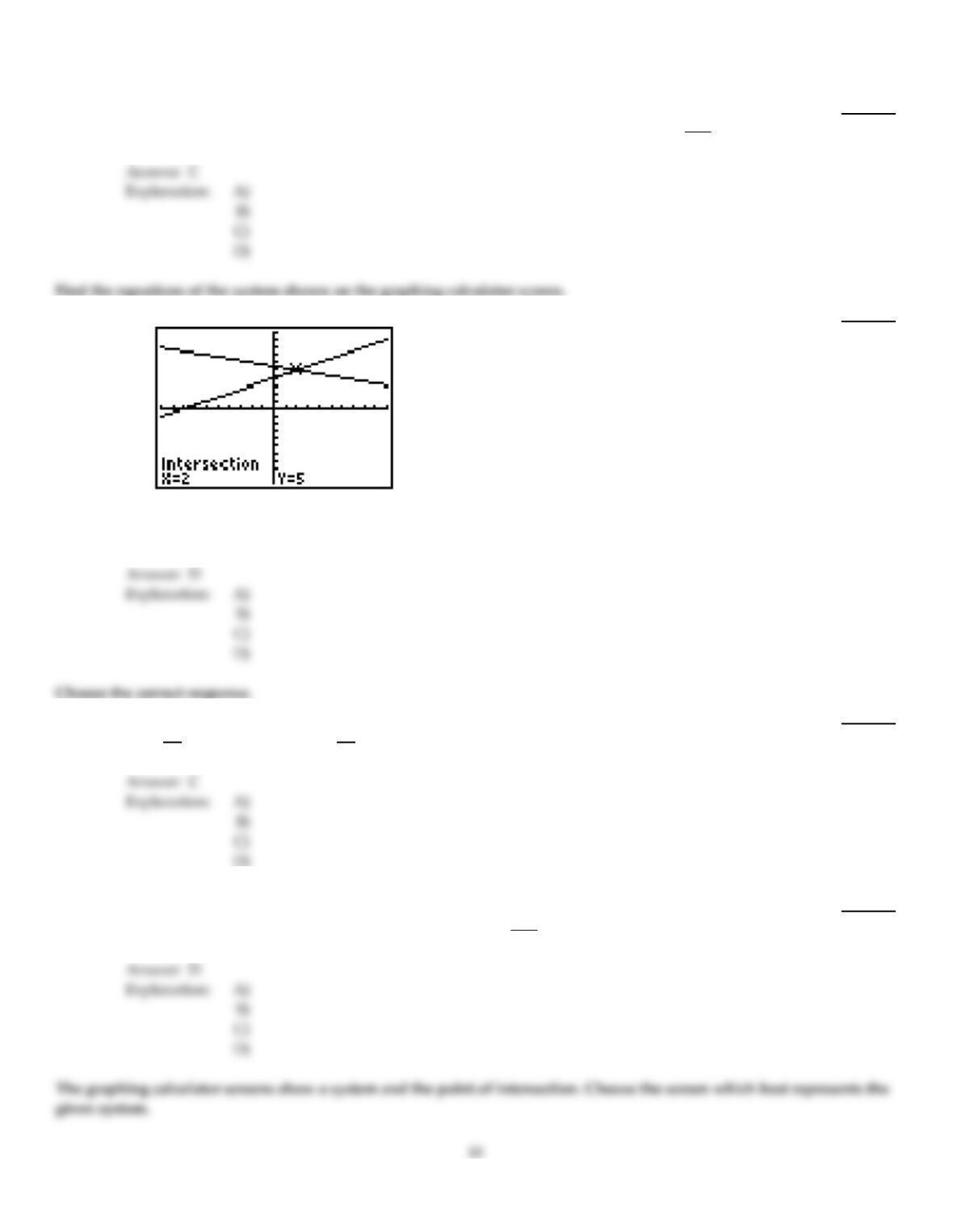
Choose the correct response.
18)
What is the speed of a plane that travels at a rate of 568 mph with a wind of r mph?
18)
A)
(568) – r mph
B)
(r –568) mph
C)
(568) + r mph
D)
568
r mph
19)
10
–10 10
–10
19)
A)
y = 2x + 1
y = –0.3x – 5.9
B)
x + y = 1
x – 3y = –9
C)
5x + y = 20
2x – y = 1
D)
x + 4y = 22
x – 2y = –8
Choose the correct response.
20)
If an animal runs for x hours at 10 mph, how many miles does this animal cover?
20)
A)
x
10 miles
B)
10
x miles
C)
10x miles
D)
10 + x miles
21)
What is the speed of a plane that travels at a rate of 523 mph against a wind of r mph?
21)
A)
(r –523) mph
B)
(523+ r) mph
C)
523
r mph
D)
(523– r) mph
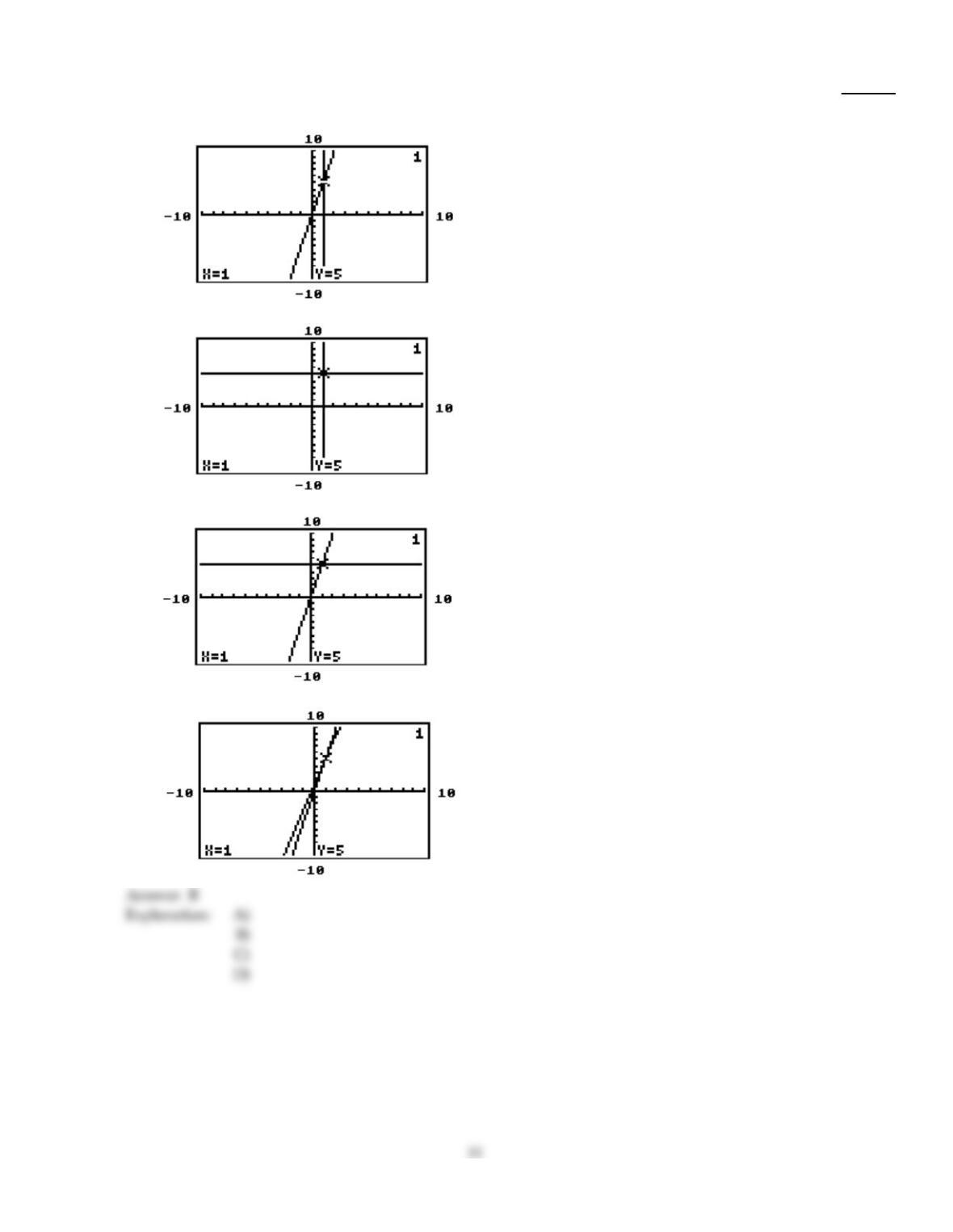
22)
x = 1
y = 5
22)
A)
B)
C)
D)
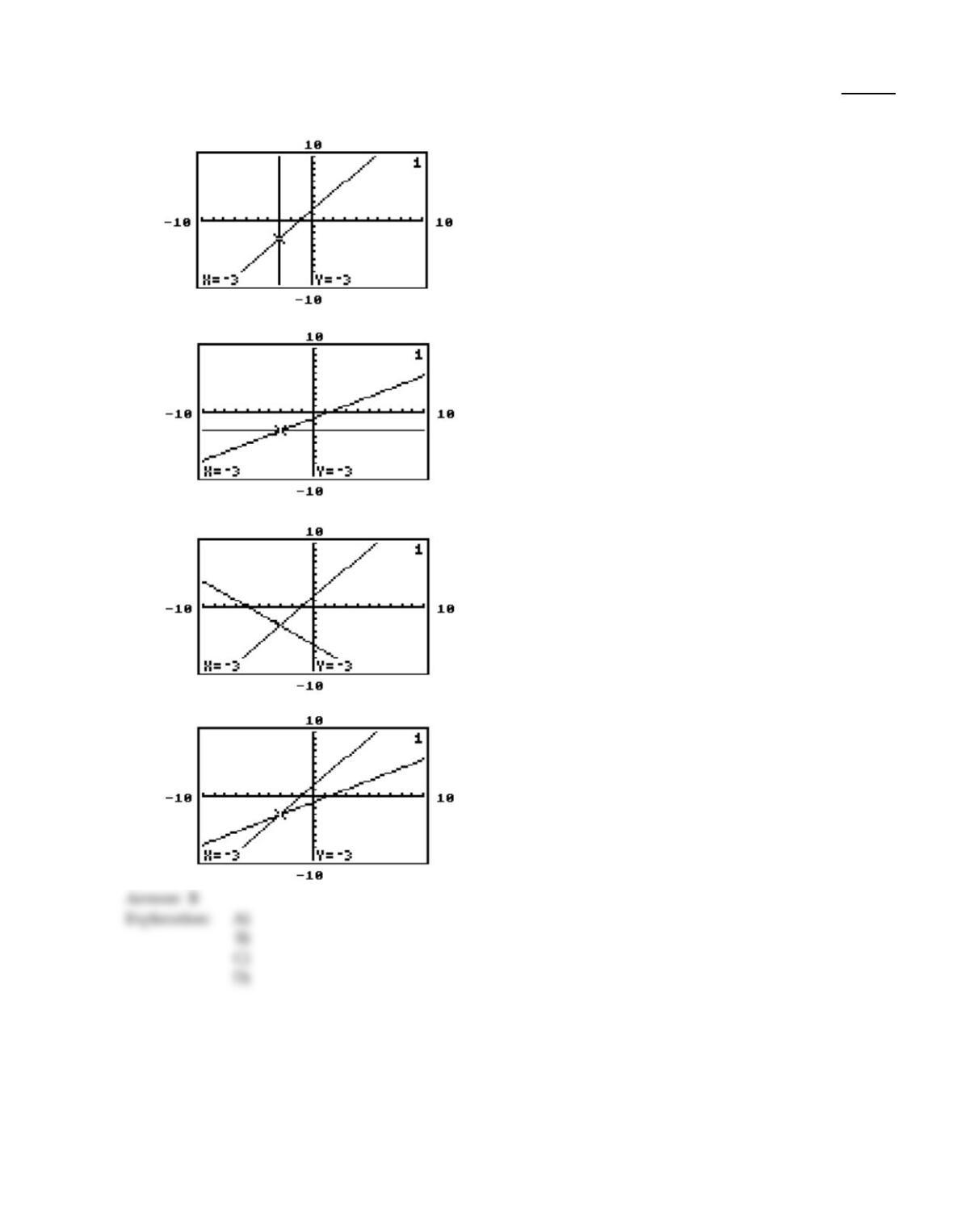
23)
3y + 3 = 2x
y = –3
23)
A)
B)
C)
D)
12
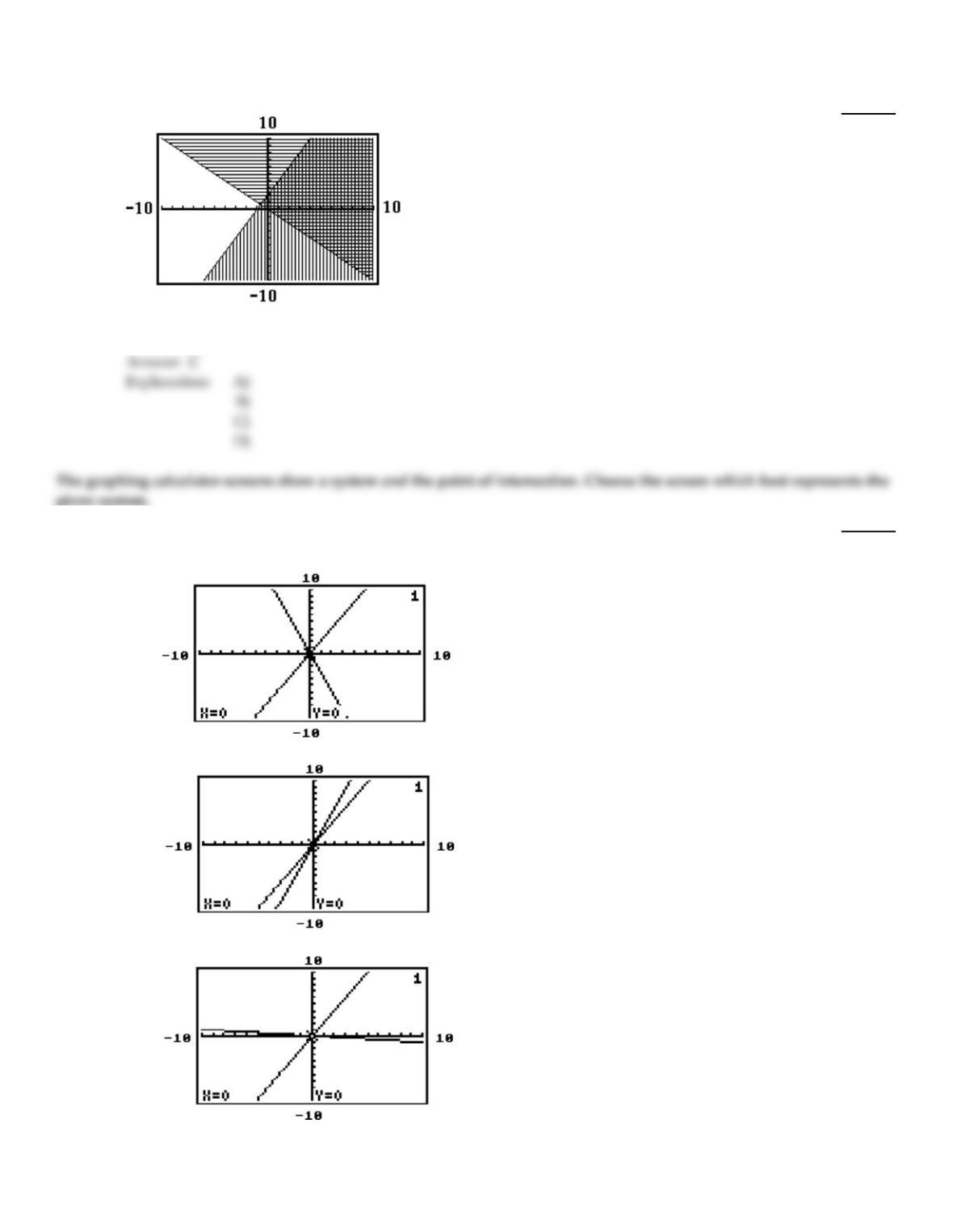
Select the system of inequalities that matches the given graph.
24)
24)
A)
y –x
y 2x + 2
B)
y –x
y 2x + 2
C)
y –x
y 2x + 2
D)
y –x
y 2x + 2
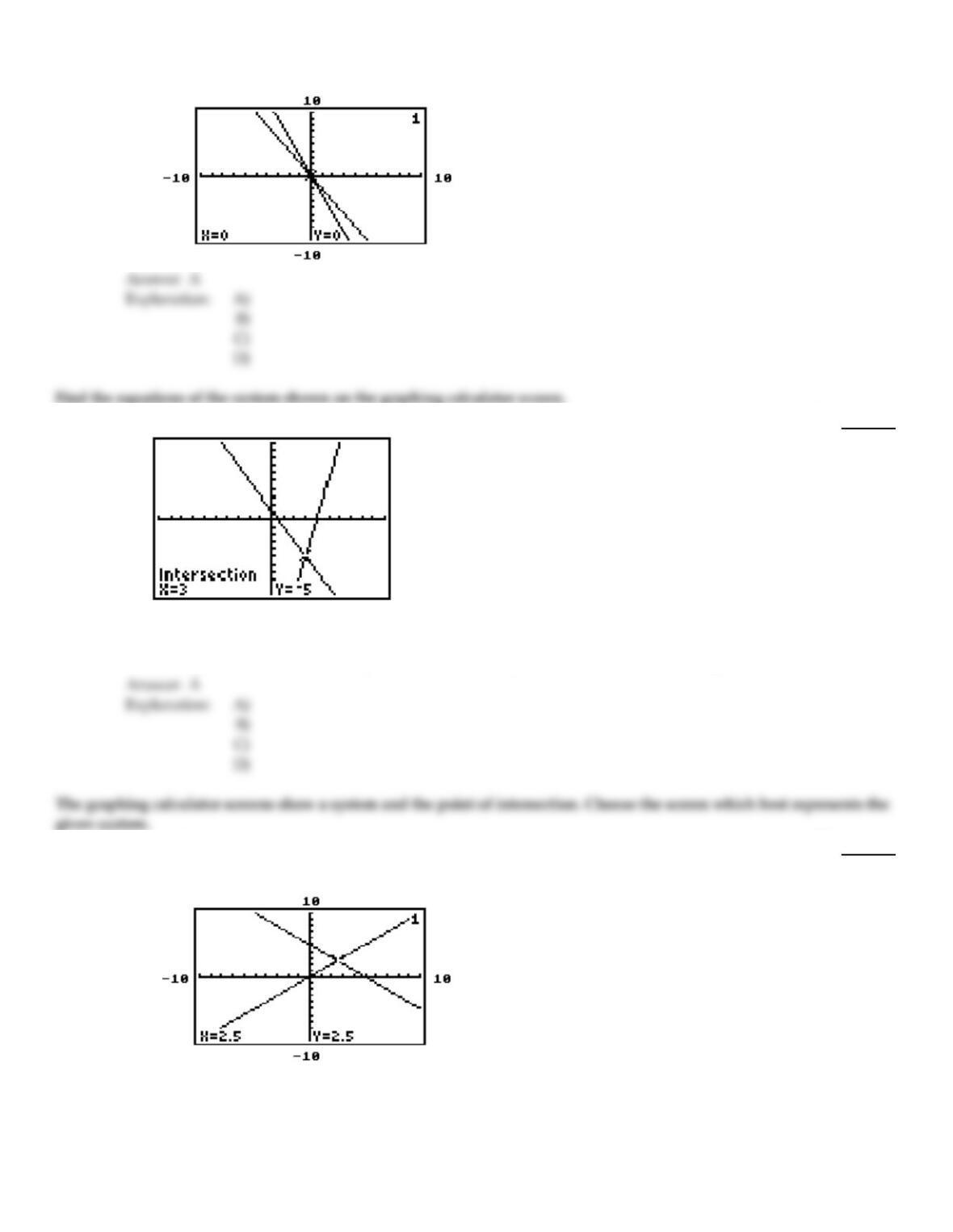
25)
2x – y = 0
3x + y = 0
25)
A)
B)
C)
13
D)
26)
10
–10 10
–10
26)
A)
2x + y = 1
5x – y = 20
B)
x + y = 1
x – 3y = –9
C)
y = 2x + 1
y = –0.3x – 5.9
D)
5x + y = 20
2x – y = 1
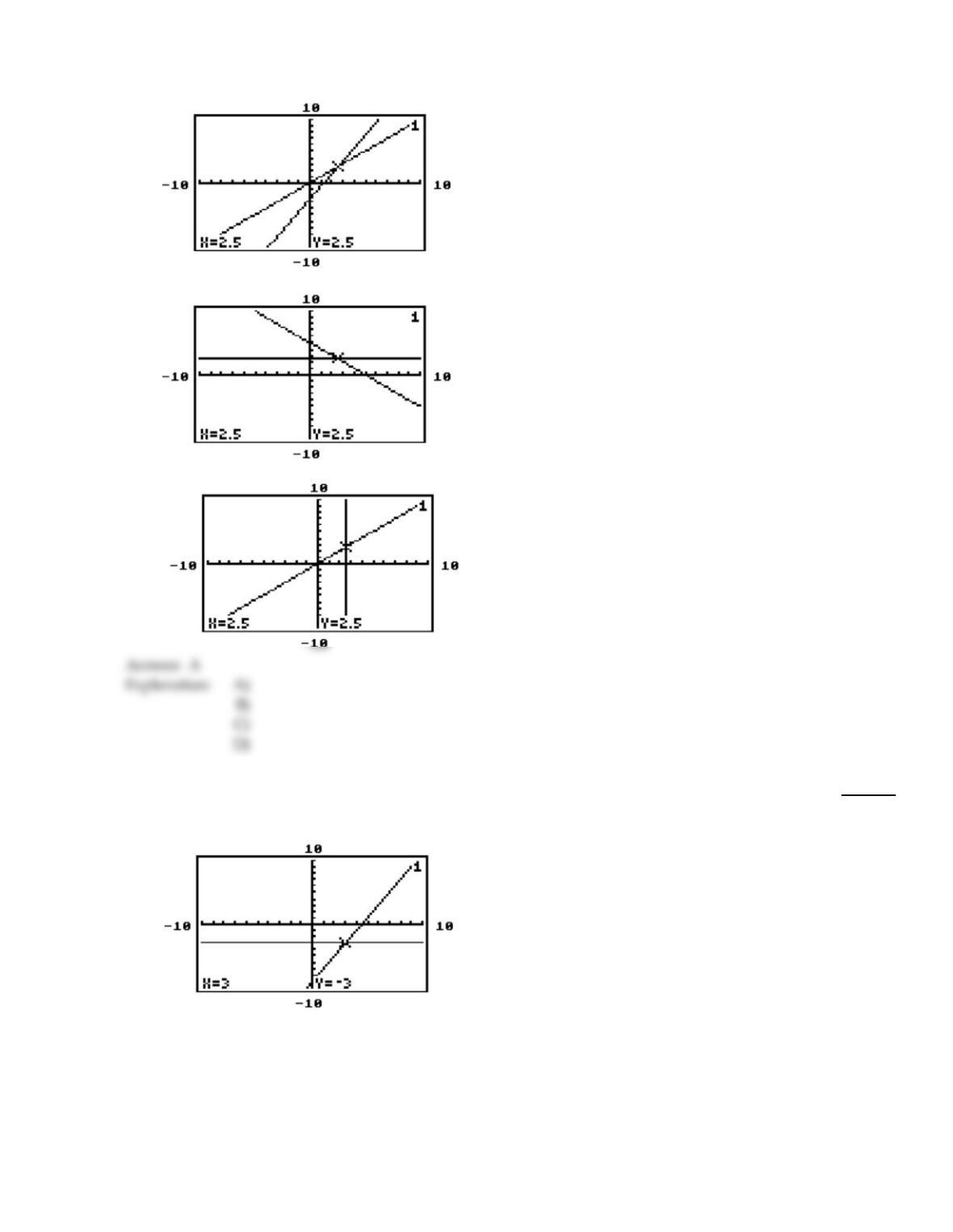
27)
y = –x + 5
y = x
27)
A)
14
B)
C)
D)
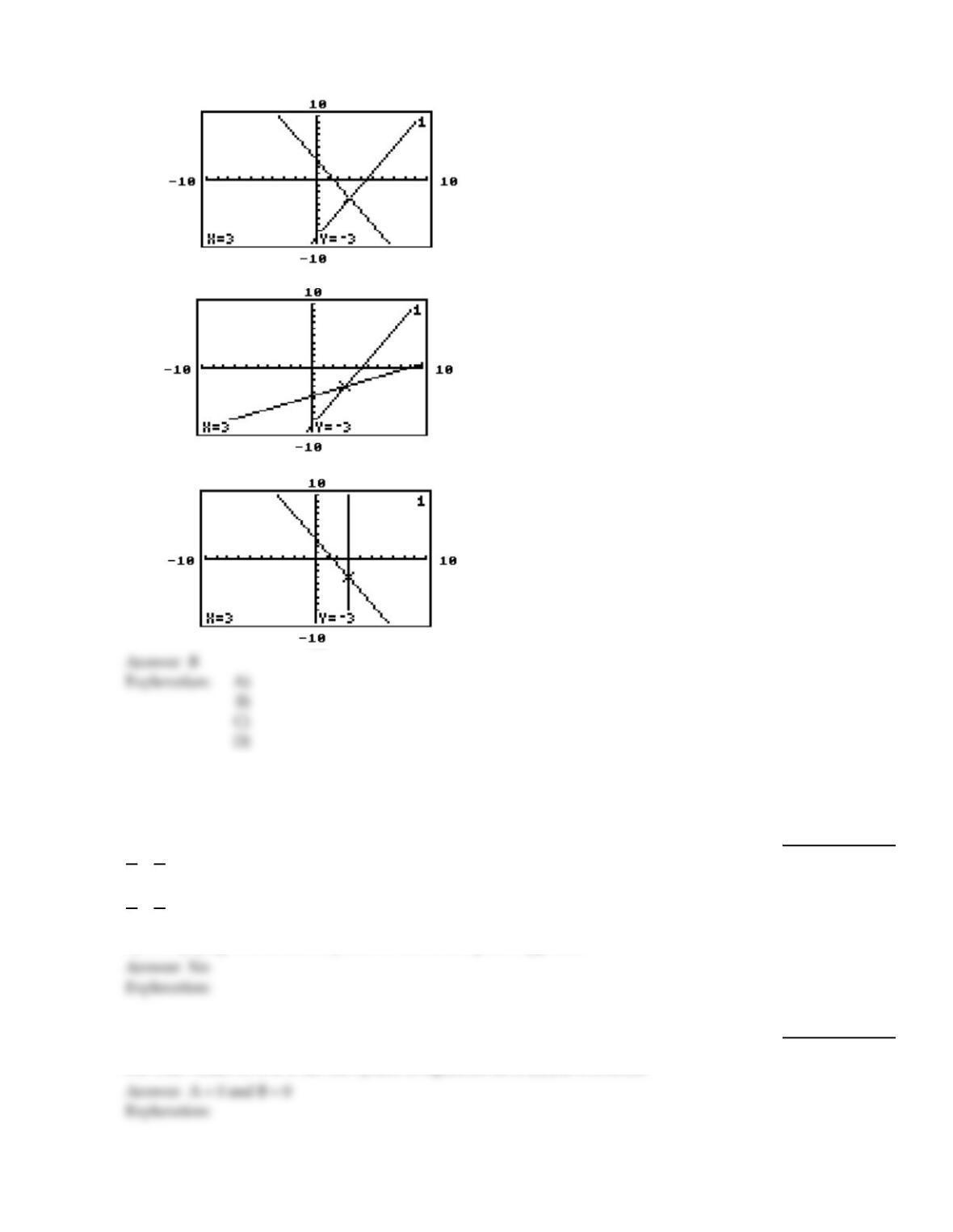
28)
y = 2x – 9
y = –2x + 3
28)
A)
15
B)
C)
D)
SHORT ANSWER. Write the word or phrase that best completes each statement or answers the question.
Provide an appropriate response.
29)
A student tried to clear the fractions in
x
9+y
3= –2
x
7+y
5=9
by multiplying both fractions by zero. Is this an acceptable approach?
29)
30)
–5x + 8y = A
10x – 5y = B
For what values of A or B can this system of equations have (0,0) as a solution?
30)
16
31)
A student solved the system of equations
x + 2y = 4
2x + 4y =8
for x in the first equation, and substituted into the second equation. The y’s also
disappeared in the process. The student claimed that the system of equations has no
solution. Is this correct?
31)
32)
Under what circumstances can a system of equations be solved more easily by graphing
than be substitution?
32)
33)
Solve the following system of equations by first solving Equation (1) for x and then
substituting for x in Equation (2). Then solve the system again by first solving Equation (1)
for 2y and substituting for 2y in Equation (2). Which procedure do you prefer? Explain
why you answered as you did.
x + 2y = 6 (1)
3x + 2y = 4 (2)
33)
34)
Write a system of equations that would be more easily solved using the elimination
method than the substitution method. Explain why elimination would be easier than
substitution.
34)
35)
2x + 3y = –9
4x + 2y =9
What number would you multiply the top equation by to eliminate the x terms?
35)
36)
Describe the three possible outcomes when graphing a system of equations, and relate each
to the type of solution(s) each system has.
36)
37)
Write a system of equations that would be more easily solved using the substitution
method than the elimination method. Explain why substitution would be easier than
elimination.
37)
38)
Explain how the multiplication and addition principles are used in solving systems of
equations using the elimination method.
38)
39)
While using the elimination method, if the following occurs, what can you say about the
graph of the system of equations?
3x – 7y = 8
– 3x + 7y = –8
0 = 0
39)
40)
Describe two advantages of the substitution method over the graphing method for solving
systems of equations.
40)
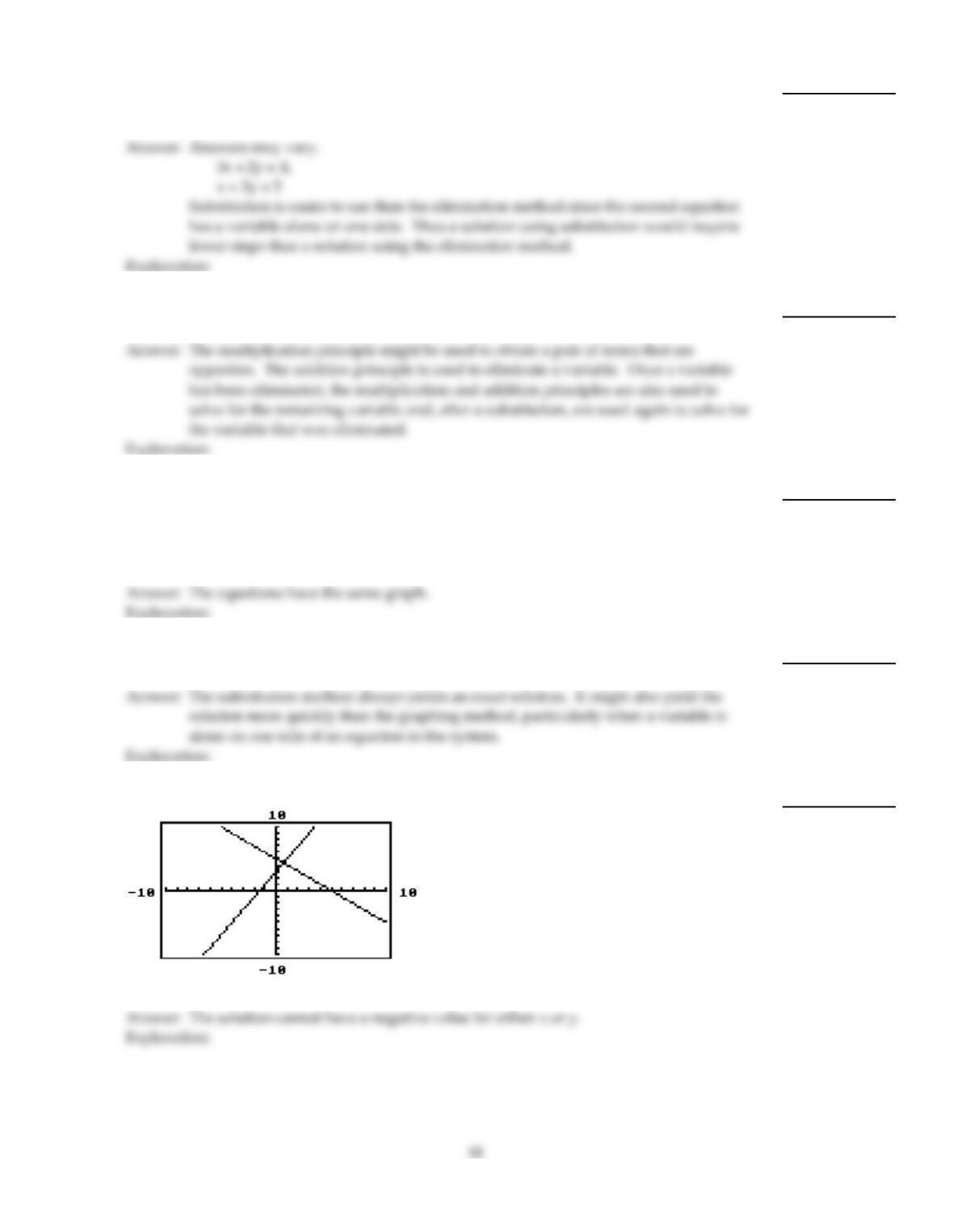
41)
Why could (3, –3) not be a solution of the system that is graphed?
41)
42)
Explain why the solution of a system of equations is the point of intersection of the graphs
of the equations.
42)
43)
A student argued that it is impossible to use the substitution method to determine if a
system of equations has no solution or an infinite number of solutions. Is the student
correct?
43)
44)
While using the elimination method, if the following occurs, what can you say about the
graph of the system of equations?
6x – 8y = 5
– 6x + 8y = 7
0 = 12
44)
MULTIPLE CHOICE. Choose the one alternative that best completes the statement or answers the question.
Write a system of equations for the problem, and then solve the system.
45)
A boat travels 36 miles downstream in 4 hours and returns upstream in 12 hours. Find the rate of
the speed of the current and the speed of the boat in still water if x = the speed of the boat in still
water and y = speed of the current.
r t d
Downstream x + y 4 4(x + y)
Upstream x – y 12
45)
A)
Boat: 15 mph; current: 9 mph
B)
Boat: 3 mph; current: 6 mph
C)
Boat: 6 mph; current: 3 mph
D)
Boat: 9 mph; current: 3 mph
46)
A system of linear inequalities can have solutions in exactly three of the quadrants.
46)
A)
True
B)
False
47)
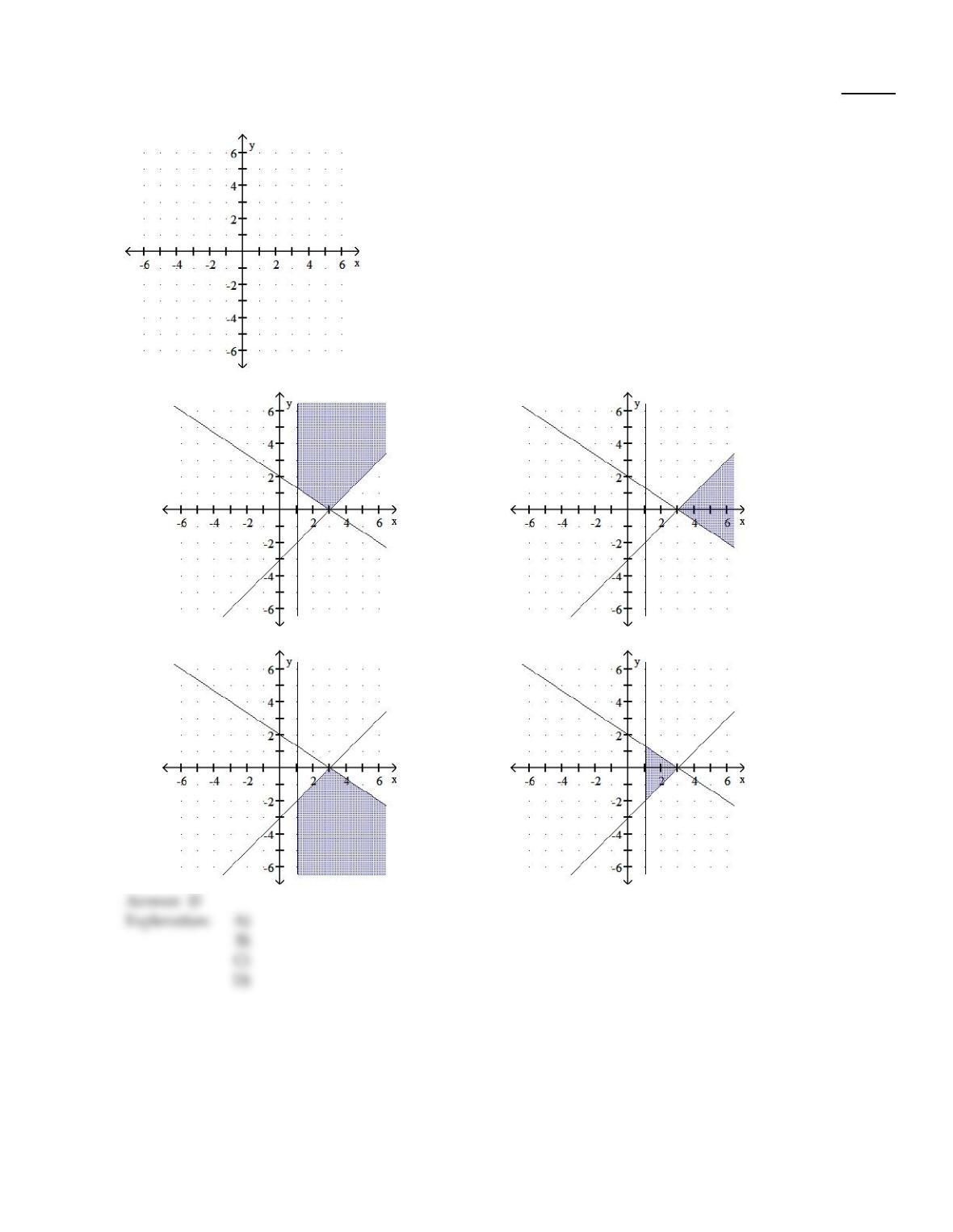
2x + 3y 6
x – y
3
x 1
47)
A)
B)
C)
D)
20
Solve the problem by using a system of equations.
48)
The distance between city A and city B is 200 mi more than the distance between city C and city D.
Together, the two distances total 1750 mi. How far is it between city A and city B? How far is it
between city C and city D?
48)
A)
City A and B: 875mi; City C and D: 775 mi
B)
City A and B: 975 mi; City C and D: 775 mi
C)
City A and B: 1750 mi; City C and D: 1550 mi
D)
City A and B: 975 mi; City C and D: 875 mi
49)
2y = – 5x – 3
20x = – 8y – 12
49)
A)
{(x, y)|5x + 2y = –3}
B)
{(–15, –6)}
C)
D)
{(–6, –15)}
Solve by the substitution method.
50)
3x +3y = 5
9x = 10 +9y
50)
A)
1
18, 5
18
B)
25
18, 5
18
C)
{(x, y)| 3x +3y = 5}
D)
Write a system of equations for the problem, and then solve the system.
51)
A store sells televisions for $360 and video cassette recorders for $270. At the beginning of the week
its entire stock is worth $49,140. During the week it sells three quarters of the televisions and one
third of the video cassette recorders for a total of $28,980. How many televisions and video cassette
recorders did it have in its stock at the beginning of the week?
51)
A)
82 televisions; 76 video cassette recorders
B)
84 televisions; 70 video cassette recorders
C)
83 televisions; 73 video cassette recorders
D)
81 televisions; 74 video cassette recorders
Indicate whether the statement is true or false.
52)
If one inequality in a system of two linear inequalities contains the “<” symbol and the other
contains the “>” symbol, the graph of the system will have solid boundary lines.
52)
A)
True
B)
False
53)
–4
9x +5
7y =48
1
7x –1
7y = –13
53)
A)
{(63, –28)}
B)
{(63, 28)}
C)
{(–63, 28)}
D)
{(–63, –28)}
54)
The manager of a candy shop sells chocolate covered nuts for $7 per pound and chocolate covered
raisins for $14 per pound. The manager wishes to make a 490–pound cashew–peanut mixture that
will sell for $8 per pound. How many pounds of each should be used?
54)
A)
Nuts: 420 lb; raisins: 70 lb
B)
Nuts: 245 lb; raisins: 245 lb
C)
Nuts: 70 lb; raisins: 420 lb
D)
Nuts: 280 lb; raisins: 210 lb
55)
2x – y =9
5x + y =33
55)
A)
{(6, 4)}
B)
{(3, 6)}
C)
{(6, 3)}
D)
56)
9x – 7y =49
–6x + 2y = –14
56)
A)
{(0, –6)}
B)
{(–1, –6)}
C)
{(0, –7)}
D)
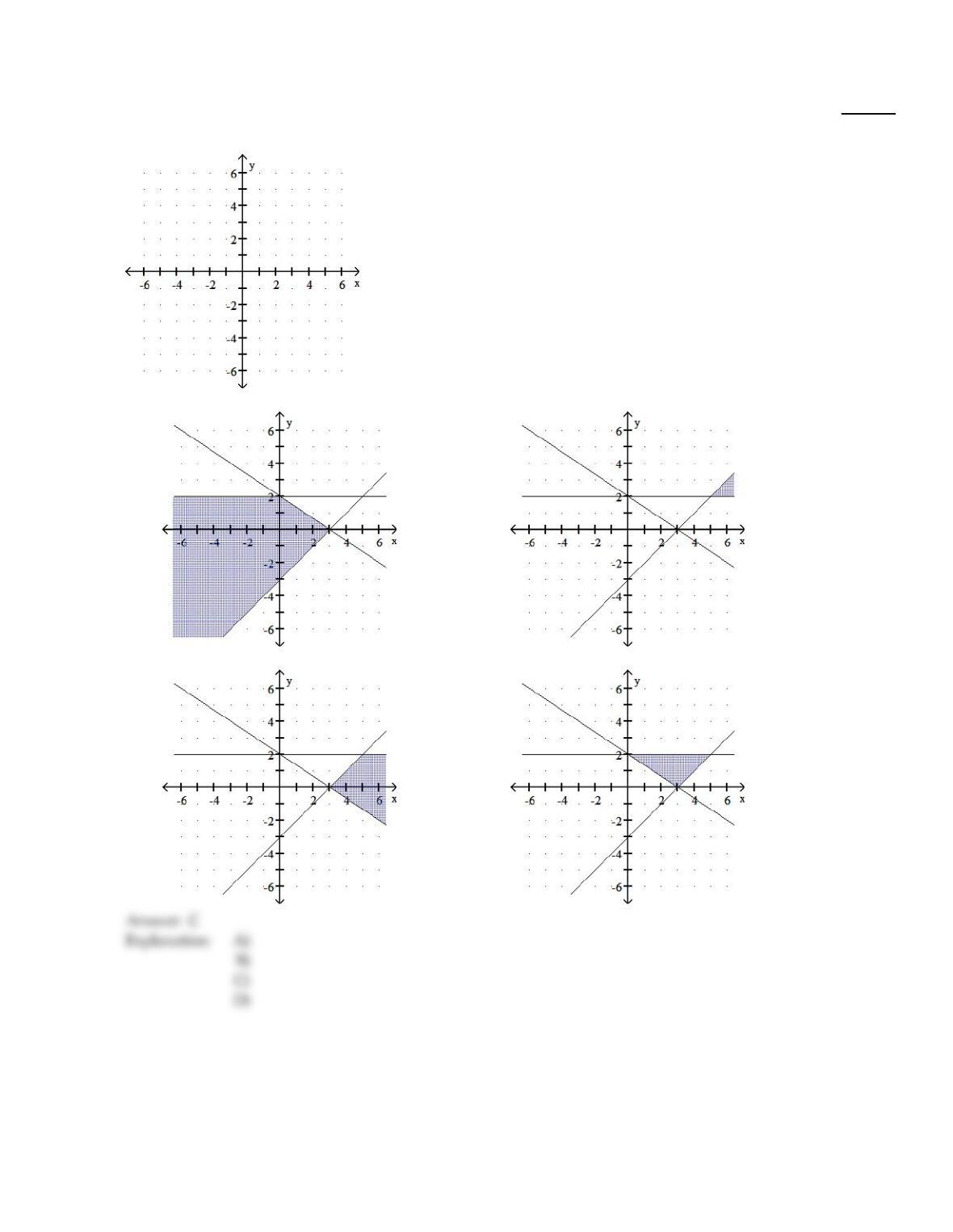
Graph the solution of the system.
57)
2x + 3y 6
x – y
3
y
2
57)
A)
B)
C)
D)
23
Solve by the substitution method.
58)
x + y =7
6x + 6y =42
58)
A)
{(0, 0)}
B)
{(5, 2)}
C)
{(x, y)| x + y =7}
D)
Write a system of equations for the problem, and then solve the system.
59)
There were 42,000 people at a ballgame in Los Angeles. The day’s receipts from $13 reserved seats
and $6 general–admission seats were $343,000. How many of each type of seat were sold?
59)
A)
$13 seats: 19,250; $6 seats: 22,750
B)
$13 seats: 29,000; $6 seats: 13,000
C)
$13 seats: 13,000; $6 seats: 29,000
D)
$13 seats: 22,750; $6 seats: 19,250
60)
Solving for which variable in which equation involves the least amount of work?
9x + 4y =57
10x + 5y =65
60)
A)
x in equation 1
B)
y in equation 1
C)
y in equation 2
D)
x in equation 2
61)
(1, –2)
4x =2– y
3x = –5– 4y
61)
A)
No
B)
Yes
Solve the system by the elimination method.
62)
2x – 6y =5
–8x + 24y = –20
62)
A)
{(–30, 10)}
B)
{(10, –30)}
C)
{(x, y)|2x – 6y =5}
D)
63)
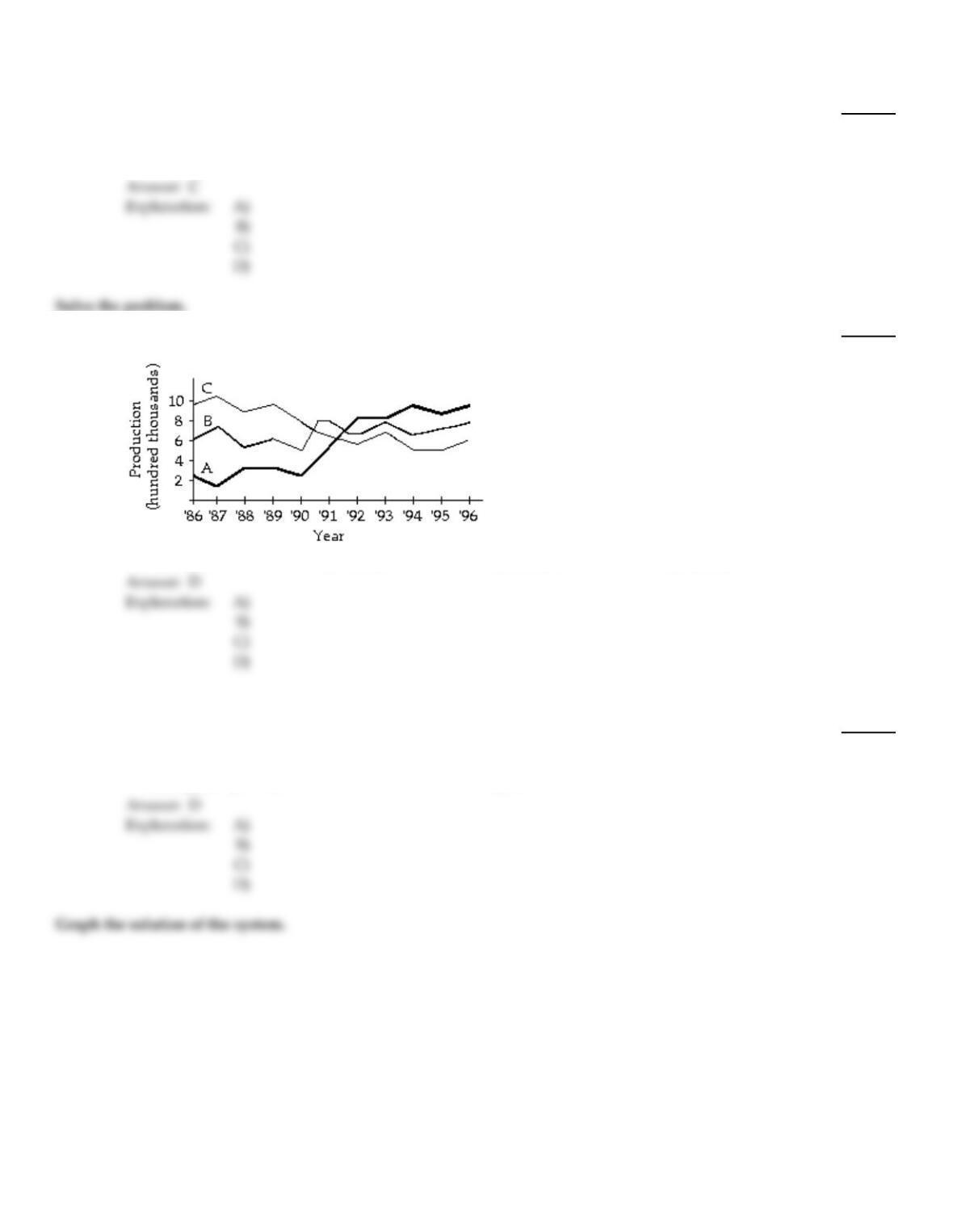
A company manufactures three products. The graph shows the production from 1986 to 1996. What
was the level of production when the production of C equaled the production of A?
63)
A)
800,000
B)
500,000
C)
400,000
D)
600,000
Solve by the substitution method.
64)
x + y = –8
x + y =3
64)
A)
{(–8, 3)}
B)
{(0, –5)}
C)
{(x, y)|x + y = –8}
D)
25
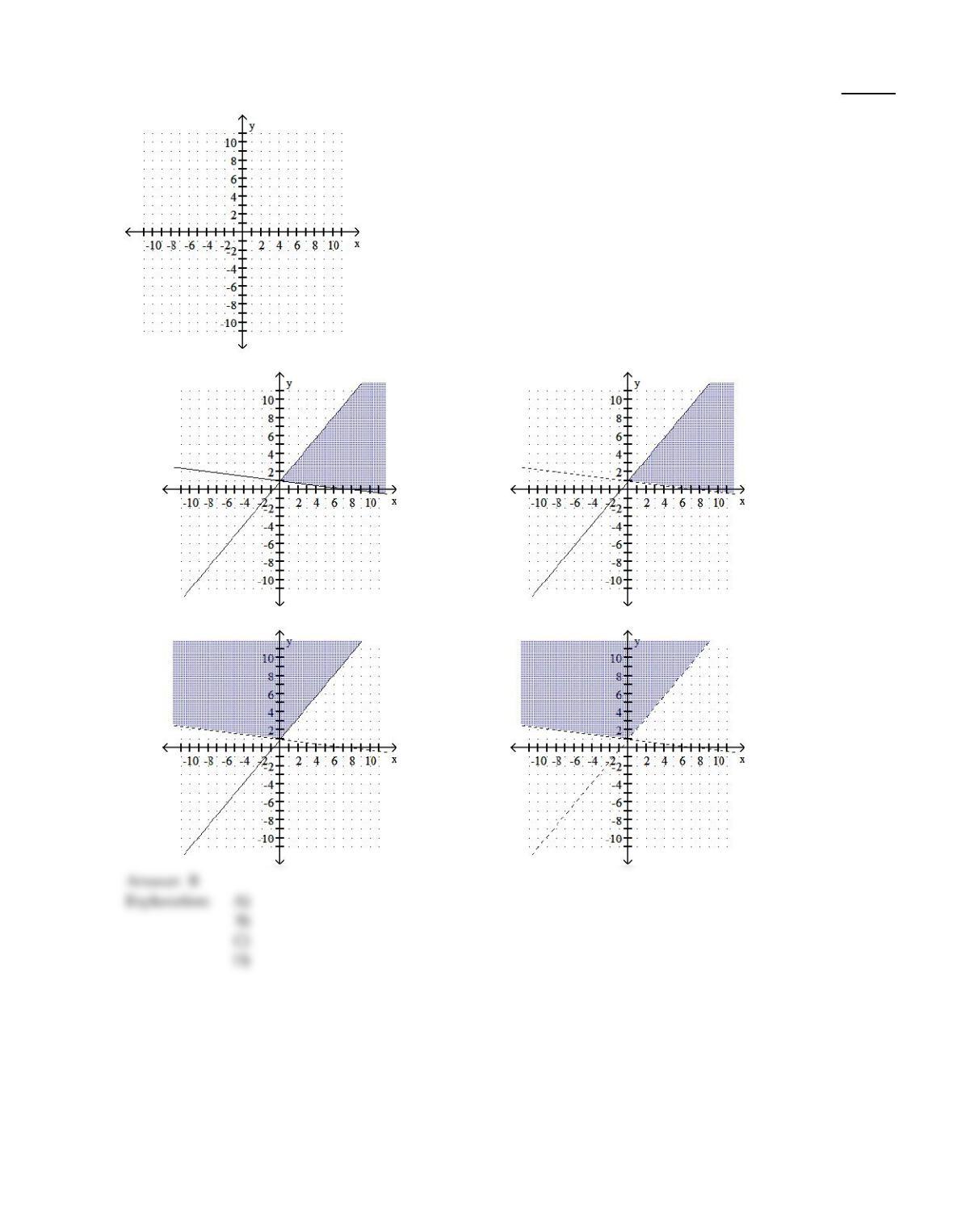
65)
x + 8y >8
6x – 5y –5
65)
A)
B)
C)
D)
26
Write a system of equations for the problem, and then solve the system.
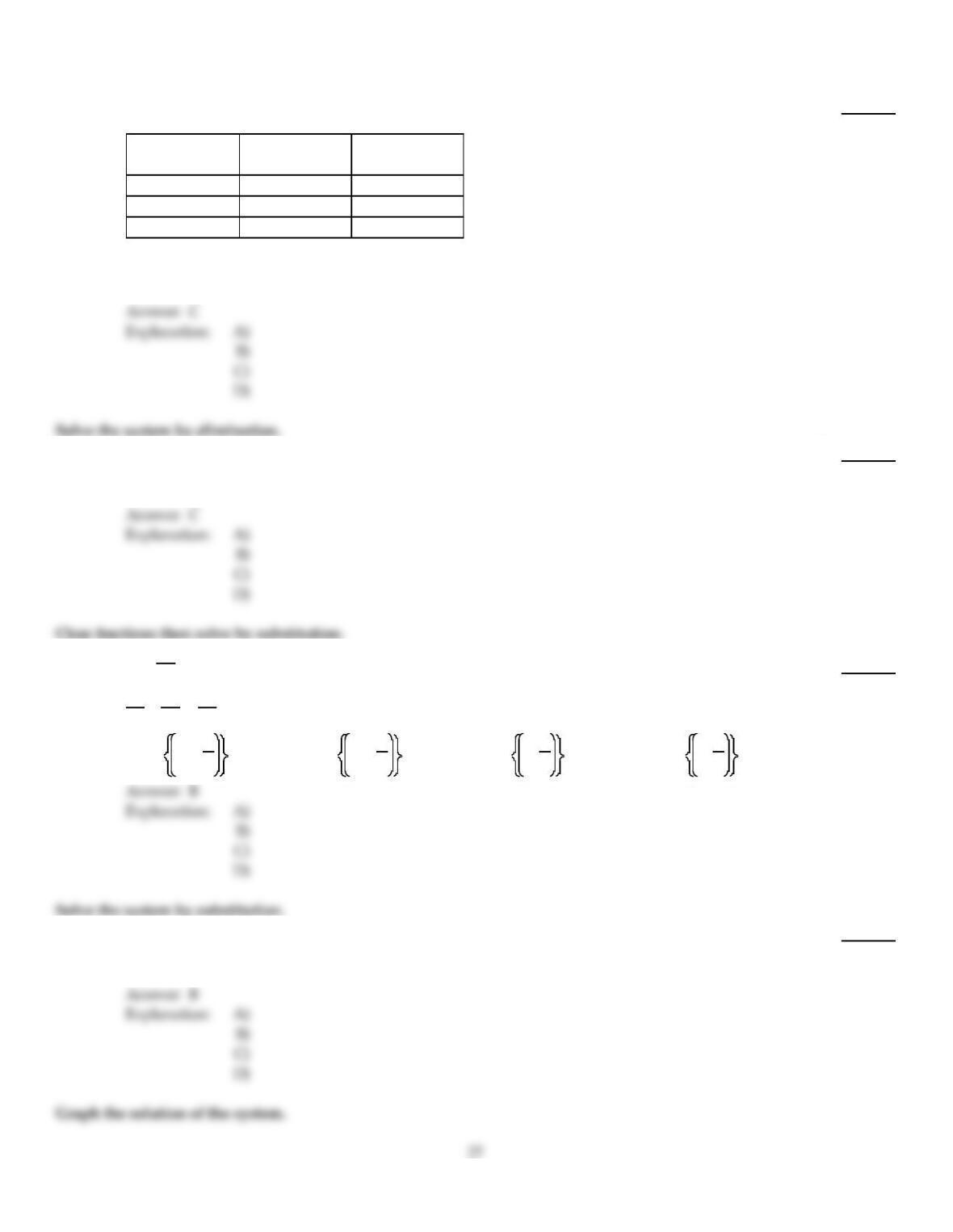
66)
John has a jarful of quarters and nickels. There are 101 coins in the jar. The value of the coins is
$15.85. How many of each type of coin?
Number of
coins Value
per Coin Total
Value
x$0.25
y$0.05
101 XXXXX $15.85
66)
A)
59 quarters and 42 nickels
B)
96 quarters and 5 nickels
C)
54 quarters and 47 nickels
D)
47 quarters and 54 nickels
67)
–6x – 6y =30
–4x – 2y =8
67)
A)
B)
{(1, –5)}
C)
{(1, –6)}
D)
{(0, –5)}
68)
3x –5y
7= 10
2x
3–9y
7=19
5
68)
A)
3, –7
9
B)
3, –7
5
C)
3, 7
5
D)
3, 7
9
69)
x –3y =55
4x – y = 0
69)
A)
{(–6, –24)}
B)
{(–5, –20)}
C)
{(–5, –21)}
D)
{(5, 20)}
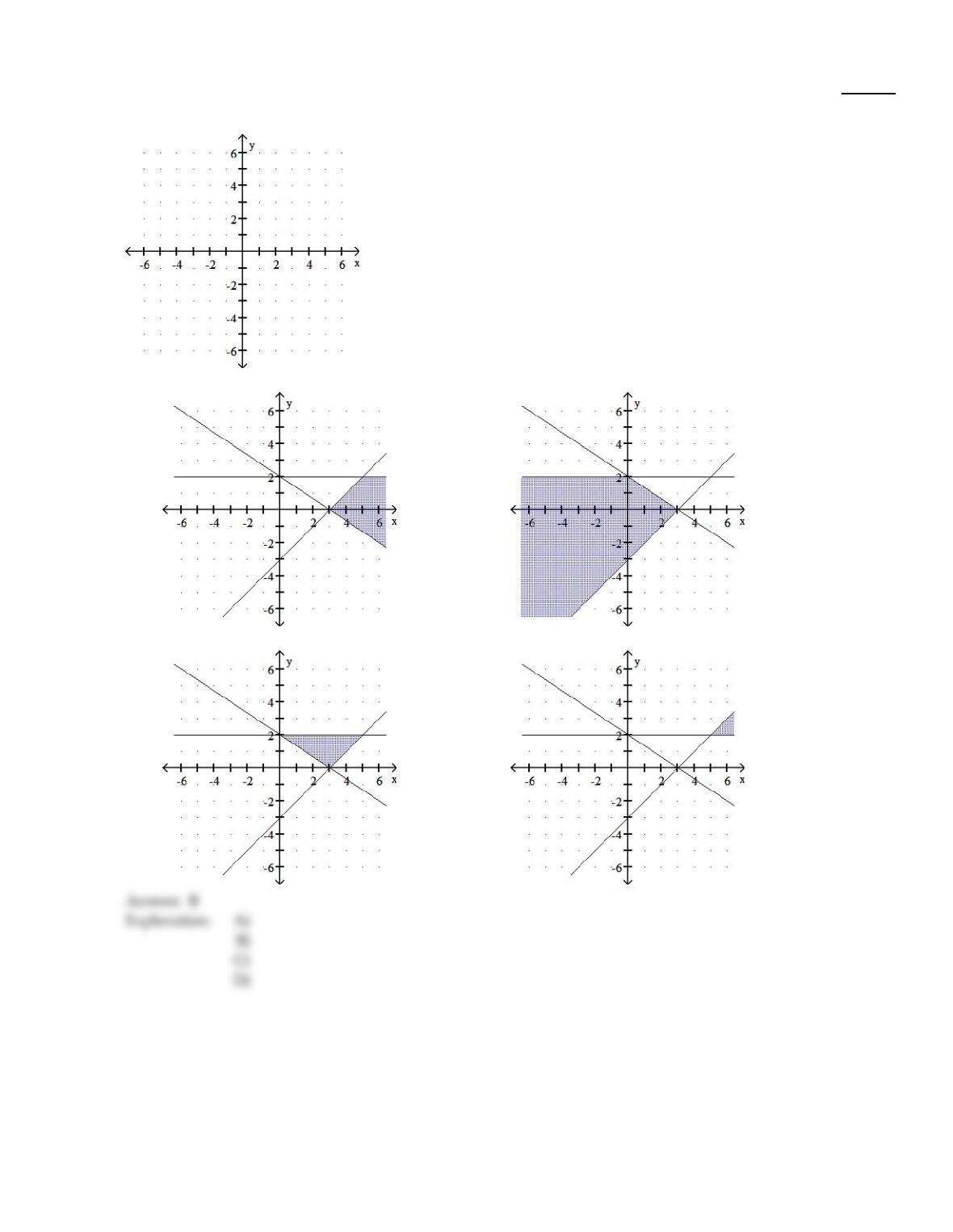
70)
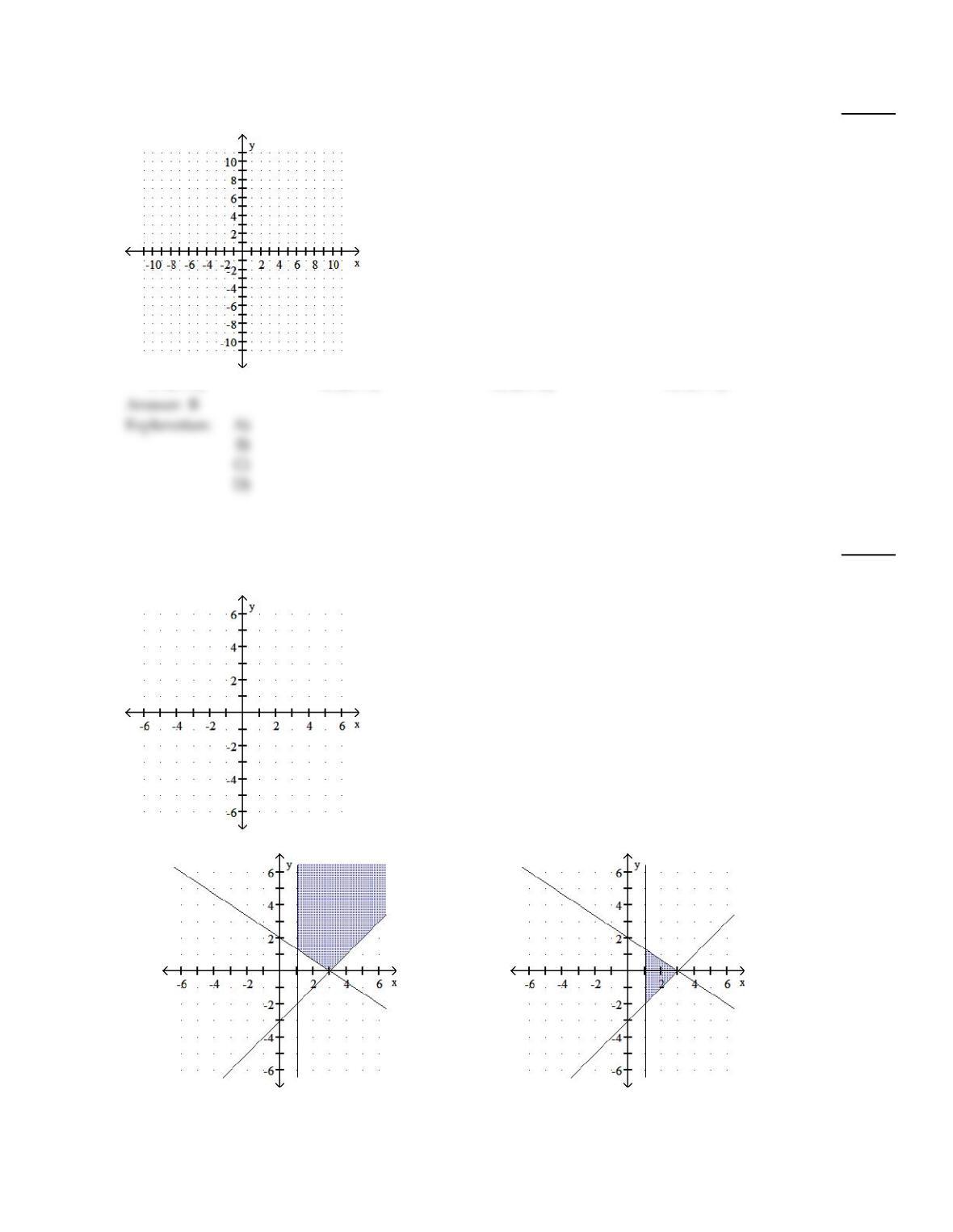
2x + 3y 6
x – y 3
y 2
70)
A)
B)
C)
D)
28
Solve the system by graphing.
71)
x + 8y =8
2x – 7y = –7
71)
A)
{(0, 0)}
B)
{(0, 1)}
C)
{(1, 0)}
D)
{(1, 1)}
Graph the solution of the system.
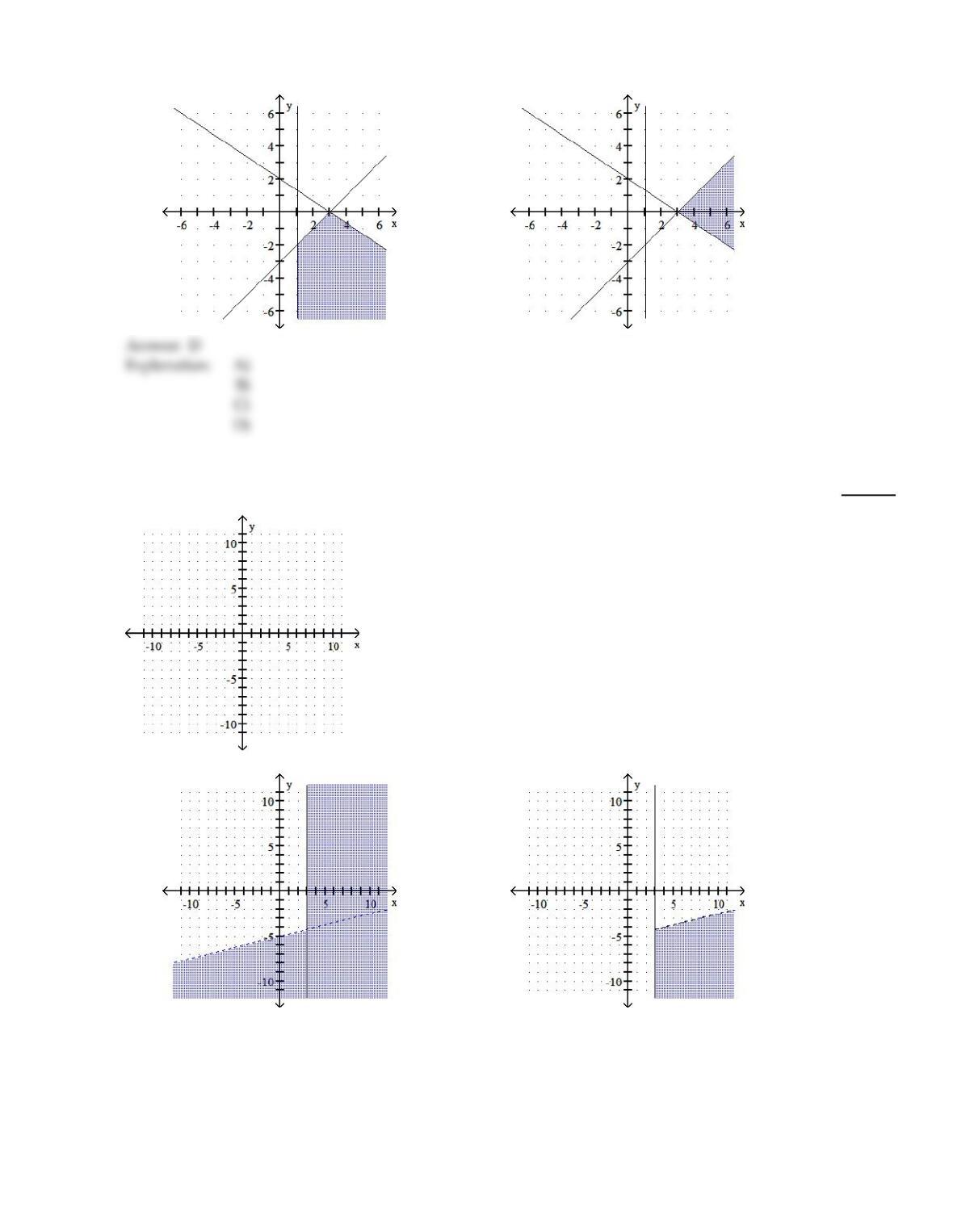
72)
2x + 3y 6
x – y
3
x 1
72)
A)
B)
29
C)
D)
Graph the solution of the system.
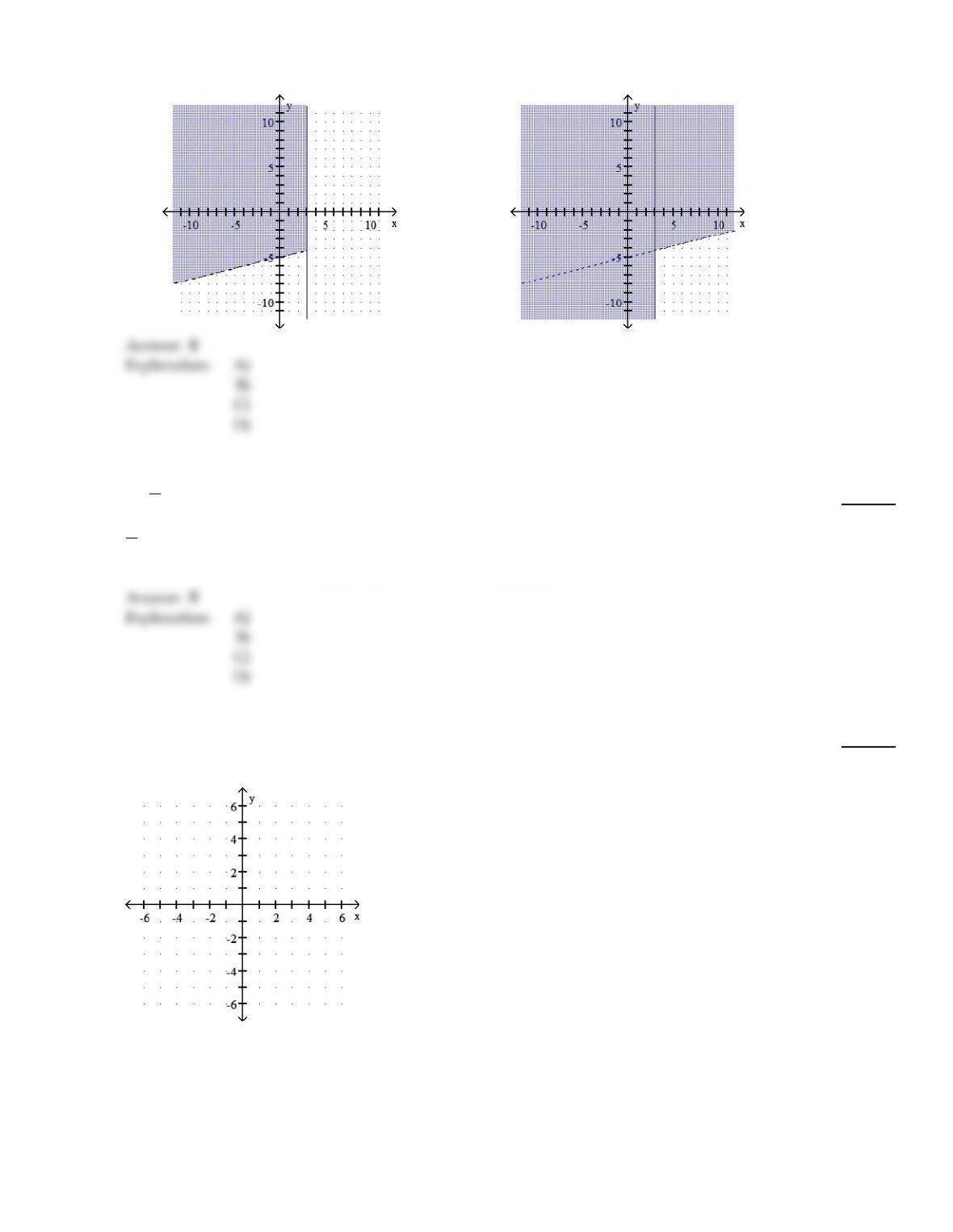
73)
–x +4y < –20
x 3
73)
A)
B)
30
C)
D)
Clear fractions then solve by substitution.
74)
x +1
4y = y – 3
1
5x – y =4x – y
74)
A)
{(4, 0)}
B)
{(0, 4)}
C)
{(1, 4)}
D)
Graph the solution of the system.
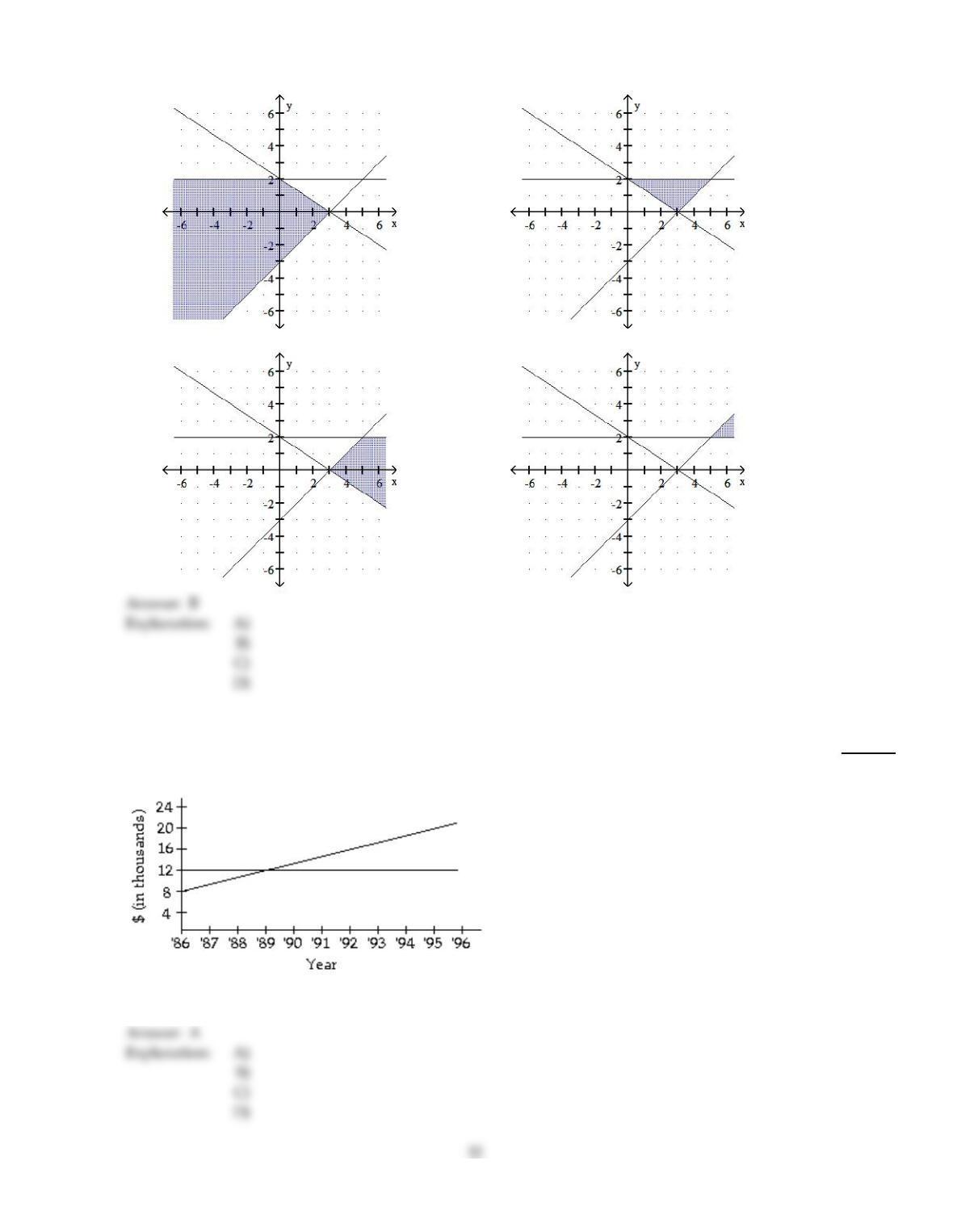
75)
2x + 3y 6
x – y 3
y 2
75)
31
A)
B)
C)
D)
Solve the problem.
76)
Deepak doesn’t trust banks, so his savings are hidden under his mattress. Betsy has her savings in
an investment at simple interest. In approximately what year did they have the same amount?
76)
A)
1989
B)
1986
C)
1988
D)
1996
Write a system of equations for the problem, and then solve the system.
77)
Paul invested four times as much money in an account paying 5% interest than he did in an
account paying 1% interest. If the total interest paid was $525, how much did he invest in each?
77)
A)
$2500 at 5%, $10,000 at 1%
B)
$10,000 at 5%, $3000 at 1%
C)
$100 at 5%, $25 at 1%
D)
$10,000 at 5%, $2500 at 1%
78)
3x
2–y
3= –18
3x
4+2y
9= –9
78)
A)
{(–12, 0)}
B)
{(12, 0)}
C)
{(x, y)| 3x – y = –108}
D)
Solve the system by elimination.
79)
8x + 5y =39
6
5x + y =23
5
79)
A)
{(5, 8)}
B)
{(8, –5)}
C)
{(–8, –5)}
D)
{(–5, 8)}
Solve by the substitution method.
80)
–7x + 8y = –31
–5x + 2y = –37
80)
A)
{(9, 4)}
B)
{(9, 5)}
C)
{(8, 5)}
D)
33
Solve the system by graphing.
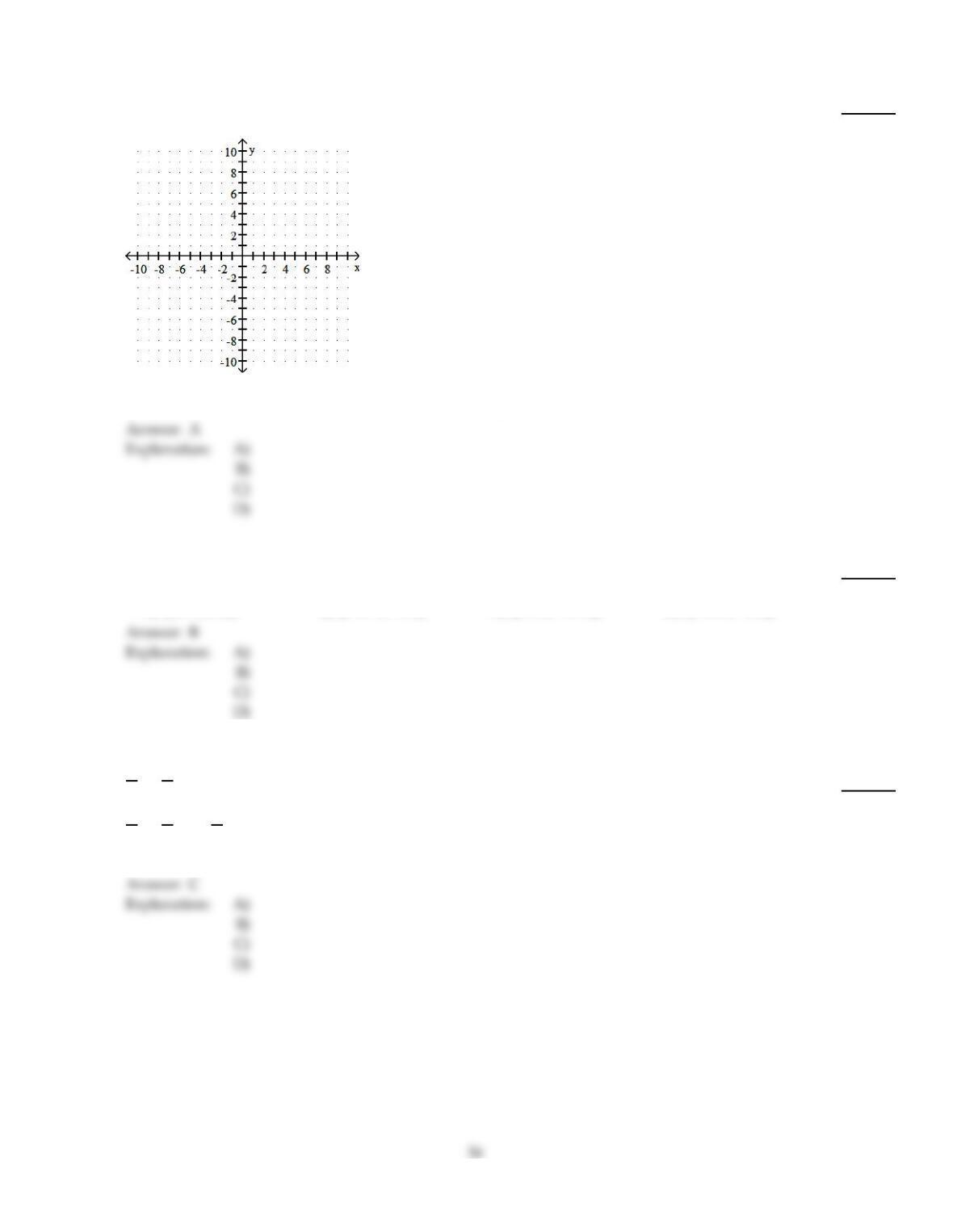
81)
2x – 3y = –21
3x + 4y =11
81)
A)
{(–3, 5)}
B)
{(x, y)|3x + 4y =11}
C)
D)
{(–5, 3)}
Use a graphing calculator to solve the system.
82)
–4x +2y = 0
8x – 2y = –3
82)
A)
{(0.75, 2.5)}
B)
{(–0.75, –1.5)}
C)
{(–0.5, –0.75)}
D)
{(–0.75, –2.5)}
Clear fractions then solve by substitution.
83)
1
4x +1
4y =4
1
5x –1
5y = – 2
5
83)
A)
{(–7, 10)}
B)
{(6, 10)}
C)
{(7, 9)}
D)
Provide an appropriate response.
84)
Solving for which variable in which equation involves the least amount of work?
y =6x + 42
8x + 7y = –106
84)
A)
x in equation 1
B)
y in equation 2
C)
y in equation 1
D)
x in equation 2
85)
(1, –3)
x + y = –4
x – y =2
85)
A)
No
B)
Yes
86)
Every system of linear inequalities has infinitely many solutions.
86)
A)
True
B)
False
87)
6x – y =22
x + 6y =16
87)
A)
Infinite number
B)
No Solution
C)
One
88)
3x – y =4
5x + y =20
88)
A)
{(5, 3)}
B)
{(3, 5)}
C)
D)
{(x, y)|3x – y =4}
89)
–4x – 5y =2
12x + 15y =6
89)
A)
{(8, 10)}
B)
{(x, y)|–4x – 5y =2}
C)
{(–8, –10)}
D)
90)
2x +5y = 5
6x –15y = 10
90)
A)
25
12, 1
6
B)
1
12, 1
6
C)
{(x, y)| 2x +5y = 5}
D)
A
Solve the problem.
91)
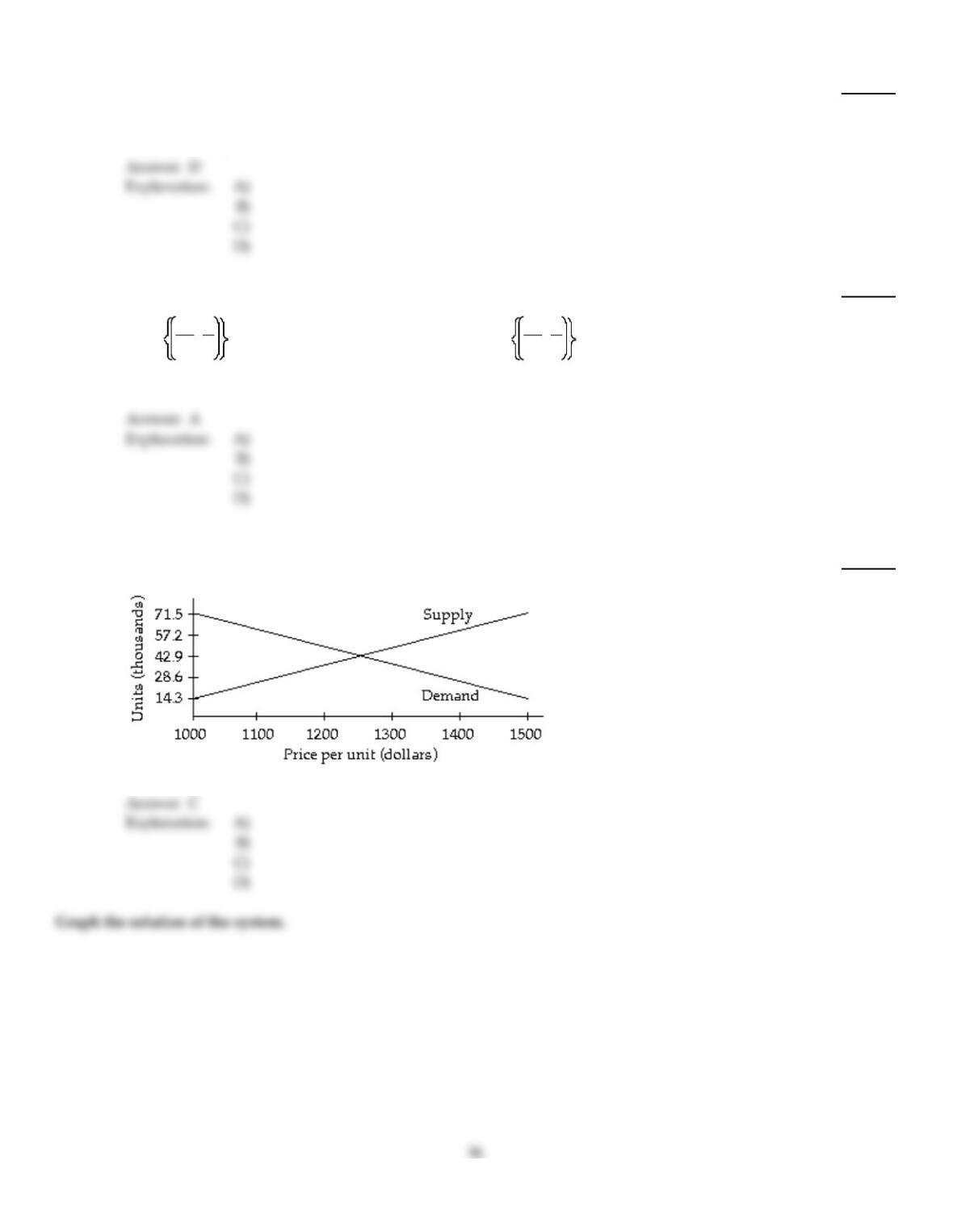
The graphs below represent the supply and demand for a product at various prices per unit. How
many units should be produced so that supply equals demand?
91)
A)
2245 units
B)
42.9 units
C)
42,900 units
D)
2250 units
C
D
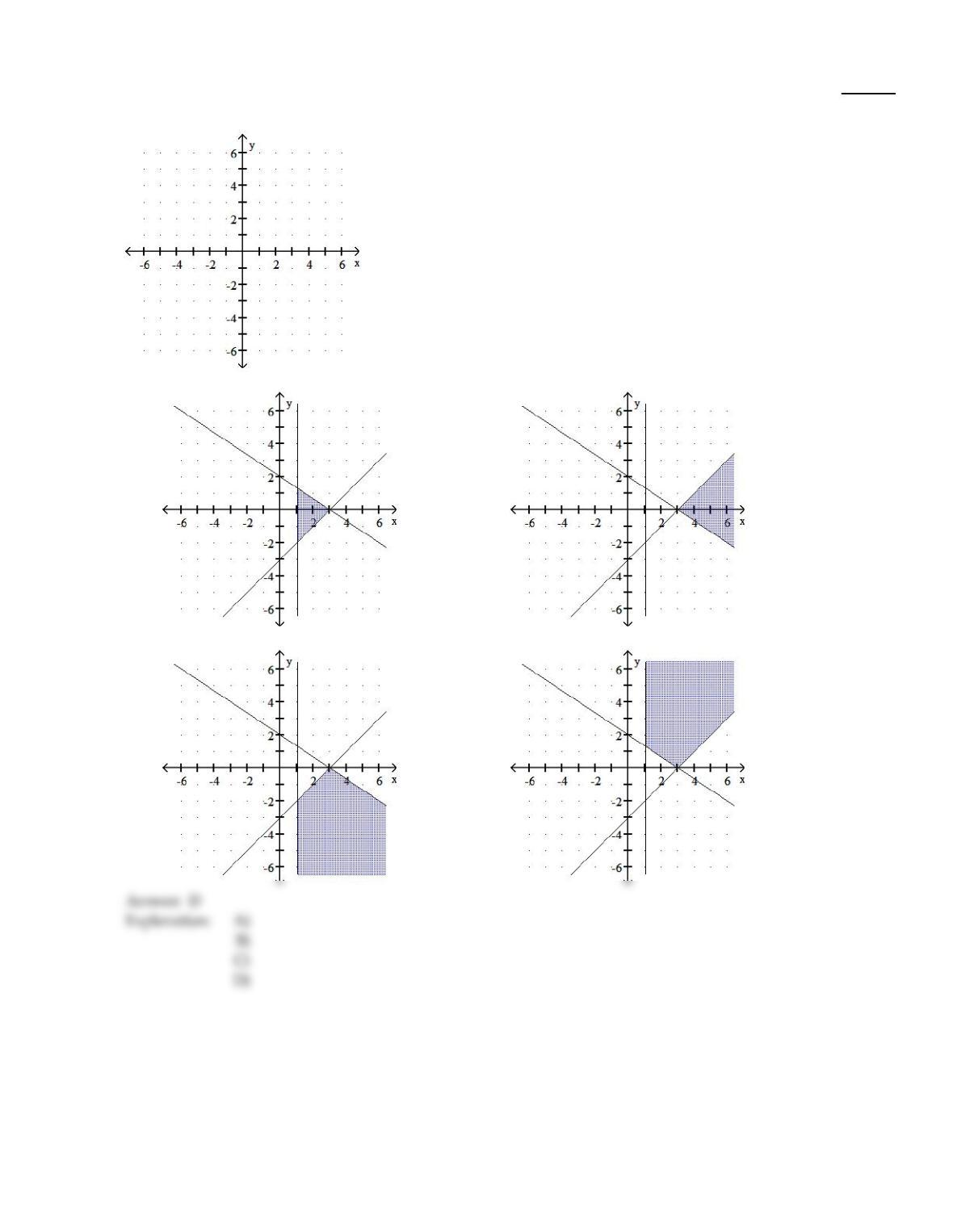
92)
2x + 3y 6
x – y
3
x 1
92)
A)
B)
C)
D)
37
Solve the system by any method.
93)
0.5x – 0.1y =3.6
0.4x – 0.3y =4.2
93)
A)
{(6, –6)}
B)
C)
{(5.4, –3.7)}
D)
{(9.3, –1.5)}
94)
8x – 5 = –5y
5x – 2y = –43
94)
A)
{(–6, 10)}
B)
{(–5, 9)}
C)
{(x, y)|5x – 2y = –43}
D)
Does the system have one solution, no solution, or an infinite number of solutions?
95)
3x = y + 3
6x – 2y = 3
95)
A)
One
B)
No Solution
C)
Infinite number
Solve the system by elimination.
96)
x + 7y =7
5x – 4y = –4
96)
A)
{(1, 0)}
B)
{(0, 0)}
C)
{(1, 1)}
D)
{(0, 1)}
38
Solve the problem.
97)
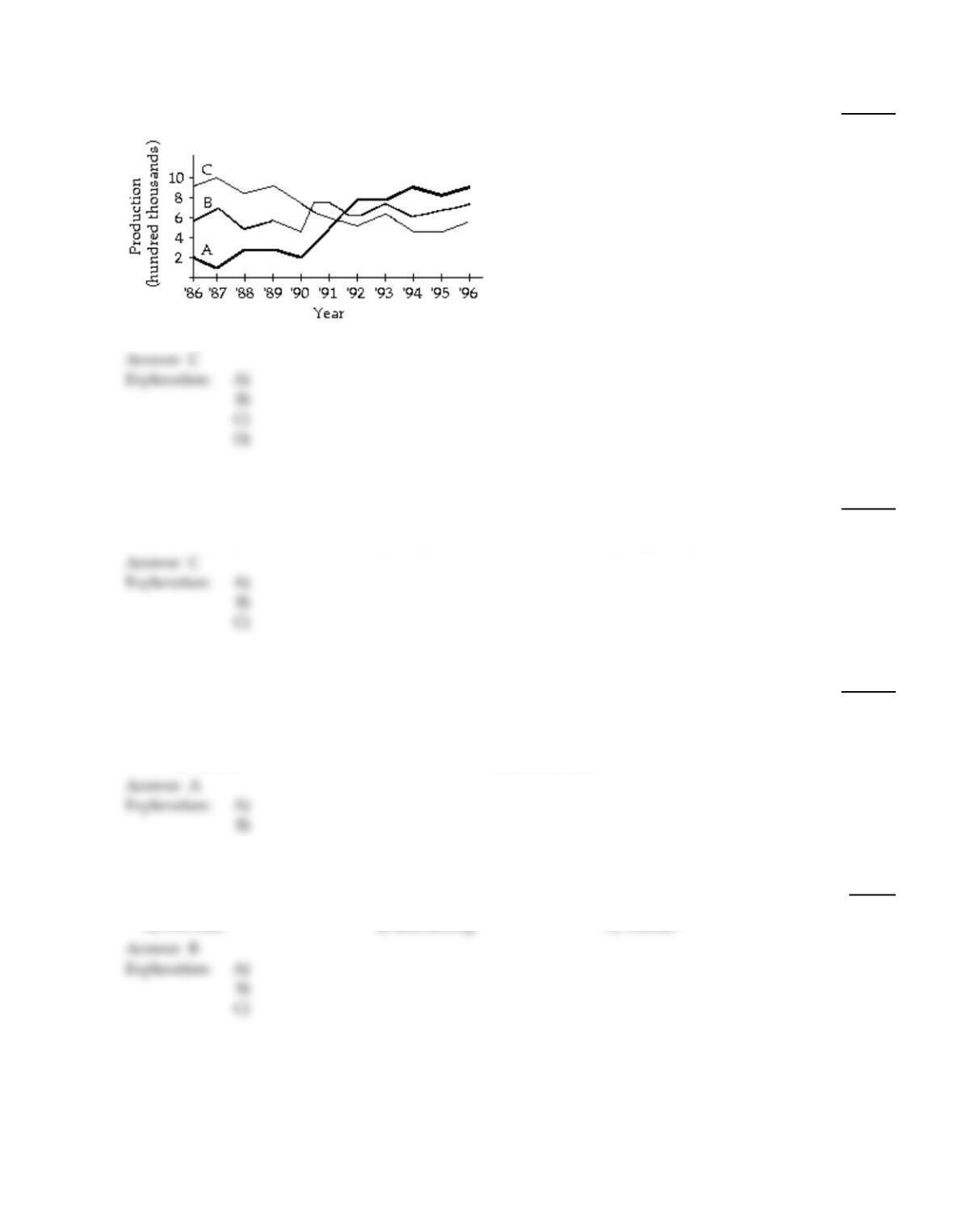
A company manufactures three products. The graph shows the production from 1986 to 1996. In
what year did the production of A equal the production of B?
97)
A)
600,000
B)
1996
C)
1991
D)
650,000
Without graphing, tell if the system is inconsistent, the equations are dependent, or neither.
98)
x + 4y =28
2x + 8y =56
98)
A)
Inconsistent
B)
Neither
C)
Dependent
Provide an appropriate response.
99)
Decide whether the elimination method or the substitution method involves the least amount of
work. Do not solve.
x + 8y = 0
x – 8y =96
99)
A)
Elimination
B)
Substitution
Decide if the graph of the system is a pair of parallel lines, intersecting lines, or one line.
100)
x + 5y =26
6x – 4y =20
100)
A)
One Line
B)
Intersecting
C)
Parallel
39
Solve the system by graphing.
101)
9x + y =35
9x + y =89
101)
A)
{(0, 0)}
B)
{(9, 8)}
C)
{(x, y)|9x + y =35}
D)
102)
2x + y =23
y =4x + 5
102)
A)
{(17, 3)}
B)
{(3, 17)}
C)
{(17, –11)}
D)
{(2, 13)}
Graph the solution of the system.
40
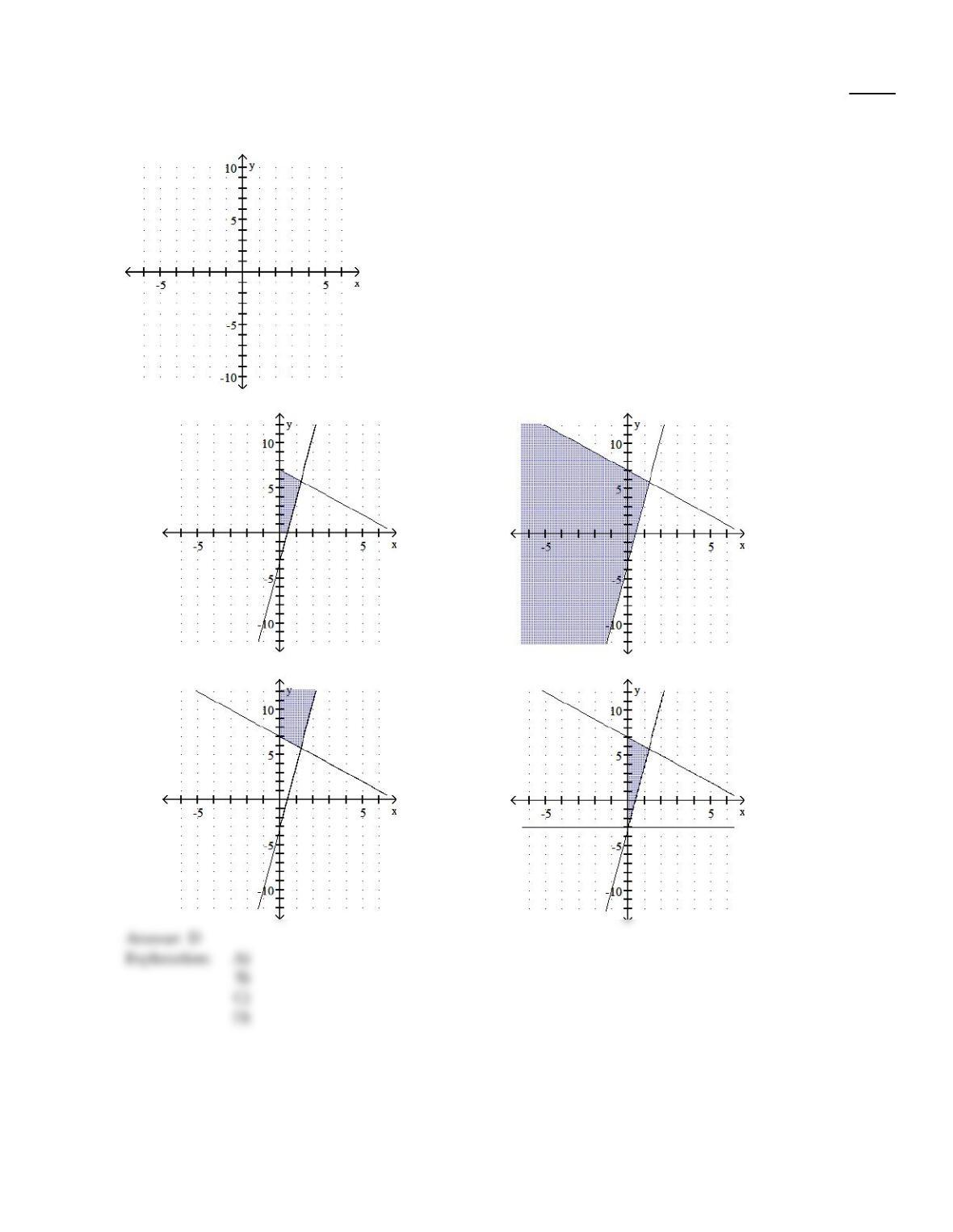
103)
x + y 7
y 7x – 3
x 0
y –3
103)
A)
B)
C)
D)
41
Provide an appropriate response.
104)
When two linear equations are solved for y and the slopes are different and the y–intercepts are
different, the lines are ?
104)
A)
One Graph
B)
Intersecting
C)
Parallel
Decide if the graph of the system is a pair of parallel lines, intersecting lines, or one line.
105)
x + 5y =26
2x + 10y =52
105)
A)
Parallel
B)
Intersecting
C)
One Line
Solve the problem.
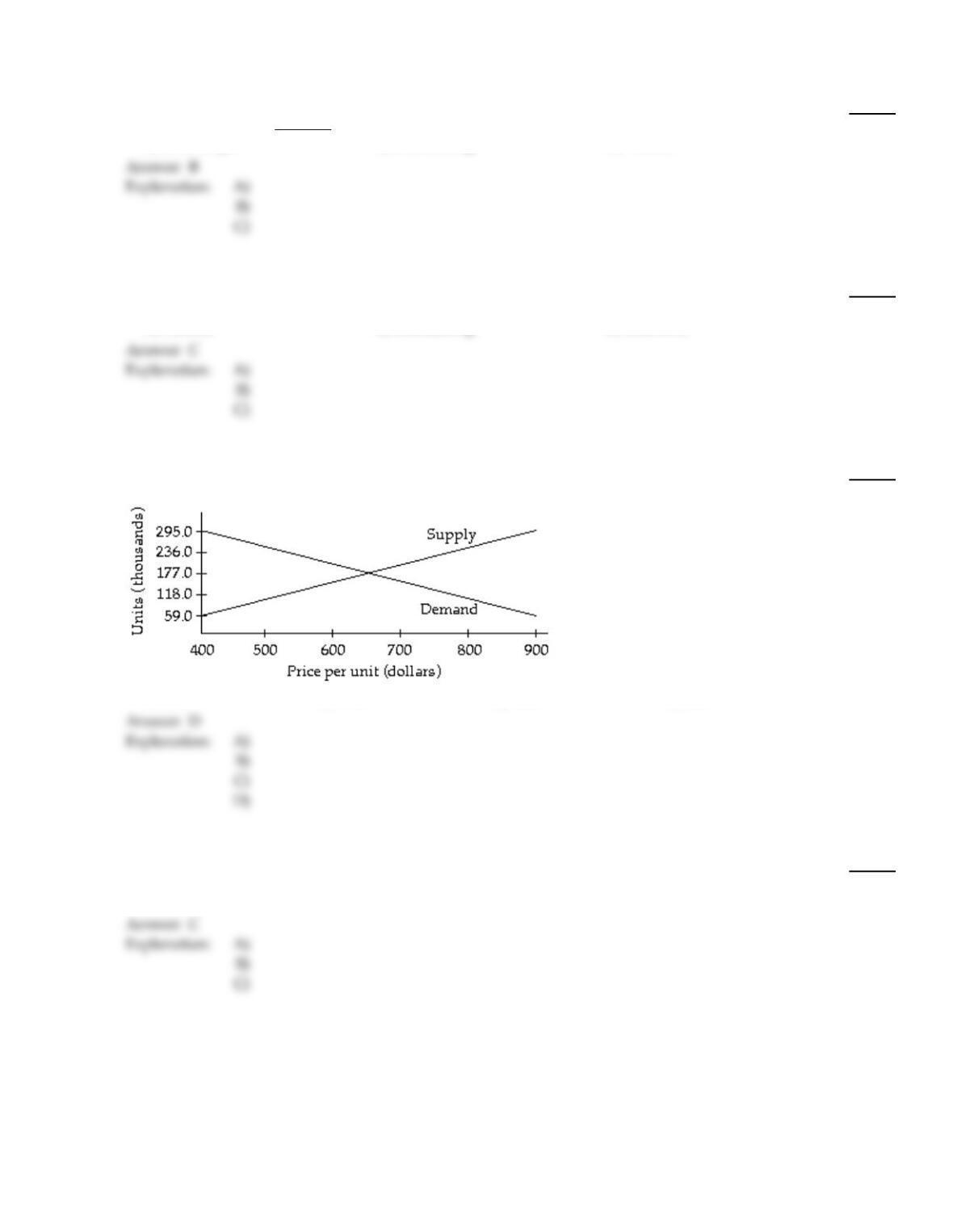
106)
The graphs below represent the supply and demand for a product at various prices per unit. At
what price does supply equal demand?
106)
A)
$177
B)
$900
C)
$400
D)
$650
Does the system have one solution, no solution, or an infinite number of solutions?
107)
2x + 3y = 6
4x + 6y = 12
107)
A)
One
B)
No Solution
C)
Infinite number
42
Write a system of equations for the problem, and then solve the system.
108)
The two largest oil spills together released 290 million gallons of oil into the oceans. The smaller of
the two released 78 million gallons less than the larger of the two. How many million gallons did
the largest and the smallest oil spills release?
108)
A)
Largest oil spill: 212 million gal; smallest oil spill: 184 million gal
B)
Largest oil spill: 106 million gal; smallest oil spill: 131 million gal
C)
Largest oil spill: 212 million gal; smallest oil spill: 106 million gal
D)
Largest oil spill: 184 million gal; smallest oil spill: 106 million gal
Graph the solution of the system.
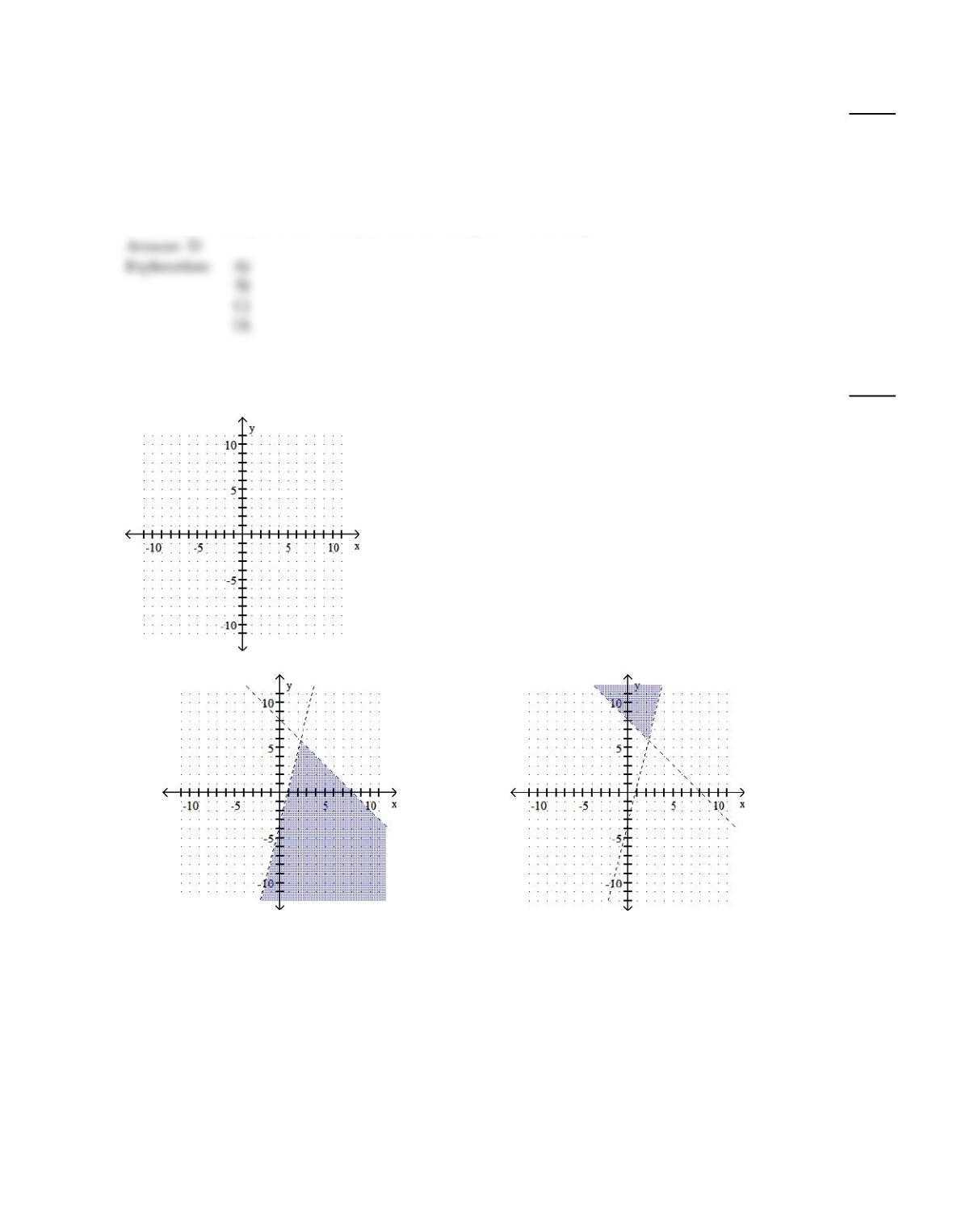
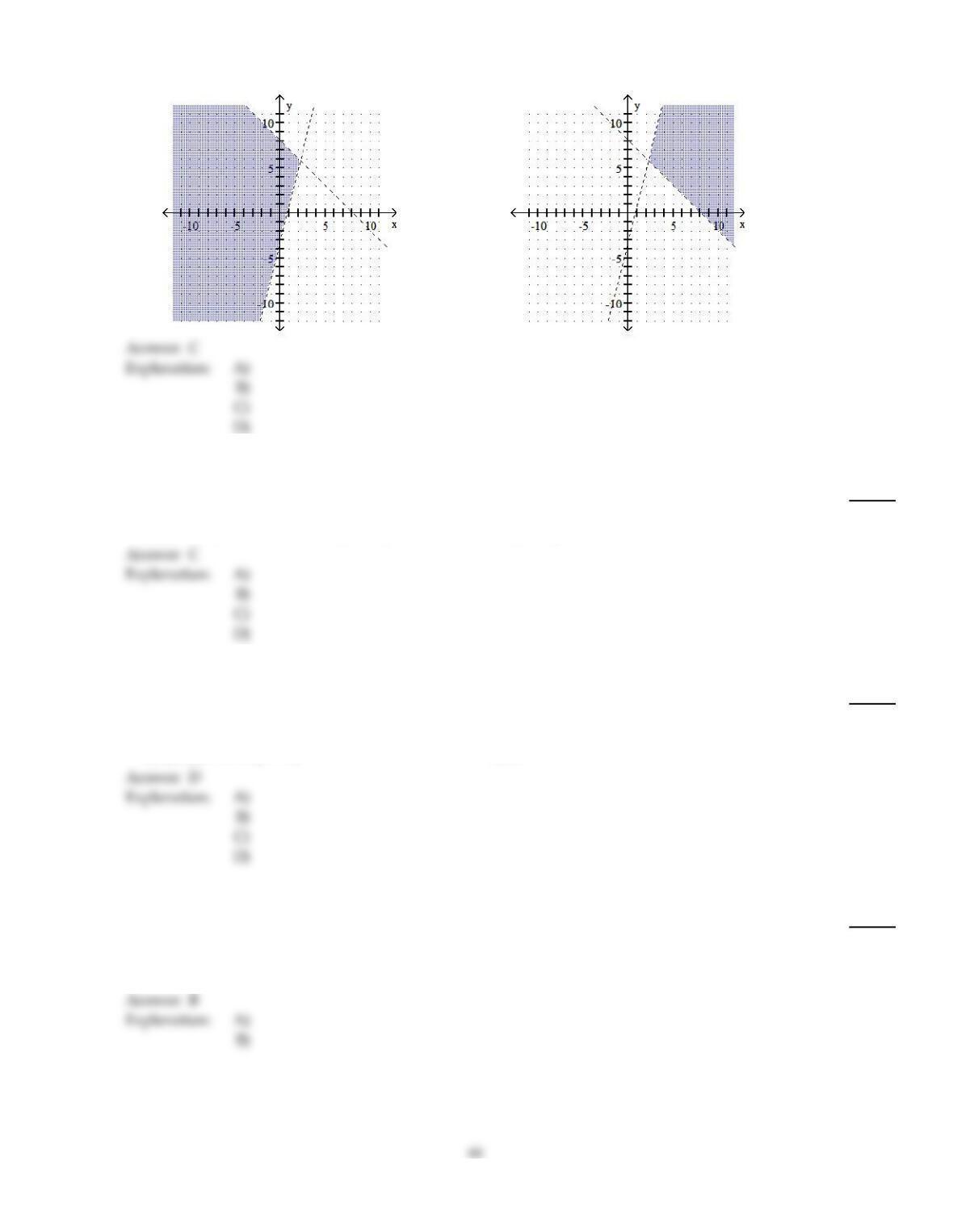
109)
x + y <8
–4x + y > – 3
109)
A)
B)
43
C)
D)
Solve the system by elimination.
110)
x – 5y =35
3x – 6y =51
110)
A)
{(–5, –5)}
B)
{(4, –5)}
C)
{(5, –6)}
D)
Solve the system by the elimination method.
111)
–3x + 3y =5
–6x + 6y = –10
111)
A)
{(–15, 15)}
B)
{(15, –15)}
C)
{(x, y)|–3x + 3y =5}
D)
Decide whether or not the ordered pair is a solution of the system.
112)
(1, 5)
2x =3– y
3x =7– 2y
112)
A)
Yes
B)
No
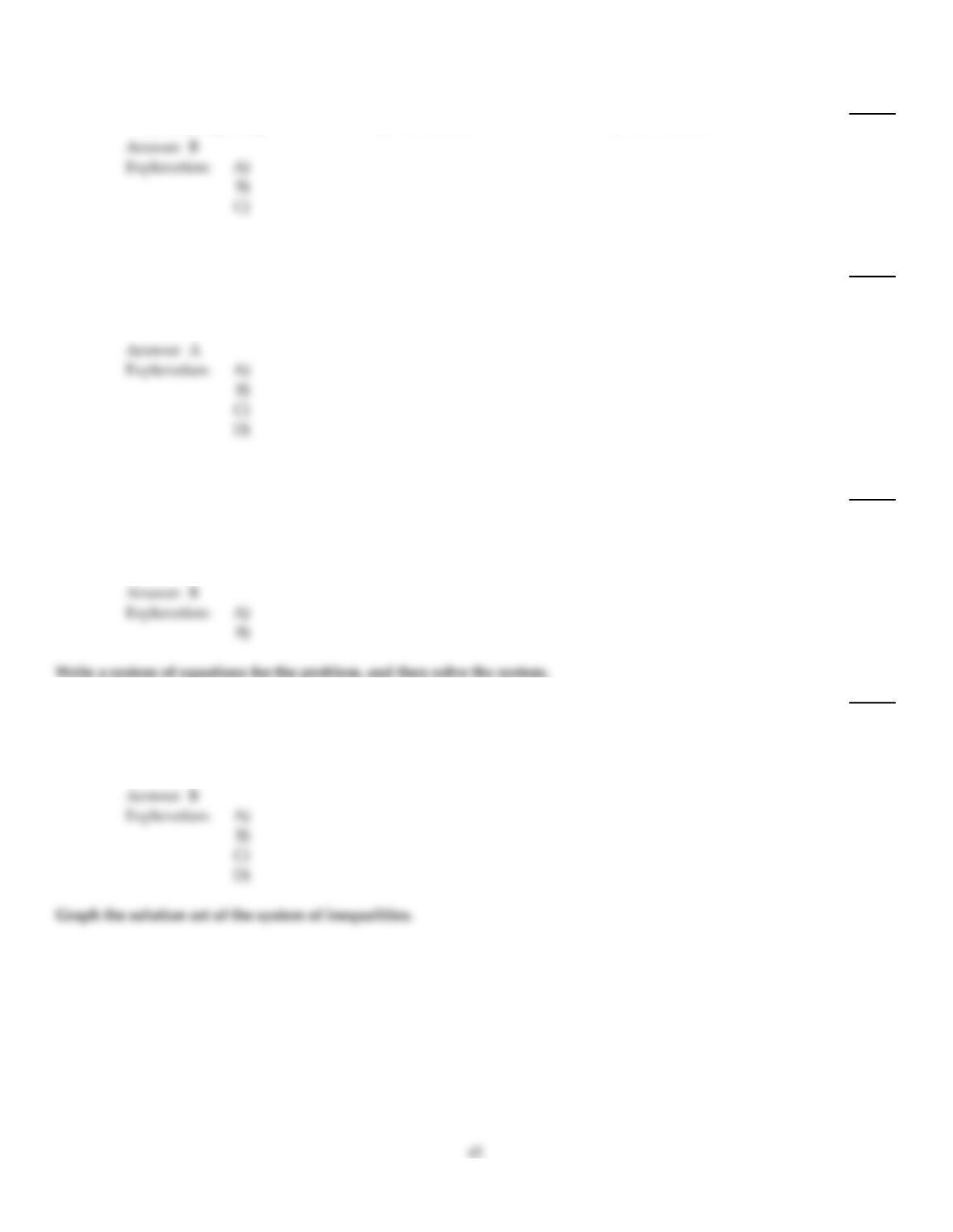
Provide an appropriate response.
113)
When solving a system of equations, you get x – 4 = x + 2. How many solutions are there?
113)
A)
Infinitely many
B)
No solutions
C)
One solution
Solve the system by elimination.
114)
–7x + 9y =42
–4x + 6y =24
114)
A)
{(–6, 0)}
B)
{(–7, 1)}
C)
{(x, y)|–4x + 6y =24}
D)
Provide an appropriate response.
115)
A student was asked to find ordered pairs that solve the system of equations
x + 2y = 3
–2x – 4y = –6.
The student claims that (1, 1) and (–1, 2) are the only solutions. Is the student correct?
115)
A)
Yes
B)
No
116)
The owner of Nuts2U Snack Shack mixes cashews worth $5.50 per pound with peanuts worth $2.00
per pound to get a half–pound, mixed–nut bag worth $1.80. How much of each kind of nut is
included in the mixed bag?
116)
A)
Cashews: 0.07 lb; peanuts: 0.43 lb
B)
Cashews: 0.23 lb; peanuts: 0.27 lb
C)
Cashews: 0.27 lb; peanuts: 0.23 lb
D)
Cashews: 0.10 lb; peanuts: 0.40 lb
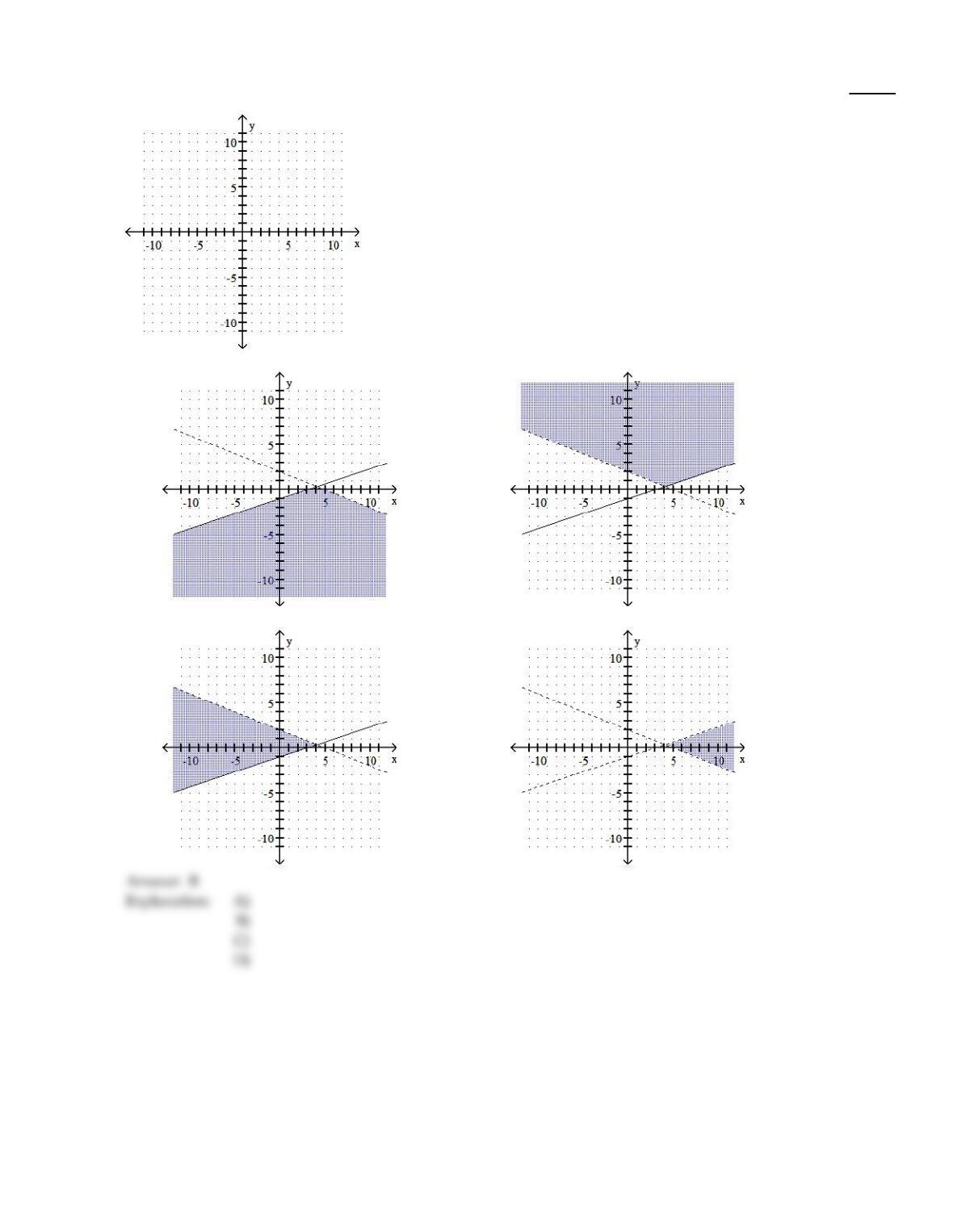
117)
2x + 5y >10
x – 3 3y
117)
A)
B)
C)
D)
46
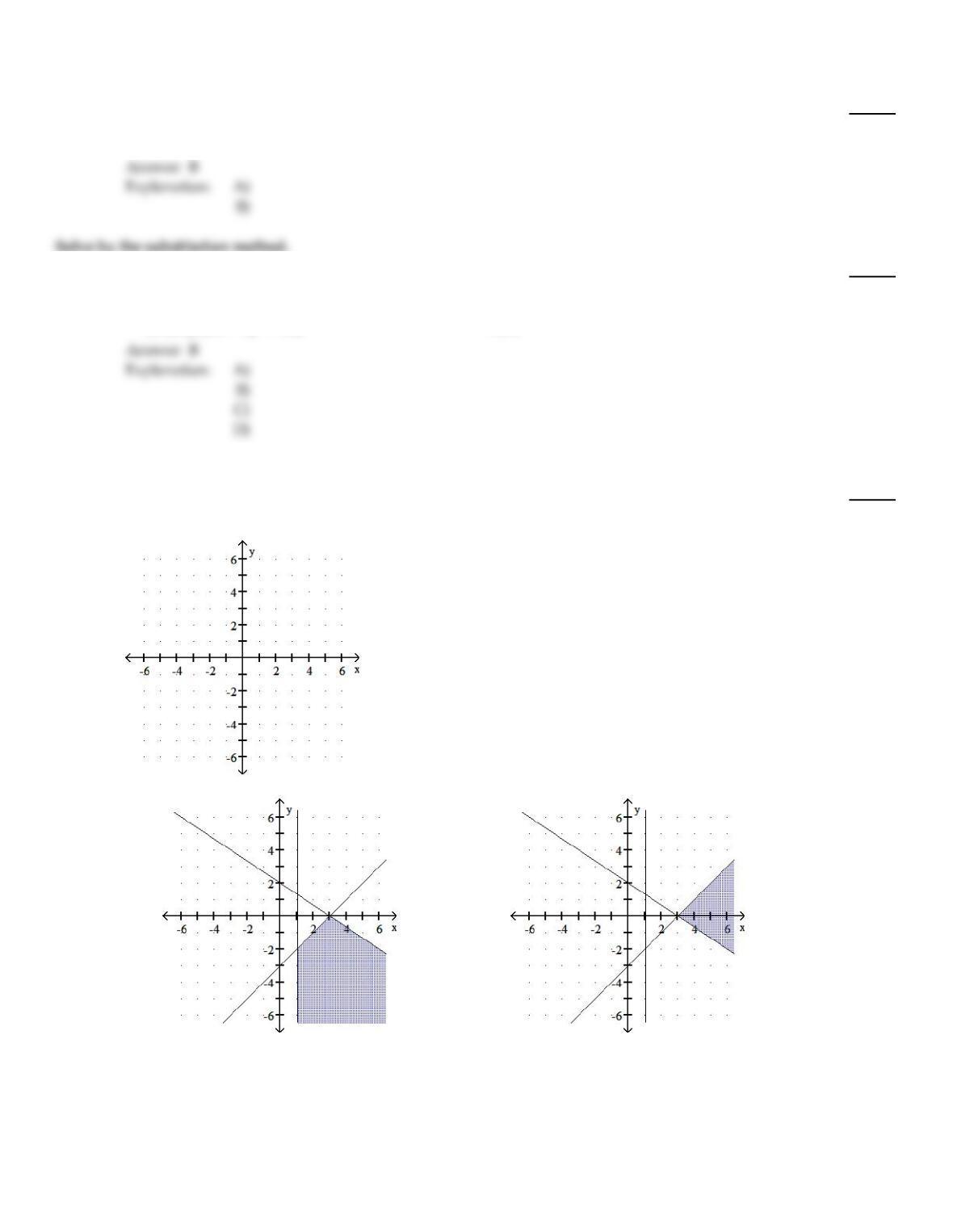
Indicate whether the statement is true or false.
118)
When graphing a linear inequality, the origin can always be used as a test point for determining
which side of a boundary line should be shaded.
118)
A)
True
B)
False
119)
8x – 7y = –32
–5x – 2y =20
119)
A)
{(–5, 1)}
B)
{(–4, 0)}
C)
{(x, y)|8x – 7y = –32}
D)
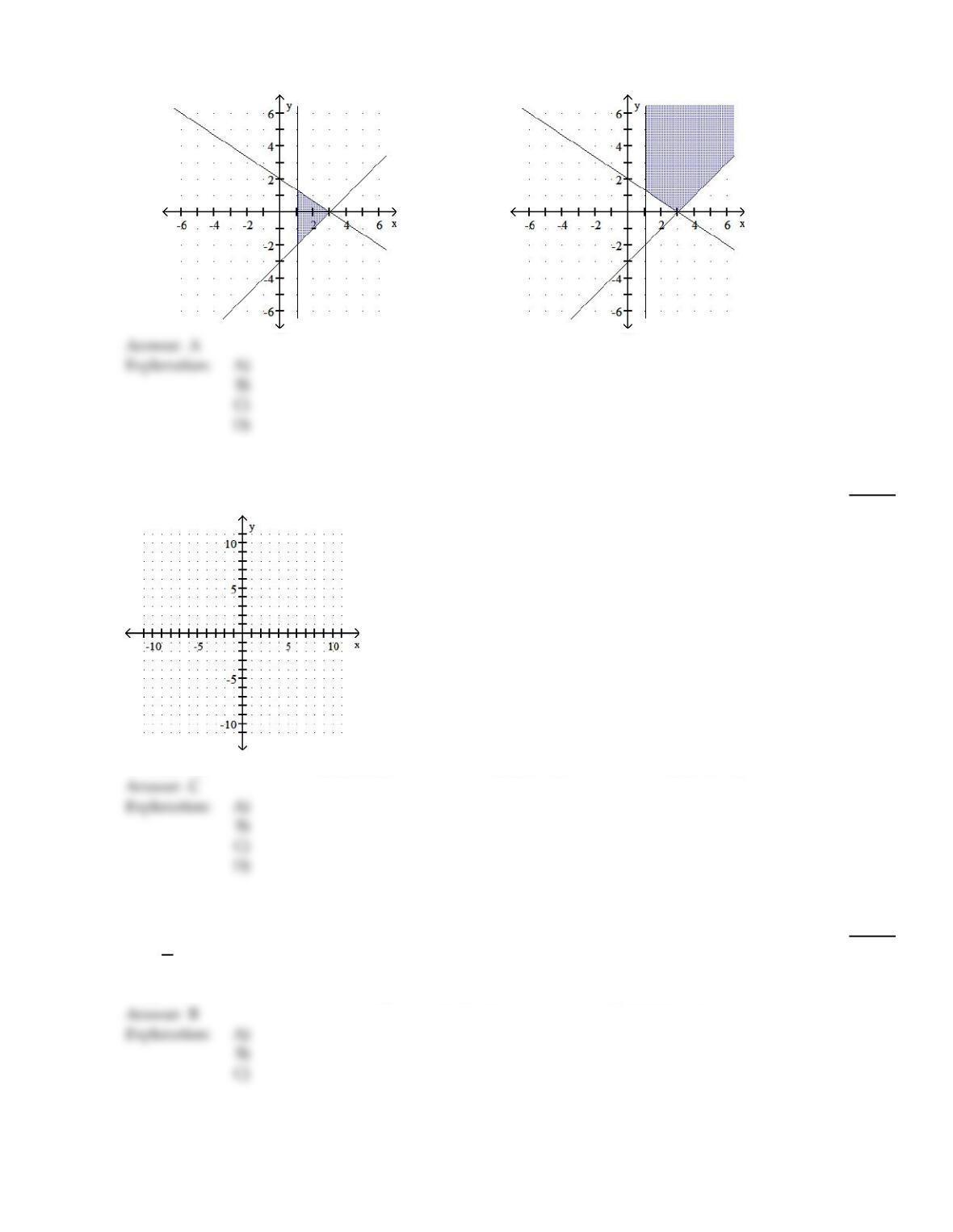
Graph the solution of the system.
120)
2x + 3y 6
x – y 3
x 1
120)
A)
B)
47
C)
D)
Solve the system by graphing.
121)
2x + y =1
x + 3y = –12
121)
A)
{(3, 2)}
B)
{(–2, 5)}
C)
{(3, –5)}
D)
{(–3, –5)}
Does the system have one solution, no solution, or an infinite number of solutions?
122)
x + 2y = 0
y = – 1
2x
122)
A)
One
B)
Infinite number
C)
No Solution
48
Solve by the substitution method.
123)
x – 4y = –16
–4x – 3y = –12
123)
A)
{(1, 3)}
B)
{(–4, 0)}
C)
{(0, 4)}
D)
124)
(–6, –1)
x + y = –7
x – y = –5
124)
A)
No
B)
Yes
B
Solve the system by elimination.
125)
–3x + 2y = –6
6x – 4y = –12
125)
A)
{(18, –12)}
B)
{(–18, 12)}
C)
{(x, y)|–3x + 2y = –6}
D)
D
Provide an appropriate response.
126)
Decide if the system has one solution, no solution, or an infinite number of solutions.
x + y =2
x + y =3
126)
A)
One
B)
Infinite number
C)
No solution
C
Solve the system by substitution.
127)
3x + y = –2
y =3x – 2
127)
A)
{(–1, –5)}
B)
{(–2, 4)}
C)
{(0, –2)}
D)
{(–2, 0)}
C
49
C
Solve the system by the elimination method.
128)
x – 4y = 8
–6x – 3y = 6
128)
A)
{(1, –3)}
B)
{(2, 0)}
C)
{(0, –2)}
D)
129)
Two cars leave a city and head in the same direction. After 5 hours, the faster car is 35 miles ahead
of the slower car. The slower car has traveled 255 miles. Find the speeds of the two cars.
129)
A)
44 mph and 51 mph
B)
53 mph and 60 mph
C)
70 mph and 77 mph
D)
51 mph and 58 mph
130)
(–3, 5)
3x =14 – y
2x =21 – 3y
130)
A)
Yes
B)
No
131)
5x – 6y = 0
–2x + 4y =0
131)
A)
{(2, 1)}
B)
{(2, 0)}
C)
D)
{(0, 0)}
132)
Decide if the system has one solution, no solution, or an infinite number of solutions.
4x – y =13
x + 2y =10
132)
A)
One
B)
No solution
C)
Infinite number
133)
Decide whether the elimination method or the substitution method involves the least amount of
work. Do not solve.
7x + 5y = –78
5x – 2y = –39
133)
A)
Substitution
B)
Elimination
134)
x + y =4
x + y =5
134)
A)
Infinite number
B)
One
C)
No Solution
135)
A system of linear inequalities can have solutions in all quadrants.
135)
A)
True
B)
False
136)
A chemist has a 25% solution of alcohol to mix with a 59% solution to get 170 L of a final mixture
that is 45% alcohol. How much of each of the original solutions should he use?
136)
A)
70 L of 25%; 100 L of 59%
B)
100 L of 25%; 70 L of 59%
C)
73 L of 25%; 100 L of 59%
D)
73 L of 25%; 97 L of 59%
137)
x – 3y = 6
3y + 1 = x
137)
A)
One
B)
No Solution
C)
Infinite number
Solve the system by the elimination method.
138)
x + 5y = –7
4x + 6y = –28
138)
A)
{(–6, –1)}
B)
{(–6, –7)}
C)
{(–7, 0)}
D)
Does the system have one solution, no solution, or an infinite number of solutions?
139)
x – 2y = 5
2x – 4y = 18
139)
A)
One
B)
No Solution
C)
Infinite number
Solve by the substitution method.
140)
0.2x + 0.8y = –5.8
0.1x – 0.1y =0.6
140)
A)
{(–1, –7)}
B)
C)
{(x, y)| 0.2x + 0.8y = –5.8}
D)
{(–7, –1)}
Solve the system by the elimination method.
141)
7x + 8y =67
3x + 6y =39
141)
A)
{(5, 5)}
B)
{(4, 5)}
C)
{(5, 4)}
D)
52
Write a system of equations for the problem, and then solve the system.
142)
x units of a product cost C dollars to manufacture and earn a revenue of R dollars. Suppose that
C =1.90x +56, R =5.90x, and no more than 9 units can be sold. Find the break–even quantity and
decide whether the product should be produced on the basis of whether it will earn a profit.
142)
A)
29 units; Do not produce: the product will lead to a loss
B)
14 units; Do not produce: the product will lead to a loss
C)
14 units; Produce: the product will earn profit
D)
7 units; Produce: the product will lead to a loss
143)
Two different gasohol mixtures are available. One contains 5% alcohol and the other 12% alcohol.
How much of each should be mixed to obtain 1250 gallons of gasohol containing 10% alcohol?
Gallons of
Gasohol Percent
(as decimal) Gallons of Pure
Gasohol
x0.05
y0.12
1250 0.10
143)
A)
357 gal 5%, 893 gal 12%
B)
893 gal 5%, 893 gal 12%
C)
63 gal 5%, 150 gal 12%
D)
521 gal 5%, 729 gal 12%
Use a graphing calculator to solve the system.
144)
5x + y =23
x + 6y = –7
144)
A)
{(5, 4)}
B)
{(5, –2)}
C)
{(–5, –2)}
D)
{(4, 3)}
Solve by the substitution method.
145)
–0.5x – 0.5y = –2
–0.1x – 0.4y = –0.1
145)
A)
{(4.4, 1.3)}
B)
{(5, –1)}
C)
{(8.3, 3.5)}
D)
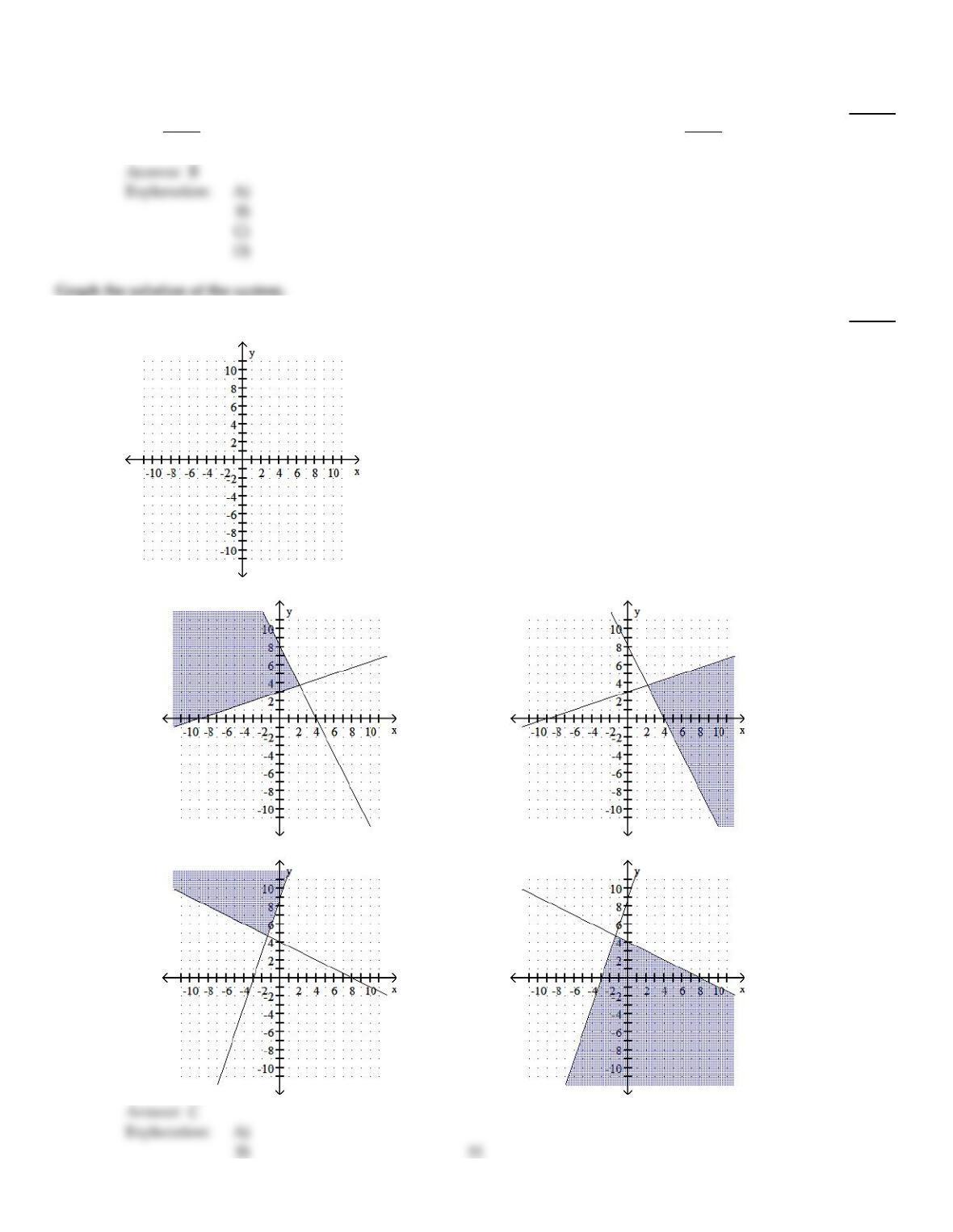
Solve the problem by using a system of equations.
146)
South Wind Vineyards uses 990 acres to plant Chardonnay and Riesling grapes. The vintner knows
the profits will be greatest by planting 210 more acres of Chardonnay than Riesling. How many
acres of each grape should be planted?
146)
A)
Riesling: 390 acres; Chardonnay: 600 acres
B)
Riesling: 291 acres; Chardonnay: 699 acres
C)
Riesling: 489 acres; Chardonnay: 501 acres
D)
Riesling: 600 acres; Chardonnay: 390 acres
147)
2x – y = 5
–4x + 2y = –18
147)
A)
Infinite number
B)
No Solution
C)
One
148)
Solving for which variable in which equation involves the least amount of work?
2x =4
x – 7y =30
148)
A)
y in equation 1
B)
x in equation 1
C)
x in equation 2
D)
y in equation 2
149)
If the y term is missing in only one of two linear equations, the lines are ?
149)
A)
One Graph
B)
Parallel
C)
Intersecting
D)
Parallel or One Graph
Choose the correct response.
150)
Which expression represents the cost of t pounds of candy that sells for $6.00 per lb?
150)
A)
$6.00
t
B)
$6.00t
C)
$6.00 + t
D)
t
$6.00
151)
3x – y –9
x + 2y 8
151)
A)
B)
C)
D)
Without graphing, tell if the system is inconsistent, the equations are dependent, or neither.
152)
x + 4y =21
5x – 5y =5
152)
A)
Neither
B)
Inconsistent
C)
Dependent
Solve the problem by using a system of equations.
153)
Two cars leave from a city at the same time and travel in the same direction. One car travels
one–half and one–half times as fast as the other. After 1 hr, they are 10 mi apart. What are the
speeds of the cars?
153)
A)
Slower car: 15 mph; faster car: 25 mph
B)
Slower car: 20 mph; faster car: 30 mph
C)
Slower car: 25 mph; faster car: 35 mph
D)
Slower car: 10 mph; faster car: 20 mph
Solve the system by the elimination method.
154)
9x + 21 = 4y
2x – 2y = 2
154)
A)
{(–5, –6)}
B)
{(–5, –5)}
C)
{(–6, –5)}
D)
Indicate whether the statement is true or false.
155)
A system of linear inequalities can have solutions in only one quadrant.
155)
A)
True
B)
False
Decide if the graph of the system is a pair of parallel lines, intersecting lines, or one line.
156)
x + y = –13
x – y = –3
156)
A)
Parallel
B)
Intersecting
C)
One Line
56
Solve by the substitution method.
157)
7x + 6y = –30
4x + 4y = –20
157)
A)
{(–1, –4)}
B)
{(0, –4)}
C)
{(0, –5)}
D)
Does the system have one solution, no solution, or an infinite number of solutions?
158)
x – 2 = y
y + 5 = x
158)
A)
Infinite number
B)
One
C)
No Solution
159)
x – y =4
x + y =10
159)
A)
{(6, 14)}
B)
{(14, 6)}
C)
{(7, 3)}
D)
{(3, 7)}
Solve by the substitution method.
160)
0.3x + 0.2y =1.3
x – 0.6y =5.6
160)
A)
{(5, –1)}
B)
C)
{(0.5, –0.1)}
D)
{(–1, 5)}
57
161)
2x – 4y =2
y =1
2x –1
2
161)
A)
One
B)
No Solution
C)
Infinite number
Graph the solution of the system.
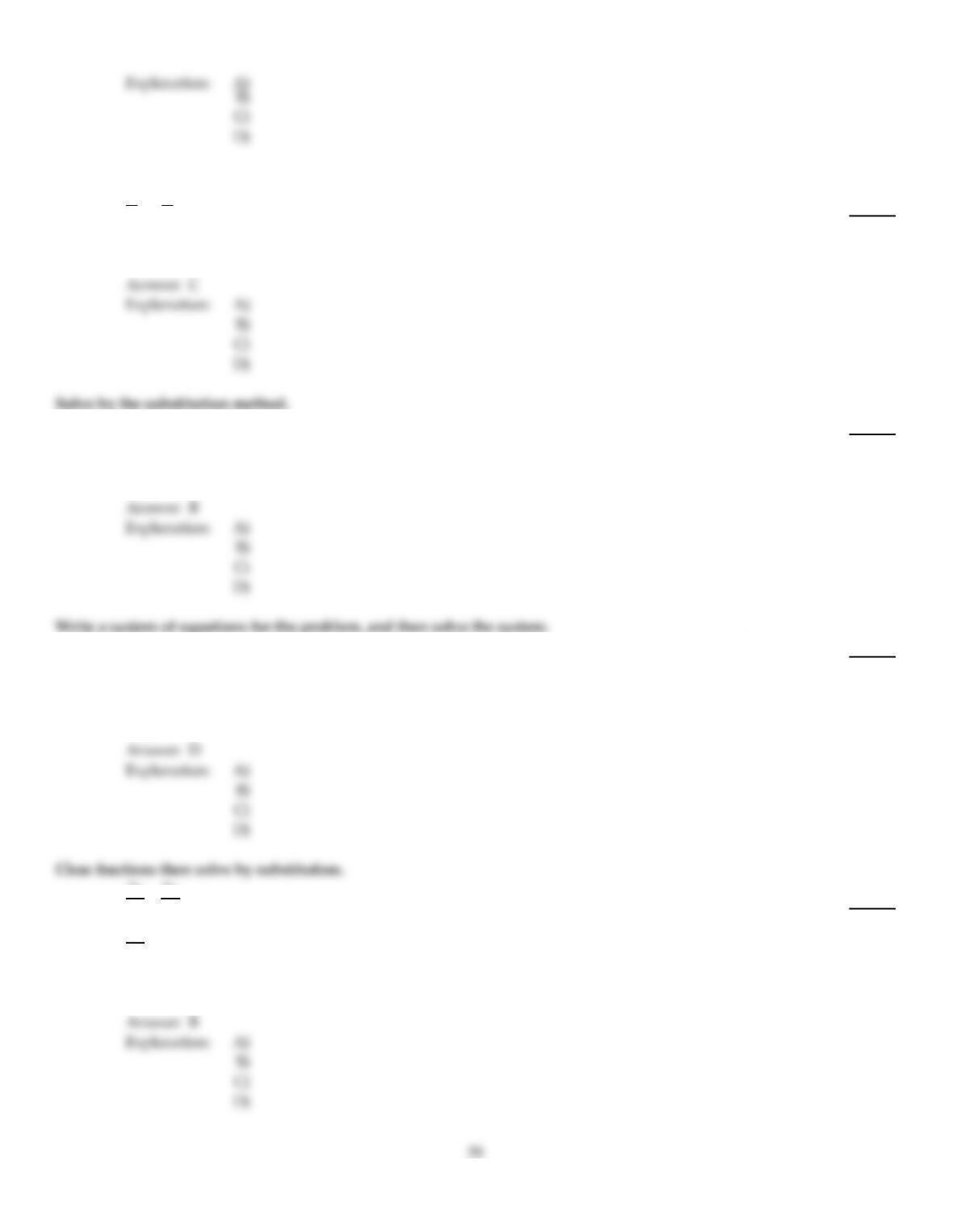
162)
2x + 3y 6
x – y 3
y 2
162)
A)
B)
C)
D)
Clear fractions then solve by substitution.
163)
1
2x +1
2y = –2
x – y = –2
163)
A)
{(–4, 0)}
B)
{(3, 0)}
C)
{(–3, –1)}
D)
164)
x – 7y =6
–7x – 6y = –42
164)
A)
{(–6, –1)}
B)
{(6, 0)}
C)
{(x, y)|x – 7y =6}
D)
165)
Two trains start from towns 129miles apart and travel toward each other on parallel tracks. They
pass each other 1.5 hours later. If one train travels 4 mph faster than the other, find the speed of
each train.
165)
A)
47 mph; 39 mph
B)
35 mph; 51 mph
C)
40 mph; 46 mph
D)
45 mph; 41mph
Clear fractions then solve by substitution.
166)
7x
3+5y
4= 4
5x
6– 2y = 21
166)
A)
{(–6, 8)}
B)
{(6, –8)}
C)
{(x, y)| 7x + 5y = 48}
D)
Provide an appropriate response.
167)
When two linear equations are solved for y and the slopes are equal and the y–intercepts are
the same, the lines are ?
167)
A)
Intersecting
B)
Parallel
C)
One Graph
168)
When graphing a system of linear inequalities, the final shaded region is made up of all points
which belong to the graphs of either of the individual inequalities.
168)
A)
True
B)
False
169)
3x – 2y =14
3x + 2y =22
169)
A)
{(2, 6)}
B)
{(3, 13)}
C)
{(6, 2)}
D)
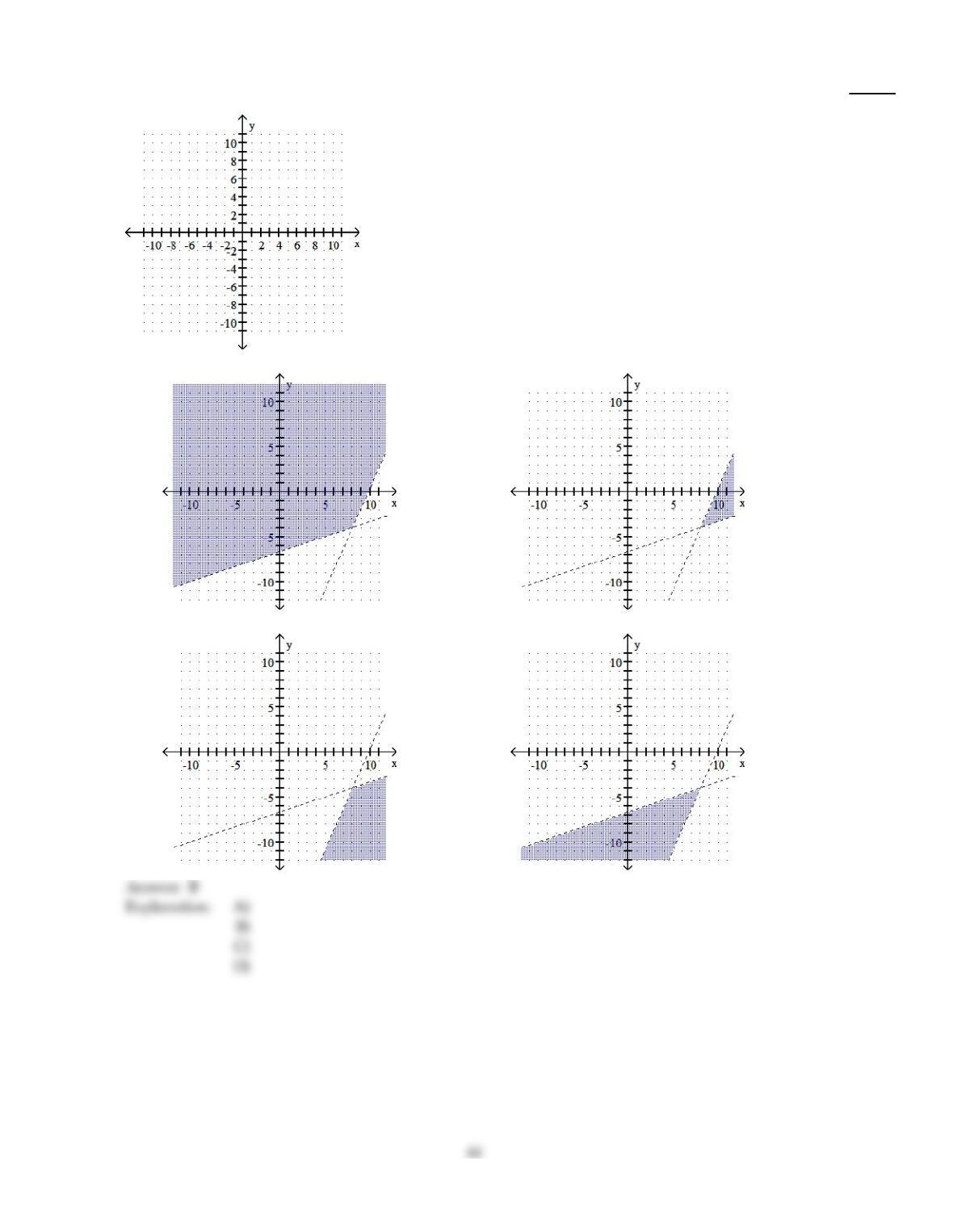
170)
9x – 4y <88
x – 3y >20
170)
A)
B)
C)
D)
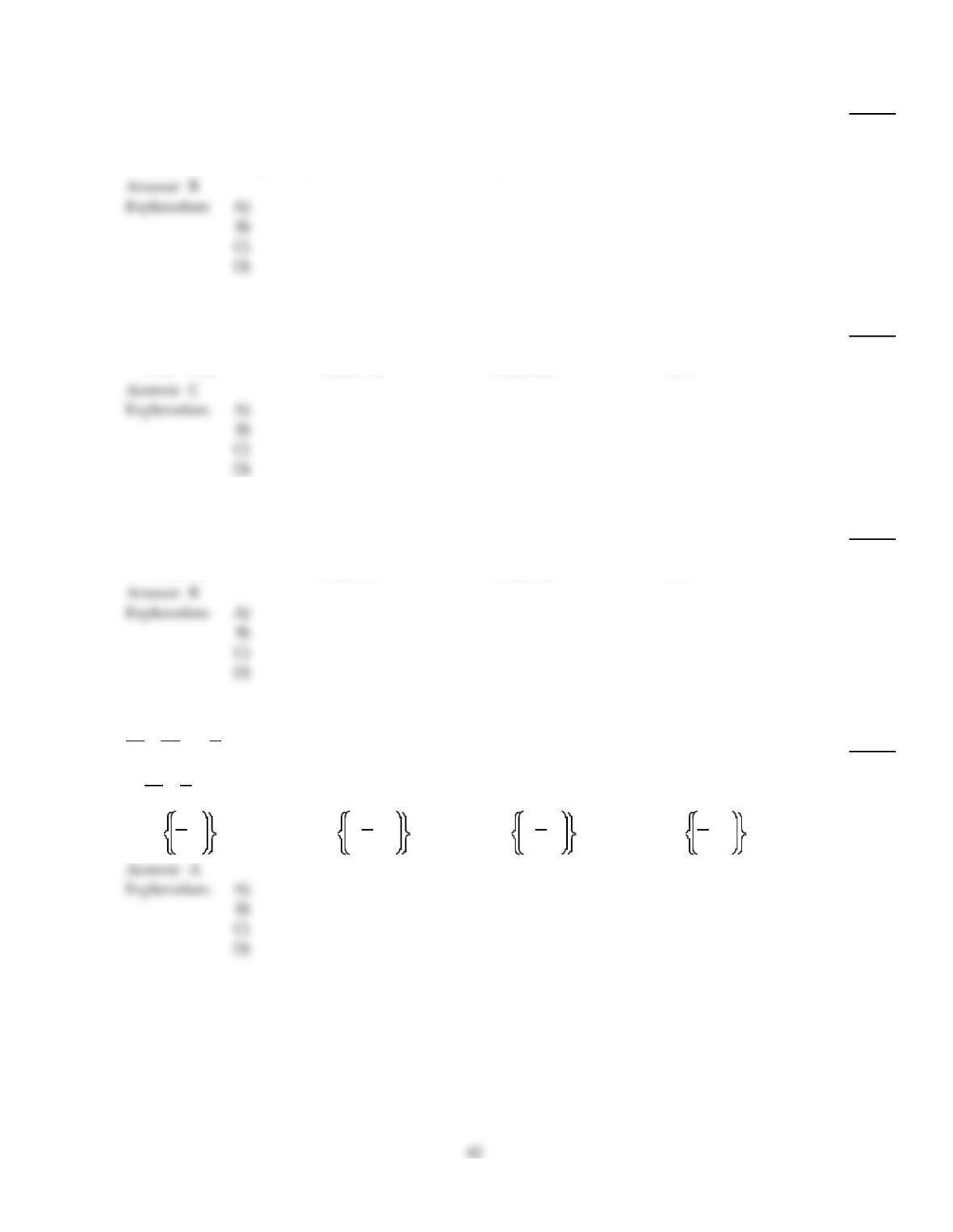
Solve the system by elimination.
171)
6x – 12 =6y
–2x + 4y = –12
171)
A)
{(–3, –3)}
B)
{(–2, –4)}
C)
{(x, y)| –2x + 4y = –12}
D)
Solve the system by the elimination method.
172)
–7x + 4y =32
–5x – 2y = –16
172)
A)
{(–1, 9)}
B)
{(0, 9)}
C)
{(0, 8)}
D)
Solve the system by elimination.
173)
9x + 8y = 0
6x – 2y = 0
173)
A)
{(0, 1)}
B)
{(0, 0)}
C)
{(2, 1)}
D)
Clear fractions then solve by substitution.
174)
5x
2–5y
4= – 5
2
8x
9=4
9
174)
A)
1
2, 3
B)
–1
2, –3
C)
–1
2, 3
D)
1
2, –3
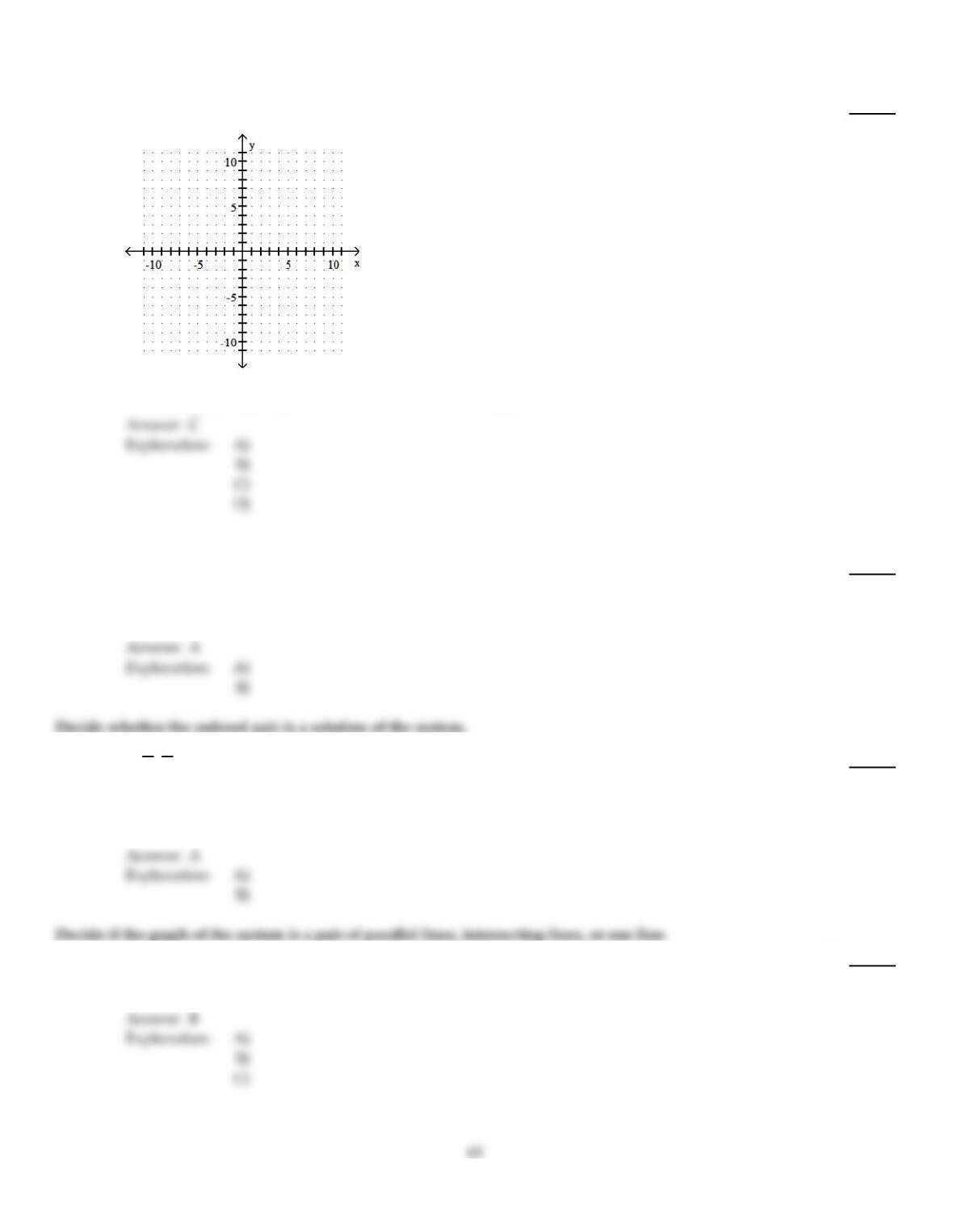
Solve the system by graphing.
175)
2x + y =10
6x + 3y =30
175)
A)
{(0, 10)}
B)
{(5, 0)}
C)
{(x, y)| 2x + y =10}
D)
Decide whether or not the ordered pair is a solution of the system.
176)
(–5, 6)
4x + y = –26
3x + 4y = –39
176)
A)
No
B)
Yes
177)
(–4
3, 4
3)
y – 2x =4
x + y =0
177)
A)
Yes
B)
No
178)
x =22
5x – 3y =18
178)
A)
Parallel
B)
Intersecting
C)
One Line
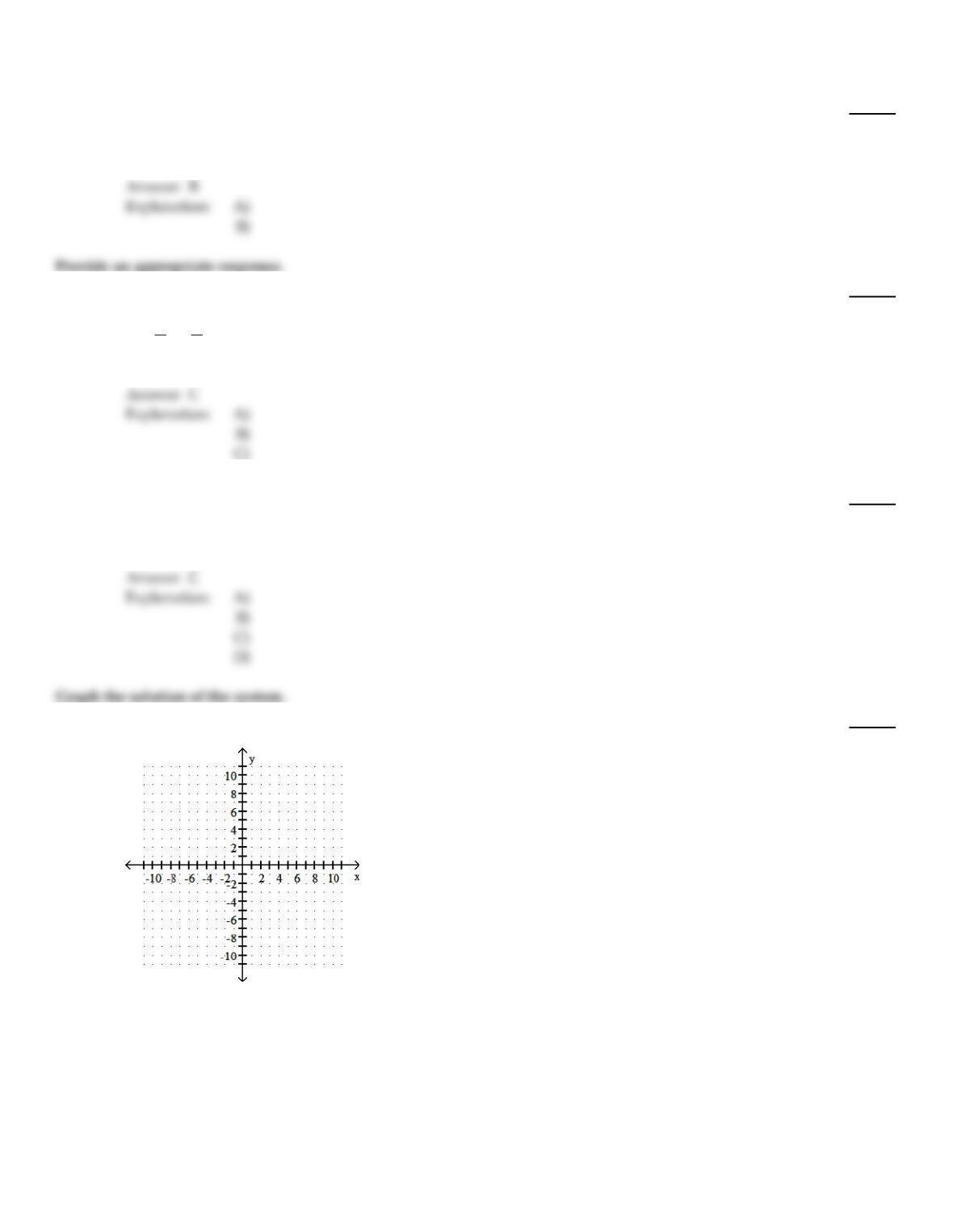
Decide whether or not the ordered pair is a solution of the system.
179)
(–4, –1)
3x + y = –13
4x + 3y = –19
179)
A)
No
B)
Yes
180)
Decide if the system has one solution, no solution, or an infinite number of solutions.
3x – 9y =6
y =1
3x –2
3
180)
A)
No solution
B)
One
C)
Infinite number
181)
Solving for which variable in which equation involves the least amount of work?
x + 9y = 0
x – 9y =72
181)
A)
y in equation 1
B)
y in equation 2
C)
x in equation 1
D)
x in equation 2
182)
x – y 2
x + y 8
182)
64
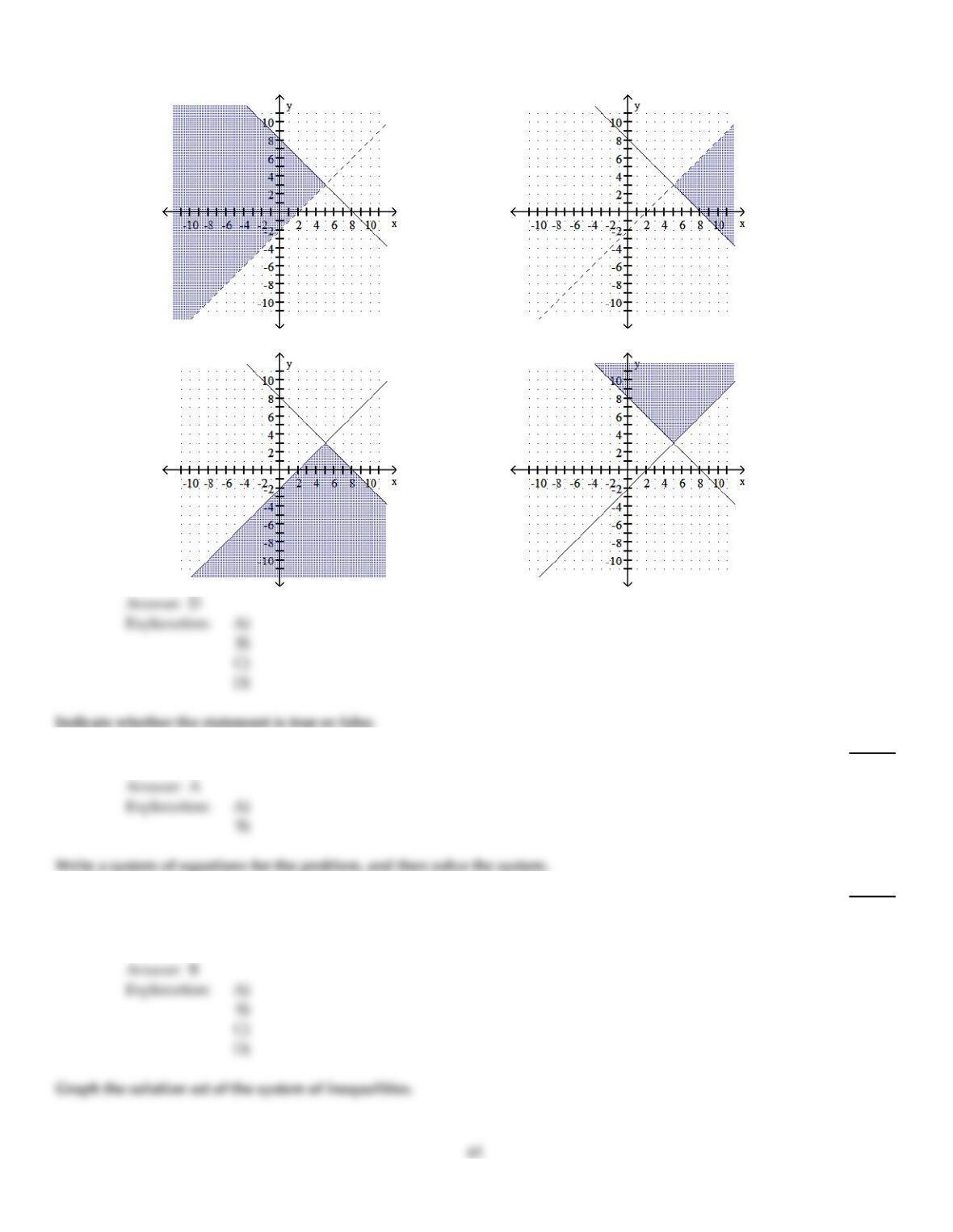
A)
B)
C)
D)
183)
It is impossible for a system of two linear inequalities to have exactly one solution.
183)
A)
True
B)
False
184)
A biologist collected 305 fern and moss samples. There were 37 fewer ferns than moss samples.
How many fern and moss samples did the biologist collect?
184)
A)
Fern samples: 171; moss samples: 134
B)
Fern samples: 134; moss samples: 171
C)
Fern samples: 171; moss samples: 268
D)
Fern samples: 104; moss samples: 134
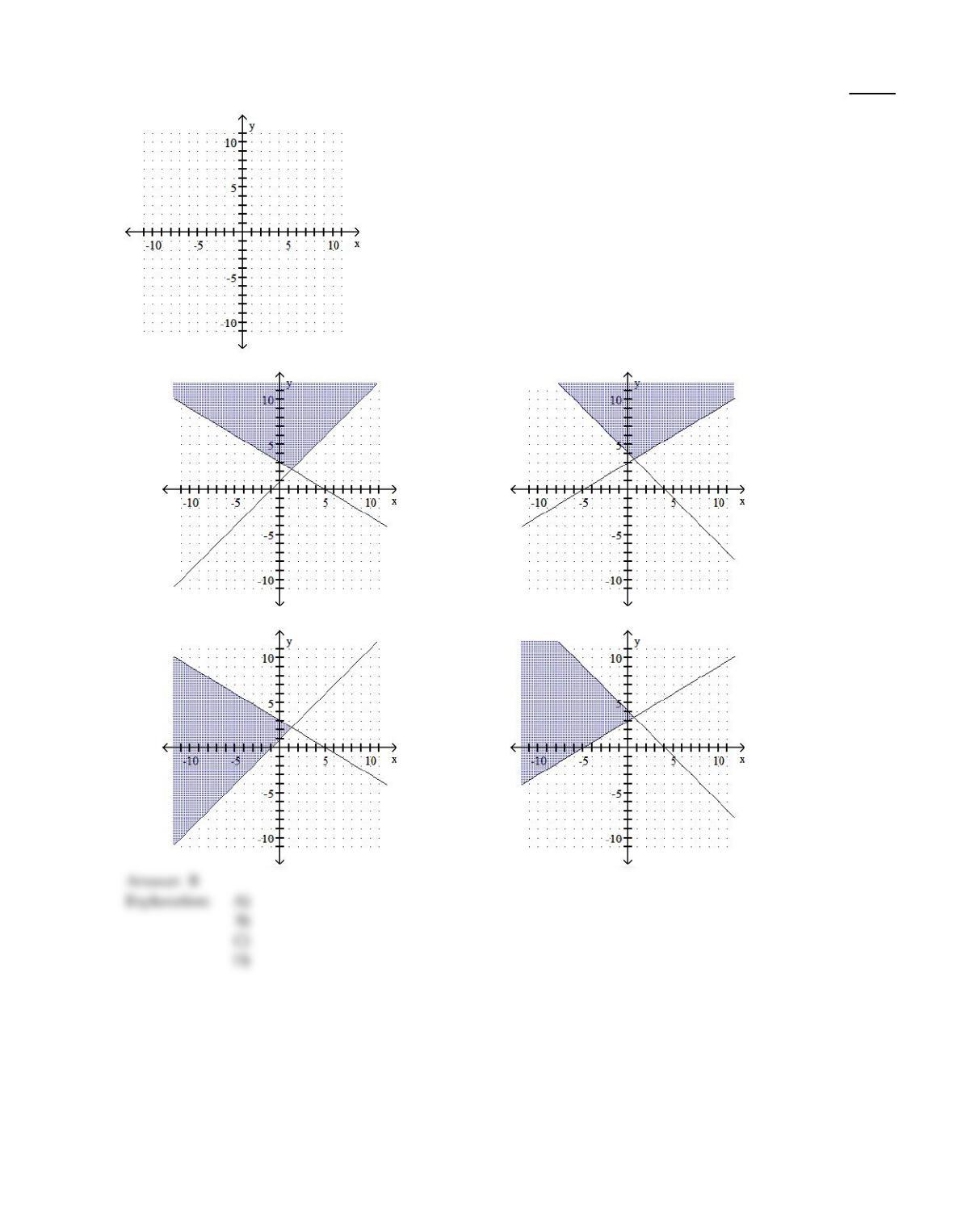
185)
x + y 4
3x –5y –15
185)
A)
B)
C)
D)
66
Without graphing, tell if the system is inconsistent, the equations are dependent, or neither.
186)
x + y = –1
x – y = –15
186)
A)
Dependent
B)
Neither
C)
Inconsistent
Solve the system by the elimination method.
187)
x – 3y =16
–4x – 4y =16
187)
A)
{(1, –5)}
B)
{(–1, –4)}
C)
{(0, –4)}
D)
A
Without graphing, tell if the system is inconsistent, the equations are dependent, or neither.
188)
x + y =14
2x – 2y =14
188)
A)
Inconsistent
B)
Dependent
C)
Neither
C
Solve the system by elimination.
189)
–3x + 5y =1
–9x + 15y =3
189)
A)
{(5, –3)}
B)
{(–3, 5)}
C)
{(x, y)|–3x + 5y =1}
D)
C
Decide if the graph of the system is a pair of parallel lines, intersecting lines, or one line.
190)
x + 4y =10
2x + 8y =22
190)
A)
Intersecting
B)
Parallel
C)
One Line
B
67
B
191)
(11, 3)
y – 3x =2
x + y =14
191)
A)
Yes
B)
No
Clear fractions then solve by substitution.
192)
3x
8–3y
5=33
80
4x
7+4y
5=37
35
192)
A)
3
4, 1
2
B)
3
2, 1
4
C)
1
4, 1
2
D)
3
2, 3
4
193)
–5x – 6y = –12
2x – 2y = –4
193)
A)
{(0, 3)}
B)
{(0, 2)}
C)
D)
{(–1, 3)}
194)
9x – 3y = –3
–3x + y = –1
194)
A)
Neither
B)
Inconsistent
C)
Dependent
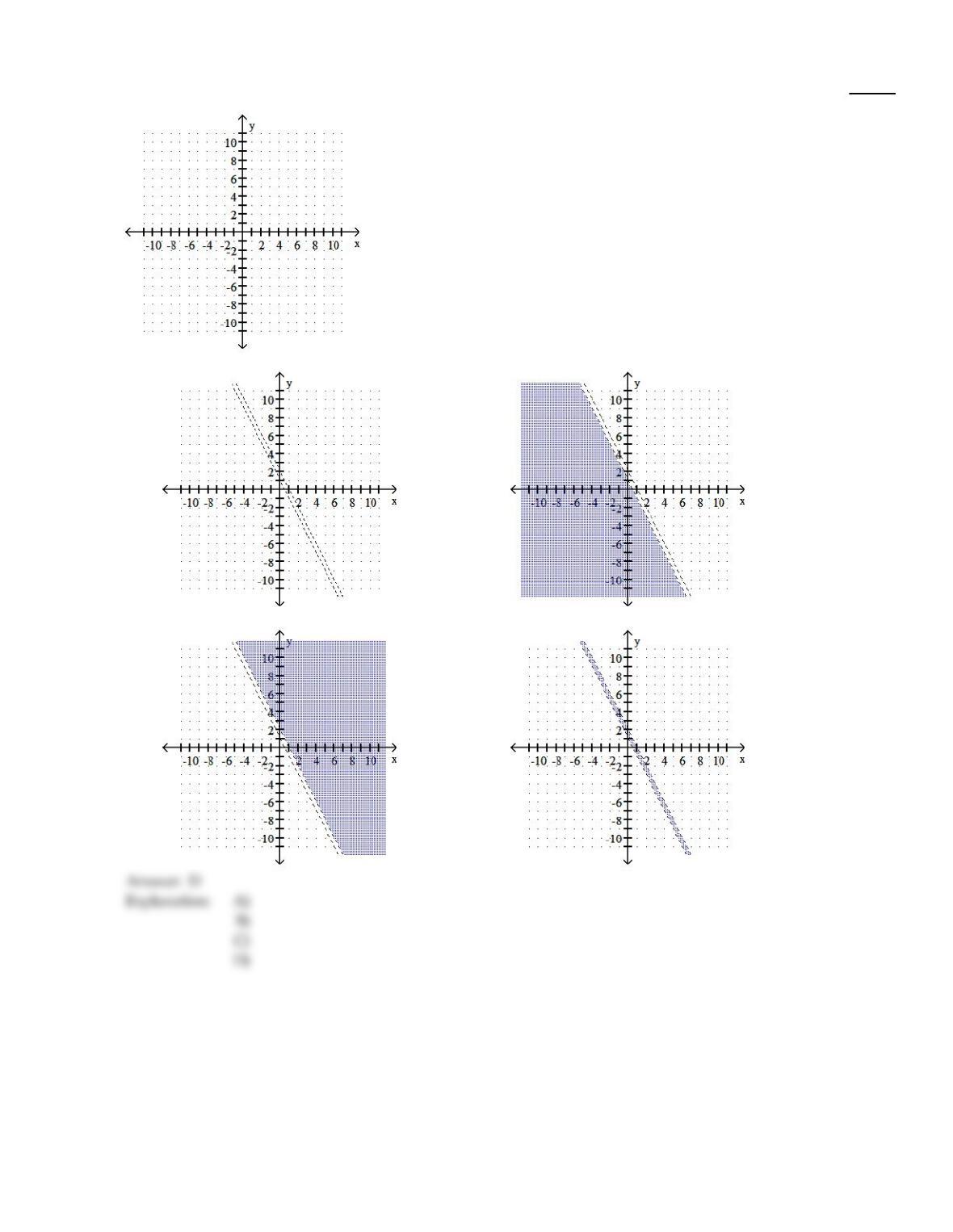
195)
2x + y <2
2x + y >1
195)
A)
B)
C)
D)
69
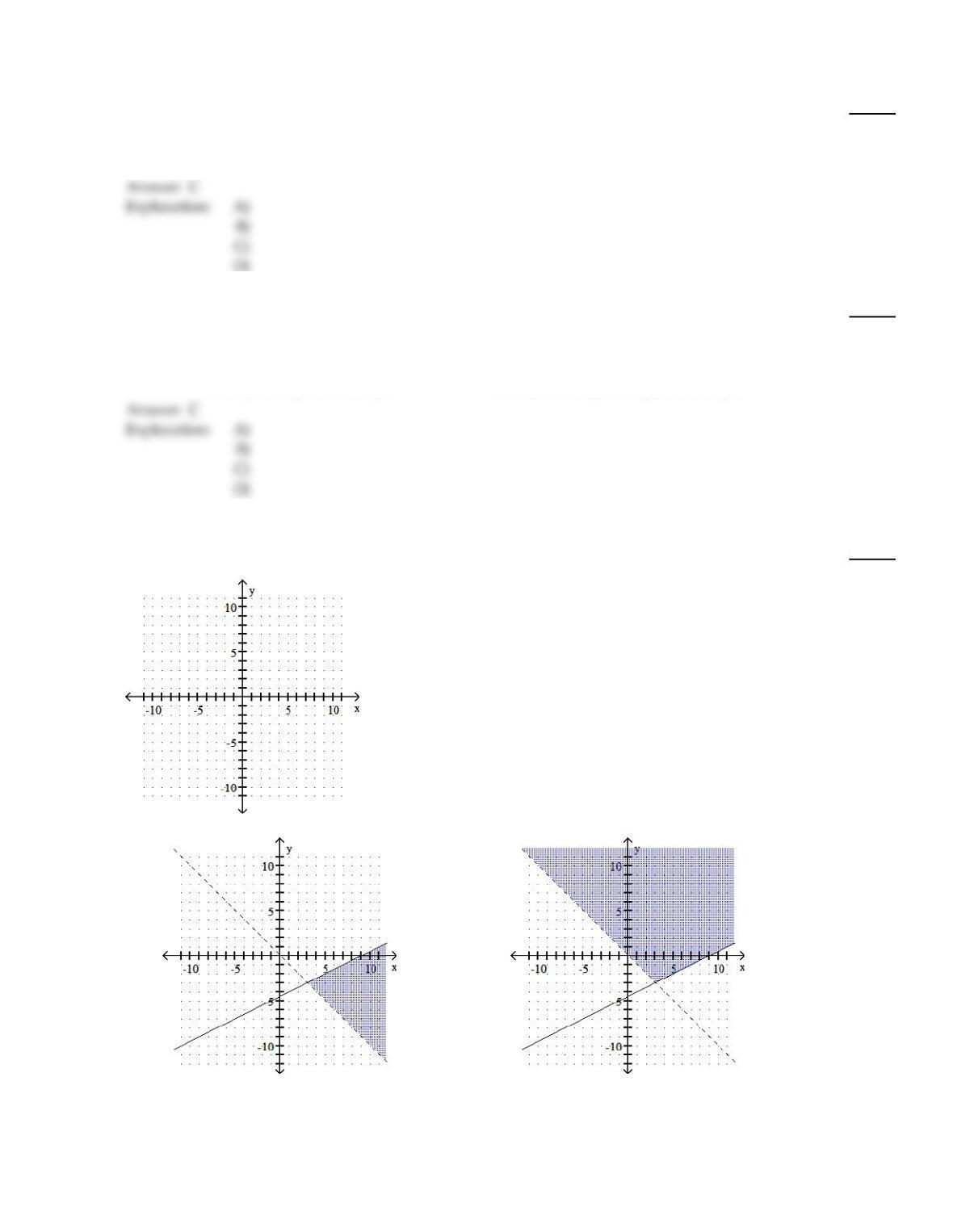
Write a system of equations for the problem, and then solve the system.
196)
If a plane can travel 340 miles per hour with the wind and only 260 miles per hour against the
wind, find the speed of the wind and the speed of the plane in still air.
196)
A)
Plane: 400 mph; wind: 40 mph
B)
Plane: 300 mph; wind: 50 mph
C)
Plane: 300 mph; wind: 40 mph
D)
Plane: 40 mph; wind: 300 mph
197)
At the beginning of a bicycle ride, Raul and Miguel are 90 miles apart. If they leave at the same time
and ride in the same direction, Raul overtakes Miguel in 5 hours. If they ride toward each other,
they pass each other in 2hours. What are their speeds?
197)
A)
Raul: 13.5 mph; Miguel: 31.5 mph
B)
Raul: 32.5 mph; Miguel: 13.5 mph
C)
Raul: 31.5 mph; Miguel: 13.5 mph
D)
Raul: 32.5 mph; Miguel: 12.5 mph
Graph the solution of the system.
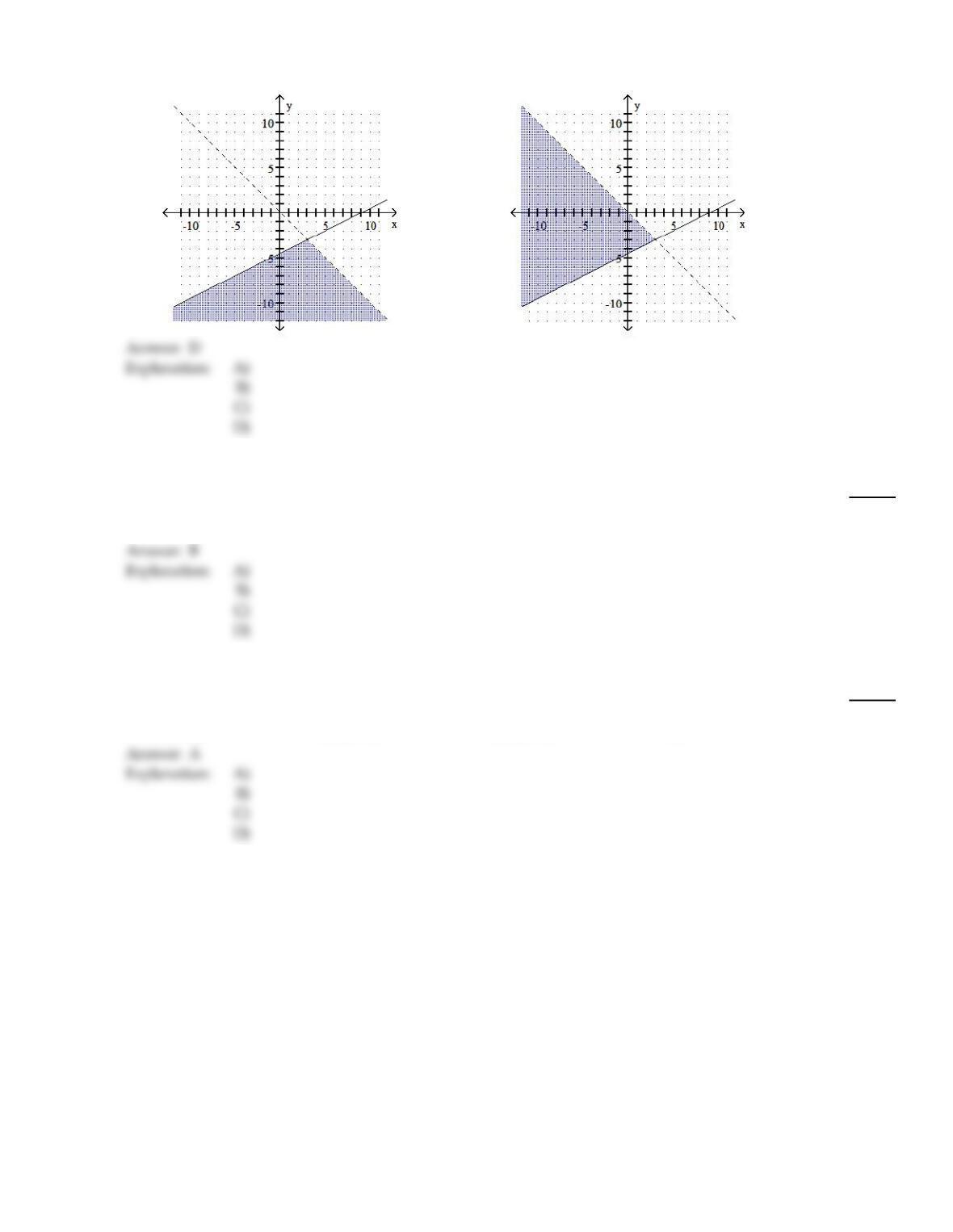
198)
x 2y +9
x + y < 0
198)
A)
B)
70
C)
D)
Solve by the substitution method.
199)
x + 4y =27
2x + 3y =24
199)
A)
{(–3, 7)}
B)
{(3, 6)}
C)
{(2, 7)}
D)
Solve the system by the elimination method.
200)
–6x + 8y = –12
–4x – 3y = –8
200)
A)
{(2, 0)}
B)
{(2, 1)}
C)
{(1, 1)}
D)
Graph the solution of the system.
71
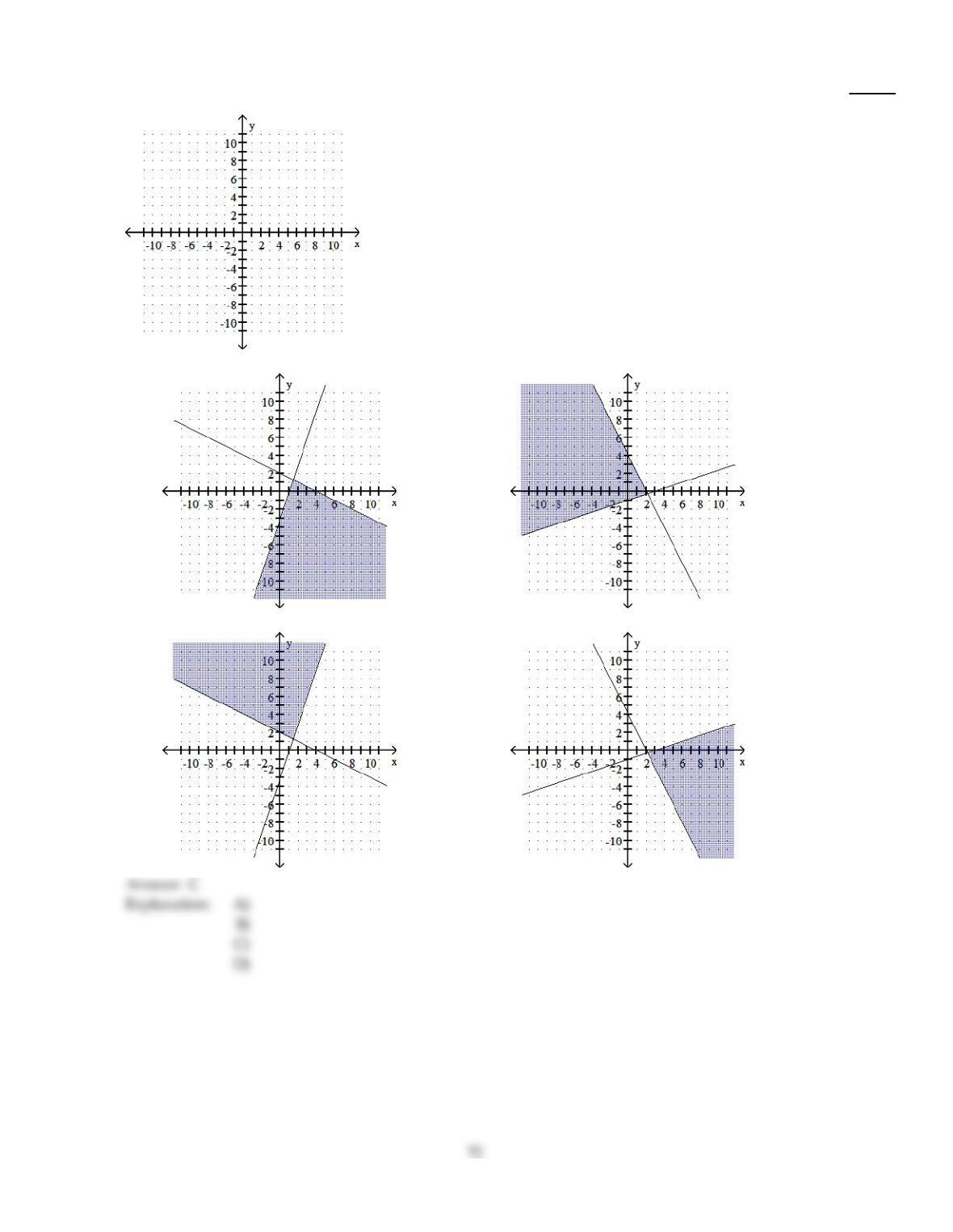
201)
y 3x – 3
x –2y + 4
201)
A)
B)
C)
D)
Answer Key
Testname: C4
Answer Key
Testname: C4
Answer Key
Testname: C4
Answer Key
Testname: C4
Answer Key
Testname: C4