Chapter 4: Activity-Based Costing
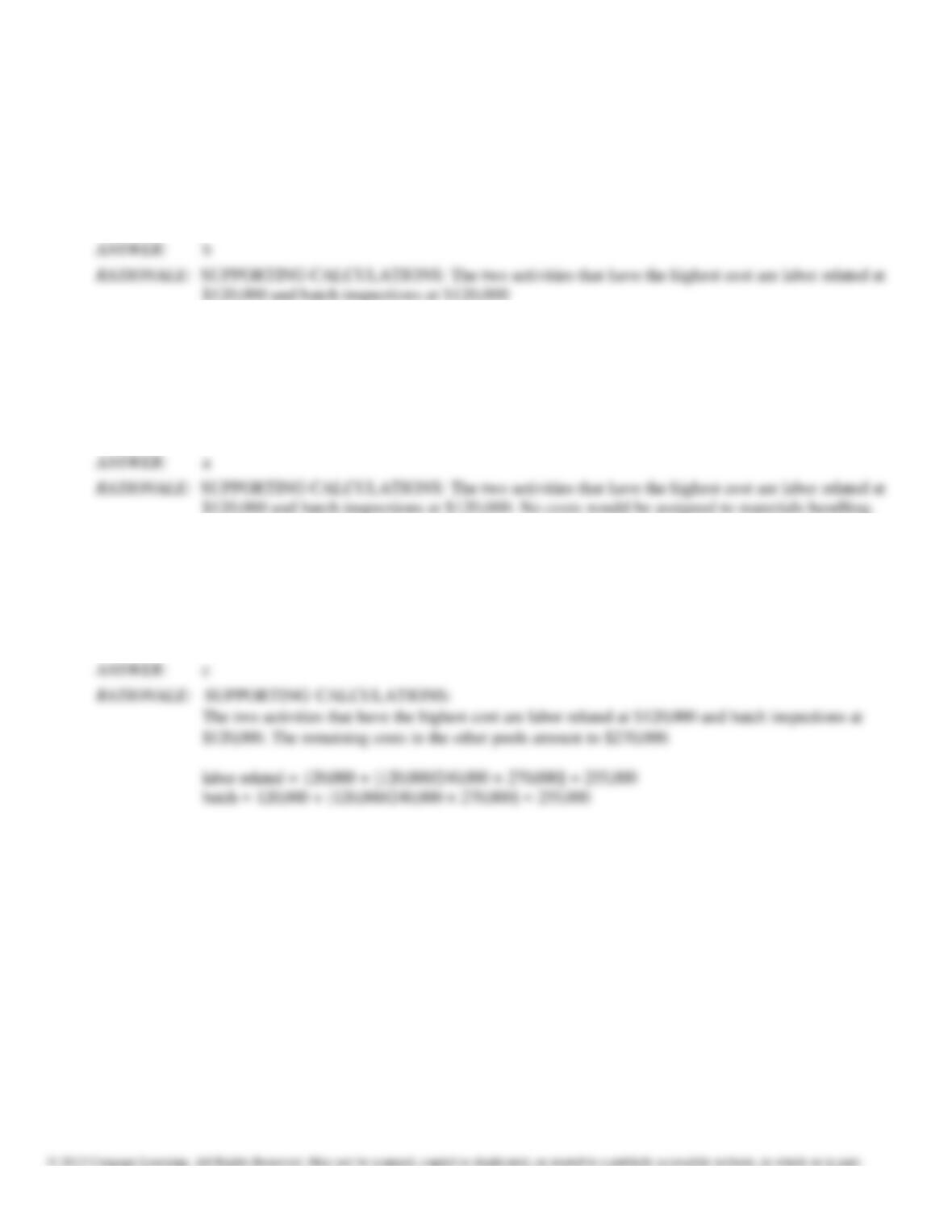
167. Refer to Figure 4-21. Under this new approach, which two activities would be selected as the cost pools?
a. materials handling and labor related
b. labor related and batch inspections
c. product design and batch inspections
d. materials handling and central purchasing
168. Refer to Figure 4-21. Under this new approach, what cost would be assigned to materials handling?
a. 0
b. $40,000
c. $140,000
d. $290,000
169. Refer to Figure 4-21. Under this new approach, what cost would be assigned to the labor related cost pool?
a. 0
b. $120,000
c. $255,000
d. $315,000
Chapter 4: Activity-Based Costing
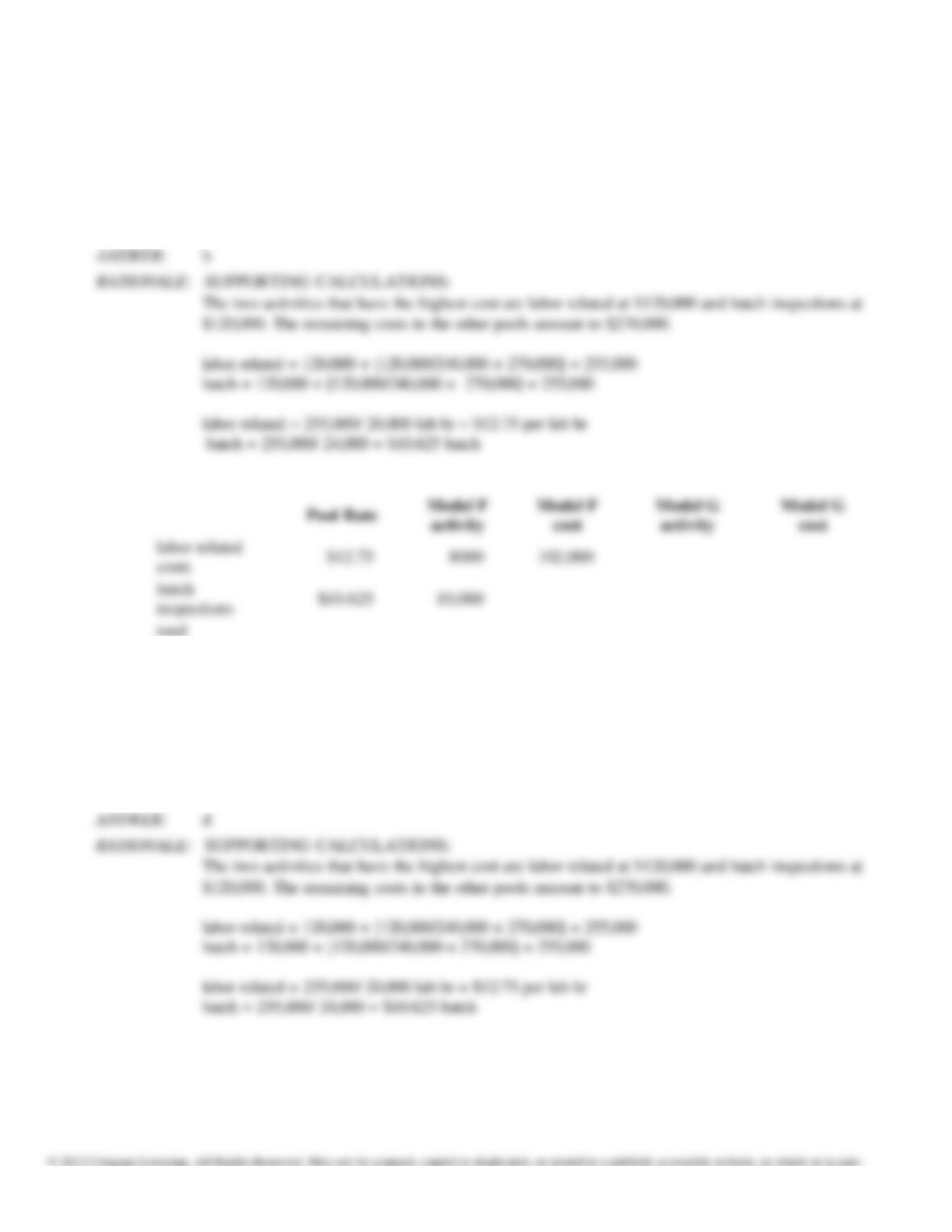
170. Refer to Figure 4–21. Under this new approach using the new rates, what labor cost is assigned to Model F in this
approximately relevant ABC system?
a. $60,000
b. $102,000
c. $153,000
d. $225,000
171. Refer to Figure 4-21. Under this new approach, what is the new pool rate for labor related costs?
a. 0
b. $6
c. $8.225
d. $12.75
Chapter 4: Activity-Based Costing
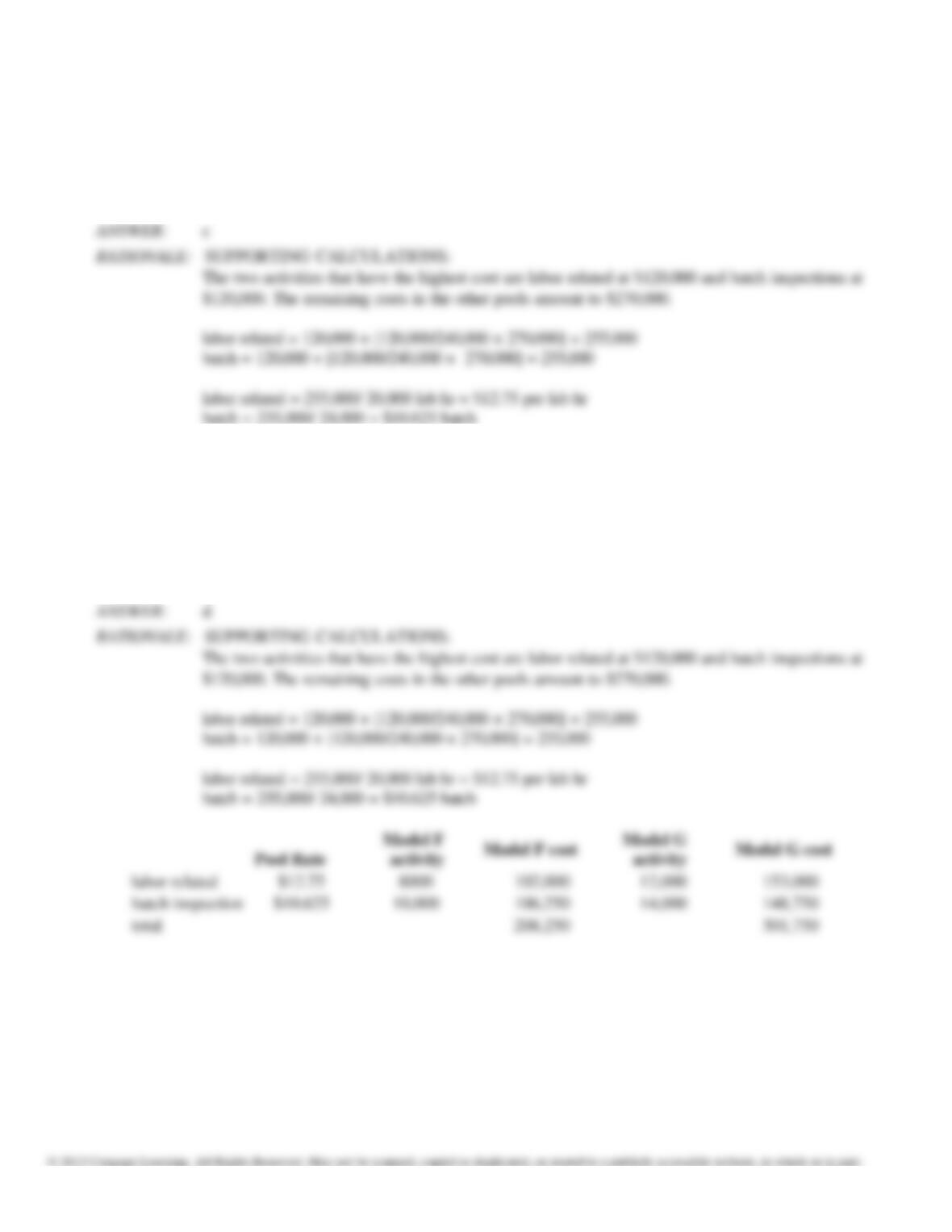
172. Refer to Figure 4-21. Under this new approach, what is the new pool rate for batch inspection costs?
a. 0
b. $5
c. $10.625
d. $15.525
173. Refer to Figure 4-21. Under this new approach using the new rates, what are the overhead costs assigned to Model
G in this approximately relevant ABC system?
a. $120,000
b. $208,250
c. $255,000
d. $301,750
Chapter 4: Activity-Based Costing
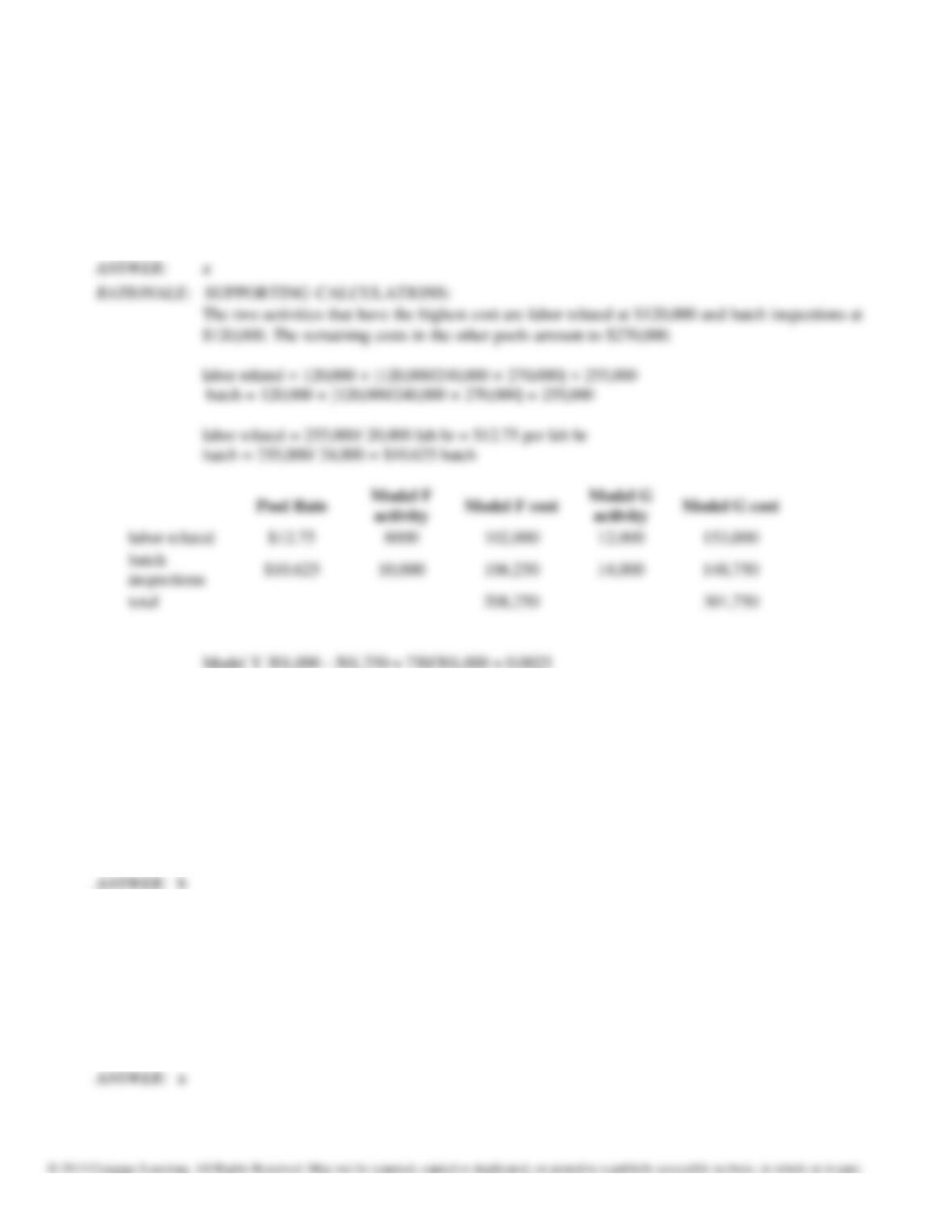
174. Refer to Figure 4-21. Using ABC as the benchmark, what is the percentage error in the cost assigned to Model
G using the approximately relevant ABC approach? (round to 4 decimal places)
a. 0.25%
b. 0.12%
c. 1.2%
d. 2.5%
175. Refer to Figure 4-21. Under this new approach using consumption ratios for labor related and batch inspections,
what set of equations would be used to create equally accurate reduced ABC allocation rates (where a = labor
hours and b = batch inspections)? (round to 5 decimal places)
a. 0.40 = 0.8a + 0.75b 0.60 = 0.12a + 0.85b
b. 0.41 = 0.4a + 0.41667b 0.59 = 0.6a + 0.58333b
c. 0.50 = 0.4a + 0.6b 0.50 = 0.6a + 0.4b
d. 0.44 = 0.8a + 0.75b 0.56 = 0.12a + 0.85b
176. Refer to Figure 4-21. Under the equally accurate reduced ABC system, using consumption ratios for labor related
and batch inspections, what allocation rate would be used to assign labor related costs? (round to 5 decimal
places) a. 0.375
b. 0.60
c. 0.625
d. 0.40
Chapter 4: Activity-Based Costing
177. Refer to Figure 4-21. Under the equally accurate reduced ABC system, what are the global consumption ratios
for Model F and Model G respectively? (round to 2 decimal places)
a. 0.41: 0.59
b. 0.44; 0.56
c. 0.40; 0.60
d. 0.50; 0.50
178. Refer to Figure 4-21. Under the equally accurate reduced ABC system, using consumption ratios for labor related
and batch inspections, the overhead assigned to labor related activities would be? (round to 5 decimal places)
a. $318,750
b. $204,000
c. $306,000
d. $191,250
179. Refer to Figure 4-21. Under equally accurate reduced ABC system, using consumption ratios for labor related and
batch inspections, the overhead cost assigned to Model F would be? (round to 5 decimal places)
a. $204,000
b. $318,750
c. $306,000
d. $191,250
180. The collected data sets that are organized and interrelated for use by an organization’s ABC information system
is(are):
a. Activity driver
b. Activity-based costing database
c. Cost objective
d. Both a and c
Chapter 4: Activity-Based Costing
Figure 4-22
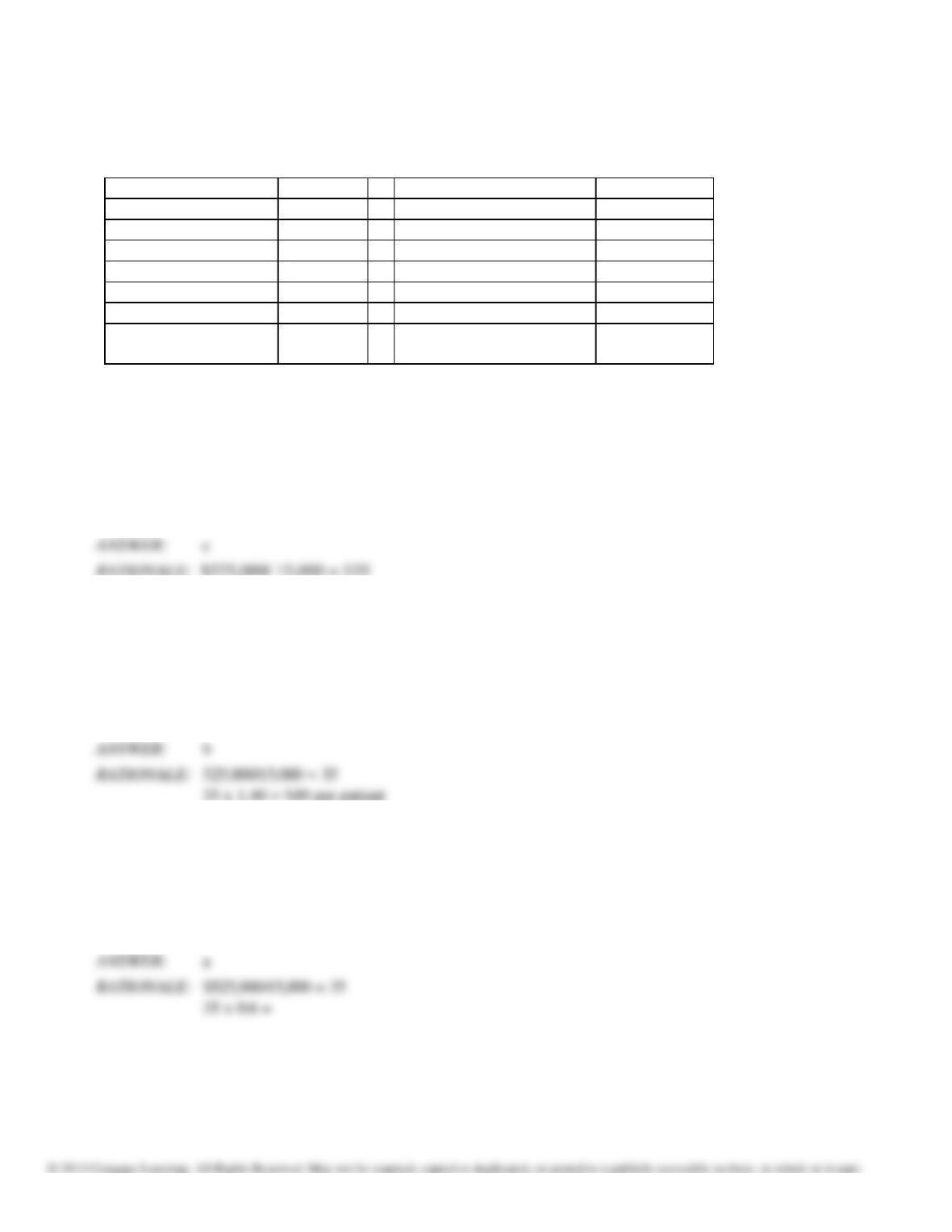
The Wellness Clinic is considering a time–driven activity based costing system. Given the following data:
Resources
Activities
time/activity
supervision
$ 60,000
treating patients
1.40 hr.
supplies and uniforms
$ 80,000
providing hygienic care
1.00 hr
salaries
$350,000
responding to requests
0.60 hr
computer
$ 10,000
monitoring patients
1.00 hr
monitor
$ 25,000
Total
$525,000
Total nursing hours
(practical capacity)
15,000
181. Refer to Figure 4-22. What is the capacity cost rate?
a. $4
b. b. $25
c. c. $35
d. $105
182. Refer to Figure 4-22. What is the activity rate for treating patients?
a. $35
b. $49
c. $21
d. $140
183. Refer to Figure 4-22. What is the activity rate for responding to requests?
a. $21
b. $35
c. $25
d. $50

Chapter 4: Activity-Based Costing
184. The grouping of logically related information is called:
a. activity driver
b. data set
c. cost objective
d. both a and c
185. Which of the following statements is TRUE?
a. A vital attribute of an ABC database is the cost of individual departments.
b. The ultimate objective of activity classification is to build homogeneous cost pools.
c. When unbundling general ledger costs to an ABC database, we are more concerned about “How are the
dollars spent?” than “What is spent?“
d. Both b and c are true.
186. In an approximately relevant ABC system
a. all activities still are separated into pools; they are allocated on estimated activity levels.
b. only the most expensive activities are allocated using appropriate cause-and-effect drivers.
c. cost pools are limited to only two cost pools.
d. none of these.
187. In the time-driven ABC systems, managers
a. assign resources to departments, then activities.
b. assign resource costs first to activities, then to products.
c. directly estimate the resource demands imposed by each product.
d. none of these.
188. In a time-driven ABC system, once the managers determine the cost of per time unit of supplying resources to
activities, the next step would be
a. for managers to determine how long an employee takes to do an activity.
b. assign costs of a department’s resources to the customer who uses the services.
c. for managers to determine the time it takes to carry out one unit of each kind of activity.
d. attempt to estimate practical capacity.
Chapter 4: Activity-Based Costing
189. If operations run on less than full capacity, what is the result on cost driver rates?
a. They are not affected.
b. They are too low.
c. They can be either too high or too low.
d. They are too high.
190. Which of the following is NOT an advantage of a time–driven ABC system?
a. There are more activity pools used to allocate costs
b. Managers can review the costs of unused capacity
c. Managers can determine how to reduce the cost of supplying unused resources in subsequent periods
d. Managers can monitor efforts to reduce costs with unused capacity
191. The Roanoke plant of the Virginia Company has two production departments: Extrusion and Assembly. The plant
produces two products: P and Q. Cost information for the production departments is given below:
Extrusion $360,000
Assembly 750,000
The following table presents activity information about the departments and products:
Extrusion
Assembly
Total
Direct labor hours:
P
10,000
20,000
30,000
Q
10,000
30,000
40,000
Total
20,000
50,000
70,000
Machine hours:
P
5,000
1,000
6,000
Q
15,000
2,000
17,000
Total
20,000
3,000
23,000
Required:
a. Compute the predetermined overhead rate for each department if Extrusion uses machine hours and
Assembly uses labor hours.
b. Calculate the per unit overhead rate for each product if 80,000 units of P were produced and 90,000 units of
Q were produced.
Chapter 4: Activity-Based Costing
b.
P
Q
units produced
80,000
90,000
overhead applied to production
Extrusion:
$18 x 5000
$ 90,000
$18 x 15,000
$270,000
Assembly
$15 x 20,000
$300,000
$15 x 30,000
$450,000
Total
$390,000
$720,000
Overhead per Unit
$4.875
$8
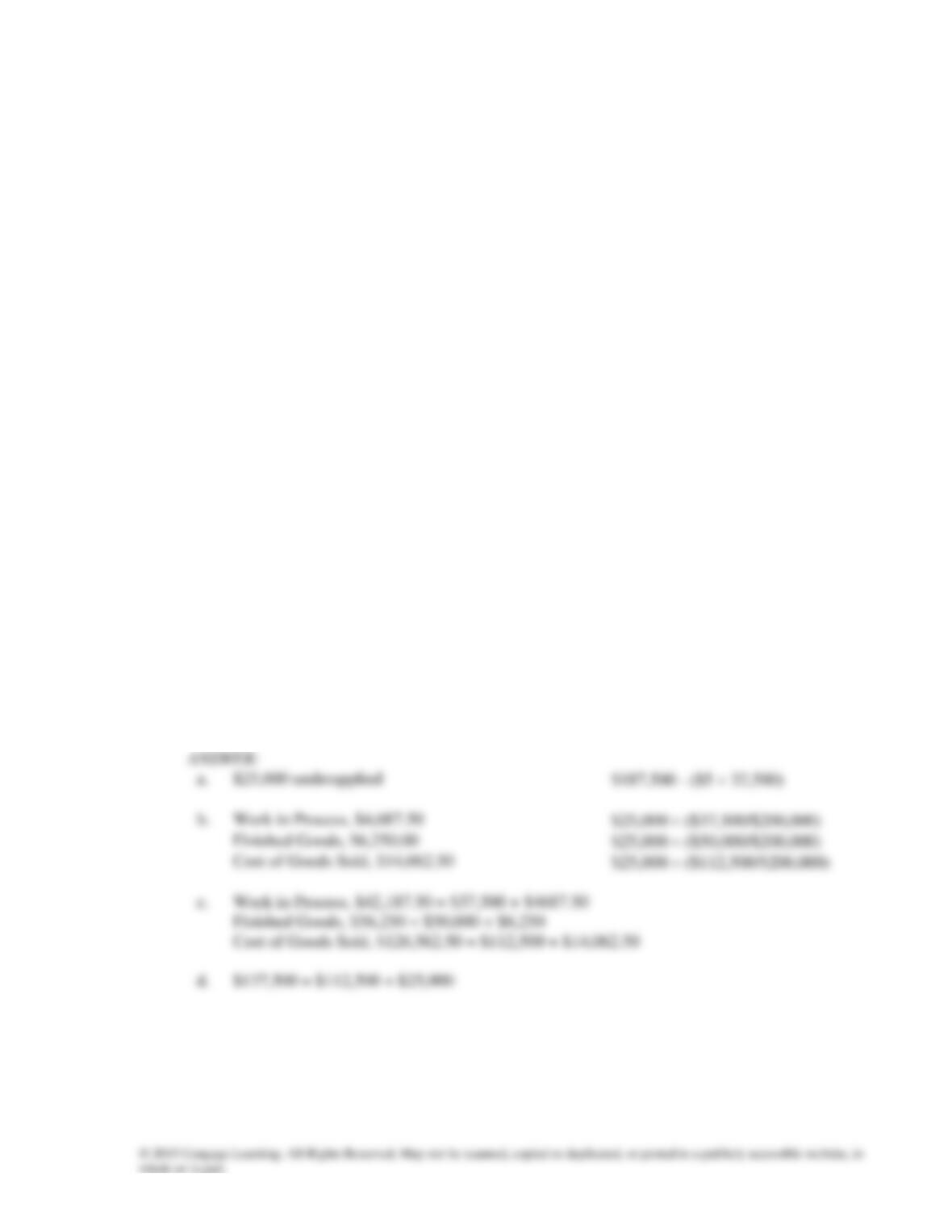
192. Lavender Company has decided to use a predetermined rate to assign factory overhead to production. The
following predictions have been made for 2016:
Total factory overhead costs $150,000
Direct labor hours 40,000 hours
Direct labor costs $200,000
Machine hours 60,000 hours
Required:
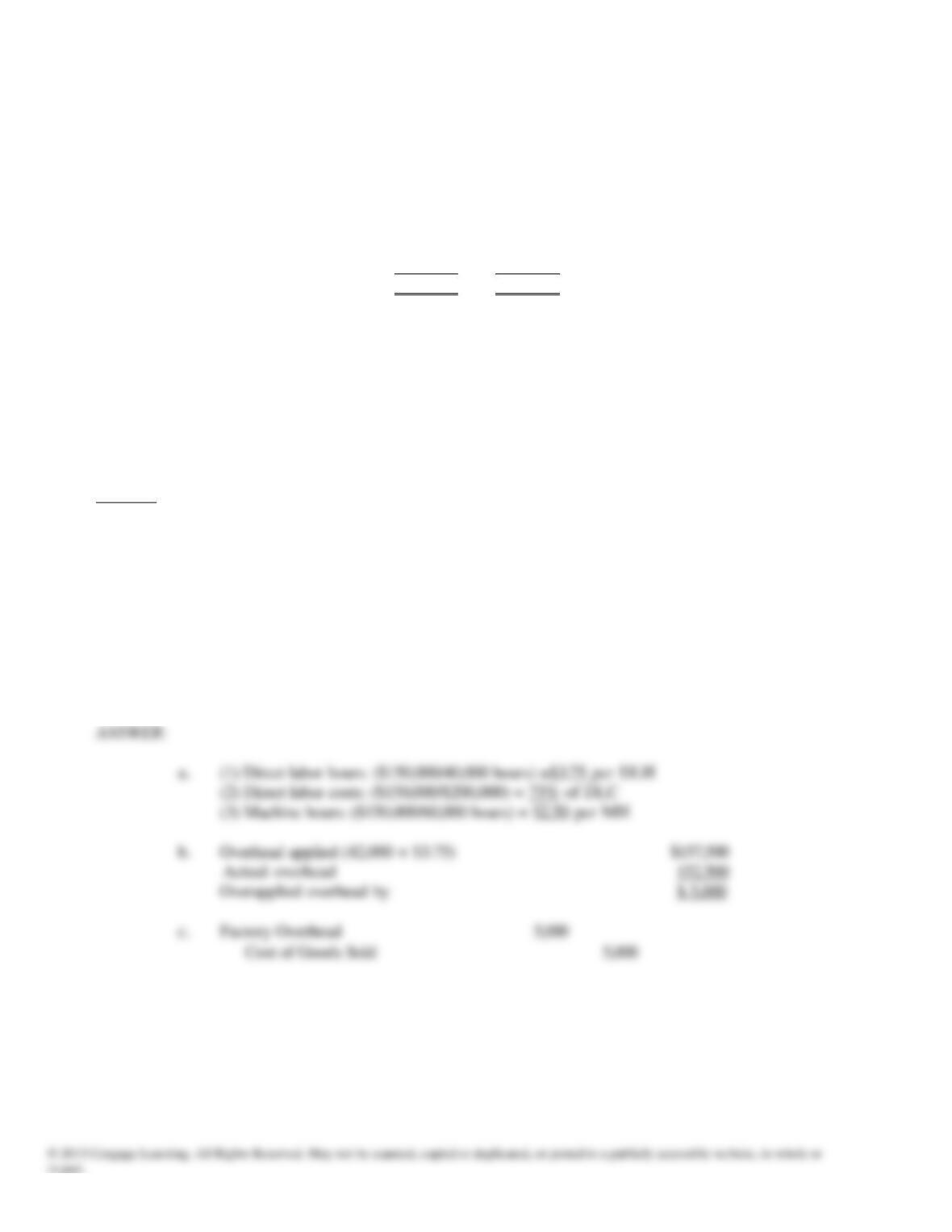
a. Compute the predetermined factory overhead rate under three different bases: (1) direct labor hours,
(2) direct labor costs, and (3) machine hours.
b. Assume that actual factory overhead was $152,500 and that Lavender elected to apply factory
overhead to Work in Process based on direct labor hours. If actual direct labor was 42,000 hours for
2016, was factory overhead overapplied or underapplied? By how much?
c. Lavender Company follows the policy of writing off any under- or overapplied factory overhead
balance to Cost of Goods Sold at the end of the year. Make the entry necessary at the end of 2016 to
dispose of the factory overhead balance determined in Part (b).
Chapter 4: Activity-Based Costing
193. The Custom Guitar Company uses a predetermined overhead rate of $5 per machine hour to apply
overhead.
During the year, 32,500 machine hours were worked. Actual manufacturing overhead cost for the
year was
$187,500. Company records showed the following account balances at the end of the year:
Materials
$22,500
Work in process
37,500
Finished goods
50,000
Cost of goods sold
Required:
112,500
a. Determine the amount of underapplied or overapplied overhead.
b. Assuming the amount of underapplied or overapplied overhead is material, determine underapplied
or overapplied overhead that would be allocated to the following accounts if the allocation is made
using ending account balances:
Work in Process
Finished Goods
Cost of Goods Sold
c. Assuming the amount of underapplied or overapplied overhead is material, calculate the new
balance of the following accounts after underapplied or overapplied overhead has been allocated:
Work in Process
Finished Goods
Cost of Goods Sold
d. Determine the balance of Cost of Goods Sold if underapplied or overapplied overhead is
immaterial.

Chapter 4: Activity-Based Costing
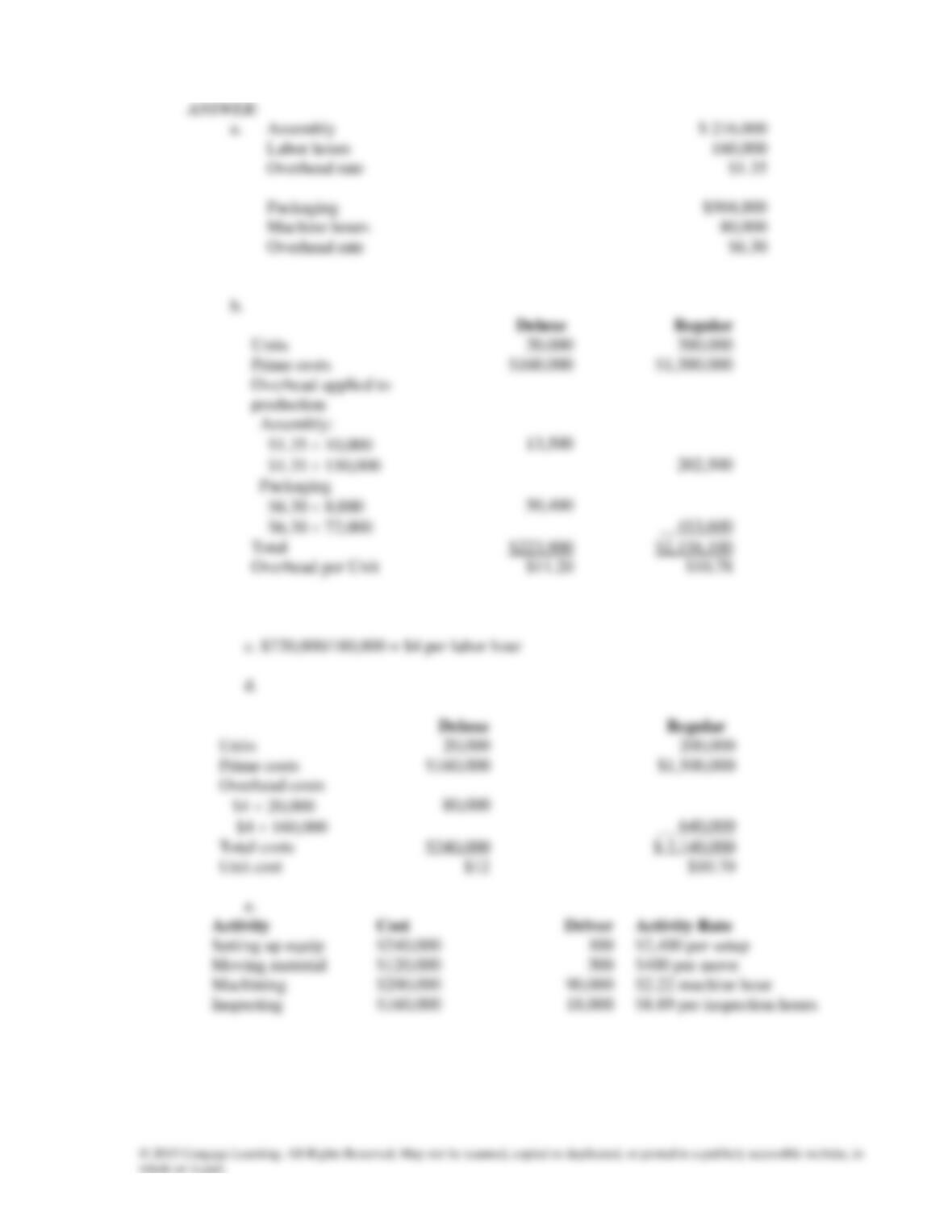
194. The Anchorage plant of the Tundra Company produces two calculators and has two production
departments: assembly and packaging. Information for the products is given below:
Deluxe Regular Total
Units produced
20,000
200,000
Prime costs
$160,000
$1,500,000
$1,660,00
Direct labor hours
20,000
160,000
180,00
Number of setups
60
40
100
Machine hours
10,000
80,000
90,00
Inspection hours
2,000
16,000
18,00
Number of moves
180
120
300
The following table presents activity information about the departments and products:
Assembly
Packaging
Total
Direct labor hours:
Deluxe
10,000
10,000
20,000
Regular
150,000
10,000
160,000
Total
160,000
20,000
180,000
Machine hours:
Deluxe
2,000
8,000
10,000
Regular
8,000
72,000
80,000
Total
10,000
80,000
90,000
Overhead Costs:
Setting equipment
$120,000
$120,000
$240,000
Moving material
60,000
60,000
120,000
Machining
20,000
180,000
200,000
Inspection
16,000
144,000
160,000
Total
$216,000
$504,000
$720,000
Required:
a. Compute the predetermined overhead rate for each department if Assembly uses labor hours and
Packaging uses machine hours.
b. Calculate the per unit cost for each product if departmental overhead rates are used. (Round to 2
decimal places)
c. Compute the predetermined plant-wide overhead rate based on direct labor hours.
d. Calculate the per unit cost of each product if a plantwide overhead rate is used.(Round to 2
decimal places)
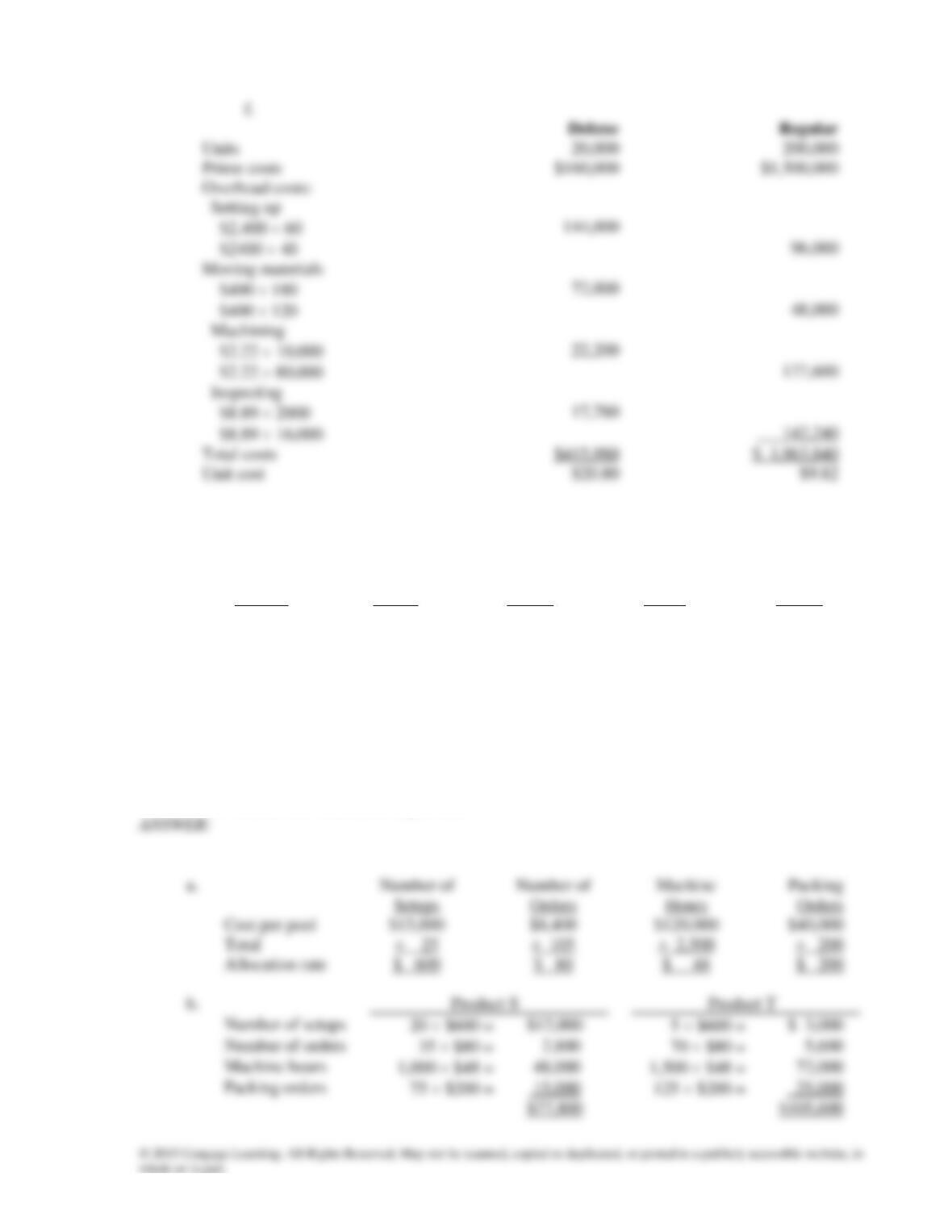
e. Calculate the overhead rates for each overhead activity.
f. Calculate the per unit cost of each product if activity rates are used to assign overhead. (Round to
2 decimal places)
Chapter 4: Activity-Based Costing
Chapter 4: Activity-Based Costing
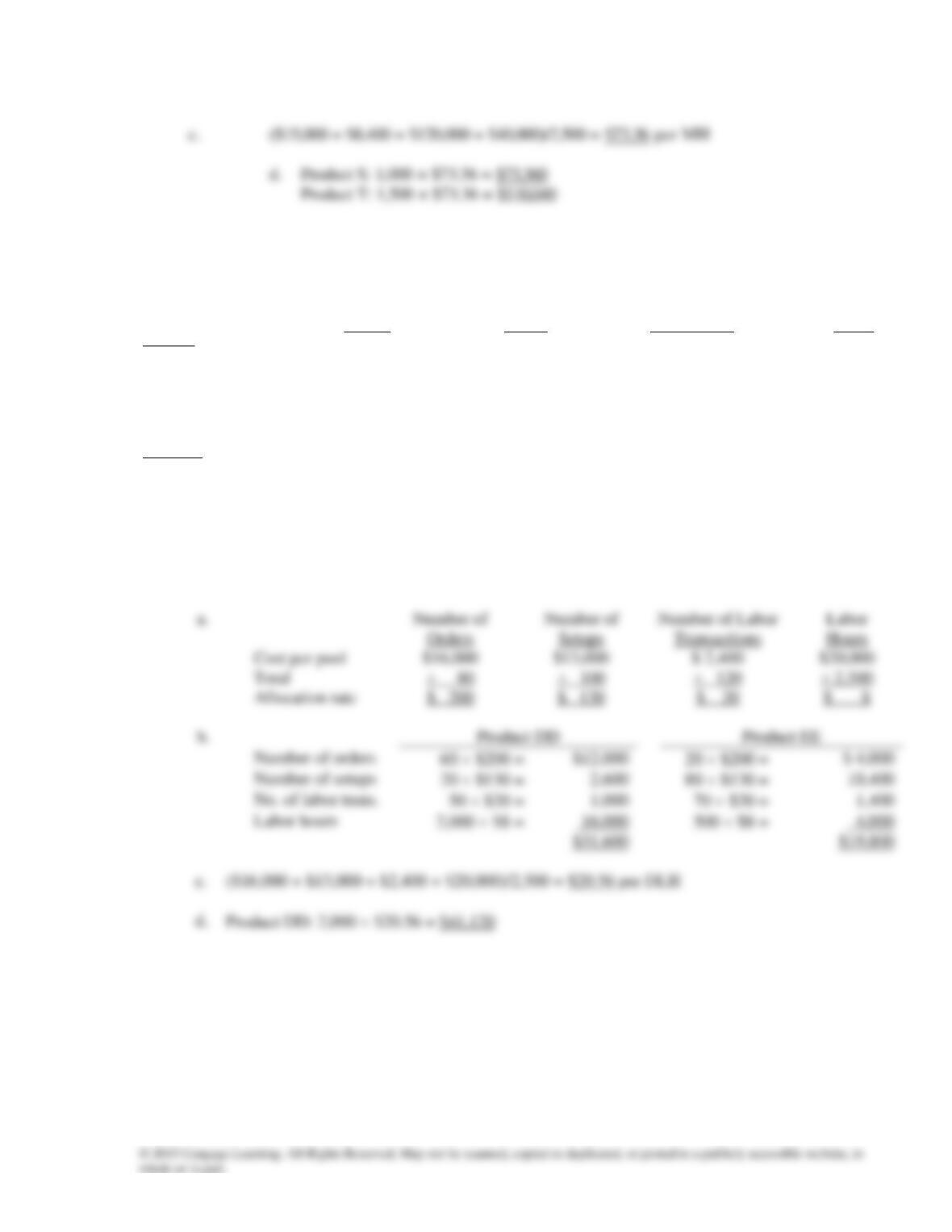
195. Tusker Corporation manufactures two products (S and T). The overhead costs have been divided into
four cost pools that use the following activity drivers:
Number of
Number of
Machine
Packing
Product
Setups
Orders
Hours
Orders
S
20
35
1,000
75
T
5
70
1,500
125
Cost per pool
$15,000
$8,400
$120,000
$40,000
a. Compute the allocation rates for each of the activity drivers listed.
b. Allocate the overhead costs to Products S and T using activity-based costing.
c. Compute the overhead rate using machine hours under the functional-based costing system.
d. Allocate the overhead costs to Products S and T using the functional-based costing system
overhead rate calculated in part (c).
÷ 25
÷ 105
÷ 200
$ 600
$ 48
5 $600 =
70 $80 =
$77,800
$105,600
Units
Setting up
$2400 40
Moving materials
$400 120
Machining
$2.22 80,000
Inspecting
$8.89 16,000
Total costs
Chapter 4: Activity-Based Costing
196. Simonson Company manufactures two products (DD and EE). The overhead costs have been divided
into four cost pools that use the following activity drivers:
Product
Number of
Orders
Number of
Setups
Number of Labor
Transactions
Labor
Hours
DD
60
20
50
2,000
EE
20
80
70
500
Cost per pool
Required:
$16,000
$13,000
$2,400
$20,000
a. Compute the allocation rates for each of the activity drivers listed.
b. Allocate the overhead costs to Products DD and EE using activity-based costing.
c. Compute the overhead rate using labor hours under the functional-based costing system.
d. Allocate the overhead costs to Products DD and EE using the functional-based costing system
overhead rate calculated in part (c).