ch04 Page 1
Chapter 4
Recognizing Revenue in Governmental Funds
TRUE/FALSE (CHAPTER 4)
1. If an entity elects to focus on all economic resources, then it should adopt a modified accrual
basis of accounting.
2. The budgetary measurement focus of governments is determined by applicable state or local
laws.
3. The revenue-recognition issues facing governments are generally focused on the exchange
transaction earning process, similar to those of businesses.
4. Governmental activities tend to derive the majority of their revenues from exchange
transactions.
5. In accounting for property taxes, under the modified accrual basis, existing standards provide
that, except in unusual circumstances, revenues should be recognized only if cash is expected
to be collected within sixty days after year-end.
6. Ad valorem taxes are taxes that are based on value.
7. Income taxes are classified as ad valorem taxes.
8. Sales taxes are taxpayer assessed, that is, parties other than the beneficiary government
determine the tax base.
9. Revenues that cannot be classified as general revenues are by default considered program
revenues.
10. Taxes that are imposed on the reporting government’s citizens are considered general
revenues, even if they are restricted to specific programs.
11. Current financial resources include cash and receivables but not investments.
12. Under the modified accrual basis, revenues are “available” if they are collected within the
current period or are expected to be collected soon enough after the end of the period to be
used to pay liabilities of the current period.
ch04 Page 2
MULTIPLE CHOICE (CHAPTER 4)
1. As used in governmental accounting, interperiod equity refers to a concept of
a) providing the same level of services to citizens each year.
b) measuring whether current year revenues are sufficient to pay for current year services.
c) levying property taxes at the same rate each year.
d) requiring that general fund budgets be balanced each year.
2. For fund financial statements, the measurement focus and basis of accounting used by
governmental fund types are
a) current financial resources and modified accrual accounting.
b) economic resources and modified accrual accounting.
c) financial resources and full accrual accounting.
d) economic resources and full accrual accounting.
3. The modified accrual basis of accounting is used in presenting the fund financial statements of
the governmental funds because
a) it is the superior method of accounting for the economic resources of any entity.
b) it provides information as to the extent the entity achieved interperiod equity.
c) it is budget oriented while facilitating comparisons among entities.
d) it results in accounting measurements based on the substance of transactions.
4. As used in defining the modified accrual basis of accounting, the term “available” means
a) received in cash.
b) will be received in cash within 60 days after year-end.
c) collection in cash is reasonably assured.
d) collected within the current period or expected to be collected soon enough thereafter to
be used to pay liabilities of the current period.
5. Under the modified accrual basis of accounting, derived nonexchange revenues are recognized
when
a) they are earned.
b) they are measurable and available to finance the expenditures of the current period.
c) the underlying exchange transaction occurs.
d) the underlying exchange transaction occurs and they are measurable and available to
finance the expenditures of the current period.
6. Under the accrual basis of accounting, property tax revenues are recognized
a) when they are received in cash.
b) in the year for which they were levied.
c) in the year for which they were levied and when collection in cash is reasonably assured.
d) when they are available to finance expenditures of the fiscal period.
7. Under the modified accrual basis of accounting, the amount of property tax revenues that
should be recognized by a government in the current year related to the current-year levy will
be
a) the total amount of the levy.
b) the expected collectible portion of the levy.
c) the portion of the levy collected.
d) the portion of the levy collected in the current year or within sixty days after the end of the
fiscal period.
ch04 Page 3
8. Under the modified accrual basis of accounting, investment revenues for the current period
should include
a) only interest and dividends received.
b) all interest and dividends received during the period plus all accruals of interest and
dividends earned.
c) all interest and dividends received plus gains and losses on securities that were sold
during the period.
d) all interest and dividends received, all gains and losses on securities sold, and all changes
in market values on securities held in the portfolio at year-end.
9. Under the accrual basis of accounting used by governments, investment revenues for the
current period should include
a) only interest and dividends received.
b) all interest and dividends received during the period plus all accruals of interest and
dividends earned.
c) all interest and dividends received plus gains and losses on securities that were sold
during the period.
d) all interest and dividends received, all gains and losses on securities sold, and all changes
in market values on securities held in the portfolio at year-end.
10. Under the modified accrual basis of accounting, imposed nonexchange revenues (such as
fines) should be recognized
a) when assessed.
b) when the government has an enforceable legal claim.
c) when collected.
d) when the government has an enforceable legal claim and when collected within the
current period or soon enough thereafter to be used to pay the liabilities of the current
period.
11. Under the accrual basis of accounting, imposed nonexchange revenues (such as fines) should
be recognized
a) when assessed.
b) when the government has an enforceable legal claim.
c) when collected.
d) when the government has an enforceable legal claim and when collected within the
current period or soon enough thereafter to be used to pay the liabilities of the current period
12. Under the modified accrual basis of accounting, gains and losses on disposal of capital assets
a) are not recognized.
b) are recognized when the proceeds (cash) of the sale are received (on the installment
basis).
c) are recognized only if there is a gain.
d) are recognized when the sale occurs, regardless of when the cash is collected.
13. Under the accrual basis of accounting, gains and losses on disposal of capital assets
a) are not recognized.
b) are recognized when the proceeds (cash) of the sale are received (on the installment
basis).
c) are recognized only if there is a gain.
d) are recognized when the sale occurs, regardless of when the cash is collected.
ch04 Page 4
14. Under the modified accrual basis of accounting, license fees, permits, and other
miscellaneous revenue are generally recognized for practical purposes
a) when cash is received.
b) when the exchange takes place.
c) over the period during which the government obtains an enforceable legal claim.
d) when related expenditures are incurred.
15. Ideally, under the accrual basis of accounting, license fees, permits, and other miscellaneous
revenue should be recognized
a) when cash is received.
b) when the exchange takes place.
c) over the period during which the government obtains an enforceable legal claim.
d) when related expenditures are incurred.
16. A city that has a 12/31 fiscal year end has adopted a policy of recognizing the maximum
amount of property tax revenue allowable under GAAP. Property taxes of $720,000 (of
which 10 percent are estimated to be uncollectible) are levied in October 2013 to finance the
activities of the fiscal year 2014. During 2014, cash collections related to property taxes
levied in October 2013 were $600,000. In 2015 the following amounts related to the property
taxes levied in October 2013 were collected: January $30,000; March, $6,000. For the fiscal
year ended 12/31/14, what amount should be recognized as property tax revenues related to
the 2013 levy on the governmental fund financial statements?
a) $720,000.
b) $648,000.
c) $630,000.
e) $600,000.
17. A city that has a 12/31 fiscal year end has adopted a policy of recognizing the maximum
amount of property tax revenue allowable under GAAP. Property taxes of $720,000 (of
which 10 percent are estimated to be uncollectible) are levied in October 2013 to finance the
activities of the fiscal year 2014. During 2014, cash collections related to property taxes
levied in October 2013 were $600,000. In 2015the following amounts related to the property
taxes levied in October 2013 were collected: January $30,000; March $6,000. For the fiscal
year ended 12/31/14, what amount should be recognized as property tax revenues related to
the 2013 levy on the government-wide financial statements?
a) $720,000.
b) $648,000.
c) $630,000.
d) $600,000.
ch04 Page 5
18. A city that has a 12/31 fiscal year end has adopted a policy of recognizing property tax
revenue consistent with the 60-day rule allowable period under GAAP. Property taxes of
$600,000 (of which none are estimated to be uncollectible) are levied in October 2013 to
finance the activities of fiscal year 2014. Property taxes are due in two installments June 20
and December 20. Cash collections related to property taxes are as follows:
1/15/14 for property taxes levied in 2012, due in 2013 $ 25,000
2/15/14 for property taxes levied in 2012, due in 2013 $ 15,000
3/15/14 for property taxes levied in 2012, due in 2013 $ 10,000
6/20/14 First installment of taxes levied in 2013, due 6/20/14 $350,000
12/20/14 Second installment of taxes levied in 2013, due 12/20/14 $150,000
1/15/15 for property taxes levied in 2013, due in 2014 $ 15,000
2/15/15 for property taxes levied in 20130, due in 2014 $ 10,000
3/15/15 for property taxes levied in 2013, due in 2014 $ 5,000
The total amount of property tax revenue that should be recognized in the governmental fund
financial statements in 2014 is:
a) $600,000.
b) $575,000.
c) $535,000.
d) $525,000.
19. A city that has a 12/31 fiscal year end has adopted a policy of recognizing property tax
revenue consistent with the 60-day rule allowable period under GAAP. Property taxes of
$600,000 (of which none are estimated to be uncollectible) are levied in October 2013 to
finance the activities of fiscal year 2014. Property taxes are due in two installments June 20
and December 20. Cash collections related to property taxes are as follows:
1/15/14 for property taxes levied in 2012, due in 2013 $ 25,000
2/15/14 for property taxes levied in 2012, due in 2013 $ 15,000
3/15/14 for property taxes levied in 2012, due in 2013 $ 10,000
6/20/12 First installment of taxes levied in 2013, due 6/20/14 $350,000
12/20/14 Second installment of taxes levied in 2013, due 12/20/14 $150,000
1/15/15 for property taxes levied in 201, due in 2014 $ 15,000
2/15/15 for property taxes levied in 2013, due in 2014 $ 10,000
3/15/12 for property taxes levied in 2013, due in 2014 $ 5,000
The total amount of property tax revenue that will be recognized in the government-wide
financial statements in 2014 is:
a) $600,000.
b) $575,000.
c) $535,000.
d) $525,000.
20. Under GAAP, property taxes levied in one fiscal period to finance the activities of the
following fiscal period are recognized as revenue in the governmental fund financial
statements
a) in the year levied.
b) in the year for which they are intended to finance the activities.
c) when collected, regardless of when levied.
ch04 Page 6
d) in the year for which they are intended to finance the activities, if collected within that
period or within a period no greater than 60 days after the close of the fiscal year.
21. Under GAAP, property taxes levied in one fiscal period to finance the activities of the
following fiscal period are recognized as revenue in the government-wide financial
statements
a) in the year levied.
b) in the year for which they are intended to finance the activities.
c) when collected, regardless of when levied.
d) in the year for which they are intended to finance the activities, if collected within that
period or within a period no greater than 60 days after the close of the fiscal year.
22. A city levies a 2 percent sales tax. Sales taxes must be remitted by the merchants to the City
by the twentieth day of the month following the month in which the sale occurred. Cash
received by the city related to sales taxes is as follows:
Amount received 1/20/14, applicable to December 2013 sales $100
Amount received 2/20/14, applicable to January 2014 sales $ 30
Amount received during 2014 related to February-November 2014 sales $400
Amount received 1/20/15 for December 2014 sales $110
Amount received 2/20/152 for January 2014 $ 40
Assuming the city uses the same period to define “available” as the maximum period
allowable for property taxes, what amount should it recognize in the governmental fund
financial statements as sales tax revenue for the fiscal year ended 12/31/14?
a) $430.
b) $530.
c) $540.
d) $550.
ch04 Page 7
23. A city levies a 2 percent sales tax. Sales taxes must be remitted by the merchants to the city
by the twentieth day of the month following the month in which the sale occurred. Cash
received by the city related to sales taxes is as follows:
Amount received 1/20/14, applicable to December 2013 sales $100
Amount received 2/20/14, applicable to January 2014 sales $ 30
Amount received during 2014 related to February-November 2014 sales $400
Amount received 1/20/15 for December 2014 sales $110
Amount received 2/20/15 for January 2015 $ 40
Assuming the city uses the same period to define “available” as the maximum period
allowable for property taxes, what amount should it recognize in the government-wide
financial statements as sales tax revenue for the fiscal year ended 12/31/14?
a) $430.
b) $530.
c) $540.
d) $550.
24. A city levies a 2 percent sales tax that is collected for them by the state. Sales taxes must be
remitted by the merchants to the state by the 20th day of the month following the month in
which the sale occurred. The state has a policy of remitting sales taxes to the city within 30
days of collection by the state. Cash received by the state related to sales taxes is as follows:
Amount received 1/20/14, applicable to December 2013 sales $100
Amount received 2/20/14, applicable to January 2014 sales $ 30
Amount received 3/20/14, applicable to February 2014 sales $ 20
Amount received during 2014 related to March-November 2014 sales $380
Amount received 1/20/15 for December 2014 sales $110
Amount received 2/20/15 for January 2015 $ 40
Amount received 3/20/15 for February 2015 $ 10
Assuming the city uses the same period to define “available” as the maximum period
allowable for property taxes, what amount should it recognize as sales tax revenue in its
governmental fund financial statements for the fiscal year ended 12/31/14?
a) $430.
b) $530.
c) $540.
d) $550.
ch04 Page 8
25. A city levies a 2 percent sales tax that is collected for them by the state. Sales taxes must be
remitted by the merchants to the state by the twentieth day of the month following the month
in which the sale occurred. The state has a policy of remitting sales taxes to the city within
30 days of collection by the state. Cash received by the state related to sales taxes is as
follows:
Amount received 1/20/14, applicable to December 2013 sales $100
Amount received 2/20/14, applicable to January 2014 sales $ 30
Amount received 3/20/14, applicable to February 2014 sales $ 20
Amount received during 2014 related to March-November 2014 sales $380
Amount received 1/20/15 for December 2014 sales $110
Amount received 2/20/15 for January 2015 $ 40
Amount received 3/20/15 for February 2015 $ 10
Assuming the city uses the same period to define “available” as the maximum period
allowable for property taxes, what amount should it recognize as sales tax revenue in its
government-wide financial statements for the fiscal year ended 12/31/14?
a) $430.
b) $530.
c) $540.
d) $550.
26. During 2014, a state has the following cash collections related to state income taxes
Payroll withholdings and estimated payments related to 2014 income $360
4/15/14 Balance of 2013 (net of $10 refunds) income taxes $ 40
1/15/15 payroll withholdings and estimated payments related to 2014 income $ 30
2/15/15 payroll withholdings and estimated payments related to 2014 income $ 35
3/15/15 payroll withholdings and estimated payments related to 2015 income $ 25
4/15/15 Balance of 2014 (net of $5 refunds) income taxes $ 45
Assuming that the state defines “available” as the maximum period allowable for property
taxes, what is the amount of revenue that will be recognized in the 2014 governmental fund
financial statements related to state income taxes?
a) $400.
b) $405.
c) $430.
d) $465.
ch04 Page 9
27. During 2014, a state has the following cash collections related to state income taxes
Payroll withholdings and estimated payments related to 2014 income $360
4/15/14 Balance of 2013 (net of $10 refunds) income taxes $ 40
1/15/15 payroll withholdings and estimated payments related to 2014 income $ 30
2/15/15 payroll withholdings and estimated payments related to 2014 income $ 35
3/15/15 payroll withholdings and estimated payments related to 2014 income $ 25
4/15/15 Balance of 2014 (net of $5 refunds) income taxes $ 45
Assuming that the state defines “available” as the maximum period allowable for property
taxes, what is the amount of revenue that will be recognized in the 2014 government-wide
financial statements related to state income taxes?
a) $400.
b) $475.
c) $430.
d) $465.
28. Under GAAP, income tax revenues should be recognized in the governmental fund financial
statements in the accounting period
a) when collected in cash by the taxing authority.
b) in which the underlying income was earned, regardless of when collected.
c) in which the underlying income was earned, if collected in the current period or soon
enough thereafter to pay liabilities of the current period.
d) when earned.
29. Under GAAP, income tax revenues should be recognized in the government-wide financial
statements in the accounting period
a) when collected in cash by the taxing authority.
b) in which the underlying income was earned, regardless of when collected.
c) in which the underlying income was earned, if collected in the current period or soon
enough thereafter to pay liabilities of the current period.
d) when earned.
30. A city with a 12/31 fiscal year-end requires that restaurants buy a license, renewable yearly.
Proceeds of the license fees are intended to pay the salaries of inspectors in the health
department. Licenses are issued for a fiscal year from October 1 to September 30. During
2014, cash collections related to licenses were as follows
Licenses issued during 2013 for the 10/1/13-9/30/14 fiscal year $ 30
Licenses issued during 2014 for the 10/1/14-9/30/15 fiscal year $180
It is anticipated that during 2015 the amount collected on licenses for the 10/1/14-9/30/15
fiscal year will be $45. In September 2013 the amount collected related to 10/1/13-9/30/14
licenses was $144. What amount should be recognized as revenue in the fund financial
statements for the fiscal year ended 12/31/14?
a) $180.
b) $183.
c) $210.
d) $225.
ch04 Page 10
31. During 2014, the city issued $300 in fines for failure to keep real property in ‘acceptable’
condition. During that period the city spent $200 to mow and clean up the unoccupied
properties for which the fines were assessed. The city estimates that $30 of the fines issued
in 2014 will be uncollectible. During 2014 the city collected $230 related to 2014 fines and
$20 related to 2013 fines. The amount of revenue that the city should recognize in its 2014
governmental fund financial statements related to fines is
a) $230.
b) $250.
c) $270.
d) $300.
32. Last year a city received notice of a $150,000 grant from the state to purchase vehicles to
transport physically challenged individuals. During the current year the city received the
entire $150,000, purchased a bus for $65,000, and issued a purchase order for a van for
$60,000. The grant revenue that the city should recognize on the government-wide financial
statements in the current year is
a) $-0-.
b) $ 65,000.
c) $125,000.
d) $150,000.
33. A city receives notice of a $150,000 grant from the state to purchase vans to transport
physically challenged individuals. Although the city did not receive any of the grant funds
during the current year, the city purchased a bus for $65,000 and issued a purchase order for
a van for $60,000. The grant revenue that the city should recognize in the government-wide
financial statements in the current year is
a) $-0-.
b) $ 65,000.
c) $125,000.
d) $150,000.
34. Payments made to a state pension plan by the state government on behalf of a local
government should
a) not be displayed or disclosed in the local government financial statements.
b) be displayed as a revenue in the local government financial statements.
c) be displayed as both a revenue and an expenditure in the local government financial
statements.
d) be disclosed, but not displayed, in the local government financial statements.
35. Unrestricted grant revenues with a time requirement should be recognized
a) when the award is announced.
b) when the cash is received.
c) in the period in which the grant is required to be used.
d) when expenditures are recognized on grant-related activities.
36. Reimbursement-type grant revenues are recognized in the accounting period in which
a) the award is made.
b) the cash is received.
c) the grantee is notified of the award.
d) expenditures are recorded on grant-related activities.
ch04 Page 11
37. At the beginning of its fiscal year, a local government owned an investment with a historical
cost of $85 and a fair value of $95. During the year, dividends of $2 were received. At the
end of the year, the investment had a fair value of $100. The amount that should be
recognized on the governmental fund financial statements for the year as investment income
is
a) $-0-.
b) $7.
c) $15.
d) $17.
38. A local government began the year with a portfolio of securities with an historical cost of
$1,200 and a fair value of $1,240. During the year the government acquired an additional
security at a cost of $260 and sold for $200 a security that had an historical cost of $172 and a
fair value at the beginning of the year of $190. At the end of the year, the securities portfolio
had a fair value of $1,330. The amount that should be recognized on the financial statements
for the year as investment income is
a) $10.
b) $20.
c) $28.
d) $30.
39. Under GAAP, investment income for governments must include
a) only dividends and interest received during the period.
b) only dividends and interest earned during the period.
c) only realized gains and losses.
d) dividends and interest received during the period and both realized and unrealized gains
and losses
40. A government is the recipient of a bequest of a multi-story office building that the
government intends to use as a new city hall. The building has a historical cost of $850,000;
a book value in the hands of the benefactor of $700,000; and a fair value of $1,050,000. The
city should recognize on its governmental fund financial statements donations revenue of
a) $-0-.
b) $700,000.
c) $850,000.
d) $1,050,000.
41. A government is the recipient of a bequest of a multi-story office building that the
government intends to sell to support program activities. The building has a historical cost of
$850,000, a book value in the hands of the benefactor of $700,000, and a fair value of
$1,050,000. The city had not yet begun to try to sell the building when its annual financial
statements were issued. The city should recognize on its governmental fund financial
statements, donations revenue of
a) $-0-.
b) $700,000.
c) $850,000.
d) $1,050,000.
ch04 Page 12
42. A city is the recipient of a cash bequest of $500,000 that must be used to plant flowers and
shrubs in the city parks. During the year only $200,000 is actually received from the bequest
and $150,000 is spent on shrubs. The amount that should be recognized as revenue by the
city in its government-wide financial statements in the current year is
a) $-0-.
b) $150,000.
c) $200,000.
d) $500,000.
43. Governments should recognize revenue from donated capital assets that will be sold to
support the government’s programs at which amount in their government-wide financial
statements?
a) historical cost to the donor.
b) book value in the hands of the donor.
c) fair value of the donated assets.
d) zero.
44. State governments should recognize food stamp revenue
a) when they receive the food stamps.
b) when food stamps are distributed by the state to eligible recipients.
c) when the recipient uses the food stamps
d) never. Food stamps are not financial resources.
45. Endowments are provided to governments with the specification that only the revenues
generated from—not the contributed assets—may be used to finance specific programs. A
government should recognize revenue from the initial endowment when
a) it receives the assets (cash).
b) when it receives the pledge.
c) ratably over 30 years.
d) never. The contributions themselves cannot be used to support the government’s
programs.
46. For purposes of recognizing property tax revenues in governmental funds, “available” is
defined as
a. revenues received within 90 days after year-end.
b. revenues received within 60 days after year-end.
c. revenues received within 120 days after year-end.
d. being up to the judgment of the preparer.
47. Which of the following are not characterized as non-exchange revenues?
a) Sales taxes.
b) Property taxes.
c) Fines and forfeits.
d) Charges for services.
48. Which of the following are derived tax revenues?
a. Income taxes.
b. Sales taxes.
c. Both of the above.
d. Neither of the above

ch04 Page 13
49. A wealthy philanthropist donates three buildings to H-Town. Each building has a fair market
value of $5 million. The town plans to use Building 1 as a new fire station and sell Buildings
2 and 3.
Building 2 is sold after year-end, but within the availability period. Building 3 fails to sell by
the time the town issues the financial statements. Which of the following correctly records
revenue from these donations in the governmental fund financial statements?
a) Buildings $15 million
Revenue from donations 15 million
b) Buildings held for sale $10 million
Donated building (deferred inflow) $5 million
Revenue from donations 5 million
c) Building held for sale $5 million
Donated buildings (deferred inflow) $5 million
d) Buildings held for sale $5 million
Revenue from donations $5 million
50. Paul City received payment of two grants from the state during its fiscal year ending
September 30, 2013. Grant A can be used to cover any operating expenses incurred during
fiscal 2014. Grant B can be used at any time to acquire equipment for the city’s fire
department. Should the city report these grants as grant revenues or deferred inflows in its
governmental fund financial statements for fiscal 2013?
State Grant—
Grant Revenue Deferred Inflow
a) Grants A and B Neither grant
b) Grant B Grant A
c) Grant A Grant B
d) Neither grant Grants A and B
51. Paul City received payment of two grants from the state during its fiscal year ending
September 30, 2013. Grant A can be used to cover any operating expenses incurred during
fiscal 2014. Grant B can be used at any time to acquire equipment for the city’s fire
department. Should the city report these grants as grant revenues or deferred inflows in its
government-wide financial statements for fiscal 2013?
State Grant—
Grant Revenue Deferred Inflow
a) Grants A and B Neither grant
b) Grant B Grant A
c) Grant A Grant B
d) Neither grant Grants A and B
ch04 Page 14
PROBLEMS (CHAPTER 4)
1. Ben City maintains its books and records in a manner that facilitates the preparation of fund
financial statements. Prepare all necessary journal entries to record the following events
related to property tax revenues for the year ended December 31, 2014. The city has adopted
the 60-day rule for property tax revenue recognition.
a. On January 3, 2014 the city council levied property taxes of $2 million to support general
government operations, due in two equal installments on June 20 and December 20,2014.
The property taxes were levied to finance the 2014 budget, which had been adopted on
November 3, 2013. Historically 2 percent of property taxes are uncollectible.
b. The city collected the following amounts related to property taxes
Delinquent 2013 taxes collected in January 2014 $ 22,000
Delinquent 2013 taxes collected in March 2014 $ 25,000
2014 taxes collected in June 2014 $ 1,080
2014 taxes collected in December 2014 $ 800,000
Delinquent 2014 taxes collected in January 2015 $ 20,000
Delinquent 2014 taxes collected in March 2015 $ 30,000
c. Property taxes due in 2014 but uncollected by the December due date were reclassified as
delinquent.
d. $4,000 of 2012 taxes were written off during 2014.
2. The City of Kayla levies a local sales tax that is collected by the merchants and remitted to the
city by the twentieth day of the month following the month of sale. The city maintains its
books and records in a manner that facilitates the preparation of fund financial statements. The
city has adopted a 60-day rule for sales tax revenue recognition, where appropriate. Prepare
all necessary journal entries to record the following transactions related to sales tax revenues
for the year ended December 31, 2014.
a.) On January 20, the city receives sales tax returns and related payments of $7,000 from the
merchants of the city for the month of December 2013.
b.) On February 20, the City receives sales tax returns and related payments of $3,000 from
the merchants of the City for the month of January 2014.
c.) During 2014 the City receives sales tax returns and related payments of $40,000 from the
merchants for the months of February-November 2014.
d.) On January 20, 2015 the city receives sales tax returns and related payments of $7,500
from the merchants of the city for the month of December 2014.
ch04 Page 15
3. The City of Katerah maintains its books and records in a manner that facilitates the preparation
of fund financial statements. Prepare all necessary journal entries to record the city’s revenues
from the following transactions for the year ended December 31, 2014.
a.) On January 15, the city received notification that it had been awarded a $300,000 federal
grant to assist in the operation of its “Meals on Wheels” program. The federal government
expects to send the cash in about three months. This is not a reimbursement type grant and
all eligibility requirements have been met.
b.) In February the city spent $31,000 on “Meals on Wheels.”
c.) In March, fines of $1,800 were issued for parking tickets. Payment must be made within
30 days, when the city has an enforceable legal claim to the amounts.
d.) In April, the city received the $300,000 grant from the federal government.
e.) In April, the city received $1,200 cash in payment of parking tickets issued in March. In
addition, $100 of tickets was contested and court dates have been set. Also, the city
expects another that $100 of tickets will be uncollectible but the remaining amounts will
be paid eventually.
f.) Restaurant licenses are issued for a one-year period, from July 1 to June 30. The license
fees are used to pay restaurant inspectors. In June, the city received $11,000 in restaurant
license fees.

ch04 Page 16
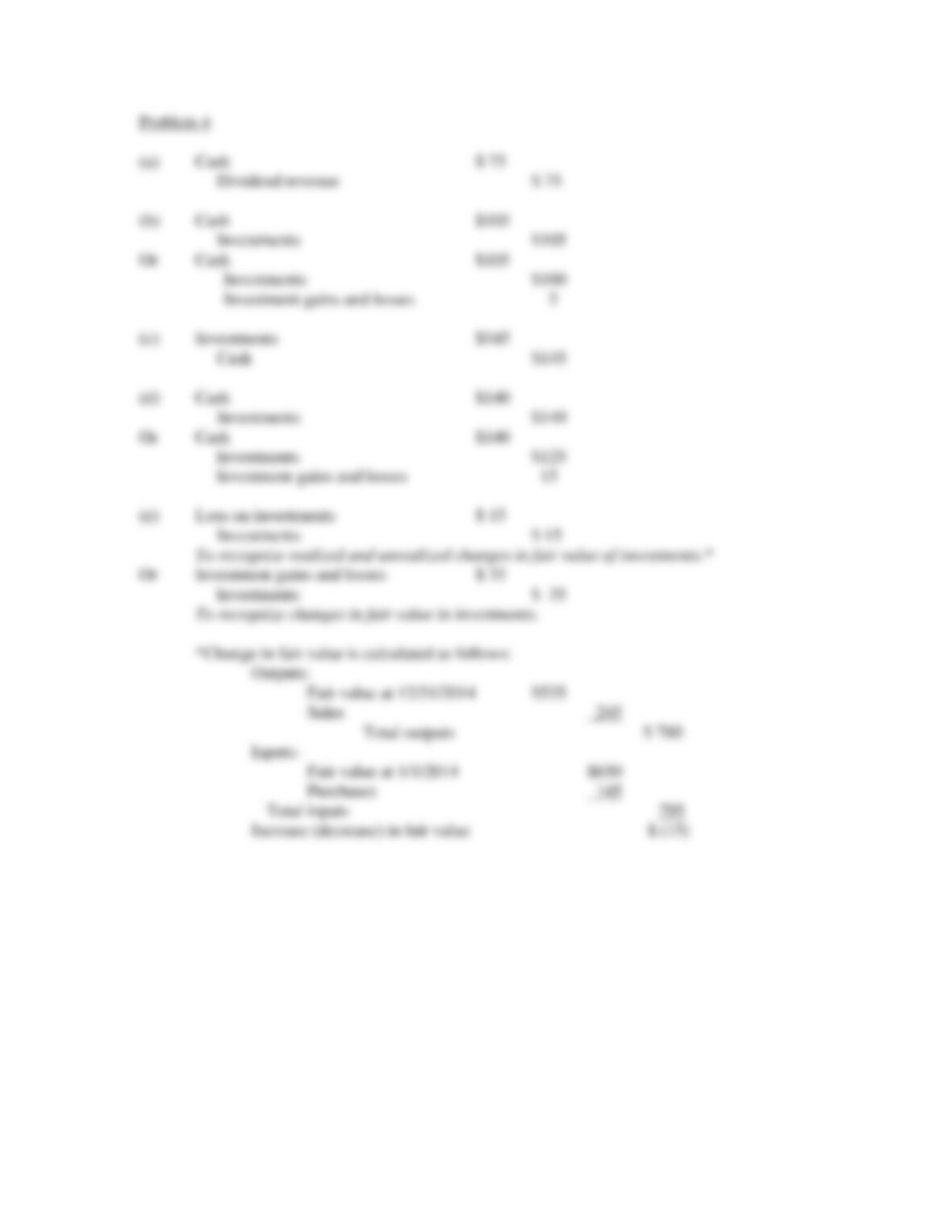
4. The City of Jolie maintains its books and records in a manner that facilitates the preparation
of fund financial statements. Prepare all necessary journal entries to record the city’s
investment income and related transactions for the year 2014. The city has a 12/31 fiscal year-
end. All of the City’s investments are required to be reported at fair value. The beginning
securities portfolio held by the general fund was as follows:
January 1, 2014
Securities Historical Cost Market Value
A $90 $ 95
B $110 $100
C $300 $330
D $120 $125
a.) Dividends received related to investments held in the general fund, $75.
b.) On March 1, Security B is sold for $105.
c.) On April 1, Security E is purchased for $145
d.) On May 1 Security D is sold for $140.
e.) On December 31, necessary adjusting entries are made to recognize appropriate amounts
of gains/losses associated with the securities. The market values of the securities at year-
end were as follows:
Dec. 31, 2014
Securities Historical Cost Market Value
A $90 $90
C $300 $310
E $145 $135
ch04 Page 17
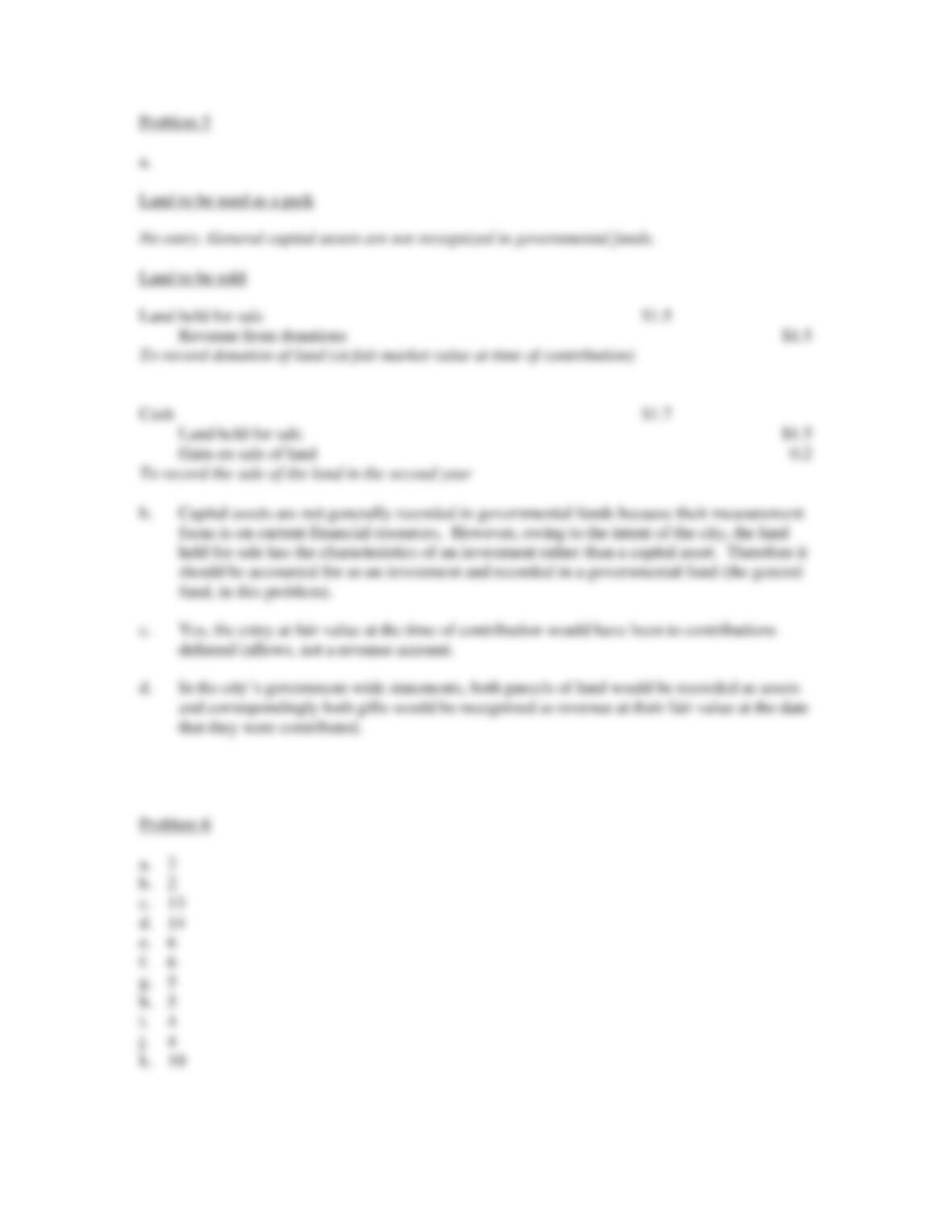
5. The City of Chessie received two contributions during its current fiscal year:
• A developer contributed 10 acres of land as part of an agreement with the city to allow
more houses to be built per acre than current zoning laws permit. The city will use the
land to build a park. The developer purchased the land for $1.5 million. The fair value of
the land at the time of the contribution was $1.9 million.
• A local resident contributed 30 acres of land to the city. The city agreed that it would sell
the land and use the proceeds to add a new wing to the city’s senior center. The resident
paid $500,000 for the land. When it was contributed, it had a fair value of $1.5 million.
The city sold the land to several developers a month after its fiscal year-end for $1.7
million.
a. Prepare journal entries to record each of these contributions in the city’s general fund.
b. Comment on and justify any differences in the way you recognized each of these
transactions.
c. Would your answer on the contribution for the senior center be different if the city had
been unable to sell the land before its financial statements were issued?
d. How would each of these transactions be reported in the city’s government-wide financial
statements?
ch04 Page 18
6. Castle County reported the following transactions during its fiscal year ended December 31,
2014:
• On February 16, 2014, the county purchased a 15-year $100,000 bond for $99,800 with
cash held in a debt sinking fund. During the year, the county received $3,000 in interest.
At year-end, the market value of the bond was $99,950.
• In December 2013, the Kiplinger foundation pledged up to $3 million to support the
county’s Art Museum. The foundation will contribute $1 for every $2 in admissions
revenue generated by the Art Museum. During 2014, the Art Museum reported $4.0
million in admissions revenue. During January and February 2015, it reported an
additional $1.0 million. The county received the matching contributions for both
admissions amounts.
• During the year, the county agreed to impose a license fee on all tanning salons operated
in the county. Licenses cover the period July 1, 2014 to June 30, 2015. The county
received license revenues of $150,000.
• The county sold two police cars for salvage totaling $7,500. It had purchased the cars five
years earlier at $30,000 each. The county had fully depreciated the police cars in its
government-wide financial statements and a total salvage value of $5,000 had been
anticipated.
• The county received a $1.5 million grant from the state to reimburse the cost of its DARE
program. The county incurred DARE program costs of $1.0 million during 2014 and an
additional $500,000 in January and February 2015.
Match the items below with the amounts that follow. All amounts are for the year ended
December 31, 2014. An amount may be selected once, more than once, or never.
a. Amount of investment income (interest, dividends, realized and unrealized gains and
losses) recognized by the county in its debt service fund.
b. Amount of investment income (interest, dividends, realized and unrealized gains and
losses) recognized by the county in its government-wide financial statements.
c. Amount recognized in the county’s general fund on the sale of its police cars.
d. Gain/loss recognized on the sale of police cars in the county’s government-wide financial
statements.
e. DARE grant revenues recognized in the County’s government-wide financial statements.
f. DARE grant revenues recognized in the county’s special revenue fund.
g. Contributions from the Kiplinger Foundation in the county’s Museum Fund (a special
revenue fund).
h. Contributions from the Kiplinger Foundation reported in the County’s government-wide
financial statements.
i. License fee revenue reported in the county’s general fund.
j. License fee revenue reported in the county’s government-wide financial statements.
k. Reported value at December 31, 2014 of the county’s investment.
1. $0
2. $3,150
3. $3,000
4. $150,000
5. $2,000,000
6. $1,000,000
7. $3,000,000
8. $500,000
ch04 Page 19
9. $100,000
10. $99,950
11. $99,800
12. $2,500,000
13. $7,500
14. $2,500
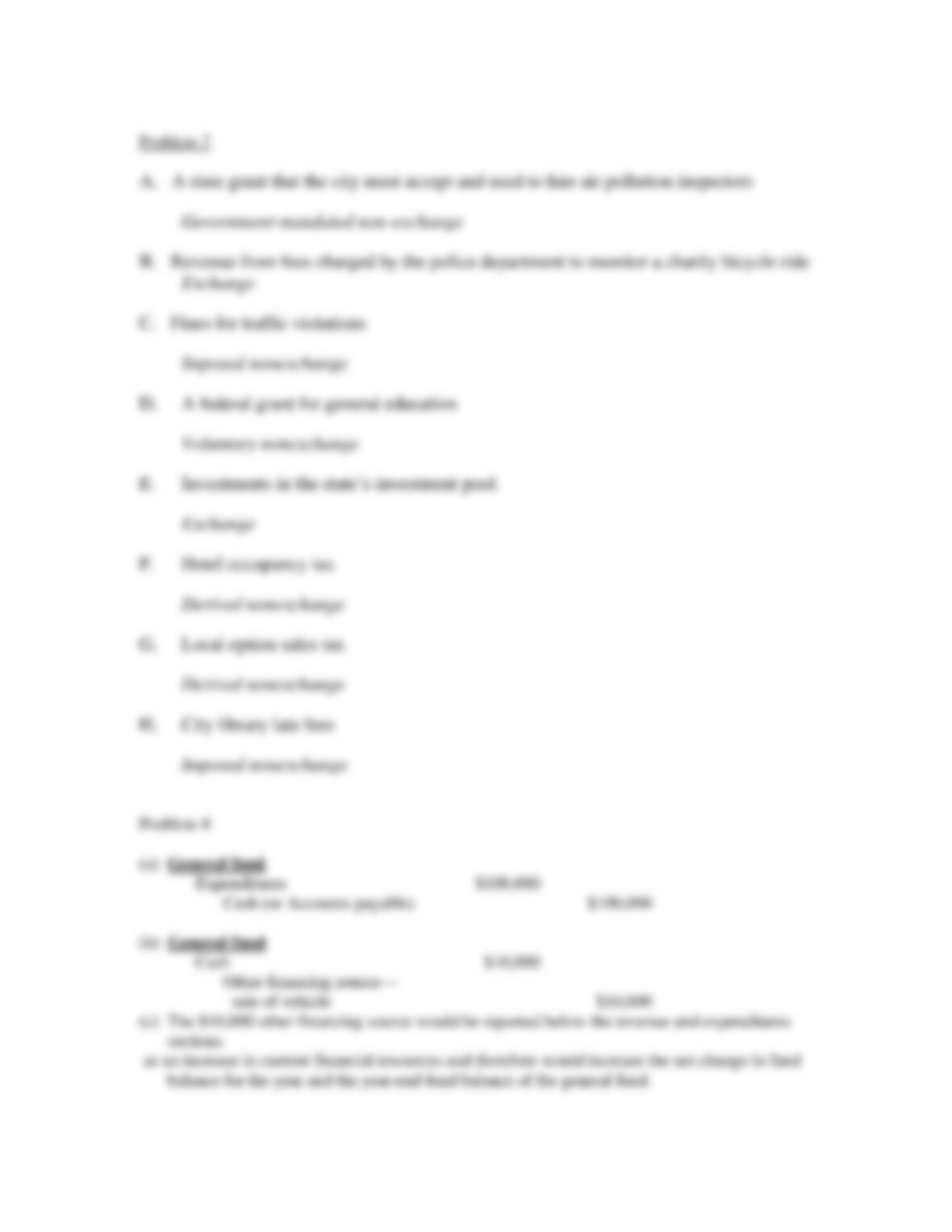
7. In addition to exchange revenues, GASB standards discuss four categories of
nonexchange revenues. For each of the following revenues recognized by a city
indicate the category into which it best fits.
A. A state grant that the city must accept and use to hire air pollution inspectors
________________________
B. Revenue from fees charged by the police department to monitor a charity
bicycle ride
_______________________
C. Fines for traffic violations
_______________________
D. A federal grant to support general education services.
E.
________________________Investments in the state’s investment
pool.
________________________
F. Hotel occupancy tax.
________________________
G. Local option sales tax
________________________
H. City library late fees
________________________
8. On December 30, 2013, a county purchases a new snow plow for $100,000. On January 2,
2014, the snow plow is seriously damaged in an accident. The plow is uninsured. Soon after
the accident, the county is able to sell the snow plow for $10,000.
ch04 Page 20
(a) Record the purchase of the snow plow in the county’s general fund.
(b) Record the sale of the snow plow.
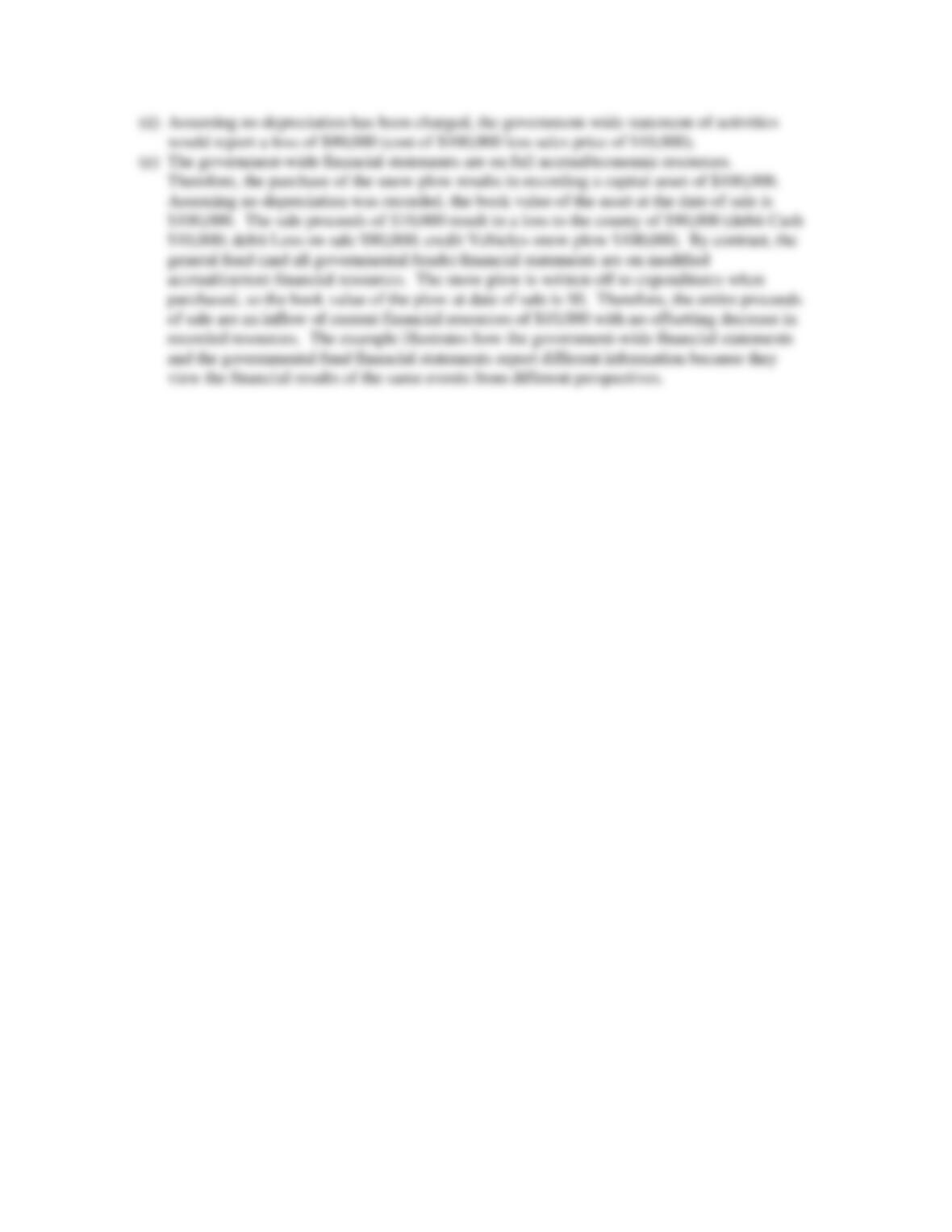
(c) How would the sale of the snow plow affect the general fund’s operating statement?
(d) How would the sale of the snow plow affect the governmental activities column of the
government-wide statement of activities?
(e) Explain the rationale for the difference between the information conveyed in the fund
operating statement vs. the government-wide statement of activities in relation to the
snow plow.
ESSAYS (CHAPTER 4)
1. Governments use modified accrual accounting to determine when transactions and events will
be recognized in the financial statements of the governmental fund types.
a.) What is modified accrual accounting and how does it affect revenue recognition for the
following types of revenue: property taxes; sales and income taxes; fines; grants of all
types; and investment income.
b.) In your opinion is modified accrual accounting the best basis of accounting for
governments? Why or why not?
2. Answer the following questions with regard to the preparation of fund financial statements. At
fiscal year-end, a city holds an investment portfolio in its general fund that has a fair market
value of $15 million and a historical cost of $28 million. The portfolio had a fair value of $18
million at the beginning of the current fiscal year. The portfolio is composed of a variety of
bonds with a face value $29 and a due date five years in the future. The bonds were acquired
to meet a $29 million debt due five years in the future.
a.) At what amount should the portfolio be valued on the balance sheet?
b.) What amount, if any, should appear on the operating statement?
c.) Defend the valuation method required by GAAP.
d.) Argue against the valuation method required by GAAP.
e.) At what amount would the city want to record these investments on its financial
statements for the current year? Why?
3. Answer the following questions with regard to the preparation of fund financial statements. A
city receives three grants from the state. One grant is received in cash but must be used only
for the acquisition of two vans specifically equipped to transport physically challenged citizens
who use wheelchairs as a means of mobility. The second grant provides for reimbursement of
costs incurred in operating a public transit system. The third grant is a distribution of state
general fund revenues allocated to each city in the state based on the population of the city.
This grant is to be used in general government operations.
a.) Discuss the various methods of revenue recognition for grants and other similar revenues.
b.) What is the appropriate basis for revenue recognition for each of the three state grants?
c.) What is the rationale for each of these methods of revenue recognition?
ch04 Page 21
4. A city receives a federal grant which the city must pass through to smaller units of
government who meet the eligibility requirements. The city must monitor these smaller units
of government for compliance with grant requirements.
a.) How should the city recognize this grant in its fund financial statements?
b.) Would your answer be different if the city were not required to monitor the other
governments for compliance with grant requirements? Explain.
ch04 Page 22
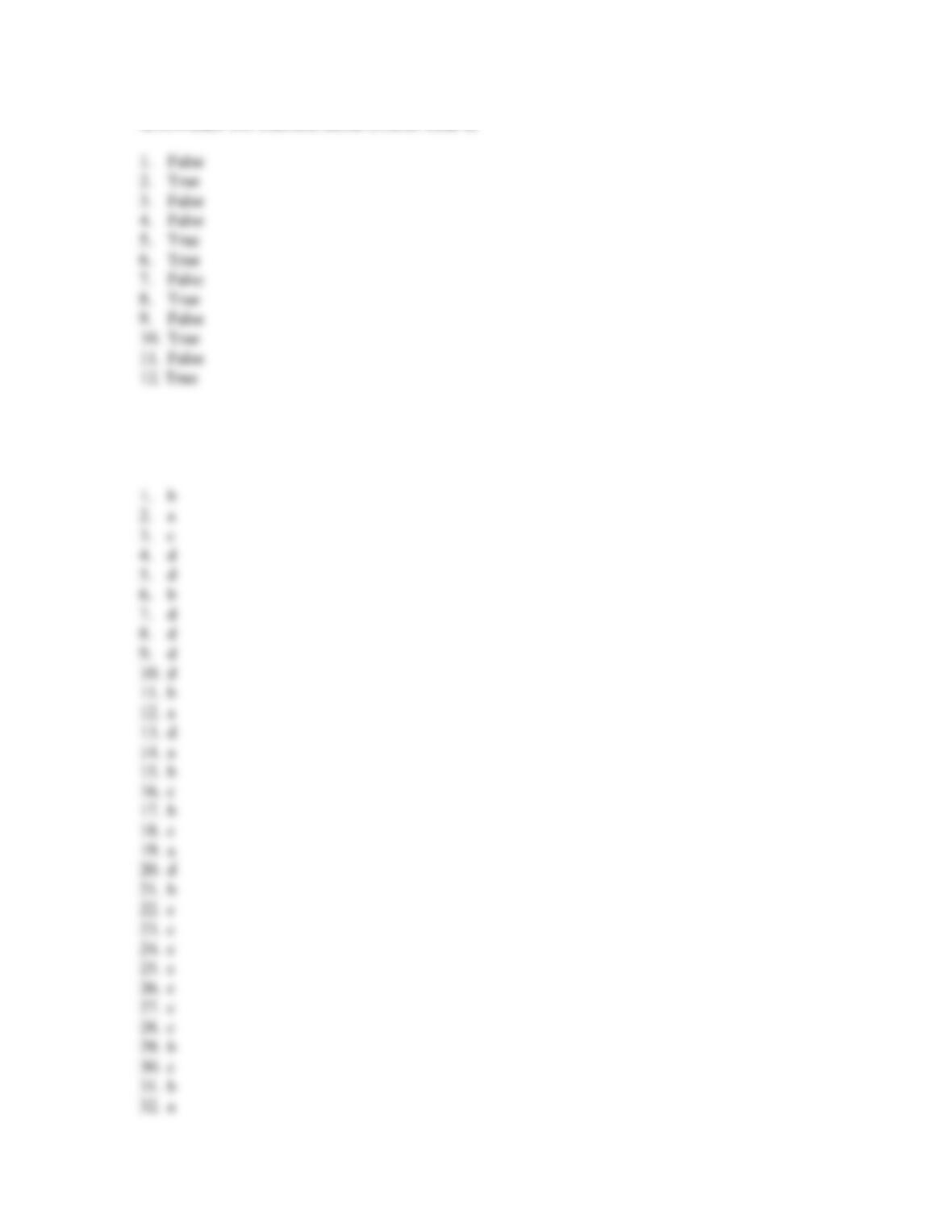
ANSWERS TO TRUE/FALSE (CHAPTER 4)
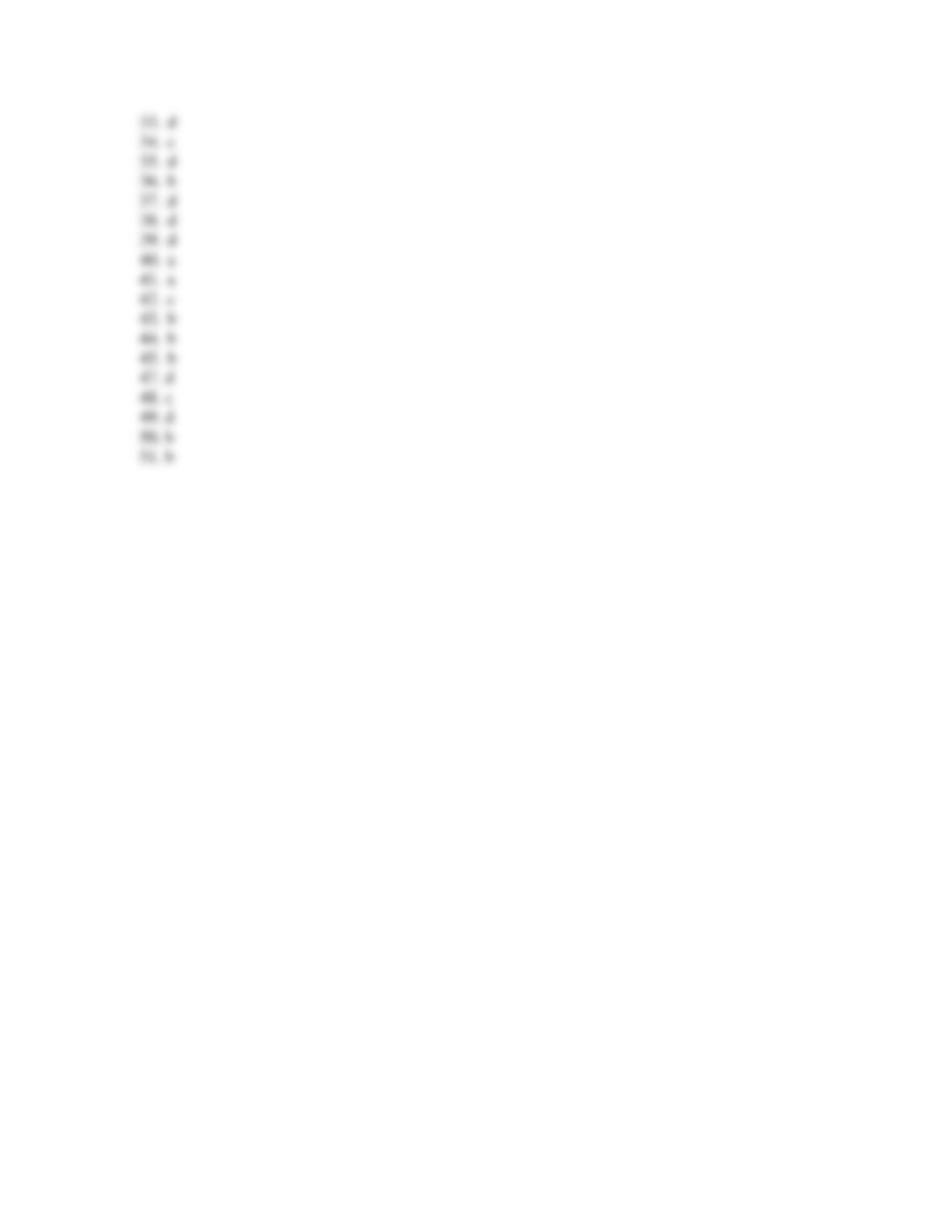
ANSWERS TO MULTIPLE CHOICE (CHAPTER 4)
ch04 Page 23
ch04 Page 24
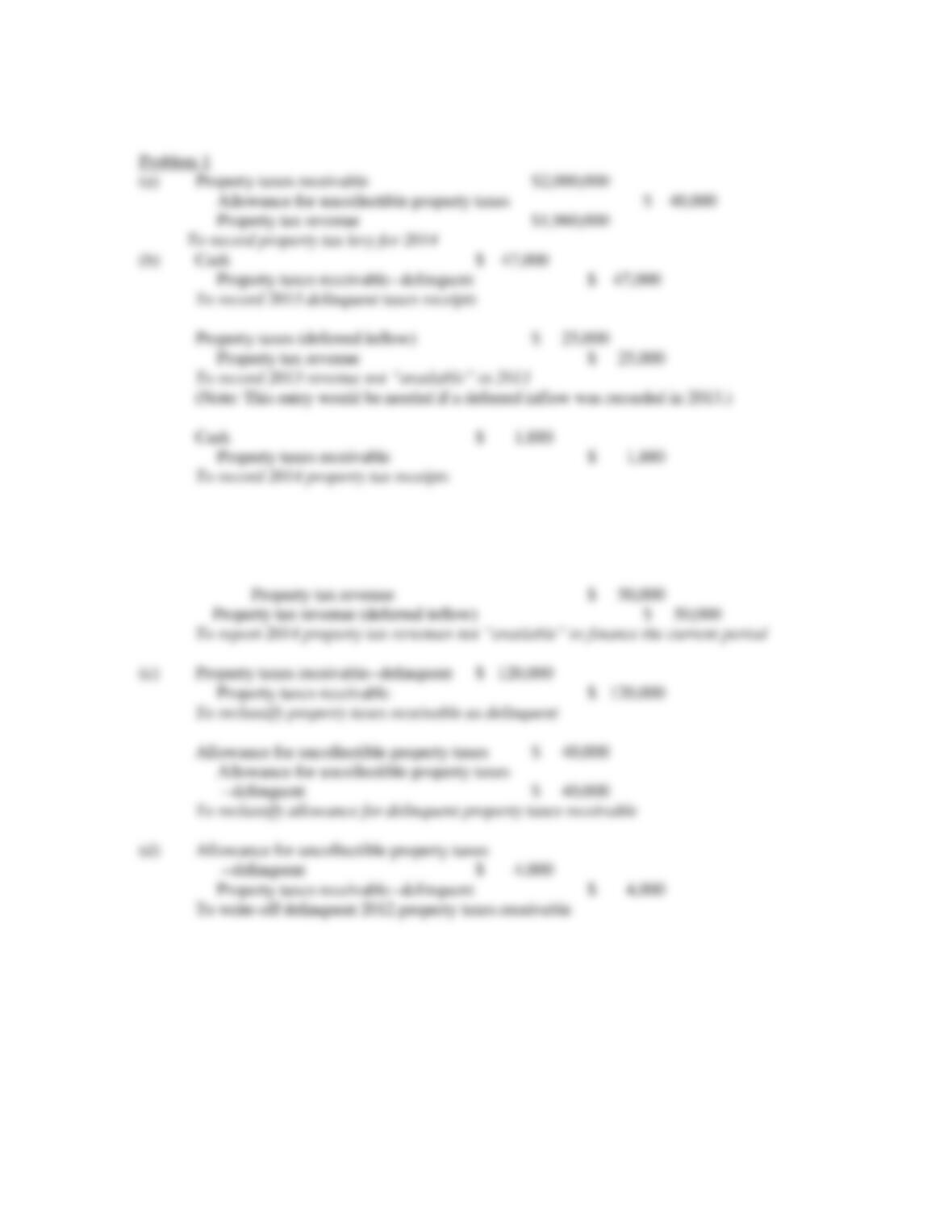
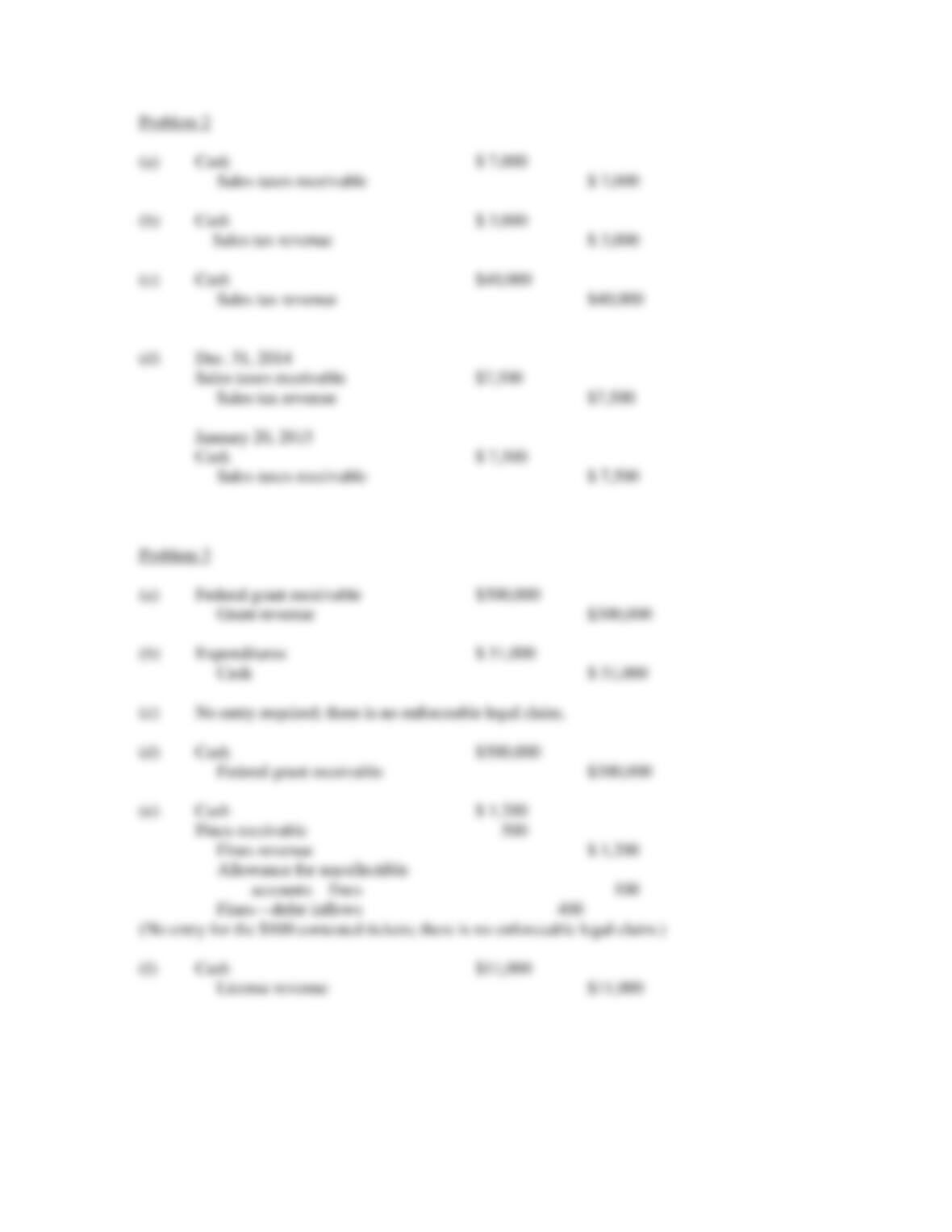
ANSWERS TO PROBLEMS (CHAPTER 4)
ch04 Page 25
ch04 Page 26
ch04 Page 27
ch04 Page 28
ch04 Page 29
ch04 Page 30
ANSWERS TO ESSAYS (CHAPTER 4)
ch04 Page 31

ch04 Page 32