
Chapter 4 — Intercompany Transactions: Merchandise, Plant
Assets, and Notes
MULTIPLE CHOICE
1. Schiff Company owns 100% of the outstanding common stock of the Viel
Company. During 20X1, Schiff sold merchandise to Viel that Viel, in
turn, sold to unrelated firms. There were no such goods in Viel’s
ending inventory. However, some of the intercompany purchases from
Schiff had not yet been paid. Which of the following amounts will be
incorrect in the consolidated statements if no adjustments are made?
a.
inventory, accounts payable, net income
b.
inventory, sales, cost of goods sold, accounts receivable
c.
sales, cost of goods sold, accounts receivable, accounts payable.
d.
accounts receivable, accounts payable
2. The material sale of inventory items by a parent company to an
affiliated company
a.
enters the consolidated revenue computation only if the transfer
was the result of arm’s length bargaining.
b.
affects consolidated net income under a periodic inventory system
but not under a perpetual inventory system.
c.
does not result in consolidated income until the merchandise is
sold to outside entities.
d.
does not require a working paper adjustment if the merchandise was
transferred at cost.
3. Williard Corporation regularly sells inventory items to its subsidiary,
Petty, Inc. If unrealized profits in Petty’s 20X1 year-end inventory
exceed the unrealized profits in its 20X2 year-end inventory, combined
a.
cost of sales will be less than consolidated cost of sales in
20X2.
b.
gross profit will be greater than consolidated gross profit in
20X2.
c.
sales will be less than consolidated sales in 20X2.
d.
cost of sales will be greater than consolidated cost of sales in
20X2.

4. Sally Corporation, an 80%-owned subsidiary of Reynolds Company, buys
half of its raw materials from Reynolds. The transfer price is exactly
the same price as Sally pays to buy identical raw materials from
outside suppliers and the same price as Reynolds sells the materials to
unrelated customers. In preparing consolidated statements for Reynolds
Company and Subsidiary
a.
the intercompany transactions can be ignored because the transfer
price represents arm’s length bargaining.
b.
any unrealized profit from intercompany sales remaining in
Reynolds’ ending inventory must be offset against the unrealized
profit in Reynolds’ beginning inventory.
c.
any unrealized profit on the intercompany transactions in Sally’s
ending inventory is eliminated in its entirety.
d.
eighty percent of any unrealized profit on the intercompany
transactions in Sally’s ending inventory is eliminated.
5. Cattle Company sold inventory with a cost of $40,000 to its 90%-owned
subsidiary, Range Corp., for $100,000 in 20X1. Range resold $75,000 of
this inventory for $100,000 in 20X1. The amount of inventory reported
on the consolidated financial statements at the end of 20X1 is _______.
a.
$10,000
b.
$18,000
c.
$21,000
d.
$30,000
6. Diller owns 80% of Lake Company common stock. During October 20X7, Lake
sold merchandise to Diller for $300,000. On December 31, 20X7, one-half
of this merchandise remained in Diller’s inventory. For 20X7, gross
profit percentages were 30% for Diller and 40% for Lake. The amount of
unrealized profit in the ending inventory on December 31, 20X7 that
should be eliminated in consolidation is _______.
a.
$80,000
b.
$60,000
c.
$32,000
d.
$30,000
7. Perry, Inc. owns a 90% interest in Brown Corp. During 20X6, Brown sold
$100,000 in merchandise to Perry at a 30% gross profit. Ten percent of
the goods are unsold by Perry at year end. The noncontrolling interest
will receive what gross profit as a result of these sales?
a.
$0
b.
$2,700
c.
$3,000
d.
$27,000

Chapter 4
4-3
8. On January 1, 20X1 Bullock, Inc. sells land to its 80%-owned
subsidiary, Humphrey Corporation, at a $20,000 gain. The land is still
held by Humphrey on December 31, 20X3. What is the effect of the
intercompany sale of land on consolidated net income?
a.
Consolidated net income will be the same as it would have been had
the sale not occurred.
b.
Consolidated net income will be $20,000 less than it would have
been had the sale not occurred.
c.
Consolidated net income will be $16,000 less than it would have
been had the sale not occurred.
d.
Consolidated net income will be $20,000 greater than it would have
been had the sale not occurred.
9. Emron Company owns a 100% interest in the common stock of the Dietz
Company. On January 1, 20X2, Emron sold Dietz a fixed asset that Dietz
will use over a 5–year period. The asset was sold at a $5,000 profit.
In the consolidated statements, this profit will
a.
not be recorded.
b.
be recognized over 5 years.
c.
be recognized in the year of sale.
d.
be recognized when the asset is resold to outside parties at the
end of its period of use.
10. Pease Corporation owns 100% of Sade Corporation common stock. On
January 2, 20X6, Pease sold machinery with a carrying amount of $30,000
to Sade for $50,000. Sade is depreciating the acquired machinery over a
5-year life using the straight-line method. The net adjustments to
compute the 20X6 and 20X7 consolidated income before income tax would
be an increase (decrease) of
20X6 20X7
a.
$(16,000) $4,000
b.
$(16,000) $0
c.
$(20,000) $4,000
d.
$(20,000) $0
11. On January 1, 20X1, Poe Corp. sold a machine for $900,000 to Saxe
Corp., its wholly–owned subsidiary. Poe paid $1,100,000 for this
machine. On the sale date, accumulated depreciation was $250,000. Poe
estimated a $100,000 salvage value and depreciated the machine on the
straight-line method over 20 years, a policy that Saxe continued. In
Poe’s December 31, 20X1, consolidated balance sheet, this machine
should be included in cost and accumulated depreciation as
Cost Accumulated Depreciation

Chapter 4
a.
$1,100,000 $300,000
b.
$1,100,000 $290,000
c.
$ 900,000 $ 40,000
d.
$ 850,000 $ 42,500
12. Porch Company owns a 90% interest in the Screen Company. Porch sold
Screen a milling machine on January 1, 20X1, for $50,000 when the book
value of the machine on Porch’s books was $40,000. Porch financed the
sale with Screen signing a 3-year, 8% interest, note for the entire
$50,000. The machine will be used for 10 years and depreciated using
the straight-line method. The following amounts related to this
transaction were located on the companies trial balances:
Interest Revenue $4,000
Interest Expense $4,000
Depreciation Expense $5,000
Based upon the information related to this transaction what will be the
amounts eliminated in preparing the consolidated financial statements?
Interest Revenue Interest Expense Depreciation Expense
a.
4,000 4,000 5,000
b.
4,000 4,000 1,000
c.
3,600 3,600 900
d.
3,600 3,600 4,500
13. On 1/1/X1 Peck sells a machine with a $20,000 book value to its
subsidiary Shea for $30,000. Shea intends to use the machine for 4
years. On 12/31/X2 Shea sells the machine to an outside party for
$14,000. What amount of gain or (loss) for the sale of assets is
reported on the consolidated financial statements?
a.
loss of $6,000
b.
loss of $1,000
c.
gain of $4,000
d.
gain of $14,000
14. Stroud Corporation is an 80%-owned subsidiary of Pennie, Inc., acquired
by Pennie several years ago. On January 1, 20X2, Pennie sold land with
a book value of $60,000 to Stroud for $90,000. Stroud resold the land
to an unrelated party for $100,000 on September 26, 20X3. The land will
be included in the December 31, 20X2 consolidated balance sheet of
Pennie, Inc. and Subsidiary at _______.
a.
$48,000
b.
$60,000
c.
$72,000
d.
$90,000

Chapter 4
15. Stroud Corporation is an 80%-owned subsidiary of Pennie, Inc., acquired
by Pennie several years ago. On January 1, 20X2, Pennie sold land with
a book value of $60,000 to Stroud for $90,000. Stroud resold the land
to an unrelated party for $100,000 on September 26, 20X3. The gain from
sale of land that will appear in the consolidated income statements for
20X2 and 20X3, respectively, is _______.
a.
$0 and $10,000
b.
$0 and $40,000
c.
$30,000 and $10,000
d.
$30,000 and $40,000
16. Company P owns 100% of the common stock of Company S. Company P is
constructing an asset for Company S that will be used in Company S’s
manufacturing operations over a 5-year period. The asset was 50%
complete at the end of 20X1 and was completed on December 31, 20X2.
Company P is recording the construction under the percentage of
completion method. The asset was put into use by Company S on January
1, 20X3. The profit on the asset was estimated to be $50,000. Actual
results complied to the estimate. On the consolidated statements, the
profit will appear as
20X1 20X2 20X3 20X4 – 20X7
a.
0 50,000 0 0
b.
25,000 25,000 0 0
c.
0 0 10,000 10,000
d.
0 0 50,000 0
17. The following accounts were noted in reviewing the trial balance for
Parent Co. and Subsidiary Corp.:
Assets under Construction
Contracts Receivable
Billings on Construction in Progress
Earned Income on Long-Term Contracts
Contracts Payable
Which of these accounts do you expect to eliminate when producing
Parent Co. consolidated financial statements?
a.
Assets under Construction; Billings on Construction in Progress;
Earned Income on Long-Term Contracts
b.
Contracts Receivable; Billings on Construction in Progress; Earned
Income on Long–Term Contracts
c.
Assets under Construction; Contracts Receivable; Billings on
Construction in Progress; Earned Income on Long-Term Contracts;
Contracts Payable
d.
Contracts Receivable; Billings on Construction in Progress; Earned
Income on Long–Term Contracts; Contracts Payable

Chapter 4
18. During 20X3, a parent company billed its 100%-owned subsidiary for
computer services at the rate of $1,000 per month. At year end, one
month’s bill remained unpaid. As a part of the consolidation process,
net income
a.
should be reduced $12,000.
b.
should be reduced $1,000.
c.
needs no adjustment.
d.
needs an adjustment, but the amount is not provided by this
information.
19. On January 1, 20X1, a parent loaned $30,000 to its 100%-owned
subsidiary on a 5–year, 8% note. The note requires a principal payment
at the end of each year of $6,000 plus payment of interest accrued to
date. The following accounts require adjustment in the consolidation
process:
Controlling
Assets Debt Retained Earnings
a.
Yes Yes Yes
b.
No No Yes
c.
Yes Yes No
d.
No No No
20. Phelps Co. uses the sophisticated equity method to account for the 80%
investment in its subsidiary Shore Corp. Based upon the following
information what amount does Phelps Co. record as subsidiary income?
Phelps internally generated income: $250,000
Shore internally generated income: $ 50,000
Intercompany profit on Shore beginning inventory: $ 10,000
Intercompany profit on Shore ending inventory: $ 15,000
a.
$50,000
b.
$44,000
c.
$40,000
d.
$36,000

Chapter 4
4-7
PROBLEM
1. Account balances are as of December 31, 20X3 except where noted.
Pipe
Match
Selected Income Statement Amounts:
Sales
$710,000
$530,000
Cost of Goods Sold
490,000
370,000
Gain on Sale of Equipment
21,000
Earnings from Investment in subsidiary
61,000
Interest Revenue
2,880
Interest Expense
2,880
Depreciation
25,000
20,000
Selected Balance Sheet Amounts {Debits/(Credits)}:
Cash
$ 50,000
$ 15,000
Notes Receivable
36,000
Inventories
229,000
150,000
Equipment
440,000
360,000
Accumulated Depreciation
(200,000)
(120,000)
Investment in Shaw
189,000
Notes Payable
(36,000)
Common Stock
(100,000)
(10,000)
Additional paid-in-capital
(250,000)
(40,000)
Retained Earnings
(402,000)
(140,000)
Selected Statement of Retained Earnings Amounts:
Beginning Balance, December 31, x2
$ 272,000
$ 100,000
Net Income
210,000
70,000
Dividends Paid
80,000
30,000
Additional Information:
On January 2, 20X3 Pipe purchased 90% of Match for $155,000. On that
date Match’s shareholders’ equity equaled $150,000 and the fair values
of Match’s assets and liabilities equaled their carrying amounts.
Excess, if any, is attributed to patents and is amortized over 10
years.
On September 4, 20X3 Match paid cash dividends of $30,000.
On January 3, 20X3 Match sold equipment with an original cost of
$30,000 and a carrying value of $15,000 to Pipe for $36,000. The
equipment had a remaining useful life of 3 years. Straight-line
depreciation is used.
On January 4, 20X3 Match signed an 8% Note Payable. All interest
payments were made as of December 31, 20X3.
During the year Match sold merchandise to Pipe for $60,000, which
included a profit of $20,000. At year end 50% of the merchandise
remained in Pipe’s inventory.
Chapter 4
4-8
Required:
1. Which method is Pipe using to account for the investment in Match?
How do you know?
2. What elimination entry(ies) are associated with the elimination of
intercompany profits due to the sale of merchandise?
3. What elimination entry(ies) are necessary with the sale of
equipment by Match to Pipe?
4. What elimination entry(ies) are associated with the note to Match?
Why are the entry(ies) made?
ANS:
Chapter 4
2. On January 1, 20X1, Prange Company acquired 100% of the common stock of
Seaman Company for $600,000. On this date Seaman had total owners’
equity of $400,000. Any excess of cost over book value is attributable
to a patent, which is to be amortized over 10 years.
During 20X1 and 20X2, Prange has appropriately accounted for its
investment in Seaman using the simple equity method.
On January 1, 20X2, Prange held merchandise acquired from Seaman for
$30,000. During 20X2, Seaman sold merchandise to Prange for $100,000,
of which $20,000 is held by Prange on December 31, 20X2. Seaman’s gross
profit on all sales is 40%.
On December 31, 20X2, Prange still owes Seaman $20,000 for merchandise
acquired in December.
Required:
Complete the Figure 4-1 worksheet for consolidated financial statements
for the year ended December 31, 20X2.

Chapter 4
4-10
3. On January 1, 20X1, Prange Company acquired 80% of the common stock of
Seaman Company for $500,000. On this date Seaman had total owners’
equity of $400,000. Any excess of cost over book value is attributable
to patent, which is to be amortized over 20 years.
During 20X1 and 20X2, Prange has appropriately accounted for its
investment in Seaman using the simple equity method.
On January 1, 20X2, Prange held merchandise acquired from Seaman for
$30,000. During 20X2, Seaman sold merchandise to Prange for $100,000,
of which $20,000 is held by Prange on December 31, 20X2. Seaman’s gross
profit on all sales is 40%.
On December 31, 20X2, Prange still owes Seaman $20,000 for merchandise
acquired in December.
Required:
Complete the Figure 4-2 worksheet for consolidated financial statements
for the year ended December 31, 20X2.
Chapter 4

Chapter 4
4. Selected information from the separate and consolidated balance sheets
and income statements of Palo Alto, Inc. and its subsidiary, Stanford
Co., as of December 31, 20X1, and for the year then ended is as
follows:
Consoli–
Palo Alto Stanford dated
Balance sheet accounts
Accounts receivable………… $ 26,000 $19,000 $ 42,000
Inventory…………………. 30,000 25,000 50,000
Investment in Stanford……… 67,000 — —
Goodwill………………….. — — 30,000
Noncontrolling interest…….. — — 10,000
Stockholders’ equity……….. 154,000 50,000 154,000
Income statement accounts
Revenues………………….. $200,000 $140,000 $300,000
Cost of goods sold…………. 150,000 110,000 225,000
Gross profit…………….. 50,000 30,000 75,000
Equity in earnings of Stanford. $9,000 — —
Net income………………… $36,000 $20,000 $36,000
Additional information
During 20X1, Palo Alto sold goods to Stanford at the same
markup on cost that Palo Alto uses for all sales. At December
31, 20X1, Stanford had not paid for all of these goods and
still held 50% of them in inventory.
Palo Alto acquired its interest in Stanford five years earlier
(as of December 31, 20X1.)
Required:
For each of the following items, calculate the required amount.
a.
The amount of intercompany sales from Palo Alto to Stanford
during 20X1.
b.
The amount of Stanford’s payable to Palo Alto for intercompany
sales as of December 31, 20X1.
c.
In Palo Alto’s December 31, 20X1, consolidated balance sheet,
the carrying amount of the inventory that Stanford purchased
from Palo Alto.
d.
The percent of noncontrolling interest ownership in Stanford
as of December 31, 20X1.
$40,000
$3,000
$15,000

4-13
5. On January 1, 20X1, Pinto Company purchased an 80% interest in Sands
Inc. for $1,000,000. The equity balances of Sands at the time of the
purchase were as follows:
Common stock ($10 par)…………………………… $100,000
Paid-in capital in excess of par………………….. 400,000
Retained earnings……………………………….. 500,000
Any excess of cost over book value is attributable to goodwill.
No dividends were paid by either firm during 20X6. The following trial
balances were prepared for Pinto Company and its subsidiary, Sands
Inc., on December 31, 20X6:
Pinto Sands
Cash……………………………….. $ 120,000 $ 62,000
Accounts receivable………………….. 290,000 194,000
Inventory…………………………… 350,000 176,000
Land……………………………….. 800,000 180,000
Buildings and equipment………………. 1,100,000 800,000
Accumulated depreciation……………… (180,000) (120,000)
Investment in Sands………………….. 600,000 –
Accounts payable…………………….. (110,000) (50,000)
Common stock, $10 par………………… (800,000) (100,000)
Paid-in capital in excess of par………. (660,000) (400,000)
Retained earnings……………………. (1,340,000) (650,000)
Sales………………………………. (600,000) (300,000)
Other income………………………… (40,000) (12,000)
Cost of goods sold…………………… 320,000 180,000
Other expenses………………………. 150,000 32,000
Total…………………………….. 0 0
=========== =========
Sands sold a machine to Pinto Company for $40,000 on January 1, 20X6.
The machine cost Sands $50,000, and $25,000 of accumulated depreciation
had been recorded as of the sale date. The machine had a 5-year
remaining life and no salvage value. Pinto Company is using straight–
line depreciation.
Since the purchase date, Pinto has sold merchandise for resale to
Sands, Inc. at a mark-up on cost of 25%. Sales during 20X6 were
$150,000. The inventory of these goods held by Sands was $15,000 on
January 1, 20X6, and $18,000 on December 31, 20X6.
Required:
Prepare a consolidated income statement for 20X6, including income
distribution schedules to support your distribution of income to the
Noncontrolling and controlling interest accounts.
Chapter 4
Chapter 4
6. On January 1, 20X1, Parent Company acquired 100% of the common stock of
Subsidiary Company for $750,000. On this date Subsidiary had total
owners’ equity of $540,000.
Any excess of cost over book value is attributable to land, undervalued
$10,000, and to goodwill.
During 20X1 and 20X2, Parent has appropriately accounted for its
investment in Subsidiary using the simple equity method.
On January 1, 20X2, Parent held merchandise acquired from Subsidiary
for $10,000. During 20X2, Subsidiary sold merchandise to Parent for
$100,000, of which $20,000 is held by Parent on December 31, 20X2.
Subsidiary’s usual gross profit on affiliated sales is 40%.
On December 31, 20X2, Parent still owes Subsidiary $20,000 for
merchandise acquired in December.
On January 1, 20X2, Parent sold to Subsidiary some equipment with a
cost of $50,000 and a book value of $20,000. The sales price was
$40,000. Subsidiary is depreciating the equipment over a five-year
life, assuming no salvage value and using the straight-line method.
Required:
Complete the Figure 4-3 worksheet for consolidated financial statements
for the year ended December 31, 20X2.
Chapter 4
4-16
7. On January 1, 20X1, Parent Company acquired 80% of the common stock of
Subsidiary Company for $560,000. On this date Subsidiary had total
owners’ equity of $540,000, including retained earnings of $240,000.
During 20X1, Subsidiary had net income of $60,000 and paid no
dividends.
Any excess of cost over book value is attributable to land, undervalued
$10,000, and to goodwill.
During 20X1 and 20X2, Parent has appropriately accounted for its
investment in Subsidiary using the cost method.
On January 1, 20X2, Parent held merchandise acquired from Subsidiary
for $10,000. During 20X2, Subsidiary sold merchandise to Parent for
$100,000, of which $20,000 is held by Parent on December 31, 20X2.
Subsidiary’s usual gross profit on affiliated sales is 40%.
On December 31, 20X2, Parent still owes Subsidiary $20,000 for
merchandise acquired in December.
On January 1, 20X2, Parent sold to Subsidiary some equipment with a
cost of $50,000 and a book value of $20,000. The sales price was
$40,000. Subsidiary is depreciating the equipment over a five-year
life, assuming no salvage value and using the straight-line method.
Required:
Complete the Figure 4-4 worksheet for consolidated financial statements
for the year ended December 31, 20X2.
Chapter 4
Chapter 4
4-18
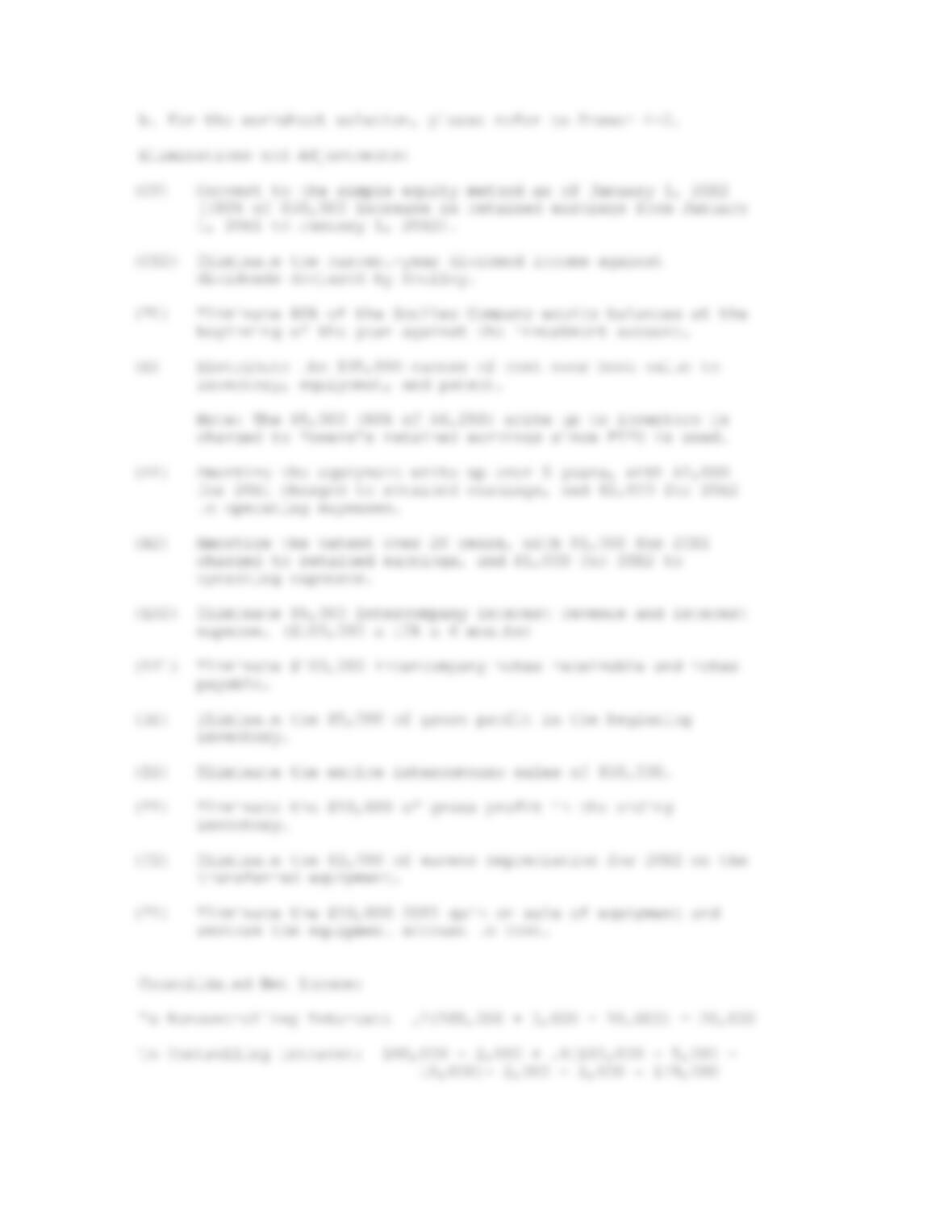
8. On January 1, 20X1, Powers Company acquired 80% of the common stock of
Sculley Company for $195,000. On this date Sculley had total owners’
equity of $200,000 (common stock, other paid-in capital and retained
earnings of $10,000, $90,000 and $100,000 respectively).
Any excess of cost over book value is attributable to inventory (worth
$6,250 more than cost), to equipment (worth $12,500 more than book
value), and to patents. FIFO is used for inventories. The equipment has
a remaining life of five years and straight-line depreciation is used.
The excess to patents is to be amortized over 20 years. The Powers
company concept (pro rata fair value approach) is to be used in any
write up of assets.
Powers 7% Bonds Payable are due in 20X8 and Sculley 12% Bonds are due
in 20X5.
On July 1, 20X2 Sculley borrowed $100,000 from Powers with a 10% 1-Year
Note.
During 20X1 and 20X2, Powers has appropriately accounted for its
investment in Sculley using the cost method.
On January 1, 20X2, Powers held merchandise acquired from Sculley for
$10,000. During 20X2, Sculley sold merchandise to Powers for $50,000,
$20,000 of which is still held by Powers on December 31, 20X2.
Sculley’s usual gross profit on affiliated sales is 50%.
On December 31, 20X1, Powers sold equipment to Sculley at a gain of
$10,000. During 20X2, the equipment was used by Sculley. Depreciation
is being computed using the straight-line method, a five-year life, and
no salvage value.
Required:
a.
Using the information above or on the Figure 4-5 worksheet,
prepare a determination and distribution of excess schedule.
b.
Complete the Figure 4-5 worksheet for consolidated financial
statements for the year ended December 31, 20X2.
Chapter 4
Chapter 4
4-20

Chapter 4
4-21
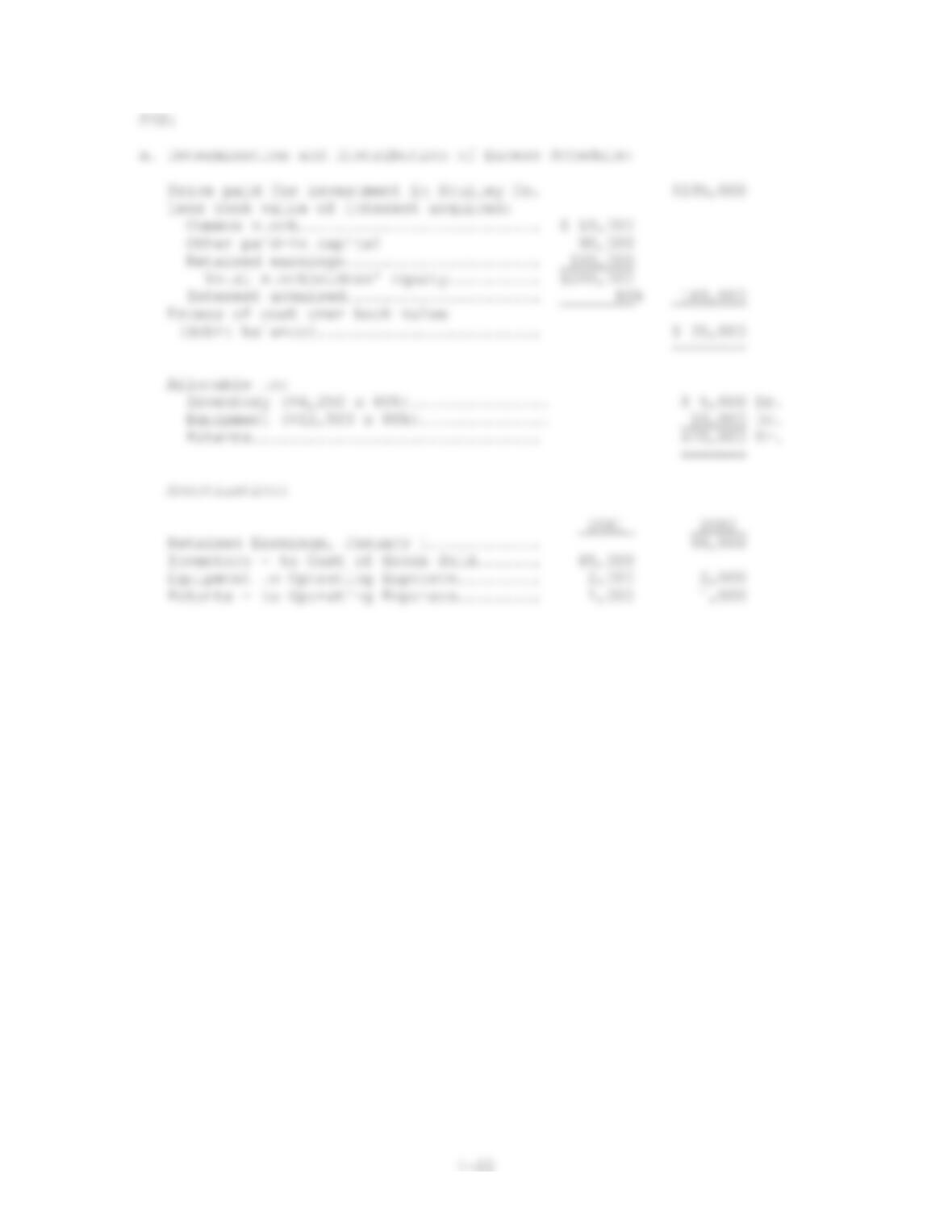
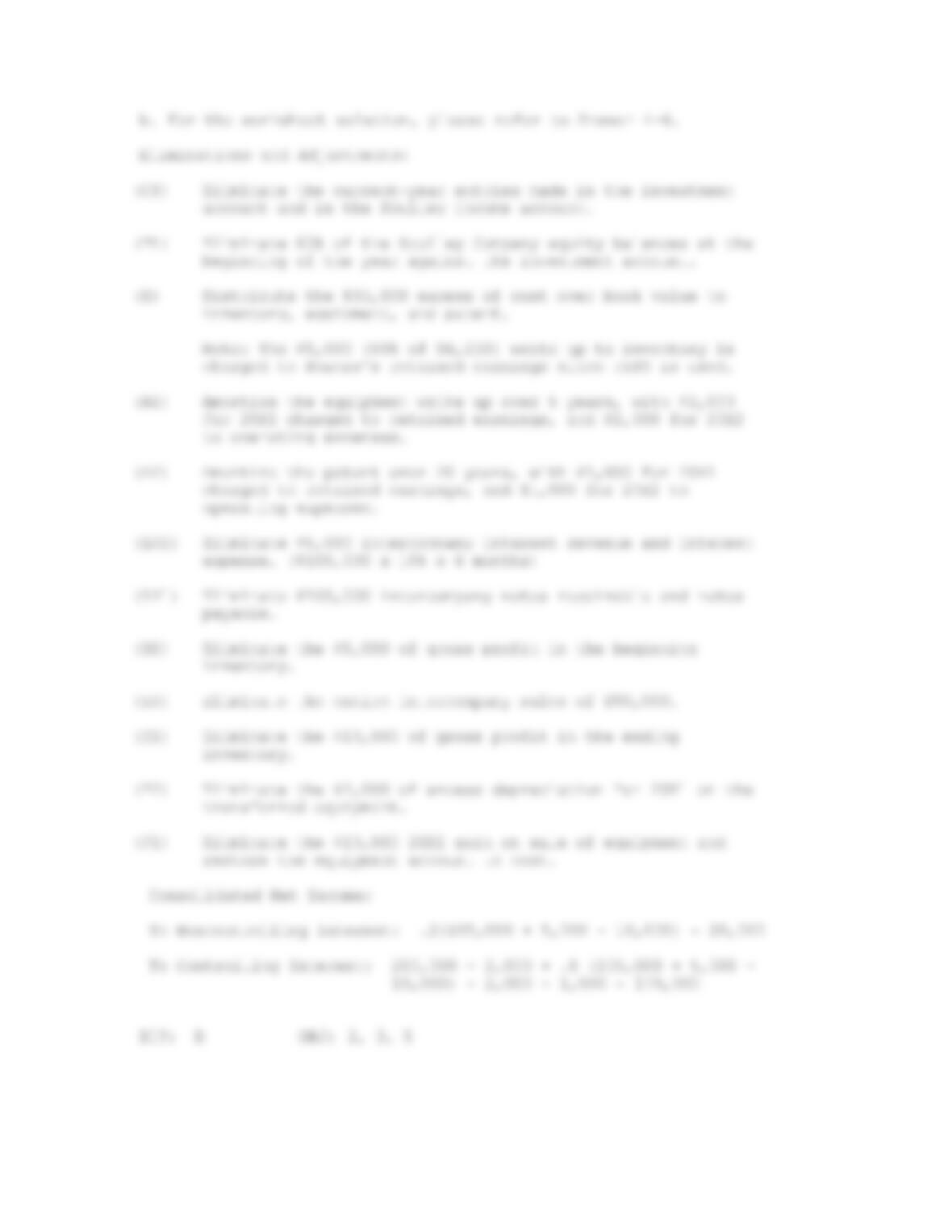
9. On January 1, 20X1, Powers Company acquired 80% of the common stock of
Sculley Company for $195,000. On this date Sculley had total owners’
equity of $200,000 (common stock, other paid-in capital, and retained
earnings of $10,000, $90,000, and $100,000 respectively).
Any excess of cost over book value is attributable to inventory (worth
$6,250 more than cost), to equipment (worth $12,500 more than book
value), and to patents. FIFO is used for inventories. The equipment has
a remaining life of five years and straight-line depreciation is used.
The excess to the patents is to be amortized over 20 years. The Powers
company concept (pro rata fair value approach) is to be used in any
write up of assets.
During 20X1 and 20X2, Powers has appropriately accounted for its
investment in Sculley using the simple equity method.
Powers 7% Bonds Payable are due in 20X8 and Sculley 12% Bonds are due
in 20X5.
On July 1, 20X2 Sculley borrowed $100,000 from Powers with a 10% 1-Year
Note.
On January 1, 20X2, Powers held merchandise acquired from Sculley for
$10,000. During 20X2, Sculley sold merchandise to Powers for $50,000,
$20,000 of which is still held by Powers on December 31, 20X2.
Sculley’s usual gross profit on affiliated sales is 50%.
On December 31, 20X1, Powers sold equipment to Sculley at a gain of
$10,000. During 20X2, the equipment was used by Sculley. Depreciation
is being computed using the straight-line method, a five-year life, and
no salvage value.
Required:
a.
Using the information above or on the Figure 4-6 worksheet,
prepare a determination and distribution of excess schedule.
b.
Complete the Figure 4-6 worksheet for consolidated financial
statements for the year ended December 31, 20X2.
Chapter 4
Chapter 4
4-23
Chapter 4
4-24
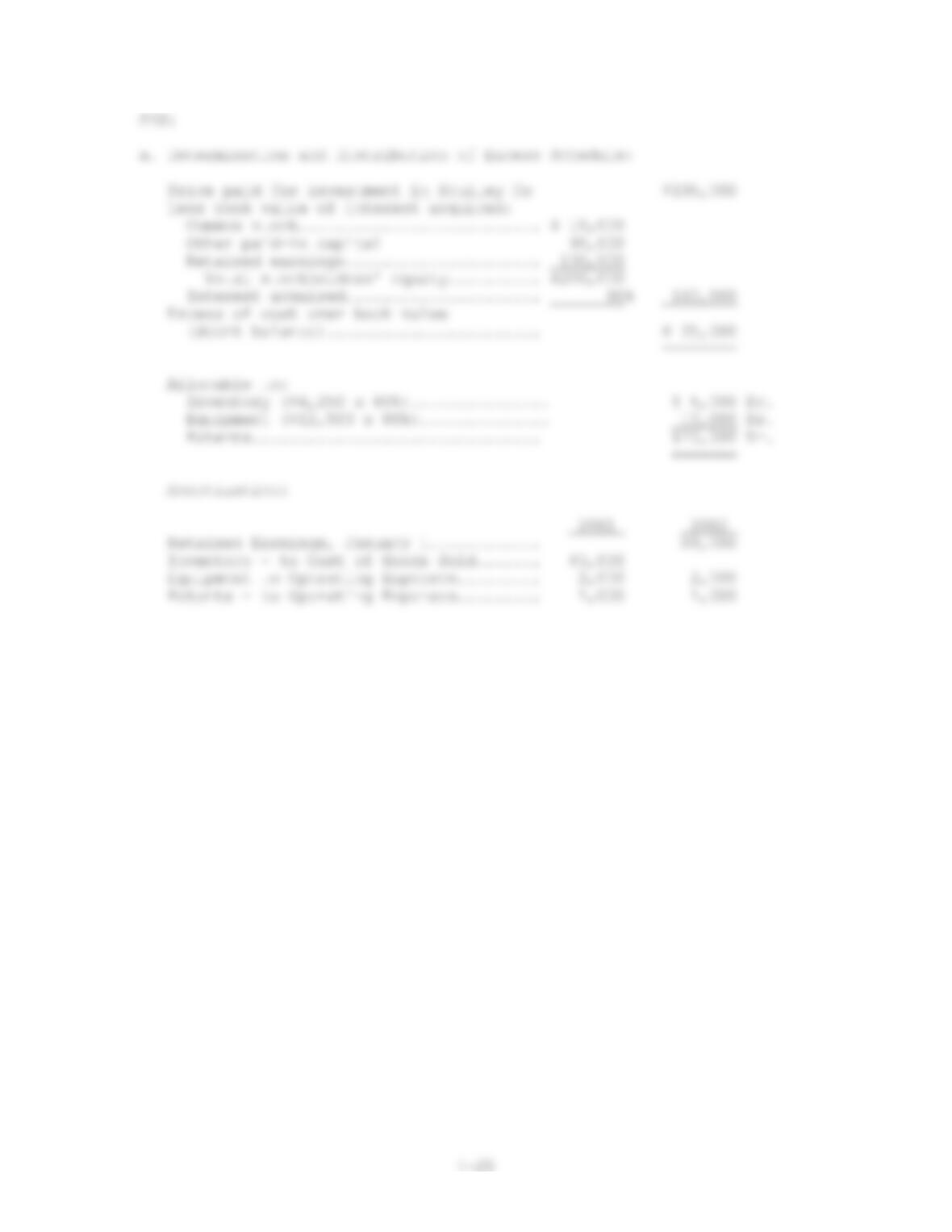
10. On January 1, 20X1, Powers Company acquired 80% of the common stock of
Sculley Company for $195,000. On this date Sculley had total owners’
equity of $200,000 (common stock, other paid-in capital, and retained
earning of $10,000, $90,000, and $100,000 respectively).
Any excess of cost over book value is attributable to inventory (worth
$6,250 more than cost), to equipment (worth $12,500 more than book
value), and to the patents. FIFO is used for inventories. The equipment
has a remaining life of five years and straight-line depreciation is
used. The excess attributable to the patents is to be amortized over 20
years. The Powers company concept (pro rata fair value approach) is to
be used in any write up of assets.
During 20X1 and 20X2, Powers has appropriately accounted for its
investment in Sculley using the sophisticated equity method.
On January 1, 20X2, Powers held merchandise acquired from Sculley for
$10,000. During 20X2, Sculley sold merchandise to Powers for $50,000,
$20,000 of which is still held by Powers on December 31, 20X2.
Sculley’s usual gross profit on affiliated sales is 50%.
On December 31, 20X1, Powers sold equipment to Sculley at a gain of
$10,000. During 20X2, the equipment was used by Sculley. Depreciation
is being computed using the straight-line method, a five-year life, and
no salvage value.
Required:
a.
Using the information above or on the Figure 4-7 worksheet,
prepare a determination and distribution of excess schedule.
b.
Complete the Figure 4-7 worksheet for consolidated financial
statements for the year ended December 31, 20X2.
Chapter 4
Chapter 4
4-26
Chapter 4
4-27
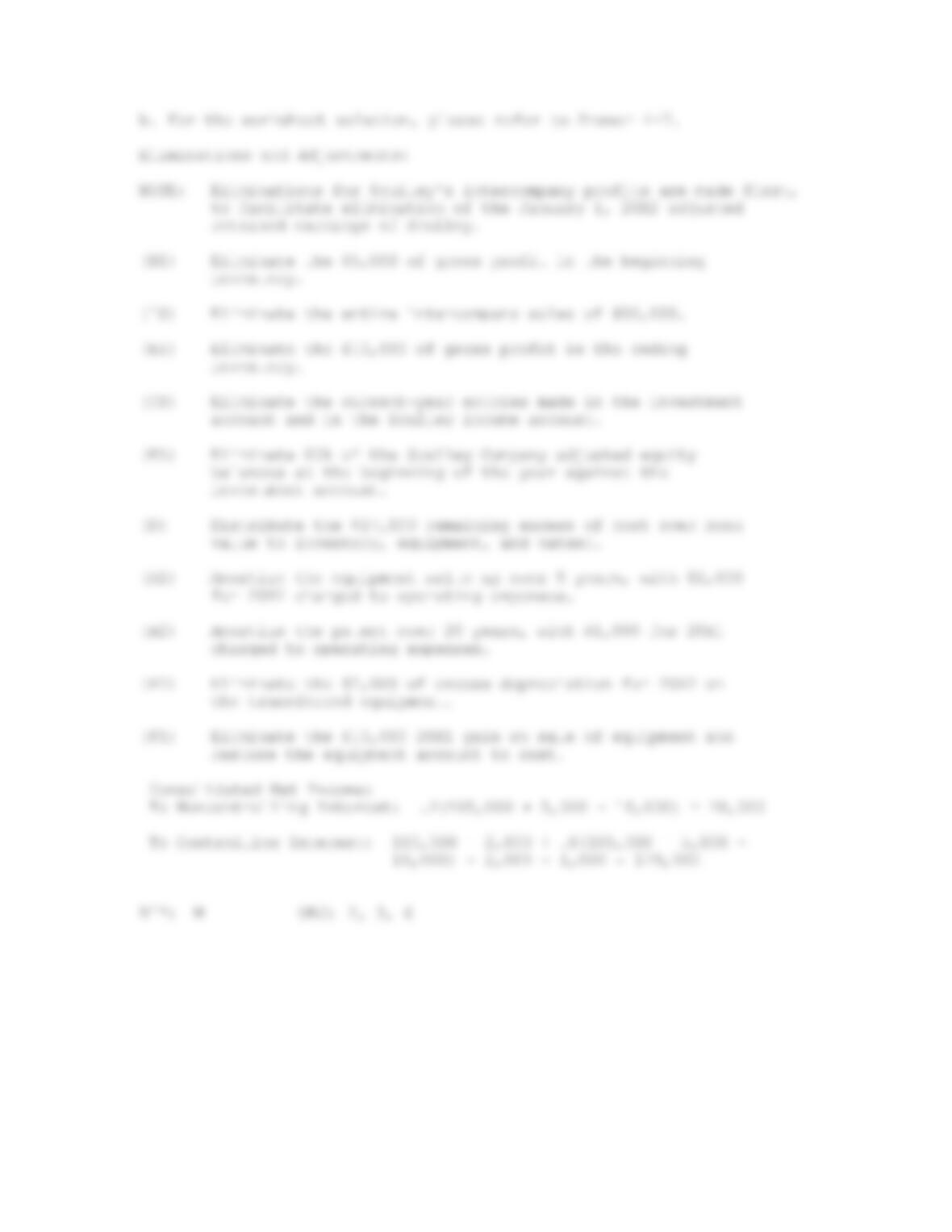
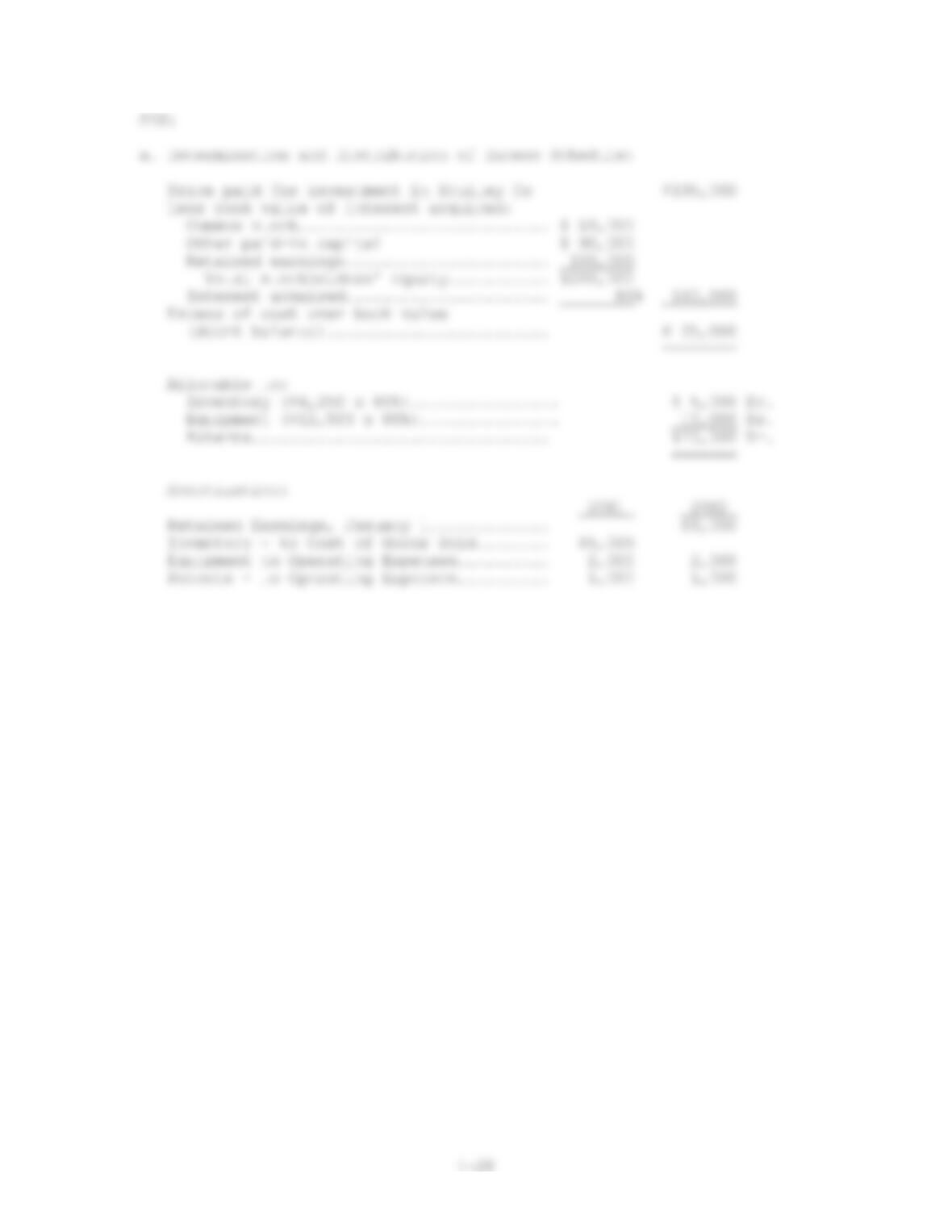
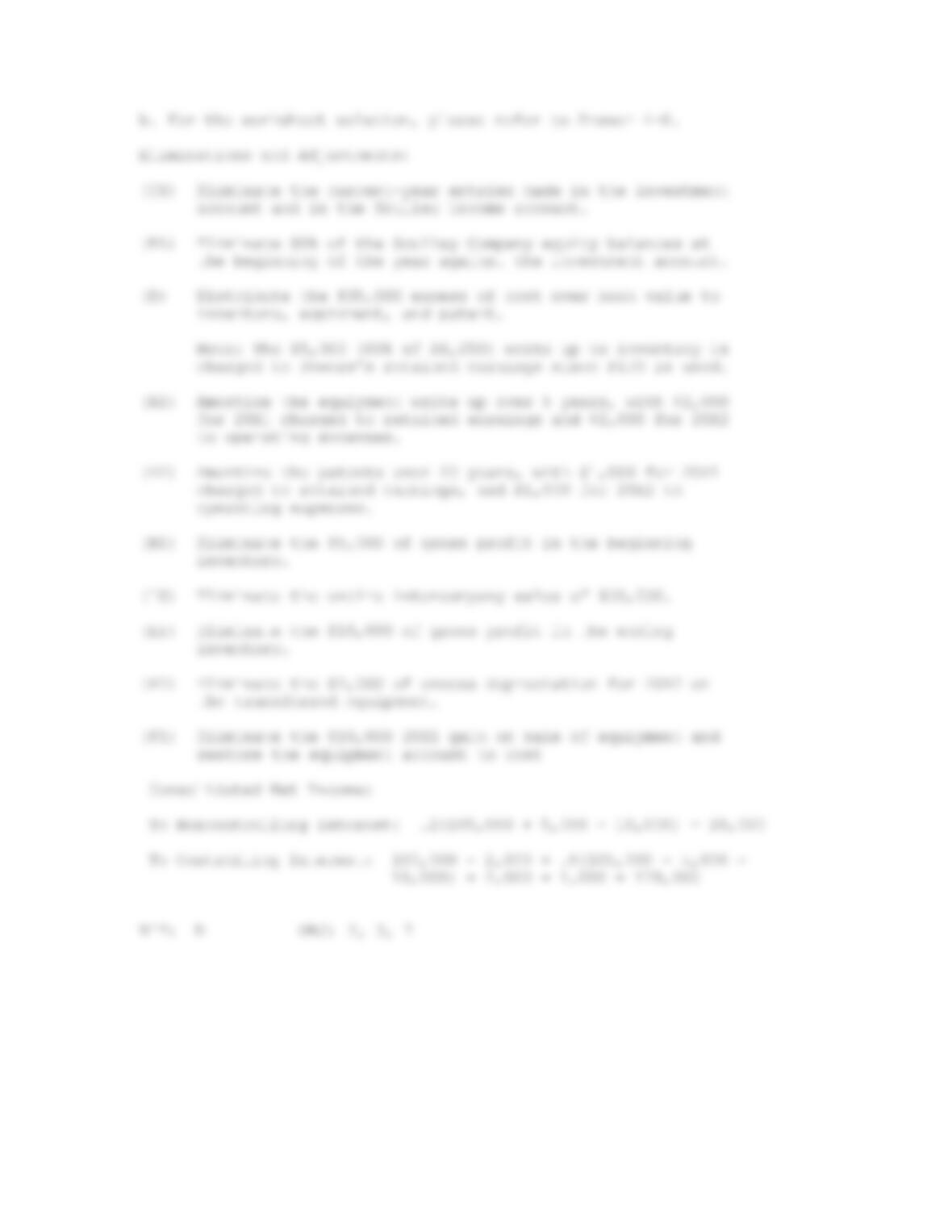
11. On January 1, 20X1, Powers Company acquired 80% of the common stock of
Sculley Company for $195,000. On this date Sculley had total owners’
equity of $200,000 (common stock, other paid-in capital, and retained
earning of $10,000, $90,000, and $100,000 respectively).
Any excess of cost over book value is attributable to inventory (worth
$6,250 more than cost), to equipment (worth $12,500 more than book
value), and to patents. FIFO is used for inventories. The equipment has
a remaining life of five years and straight-line depreciation is used.
The excess attributable to the patents is to be amortized over 20
years. The Powers company concept (pro rata fair value approach) is to
be used in any write up of assets.
During 20X1 and 20X2, Powers has appropriately accounted for its
investment in Sculley using the simple equity method.
On January 1, 20X2, Powers held merchandise acquired from Sculley for
$10,000. During 20X2, Sculley sold merchandise to Powers for $50,000,
$20,000 of which is still held by Powers on December 31, 20X2.
Sculley’s usual gross profit on affiliated sales is 50%.
On December 31, 20X1, Powers sold equipment to Sculley at a gain of
$10,000. During 20X2, the equipment was used by Sculley. Depreciation
is being computed using the straight-line method, a five-year life, and
no salvage value.
Required:
a.
Using the information above or on the Figure 4-8 worksheet,
prepare a determination and distribution of excess schedule.
b.
Complete the Figure 4-8 worksheet for consolidated financial
statements for the year ended December 31, 20X2.
Chapter 4
Chapter 4
4-29
Chapter 4
4-30
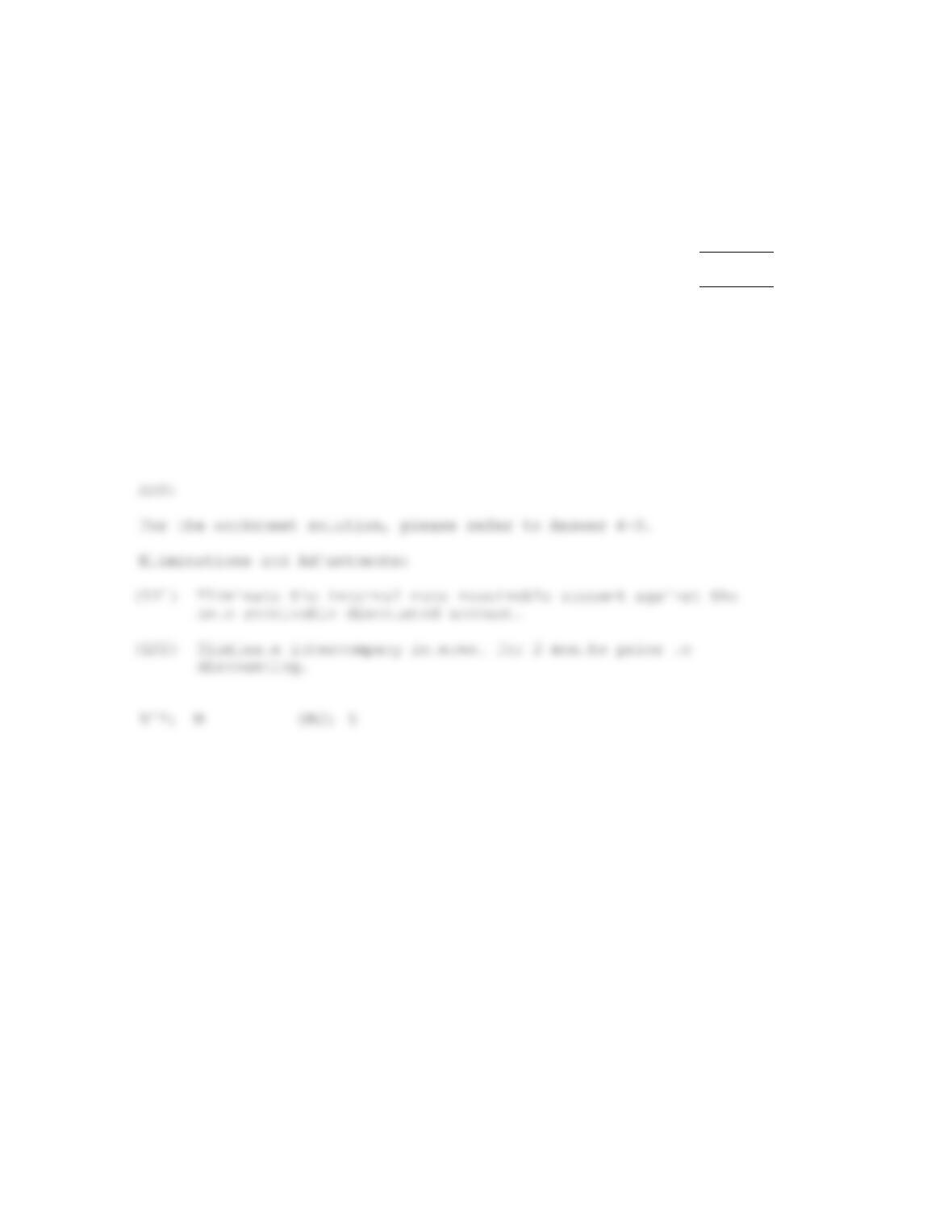
12. On June 1, 20X3, Sprung Company, a wholly-owned subsidiary of Payles
Corporation, borrowed $100,000 from Payles and signed a one-year, 12%
note with interest payable at maturity. On August 1, 20X3, Payles
discounted the note at a 15% annual interest rate at a bank. The
proceeds were calculated as follows:
Principal of note……………………………….. $100,000
Interest due at maturity (12% x $100,000)………….. 12,000
Total maturity value…………………………….. $112,000
Discount (maturity value x 15% discount x 10/12 year… (14,000)
Net proceeds of note…………………………….. $ 98,000
========
Required:
Prepare the eliminations that would be made on the Figure 4-9 partial
worksheet dated December 31, 20X3, and extend the appropriate accounts
to the consolidated statements.
ESSAY
1. For each of the following intercompany transactions, state the
principle to be used in accounting for intercompany gains on current
and future consolidated income statements:
a.
Gains on merchandise sales
b.
Gains on the sale of land
c.
Gains on the sale of depreciable fixed assets
d.
Interest on intercompany notes
Chapter 4