
Exam
Name___________________________________
MULTIPLE CHOICE. Choose the one alternative that best completes the statement or answers the question.
1)
Extrusive igneous rocks are typically finer grained than intrusive igneous rocks. Why?
1)
A)
Intrusive magma flows onto the Earth’s surface and cools very slowly, allowing many small
mineral grains to grow.
B)
The extrusive magma cools quickly so the mineral grains do not have time to grow.
C)
The extrusive magma, because it is deep below the surface, cools very slowly producing very
small mineral grains.
D)
Intrusive magma is cooler because it is well insulated by the surrounding rock.
2)
In which of the following igneous rocks and environments would you expect to find unusually
high concentrations of rare elements such as lithium, beryllium, and boron?
2)
A)
pegmatite; crystallized from a water–rich, highly differentiated, residual magma
B)
pumice lump; crystallized at depth in a mass of intrusive granite
C)
peridotite; crystallized at depth in the upper mantle
D)
basalt dike; fills a vertical fracture at shallow depth
3)
Which igneous rock or magma has the lowest silica (SiO2) content?
3)
A)
andesite
B)
basalt
C)
peridotite
D)
granite
4)
A(n) ________ texture represents a single, long period of cooling and crystallization.
4)
A)
pyroclastic
B)
aphanitic
C)
phaneritic
D)
glassy

5)
In a porphyritic volcanic rock, which mineral grains are the last to crystallize?
5)
A)
phenocrysts
B)
vesicles
C)
matrix or groundmass
D)
pegmatites
6)
A(n) ________ texture would be most unlikely to occur in an extrusive igneous rock.
6)
A)
pyroclastic
B)
aphanitic
C)
glassy
D)
phaneritic
D
7)
________ is a volcanic rock that is extremely vesicular and glassy.
7)
A)
Tuff
B)
Pegmatite
C)
Obsidian
D)
Pumice
D
8)
________ is the dominant lava erupted from volcanoes on Hawaii and Iceland.
8)
A)
Basalt
B)
Rhyolite
C)
Peridotite
D)
Andesite
A
9)
The last minerals to crystallize on Bowen’s Reaction Series result in igneous rocks with a ________
composition.
9)
A)
felsic
B)
intermediate
C)
ultramafic
D)
mafic
A
10)
Which of the following minerals crystallize early in Bowen’s reaction series?
10)
A)
muscovite
B)
olivine
C)
quartz
D)
biotite
B
C

11)
All of the following are factors that affect the generation of magma EXCEPT for ________.
11)
A)
crystal size
B)
heat
C)
pressure
D)
volatiles
12)
Which of the following igneous rocks has a pyroclastic texture?
12)
A)
rhyolitic tuff
B)
porphyritic basalt
C)
andesitic lava
D)
intrusive granite
A
13)
Which of the following best describes an aphanitic texture?
13)
A)
The rock consists of broken, volcanic–rock and mineral fragments.
B)
The rock is crystalline; mineral grains are too small to be visible without a magnifying lens or
microscope.
C)
The mineral grains have glassy textures.
D)
The rock is crystalline; mineral grains are of distinctly different sizes.
B
14)
________ is composed mainly of ferromagnesian minerals.
14)
A)
Andesite
B)
Peridotite
C)
Rhyolite
D)
Granite
B
15)
The sizes, shapes, and arrangements of mineral grains in an igneous rock are known as ________.
15)
A)
silica content
B)
Bowen’s reaction series
C)
mineral content
D)
texture
D
A

16)
Which magma is most likely to quench (congeal) to a natural glass?
16)
A)
highly viscous; cools slowly
B)
highly viscous; cools quickly
C)
highly fluid; cools quickly
D)
highly fluid; cools slowly
17)
Which of the following igneous rocks exhibit aphanitic texture?
17)
A)
granite, gabbro
B)
andesite, diorite
C)
andesite, rhyolite
D)
rhyolite, gabbro
18)
Visible quartz and potassium feldspar grains are the main constituents in a ________.
18)
A)
rhyolite
B)
basalt
C)
granite
D)
gabbro
19)
________ often contain gem–quality crystals of minerals such as beryl and tourmaline and high
concentrations of relatively rare elements such as lithium, boron, and beryllium?
19)
A)
Granitic pegmatites
B)
Welded tuff sheets
C)
Diorite plutons
D)
Basaltic lavas
20)
________ is named for a prominent, volcanic mountain range in western South America.
20)
A)
Peridotite
B)
Pegmatite
C)
Basalt
D)
Andesite

21)
A ________ is an open cavity in a volcanic rock that was filled by a gas bubble when the lava was
still mainly liquid.
21)
A)
porphyrocryst
B)
xenocryst
C)
phenocryst
D)
vesicle
22)
What do pumice and obsidian have in common?
22)
A)
basaltic composition
B)
ultramafic composition
C)
phaneritic texture
D)
glassy texture
23)
Consider Bowen’s reaction series. Which mineral would you expect to see as a phenocryst in a
porphyritic basalt?
23)
A)
quartz
B)
olivine
C)
orthoclase
D)
sodium–rich plagioclase
24)
Changing the composition of magma by incorporating surrounding host rock is known as
________.
24)
A)
partial melting
B)
differentiation
C)
assimilation
D)
magma mixing
25)
________ is the dominant feldspar in basalt.
25)
A)
Microcline
B)
Pyroxene
C)
Orthoclase
D)
Plagioclase

26)
________ is characterized by very coarse mineral grains.
26)
A)
Obsidian
B)
Pegmatite
C)
Granite
D)
Pumice
27)
________ has the same mineral composition as andesite.
27)
A)
Diorite
B)
Basalt
C)
Gabbro
D)
Granite
28)
Which of the following are used for studying rocks with a polarizing microscope?
28)
A)
thin sections
B)
grain karats
C)
broken chips
D)
polished cubes
29)
________ is thought to be common in the Earth’s mantle but rare in the crust.
29)
A)
Granite
B)
Pumice
C)
Pegmatite
D)
Peridotite
SHORT ANSWER. Write the word or phrase that best completes each statement or answers the question.
30)
What term denotes the larger mineral grains in a porphyritic igneous rock?
30)
phenocryst
31)
A(n) ________ texture refers to rocks composed mainly of mineral and volcanic fragments.
31)
32)
Technically, the process whereby ions arrange themselves into orderly patterns during the
cooling of a liquid is called ________.
32)
33)
Melting of rocks to form magma as a result of decreases pressure is known as ________.
33)

Word Analysis. Examine the words and/or phrases for each question below and determine the relationship among the
majority of words/phrases. Choose the option that does not fit the pattern.
34)
a. olivine b. quartz c. amphibole d. pyroxene
34)
35)
________ is the name given to molten rock below the Earth’s surface.
35)
36)
Pegmatites consist of what size mineral grains?
36)
37)
Igneous rocks are classified on the basis of what two main characteristics?
37)
Word Analysis. Examine the words and/or phrases for each question below and determine the relationship among the
majority of words/phrases. Choose the option that does not fit the pattern.
38)
a. phenocrysts b. crystals c. groundmass d. vesicles
38)
39)
________ refers to the removal and isolation of early–formed mineral grains that can cause
the composition of the remaining magma to change.
39)
Word Analysis. Examine the words and/or phrases for each question below and determine the relationship among the
majority of words/phrases. Choose the option that does not fit the pattern.
40)
a. biotite b. hornblende c. plagioclase d. augite
40)
41)
a. granite b. basalt c. diorite d. gabbro
41)
42)
Pyroxene, hornblende, and biotite are all minerals found on the ________ series of Bowen’s
Reaction Series.
42)

Word Analysis. Examine the words and/or phrases for each question below and determine the relationship among the
majority of words/phrases. Choose the option that does not fit the pattern.
43)
a. obsidian b. rhyolite c. pumice d. welded tuff
43)
44)
________ magma, commonly erupted along oceanic ridge systems, originates by partial
melting of mantle peridotite.
44)
45)
Name two igneous rocks with glassy textures.
45)
TRUE/FALSE. Write ‘T’ if the statement is true and ‘F’ if the statement is false.
46)
In an igneous rock with a phaneritic texture, the mineral grains are visible to the unaided eye.
46)
47)
Most lava crystallizes to form igneous rocks with phaneritic textures.
47)
48)
A porphyritic texture includes two different sizes of mineral grains, the phenocrysts and the
vesicles.
48)
49)
Bowen’s reaction series predicts the sizes of the different mineral grains that grow from
crystallizing magmas.
49)
50)
Minerals, such as plagioclase feldspar, on the continuous branch of Bowen’s Reaction Series react
with the magma to form lower temperature, more stable minerals such as hornblende or biotite.
50)
51)
Pegmatites are smaller volume, intrusive bodies with glassy textures.
51)
52)
Olivine is an important mineral in peridotites and other ultramafic rocks.
52)

53)
Olivine and quartz commonly crystallize together from mafic or basaltic magmas.
53)
54)
Basalt is the aphanitic or fine–grained equivalent of gabbro.
54)
55)
The process of magmatic differentiation can generate residual, more felsic magmas from mafic
magmas such as basalt.
55)
56)
Plutonic rocks are intrusive and generally consist of mineral grains coarse enough to be readily
visible in a hand sample.
56)
57)
Glassy igneous rocks form when magma cools too fast for mineral grains to grow.
57)
MATCHING. Choose the item in column 2 that best matches each item in column 1.
Match the description with the appropriate texture.
58)
rock has two or more, distinctly
different–sized populations of mineral
grains
A)
porphyritic
58)
Match the following rocks to their equivalent aphanitic or phaneritic igneous rocks.
59)
granite
60)
diorite
A)
rhyolite
59)
60)

61)
mineral grains are of roughly equal
size and coarse enough to be seen
without a microscope or magnifying
glass
62)
a magnifying glass or microscope is
needed to see individual mineral
grains
63)
magma cools and consolidates without
growth of mineral grains
A)
glassy
B)
phaneritic
61)
62)
63)
Match the following rocks to their equivalent aphanitic or phaneritic igneous rocks.
64)
basalt
64)
A)
gabbro
ESSAY. Write your answer in the space provided or on a separate sheet of paper.
Critical thinking and discussion questions. Use complete sentences, correct spelling, and the information presented in
chapter 4 to answer the questions below.
65)
In a series of basaltic lava flows on Hawaii, the top and bottom of each flow is difficult to distinguish just by
looking at the layers of rock. What are some rock characteristics (texture, mineralogy, etc.) and other features
that you might use to recognize individual lava flows?
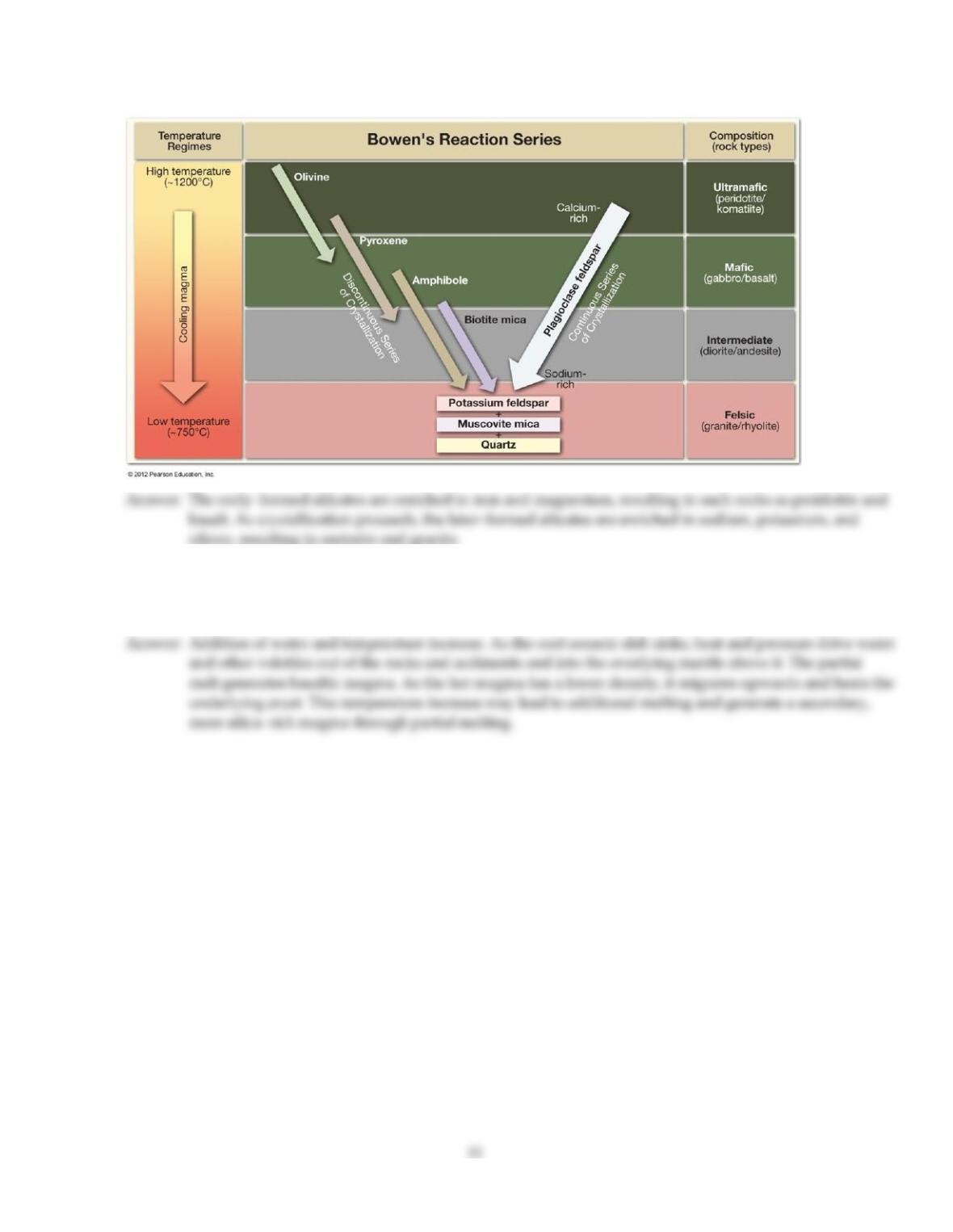
66)
In general, what happens in terms of composition as crystallization proceeds down the Bowen’s reaction?
67)
All other factors being equal (geothermal gradient, pressure, composition, and heat from other sources such as
friction), why is magma generally produced in association with subduction zones as opposed to areas away
from subduction zones?
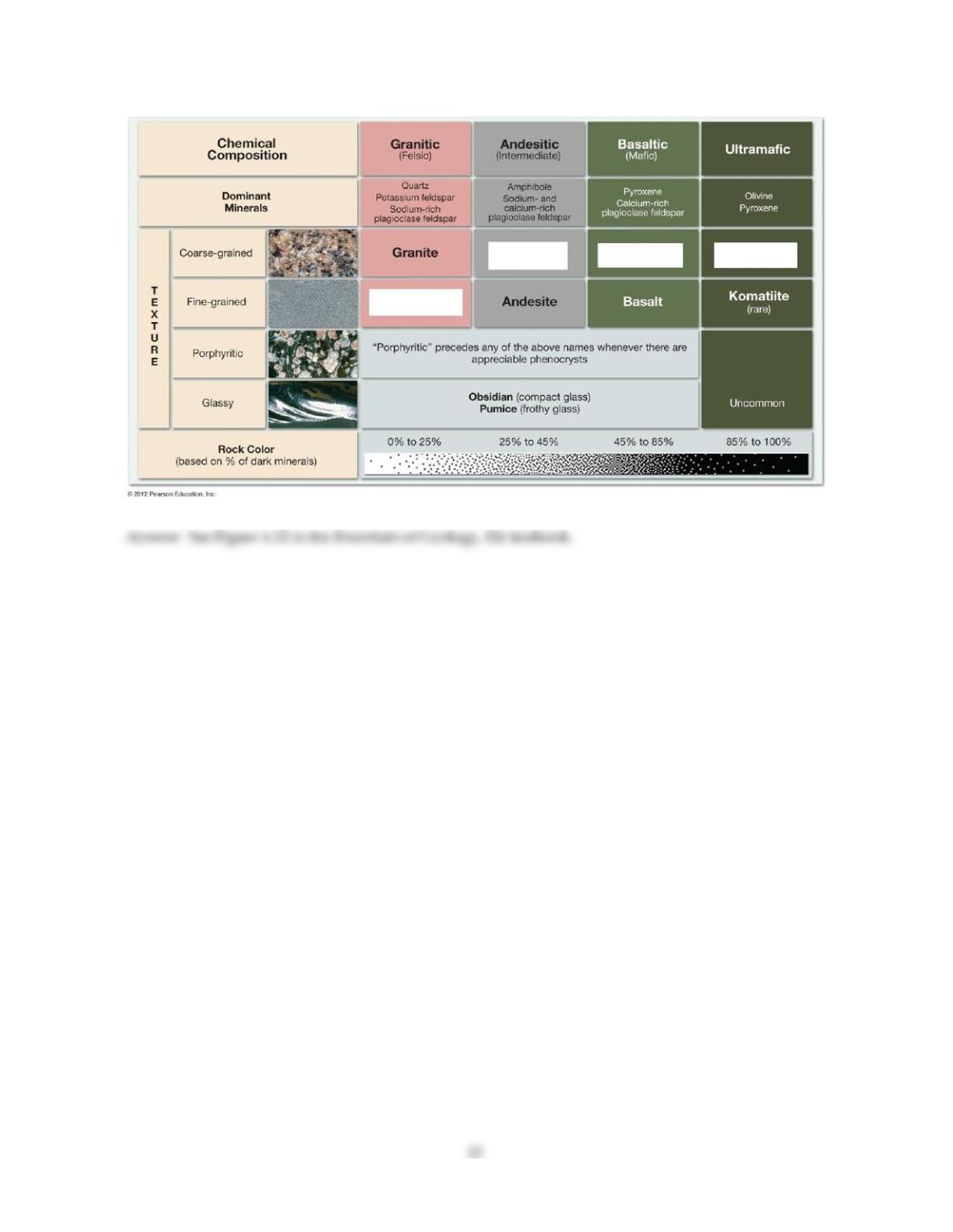
68)
Fill in the missing rock names on the chart below.
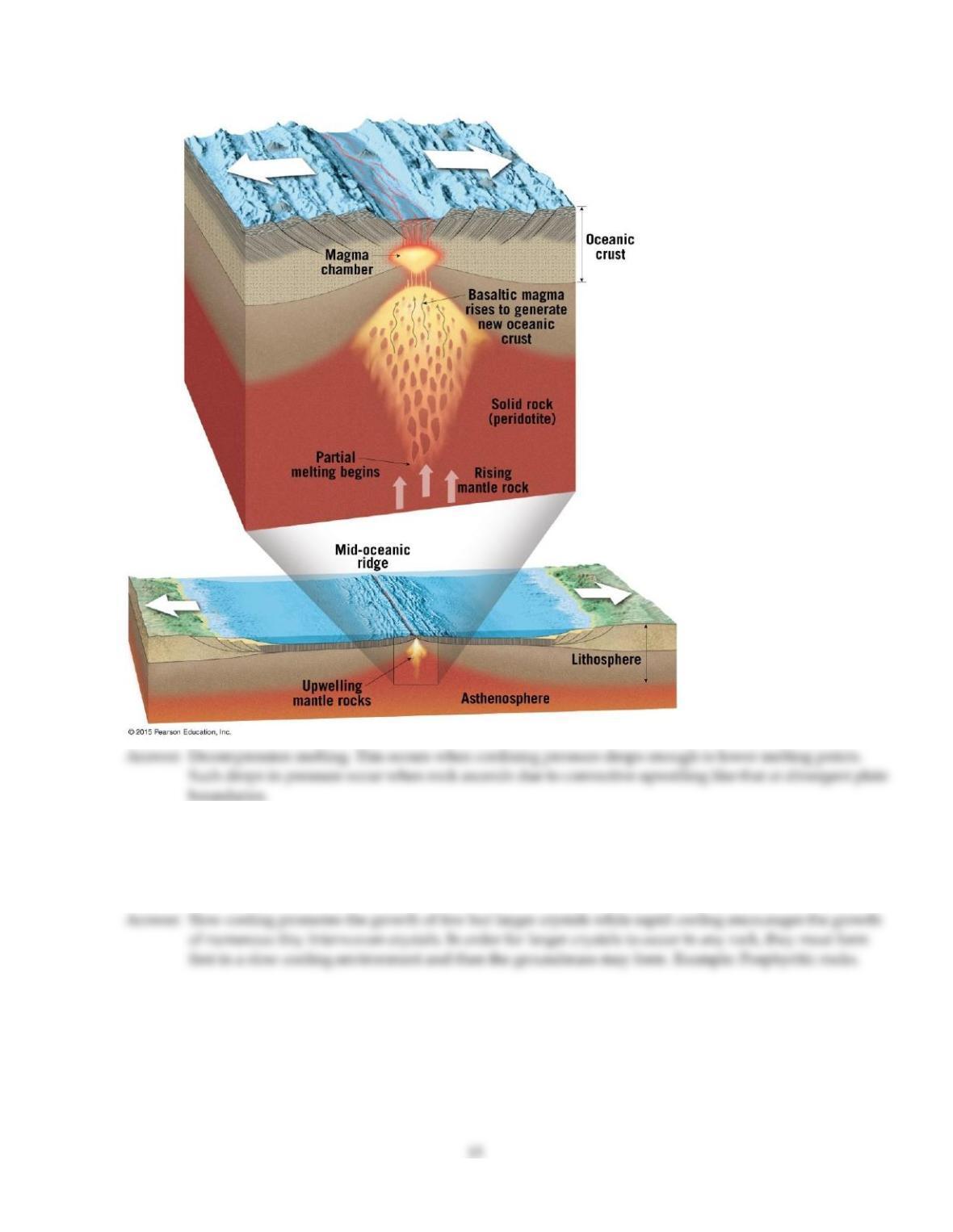
69)
What magma–generating process is exhibited by the diagram below? When does this process take place?
70)
The size of crystals in igneous rocks is generally a function of the rate of cooling. However, within the same
rock, crystal size does not necessarily reflect the order of crystallization for individual minerals. Without using
Bowen’s Reaction Series, how might you determine the order of crystallization of minerals in an individual rock
sample? (Hint: Think about the texture.)

15